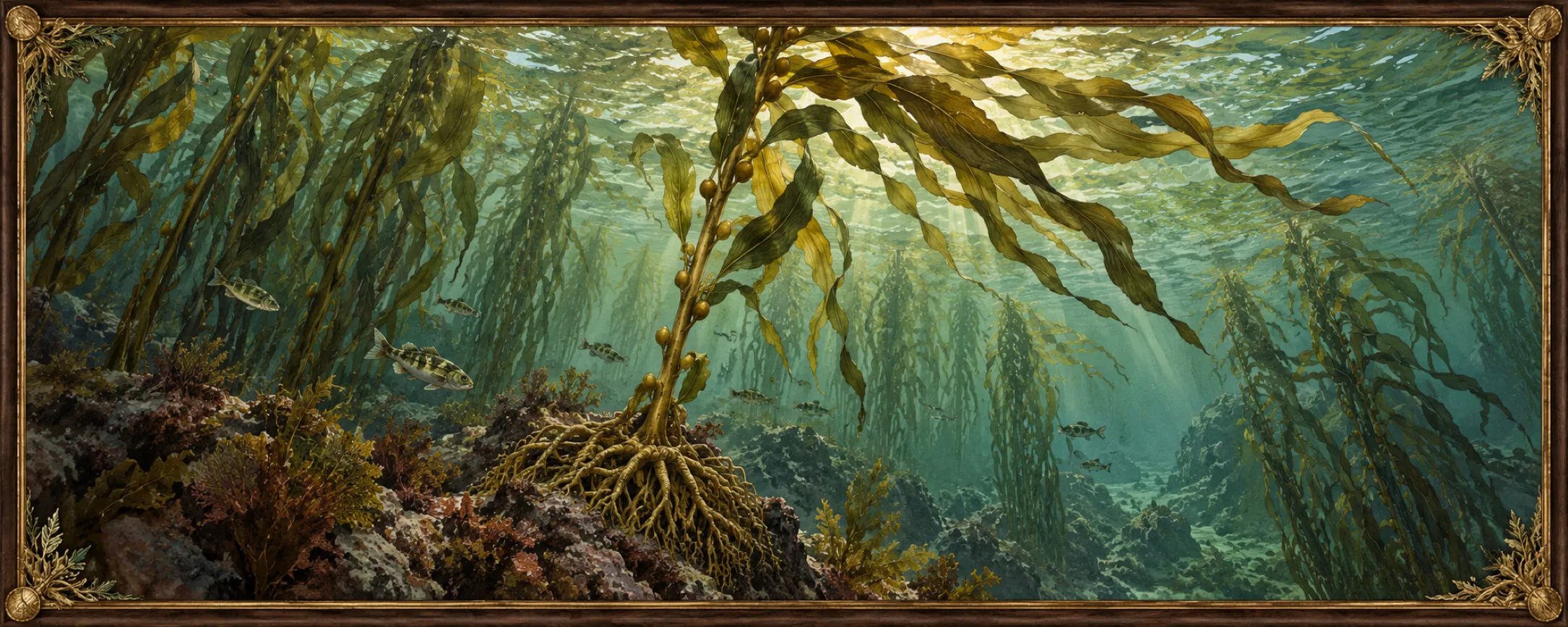
Kelp
Kelp is the tall weed of the open shoals: a brown sea-plant that roots on reef and stone below the swell and climbs towards the light until whole reaches of water lie in its shade. On Caeldon it matters most to the Thaluren, whose settlements sit in kelp-shadowed water and whose return runs gather in the greatest kelp forest of all, the Kelpshade. The shorter weed of the tide line is another thing, gathered from the shore.
Appearance
A kelp plant is a single long stalk, a hand’s breadth thick at the foot and thinning upwards, anchored by a tangle of grasping holdfast roots on rock. In a sheltered shoal it rises the height of a tall tree, and near the surface it spreads into long ribbon blades, olive-brown in shallow light and almost black below, each blade buoyed by small gas bladders the size of a thumb-joint. Grown together, the stalks make a forest: the light comes down green and broken, the whole stand leans one way with the current and then all the other, and a sound like slow rain comes off the blades as they rub. Torn kelp on a beach is rubbery and slick, smells of iodine and salt, and dries to a brittle black.
Habitat and Range
Kelp needs cold, moving, clear water over hard ground, with a reef or headland to break the worst of the swell. Its forests fill the shoal worlds inside the current roads of the Tidebound Reaches, and the broadest of them, the Kelpshade, is where returning runs rest and gather before they turn for the estuaries. Smaller beds grow off the outer rocks and headlands of the Tidelace Coasts.
Beyond Caeldon, the Surging Deep has whole floating islands of kelp, and the Drowning Garden a forest of towering kelp among coral trees (see Drowning Garden Flora).
Behaviour and Temperament
Kelp only grows and sways, but a forest of it behaves like a place. It breaks the current into gentle water, and fish, shellfish, and the young of the sea crowd into its shade. It hides what rests inside it: a whole Thaluren run among the stalks can be invisible from a stone’s throw off. Storms tear it loose in rafts that drift ashore or out to sea.
Life Cycle
Kelp grows fast through the light months, a stalk lengthening by a forearm in a good week, and sheds its old blades in the storm season. A plant lives a few years before its holdfast fails or a storm takes it, and new plants rise from the spores of the old on the same rock, so a forest outlives every stalk in it. A forest can thin in a bad run of years and return in a good one.
Uses and Dangers
To the Thaluren a kelp forest is shelter, larder, and gathering ground. Settlements such as Turningshoal sit in reef shelter on its inner edge, the shoals tended within it give fish and shellfish, and the young who come down from the rivers are counted at the Kelpshade, where they first learn the sea. Gnome households of the Tidelace eat kelp beside fish, shellfish, and seabird eggs, cut from the beds off the harbour rocks and dried on the racks. The dangers are small: a swimmer or a boat’s oar can foul in the blades, and drift-rafts after a storm can block a narrow channel.
Lore and Belief
The Kelpshade is not holy, but it is where a run becomes a run again, and a thin count of the young there is grief and evidence at once. Gnome and Human coasts give Maris of the Tides hair of living kelp and seaweed, and carve her trident wound with a rope of kelp. Scholars of the planes say the sea’s kelp grows thickest where the Surging Deep runs close to the world; no one has shown it, and the Thaluren, who live inside the forests, have little interest in the claim.