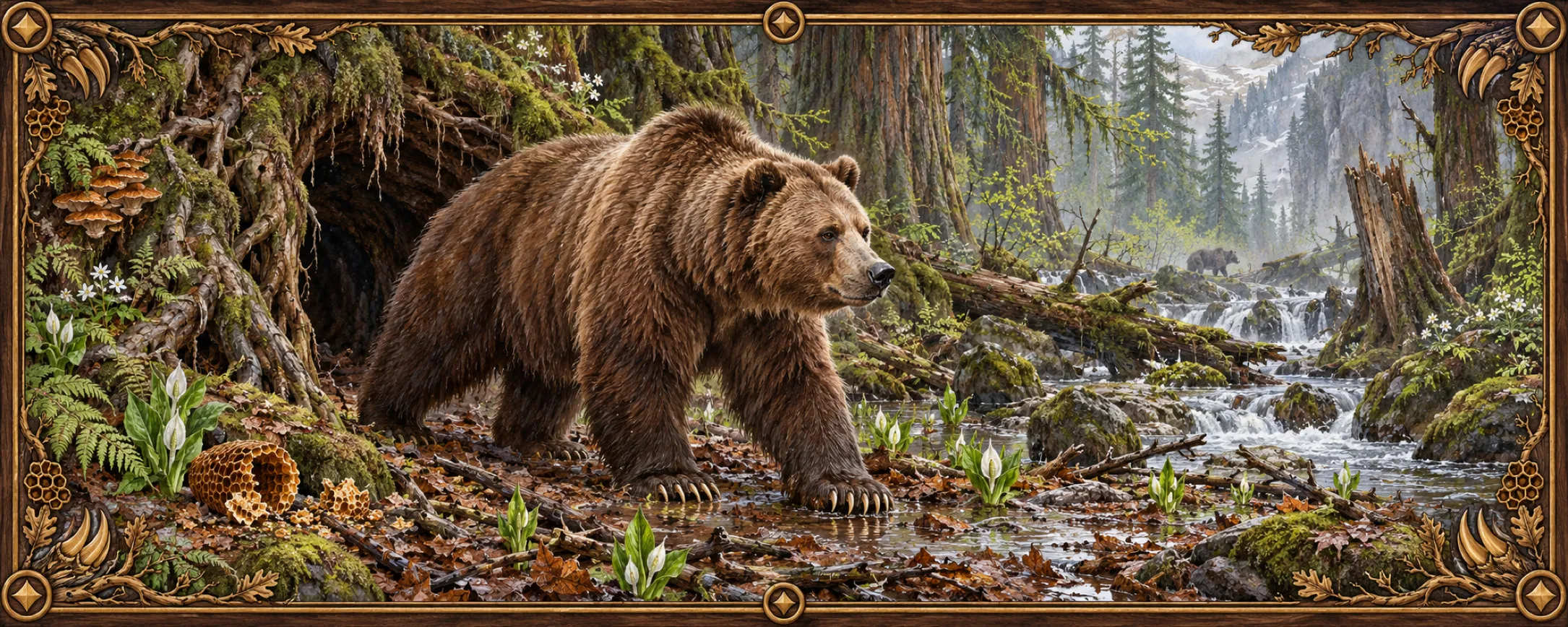
Brown Bears
Brown bears are the largest beasts of the old forest. They sleep out the winter in the root-fed hollows that open under the Elderweald’s leaf-litter, and when the wet season fills those hollows they come out early, hungry, and in a temper. Wood Elves share their ground with them and will not dig one out; Humans at the forest edge fear them more than wolves.
Appearance
A grown bear on all fours stands as high as a Human’s chest, and reared up on its hind legs it is taller than any Human. It is massive through the shoulders, with a hump of muscle above them, a broad dished face, small round ears, and small dark eyes. The coat is shaggy and brown, from honey-gold to nearly black, often frosted paler at the tips. The front claws are as long as fingers and pale as horn.
It walks with a rolling, flat-footed gait and can run faster than a horse over a short distance. It huffs, clacks its teeth, and grunts; a roused bear roars. Its scent is heavy, rank, and musky, and a den smells of it for years.
Habitat and Range
Bears live in the deep, uncut forest of the Elderweald, where the hollows under the root-mat give them dens, and in smaller numbers in the planted understorey of the Crownboughs, which High Elf houses keep clear of them as best they can. Each bear holds a wide range alone, and they are never many.
Behaviour and Temperament
A bear eats nearly anything: roots, fungus, nuts and berries, grubs from rotten wood, honey, fish from the forest streams, carrion, and the odd deer calf. It spends the autumn eating and the winter asleep in a hollow, waking now and then. It avoids people and gives way if it hears them first. The danger is surprise: a bear met suddenly at close range, a sow with cubs, or a bear flooded out of its hollow in spring before the forest has food for it, which will stand its ground and charge.
Life Cycle
Bears mate in early summer, and the sow gives birth in the winter den to one to three tiny cubs, which come out with her in spring and stay with her for two or three years. A bear may live twenty or thirty years.
Uses and Dangers
Bears give little that the forest peoples take: the Wood Elves do not hunt them as game, and a bearskin at the forest edge is a Human lord’s boast. Their cost is the occasional death of a gatherer who walked into one, the raided store-hollow, and the hives torn open in autumn.
Lore and Belief
Groves say a bear in its hollow is sleeping in the ground’s keeping, and to dig one out of grove ground is to break into someone’s house; a grove whose hollows flood will move its own people before it moves the bear. Some Wood Elves say the bears remember the forest before any grove was grown. Edge villages hold that a bear that comes out before the thaw is a sign of a hard spring.
Edge villages remember the bear-years by name, and the song of the woodward who held a hollow-mouth with a boar-spear while a gathering party ran is sung at every winter fire on the Elderweald’s edge. A lord’s bear-hunt into the forest is something the groves do not forgive.