Ash-Wights
Ash-Wights are the soldiers of the Ashen Army of the Ashen Child, the Cast-Out who was once the Ember-Lord of Ignis and fell because it could not let one fire go out. Out of what fire leaves behind it shapes them in the likeness of what was lost, and its grief keeps them walking. They are not the dead who burned, only the shapes of them, held up by a sorrow that refuses to end.
Appearance
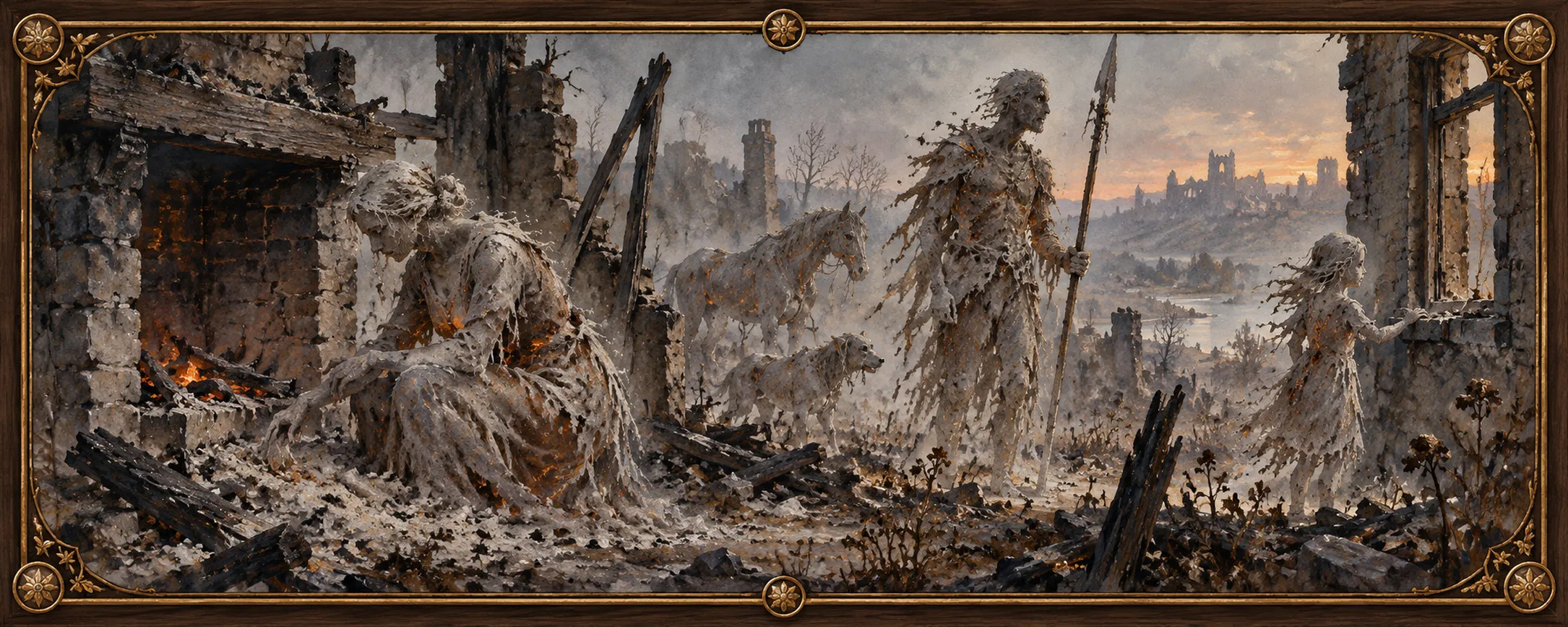
An Ash-Wight is a figure of grey ash in the shape of something that burned. Most are people, a woman at a hearth, a child, a soldier with the ghost of a spear, but there are ash-horses from a burned stable, ash-dogs, and once, the tales say, an ash-tree that walked. The ash flakes from them as they move and reforms, so that their outlines are always a little soft, always settling. Inside, through cracks in the grey, glows a faint, dull orange, like coals almost out.
They shamble, slow and heavy-footed, and leave fine grey ash behind them in which grass withers. They make no voice; the only sound is a dry whisper of falling ash and, close by, the faint crackle of an ember dying. They smell of cold hearths and wet burned timber, the smell of a house the morning after a fire.
Habitat and Range
They are found where the Ashen Child walks or has lingered: a city it held standing after a burning, a fire-cleared wood that never greened again, the room of someone it keeps in the Long Goodbye. A place where the Child has stayed long may hold whole streets of them, standing at doors and hearths in the shapes of the families that lived there.
Behaviour and Temperament
Ash-Wights move by the Child’s grief, not by any will of their own. Each does what the thing it is shaped like once did: the ash-mother bends to a cold hearth, the ash-soldier walks its old wall, the ash-child waits at the window. When the living come among them, they gather, slowly, and press close, as if they wanted to be warmed.
They do not rage or hunt. They are melancholy shapes, and their danger lies in the cold and despair they carry, and in the way the grieving come to them and stay.
Abilities
An Ash-Wight carries the Child’s ash cloud in small. Fires gutter near it, warmth drains from the bodies it presses against, and a listless grey despair settles on the minds around it, so that the living sit down beside it and do not get up. Its touch withers plants and chills skin, and its ash does not wash out of cloth.
Scattering one does not end it; the ash drifts back together while the Child still grieves. A new fire lit from the old ashes, a seed planted in them, or a goodbye said aloud by someone who has let the lost go breaks the shape for good.
Life Cycle
Ash-Wights are raised, not born, and last as long as the Child’s grief for what they were. When the Child leaves a place, its wights slump into heaps of ordinary ash, and those heaps, the stories say, make good soil afterwards, as ash should.
Uses and Dangers
Ash-Wights take hope. The bereaved see the shapes of their lost and stay among them, wasting, while their fields go untilled and their own fires go out. A town where wights walk does not rebuild. Neighbours who come to help are told to light a new fire at once and to look at nothing.
Lore and Belief
Many people believe the wights are the ghosts of the burned, and some keep vigil beside them, hoping to speak to their dead; the wights are only shapes, and nothing answers. In fire-prone country folk carry a fresh candle on journeys to burned places, which is wise. Some say a wight is warmed by kindness and fades in peace, and for once kindness of that kind is close to true: mourning finished is what ends it.
Looters who go into a burned town for what the fire left say the wights stand in every doorway and do nothing, and that the cold that comes off them takes the will to carry anything out; most come back empty-handed and some do not come back at all.