Moles
Moles are the small tunnellers under the meadows. They are almost never seen, but their hills are everywhere, and they are a nuisance out of all proportion to their size: molehills foul the scythe in a hay meadow, and in terraced country a mole’s run under a drain lets water into a retaining wall. Mole-catchers walk the fold commons of the Leeward Folds each spring and the meadows of the Basins each autumn.
Appearance
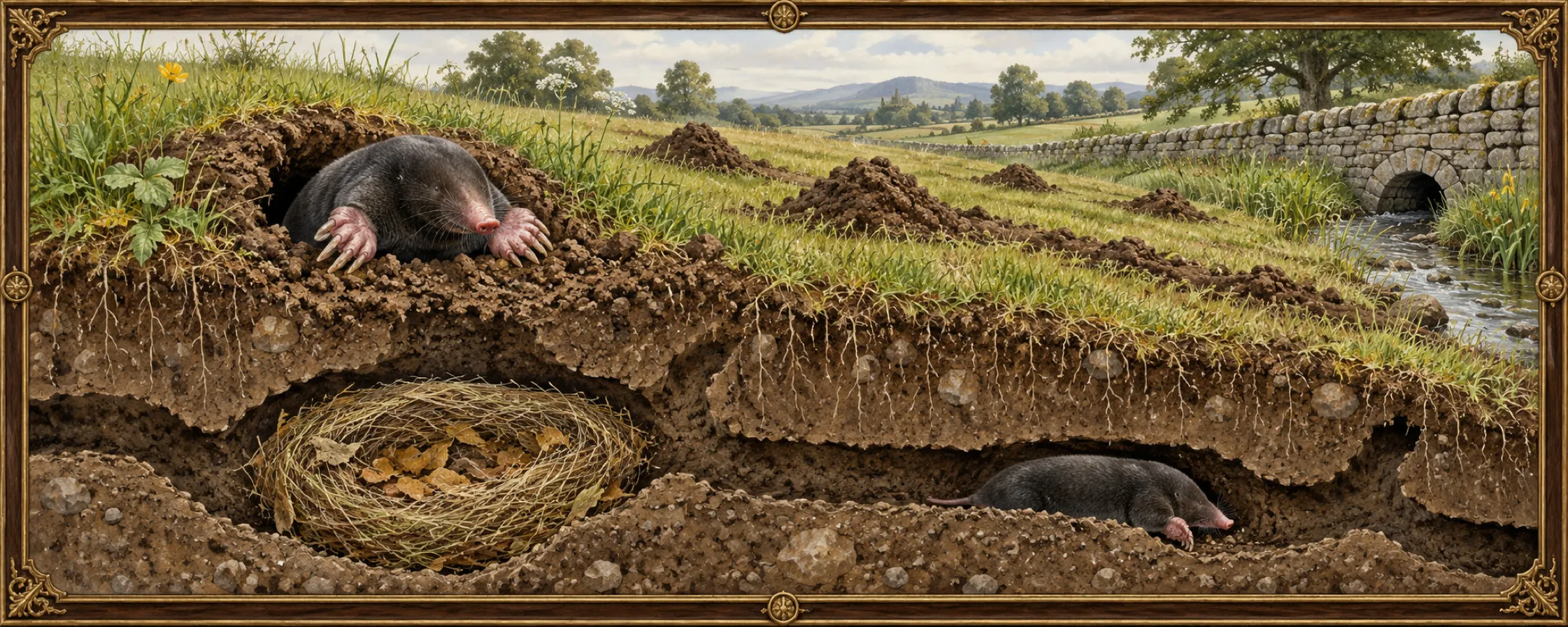
A mole is about the length of a hand, a velvet cylinder with no neck, a naked pink snout, and tiny eyes hidden in its fur. Its forefeet are enormous for its size, broad pink spades turned outward with heavy claws. Its fur is short, dense, and black-grey, and lies either way, so it can go backwards in its tunnel as easily as forwards.
Above ground it is clumsy and slow. Below ground it swims through soil. Molehills, cone-shaped heaps of fine crumbled earth, show where it has been; a raised ridge across a field shows where it is going.
Habitat and Range
Moles live in soft, worm-rich soil: the meadows and fields of the Confluence Basins above the flood line, the terraces and gardens of the Leeward Folds, and the terraced fields of the Headwater Marches. They avoid the wettest ground and rocky soil.
Behaviour and Temperament
A mole digs a network of tunnels and patrols it, eating the worms and grubs that fall in. It stores worms in a larder, bitten so they live but cannot crawl away. It lives alone and fights any other mole it meets. Floods drive moles out of low ground, and they are sometimes seen swimming.
Life Cycle
Young are born in spring in a grass-lined nest under a larger hill. They leave the nest at about a month and travel above ground to find their own soil, which is when owls and herons take them. Moles live two or three years.
Uses and Dangers
Mole fur, soft and short, makes waistcoats and purses for those who can get enough skins. The cost is the hay meadow fouled, the scythe blunted on hidden earth, and, worse, the terrace drain undermined: water finds a mole run, follows it, and softens the fill behind a wall until the wall slumps. That is why terrace commons hire mole-catchers with traps and spades.
Lore and Belief
Fold Halflings count a mole-catcher’s work as part of keeping walls, and the mole-catcher reports his tally at the commons beside the wall-menders. Basin Humans say a mole’s paw carried in the pocket cures toothache, and that molehills thrown up in a line towards a house foretell a death in it.