Salt Pines
Salt pines are the trees of the far-side headlands, the only trees that will stand the salt wind on the cliffs of the Tidelace Coasts and the Soundchain Roads. The wind shapes them, and Gnome pilots read the shape. Their resinous wood is the beacon fuel of last resort, burned when the beacon oil runs out.
Appearance
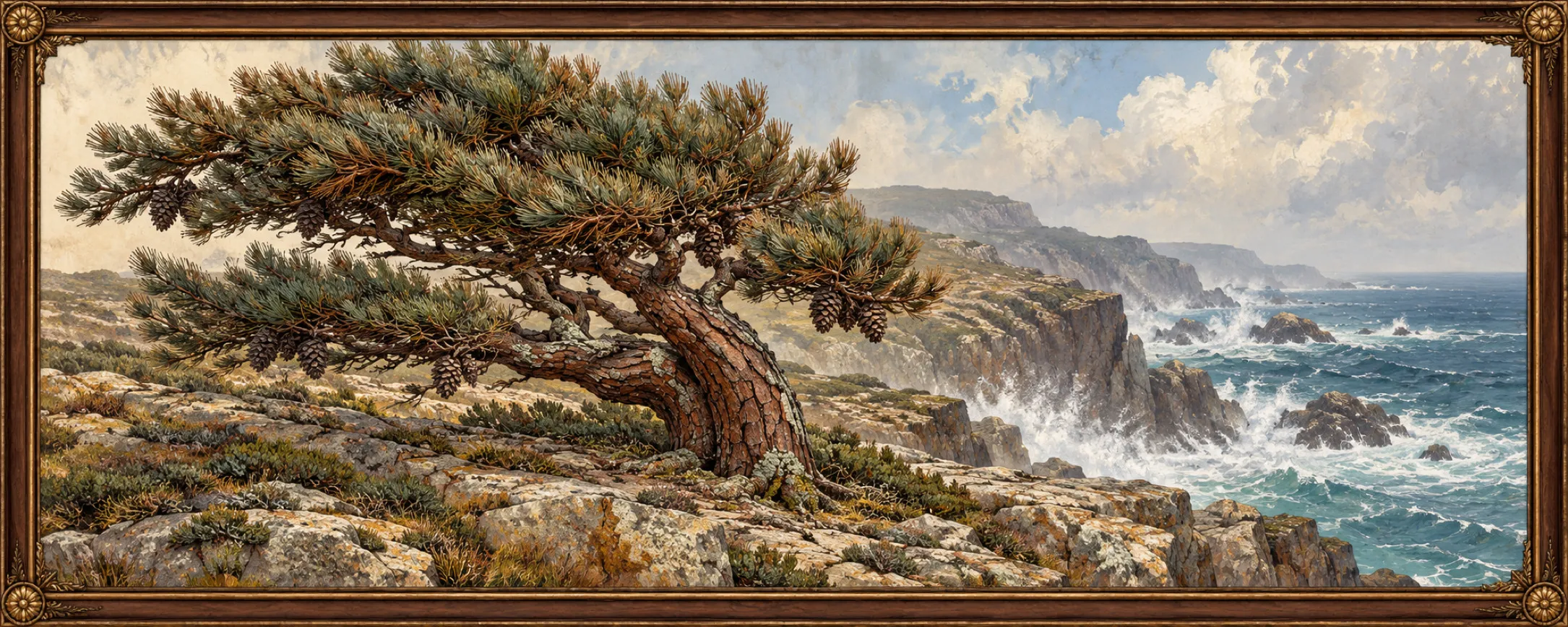
A salt pine is low and broad, seldom more than two or three times a person’s height, with a thick, short, often split trunk and a flat, dense crown swept entirely to one side, so that the whole tree leans away from the sea like someone walking into a gale. On the most exposed headlands it lies almost flat along the rock. Its bark is dark red-brown and deeply plated, its needles long, stiff, and grey-green, often browned at the tips on the seaward side by salt. Its cones are heavy and lopsided, swollen on the side that faces the light. The wood is dense and resinous, and a salt pine headland smells of pitch and salt.
Habitat and Range
It grows on headlands, cliff tops, and the upper sea-cut terraces from the Soundchain cliffs east along the Tidelace, rooted in cracks and thin soil, and on the outer isles where nothing else of its size stands. It is sparse: a headland may hold a few dozen, each one known.
Behaviour and Temperament
It grows away from the wind and only as tall as the wind allows. Buds on the seaward side are killed by salt and spray each winter, and the tree builds itself out on the lee. That is why its lean shows the wind that blows most often and hardest, not the wind of any one day.
Life Cycle
It grows very slowly, and a salt pine thick enough to cut is older than most harbour families' records. Seed is shed from cones that open in fire or in dry summers.
Uses and Dangers
Pilots and sounding houses read the lean of the salt pines on each headland as a record of the prevailing wind there, and a new pilot learns the trees of every headland on the Lacework along with its marks; a tree that falls is entered in the sounding house’s records. Their wood is not cut for building. When the beacon oil runs out in a long storm season, beacon keepers split salt pine deadwood and burn it in the beacon basket, and a beacon tower keeps a stack of it under cover for that reason. Only deadwood and fallen trees are taken, unless a beacon is failing. Coastal Humans gather the cones for kindling and the resin to caulk their boats.
They harm no one.
Lore and Belief
Gnomes say a salt pine is the one honest mark on the coast, because the wind does not pretend. Harbour children are told that a salt pine that leans the wrong way warns of a false beacon nearby. Human fishers of the coves believe the trees are drowned sailors who climbed the cliffs and were turned to wood looking back at the sea, and they touch one for luck before going out.
Wreckers who light false beacons on the headlands hang their lamps from salt pines, and the harbours hang wreckers from the same trees when they catch them.