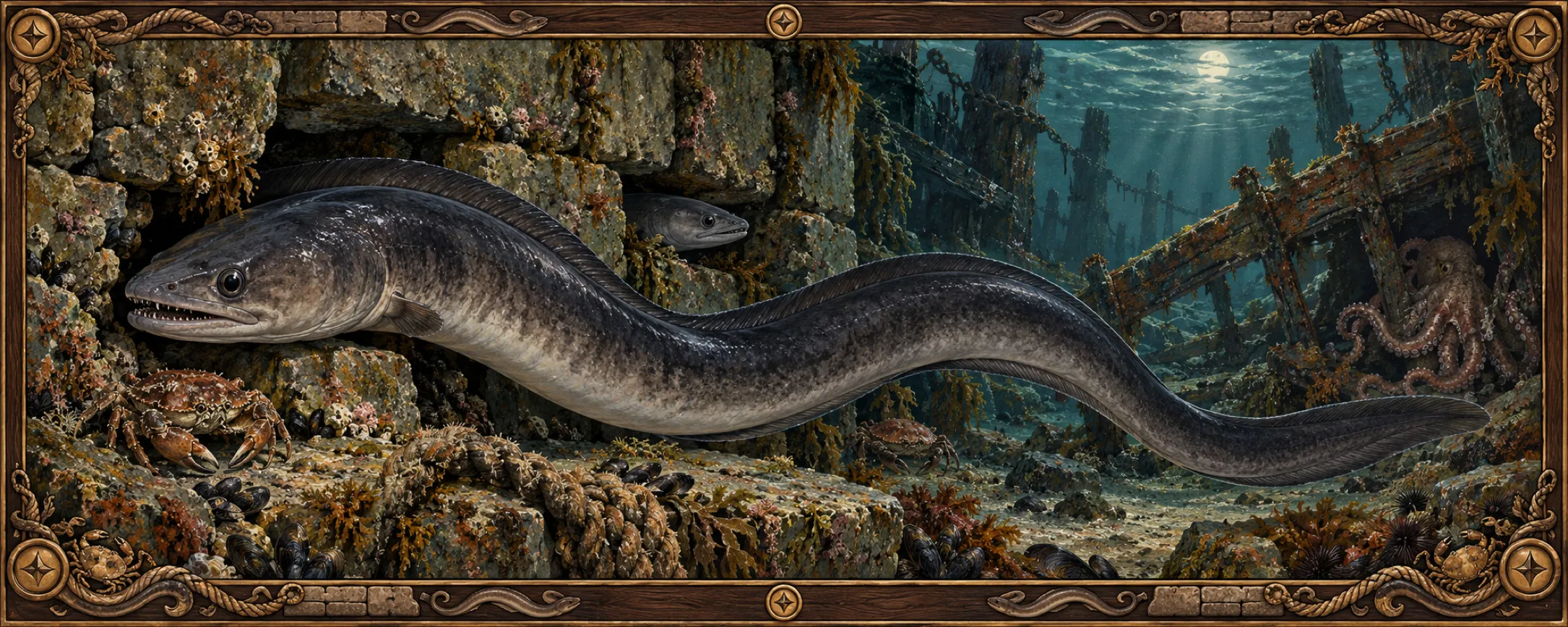
Congers
Congers are the great sea eels of the far-side coast. They live in the gaps of breakwaters, in the drowned harbour works of earlier Gnome lines, and in wrecks, and they come out at night to hunt. A conger is far bigger and stronger than the river eels of the cradle, and every breakwater crew on the Tidelace has a conger story, most of them about hands.
Appearance
A grown conger is as long as a man and as thick as his thigh, and the oldest are longer: a heavy, scaleless, round body tapering to a flattened tail, with a continuous fin along the back and belly. It is grey to near-black above and pale grey below, and its skin is smooth and slimy. The head is broad and blunt, the jaws large and lined with close-set teeth, the eyes big, round, and dark. It moves with a slow, powerful wave of the whole body. Taken out of the water it thrashes, barks, and bites, and keeps biting long after a fisher thinks it dead.
Habitat and Range
They live along rocky coasts wherever there are holes to hide in: the gaps between breakwater blocks, the old drowned breakwaters and towers off the inlets, the rock ground off the headlands, and wrecks of every age along the Tidelace and the Soundchain Roads. A large conger keeps the same hole for years, and divers and breakwater crews come to know where each big one lives.
Behaviour and Temperament
A conger hides by day with only its head showing and feeds at night on fish, crabs, squid, and octopus. It does not hunt people, but it bites anything put into its hole, and a hand reaching into a breakwater gap for a dropped tool, a lobster, or a fouled line may come back short of fingers. Once it has a grip it twists, like any eel.
Life Cycle
Congers grow for many years in their holes and then, when they are old, leave the coast for the open sea in autumn and do not come back. No one on the coast has seen them spawn, and the small congers that appear in the rock pools come from somewhere out past the beacons.
Uses and Dangers
Congers are food: firm, white, and rich, caught on long baited lines set off the breakwaters overnight, and eaten fresh in steaks, in stews, or salted and dried. A big one feeds a household for days. Their danger is the bite. Breakwater crews setting blocks by hand, gatherers working the stones at low tide, and anyone diving for a lost anchor learn to look before they reach.
Lore and Belief
Breakwater crews say that every breakwater has its conger, that it grows as old as the wall, and that a wall whose conger leaves will fall in the next storm. A crew that catches a very large one sometimes lets it go for that reason. Human hamlets say congers eat the drowned, and a hamlet that has lost a boat will not eat conger that season.
Wreck-divers fear them more than the dark: every breakwater has its one-handed diver who reached into a wreck’s strongroom for a chest of silver.