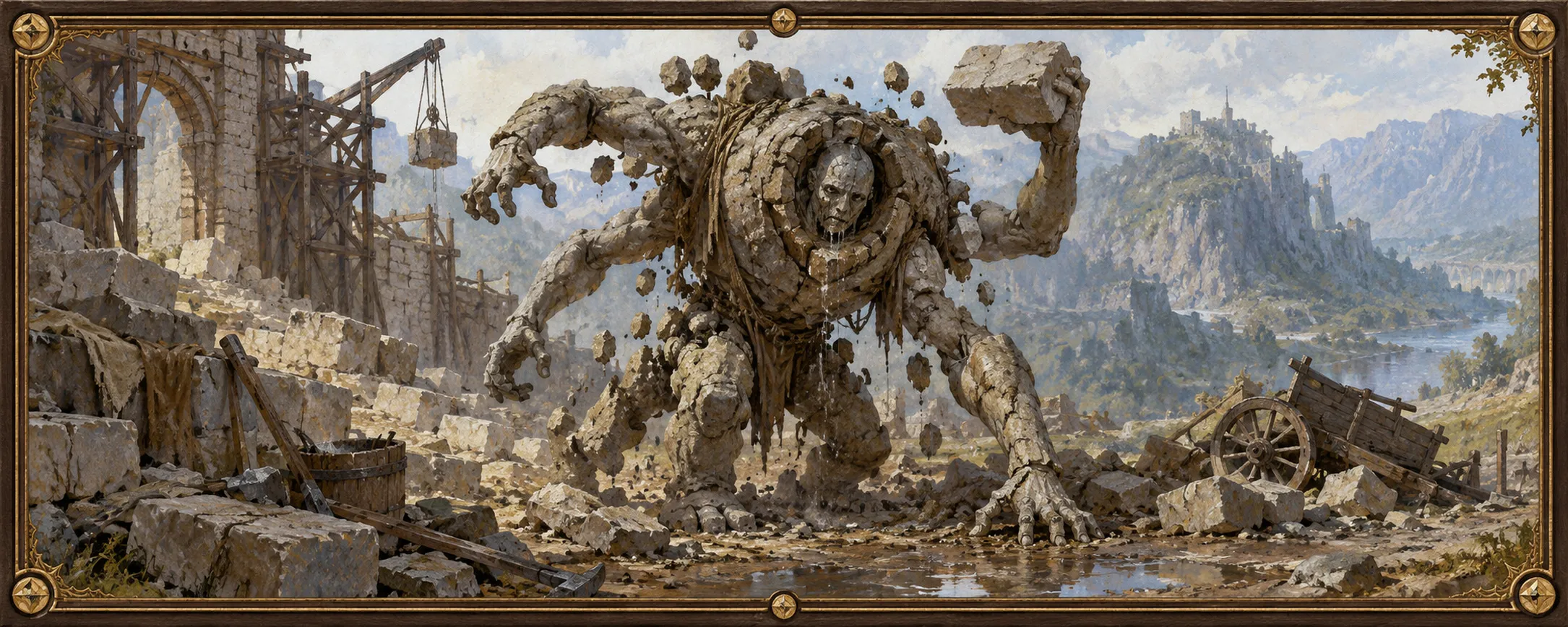
Ill-Called
The Ill-Called are what bad conjuration makes. A conjured construct does not fail gracefully: called carelessly, in haste, past the conjurer’s strength, or in a place that pulls the working awry, it can arrive malformed, hungry, or attached to something its maker did not intend. Most come apart within the hour. Some do not, and it is for them that lords and temples keep conjurers who know the Word of Banishing.
Appearance
An ill-called thing looks like the construct it was meant to be, gone wrong. A stone servitor with too many arms, or none, or its face in its chest; a water bearer that will not hold its shape and spills and gathers as it goes; a house-avatar keyed to the wrong house, or to a person, wearing parts of the room around it. Its edges waver more than a sound construct’s, and parts of it shift as if it were still being made. It carries the sound and smell of its matter, louder than it should: grinding, dripping, the reek of a midden it was called out of.
Habitat and Range
They appear wherever conjurers work: building sites, mines, households, campaign camps, and the studies of the over-ambitious. Thin places and ley-rich ground, where magic answers more strongly than the caster expects, see more of them than elsewhere.
Behaviour and Temperament
An ill-called construct does what it was told, wrongly, or what it was half-told, or what it fastened to instead of its task. Malformed, it does its work in ways that break things. Hungry, it draws on whatever it can reach, its maker’s reserves first and then the warmth, matter, or strength of things nearby. Attached, it follows something its maker never named, a passer-by, a child, an object, and will not leave it. It has no will of its own; it is only pattern held badly.
Abilities
It has a construct’s strength, unchecked by a construct’s limits, and it does not weaken as its maker tires, because it is no longer drawing only on its maker. Some drain the reserves of anyone who touches them.
Life Cycle
Most fall apart within an hour or a day, into rubble, a puddle, dust. Those that last do so by feeding, and a hungry one that has found something to feed on can go on for weeks. The Word of Banishing ends them by collapsing their path and denying them pattern.
Uses and Dangers
They have no use. Their dangers are the harm they do and the question of who answers for it: custom lays the blame and the blood-price on the conjurer, if anyone can find them, and conjurers of the White Circle Halls are called to dismiss them and to swear to what they saw after. The Hall of Borrowed Forms, which teaches emergency assembly, is blamed for more of them than any other school.
Lore and Belief
Folk say an ill-called thing has let something in from outside, that a spirit or a dead soul has taken the shape; conjurers say it is only bad pattern, and they are right, since a construct has no will. Builders and miners call one a "wrong-hand" and leave a site where one has appeared until a dismisser has come.
Builders tell of the ill-called thing that walked off a quarry site with a block in its arms and was found a week later laying stones in a field, building a wall to nowhere, and of the conjurer’s apprentices who died taking it down.