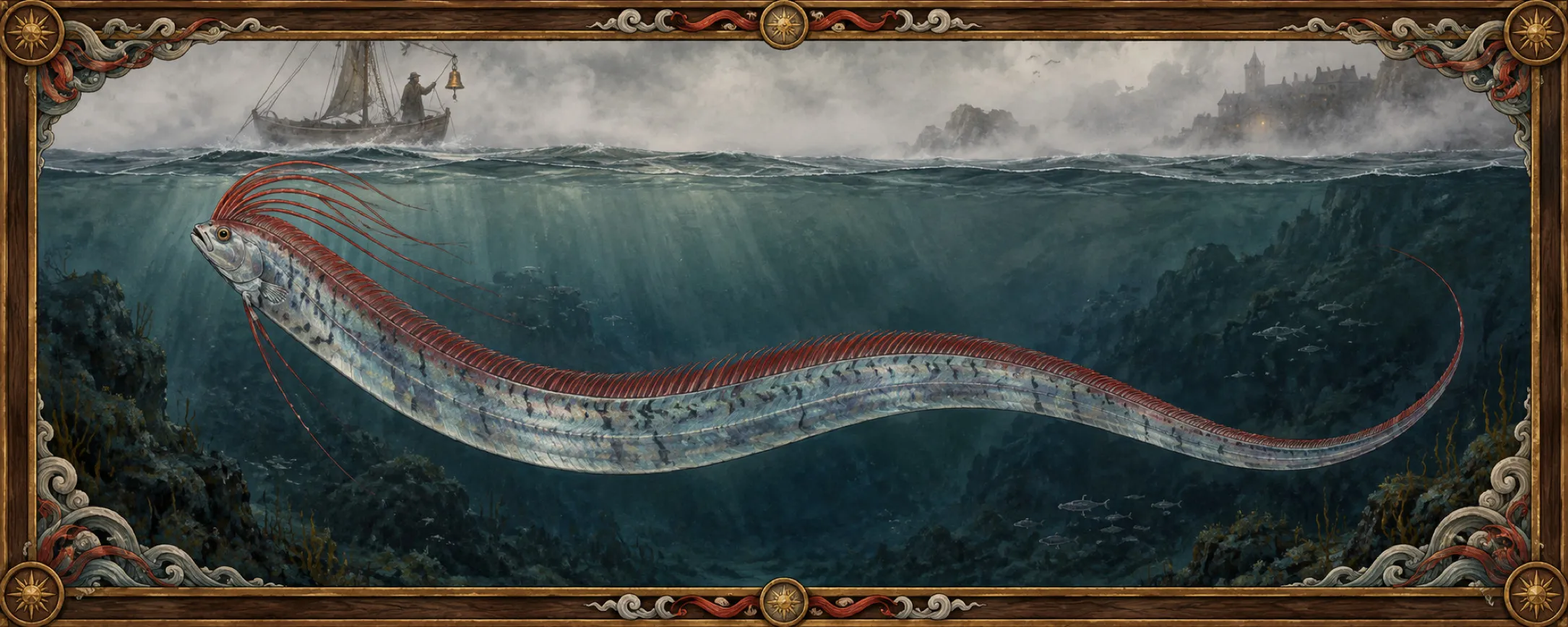
Fog Serpents
Fog serpents belong to the tales of the coastal Human hamlets of the Tidelace: long silver serpents with blood-red crests that swim in the Long Grey, the great fog belt of the outer coast, and drag down boats that lose their way. Nobody has seen one in the fog and come back to say so clearly. What the sea does give up, every few years, is a long, silver, ribbon-like fish from the deep, dead or dying on the shingle, and that is the truth behind the tale.
Appearance
The fog serpent of the tales is as long as a boat or a harbour quay, silver as a blade, with a red crest along its head and back that stands up like a flame, and eyes like lamps; it rises out of the fog beside a boat without a sound.
The fish that washes up is real and nearly as strange. A ribbonfish is far longer than a boat, but flat and thin as a belt, no thicker than a hand, and soft and fragile. It is shining silver, marked with faint dark streaks and spots, and a red fin runs the whole length of its back, rising on its head into a crest of long red rays. It has a small toothless mouth and large eyes. Stranded, it soon dulls and tears, and a few days on the shingle reduce it to a long, reeking silver rope.
Habitat and Range
The ribbonfish lives far out and deep in the open sea, where no Gnome pilot or coastal fisher goes. It comes to the surface only when sick or dying, and the wind and currents that bring the Long Grey onto the Tidelace sometimes bring it ashore too.
Behaviour and Temperament
In the deep, a ribbonfish hangs upright in the water, rippling its long back fin to move, and eats the tiny shrimp and drifting creatures of the dark water. It harms nothing larger than a shrimp. The fog serpent of the tales hunts boats and fishers lost in the fog.
Uses and Dangers
The ribbonfish does no harm and is not eaten; its flesh is soft and jelly-like. The tale does its own work: children are kept off the water in fog, and a boat caught out in the Long Grey stays where it is and rings its bell.
Lore and Belief
Coastal Humans say the fog serpent rises when someone on the shore has broken faith with the sea, and that a serpent washed up dead means the sea has taken its due and will be calm for a season. Some hamlets hang the red crest rays of a stranded ribbonfish over the door of the shrine to Maris of the Tides. Gnome sounders, who have measured the stranded fish and logged them, say the serpent is a ribbonfish seen in fog by tired eyes, and that the fog does the rest. Like the dragons of the cradle’s tales, the serpent is more widely believed in than seen; unlike the dragons, its plain truth lies on the shingle every few years for anyone to look at.
That has never stopped the tellers: every Tidelace alehouse has a man who saw the serpent take a boat whole, and a beast-hunter who once sailed out after one with a harpoon and a crew of drunk cousins is still sung of on the Soundchain Roads.