Mules
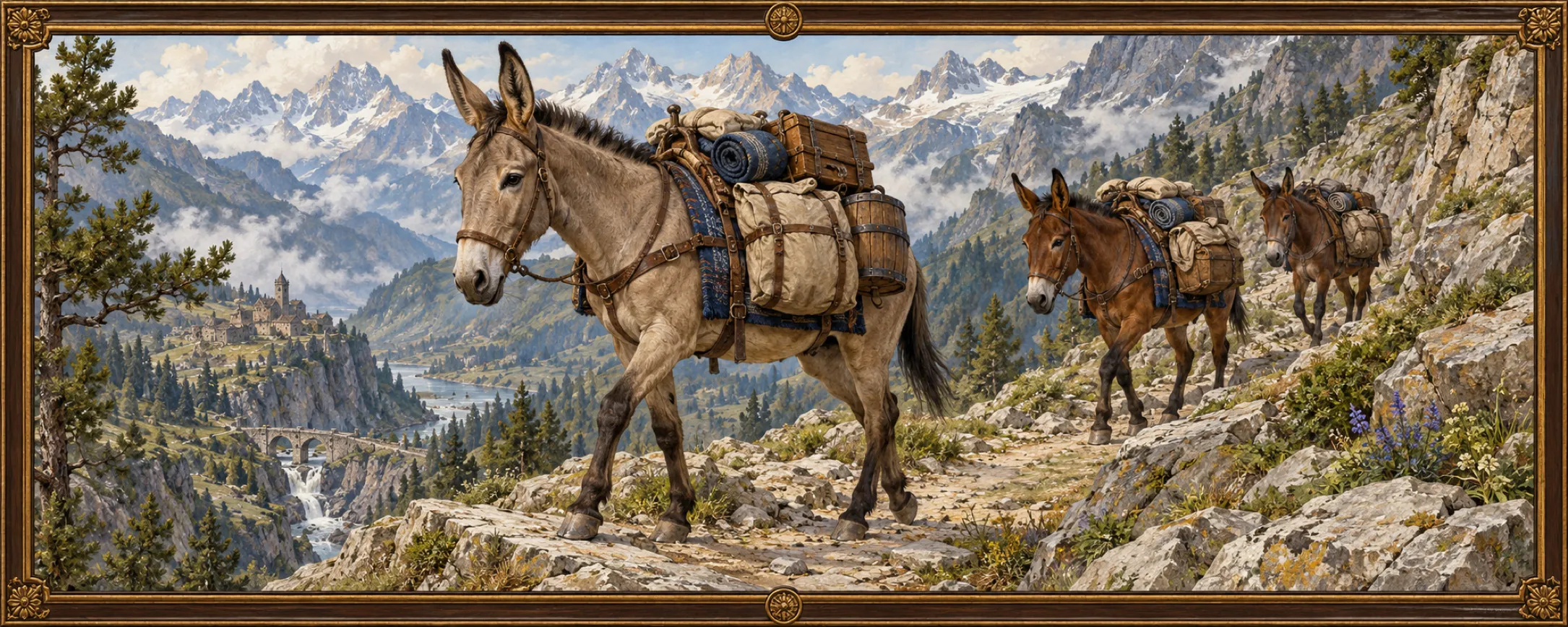
Mules are the road beasts of the mountains. A basin caravan climbing the exchange roads of the Headwater Marches goes on mules where it can: they are ridden on the easy stretches, loaded on the steep ones, and walked on the worst, and the caravan-master who loses one counts it before the cargo. Mules are bred, not born of their own kind, so every one of them is a horse-breeder’s work.
Appearance
A mule has its sire’s long ears and its dam’s height and body: about as tall as a riding horse, but narrower, with a shorter, upright mane, a thin tufted tail, small hard hooves, and a long, patient head. Most are brown, bay, or mouse-dun, sometimes with a dark stripe down the back. It walks with a short, careful, deliberate step, placing each hoof where it chooses. Its call is a mixture of whinny and bray, a creaking honk that carries down a valley. A mule string smells of sweat, dust, and harness.
Habitat and Range
Mules work the roads where carts cannot go and horses fail: the Headwater exchange roads up through the foothill towns and walled waystations to the oath-yards of the Ironspine holds. Waystations keep fresh animals for the caravans, many of them mules. They are less common in the flat country of the Basins, where carts and oxen do the work.
Behaviour and Temperament
A mule is careful, stubborn, and clever. It will not step where it judges the ground unsound, and no beating changes its mind; mountain carters say a mule’s refusal has saved more lives than any guide. It is hardy, eats rough fodder, works long, and keeps its head on a narrow ledge where a horse panics. It also remembers ill use for years and will kick the one who gave it.
Life Cycle
A mule is bred by putting a jack to a mare, and it cannot breed in its turn. It is broken to the pack at three and works for twenty years or more if it is treated well, longer than most horses.
Uses and Dangers
Mules carry riders, packs, and panniers on the exchange roads: grain, salt meat, cloth, and lamp oil up; metal, tools, and dressed stone down. Heavy haulage they leave to the Ogre bands. On the worst passages, such as the Rattlecut gorge, where the river takes part of the road in a wet spring, travellers are told to walk their mules and not ride. In winter they are the first loss of a caravan caught late in the snow (see Pack Animals).
Lore and Belief
Mountain carters trust a mule’s judgement over their own. "Ask the mule" is the Headwater answer to any doubt about a stretch of road, and a mule that stops dead at a bridge is turned round, whatever the toll-keeper says. Lowland people take the same stubbornness for spite and say a mule waits all its life to kick you once.