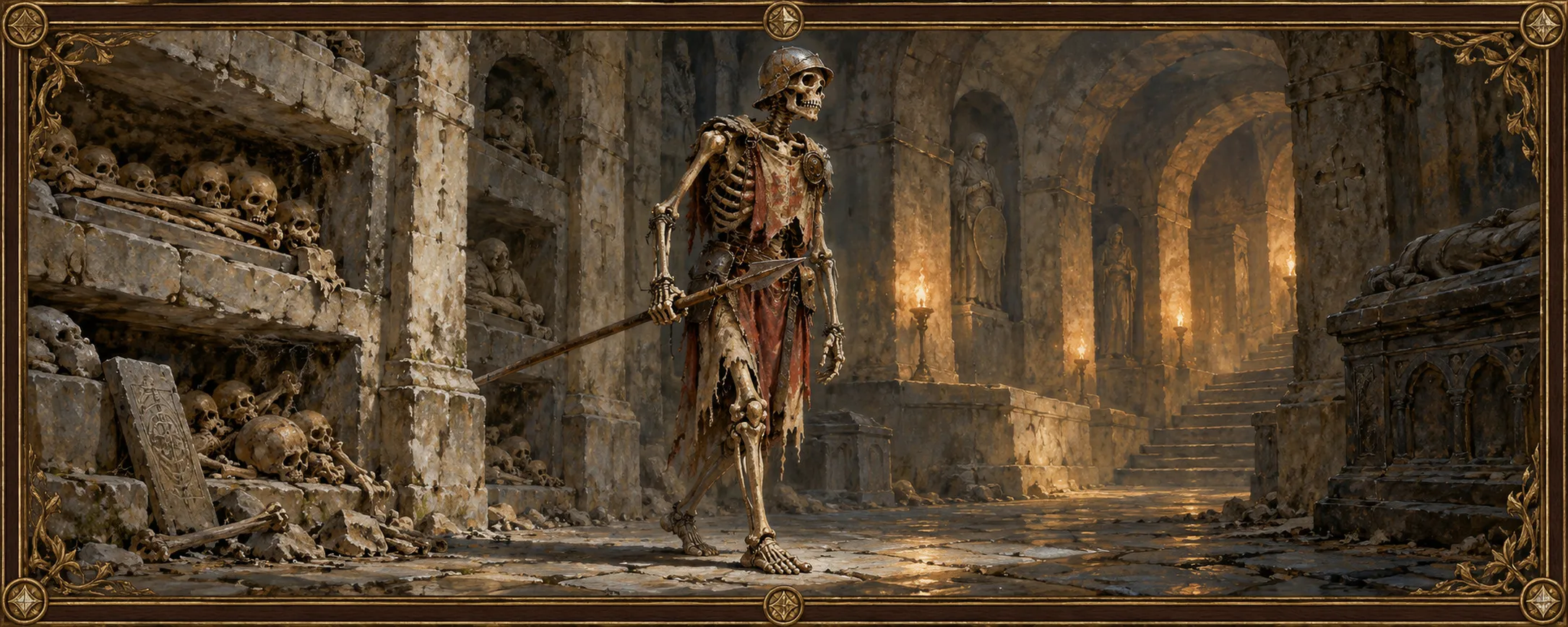
Marrow Sentinels
A Marrow Sentinel is a guard made of the dead. The spell of that name anchors a skeleton, or a construct built from ossuary bone, into a fixed watch pattern around a tomb, a wall, or a chamber, and there it walks its round until the binding fails. Catacomb keepers set old oath-sworn guardians to patrol their outer halls against grave robbers this way. A sentinel is a body given a task; nothing of the person whose bones it uses keeps the watch.
Appearance
Most sentinels are whole skeletons, yellow-brown with age and tomb-damp, the joints bound with wire, gut, or cord where the ligaments have gone, and a ring of chalked or carved signs on the skull or breastbone that holds the command. Many still wear what they were buried in: a rusted helm, the scraps of a tabard, a ring loose on a finger bone. An ossuary construct is stranger: a figure taller than a man, built of many people’s long bones lashed and pegged together, with a skull at the top or several, the kind of thing an ossuary order makes from bones that have no names left.
A sentinel walks stiffly and evenly, at the same pace every round, turning at the same flagstone. Its bones click and its feet scrape. It smells of dry dust and old lime, and of the oil some keepers rub into its joints.
Habitat and Range
Sentinels are found where the dead are kept and robbed: catacombs, crypt halls, the outer chambers of noble tombs, ossuary monasteries, and sometimes a wall or gate that a house wants watched by its own dead. One may stand alone at an inner door; a large catacomb may set a dozen on interlocking rounds.
Behaviour and Temperament
A sentinel has no temperament. It walks its circuit, and when something crosses the watch it was set against, it turns and strikes, then returns to the circuit. It does not follow far, does not think, and does not change its plan: it is made for repetitive rounds, not for a fight that moves. Those who know the keepers' rite, or carry the token the keepers set into the command, pass it untouched.
Abilities
Bone does not tire or sleep, so a sentinel keeps its watch through nights and seasons without flagging. A simple binding lasts a night; a full installation, a long rite with inscribed command, ward markers, and bone, holds for many months. It fights with the strength of the command rather than of muscle. A hard enough blow shatters the binding with the bones, and sanctified disruption breaks it outright.
Uses and Dangers
Sentinels guard what families and orders cannot afford to watch with the living. They are cheaper than guards and cannot be bribed. The danger is that they cannot judge: a sentinel set against intruders strikes a mourner who forgets the rite as readily as a thief, and a binding left too long may fail in the middle of a round and drop its bones in a passage.
Lore and Belief
Where necromancy is a sacred funerary art, a sentinel is an honour: the oath-sworn dead guarding their kin still. Where it is a crime, the same sight is desecration, and some peoples forbid animating the dead at all. Common belief holds that the guard’s own ghost walks inside the bones; it does not, and the keepers know it, though many do not say so. Grave robbers swear that a sentinel can be stilled by naming the dead it was made from, which works only when the keepers built the name into the command.
Tomb-robbers' tales tell of a crypt where the sentinels let a band reach the burial chamber and the treasure and then closed the door behind them, and of the one robber who came out, years later, as a sentinel himself.