Bracken
Bracken is the great fern of open ground, and wherever grazing slackens it moves in and stays. It gives a Human household bedding, thatch, and the litter for its byre, and it poisons a beast that grazes it hungry. Across the old terraces of the Witnessfields it stands mixed with the grass and heath that took them when the archive world ended.
Appearance
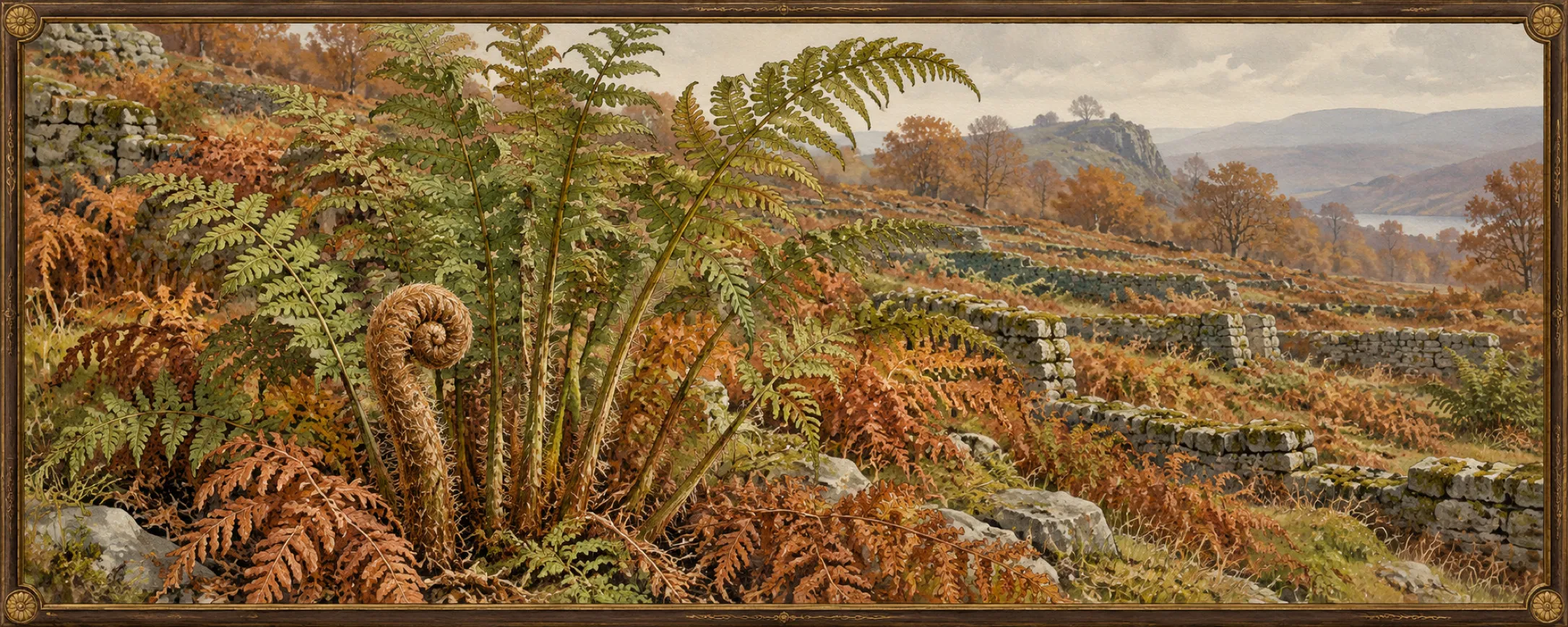
In spring bracken comes up as single stems from underground, each tipped with a tight, brown-furred coil like a shepherd’s crook. By midsummer each has unrolled into one great frond, waist- or shoulder-high, its stem stiff and grooved and its blade cut into many pairs of narrow, finely divided leaflets, a hard, bright green. A slope of it in summer is a sea of green that hides a lying beast or a walker. In autumn it turns red-brown and dries in place, rustling, and stands through winter as dead russet bracken. Crushed, it smells green and bitter.
Habitat and Range
It grows on dry, acid, light ground: heaths, hill pastures, wood clearings and edges, abandoned fields and terraces, from the basin uplands to the foothills of the Headwater Marches. It dislikes wet ground, deep shade, and the plough. It is part of the heath of the uplands (see Grass and Heath).
Behaviour and Temperament
Bracken spreads by thick black roots that run a hand’s depth underground, sending up fronds as they go. A stand advances a pace or two a year into grass that is not grazed hard, shades out what lies beneath it, and is almost impossible to dig out. Burning clears the fronds but not the roots.
Life Cycle
The roots live for generations, and a stand may be older than any settlement near it. Each frond lives one season. Bracken seldom sets spore that grows; it holds ground by root.
Uses and Dangers
Cut dry in autumn, bracken is bedding for people and beasts, litter for the byre, packing for stores, and thatch that lasts a few years. It is burned for a quick fire, and its ash goes into soap and glass-making. The young coils are eaten in some poor households in spring, though they are not wholesome.
Grazed, it poisons. Cattle and horses that eat it in a dry year, when the grass fails, sicken over weeks, bleed from the nose and in the dung, stagger, and die; sheep go blind. Herders keep hungry stock off bracken slopes. On abandoned ground it is a sign of how long the land has been left, and how hard it will be to win back.
Lore and Belief
Many believe bracken seed, gathered at midsummer night, makes the gatherer unseen, and nobody has ever found the seed. In the Witnessfields, Flockturn’s herders say bracken grows best where the old oaths were broken, and that the terraces that still hold grass are the ones whose oaths were kept. Basin folk say to cut bracken before the solstice is to call rain.
Thieves and outlaws who have bought "bracken seed" from a hedge-witch and walked into a lord’s hall thinking themselves unseen are a stock joke of the Basin alehouses, and of the gallows.