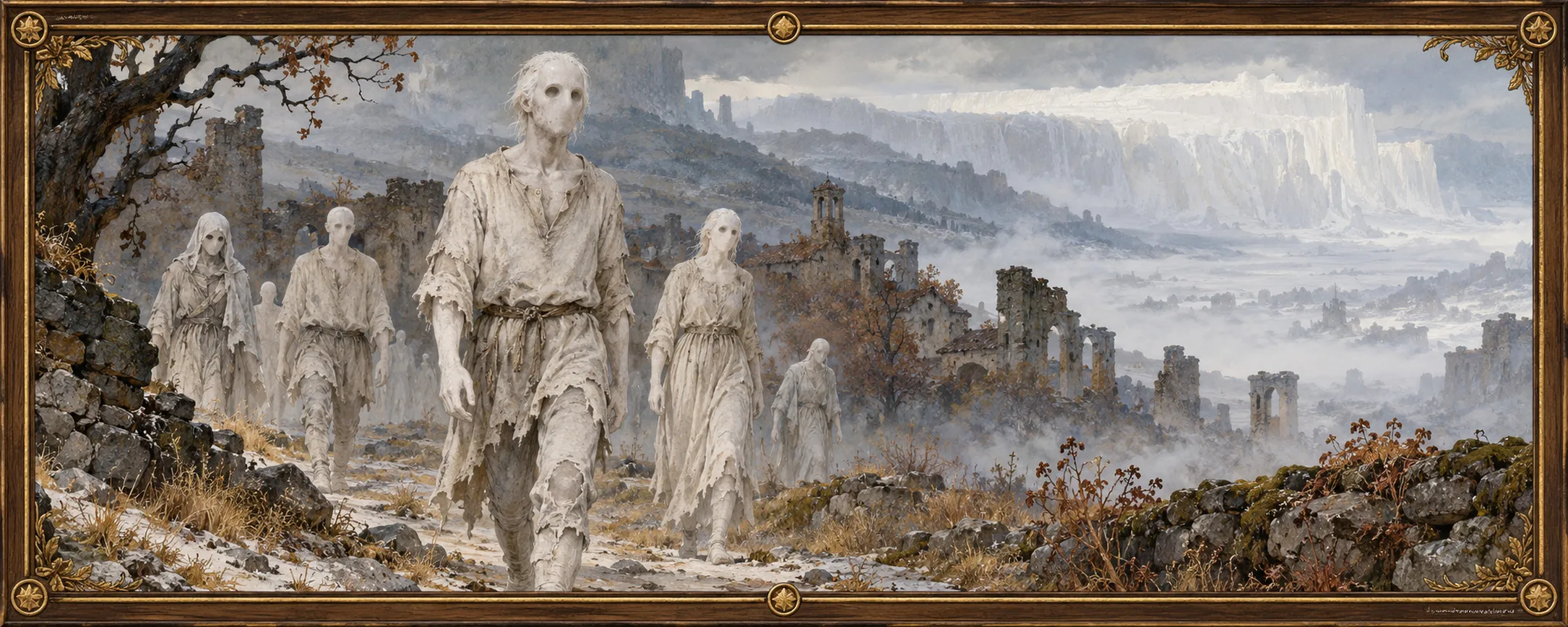
Blank Hosts
The Blank Hosts belong to Mnemosyne Null, the Unwritten, a Beyonder that cures the world of its past by erasing it. A Blank Host is what the spreading blank leaves of a person when it has taken everything but the body: no personality, no memory, no will. It keeps its strength and walks out of the pallor to find those who still remember, and to stop them remembering.
Appearance
The body is the one the victim had, the same height and build and the same strong shoulders or bad knee, but the blank has drunk its detail. Skin, hair, and clothing fade to one chalky, colourless pallor, as though everything had been washed a hundred times. The face smooths out: brows and lines vanish, the nose softens to a ridge, and the eyes and mouth remain only as blank openings, pale and empty. A ring, a scar, or an embroidered hem may linger for a day as a faint grey ghost before it goes.
A Blank Host makes no sound at all. Its feet fall without noise, its breath is not heard, and those who stand near it notice that even the ringing in their own ears has stopped. It has no smell. It moves at an ordinary walk, steadily, the way someone walks who has nowhere else to be.
Habitat and Range
On Caeldon, Blank Hosts come only out of the Paling, the pale country that the Mnemosyne Null Incursion (c. 132,000-c. 130,000 BR) left: now and then someone who stayed in it too long walks out emptied. While an Incursion runs, hosts leave the pallor to hunt and return to it, and the blank spreads behind them; a place long under the Unwritten may hold more hosts than it ever held people, because travellers and rescuers are taken too.
Behaviour and Temperament
They do not speak or think; they simply are. A Blank Host does not hate, hunger, or want. It seeks out anyone still remembering, by a pull that seems to run toward memory itself: a grieving widow, a scholar with his books, a child singing a counting song. It reaches the one who remembers and lays hold, and it does not let go while the blank works. Crowds of hosts gather in silence where a town keeps its records or its graves.
A host shows no pain and no hesitation, and nothing it once loved slows it. A mother made blank passes her own children as she passes a fence post, unless they are remembering, and then she comes for them.
Abilities
A Blank Host carries the blank with it. Its touch takes memory in the order the pallor takes it: this morning’s meal first, then a name and a family, then speech and walking, until the one held becomes another host or ceases to be. Nearby, things lose their history: a hero’s sword becomes a piece of metal, a letter a page of marks nobody can read.
It is held back by memory. A name spoken aloud, a song sung, a locket clutched, a story told together by a group pushes it off; telling a host its own name is said to make it falter.
Life Cycle
Blank Hosts are made from the living, and a Cult of the Blank Slate would be emptied into hosts at the end. They do not age or feed. When the blank behind them is driven out, a host falls still where it stands, a pale body without anyone in it. Its people bury it under its old name, carved deep.
Uses and Dangers
A Blank Host offers nothing. Its danger is that its own kin forget to fear it as the blank spreads, and that every person it takes becomes another host. Households round the Paling keep their names, songs, and genealogies aloud as a nightly habit.
Lore and Belief
Some call the hosts the Faceless and take them for ghosts who have forgotten they are dead. Others believe that a host still remembers, deep down, and can be called back by its true name; that is only half so, since a name makes it falter but does not return what was taken. A Cult of the Blank Slate would hold the hosts blessed, free at last of every grief. Hearth tales tell of a child who sang her father’s own lullaby to a host until it lay down, and whether it happened no one recalls.
Bounty-takers will not ride after an outlaw into the Paling, and outlaws know it; the tale of the brigand who hid there for a season and came out not knowing his own name or his crimes is told on both sides of the gallows.