Octopus
The octopus of the Tidelace Coasts lives in rock pools, the gaps of breakwaters, and the rocky shallows, and it is the cleverest thief on the shore. It robs crab pots, slips through the gaps of fish traps, and can open a stoppered jar from inside or out. Gnome children are set to watch one in a pool at low tide, to learn patience.
Appearance
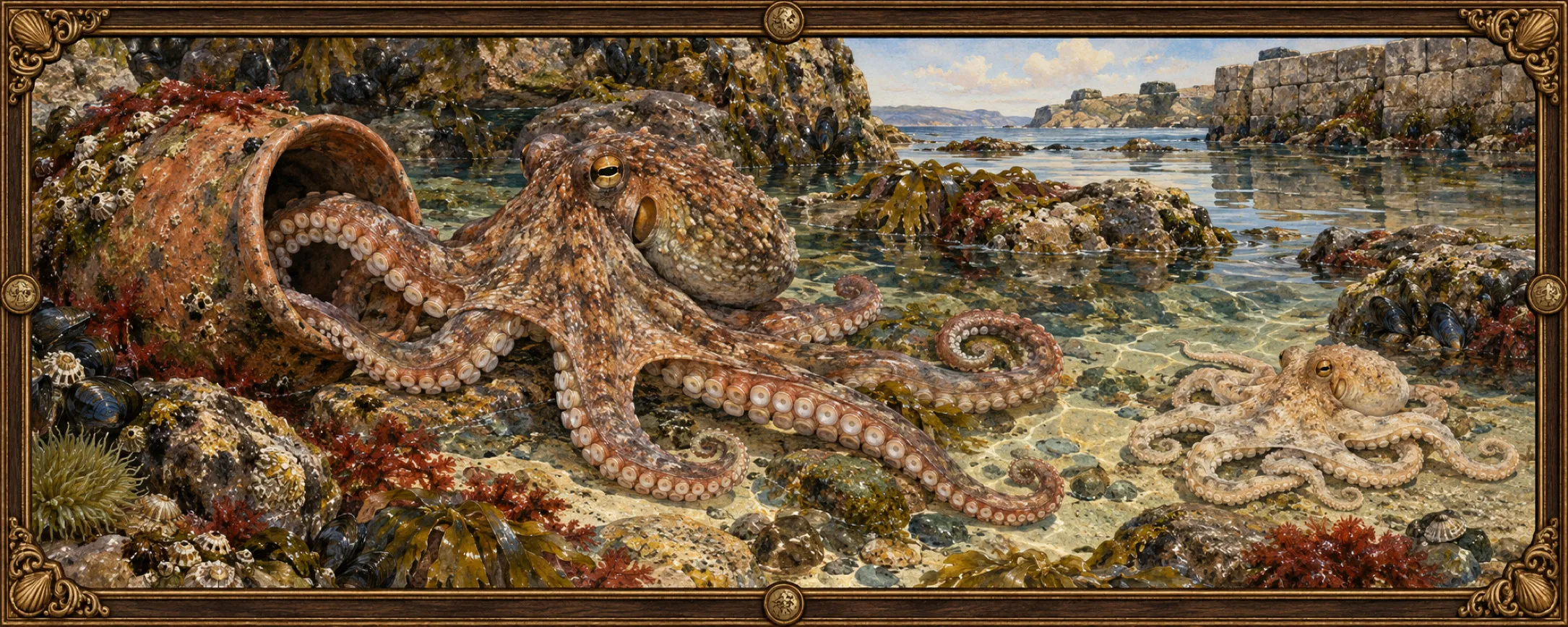
An octopus has a soft, bag-like body the size of a fist to that of a head, two large eyes with slotted pupils, and eight long arms lined underneath with rows of pale suckers; the biggest span as wide as a man’s outstretched arms. Its colour changes in a moment with its mood and its ground: mottled brown and grey against rock, sand-pale on sand, flushing dark red when alarmed, ghost-white when afraid. Its skin can raise bumps and spikes to match weed or stone. It walks on its arms over the bottom, squeezes through any gap larger than its beak, and swims backwards in a rush by squirting water. It is silent, and smells only of the sea.
Habitat and Range
It lives in dens in rocky ground: holes under boulders, gaps in breakwaters and quay walls, old pots and jars on the bottom, and rock pools that keep their water at low tide. It is commonest in the sheltered inner sounds and the breakwater-closed inlets of the Tidelace, and keeps the same den for weeks.
Behaviour and Temperament
The octopus hunts at dusk and night for crabs, shellfish, and fish, prying shells open or drilling them, and leaves a heap of empty shells at its den mouth. It is shy but intensely curious: it will reach an arm out to touch a hand held still in a pool, examine a dropped tool, and take it home. It learns quickly, remembers which pots hold crabs, and opens what it has learned to open.
Abilities
An octopus can change its colour and the texture of its skin to vanish against rock, weed, or sand, squeeze its body through a hole the size of a coin, and squirt a cloud of dark ink to cover its escape. It can undo a lashing, lift a lid, and twist out a stopper.
Life Cycle
An octopus lives only a year or two. A female lays strings of eggs in her den, guards and cleans them for weeks without eating, and dies when they hatch. The young drift as specks in the water before settling on the bottom.
Uses and Dangers
Octopus is food, beaten tender on the rocks and boiled, grilled, or dried. Fishers catch it in clay pots lowered on lines, which it enters as a den. It costs the crab-potters many a catch, and a stoppered jar of salted fish left on a quay overnight is not safe. Its bite, rarely given, is painful but no worse.
Lore and Belief
Gnome households say the octopus is the only creature on the coast that reads a mark better than a pilot, and a child who loses patience watching one is told the octopus is still waiting. Coastal Humans say an octopus that comes up onto the shingle foretells a storm, and some hamlets will not eat one taken from a drowned harbour, saying it has been at the dead’s stores.
Wreck-divers say the great octopus of a drowned harbour guards the sunken strongrooms, and that a diver who comes up with a coin in one hand comes up with an arm round the other.