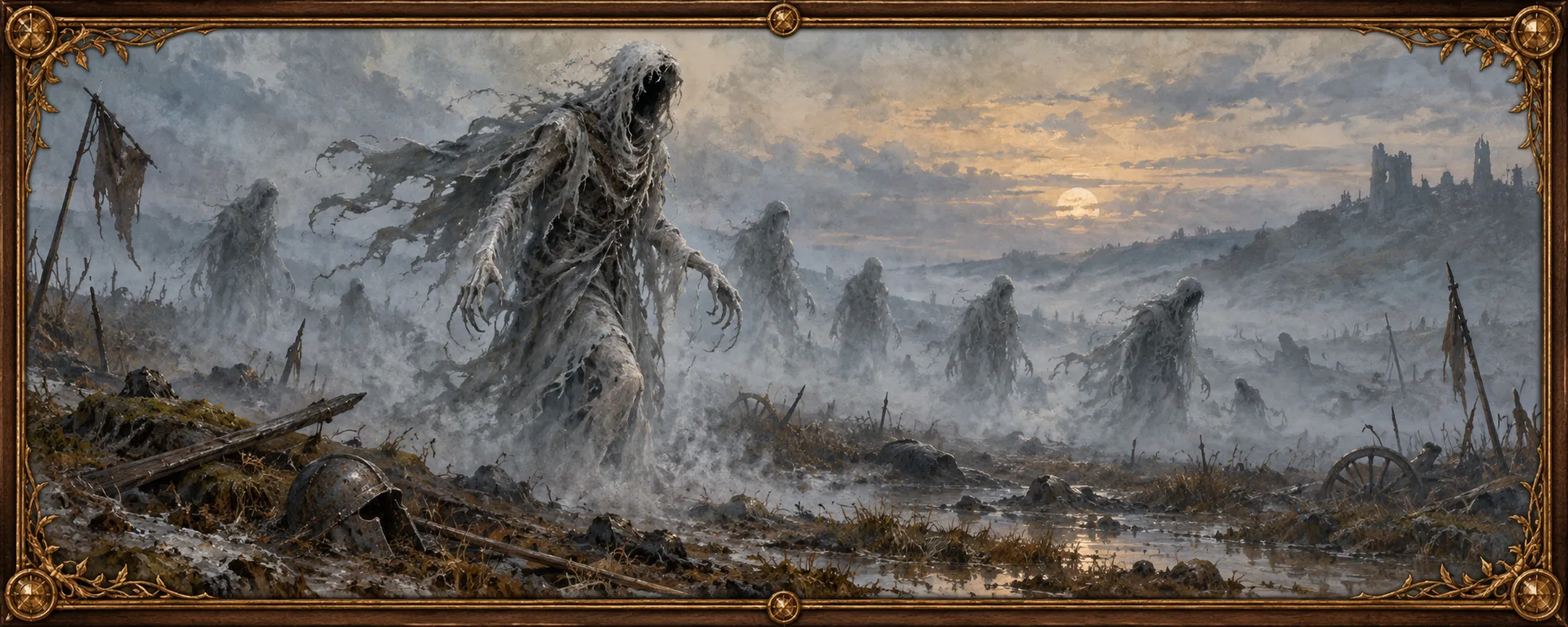
Hostile Remnants
Most of the dead settle. Their Echoes soften and disperse, or pass into Record, helped by grief, rite, and remembrance (see Resonant Continuity). Some do not. A hostile remnant is death residue that has hardened instead into a lingering presence that turns on the living: a restless haunt in a house, a cold thing at a graveside, the angry murmur over a battlefield after dusk. The name covers a family of hauntings rather than one being. The worst of them are the hungry remnants of the Hushvale, which feed on warmth, breath, names, or recognition.
Appearance
A remnant is felt before it is seen. The first signs are a cold spot that does not move with the draught, a smell of damp earth or old blood where none should be, lamp flames that lean towards one corner, and a sense of being watched by someone angry. Seen at all, it is a smear of grey at the edge of sight, a shape that is almost a person and then is not. Battlefield remnants show as many such shapes, moving together like smoke over the ground. Some are only sound: knocking, scraping inside a sealed coffin, a voice repeating one word.
The Hushvale’s hungry remnants are said to look like the fog itself thickening into a figure, close enough to touch, with a hollow where a face should be.
Habitat and Range
Remnants form where death was sudden, violent, or left unfinished: hasty battlefield burials, plague pits, the graves of the unclaimed, mortuaries where a body waits too long, and places where two peoples' rites quarrelled over one dead. Haunted moors and old battlefields hold them for generations. The Hushvale, where the fog, the dead, and the Wake-Seal meet, is full of them.
Behaviour and Temperament
A remnant is not the dead person and does not think as they did. It is the strongest feeling they died with, fear, rage, grief, or need, gone hard and set against whatever comes near. It clings to a place, a body, or an object; it frightens, harries, and drains, and it grows stronger the longer it is left. The hungry remnants of the Hushvale hunt in the fog, and take from the living what the dead no longer have.
Abilities
A remnant can chill a room, sour a mood into dread, move small things, and wake twitching and scraping in the dead it clings to. Strong ones attach to the living and drain their energy and sanity. In the Hushvale they take more: the warmth from a body, the breath from a sleeper, a name from a mind, or the power to recognise a face. Rites and magic break them. Necromancers quiet them with Grave Quiet; Trace Magic unties them gently; Sanctified Magic drives them back by force.
Uses and Dangers
Remnants give nothing but warning. They are what funerary custom exists to prevent, and what careless necromancy causes, since agitated remnants are among its known costs (see Costs and Side Effects). Mortuary staff use Trace Magic to tell which body may harden overnight and isolate it, burial parties cross battlefields by the safest path, and pilgrims sleep inside sanctified rings while the haunted moor mutters outside.
Lore and Belief
Every people that finishes its dead fears what happens if it does not, and most believe a haunt is a soul that was refused its rest, angry at the living who failed it. That is close: a remnant forms most readily where rites were skipped, quarrelled over, or impossible, and where nobody grieves. Grave-lights, vigils, and spoken names keep the dead quiet, and many peoples pray to Ennor the Grave-Watcher, under their own names for him, to guide the dead past the threshold before they can turn.
Grave-robbers and battlefield strippers wake more haunts than anyone, and the songs are full of the looter who took a ring from a field of the unburied and was followed home by the hand it came from.