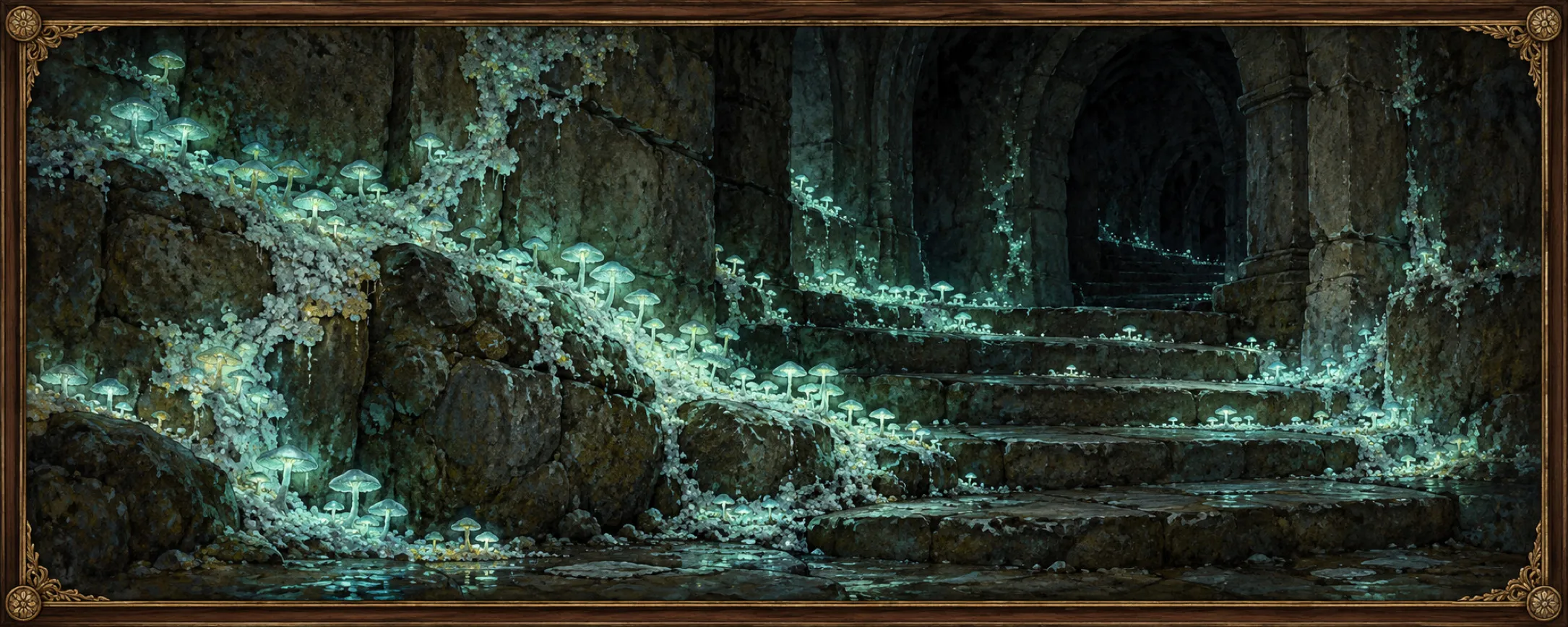
Glowing Fungi
Glowing fungi give a weak, cold light of their own. Wild, they are known from two zones of the Iron Backbone: they cling to the moving walls of the Flux Maze and to the walls of the Gravity Well, where they are much of what light there is. In the world they are grown, not found: a nature-worker touches spores to a damp wall and a dim glow spreads. They are a different thing from the food fungus of the fungus beds, which gives no light, and from the gloam of living root, which is the only light the Roothollows make of themselves.
Appearance
The fungus grows as a thin crust and as clusters of tiny caps no bigger than a fingernail, spread across stone in patches from a palm’s width to a wall’s length. By lamplight it is a dull greyish white, easy to miss. In the dark it shows its colour: a pale blue-green in most strains, a faint gold in some, never brighter than a few coals, and enough to see a hand or a step by but not a face across a chamber. The light is steady and does not flicker. The fungus has a faint smell of wet stone and mushrooms, and it makes no sound.
In the Flux Maze it is said to grow in ribbons along the seams where the walls part and close. In the Gravity Well it lies flat and dense, pressed to the stone, its caps barely raised.
Habitat and Range
It needs damp, darkness, and stone or old wood to cling to. Brightness and dryness stunt it, which is why it lasts in deep caves and tunnels and fades near a cave mouth. In the Flux Maze it moves with the walls it grows on, so a patch seen in one corridor may be met again in another. In the Gravity Well, which has no light from above, it clings to the walls, and with the faint glow of the ground itself it is all there is to see by.
On Caeldon no wild stand is widely known; the faint foxfire of rotting deadfall in the old forests is too weak to count as light. The glow met in a mine or a caver’s tunnel has nearly always been grown there by someone, and it lasts as long as the damp does.
Behaviour and Temperament
It spreads slowly across damp stone, feeding on the film of water and whatever is dissolved in it, and it retreats where the stone dries. It does not glow more brightly for being touched or disturbed. Where it grows thickest the stone beneath is soft and stained.
Abilities
Its one gift is its light: cold, smokeless, and lasting as long as the fungus lives, with no fuel to carry and no flame to fail in a draught. The light is too weak to read small writing by.
Life Cycle
It spreads by spores too fine to see and by creeping out from its edges. A patch grown by a nature-worker on a suitable wall settles in within days and can last for years; on a dry or sunlit wall it dims and dies within the season. Dead fungus loses its glow first and then flakes away as grey powder.
Uses and Dangers
Its use is light. The Fungal Lantern of Nature Magic grows it on a damp wall to light a tunnel harmlessly for cavers, fed by moisture, plant matter, and the worker’s own reserves, and the same school keeps cultivated spore strains for other ends (see Spore Cloud). In the zones the fungus is the traveller’s only steady light, and the danger lies in what it lights: in the Flux Maze a line of glowing fungus is no guide, since the wall it grows on moves.
The fungus itself is harmless.
Lore and Belief
Little that is said of it in the world is first-hand, and knowledge of the zones is uneven and often wrong (see Knowledge of the Cosmos). Miners say a tunnel where the glow will not take is a tunnel the stone does not want worked, and some believe that a patch carried home from a Rock-Gate cavern will light the way back to it. Visitors to the Maze tell that the fungus marks the paths the Maze has already closed; others say the opposite. None of these has been shown to be so.
Ruin-delvers who follow a glowing seam into the Maze tell of treasure seen by its light and lost when the walls moved, and of companions who walked into the dark beyond the glow and did not answer.