Pigs
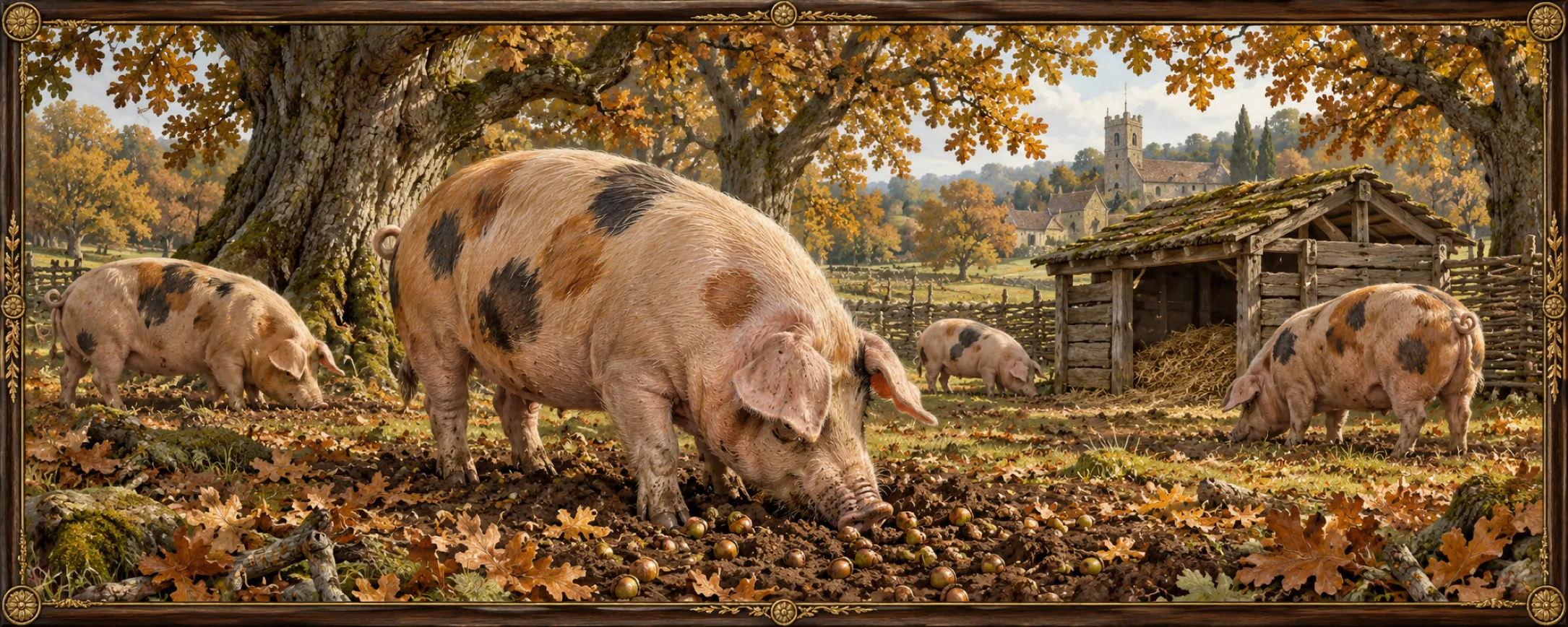
Pigs are the household’s living larder. A village family in the Confluence Basins keeps one or two in a sty behind the house, feeds them on scraps and whey, turns them into the oak woods in autumn to fatten on the mast, and kills them at the turn of winter. Halflings of the Leeward Folds keep them in terrace pens, and Goblin households keep a pig wherever they can.
Appearance
A household pig is as long as a Human is tall and stands knee-high, heavy-bodied and short-legged, with a long snout ending in a flat, mobile disc, small eyes, and large ears that hang forward over the face. Most are pink or sandy under a sparse coat of coarse pale bristle, often spotted black or ginger; woodland breeds are darker and hairier, nearer the wild boar. Neither sex keeps tusks of any size.
Pigs grunt continually as they root, squeal when handled, and scream when killed, a sound every village child knows. A sty smells strongly and a pig does not, if kept clean.
Habitat and Range
Pigs are kept wherever there are households with scraps to spare: across the villages and towns of the Cradle web and in the fold houses of the Folds. They are fewest in the high hold country and on the move with herders.
Behaviour and Temperament
A pig eats almost anything: scraps, whey, roots, acorns, beechmast, grubs, carrion. It roots with its snout and will turn over a garden in an afternoon. It is clever, curious, and sociable, learns its keeper’s voice, and can open a badly latched gate. A sow with piglets bites anyone who comes between them.
Life Cycle
A sow farrows twice a year, eight to twelve piglets each time. Most pigs are killed in their first or second winter; a breeding sow may be kept for many years.
Uses and Dangers
A pig gives more meat for its keep than any other beast: pork fresh at the killing, bacon and ham smoked and salted for the winter, lard, sausage, and black pudding, bristle for brushes, and hide. In autumn villagers drive their pigs into the lord’s woods for pannage, paid for in coin or pigs, and quarrels over pannage are a staple of the lord’s hall, where the lord’s own reeve is usually right. Pigs left to wander dig up graves and crops, and an untended pig has eaten a child left alone in a yard.
Lore and Belief
The pig-killing at the turn of winter is a household feast, and the first cut is offered at the household shrine. Basin Humans say a pig can see the wind. Pigs that go wild do not stay pigs for long; the feral swine of the ruins, the Ruin Hogs, are their descendants, and Goblin salvagers fear them more than any yard pig.