Timber Trees
Timber trees are the working trees of Caeldon: the ones people fell for beams and bracing, cut back for poles, strip for bark, tap for resin, and burn. The Material Plane has timber enough to support civilization, but it must be worked for. The peoples name these trees by their use and the country they grow in, not by any reckoning of kinds, and the trade in them runs from the foothill woods of the Headwater Marches uphill to the holds and the Deeps.
Appearance
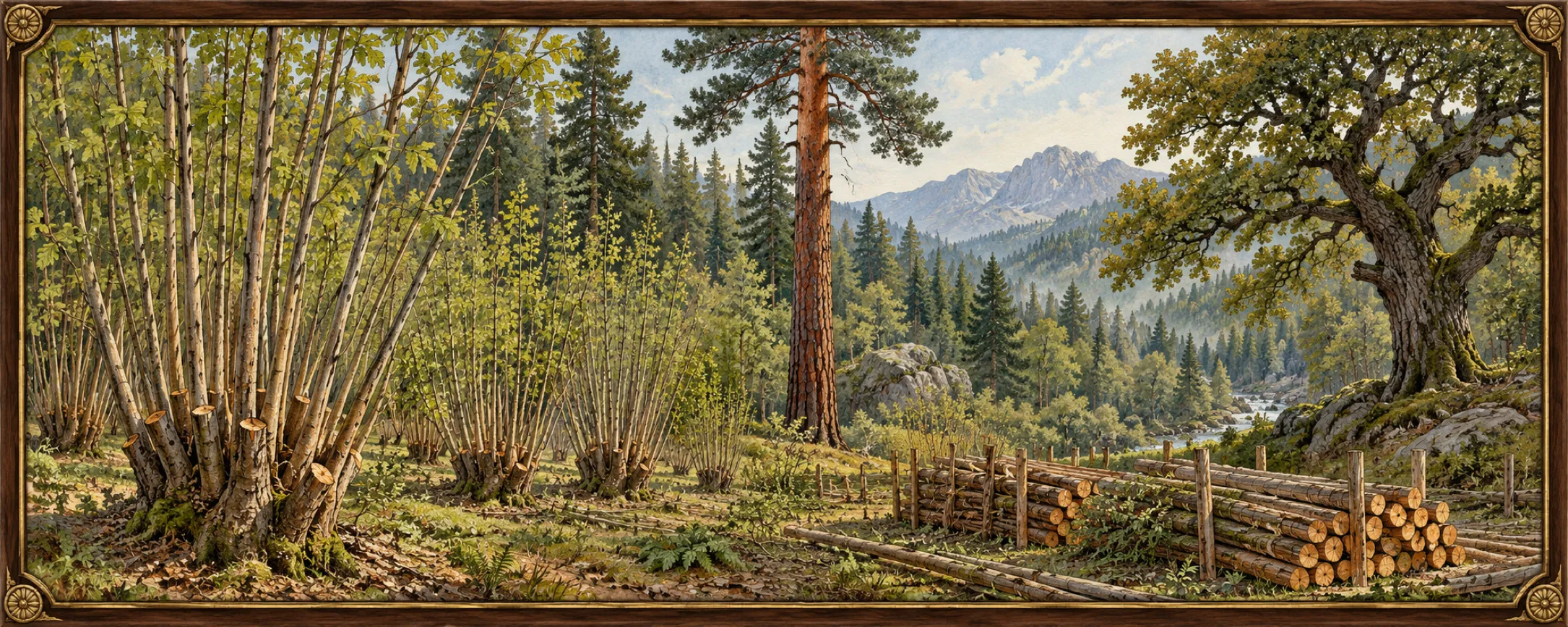
Foothill Pine
The commonest timber of the Headwater woods is a tall, straight conifer, three or four storeys high in a good stand, with reddish scaly bark that peels in plates, a narrow crown of dark blue-green needles held high, and a clean trunk below. Its wood is pale, light, and resinous, and a fresh-cut stack smells sharp and sweet for a season. This is the bracing timber of the mines.
Edge Oak
At the edges of the forests and in the lighter woodland where the Elderweald thins towards the basins grows a broad-crowned oak, black-barked and deeply furrowed, its limbs spreading wider than it is tall, its leaves lobed and leathery and its acorns cupped in grey. Its wood is heavy, dark gold, and slow to rot. It is the beam and bridge timber the basin side most wants and is least allowed to cut.
Coppice Wood
In broken woodland, and above all in the Briarreach, the useful trees are kept low: hazel-like shrubs and quick, pale-barked ash cut to the ground every few years, so that each stool sends up a ring of straight, smooth poles, grey-brown and as thick as a wrist. A coppice ground looks like a field of rods in every stage of growth.
Bark, Resin, and Dye Trees
The same woods give other goods than wood. The bark of oak and of a smooth-skinned birch is stripped in spring for tanning and cordage; the foothill pine and the conifers of the Briarreach slopes are tapped for a thick amber resin that hardens in the air; and bark, root, and gall give the browns, blacks, and yellows of the dyers.
Habitat and Range
Foothill pine fills the slopes and stream-cut spurs above the Headwater valleys and the lower flanks of the Ironspine. Edge oak grows along every forest margin of the cradle-web. Coppice belongs to the Briarreach, a forest that keeps breaking, where windthrow and deadfall leave light for quick growth. Timber belts, the worked woods of the frontier, lie on both sides of Caeldon among rough uplands, border farms, and heavy settlement edges, and there Ogre bands do the carrying.
Behaviour and Temperament
Timber trees only grow, but each kind answers cutting differently. Pine does not regrow from the stump: a felled slope stays felled until seed takes it again. Oak and ash come back from the stool, and coppice is the art of using that. The deep weald is another matter. Its ancient trees are not timber at all to the people who live among them (see Great Trees and Groves).
Life Cycle
Foothill pine reaches bracing size within a lifetime of a Human and good beam size in two. Edge oak takes centuries to its full spread and can stand for many more. A coppice stool, cut in turn every few years, can outlive any tree grown from it.
Uses and Dangers
A Headwater valley household cuts timber in the foothill woods alongside its barley, oats, and herds, and sells to the holds above. Bracing timber goes up with grain, salt meat, wool and cloth, and lamp oil, much of it bound past the Ironspine Holds for the Stonewake Deeps, where no tree grows; at Seamhead, timber yards feed the bracing of the working below. Kobolds have a sharp sense for bad timber, and a mine crew trusts a Kobold’s word on a prop over its own eyes.
The Elderweald sells only what the forest lets fall: resin and seasoned deadwood, gathered under watch. Cut timber is never sold, and it is exactly what the basin side wants; from the first contacts at the forest edge the Human side has seen fuel and timber where the Wood Elves see a living continuity. The Briarreach sends out seasoned thornwood, coppice poles, bark and resin, and dyes through the Waitfield.
Ogres carry what others cannot: bridge beams, roof timbers, flood gates, and the timber of the frontier belts, often moving between quarry hauling, flood repair, and timber carrying with the seasons. Their own camps are long houses of timber and hide. In the Broken Marches and the Greyford Reach much timber is not cut but salvaged: old beams out of ruined works, sold quietly to border lords.
The dangers are the work’s. A falling tree, a log loose on a slope, and a haul gone wrong kill woodcutters and haulers every year, and a rotten prop in a mine buries a crew.
Lore and Belief
Headwater people say pine cut in the dark of winter lasts longest underground, and Dwarven bracing-masters will not use wood felled while the sap runs. Basin folk speak of the uncut Elderweald as wasted timber; Wood Elves answer that the forest was never waiting to be used. Ogre bands hold that a beam carried is a burden shared and owed, and count a timber haul with the rest of their sworn labour.
Timber belts are where the frontier’s feuds are fought: lords' foresters, Elven wardens, and woodcutters' crews have killed one another over a stand of pine, and the songs of the Headwater remember the night a whole felling camp was burned out by men no one would name.