Reed
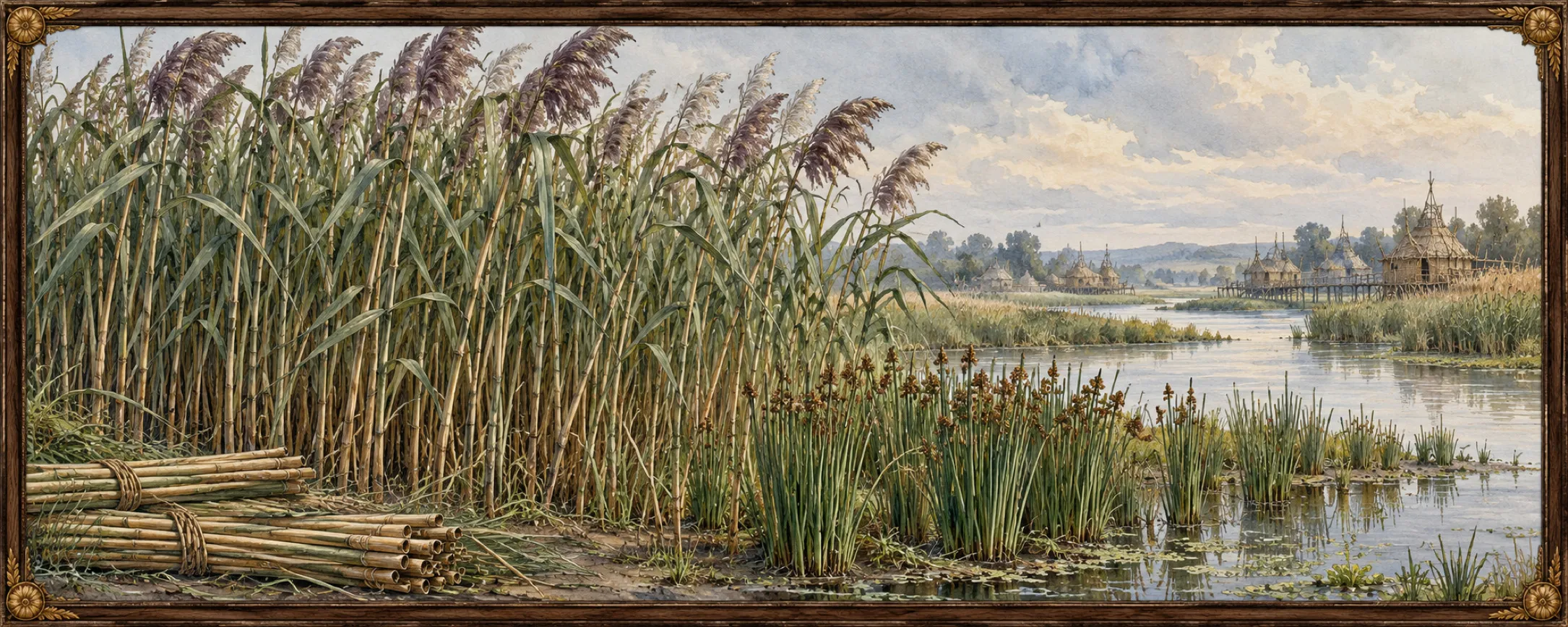
Reed is the tall grass of wet ground, growing in beds so dense that from a boat a fen looks like a field. Where land and river never settle which is which, reed is the plant that holds the edge. It is the home ground of the Reedfolk, whose households live on stilts and reed islands among it and cut it for a living, and it lines the salt-facing mouths where the Thaluren hold their circles. Beside it grows rush, a lower, rounder plant of the shallows.
Appearance
Reed stands two to three times a person’s height. Each stem is a hollow, jointed cane no thicker than a finger, green in summer and straw-gold by autumn, with long grey-green blades that sheath the stem and rattle in wind. At the top it carries a loose plume, purple-brown when it flowers in late summer and silver-buff in winter, when the dry beds hiss and whisper with every gust. Cut and bundled, it smells of dry hay; a bed in summer smells of mud and green water.
Rush grows lower, to about the waist, in clumps of smooth, round, dark green stems with no leaves to speak of and a small brown tuft of flower near the tip. Split and peeled, its pith is white and soft.
Habitat and Range
Reed grows wherever slow water stands over soft ground. Downstream in the Confluence Basins long reaches of reed, fen, and seasonal flood open towards the Serath, the greatest of them the Reedmere, the main Reedfolk country inside the Basins. In the Lower Serath reed beds and willow thickets fringe the abandoned channels, backwaters, and oxbow lakes of the flood-ground. Rush lines the gravel shallows of the Greyford Reach.
On the far side, reed grows in the estuaries of the Tidebound Reaches, where salt and fresh water mix. There it builds reed-shelves: banks of dense reed on silt that stand just clear of high water in most seasons, firm at the heart and treacherous at the edge. The largest field of them breaks the river into braided channels at the Split Reed Mouth.
Behaviour and Temperament
Reed spreads by creeping roots, not by seed, and a bed is in truth one plant or a few, knitted through the mud. That root-mat is what makes a reed island: silt caught among the stems rises year by year until the bed stands above ordinary water. A flood can tear an island loose or drown it, and a low year can raise one that is gone again at the next rise, which is why a Reedfolk house remembers which islands are there only in low years. A bed grown over a bank looks like solid ground long after the water has eaten away beneath it.
Life Cycle
New shoots push up from the roots in spring, grow fast through summer, flower at its end, and stand dead and dry through winter, when cutting is done. A bed that is cut each winter comes back thicker; one that is left fills with its own litter and slowly turns to fen and then to firmer ground.
Uses and Dangers
Reedfolk households in the fens, on the Reedmere and in the channel country of the Serath fish, guide boats, and cut reed, and reed goes downriver among the Lower Serath’s exports beside fish and boats. Cut reed thatches roofs, bundled reed firms a landing or a path across soft ground, and split reed is woven into mats, baskets, screens, and fish-traps. Rush gives matting: Goblin households at Lowbank in the Greyford Reach sleep on rush mats around a clay hearth, and peeled rush pith dipped in fat makes a cheap light. Reedfolk eat reed roots beside fish, eel, and waterfowl, dug in winter and roasted. A single reed makes a pipe or a flute.
Reed itself harms no one. The cost is the ground: a bed hides channels that have moved, soft banks, and scour holes, and a stranger who walks out on reed as if it were land can go through it to the waist or deeper. On the shelves of the Split Reed Mouth a channel true at the morning ebb can be false by the evening flood.
Lore and Belief
To the Reedfolk, reed is the record of the water. A house’s keepers know which beds have shifted, which islands are low-year ground, and which shelf has crept into a channel, and a child who can recite the floods of the house knows which reed island will be there in a wet spring. The drowned reed cities of Reedfolk memory are remembered as places that stood where the reed was, before altered channels drowned them.
Human river towns picture Serovan the River-King with hair of green reed and water-weed. A single unbroken reed in a carved flute was the sign of the Many-Named, the Oral Tradition, the faded god of memory kept by voice. On the far side the reed-shelves are meeting grounds, not holy ground: mixed circles of Thaluren and Gnome pilots gather on them to state what kind of passage a channel is carrying.
Outlaws and smugglers hide in the reed beds where no lord’s riders can follow, and the Reedfolk tell of a reed-fire set to burn out an outlaw band that took three villages with it.