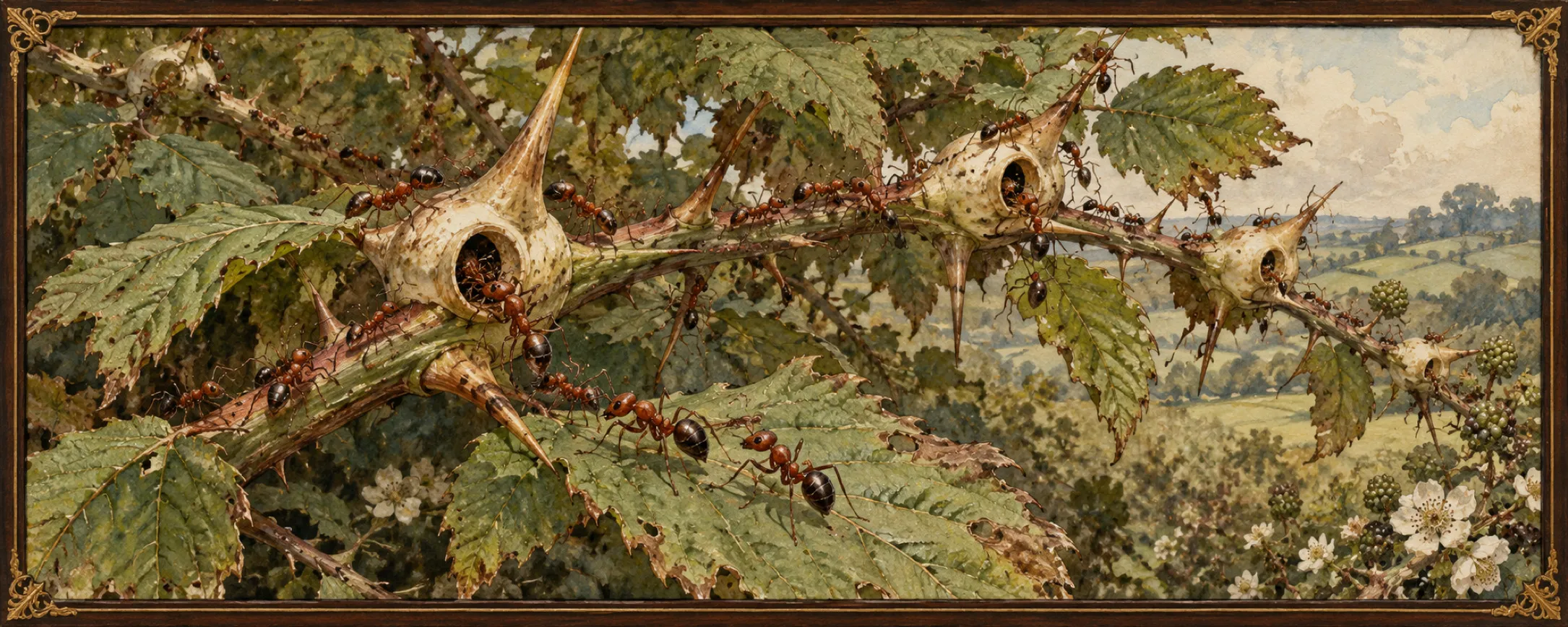
Thorn Ants
Thorn ants live inside the spines of one kind of thorn, which the Thorn Elves call ant-thorn, and pour out to sting anything that shakes it. The Thornbound Circles weave ant-thorn into the cultivated hedges around their clearings in the Briarreach, so that a hedge does more than block: it answers. Those who know the gaps pass. Those who push through are stung.
Appearance
A thorn ant is small, about the length of a grain of wheat, slender and rust-red with a darker, glossy belly and a sting at its tip. It runs fast and in lines. Its home, the ant-thorn, is a shrub of the thickets with paired spines at every leaf, each pair swollen at the base into a hollow, pale, horn-like bulb the size of a thumb-joint; the ants cut a small hole in each bulb and live inside. A shaken ant-thorn hums faintly as the ants come out, and gives off a sharp, vinegary smell that tells every ant on the bush to come.
Habitat and Range
They live only on ant-thorn, and ant-thorn grows only in the Briarreach and its ravine edges, in the broken thicket among the commoner thorn. Wild stands are scattered. Cultivated stands are not: a Thornbound hedge may hold a run of ant-thorn wherever its keepers want no one to try it.
Behaviour and Temperament
Ants and thorn keep each other. The ant-thorn feeds its ants with sweet nectar from small cups at the leaf stalks and with tiny food beads at the leaf tips; the ants clear the bush of beetles, caterpillars, and climbing vines, and sting any browsing beast or brushing body. A colony owns its bush and its near neighbours and fights other colonies at the edges. They do not chase far; a person who steps back from the hedge is left alone.
Abilities
One sting is a sharp burn and a welt. A swarm is another thing: hundreds of stings in a breath on hands, neck, and face, with swelling, fever, and in a child or a small body worse (see Stings and Bites). A deer or a pig driven into a stand of ant-thorn learns, and does not come back.
Life Cycle
A queen settles in a young ant-thorn’s first hollow spine and raises her workers there, and the colony grows as the bush does, taking each new thorn as it swells. A large colony on an old bush may hold a single queen for many years, and winged queens leave it each summer after rain to find young bushes of their own.
Uses and Dangers
To the Thornbound, ant-thorn is a hedge-keeper’s best plant and the ants its keepers. Hedge-wardens plant it at the false gaps a stranger would try, train it into the weave, and leave the true ways free of it. Wardens learn to move through it slowly, in hard leather and hoods, and to smoke a run of hedge before they lay it. Ravine Trolls who keep the crossings know the ants too, and leave ant-thorn standing on approaches they want watched.
The danger is to strangers: woodcutters from the basin side who find a hedge they did not know was there and try to cut it.
Lore and Belief
Thorn Elves say the hedge chooses its visitors, and they mean it as more than a figure; children are told the ants know whose hands planted the thorn. Basin folk of the frontier say that the Elves taught the ants to hate Humans. A Troll saying holds that a crossing with no ants on it has no one watching it.
Frontier tales tell of a war-band of Human raiders that tried a false gap in the hedge at night and was found in the morning still in the thorn, stung past knowing; the Thornbound did not need to draw a blade.