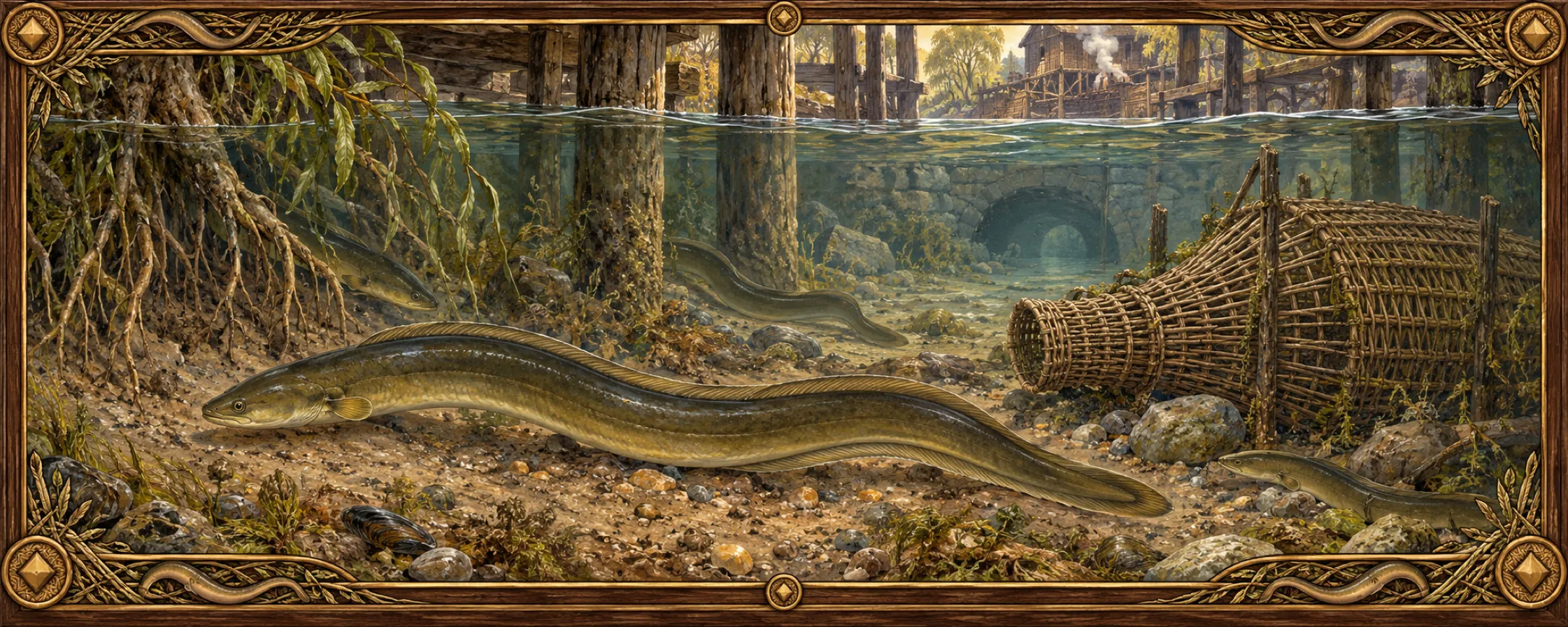
Eels
Eels live in the slow water of the cradle-web’s lowland rivers, in the fens and channels of the Confluence Basins and the Lower Serath and the side channels of the braided river at the Greyford Reach. Reedfolk households eat them with fish and waterfowl, and they are an everyday food on the Lowbank side of the Greyford crossing. Goblin households living on timber platforms above the flood line take them, with small fish, from wicker traps set among the piles and bars. On Highbank, where the inns serve trout, eel is poor people’s fare and known as Lowbank food.
Appearance
A grown eel is about as long as a forearm and fingertips together, and some old ones as long as a child is tall: a single round muscle tapering to a flattened tail, with a small pointed head, small eyes, and a fringe of fin running the length of its back and belly. Its skin is dark olive above and dirty yellow below, so slick with slime that it slides through a bare hand. Out of water it twists and knots itself and makes no sound. It smells of river mud, and the smell stays on the hands that clean it.
Habitat and Range
Eels keep to the slower water. In the basins and the Serath that means fen pools, slow channels, and the quiet reaches behind levees; at the Greyford, the side channels between the gravel bars and willow islands, the scour holes below the old causeway stubs, and the flooded culverts and storework cellars under Lowbank. They lie hidden by day under stone and in the mud and silt, and they are most numerous where the water is quiet and the bottom soft. The main channel under the Greyspan runs too fast for them.
Behaviour and Temperament
An eel feeds at night, nosing along the bottom for worms, small fish, and whatever the river carries down. It shies from light and moves off at a shadow. It will push into any opening that smells of food, which is why the wicker trap works: a narrowing mouth it can find its way into and not out of. A trapped eel fights the wicker for a while and then lies still.
Life Cycle
Eels grow slowly and live long, an old eel outlasting many floods in the same hole. They do not breed in the channels where they are caught, and none of the trapping families has seen an eel’s egg or young: the small eels simply arrive in the side channels each spring with the rising water. Where they come from, and where the big eels go when some autumns they vanish downstream, the families do not know.
Uses and Dangers
Eel is cheap, fat, and filling, and keeps well when smoked over a platform hearth. A Lowbank household sets its traps at dusk, lifts them at first light on the way to the fords, and eats eel and small fish with porridge from Highbank grain and greens from the island patches. Traps are set where each household always sets them, and moving another family’s trap is a quarrel. Eel gives no harm beyond a bite to a careless hand, but the culverts where the best eels lie are the same culverts that flood and trap air, and a trap-setter can drown there.
Lore and Belief
Lowbank children are told that an eel in the trap at dawn means the night’s water was kind. Highbank calls the Fordbank "the eel side," not fondly, and Lowbank answers that an eel never paid a toll. The eel’s disappearance downstream in some autumns is taken by some trappers as a sign of a hard winter to come.