Beans
Beans are the field bean of the Human river country: a coarse, filling pulse grown in strips beside the grain, dried hard, and kept through the winter. Few people praise them and nearly everyone eats them. Their fame on the roads comes from one meal. Before any job, an employer of an Ogre band sets out big pots of barley and beans, salt meat, and bread, and a caravan master who skimps on it is never hauled twice.
Appearance
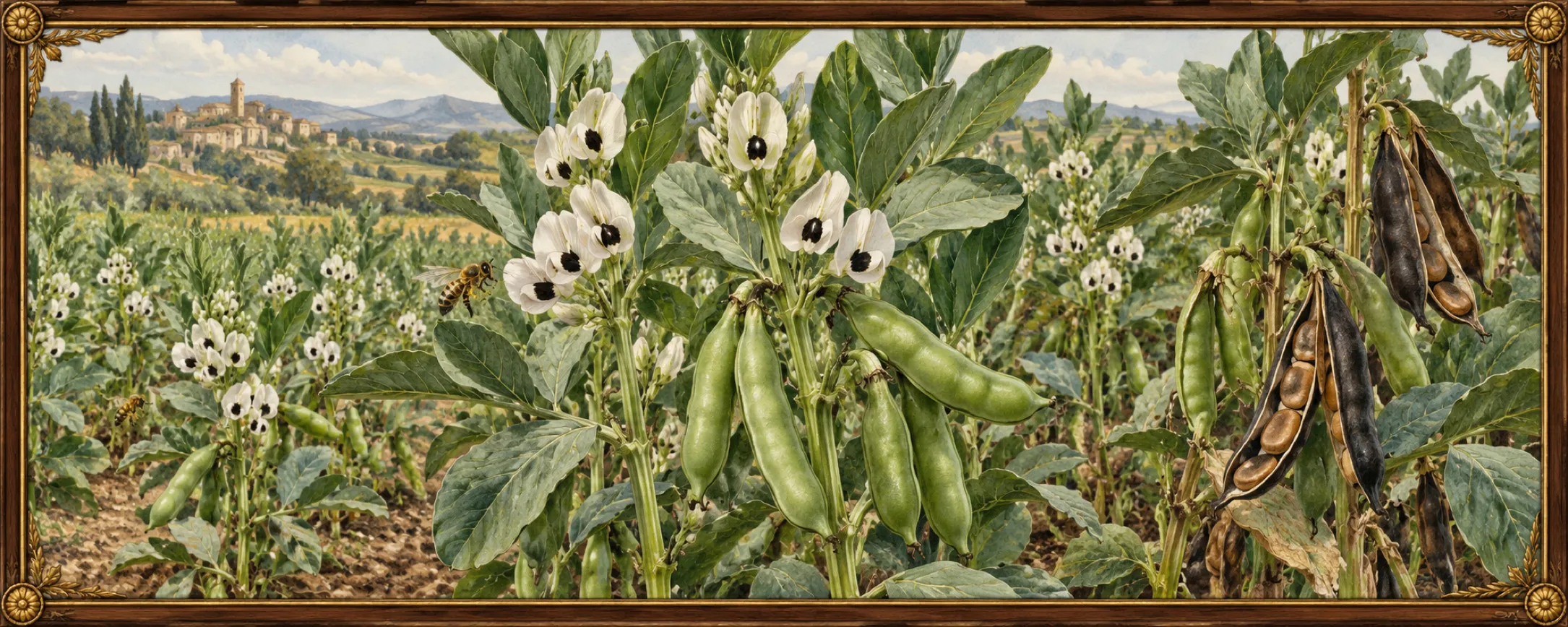
The field bean grows as a stiff, square-stemmed plant about waist high, with grey-green paired leaves and no tendrils. In early summer it flowers white, each flower marked with a black blotch like a thumbprint, and a bean field in bloom smells sweet and heavy enough to be noticed from the road and loud with bees. The pods that follow are thick and green, as long as a finger, and blacken as they dry on the plant. Inside lie three or four flat, brownish beans the size of a thumbnail, hard as gravel once dried.
Habitat and Range
Beans are grown across the Confluence Basins and in the valleys of the Headwater Marches, on strips that rest the ground between grain years, and in village plots on the rises above the flood. They travel as sacks along the Sheaf Road and down the barges, and the camps, inns, and work yards of the Greyford Reach and the Lower Serath eat more of them than they grow.
Behaviour and Temperament
Beans are sown in early spring, sooner than most crops dare, and stand cold well. They feed the soil rather than tire it, and a field that has grown beans gives a better grain crop the year after, which is why careful basin farmers set them between grain years. Blackfly and a wet harvest are their troubles.
Life Cycle
Beans are sown in early spring, flower at the start of summer, and dry on the plant by late summer, when the whole plant is pulled and stooked until the pods rattle. The best plants are left for seed, and a household’s seed beans are the last thing it eats in a hungry spring.
Uses and Dangers
Dried beans are winter food for people and beasts alike. Soaked overnight and boiled long with barley, salt meat, or whatever is to hand, they make the thick pottage of labourers, carters, haulers, and soldiers on the march. They keep for a year in a dry store and travel well, which makes them a staple of any party that cannot count on the next market.
The Ogre meal is not charity. Under the food-right custom of the Hearth-Weight Compacts, the band is fed before it lifts anything, the weakest first: the youngest, the injured, the old. At the Ogre camp on Onefire Terrace above Lowbank the pots of barley and beans are on the fire before sunrise on every working day, and the band carries no beam until they are empty.
Beans eaten raw or undercooked sicken the eater, and a few people sicken from them however they are cooked.
Lore and Belief
To Ogres the bean pot is a contract made visible: a band that has eaten has accepted the work, and an employer who has fed it has accepted the band. Human carters on the Headwater roads call a hard, fair bargain a "bean-pot bargain". Basin farmers say a bean field in flower is the last sweet thing before the hard work of summer.
An Ogre band that has eaten from the pot and then breaks its bargain is hunted down by the next band that hears of it, and the songs of the burden roads tell of such hunts with relish.