Hares
Hares are the long-legged runners of the open fields. They are the game of coursing dogs and hawks, food for poor households who snare them, and in basin tales the shape a witch takes to cross the fields at night. When the hares box on the stubble, spring has come.
Appearance
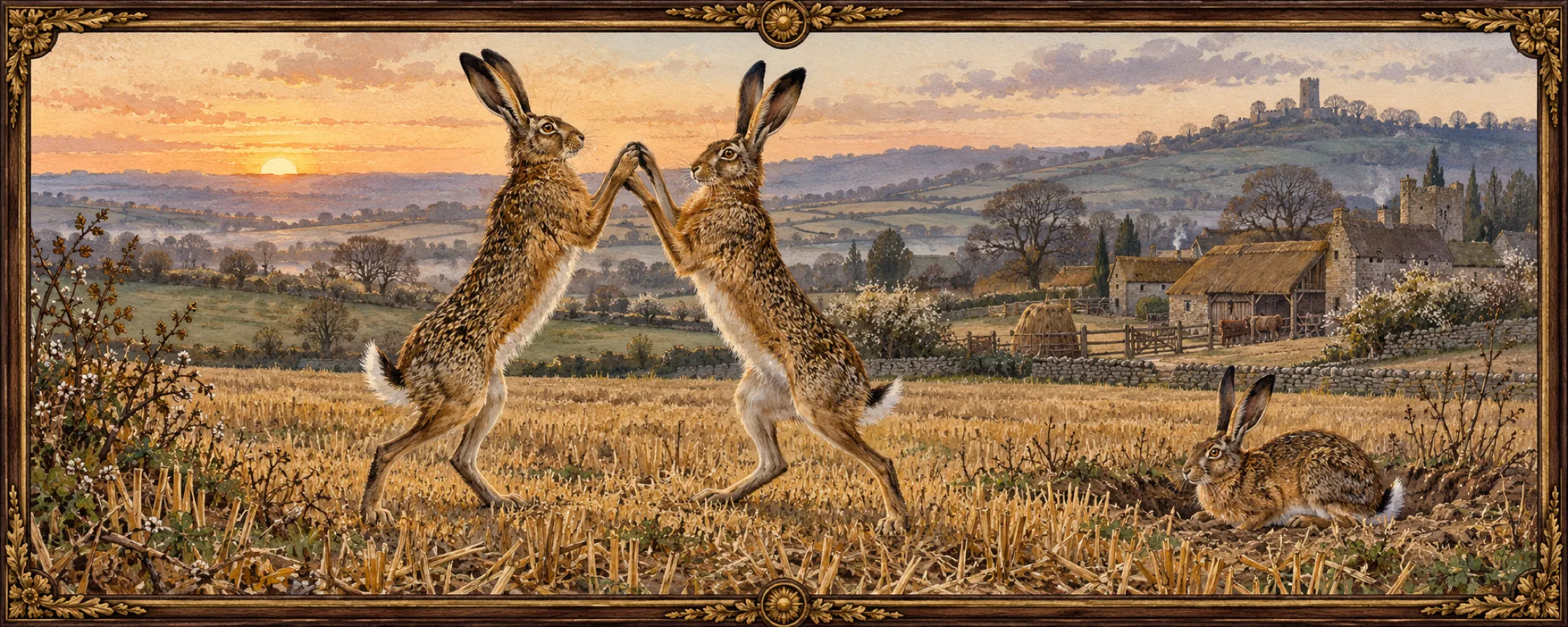
A hare is larger than a rabbit and rangier, as long as a forearm and hand with long, black-tipped ears longer than its head, and very long hind legs. Its coat is tawny brown flecked with black, white on the belly and under the tail, and its large amber eyes are set high on the sides of the head so that it sees nearly all round. In the Headwater heights some hares turn white in winter.
It sits crouched and still in a shallow scrape in the open, its ears flat, and when flushed it is gone in great zigzag bounds faster than any dog but a running hound. It is mostly silent; a caught hare screams like a child.
Habitat and Range
Hares live in open country: the fields and stubbles of the Confluence Basins, the heath and grassed terraces of the Witnessfields, where nobody hunts them, and the terraces and summer slopes of the Headwater Marches.
Behaviour and Temperament
A hare feeds on grass, herbs, and young crops at dusk and by night and lies up in its scrape by day, trusting to stillness and then to speed. It does not burrow. In early spring the hares gather on open fields and the females box off the males, standing up and striking with their forepaws, which is the sight that gives the season its sign.
Life Cycle
A female bears several litters a year, two to four young each, born furred and open-eyed in a scrape and left alone most of the day. Hares are food for foxes, hawks, eagles, and wolves, and few live more than a few years.
Uses and Dangers
Hares give meat and soft fur for linings and mittens. Coursing hares with running hounds is a lord’s sport in the Basins; snaring them is a poor family’s meat, and on a lord’s land it is poaching. They eat young crops and bark in hard winters, but not enough to matter much.
Lore and Belief
Basin Humans tell of witches who cross the fields at night in a hare’s shape, and of a hare shot by a farmer that limped home to become a neighbour with a wounded leg. Meeting a hare on the road at the start of a journey is ill luck; seeing them box is good. Flockturn herders say the hares of the Witnessfields are the fattest anywhere, because no one inside the markers has ever been allowed to eat them.
Poachers who take the Witnessfields hares tell it as a dare: to slip past the markers by moonlight with a net and come back fat.