Well Grouse
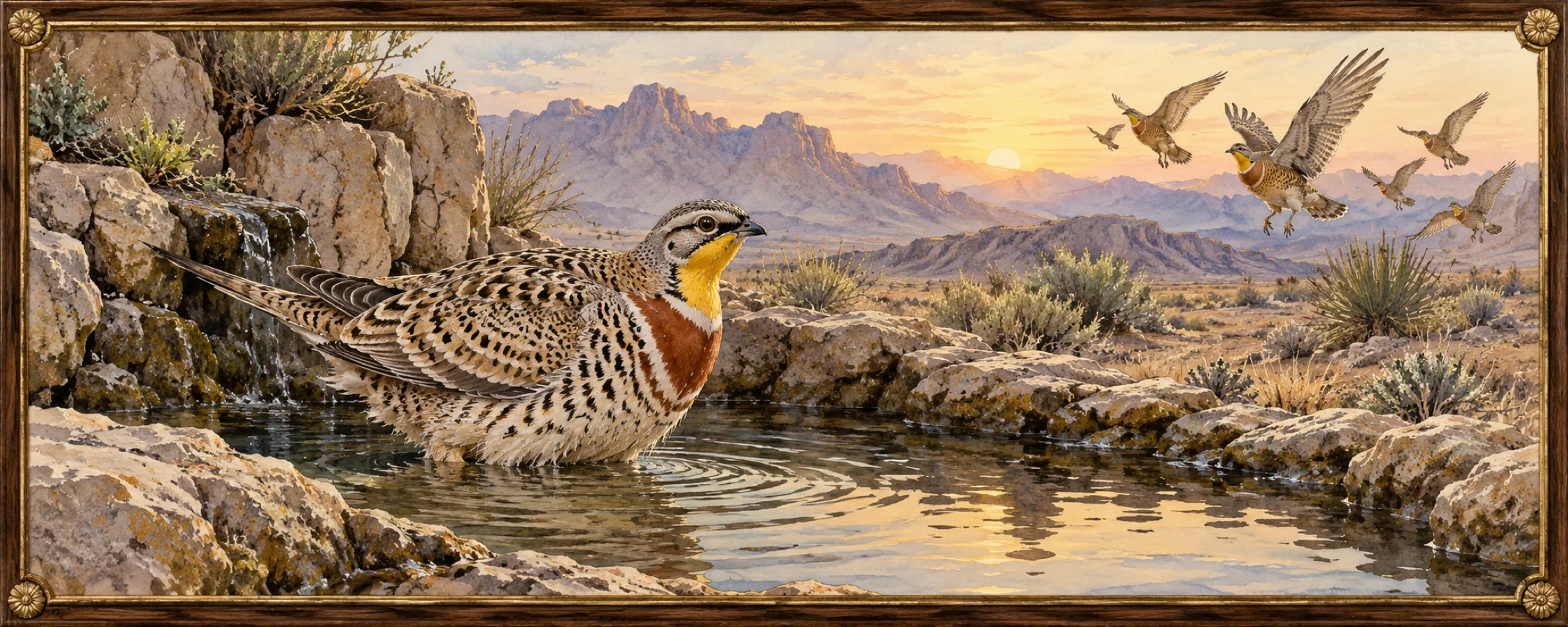
Well grouse are the sand-coloured birds of the desert edges that fly to water every morning at first light, in calling flocks, along the same lines every day. For the crossers of the Glassbelt they are the oldest guide there is to a well no one has marked: watch which way the grouse fly at dawn, and walk that way.
Appearance
A well grouse is the size of a pigeon, plump and short-legged, with a small head, a short bill, long pointed wings, and a long pointed tail. Its plumage is the colour of the desert, sandy buff, finely barred and spotted with brown, black, and white, with a chestnut or black band across the breast and, on the cock, a yellow throat. On the ground it shuffles on its short feathered legs and vanishes against the stones; in the air it is fast and direct. Flocks call as they fly, a liquid, bubbling gattar-gattar that crossers learn to hear before they see the birds.
Habitat and Range
They live on stony desert, the edges of the pans, and the dry rims, in the Glassbelt Interior and across the floors and outer slopes of the Rimward Basins, and feed far from water on seed. They drink once a day and will fly a long way for it.
Behaviour and Temperament
Well grouse spend the day on the ground eating small hard seeds, and the night huddled on open ground. Every morning, soon after first light, they gather and fly to water in flocks of dozens to thousands, drink quickly at the edge, and leave. They are wary of people and quick to fly.
Abilities
The cock’s belly feathers are made to hold water like a sponge. In the breeding season he wades into a pool at dawn, soaks them, and flies back to the nest, sometimes a long morning away, where the chicks drink from his breast.
Life Cycle
The hen lays two or three cryptic eggs in a bare scrape on open ground in spring. Both parents sit, and the chicks run soon after hatching and are fed with water by their father until they can fly. They live a few years.
Uses and Dangers
The grouse are food, netted at wells in large numbers by those who know where their flight lines go. Their real use is the line: a crosser who watches the dawn flight can find a seep, a hidden cistern, or a forgotten well that no marker shows, and many of the crossing’s named waters were first found this way. The birds do no harm.
Lore and Belief
The Kindreds keep the grouse lines in their route memory beside the marks, and an old crosser can say which way the birds fly from any camping ground on the crossing. A water found by following the grouse is not claimed by anyone; the crossers say it belongs to the birds. Orc custodians at the Lastwater Wells say a morning with no grouse at the well means the water is going bad, and they test it before anyone drinks.