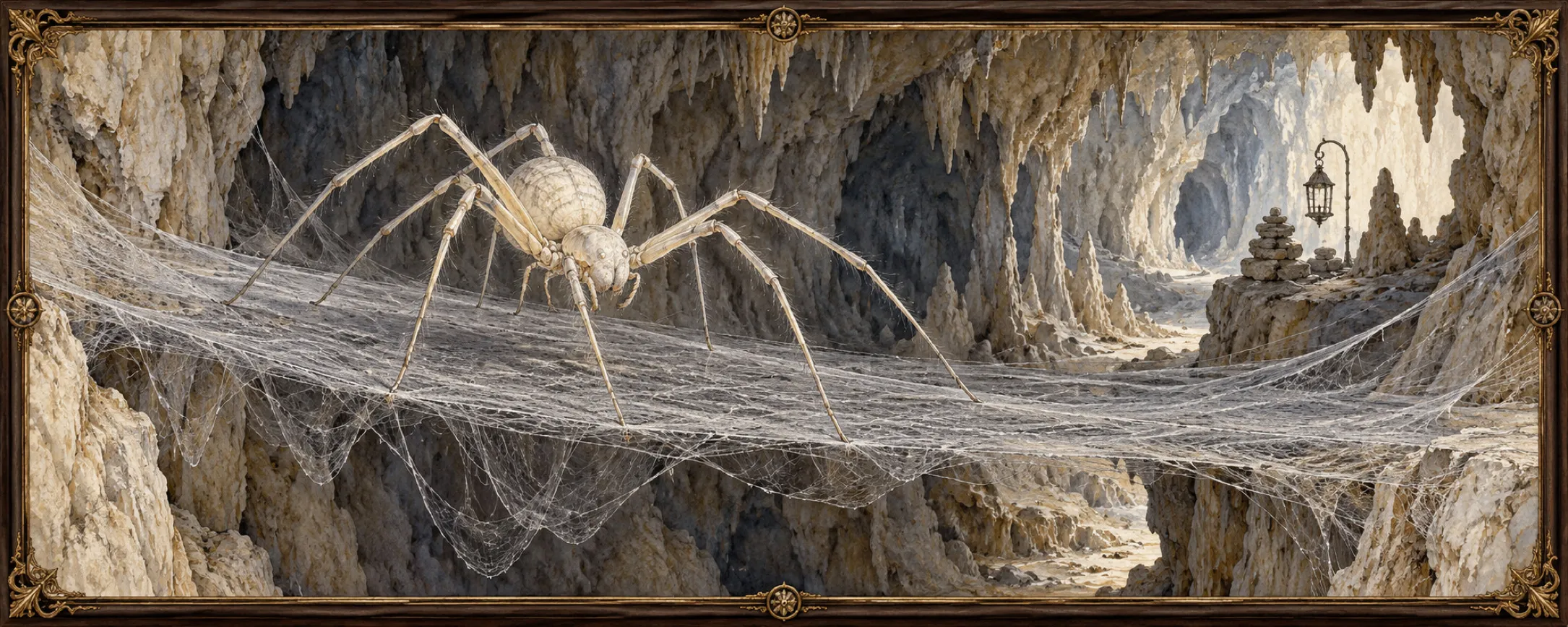
Lampless Spiders
Lampless spiders live in the dark below ground, where nothing walks often enough to break their webs. In the Roothollows their webs are a sign the route keepers trust: a way strung across with them has gone unused, whatever its marks say. Dark Elf keepers read the webs before they read the marks.
Appearance
A lampless spider is pale as a peeled root, white to faint yellowish, with a small round body the size of a fingernail and very long, fine legs that span a hand. It has no eyes, or only faint pale spots where eyes would be. It moves slowly, feeling ahead with its front legs, and hangs still for hours. Its web is a wide sheet of fine, dust-grey silk strung across a passage from wall to wall, low or at head height, with loose threads trailing below it. In lamplight a web looks like a curtain of breath; it has no smell, and the spider makes no sound.
Habitat and Range
They live in the unlit, still, damp passages of the deep: the Roothollows below the living root, the old ways of the Stonewake Deeps, and the culverts and service tunnels under the Broken Marches. They need the air to stay still and the way to stay quiet. A passage walked every day has none; one left a season has a few; one left a year is curtained.
Behaviour and Temperament
They catch the small pale life of the deep: cave crickets, flies that breed on dead root and fungus, and the young of other spiders. They do not hunt people and seldom bite, but a hand pressed onto one, or a face walked into a web, may take a bite before it is shaken off.
Abilities
The bite numbs. The skin around it goes cold and dead for an hour or two, the numbness spreads up a hand or across a cheek, and then it passes, leaving a small red mark. It does not kill, though a Kobold child bitten on the throat may struggle to swallow for a while.
Life Cycle
A female lays a few eggs in a pale silk ball and carries it in her jaws until the young hatch. Spiderlings ride on her back for some days before scattering on threads along the passage. They grow slowly in the cold, and an old lampless spider may be older than the child who finds it.
Uses and Dangers
Their use is the reading. A route keeper of the deep knows that marks can lie, through error, through malice, or because the way changed after they were cut, but a web across a passage means nobody has come through it since the web was spun. A web freshly torn on a way thought unused means someone has been there. Kobold crews in the Deeps read them the same way, and Kobold underhouses in the Marches leave an outer web whole as a tripwire. The danger is small: a numb hand, a fright.
Lore and Belief
Dark Elves call a curtained way a closed mouth and do not break a web on a way struck from the reckoning, since breaking it would be walking it. Children are told that the spiders spin over every way that someone failed to come home by. Dwarves say a lampless spider in a working is a sign the air there is good, since they die in bad air; that is not certain.
Ruin-delvers in the Marches' underlayers take a thick curtain of web across a passage as a warning that no one has walked it for a lifetime, which means there is still something worth taking beyond, and something that kept the last delvers from coming back.