Chapter 1. The Planes
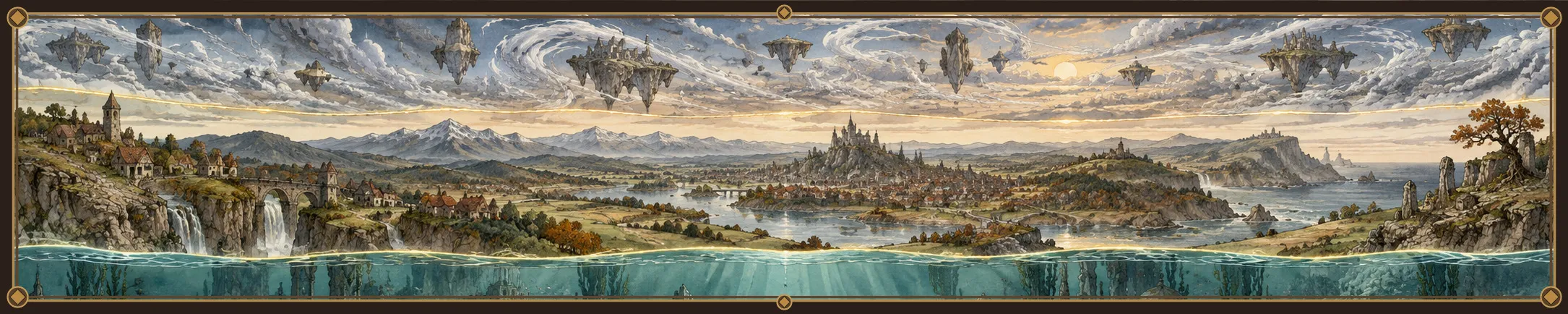
Five that lack and five that drown,
ten that sing behind the sound,
one that keeps the middle true:
there we stand on common ground.
The March-Town Primer
Begin with a bubble. Picture it hanging in a dark that is not darkness, because darkness is a thing and what lies outside is nothing at all. Inside the bubble everything that exists is ordered, and the order has layers. At its heart lies a world of weight and weather, where stone is heavy, water runs downhill, and a person can choose to be kind or cruel. Around that world, like rooms leading off a hall, lie the planes where one condition of life has failed or overflowed: worlds without safety, without warmth, without meaning, and worlds drowning in growth, order, or truth. And behind every one of them, finer than matter, sound the ten Harmonics, the realms of pure concept from which fire takes its heat and speech its power to bind. The cosmos was never made. It has always existed in some state, and one thing more is true of it: existence here is a matter of frequency and interaction before it is a matter of place. Where a thing is matters less than what it resonates with.
This chapter tells the truth of the cosmos, and that truth is hidden. Nobody in the world knows the shape set out here for certain. The few who come nearest, in the highest circles of scholarship, argue among themselves. What the peoples of Caeldon actually know and believe is told at the end, in What People Know.
A Bubble of Order
The cosmos has three tiers. The Anchors are the planes where matter is dense, physics holds steady, and life can live. They are permanent, self-sustaining worlds with their own ecologies and inhabitants, and everything in them has weight, mass, and bulk; cause follows cause in them, though each has its local habits. The Harmonics are not made of matter at all. Each is made of the concept it carries, and a visit to one is less like visiting a country than like stepping inside an idea. The Resonant Zones are the places where a Harmonic presses through into an Anchor and overwrites its law for a while, an hour or an age; they have a chapter of their own, The Resonant Zones. Everything is connected by the Veil, the fluid space between places, and everything is enclosed by the Boundary, beyond which lies the Nothing. Both are told in The Veil and the Outside.
The principle that binds the tiers together is called the Resonance Principle. Much of what mortals think of as ordinary is in truth a resonance: a Harmonic touching an Anchor. Dreams come when the Dreaming Veil resonates with the Material Plane. Lightning comes when the Crucible resonates with the air. A haunting is the Whispering Trace resonating through a place. None of this is magic in the sense a village means by the word. It is how the world works when nobody is working anything at all.
A handful of laws frame everything else, and most of them can be stated in a sentence. The universe always existed; it was not created. Phenomena such as dreams, lightning, and hauntings are resonances. The nature of a plane, whether it lacks or overflows, shapes the behaviour and the morals of those who live in it. The Boundary must hold, for if it fails the cosmos is erased. And only the Material Plane possesses true free will, because every other plane is shaped by the pressure of its own extreme.
The last two of those laws are the ones a writer will feel most. The first means that the cosmos is finite and has an edge, and that the edge is held. The second means that the world where stories happen is the one world where the people in them can truly choose.
How the Layers Came to Be
The layering is old, and it was not designed. It was the outcome of a strain.
The ten Primes, the impersonal forces whose interplay is the cosmos, woke one after another out of its original potential; how and in what order is told in The Ten Primes. The Harmonics formed early, as long-stabilizing mediations that eased the strain between the Primes, and only later became the foundations on which the physical law of the Anchors is built. The field they shaped was at first one sphere, a proto-anchor field: not a set of separate worlds but one continuous expanse of gradients, where absence lay beside excess, rigidity beside flow, and every tendency bled into its neighbours.
Through the long phase called the Great Polarization, that sphere was sharpened from many directions at once. The elemental Harmonics began the sorting: structure against flow, transformation against stasis, motion against fixity. The abstract Harmonics, sharpening later, deepened it: revelation against concealment, law against dissolution, perfected completion against open incompletion, memory against erasure. The cosmos learned its own incompatible possibilities too fully to keep holding them together. By the late polarization, after the last Prime had woken around 34,700,000,000 BR, the sphere was still connected, but its connectedness had become the problem. Too many conditions that could not live side by side were being made to.
The Unformed, the forces that press towards the undoing of form itself, did not cause the crisis, but they gave it its last push. At the Inward Sundering, around 33,600,000,000 BR, the overstrained sphere failed, and it failed inward. It did not burst into neat fragments. The most polarized conditions separated into distinct planes, the Deficit and Surplus Planes, while a balanced residual core remained at the centre. The reorganizing force released in that moment helped the Primes push the Unformed back far enough for reality to endure in its altered form. The cosmos survived its first catastrophe not by preserving what it had been, but by becoming something else.
The new extremes settled quickly, because their identities were narrow: a plane that is only hunger, or only order, has little to reconcile. The core settled with great slowness, because it had to remain mixed without becoming incoherent. Through the Long Settlement of the Balanced Core, from the Sundering to around 12,000,000 BR, pockets of stability formed in it, failed, and formed again. Space became dependable only by degrees. Then, at the First Equilibrium, around 12,000,000 BR, reciprocal balance became durable enough that no single Harmonic pressure could seize the whole core for long, spatial law held everywhere and not just in pockets, and cause and persistence held at large scale without constant correction. The core had become a true Material Plane, and only then could planets, seas, and skies condense in it. Caeldon came long after.
This is the deepest reason for the shape of everything else. The Material Plane is not simply the middle of the cosmos. It is a balance that was won, over a span of time so long that it dwarfs every history in this book, and it is held by tension made reciprocal rather than by tension removed.
The Equilibrium
The Material Plane is the central Anchor, also called the Equilibrium. Its gift is balance. Its resources are limited but renewable: there is enough food, water, and fuel to sustain life, but not so much that growth runs out of control. Danger exists but is not everywhere; predators, storms, and wars come, and so do years of peace. Truth can be found but is not forced on anyone; secrets can be kept and lies uncovered. Connection is possible and solitude is allowed.
Its landscapes contain every kind found on the other Anchors, but moderated. Its forests are lush and green without the suffocation of the Verdant Expanse. Its mountains are hard and high without the frozen stillness of the Frost-Bound. Its deserts are harsh without being empty of all life, its cities ordered without being caged, its ruins old and strange without being meaningless. Its sounds mix wind and water and animals with speech and work, and its silences are not oppressive. Its smells are earth and rain, food and decay. Its light plays naturally across a full range of colour, and its shadows fall where shadows ought to.
Its physics are the baseline against which every other plane is measured. Energy is conserved: it cannot be made from nothing, only moved or changed, and magic obeys the same law, drawing on outside sources or spending what a body holds. Time runs forward at a steady rate; a Resonant Zone may slow it or loop it locally, but the plane’s own flow is constant. Cause follows cause reliably, though not always in proportion. And things drift towards disorder unless life and labour hold them back. Nothing here stays as it is. Seasons turn, landscapes shift, peoples rise and fall, and that ceaseless change comes from the Shifting Path, the Harmonic of possibility, which keeps any state from becoming permanent.
The Material Plane is also, uniquely, resistant to extreme resonance. Fire worked here behaves as fire; it does not freeze, as it can on the Frost-Bound, or drain away, as on the Ashen Wastes. Words bind here, but not with the absolute force they have in the Gilded Cage, nor do they vanish as they do in the Silence. A mage can rely on a working on the Material Plane in a way no mage can rely on it anywhere else.
The Plane Where Choice Is Real
That balance is why free will lives here and nowhere else. On the planes of lack, behaviour is dictated by survival; on the planes of excess, by saturation. Only on the Material Plane can a being choose between cruelty and kindness, generosity and greed, honesty and deceit, without the world making the choice first. It is the one world where the question "what will they do?" has no answer until they do it.
Mortals are the observers through whom the interplay of the Primes takes clear shape. They choose whom to worship, what to believe, and how to shape the world, and an alignment freely chosen is a deeper and steadier resonance than the instinctual resonance of the extreme planes, where a being resonates with its plane’s condition because it cannot do otherwise. The Material Plane does not create the Primes and is not their source. It is the mirror in which their interplay finds its most balanced expression, and the fulcrum on which the cosmos rests: it holds the tension between the planes of lack and the planes of excess and keeps either from pulling everything further towards its own extreme. Losing it now would tip the universe towards entropy on one side or frozen perfection on the other. It is, in the old phrase, the only place where life can truly live.
Its peoples show what that freedom does with a world. Rule is held by whoever is strong enough to hold it, from clan and hold elders to lords, kings, temple households, and the ruling houses of cities, and it rests on custom, oath, kinship, and force. Livelihoods rest on trade, farming, making, and what can be dug or taken. Faiths mix many gods, city cults, philosophies, and narrower devotions. And the plane sustains a broader diversity of durable mortal bodies and ways of life than any other, because its conditions are balanced enough that no single answer to them is forced on every people.
The Hub and the Thin Places
The Material Plane is the hub of the Veil. Nearly every journey between two other Anchors passes through it; direct travel between two of the extreme planes is rare and dangerous, and needs a powerful artefact attuned to both, a natural thin spot where their borders touch, or the help of a being native to the Veil. So beings of every tier can be found on Material soil. It is a crossroads for travellers from other planes, a sanctuary for exiles fleeing the extremes for its balance, and a battleground where rival powers from different tiers carry their quarrels onto ground that belongs to none of them.
The Veil is thinnest here, and thinnest of all where a place already leans towards another plane. Battlefields and places of great violence lean towards the Scourge. Dead ground, abandoned mines, and places of cold decay lean towards the Ashen Wastes. Deserts, drought-struck land, and dried-up wells lean towards the Parched. Glaciers, winter peaks, and deep caves lean towards the Frost-Bound. Abandoned libraries, ruins, and places of deep meditation lean towards the Silence. On the other side, ancient forests and overgrown ruins lean towards the Verdant Expanse; judgement halls, counting-houses, strongrooms, and rigidly ordered towns towards the Gilded Cage; oracle sites, mirrors, and places of judgement towards the Radiance; temples, gathering places, and the rites where a community comes together, weddings and funerals above all, towards the Weave; and perfect gardens and places of absolute clarity towards the Apex.
Sometimes the leaning shows. Planar bleed is the name for what comes through: a sudden frost in high summer, a burst of fire nobody lit, a creature that belongs to no country of this world. The beasts and wanderers that come through are the monsters of half the songs on Caeldon. To the people who live on the hub, it means that the strange comes to them: a thing from the Scourge loose in a hill pass, a cold blue fire in an old mine, a shrine path where the fog does not lift and travellers walk in and come out a year later. Most never see one; every region has a tale of someone who did. Shrines and settlements grow up beside thin spots all the same, what little traffic there is with other planes passes through them, and they live with the bleed as river towns live with floods. Long living beside such a place has its own cost. Prolonged exposure to one Harmonic or one extreme plane, near a zone of the Crucible or a thin spot to the Scourge, can warp both the land and the minds of those who stay: this is the pull of the extremes. And though magic is reliable on the Material Plane, heavy use of it can draw attention from other planes or unsettle the Resonant Zones nearby. The sensible traveller’s rule, as the schools put it, is to respect the balance, take nothing to the point of exhaustion, and be wary of any place that feels wrong, or too perfect.
The Planes of Lack
The five Deficit Planes are worlds shaped by absence. Each is stable and physically real, but in each one vital condition is missing, and missing enough to reshape every ecology, custom, and habit of survival in it. The shortage is not weather. It is the plane’s law, a permanent bottleneck around which everything has grown.
Material Plane cultures often call them hells, and the name is a mistake. Their peoples are not evil. They are adapted to scarcity that never ends, and they tend to share the same hard habits: firm limits on trust, careful use of every resource, survival worked into ritual, and morals shaped by necessity rather than plenty. Their communities survive by pushing their costs outward, through conquest, extraction, exclusion, or strict rationing, and compassion exists among them, but usually as a luxury. Small mistakes kill quickly on these planes, so they reward reliability over experiment, and the short term over the long. The further a traveller goes from the Material balance, the less forgiving recovery becomes. What comes through from them is what Material Plane peoples remember: the starved hunters loosed from a battlefield thin place, the cold things that creep out of abandoned mines, the thirst that walks out of a dried-up well.
The five lie on a gradient of deprivation, and the schools rank them by the kind of harm they do. The Scourge is the most active: violence is constant there, but at least there is motion and struggle. The Ashen Wastes are the most depleted, a world in which energy itself is dying. The Parched is the most visceral, its thirst immediate and overwhelming. The Frost-Bound is the most still, a cold that preserves but forbids all growth. The Silence is the most existential, because it attacks not the body but the mind and the self. Where two of them meet, the deprivations stack, and their borders are harsh: between the Scourge and the Parched a violent badland of drought where predators from both planes raid for what little there is; between the Ashen Wastes and the Frost-Bound a deep gradient where heat and every recoverable spark collapse together; between the Frost-Bound and the Silence an extreme stillness where a body may go on surviving while the mind inside it stops.
The Scourge
The Scourge is the plane without safety. Every moment there is a possible death, and every meeting a calculation of threat against reward. Its colours are crimson, rust, charcoal, and the bruised purple of a sky choked with smoke; its light is either blinding or absent, never soft. Its mountains are sharp as knives, its valleys full of the wreckage of old wars, its forests twisted thickets of thorn, its rivers red with silt and blood. It is never quiet. Steel clashes, beasts roar, the wind howls through broken walls, and a silence there is usually a trap.
Its physics serve its pressure. Force is amplified, so that a blow lands harder and a fall breaks more bones. Buildings, bridges, and walls are unstable and come down under strain, so that most dwellings are temporary or carried. Violence draws predators, natural and otherwise, and peaceful gatherings are all but impossible, as if the air itself incited aggression. Gear wears out with frightening speed: metal rusts in days, leather cracks in hours, wood splinters.
Its people, the Scourge-Born, are muscular and scarred, thick-skinned, with eyes often of two colours or faintly glowing, made for catching movement in chaos. They heal fast and feel little pain, because pain is a distraction they cannot afford. Their societies are built on strength: a leader is whoever can defeat every challenger, alliances last as long as they profit both sides, and betrayal is expected rather than resented. To them, killing a wounded enemy is wisdom, not cruelty. Their beasts are made for the same world: pack-hunting Blood-Hounds, armoured Iron-Claws whose jaws crush stone, and Murk-Fangs that strike unseen from darkness. On the Scourge a single undamaged sword can buy a kingdom, and the rare pockets of safety are held by whichever warlord can hold them. Those who stay too long risk the Blood-Fury, a rage that turns them on friend and foe alike until they drop.
It is reached from the Material Plane through what travellers call War-Gates: battlefields where the Veil has worn thin, and the ruins of great conflicts. Crossing its Veil is like passing through a storm of blades, and what the crossing takes from the mind is the knowledge of whom to trust. Mortals who follow the fire of Ignis or the restless motion of Zephyr, the two currents that drive the plane, call it a necessary crucible: in their telling it is the engine of change, the pressure without which life would stagnate. Sellsword companies tell it otherwise. They speak of a field where the fighting never quite ended and the dead were replaced each dawn by something hungrier, and of sellswords who crossed for the arms of ancient wars and came home berserk. The songs remember those who came back whole, because there are so few of them.
The Ashen Wastes
The Ashen Wastes are the plane without energy. Energy there is not merely scarce; it is actively dying. The colours are grey, muted brown, and dull black, and nowhere is there anything bright. The sky is a perpetual dusk under a dim sun that gives no warmth, shadows seem to swallow light, the plains are grey ash and cracked earth, the mountains have worn down to skeletons, and the rivers creep with something thick as sludge. Sound loses its strength so fast that a scream arrives as a whisper and thunder as a dull thud. Wood snaps like dry bone and metal grows brittle enough to shatter. The air smells of old dust and burnt wood, and of something travellers can only call nothing.
Heat drains away within moments of being made, whether from a fire, a body, or friction, and keeping warm is constant, exhausting work. A thrown stone slows almost as soon as it leaves the hand. Digestion and burning crawl or fail, so that food gives little strength and fuel burns poorly. Time feels slower there, and yet bodies age faster, worn down by the labour of simply going on.
Its people, the Ash-Walkers, are tall and emaciated, with grey skin like cracked porcelain and large dark eyes made for the gloom. They move slowly to save strength and fall into torpor for days instead of sleeping. They are preservationists before they are anything else. Any source of warmth, a warm stone, a single spark, is hoarded with religious fervour, and waste is the gravest sin they know. They are not aggressive by nature, but they will kill at once for heat or fuel, and they look on the Material Plane as a wasteful paradise where energy is squandered without a thought. Cold-Stalkers, wolf-like hunters that track the slightest difference in warmth, and insect-like Dust-Striders that strain energy out of the air and leave a colder trail behind them, are its common beasts. A hot stone or a warm core can be traded there for years of survival, and those who stay too long suffer the Freeze, cooling until they stand as statues of ice and ash. Travellers carry bells or drums only to hear something.
Its Cold Gates on the Material Plane are volcanic vents gone cold and deep caves. Its Veil is thick and sluggish, like wading through cold syrup, and travellers often forget why they came. The Wastes are the sink of the universe: when energy is spent on the Material Plane, the waste heat dissipates, and in the long cycle of the cosmos it drains here, along the pull of Umbra and Terra, the two currents that run strongest in the plane. Without that sink the universe would overheat. It is a necessary place, and a place of sorrow. Most who go there come for the cold-forged objects it yields, or to hide from those who would burn them, and few stay. On Caeldon its tales come from abandoned mines and dead ground where the cold sets in out of season: the miners found standing grey and frozen at the face, the lamp that went out and would not relight. Delvers who bring back cold-forged blades are paid well and asked few questions.
The Parched
The Parched is the plane without sustenance, a world where water, food, and anything that nourishes are absent, and where every living thing is driven by a single instinct: find something to consume before something consumes you. Its colours are burnt ochre, pale sand, cracked clay, and bleached bone. Its sky is a hazy yellow thick with dust that never settles, and its sun a bloated pale disc that hangs unmoving, giving light without growth. Deserts and cracked mud flats run to every horizon, cut by canyons carved by rivers that no longer exist, and the skeletons of enormous creatures lie picked clean. There is no rain, no river, no lake; what moisture there is lies deep in the rock. The wind sounds like sand rasped over stone, and nothing anywhere sounds like water.
Liquid flies from the world there. A bowl of water boils away in minutes and spilled blood dries to powder in moments. The ground drinks with unnatural thirst, so that a spilled cup is gone before it can pool, and even sealed vessels slowly lose what they hold. A living body burns through its own fat and muscle at a frightening rate. The dry air builds charge until sandstorms throw lightning.
Its people, the Dust-Eaters, are gaunt and leathery, sharp-featured, with small dark eyes and wide, toothed mouths. Glands in their throats draw trace moisture out of rock, sand, and air, and they can digest almost anything once alive, bone and dried sinew included. To them every exchange is a negotiation over resources and trust is a luxury; strangers are competitors or prey, they will trade when it pays and kill for a waterskin when it pays better, and charity is a concept they do not have. Dust-Wyrms swim through loose sand, sensing footfalls above them; swarms of Bleed-Beetles drain moisture from anything living; Bone-Walkers defend a carcass to the death. A flask of clean water buys loyalty, weapons, or lives. The plane is rich in rare salts and crystals prized for alchemy and enchantment, and mirages lead travellers in circles until they fall. Those who stay too long fall prey to the Thirst-Madness, until they would drink a companion’s blood.
Its Dry Gates are abandoned wells that go down too far and desert oases that are thin spots in disguise. Its Veil is dry and abrasive, like being buried alive in sand, and memories dry out on the crossing and crumble. It is the hunger of the universe, the plain truth that existence requires consumption. Here Aqua’s current runs dry and Umbra’s endings close in. Prospectors come for its minerals, hunters for its beasts, and the desperate for the Dry Wells, ruins said to hold things from before the scarcity, and fewer leave than come. Desert peoples know it as the land behind the dry well: the caravan that camped by a dead spring and was gone by morning, its camels found drained, and the delvers who went looking for the Dry Wells and came back mad with thirst or not at all. The minerals they do bring out sell for their weight in gold.
The Frost-Bound
The Frost-Bound is the plane without warmth, and it differs from the Ashen Wastes as stillness differs from decay. The Wastes are a world running down; the Frost-Bound is a world held. Its cold is not a temperature but a force that resists change, preserving everything it touches, turning the living to statues of ice and trapping memories in crystal. Its colours are stark white, deep blue, and translucent grey under a pale, frozen azure sky full of snow that never melts. It has no sun, only a faint, distant glow that lights without warming. Glaciers, ice spires, and frozen seas run on forever, and its waterfalls hang frozen mid-fall. Breath turns to ice fog at once and skin freezes to metal in moments. Sound carries faster and clearer in that air, but brittle, so that a snapped twig rings out like a crack of a whip and the wind howls with a metallic edge. It smells clean, sharp, and sterile, and of nothing that ever grew or rotted.
Heat there does not escape; it is trapped. A fire lit on the Frost-Bound burns with a blue flame that eats the air but throws no warmth, its heat locked inside it. Every material grows brittle, so that a blow shatters instead of denting, and a sword stroke may break the blade. The cold air thickens until running feels like wading. And nothing decays: bodies, wounds, and anything once written down are kept exactly as they were.
Its people, the Frost-Born, are tall and slender, with translucent skin showing blue veins and eyes of solid white or silver. They make warmth slowly, can go weeks without food in a hibernating sleep, and dress in the hides of ice-beasts. They are solitary and stoic by conviction: they believe that closeness leads to weakness and to the loss of heat, so they speak rarely, since speech spends warmth, and prize endurance, silence, and the keeping of the self. They are not aggressive unless provoked, but they look on strangers as heat thieves, and they are master hunters of the ice. Pack-hunting Frost-Wolves, blind Glacier-Drakes that burrow through the ice and sense heat, and crystalline Ice-Shards that wake when disturbed and attack anything warm share the plane with them. Its most valuable things are heat sources and insulation, and objects from the Material Plane that the cold has caught and kept perfectly. Its worst danger is the same Freeze that waits in the Wastes, with a cruelty of its own: those it takes stand as statues of ice, still aware within.
Its Ice Gates are glaciers that melt open into the Veil and frozen lakes. Its Veil is crystalline and sharp, like walking through a field of glass, and what the crossing does to memory is not to erase it but to freeze it in place where it cannot be reached. The Frost-Bound is the cold store of the universe. Umbra’s trace and Terra’s permanence shape it, and it freezes in place whatever its cold catches, memories, histories, and Echoes alike: kept, but locked away, waiting to be thawed. That keeping is partial and local; the deep retention of what is remembered belongs to the Eternal Record. Travellers go to the Frost-Bound to recover lost memories, to lay up dangerous objects where nothing will ever change them, and to seek what they call the Eternal Sleep. Few return unchanged. Glacier and winter-peak peoples tell of travellers who walked into a white cave and were found a lifetime later, unaged and frozen with their eyes open, and of ice-statues in the high passes that some say are still awake. Shrine-keepers there will not light a fire near a thin place.
The Silence
The Silence is the plane without meaning, and the cruellest of the five, because what it takes is not warmth or water but the self. Where meaning fails, something plainer fails first, and which thing depends on where the traveller stands: sound at one edge of the plane, speech at another, memory or motion at others. These are faces of the one absence, not separate absences.
Colours drain from things while one watches, leaving them faded grey and washed-out white. The light comes from no direction and casts no shadows. Flat plains of smooth, featureless stone run on without mountains, trees, or rivers, and where there are structures they are geometric shapes that serve no purpose and bear no names. The air is still and heavy, as though holding its breath, and the quiet is not the quiet of a library but the absence of sound itself, a pressure on the ears. Touch gives no texture and no temperature. Food has no taste. Thoughts slide away when one tries to hold them, and memories fade within minutes of being made.
Its law is decay of meaning. Spoken words are only noise and written ones fade from the page, so that nothing can be shared. An act done without a clear and present purpose loses its effect: a sword stroke may fail to cut if the mind behind it is not fixed on what the cut means, and a rock may not move for a push made without enough intent. Travellers forget why they came, who they are, and at last their own names within hours.
Its natives, the Hollows, are pale and gaunt, with blank faces and milky eyes, moving in jerks when anything moves them at all. They do not speak, eat, or truly sleep. They have no society, no rank, and no shared purpose; each is an island of awareness slowly dissolving, and they neither attack unless provoked nor defend themselves. Beside them drift the Unspoken, beings that have lost their names: Fragment-Speakers, former travellers who repeat scraps of conversations they no longer understand; Void-Stalkers that feed on whatever meaning is left in a traveller’s mind; and the Wordless, which have no form at all, only a presence that drains the will to exist. A Hollow’s emptiness is contagious, and the plane’s slow process of erasure is called the Fade: memories go, then personality, then the will to live, until the traveller is a Hollow too.
What is valuable there is whatever holds the self together: a keepsake, a remembered saying, a ritual repeated, a rare moment of clarity, and simple tools that work without anyone meaning them to. Visitors are told to write their names and purposes down often, and to say them over to themselves. The Quiet Gates are libraries where nobody reads any more, places of abandonment, and places of deep meditation. Its Veil is a white noise that feels like being erased, and the crossing can take the memory of ever having left home. The Silence is the graveyard of meaning: when a story ends, a name is lost, or a memory fades, whatever of it is not held in the Eternal Record may drift here and come apart. Verba’s meaning unravels in it and Umbra’s endings settle. Those who go there seek lost memories, an escape from the world’s noise, or what they call the Final Quiet, and the few who return rarely remember why they went. Its tales on Caeldon come from abandoned libraries and dead ruins: the scholar found sitting at a blank page with nothing behind his eyes, the hermit who went seeking the Final Quiet and was found by kin he could no longer know. Ruin-delvers fear a ruin where no echo answers.
The Planes of Too Much
The five Surplus Planes are worlds shaped by excess. Each is stable and physical, but one vital condition saturates it so completely that agency, privacy, and variety come under pressure. Their residents cannot opt out of the plane’s condition. They manage it.
Material Plane cultures call them heavens, and that name is as wrong as the other. Their peoples are not good; they are adapted to overflow, and their virtues are paid for in individuality, freedom, or growth. Surplus cultures gain stability by reducing difference, and the cost is usually ambiguity, dissent, or the self. They put the many before the one, follow rules and rites gladly and to the letter, fear anything new or sudden, and build their morals around stillness and a life where nothing is hidden. Because their worlds already run near the limit of what they can express, change is expensive there, and tends to come by sudden release of pressure rather than by gradual reform.
They too lie on a gradient. The Verdant Expanse is the most vital: life overflows, and the individual is consumed. The Gilded Cage is the most structured: safety is guaranteed, and freedom forfeit. The Radiance is the most revealing: truth is absolute, and privacy impossible. The Weave is the most connected: empathy is perfect, and the self dissolves. The Apex is the most complete: perfection is reached, and nothing can ever change again. Their borders blend rather than grind. Where the Verdant Expanse meets the Weave, the network of life and the network of minds merge into a single pulsing organism. Between the Gilded Cage and the Apex, order imposed from outside becomes perfection that needs no imposing. Where the Radiance meets the Weave, full exposure merges with shared feeling until no private interior is left. Such borders, travellers say, feel like paradise on arrival and like a prison after a while. The danger the Surplus Planes pose to Caeldon is gentler than the hells' and worse: the traveller who came home from a heaven and pined to death for it, the garden that crept out of a thin place and swallowed a village whole.
The Verdant Expanse
The Verdant Expanse is the plane where life reproduces faster than anything can contain it. Nothing there is still; everything grows, spreads, consumes, and merges, and nothing knows the word enough. A seed can become a forest in an hour. Its colours are saturated greens and yellows, deep purples and vivid pinks so intense they seem to pulse, and the only brown is rich living soil. The light comes dappled and shifting through canopy that grows over the sun. Trees twist into spirals, roots form bridges, flowers bloom and wither in moments, and moss swallows the sound of a footstep. Its rivers are thick with growth and bright with glowing plankton. The air is humid and heavy with pollen and spores, and smells of rotting fruit, nectar, and wet earth so strongly it can turn the stomach. Insects buzz, birds scream, leaves rustle, sap oozes, and the chorus never stops. Even thought feels crowded there, hummed over by the sheer volume of life.
Everything living runs fast. A wound heals in moments and a meal is gone in minutes, and hunger and exhaustion come as quickly. Space itself is fluid: a short path stretches as vines grow across it, and a room widens as its walls sprout. The dead are composted within hours, and even metal and stone are slowly overgrown and eaten by lichen and fungus. Plants and animals are loosely linked through a root-network, so that harm to one part of the land is felt by the whole.
Its people, the Verdant, are tall and supple, with skin like bark, leaves, or moss and hair of vine and flower. They draw strength from sunlight and soil, rest by blooming rather than sleeping, and regrow a lost limb in hours. To them the self is a passing state, a node in a greater network; decisions are made together, and possession means nothing, because everything belongs to the Expanse. They are gentle and overwhelming. A Verdant will embrace a stranger until the stranger is buried in vines, and they cannot understand privacy or personal space; outsiders seem to them isolated and starving. Some of the plane’s creatures are its own guardians, Tree-Men rooted into forests, their arms become branches; others are its hunters, Flower-Stalkers that lure prey by mimicking blossoms, and Spore-Clouds that take hold of a host and make it spread seed.
The Expanse can cure almost any injury or illness, its fruit and nectar are everywhere and rich, and its living wood is stronger than steel. Its dangers are the same abundance: growth that can bury a traveller in minutes, carnivorous plants that count visitors as manure, and a slow merging with the network until a traveller forgets their own name. Visitors are told to move fast, touch nothing, and cut any root they feel closing on them, and not to bring food, because it will sprout. Its Seed-Gates are ancient forests, overgrown ruins, and places of sudden growth; its Veil is a tangle of roots pulling a traveller in a thousand directions, and the past there is not erased but overgrown. It is the engine of creation, where Aqua’s lifeforce and Ignis’s energy pour through at full strength: without it the universe would be a sterile rock, and unbalanced it would grow over the whole cosmos. Herbalists come for its plants and the dying for its healing. Hardly anyone comes back wholly themselves, and many carry a piece of the Expanse growing inside them. Forest peoples tell of thin places where the green breaks through: the herb-hunter who went in for a root that cures everything and came out with leaves under his skin, the overgrown ruin that was a village a summer ago. Healers pay well for what the brave carry out.
The Gilded Cage
The Gilded Cage is the plane of absolute order, where freedom is the only crime. Every action has a prescribed path, every object a designated place, and every being a fixed role. Chaos there is not merely dangerous; it is impossible. Its colours are polished gold, pristine white, and slate grey, and every surface is clean, reflective, and symmetrical, without dirt, rust, or decay. Its light comes from sources set into ground and sky, so that there are no shadows, and day and night are kept by clocks rather than by any sun. Its cities are grids of perfectly straight streets lined with identical buildings stacked to measure; its trees are trimmed into cubes and spheres. The air is still and scentless and the temperature never changes. Clocks tick, feet march, gears shift, and speech is measured and polite. Even thought runs in straight lines there, and an unruly idea feels like a wrong note in a song.
Its physics enforce its order. Every object and being must keep to its line: stepping off a prescribed path feels like walking uphill. There is no luck and no chance; a dropped cup breaks exactly as it must, without miracle or accident. Time is cut into exact units and ageing is paused or regulated. And whatever breaks the rules is corrected. A leaning wall slowly straightens itself, and a person who acts out of turn may feel their limbs begin to stiffen.
Its people, the Gilded, have skin like polished metal or porcelain and symmetrical, unchanging features. They wear identical uniforms distinguished only by rank, need tending rather than food or sleep, oil, polish, and adjustment, and feel pain only when they break a rule. Their society is protocol: rank depends on how well one keeps the rules, and deviance is punished by being set right again. They are polite, efficient, and without feeling; they do not joke, argue, or make any art that has not been approved, and they see visitors as unstable and dangerous. Their Enforcers patrol the streets, tall armoured figures with batons that pulse with order, and they do not kill; they reset. Tireless clockwork guards obey without question. In the public squares stand Rule-Breakers, former inhabitants turned into statues as warnings, and for the worst offences there is the Golden Touch, which turns the violator into a statue of gold.
The Cage offers what no other plane can: nothing breaks, nothing fails, and there is no crime, war, or disease. Its instruments are perfectly accurate, its vaults perfectly safe, and its judgements final, and visitors come to store valuables, seek a judgement no lord can buy or overturn, or escape the chaos of the Material Plane. The cost is the will. Inhabitants slowly lose the ability to choose for themselves, visitors feel their own invention draining away, and leaving can be physically blocked by walls nobody can see. The way out, travellers say, is the Exit Protocol, followed exactly and without improvisation. Its Gateways of Law on the Material Plane are judgement halls, counting-houses, strongrooms, and places where rules are kept to the letter, and its Veil is a maze of corridors that must be walked in a fixed sequence, where a wrong turn leads back to the start. It is a containment field held by Terra and Verba: the order without which no civilization could exist, and an order that, spread too far, would set all life fast in its rigidity. Few return with their creativity intact. Material Plane peoples tell of strongrooms where a door opens on endless golden halls, of thieves who broke into a vault and never left it, and of the gold statue in an old hall that was once, the tale says, a man who broke an oath sworn there.
The Radiance
The Radiance is the plane where truth is absolute and privacy impossible. Light and knowledge fill it to saturation; nothing there can be hidden, lied about, or misunderstood, and to enter it is to be stripped of every mask, deception, and illusion. Its colours are blinding white, gold, and shifting iridescence. Light pours from the ground, the air, and the beings themselves, so that nothing casts a shadow, and to look towards its source hurts. It is a country of crystalline plains and glass towers where walls do not exist and every barrier is a field of light. The air shimmers and feels charged, like the moment before lightning, and smells of rain on dry earth and burning incense. Its sound is a chorus of everything being said at once, not a din but a hum, in which lies sound like a screech and truths like pure tones.
Its law is transparency. Cloaks, masks, and walls turn clear, and secrets show as distortions in the light. Intentions are visible as auras: malice as a dark, jagged warping, kindness as a soft warm glow, and deceit as an aura that flickers and shrieks. Thoughts out of keeping with what is real cause pain, so that a liar’s throat burns and a hypocrite’s skin blisters. There is no behind; every angle is seen. Touching another person feels like touching their Pattern, their intentions and feelings felt as physical sensations, and a visitor cannot even lie to themselves.
Its people, the Illuminated, glow from within, their features sharp and clear without softness, their eyes pools of light. They do not sleep, since a mind with no secrets needs no rest from them, and they live on light and truth. They practise radical honesty: no diplomacy, no politics, no courtesies. If they dislike someone they say so; if they love someone they show it; a conflict is settled at once by facing it. Outsiders find them blunt to the point of cruelty, and they in turn think outsiders sick, because outsiders hide. Around them move the Revealed: those the Light shattered, liars who could not bear the exposure and whose minds broke, now wandering as glowing husks; the Confessors, who shed every secret of their own will to join the Illuminated and are serene but no longer individual; and the Truth-Seekers, which hunt the dark spots of liars to consume what they hide.
The Radiance can cure madness or delusion with clarity, and agreements spoken there are unbreakable because they are spoken in absolute truth. Its dangers are exposure: shames and hidden desires dragged into the light, the burning that every lie brings, and the end of every art that needs mystery, so that a love poem there is a statement of fact. Its Oracle Gates are places of judgement, places of confession, and mirrors, and crossing its Veil is an interrogation by a thousand voices in which the traveller remembers every shameful moment of their life. It is the judge of the universe, the reason nothing can be hidden forever; mortals who follow Lux and Verba treat it as the corrective that keeps the cosmos from sinking into total deception. To anyone who lives by secrets it is a place of terror. Hardly anyone’s pride survives the visit, and many come home understanding themselves painfully well. On Caeldon it shows itself at oracle sites and old mirrors. Songs tell of the queen who looked into the bright glass and could not stop confessing, and of the oracle’s light that hunted traitors for the lords who kept it. Liars will not stand near such a place.
The Weave
The Weave is the plane where separation is impossible. Every mind and every Pattern is linked in one continuous network, and "I" has become "we". Privacy does not exist there, not because secrets are revealed, as in the Radiance, but because there are no private thoughts to keep. Its colours are shifting iridescence, soft pastels, and translucent blues that flow into one another like oil on water, with no hard edges. Light comes from the beings themselves, and nothing casts a shadow because nothing there is solid enough to block light. Floating islands are joined by bridges of light, structures are grown or woven from strands of energy, and the ground gives underfoot like a stretched hide, rising and falling with the shared mood. The air thrums low and warm like a blanket and smells of rain and clean linen. Its sound is millions of voices speaking as one, not a din but a single complex chord, and silence there is impossible: even a thought ripples it.
Pain, pleasure, and feeling are shared: when one is hurt, all feel a fraction of it, and when one is glad, all are. Movement is shared too, so that the group moves as one body. A question asked by one is answered by all at once. Touch is felt by everyone near, and proximity is enough for speech.
Its people, the Linked, have skin like a mirror that shows the faces around them and wide, deep eyes full of the collective’s feeling. They do not eat or sleep alone, drawing strength from the network, and they know neither loneliness nor fear, which are thinned to nothing among so many. They have no family, nation, or class, only the Weave, and they decide by a consensus reached in an instant. Gentle and endlessly patient, they cannot grasp "me" or "mine", and they pity outsiders as broken and lonely. Beings that have merged entirely into the network form the Chorus: the Singers, which manifest as pure sound and weave the shared mind into new patterns, the Menders, which heal rifts in the connection, and the Lost, visitors absorbed until they are only one more voice.
The Weave can heal grief, trauma, and isolation with perfect understanding, and offers the knowledge and strength of a whole people at once. Its danger is the Dissolution: a traveller who forgets who they are and merges into the whole. Even short of that, the feelings of so many can overwhelm a single mind, one moment of shared grief can arrive like a tidal wave, and the network can refuse an individual will outright. When the network is cut, the sudden silence is itself a wound. Its Bridge-Gates on the Material Plane are places of deep connection, weddings, funerals, and gatherings, and crossing its Veil draws a traveller into a vortex of voices in which their past dissolves into everyone else’s present. It is the glue of the universe, where Verba’s meaning and Zephyr’s motion bind everything together; pushed too far, that binding would swallow all individuality and leave a cosmos of one mind. Travellers come for healing, to find a lost loved one, or to know perfect unity. Individuality rarely survives the visit, and many leave missing the connection for the rest of their lives. Where the Weave runs close to temples and gathering places, the tales are of whole congregations that wept as one, and of the mother who went in to find her drowned son, heard him, and stayed.
The Apex
The Apex is the plane of perfection completed, where nothing can be better, nothing can be added, and therefore nothing changes. The struggle for existence has ended there, not because it was won but because it is unnecessary: no pain, no error, no growth. It is a paradise that feels like a prison. Its golds, whites, and silvers are so perfect they seem to vibrate. Its light is even and comes from everywhere, and there are no shadows, because there are no irregularities to cast them. Its hills are perfect domes, its trees identical repeating patterns, its rivers flowing in exact curves, and the ground underfoot is smooth as polished marble. A constant hum sounds through it, mathematically perfect, soothing and monotonous, and music played there is flawless and without feeling or surprise. Ideas arrive complete and cannot be altered.
Its first law is completion. Any attempt to alter an object, build something, or change a state is rejected, and the world corrects the change back to its perfect form. Movement is effortless but aimless: whatever is set moving goes on in a straight line forever unless stopped. Nothing wears or ages. Cause and effect are absolute, without chance or luck. Strong feeling is damped, since it implies a departure from the perfect state, and in its place is a constant mild contentment.
Its people, the Apex-Born, are of impossible symmetry and beauty, flawless of skin, unageing, unscarred, unchanging, with large calm eyes. They do not eat, sleep, or reproduce in any ordinary way; they simply exist. They have no art, science, or philosophy, since everything is already known, and no laws, since nobody breaks or wants anything. They move with slow grace, speak only when they must and always precisely, and they pity outsiders as unfinished. Its other beings are the Flawless: Crystal-Golems that guard its borders, Harmony-Beasts that move in perfect step and never hunt or die, and Echo-Statues, visitors who stayed too long and were perfected into motionless, smiling figures of eternal bliss.
Things made in the Apex never fail: a sword from there never dulls and a shield never breaks. Its clarity can cure madness, addiction, or confusion, though visitors sometimes leave without any sense of purpose at all. Its dangers are stagnation, boredom deep enough to shut a mind down, the violent rejection of anything imperfect brought into it, and the slow loss of one’s own flaws, history, and self. Visitors are told to bring reminders of their mistakes and struggles as anchors, and to leave before they forget why they wanted to. Its Mirror Gates are perfect reflections in still water and moments of absolute clarity, and its Veil is smooth and frictionless, like sliding on ice. It is the end of the story, the place where Lux finds no possibility left to open and Verba no tale left to tell: the universe could die there, not of destruction, but of completion. Its tales are tales of paradise and its price: the knight who found the perfect garden and stood in it until he was stone, the jeweller who brought back a flawless gem and never made another thing. Delvers who carry out a perfected artefact can name their price.
The Axis Between Them
The ten extreme planes are not ten unrelated worlds. They pair across the Material Plane, each lack matched by the same concept in its saturated form, and the pairing is called the Deficit-Surplus Axis. The Scourge, with no safety, pairs with the Gilded Cage, which offers nothing else, in the concept of survival. The Ashen Wastes, with no energy, pair with the Verdant Expanse, which has too much growth, in vitality. The Parched, where no need is ever met, pairs with the Apex, where every need is met already, in consumption. The Frost-Bound, which keeps everything still, pairs with the Radiance, which keeps everything exposed, in preservation. And the Silence, where meaning fails, pairs with the Weave, where connection is total, in communication.
The Material Plane sits at the middle of every one of these axes. That is the deepest sense in which it is the Equilibrium: not a lukewarm average of the extremes, but the one place where each pair is held in balance against the other.
The Ten Harmonics
A Harmonic is less like a place than like the inside of an idea. The Crucible is not a land with fire in it; it is the concept of fire given form. To a mortal each Harmonic seems an inexhaustible reservoir, but it is not one: a Harmonic creates nothing from nothing. It is a vast gradient of access in which forces that already exist are sorted, concentrated, passed on, and made intelligible, and when a mage draws on one, that is all the mage is doing. Each Harmonic is a stabilized pattern of one Prime’s current, not a source from which the Prime came, and each is far harder for a mortal mind to grasp directly than any Anchor.
The Harmonics bleed into the Anchors as their physical law. The Crucible gives energy, which shows on the Anchors as heat, fire, and change; the Surging Deep gives flow, which shows as water, blood, and the processes of life; the Iron Backbone gives structure, which shows as stone, bone, and stability. Without that bleed the Anchors would be formless voids. The Harmonics give matter its shape.
Their influence on any Anchor is uneven. It depends on how near the Anchor lies to the Harmonic in the Veil; on how far a place already leans towards it, as a volcano leans towards the Crucible; and on mortal activity, since ritual, worship, and magical practice can strengthen or weaken the tie between one Harmonic and the Material Plane. Where the bleed is too strong or lasts too long, a Resonant Zone forms.
The Elemental Harmonics
Four Harmonics are elemental, the physical forces that shape the universe.
The Crucible is energy, heat, and transformation, the current of Ignis, and the engine of change that destroys the old and makes it new. Its colours are blinding white, searing orange, deep violet, and molten gold, and its sky is a churning ocean of fire. Rivers of lava flow past floating islands of cooling rock and obsidian mountains that keep reshaping themselves, and the roar of flame and cracking stone is felt in the bones. In it, small heats escalate into great ones, impurities burn away, and nothing stays as it was. Its Forgers are beings of living magma and cooling rock whose skin cracks to show glowing cores; they do not burn, they are the fire, and they see the universe as raw material to be worked into something better. To them visitors are cold and unrefined, and their own greatest danger is to cool and shatter. Wilder Burners, beings of pure flame, consume whatever they meet. The Crucible’s gates on the Material Plane are volcanoes, forges, and places of great heat, and its Veil crossing feels like being roasted, burning away all but the most intense memories. Visitors risk Pattern burns, in which the fire consumes something of who they are. Smiths and volcano-dwellers tell of forge-fires that opened onto the Crucible: the master who reached into the white heat for a blade that could not be made anywhere else and drew back a hand of ash, and the mountain shrine where a fire-gate opened and the shrine-keepers walked into it singing.
The Surging Deep is water, flow, life, and adaptation, the current of Aqua, and the circulation of the cosmos. Its colours are blues, turquoise, emerald, and silver, from pale surface to abyssal dark, and glowing life lights its depths. It has no solid ground: there are endless oceans, floating islands of kelp, cities of coral and crystal, rivers that flow upward. Every breath there feels like breathing water. Its laws are that nothing stands still, that life adapts at once, so that a visitor’s body begins to change to suit it, that nothing is wasted and death feeds life, and that the deeper one goes, the greater the pressure and the deeper the truth. Its Tidesingers, with skin like sea glass and hair like kelp, speak in song and vibration and see the universe as one living whole to be kept in balance; among its other beings are Wave-Weavers that shape currents and Life-Bearers that carry the seeds of life to new worlds. Its gates are oceans, rivers, wells, and places of ritual washing. Sailors and river peoples tell of the drowned who come back from the depths speaking of a sea with no surface, and of the diver who went down for a pearl in a sacred pool and came up a year later, not knowing which way the shore lay.
The Iron Backbone is earth, structure, and stability, the current of Terra, the skeleton that holds the universe together. Its colours are deep greys and browns, metallic silver, and veins of glowing gold and copper; its light comes from within the rock, pulsing slowly like a heartbeat. Its mountains float, its molten metal flows upward, and its caves are perfect spheres. Nothing stands there without a foundation; whatever is built is almost impossible to destroy, and the plane mends damage in time; weight follows significance, so that a trivial pebble is light and a monument of history impossibly heavy; and the stone remembers everything that ever happened on it. Its Stonewrights, of living granite, obsidian, and metal, with amber eyes and jointed limbs, are builders and guardians who speak in short, exact sentences and find visitors fragile. Stationary Foundations hold up its islands, and the Cracked, beings who have suffered structural failure, wander seeking repair or someone to drag down with them. Its gates are mountains, quarries, and ancient ruins. Quarry and mountain folk tell of miners who broke into a seam of living stone and became part of the wall, and of the Dwarf who laid his hand on a hold’s oldest pillar and lived through ten generations of its memory in a heartbeat.
The Unbound Gale is air, motion, freedom, and thought, the current of Zephyr, the breath of the universe and the carrier of ideas. Its colours are pale blues, whites, and silvers in streaks rather than fields, and it has no ground at all, only floating islands, swirling vortices, mountains of compressed wind, and rivers of mist. Nothing there is still, and to stop is to cease; direction answers to will, so a traveller can walk on air if they mean to move; and the wind carries everything, so that nothing is lost, only blown elsewhere. Its Wind-Walkers, with skin like glass and no feet, glide on its currents, speak fast, interrupt often, and find visitors heavy. The Stillness are those who resisted the wind and hang frozen in mid-air, waiting for a gust to release them. Its gates are high peaks, open plains, and places of great height. Peak and plains folk tell of the wind that took a herdsman off a high pass and set him down three valleys away with no memory of his name, and of the riders who rode with a storm-wind for one night and could never sit still again.
The Abstract Harmonics
Six Harmonics are abstract, the conceptual forces that give existence its meaning.
The Dreaming Veil is imagination, art, and dream, where Imago runs strongest with Lux and Zephyr beside it. It is not to be confused with the Veil itself. Its colours change with the feeling of whoever looks, its light comes from the observer’s own mind, and its geography follows expectation: expect a mountain and one rises; expect a door and one appears. Laughter there sounds like wind chimes and sadness like distant rain. Objects stand for ideas, a key for opportunity, a lock for fear, and to handle the symbol is to handle the idea; past, present, and future lie side by side; and those who know they are dreaming can reshape it, while those who do not are at its mercy. Its Lucids, beings of light and thought, help lost dreamers find their way back to waking; its Phantasms include Nightmares born of fear and Muse-Spirits that grant visions; its saddest residents are the Wanderers, sleepers on the Material Plane who never woke and who slowly become part of its landscape. Dreams are not false there. They are unfinished patterns of reality. Most dissolve at waking, but a dream repeated by many sleepers, painted over and over, ritually named, or remembered with great force can cross through a thin place and be held long enough to become an object, an omen, a creature, a road, a wound, and such things obey the logic of symbols before the logic of matter: a dream-key opens the door that means escape, not every lock. Its gates are beds, chambers of meditation, and places of deep rest. Every people has its sleepers: the shepherd who lay down on a barrow and slept forty years, the child whose nightmare came out of her bed and killed the house dog. Dream-readers are paid to sit by the bedside of anyone who will not wake.
The Eternal Record is knowledge, history, and memory, the current of Memoria with Verba often joined to it, the universe’s library and its conscience. Its light comes from shelves and scrolls, its endless stacks loop and stretch beyond any sense, and its rivers run with ink. It hums like a hive with the whisper of a billion voices reading, and smells of old paper and dust. Nothing in it decays, anything can be found by one who knows how to look, its facts admit no interpretation, and knowledge has weight, so that a book of history is heavier than a stone of the same size. Its Archivists, with skin like paper and eyes like lenses, only observe and record, and among its other beings are Indexers that file what arrives, Censors that seal away knowledge too dangerous for the Material Plane, and the Forgotten, the Record-bound Echoes of people erased from the world, wandering the stacks. To read too much there can crush a mortal mind; to learn there of a thing that has not yet happened is to risk unravelling one’s own course through time. Its gates are ancient libraries, archives, and places of study. Archive-keepers tell of readers who went too deep: the old librarian found at his desk who could recite every king of a fallen realm and no longer knew his own wife, and the sealed shelf in a hold archive that no one, the keepers say, has opened and come back.
The Shifting Path is possibility, chance, and the future, the open current of Lux, the place where what the universe will become is still undecided. Its light is broken into colours that tell probability, gold for the likely and an unstable violet for the unlikely, its ground is a mosaic of mirrors showing other courses of events, and every possible outcome of a conversation is heard at once. Every act forks there; a tossed coin may land on either face or stand on its edge; distant paths can meet and snap into one; and the harder one tries to foresee the future, the less certain it grows, because looking fixes one outcome and erases the rest. Its Wayfinders, with skin that shifts like a kaleidoscope and compasses that point to possibilities instead of north, age only when they commit to a choice, and guide the lost through its branches. Its gamblers feed on risk, and the Forked are travellers caught in indecision, existing in several states at once. Its gates on the Material Plane are crossroads, junctions, and places where a choice is made. Crossroads tales come from the Path: the traveller who chose one road and met himself coming back down the other, the gambler who could not lose until the night the Path took everything at once. Peoples who bury their dead at crossroads say it keeps them from choosing to come back.
The Binding Song is language, law, and connection, the purest current of Verba, the bond that holds every people together. Its colours are ink-black, parchment-white, gold, and the crimson of an oath’s blood; its light comes from glowing script that floats in the air. It is a country of libraries, judgement halls, and singing halls, with bridges of sentences and walls of laws, and every movement there makes a sound: walking makes a rhythm, breathing a melody, and a thought writes itself on the air beside the thinker. To name a thing there is to define it, so that a stone named heavy grows heavy; a promise spoken makes a physical tether between speaker and hearer, and breaking it wounds; a lie cannot be held and splits the ground or the speaker’s flesh; and grammar is law, so that a broken sentence does nothing. Its Scribes record every word spoken and enforce the laws of language, its Arbiters judge disputes over oaths, and among them move the hunters of those who break vows. A promise made there binds across all planes, and a visitor cannot leave until it is kept. Its gates are judgement halls, libraries, and places of oath-taking. On Caeldon the Song is felt at oath-stones and old judgement halls. The tales say an oath sworn on such ground follows the oath-breaker to his grave; they tell of the lord whose broken word wound him in chains no smith had forged, and of the curse laid at a gate that still kills whoever passes it without the answer.
The Whispering Trace is death, reflection, and remnant, the current of Umbra, the space between the living and the gone, where what was refuses to become fully what is not. Its colours are faded sepia, misty grey, deep indigo, and translucent black, as if seen through old glass. Its light seems to come from the memories of things. It is a country of ruins, graveyards, and misty woods, with rivers of liquid shadow and skeletal, silent trees, and it is never quite quiet: there is always a murmur of voices and footsteps that are not there. Every act leaves a trace in it; it reflects the visitor’s own heart, so that fear takes shape as monsters, regret as barriers, peace as light; things in it fade unless memory holds them; and a strong memory can draw an Echo back into clarity while a forgotten one fades. Its Echo-Walkers, translucent and faceless, flickering like candle flames, help lost Echoes towards release, reconciliation, or passage into the Record. Keepers of Dust sweep its floors and gather the remnants of fallen civilizations; the Unfinished, Echoes formed around unresolved business, repeat themselves endlessly. A visitor forgotten by everyone on the Material Plane, it is said, may be drawn into its void and cease to exist entirely. Its gates are cemeteries, battlefields, and places of death, and they are the haunted places of every people’s tales: the mourner who followed a beloved voice into the grave-mist and did not return, the battlefield where the dead still muster each year on the day they fell.
The Frozen Moment is time, stasis, and permanence, the current of Aion, reinforced by Terra and Memoria, and the anchor that holds moments long enough for history and consequence to exist. Its colours are icy blue, silver, and pearl, as if seen through frosted glass, its light never changes, and its shadows never move. Its ground is a sheet of unblemished ice among frozen waterfalls and mountains like statues, and its silence is so complete that the only sound is the ringing of one’s own ears. Time does not flow there: a dropped object hangs in the air, a candle does not melt, a wound neither heals nor bleeds; nothing ages; and motion is hard to begin and impossible to stop. Its Stilled, beings of crystal and ice with closed eyes, wake only when something significant happens and guard the history of the universe against loss. Among its Preservers are the Memory-Keepers, which store the memories of the dead in crystal, and the Clockwork, automata that tick in unison and go on counting time even where time has stopped. The Frozen are anyone caught in its stillness, aware and unable to move. Its gates are ancient ruins and places of deep meditation. Ruin-delvers tell of halls where time has stopped: a feast laid a thousand years ago and still warm, a guard frozen mid-stride whom no one dares wake, and the delver who reached for a crown on a still throne and stood there beside it when his companions came back.
How the Harmonics Meet
The Harmonics do not stand apart. Some pairs strengthen each other, and they do it by easing transfer and conversion, not by making energy from nothing: fire and wind make storms, wildfires, and the spark of inspiration; water and earth make soil, rivers, and the ground of life; imagination and possibility make prophecy and invention; language and memory preserve history, fix oaths and customs in words, and steady knowledge. Other pairs grind against each other. Energy and stasis meet in unstable places where time and heat lurch wildly. Motion and structure meet in grinding friction and broken ground. And dreams and the Radiance, which is not a Harmonic but a Surplus Plane, oppose each other so strongly that the pair is counted among them anyway: where they meet, clarity and confusion come together in the same place.
Three together can make what none makes alone. Energy, flow, and structure, the Crucible, the Surging Deep, and the Iron Backbone, sustain the living body, which is metabolism, fluid, and form at once. Imagination, language, and possibility together make prophecy, the putting of possible futures into words. And death, memory, and stasis, the Whispering Trace, the Eternal Record, and the Frozen Moment, together hold a dead Pattern’s remnant past its natural release. That is how the undead are made.
Each Harmonic also leans towards particular extreme planes, and those leanings decide where zones form and which Harmonics a plane’s natives reach most easily. The Crucible is starved in the Ashen Wastes and feeds growth in the Verdant Expanse. The Surging Deep is absent from the Parched and sustains the Verdant. The Iron Backbone crumbles to dust in the Parched and is enforced in the Cage. Imagination is dead in the Silence and laid bare in the Radiance; memory fades in the Silence and is revealed in the Radiance. Possibility is frozen in the Frost-Bound and completed in the Apex. Time is locked in the cold of the Frost-Bound and stopped at the point of perfection in the Apex.
Going There
No sensible mortal goes into a Harmonic directly. Visitors to the Crucible may be burned away by concentrated energy, visitors to the Surging Deep may drown in the concept of flow, visitors to the Iron Backbone may be crushed by the weight of structure, and visitors to the Unbound Gale may be scattered by pure motion. The abstract Harmonics are subtler and no kinder. The safer way to meet a Harmonic is where it has already come halfway, in a Resonant Zone, which serves as a buffer between the concept and the world. Every school keeps its tale of the student who opened the way too wide: the fire-mage found as a scorched outline on the workshop floor, the stone-singer who was never moved from where she stood. Masters tell them to apprentices on the first night.
Mages meet the Harmonics every day without going anywhere. Some use their own bodies as a conduit, at a high personal price; some draw on what the surroundings hold, so that their strength depends on where they stand; some open a minute tear to a Harmonic through a prepared conduit, which needs tools and risks backlash. In each case the mage moves and reshapes energy that already exists. How that works and what it costs is told in Part III, The Laws of Magic.
What the Planes Make of a Person
The planes are not only places. They are also the frame in which a person exists, persists, and ends. What follows is true, and almost nobody in the world knows it. Its terms belong to a few of the highest circles of scholarship. Ordinary people live by older words and their own beliefs, and nobody judges by these names. Who a person still is after death, return, or war, kin and faiths answer by custom and belief, and the old songs are full of the doubt: the bride who came back from the barrow and would not eat salt, the twin lords who both swore they were the elder.
Pattern, Echo, and Record
What people call the self is, in the doctrine, a Pattern: a living, changing configuration that leaves Echoes of itself in people, places, and things, and whose coherent Echoes may be kept in Record, chiefly in the Eternal Record. The planes shape all three. A Pattern is strongest on the stable Anchors, and above all on the Material Plane, where free will and long development of the self are surest; where the Veil runs thin or turbulent, more Echoes are made and more are distorted. What a person is, what a death leaves, and when someone is no longer themselves are told in What Makes a People.
Fate and Songlines
Almost everyone believes something about fate: that it is written at birth, decreed by the gods, read in stars and omens, or simply luck. Faiths, families, and trades hand down their own theories, and most of them are speculation. Only in the highest circles of scholarly argument does the talk come close to the truth, and there it is still argued.
The truth is this. There is no universal predestination. Reality is made of frequencies, but choice is real, and no being is born with a destiny it must fulfil. What many cultures call destiny those few scholars call songline imposition: an outside force applying sustained resonant pressure to bend a person, a group, a sworn order, an object, or a plane towards one course. The imposed course is the songline, the strength of the weighting is its pressure, and the mounting cost of resisting it is its dissonance.
Imposition does not replace a mind. It works through three channels: it makes some outcomes easier to reach, it draws events and chances into line with the course, and it makes every choice off the course more costly, emotionally, socially, magically, or materially. Under it, aligned choices settle quickly, neutral ones grow uncertain, and opposed ones grow ever more expensive. But resistance remains possible at every stage. Pressure that tries to overwrite a person outright tends to break rather than rule: it produces fracture, backlash, collapse of the imposed course, or a violent release of the dissonance, and a deeply embedded line removed all at once can leave a shock behind it, a self thrown off balance and odd things happening in the place where it was cut. Imposed lines can come from powers of divine scale, from resonant beings, from the combined weight of a ritual many people perform, from objects made to steer a course, and from coercive dark practice.
The scholars keep one word for one case, though everyone else uses it loosely. Fate means songline pressure on mortals on the Material Plane, and only that, because only there does it press on wills that are truly free. Fate is not a fixed future, not a script written at birth, and not proof that choice is an illusion. Prophecy only observes the likely courses; imposition constrains them. The Shifting Path weakens any imposed line by multiplying the branches around it, diluting the pressure and reopening outcomes that seemed closed; the Frozen Moment does not erase lines, but can make one last longer and press more gently, or press harder and break sooner. The scholars separate a vow sworn freely, limited and revocable, from one forced, and severe influence, which leaves real choices and a way to withdraw, from the theft of a will, which leaves neither. No people measures songline pressure or keeps anyone to watch it. Where custom touches any of this, it forbids magic used on a person to bend their choices against their will, and speaks of binding, compulsion, and coerced vows rather than songlines. Elders, priests, and lords judge it by what the person did, what changed in them, and what people saw; they rarely know the ideas beneath, and they come down hardest on a binder with no one to stand behind them.
Fate is still the stuff of song: the foundling every omen pointed to, the champion who rode against a doom foretold and broke it, the bride who walked a road she never chose and turned at the last step. In the tales the doom is always strong and never quite certain, which is nearer the truth than the tellers know.
What People Know
Knowledge of the cosmos follows a gradient: the higher a tier stands, the less is really known of it, and the nearer the Material Plane, the more. At every tier there are competing theories, many names for one thing, and schools that disagree. Some guesses come closer to the truth than others, but nothing about the true layout of the universe is known for sure. Anchor, Harmonic, Deficit and Surplus are the records' terms, not the world’s; in the world the names vary by people, faith, and school. What people know of fate is told with it above, and of Pattern in What Makes a People.
The World Underfoot
The Material Plane is known as the world itself, and unevenly: well near home and along roads and records, thinly beyond them. People know what the land gives and what it costs, what magic does for them and what it takes, and where the thin places of their own country lie and which of them to keep away from. That this world is one plane among many, a balance won between extremes, is a scholar’s idea. To most people the world is simply the world.
The Other Planes
That other realms exist is known everywhere: from travellers' tales, from the few who cross the Veil and come back, and from what comes out of the realms, exiles and natives met at a thin place. Some are known to be hostile or extreme, and many peoples take the planes of lack for hells and the planes of too much for heavens, which is as natural as it is wrong. How many there are, how they lie, and what each lacks or holds in excess is theory. In the tales the other realms are hells and heavens, drowned kingdoms and gardens without end, and the few who came back from one are remembered by name in their own valley for generations. The rhyme of The March-Town Primer, five that lack and five that drown, is one scheme of their number, taught to children with their letters; its count is close to the truth, its teachers could not say why, and other schemes count otherwise.
The Harmonics
Every mage knows that magic draws on deep sources, and so does anyone who has watched one work. What those sources are, nobody knows. Mages train in their schools' workable traditions, not in metaphysics, and each school accounts for its power in its own way, coloured by what its teachers believe of the powers behind the world. That there are ten such realms, each the settled current of one force, is argued only in the highest circles of scholarship. People who have stood in a Resonant Zone or dreamt too vividly have touched a Harmonic without knowing what they touched.
Each later era knows more of the planes, and more exactly, than the Medieval Era does. None ever knows them fully or correctly; the arguments go on, and so do the many names.
Tensions
-
The crossroads. Because nearly all travel between the other planes passes through the Material Plane, its soil is crossroads, sanctuary, and battleground at once. Exiles from the extreme planes shelter on it, and the powers that pursue them follow them there.
-
What comes through. Beasts and wanderers from the extreme planes come out at thin places, and most are hunted by whoever lives nearest. A village that finds one in its hills pays a beast-hunter if it can, and sends its own if it cannot.
-
Shrines on thin ground. Shrines and settlements grow up beside thin places in the Veil, where what little traffic there is with other planes passes. The same thinness lets planar bleed through, and a place that lives by its thin spot lives with its sudden frosts, its unlit fires, and the travellers who walk in and come out a year later.
-
The pull of the extremes. Long living beside a thin spot to the Scourge, or beside a zone of the Crucible, warps the land and the minds of those who stay. Whole communities can drift towards the temper of a plane they have never seen.
-
Fate by consent. Some vow traditions shape a sworn person’s course, limited and revocable, and think of it as a vow, not as a course imposed. Consent given under duress, dependency, or concealed escalation is no consent, and every such vow carries the question of where a sworn course ends and a stolen will begins.
-
Luck that is not luck. A true imposition is usually taken for a run of luck, a curse, or the will of a god. Those who suffer it go to omen-readers and priests whose theories of fate are speculation, and almost nobody who could name what presses on them, or lift it safely, is within reach.