Chapter 11. The Elder Peoples
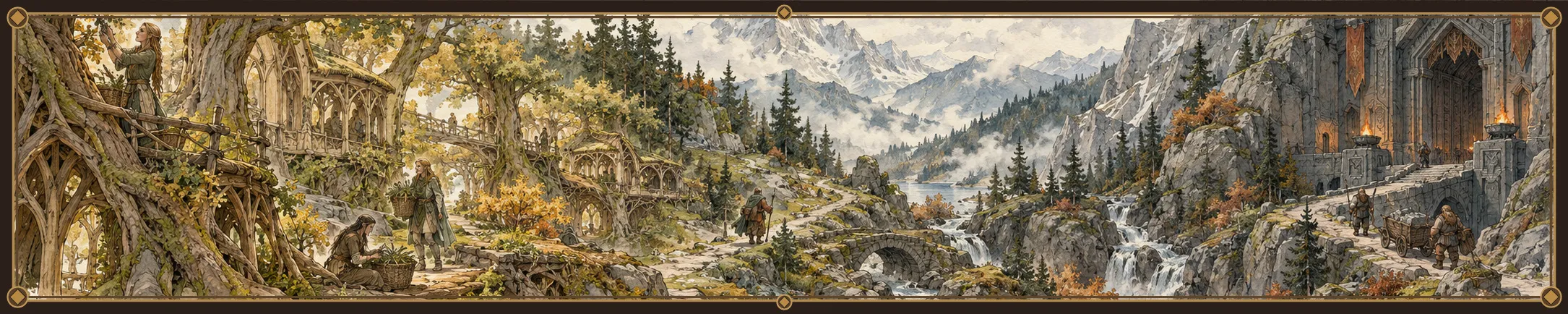
The tree keeps time by growing,
the stone keeps time by holding.
Ask an Elf when a thing began:
she’ll tell you what it’s becoming.
Ask a Dwarf, and he’ll ask you back
who held the stair, and who’s holding still.
Songs of the Sheaf Road
Long before the first Human looked at the sky and knew itself, two peoples were already old on Caeldon. Both descend from ancestors that were not quite of the Material Plane: the Elves from a crowded field of half-plant kinds steeped in the abundance of the Verdant Expanse, the Dwarves from lithic forms crushed into shape under the Iron Backbone. Both survived by becoming fully material peoples, and both still carry the older inheritance in changed form, the Elves in growth and attunement, the Dwarves in density and endurance. A Human who grows up near either learns quickly that they are people like any other, who eat, work, quarrel, love, and grieve, and learns more slowly that they keep time differently, and keep grudges longer. An Elven child is waited for until it shows what it is. A Dwarven child is kept deep in the stone until it has set. The two are each other’s oldest neighbours and oldest enemies, and between them they hold some of the longest quarrels on Caeldon, fought with arrows and axes before anyone wrote them down: whether the living world is to be tended or shaped, whose greatness will last, and how anyone can know that a person who has changed is still the same person.
Two Old Inheritances
The oldest peoples did not arise from bare ground. Between about 700,000 and 500,000 BR, as Caeldon’s great regions settled into lasting contrast, the first durable lineages took hold within them: in the canopy-and-root country, lines of life that ran towards growth, long life, and the binding of life to place; in the mountain-and-depth country, lines that ran towards density, endurance, and weight. Neither was one tidy first stock. The Verdant elder field held rooted kinds, flowering kinds lifted high, thorned kinds hardened by hardship, and dim kinds that lived under the roots; the lithic field held seam-dwellers, peoples of the crushing deep, ridge-folk who weathered like stone, and peoples of the fault lines. Most of both did not last. They failed, dwindled, turned to stone, broke apart, or were absorbed, and survive, where they survive at all, in ruins, ritual memory, old taboos, and the occasional too-large skull in a mine-cut.
The Elves and the Dwarves are the lines that came through, and both remember their origin in the same way: not as a beginning, but as a survival. The Elves remember an older living inheritance tamed into a true people of the Material Plane, still marked by long memory and kinship with the living world but no longer ruled by the unchecked abundance of what came before. The Dwarves remember a long crushing: an older Backbone-shaped inheritance changed slowly through the early instability remembered as the Uneven Settling, in which some lines failed and others grew less able to live under harder conditions. Dwarves are emphatic that they are not a degraded remnant of something better preserved. They are the line that endured.
The first stable Elves took form across the Elderweald and the older Roothollows below it, between about 500,000 and 450,000 BR, as one people of grove and root-depth, not yet divided into the branches of later history. The first stable Dwarves took form across the Ironspine, between about 475,000 and 425,000 BR, as one people of hold-making, defended passage, and long memory. Every later Elven branch and every later Dwarven hold descends from those two peoples. There were no separate births. That is why an Elf of the deep houses and an Elf of the bough-halls, however bitterly they disagree, are kin, and why a Dwarf of the high gates and a Dwarf of the Stonewake seals answer to the same ancestors.
The Elves
Elves are not plants, and an outsider meeting one in ordinary life sees a person. What remains of the Verdant inheritance shows in presence more than in anatomy. Around the thresholds of body and heart, at fertility, adolescence, illness, grief, or ritual, an Elf’s vitality, colouring, scent, or responsiveness to the surroundings can shift in ways that kin, lovers, healers, and others of the same branch notice, and strangers mostly do not. An Elf in grief may seem dimmer to those who love her; an Elf near a birth may seem, to a healer’s eye, to belong more closely to the place around her. The signs are subtle and they vary by branch, but they are real, and Elven life is built to read them.
They are not only tenders of groves. Every branch keeps its hunters and its watch: grove hunters who share the deep forest with grey wolves and brown bears, Thorn Elf hedge-wardens who plant ant-thorn at the false gaps a stranger would try, and Dark Elf route keepers who meet whatever comes up the Known Ways at the threshold chamber with a blade across their knees. Elves keep laments for their losses longer than tales of their victories, and an Elf’s grief can outlast a Human kingdom.
Birth and the Verdant Threshold
Elven fertility is rarer and more cyclic than Human fertility, and children are few. Conception is internal and birth familiar to other peoples, but development still passes through a threshold the Verdant left behind. In the most settled lines it may show only as a brief living sheath or some other subtle boundary before the infant is fully independent. In the oldest Wood Elf communities it is more plainly grove-linked, and Thorn Elf and Dark Elf births carry harder or more guarded forms of the same inheritance.
The deepest form of all, from the ancestors before the Elves were fully Elves, was stranger: a seed-after-union cycle in which a new life gathered first as a living kernel or pod, a growth-form, before any infant emerged. It is not the way of later Elves. Rare archaic births still happen, mostly in very old Wood Elf groves, and when they do they are an event for the whole grove: a family’s distinction, a ritual memory made flesh, a sacred exception rather than anything a household expects.
Growing Into Themselves
An Elven child is not only expected to grow but to show, over time, what it is: in temperament, in affinity, in what it has inherited. Infancy is treated as a time of delicate attunement, when season, light, the condition of the grove, and the care of kin matter unusually strongly. Naming and maturity come in stages, each marked when the person has visibly grown into it rather than at a fixed age. Adolescence is when branch inheritance shows most clearly, in temperament, role, magical leaning, and what others begin to expect, and some Elven peoples mark that stage with heavier rites than others. Elves have a gardener’s patience with their young and a gardener’s conviction that something forced into shape too early will grow wrong.
The branches carry the same patience differently. Wood Elf children are named slowly and nobody hurries them; a child is expected to show in its own season what it is, as a sapling shows in time what kind of tree it is, and adulthood comes when the grove agrees that the person has arrived. High Elf houses mark each stage formally (birth, naming, coming of age, and the taking of a house role), consult their tenders at every step, and end the long youth in presentation, when the young person is shown to the house and, if the house is of rank, to the assembled houses. A Crownbough house expects its young to arrive polished, and does not easily forgive one who does not. How a house and its tenders argue over that timing is told with the Crownboughs in The Forest Heartlands (MED). Thorn Elf children are kept close and named late, even by Elven measures, and are taught the approaches, the ambush ground, and the warning signs of their woods before they are taught much else. Dark Elf naming moves through its stages slowest and most guardedly of all: a child of the deep houses learns the house’s Known Ways by mouth and by foot, recites them back turn by turn to a route keeper, and is named at last in the house’s root-chamber, among the dead.
Healing and the Return of the Dead
Elven medicine works to restore rhythm, vitality, and attunement: to bring a body back into its own pattern and its own place, rather than to set and secure it as a Dwarven healer would. An Elf who is ill is out of time with herself, and the cure is to bring her back.
The same care runs to the end of life. Elves do not treat the dead as lives ended and sealed away but as returned, carefully, to a living whole larger than any one life. A Wood Elf body is given back to living ground among the grove’s trees, and the ground that holds a household’s dead is its oldest hold on the place; to clear such ground would be to clear someone’s dead, and Human woodcutters have died for less. High Elves return their dead to the family grove under the rites of return of their faith. Dark Elves keep the same custom underground, against the living root of a house’s root-chamber, so that a house that loses a chamber loses its dead with it (see Stone and the Deep, MED).
The worst Elven death is one that cannot be returned: a gatherer who walked into a bear in the deep hollows and was never found, a lone walker taken by a ravine cat on a Briarreach crossing, the Dark Elf dead who lie in root-chambers beyond the Sealing bars. Such dead are named in laments instead, and the laments are kept for longer than most Human songs have existed. To say of an enemy may no one sing you home is to wish them that death, and it is not said lightly by a people that remembers every time it was.
Where Elves have lived beside Humans, the two ways of finishing a life have had to meet. On the Elderweald’s edge, since a death in a mixed settlement about 16,000 to 15,000 BR, a death is finished twice: the body returned in the Wood Elf manner, the mourning held in the Human one. The custom and its accord are told in The Forest Heartlands (MED).
Four Branches
Four branches have grown from the common root, each with a civilization that keeps, hardens, or turns its inheritance. The branchings took more than a hundred thousand years, roughly from 450,000 to 318,000 BR, and every one of them is remembered as a departure from one old people rather than a separate beginning, and every one was paid for.
The Wood Elves came first. In the Elderweald, between about 490,000 and 470,000 BR, the earliest stable Elves settled into a grove-bound people who live within the forest as it grows rather than cutting it to their own design, and their civilization, the Rootcrown Concord, held to that answer. Nobody rules the Concord; groves under trees older than the Concord itself are held together by memory and by duty to the forest, and a grove that ignores a circle of its neighbours soon answers to all of them. Wood Elves gather rather than clear, take wood only from what has fallen, and keep paths open by walking them. The grove’s hunters are its guard: they track whoever cuts a living tree, turns a stream, or sets a fire in the wrong place, and the timber thieves and the poachers of the moss-coated greenharts who come in from the basin side seldom go home.
The Thorn Elves hardened under harsher ground. In the Briarreach, between about 425,000 and 410,000 BR, part of the old Elven world met a broken country of thorn and ravine and answered with watchfulness, hedges, and strict custom about who may approach, and the Thornbound Circles grew from that answer. They live by the bow and the hedge: settlements as rooted as any grove, hidden behind thorn walls grown for war, in a forest they remember as trying to kill them. They are the Elves who were neither refined nor ruined, only hardened, and their vigilance has outlasted the worst of the old dangers and become custom.
The High Elves pushed the other way. In the Crownboughs, from about 398,000 BR, a line refined older Wood Elf ways into living architecture, magical shaping, ranked houses, and splendour, and the Crownbough Courts were founded on it. Their halls are grown from living wood high among the boughs and trained over generations, and no hall is ever finished; a young High Elf learns a craft by continuing shaping begun by a grandparent’s grandparent. Several courts rule rather than one crown, each the gathering of a few great houses that settle rank by custom, oath, and what their groves, wealth, and sworn followers let them enforce, and quarrels between equals are fought out in duels of shaping or, when the insult runs deep enough, with swords on a garden-walk with nothing beneath it. They are the most settled and formal of the Elven lines, and the one with which Human-Elf children are most easily born.
The Dark Elves were already ancient before catastrophe found them. An underworld-margin branch of the upper Roothollows, they were always the most conscious of thresholds among Elves, ordered around guarded passage, chamber-right, admission chamber by chamber, and a sworn duty of refuge. Then came the Drowning Bloom, about 335,000 to 330,000 BR, and the sealing of the upper Roothollows that followed, and the survivors were driven into a much sharper break. The wound did not create the Dark Elf branch; it hardened it, and the hardened branch built the Gloamroot Covenant, where power belongs to whoever can hold water, food, dry chambers, and a safe way through the dark. After that, Elven branching was no longer only a matter of country and preference. It became a matter of wound, blame, and memory, and Dark Elves have lived ever since between two beliefs: that refusing refuge is a betrayal never forgiven, and that every stranger at the door may bring the flood, the rot, or the thing that followed them. Their laments still name the guards of the Drowned Court, who sank so that others might float and rose again out of black water with spears of root to hold the survivors' last chambers.
Beneath the four lie older layers: Verdant proto-Elven lineages, elder root-kin, and the threshold folk of the old Roothollows. None lives as a people now. They survive in ruins, ritual memory, branch taboos, and the overgrown halls of the vanished root-kin under the oldest woods, closed with thorn that was grown to keep someone out. Some of those halls still hide and feed whoever they were sworn to and no one else, and the Human delvers who cut their way in come out, when they come out, with green-bronze and strange seed, and with the grove wardens a day behind them.
Elves of Two Peoples
Rare Human-Elf children are real wherever contact has run long enough to make mixed households ordinary, most often with the settled High Elven line, though no pairing is impossible by default. In Human and frontier communities they are named and accepted earlier than any Elven household would name a child. Even so, their growing-up is usually more uneven and prolonged than Human observers expect, and their branch-linked tendencies show more weakly and more by circumstance than in full Elves. Adults of mixed descent are accepted in many societies without being sorted into one people-category: local custom, branch inheritance, upbringing, and the temper of whoever holds the land or heads the house decide how each is read, and the same person can be read three ways in three towns.
Belief
Elven belief varies by branch, but every branch holds to guided emergence and the return of the dead to the living world. High Elves keep an organized faith, the Ordered Bough, whose temples are temple-gardens tended across generations and whose clergy are tenders, with authority resting on patience and on what has visibly flourished under their care; its most powerful and most contested patron is Saerith the Mirror-King, the god of finished form, and a failed house leaves rooms where his silver mirrors still hang, showing the viewer a better face, and some who look too long never come away the same. Wood Elves keep the older grove reverence from which the Bough grew, as custom rather than organized religion, and Thorn Elves keep a harder, more guarded form of the same reverence. Dark Elves honour the Last Chamber as a true but severe god, sworn by when a house must say honestly whether it can take one more life, and still name Ithaere the Drowned Mother in their laments. How these faiths are practised in a given era is told in that era’s book.
The Dwarves
Dwarves are not stone come to life. They are a true people, dense and durable, who eat and drink, labour, recover, and age as fully embodied beings; but their bodies remember where they came from. They are suited to deep earth, its weight, and hold-cut halls; the deep air that crushes other peoples feels to them like steadiness. They bear scarcity unusually well and value food for its density and keeping rather than its delicacy: a Dwarven storehouse is full of dried meat, hard cheese, barley, roots, and fungus from the hold beds. They keep a little of the old ability to draw restoration and steadiness from stone itself, though ordinary food and drink are the basis of their lives. In old age their long strength stiffens and grows less forgiving rather than softening into frailty; an old Dwarf is more often brittle than weak.
They are stoic, not cold. Dwarves tend towards self-control, endurance, and a steady bearing, and their feeling runs compressed and heavy. When it breaks into the open it comes with force, which is why other peoples who mistake a Dwarf’s silence for indifference are so often surprised. Most are slow to trust and slower to forgive a broken word, and the worst Dwarven curse is the shortest: forsworn, said over a broken word, and a hold that says it of a Dwarf will not say that Dwarf’s name again.
Their heroes are keepers more than conquerors: the gate warden who held the stair while a hold went down behind her, the seal-keeper who shut a flooding gallery with his own kin on the far side and lived to be sung about and cursed for it. The hall toast is to the stair, for everyone who held one, and hold children play gate and stair, one side holding a doorway with sticks while the other tries to rush it; the side holding the stair always wins in the end, because that is how the game is told.
Setting
A Dwarf is not finished at birth. Infancy is a setting time, as much bodily as cultural, in tended stone cradles deep in the hold, while the body settles into lasting form. A hold keeps its cradle-chambers deepest inside, behind the most doors, where an enemy would reach last, and guards them more closely than its treasuries: an infant still setting is the thing a hold can least afford to lose, and a child lost to the mountain is the worst loss a hold can suffer.
Childhood is long and maturity comes in stages, and every stage is marked slowly and in public. A name is given when it can be carried: in the Ironspine a child’s name is cut on a small stone kept in the cradle-chamber until the elders think the child able to bear it, and the stone then goes home with the household. A craft is taught one burden at a time. An oath waits until the young Dwarf is thought able to keep it, and a young Dwarf’s first oath, sworn at the gate before a custodian who asks Kerrund’s question aloud, is cut into the hold’s archive; an oath broken at the gate is avenged by the whole hold, not only by the injured kin. That is why Dwarven naming, kinship, healing, and burial all lean on steadiness, shared care, and proper rest. A life must be brought safely into lasting form, not merely begun.
It is also why Dwarves look at other peoples' thresholds with suspicion. Humans who name a child in its first days look rash to them, and Elves who trust a child to find its own way look careless.
Proofs of the Line
The long survival of the Dwarven ancestors left a wound as well as a body. Inside the surviving kin, the great change was lived as the same people enduring: we are still ourselves. Outside, and in bad times, some lines denied that the changed survivors were still themselves. Dwarves have answered ever since with proofs. Speaking-for came first, kin speaking up for a life, because a community’s acceptance was what kept a doubted Dwarf alive. Line-memory followed, once holds lasted long enough to keep tallies across generations. Craft proof came last and is the most Dwarven of the three: the work of the hand that shows the same self still holds.
All three are tested in the Proving of the Unbroken Line, though holds and eras have names of their own for it. It is called when a Dwarf comes back changed or after long absence, out of a sealed gallery, out of years of Dark Elf captivity, out of a mountain that was thought to have killed them, or when a rival says openly that someone is no longer who they were. The hold’s elders, its keepers of line-memory, and its leading crafters sit together in the great hall, and the strongest kin among them weigh heaviest. The challenger may open the hearing, but only the sitters question, and they call whom they choose to speak. The hold watches in silence; whoever breaks it is thrown out, and some holds add a beating. To appear is to give oneself to the sitters entirely: their questions on kin, old burdens, and former place, and any work they ask the doubted Dwarf’s hands to do before them. One who will not come loses what is in doubt, unless it is later shown they could not come.
What comes back comes in steps. Kin, shelter, food, and burial return first, and most holds leave even one who loses these bare protections, though the hardest deep holds may narrow them in a lean time. A craft place returns more slowly, and in strict holds it weighs nearly as much as inheritance, because it carries the right to shape what the hold depends on. Inheritance, office, and the right to speak for others need nearly every sitter, which gives a powerful family in the hall a long reach; an heir with strong kin behind them is heard sooner and more kindly, and an exile who comes back with no kin at all has sometimes been sent back out of the gate into the snow. Most end with the sitters' word spoken on the spot; hard ones send the sitters out to argue before they return. The hearing never asks whether someone is still a Dwarf, only whether they are the same Dwarf and what the hold still owes them.
Under the Dwarves' faith the proving is held before the gods as well as the hold-elders, and the person whose place is doubted answers the questions of holding for their own life, with kin and craft-mates speaking beside them.
Healing and Burial
Dwarven medicine resets the body and secures it: a break is set, a body supported, a recovery held steady until it can bear weight. Where an Elven healer asks whether a body has found its rhythm again, a Dwarven healer asks whether it will hold.
Burial is the last answer a life gives. It is a final proving in miniature, in which the dead are declared to have held and are then sealed with care. Proper rest matters as much as the setting of the newborn did, because the same principle governs both ends of a life: a Dwarf is brought into lasting form, and laid to rest in it. In the deep holds the custodians who mark closures and keep the tallies also seal the dead, and every grave closure carries more than one custodian’s mark and an entry in the archive. A sealed door with the living behind it is another matter, and most holds have one of their own that nobody opens and everybody listens to; behind old seals the Seal-Knockers knock, three blows and a pause, sometimes for years.
Holds, Depths, and Branches
The oldest Dwarven line became an argument as well as a people. In the Ironspine, between about 465,000 and 445,000 BR, the first Dwarves cut the mountain into halls rather than live on its face as it was, and came to one conviction: that a people endures in what it builds, in sound halls, dependable passages, and memory cut into stone. The Ironspine Holds, founded soon after, have no king. Their heart is the hold: a fortress-city cut into the mountain around a gate, a forge, a granary, and the tablets of its dead, kept by people who believe that whatever holds up a roof deserves respect and whatever does not deserves none. Inside a hold the elders and great houses rule by custom and oath, and a household that defies them finds the forge, the granary, and the gate closed to it. Between holds there is no crown, only old oaths and the strength each can bring. Hold grudges are carved, not spoken, and a feud between two holds over a seam, a road, or an insult at a gate-feast can run for a thousand years, fought by ambush in the underways and recut on both sides' tablets each generation so the letters will not soften.
From the holds, the deep world grew denser. In the Stonewake Deeps, between about 365,000 and 350,000 BR, more of the lower world’s ways and water came together than anywhere else, and whoever held Stonewake’s passages and reservoirs held the deep. That concentration became the Stonewake Compact, a civilization within the hold-world, small and dense, where power belongs to whoever keeps the ways open, the water clean, and the records true, and has for three hundred thousand years against flood, collapse, Dark Elf war-bands, and whatever comes up from below. In Stonewake a seal is a matter of oath, not impulse: a shut door can save a hundred holds or bury the people behind it, an ordinary seal needs the oath-marks of several custodians, and an emergency seal set by whoever holds the passage must answer to the elders afterwards, with the kin of anyone sealed in wanting an answer. Its heroes are read rather than sung, off the tablets beside the seals and gates they kept.
Ironspine and Stonewake Dwarves are the clearest branches. Beyond them, Dwarves vary by depth, hold, and neighbours more than by birth. The deep holds are the severest: they store everything, forgive little, and give rule to whoever keeps the air and water moving. Mountain-facing and high holds live with weather, haulage, and traffic; the Highhold and Gatehold Dwarves of such places are real and recognizable, but they are lifeways, not kinds. Corridor communities nearest Humans and Elves are used to bargaining and to strangers at the gate. Under all of it lie older forms that belong to memory rather than to the living: lithic ancestor lines, burdened deep forms, old seam-kin, and lost pressure holds below the lowest kept routes, where unwoken frames stand at their posts and the treasure-songs say the forge-lords left their hoards behind the last door.
Each depth has its own killers. On the heights stone cats take herds and lone climbers, and a warden who wears a stone-cat pelt has a story to tell about it; pass bears break into waystation stores. In the mine-edges flood, bad air, and brace-gnawers in the props kill more Dwarves than any enemy. In the deepest halls stand the Burden-Stays, keepers who would not let a refuge fall and now hold up its roof with their own bodies.
Not every hold that fell was sealed. The Ironspine is studded with dead holds, lost to flood, collapse, plague, or the deep enemy, and their halls are full of the hold-world’s wealth: forge-work blades that still keep their edge, lamps that still light at dusk, and doors whose old sigils still spit fire at whoever forces them. Human and Goblin delvers go in for it, and the holds hate them for it as grave-thieves. Dwarves go in too, as reclaimers: kin of the lost hold who swear on its name-stone, with a hand on the cold hearth, to go down, take back its hall, and relight its fire, and who mostly come back with a name-stone, a few heirlooms, and the news of what lives in the halls now. A hold relit by its own kin after centuries is the greatest deed a Dwarven family can boast of, and a few have.
The Dwarves were also the first makers of the frames from which the Wrought descend: mindless golem-like workframes built for heat channels, vent shafts, pressure gates, and the other places where craft demanded more than a body could survive. Some still stand in the old workings, and no one can tell from the doorway which are only tools. The people who later woke from that tradition belong to themselves, not to the holds, and their story is told with the bridge peoples.
Belief
Dwarven belief is organized in one faith shared by the holds, the Held Covenant, in which the great gods are questions every hold must answer aloud: Kerrund the Stone-Warden’s will you hold?, the Measured Seal’s must this close?, and the Last Chamber’s can this still bear? Its clergy are custodians, keepers of seals, tallies, and the rolls of the hearings, and its central rite is the Proving of the Unbroken Line. Dwarves honour the Mountain-Father by title only and ask him nothing. How the Covenant is practised in a given era is told in that era’s book.
Old Neighbours
Elves and Dwarves are each other’s oldest enemies on Caeldon, and their enmity is a quarrel of first principles as much as of borders.
It began on the margins of the Elderweald and the Ironspine, where the forest climbs into the mountain’s feet and both peoples drink from the same springs. At first they bargained as often as they fought, and the first raids were as much theft as war: Elven hunters taking Dwarven tools, hold miners felling grove timber for props. But the same slope was a living grove to one and a seam waiting to be opened to the other, and between about 410,000 and 385,000 BR the frontier became the verge wars: generations of raid, ambush, fouled water, and felled groves, each ending in whatever terms the side holding the slope that season could impose. Dwarven miners turned streams to wash their ore, and the groves below them sickened; Elven wardens answered by night, cutting props in the adits and leaving miners in the brakes with arrows in them; hold axe-bands came down in strength to fell the thickets that hid the archers, and the felled groves were mourned as murdered kin. The verge wars made the first heroes and villains the two peoples still name against each other: a warden who held a spring alone against an axe-band through a night and was found at dawn with the axes broken round her, a hold captain who poisoned a grove’s spring and was hunted by its wardens for twenty years and never caught. Their battle-grounds are the oldest haunted ground of the margins, where hunters still hear axes in empty woods, and abandoned adits of those wars still pock the lower slopes, some holding the tools and ore-hoards the miners fled from, and some Elven arrowheads still in the bones. The question beneath the killing, whether a people endures by living with the land or by mastering it, has outlived the last verge raid by ages.
The rise of the High Elves gave the old frontier a prouder edge. Between about 375,000 and 355,000 BR the Crownbough Courts and the great houses of the Ironspine Holds turned the enmity into a contest of pride. To the Courts, the holds were strong and graceless: masters of the load-bearing wall, deaf to beauty. To the holds, the Courts were brilliant and hollow, all display and shaped wood, forgetting that a hall must first be defended and a people first survive. Mostly it was fought with insult and splendour: a Dwarven-forged blade sent as a gift and refused, a grown Elven harp sent back with its strings cut. But on the slopes between them it was fought with blood, in hunting-parties ranging into Dwarven valleys and hold war-bands coming out of the gates to answer, and Dwarven quarry-gangs still call one worked-out slope at the forest’s mountain edge the Red Face, and will not say why where an Elf can hear. Neither side could dismiss the other, and that grudging respect kept the rivalry from turning into conquest, though not from turning into feud along every verge road for twenty thousand years. Dwarven blades taken in raids still hang in Crownbough halls as trophies, and grown Elven armour lies in hold vaults as proof that it could be pierced; a few have been stolen back by daring thieves, whose deeds are told on both sides, as heroism or as theft.
Below the forest the enmity is older and bloodier. After the Drowning Bloom broke the upper Roothollows, Dark Elf houses and the Dwarves of the Stonewake fought for the Rootstone Heartwell chamber by chamber, and whoever held the chambers held the water. That war, fought by lamplight in the water-chambers, is the root of the Burdened Seal Histories: the keeper who shut the deep gate with refugees still on the far side, because what came behind them would have taken a hundred halls. Stonewake sings that keeper as a hero; the Dark Elves name the same keeper a murderer. The deep border is quiet more years than not, but never at peace. A well is fouled, a patrol does not come back, a raid on a fungus bed is answered by a raid on a gallery, and blood-feuds between hold-families and Dark Elf houses run back further than any Human kingdom.
The difference reaches every stage of a life. One people lets a child emerge; the other sets it. One names in stages as a person grows into themselves; the other names when the name can be carried. One heals by restoring rhythm; the other by resetting and securing. One returns its dead to the living world; the other seals them with care, as a final hearing. Each finds the other’s way of bringing a life into the world faintly reckless or faintly cold.
Both reached the younger peoples early. Dwarven route knowledge, iron, and craft entered Human history through the foothills, where the holds and the marcher lords have fought outlaws and winter on the same roads for twenty thousand years, and that guarded trust is the oldest lasting bond between Humans and Dwarves. The Wood Elf forest edge taught Humans what it costs to cut into a living wood, with arrows from the dark and roads grown into bramble mazes by the next moon, and the High Elven houses later gave them a model to admire, imitate, and resent. Dark Elves, when Humans met them at all, were feared as rare and dangerous powers from below, and every basin town has its story of the treasure-seeker who went down after Dark Elf silver. How the elder peoples worship, who rules their holds and groves, and what they fight over in a given era is told in that era’s book.
Tensions
-
One people or four. Since the Roothollows darkened, the Gloamroot houses have been in a long contest over whether the wider Elven world counts them as rightful. No grove, bough-house, or circle is strong enough to settle for the others whether a Dark Elf line stands on the same footing as its own, so each answers as its own borders and grudges allow.
-
Tending or shaping. The Wood Elf groves hold that the living world is to be cooperated with; the High Elf houses that it may be refined. The argument is older than any of the four Elven civilizations and runs through all of them.
-
Read late, named early. Human-Elf children are named and accepted early in Human and frontier settings, then read slowly, unevenly, and sometimes never by Elven kin. Which reading governs a mixed adult’s inheritance is decided place by place, usually by whoever holds the land or heads the house.
-
Capable before accepted. In the Gloamroot houses a young Dark Elf can be useful, formidable, and plainly real long before the elders let the line continue through them. Survival value does not make an heir there, and a capable heir can wait years in the root-chamber’s shadow.
-
Bare protections. Most holds leave even one who loses at the Proving shelter, food, and burial, but harsher deep-world holds narrow those protections in lean times. Corridor Dwarves call that a proving turned into exile; the deep holds answer that a hold which cannot feed its own cannot keep feeding the doubtful.
-
A place won at the gate. Corridor communities, used to bargaining with Human and Elven neighbours, give a doubted Dwarf back their place on terms the deep worlds think too easy. When a corridor Dwarf goes down to a deep hold, the deep hold’s elders decide whether a place their own hall did not grant counts at all, and they usually decide it does not.
-
The knock behind the seal. When a seal the hold later calls unjust starts to knock, the kin of those behind it want it opened and the seal-keepers will not, for fear of the flood, the contagion, or the enemy it was made to hold. Every generation some young warriors go down with picks to open one themselves, and the hold has to decide whether to stop them by force.