Chapter 3. The Veil and the Outside
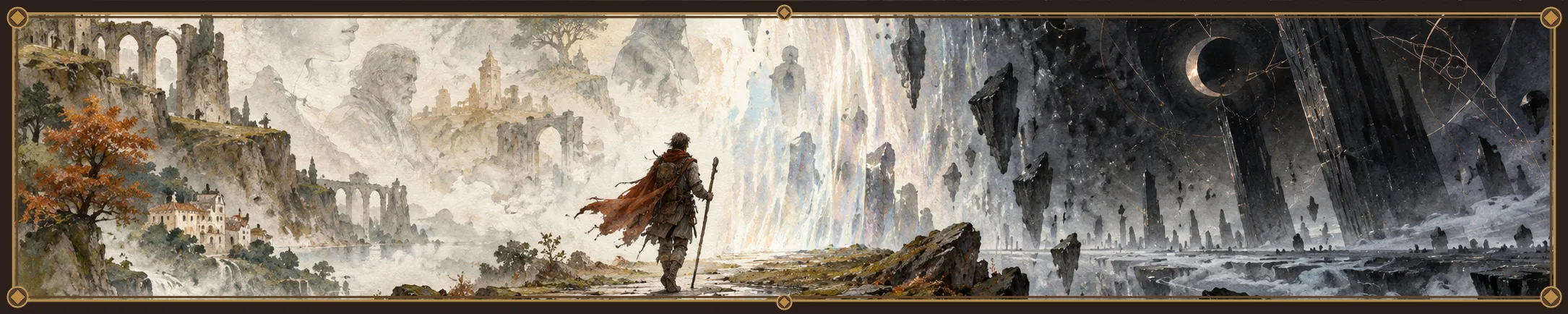
Know where you are going. Know what you will pay. Do not linger, do not follow a voice you love, and remember your name.
On the Space Between Places
Between any two planes lies the Veil, and the Veil is not a place. It is the space between places: a fog that is not water, corridors that are not built, a distance measured in will instead of miles. Travellers who have crossed it describe the noise of the world falling away behind them, the light going dim, sound going dull, and a loneliness so complete that some never find words for it afterwards. And beyond the Veil, beyond every plane and every Harmonic, lies the edge of everything: the Boundary, a shimmering membrane that only the mightiest of the powers can perceive, and past it the Nothing. No mortal has ever reached the Boundary and come back. Those who tried did not die. They were unmade, and nobody remembers who they were.
This chapter tells the truth of the Veil, the Boundary, and the Nothing. Little of it is known in the world. The Veil is crossed by few and explained by fewer, and no one has ever come back from the edge to describe it. What people know and believe is told in What People Know.
The Space Between Places
The Veil connects everything. Every Anchor and every Harmonic lies within it, every journey from one plane to another passes through it, and no plane is ever wholly cut off from the rest. It is the skin of the universe: the membrane through which all travel must pass, and the canvas on which the Resonance Principle paints its anomalies. Where the planes are layers of the cosmos, the Veil is what lies between the layers and holds them in reach of one another.
It has no fixed shape. Two places far apart on the Material Plane may lie side by side in the Veil if they share a strong resonance, a battlefield and the Scourge, a library and the Eternal Record. Up and down mean nothing in it, and travellers steer by feeling the pull of where they mean to go. Distance there is not measured in miles but in intent, resonance, and difficulty: a journey that should take days may take moments if the traveller’s will is strong, or an eternity if they are lost in their own doubts. Time is elastic. A minute spent in a foggy corridor may be a year at home, or the other way round. On the Material Plane, where space runs straight and time runs evenly, nobody has to think about such things; in the Veil, nobody can stop thinking about them.
It is the great equalizer. It strips away both the physical laws of the Anchors and the conceptual purity of the Harmonics, and leaves the traveller in a state of pure potential, among fog, shifting corridors, and geometries that could not be drawn, where the only constant is change. The strongest arm counts for nothing there and the surest footing gives way; what carries a traveller is the clarity of their purpose. The Veil is not the Nothing, but it shares something of its absence. In its deeper reaches the noise of the Material Plane fades, sound grows muffled, light dims, and the mind feels alone. This is why so many travellers speak afterwards of a dread they cannot explain. They have been, for a while, a long way from anything.
The Fog
The Veil is most often described as a fog, and the fog is not vapour. It is unmanifested reality: the raw stuff of possibility and dream, the substance of the Shifting Path and the Dreaming Veil, waiting to be given form. Its thickness tells the traveller what kind of crossing they are making. Where it is thick, the way is hard, confusing, and dangerous, and travellers lose themselves easily. Where it runs clear, two places are strongly joined and the crossing is quick and safe. Old travellers read it as river pilots read water, by colour and movement, and they trust a clear stretch less than a novice does, because thick fog also hides what lives in it: the predators of the Veil, and the toll-keepers who may or may not be willing to help.
It has weather. Great workings of magic, surges in a Prime’s current, and breaches of the Boundary raise storms in the Veil, sudden shifts in which the corridors move, the fog thickens or tears, and travellers caught in them may come out somewhere they never meant to go, or not come out at all. The same storms move the thin places of the world. A Veil that has always been thick between a village and the Harmonic behind it may thin after such a storm, and a zone may wake where none was known before.
The Four Laws
The Veil’s behaviour follows four laws, the rules of resonant navigation, and every traveller who has survived a crossing could recite them.
By the law of intention, the Veil answers the traveller’s purpose. One who knows where they are going, and believes they can get there, finds the path clearing ahead. One who doubts finds a labyrinth. The Veil does not care whether the purpose is good, only whether it is clear.
By the law of resonance, a crossing between places that share a theme is easy, and one between places that do not is thick and hostile. A traveller going from an ancient library to the Eternal Record finds the Veil thin and clear; the same traveller going from that library to the Scourge finds it choked and hostile. It is the same law that sets battlefields beside the Scourge and counting-houses beside the Gilded Cage, seen from inside.
By the law of cost, every crossing is paid for. The price may be in the body, as exhaustion or lost time; in the mind, as lost memories or confusion; or in something deeper, a memory given up, a promise made, or a piece of the traveller’s Pattern, the living configuration that makes a person who they are. The harder the crossing, the higher the price, and travellers have come home with years gone from their lives, with gaps in what they remember, and with less of themselves than they took.
Every road between the worlds is a toll-road, and no clerk stands at the gate to tell you the fare. The Veil weighs the crossing and takes what it weighs. A short way between like places costs an evening’s weariness. A long way between unlike places may cost a year you will not find again, or the sound of a voice you meant to keep.
On the Space Between Places
By the law of drift, a traveller who loses focus begins to wander: into some Resonant Zone, onto the wrong Anchor, or into the fog for good. The drift is the Veil’s first danger and its commonest. It does not strike; it simply lets go of whoever lets go of their purpose, and the drifting traveller passes from plane to plane without arriving anywhere, until the mind breaks or thins into the fog.
The Many Faces of the Veil
The Veil is one thing, but it is not the same everywhere. Near each plane it takes on that plane’s character, and so does the price it exacts. Travellers who have crossed often describe the approaches to the other planes as a sailor describes harbours, by how they feel and what they take, and their accounts agree well enough to be set down.
Towards the Anchors
The approaches to the ten extreme Anchors, and the gates by which the Material Plane opens onto each, are described plane by plane in The Planes. Seen from inside the Veil, they fall into two families. Towards the planes of lack, the Veil takes. It is a storm of blades towards the Scourge, cold syrup towards the Ashen Wastes, burying sand towards the Parched, a field of glass towards the Frost-Bound, and a white noise like erasure towards the Silence, and each strips something from the mind: the knowledge of whom to trust, the reason for coming, memories dried to dust or frozen out of reach, and at the Silence the memory of ever having left home. Towards the planes of excess, the Veil does not take so much as overwhelm. Roots overgrow the past towards the Verdant Expanse; a maze that must be walked in a fixed order loops back on every wrong turn towards the Gilded Cage; a tunnel of light makes the traveller remember every shameful moment towards the Radiance; a vortex of voices dissolves the past into everyone else’s present towards the Weave; and towards the Apex the way is smooth as ice, and what slides away is the traveller’s own flaws, and sometimes their reasons for wanting to leave.
Towards the Harmonics
Towards the Crucible, the Veil is a storm of fire and lightning, and crossing it feels like being roasted alive; it burns away all but the most intense memories. Towards the Surging Deep it is a network of currents and channels, and crossing it is like swimming; what it takes is dilution, as the traveller begins to forget themselves in the flow. Towards the Iron Backbone it is a network of tunnels and shafts, a climb rather than a walk, and instead of forgetting, the traveller carries the weight of the past with them as a burden. Towards the Unbound Gale it is all currents and eddies, like flying, and it scatters, so that travellers forget where they came from or where they meant to go.
Towards the Dreaming Veil it is a mist of thoughts, and travellers drift through it; memories come out disjointed and symbolic. Towards the Eternal Record it is a corridor of endless doors, like wandering a library that never ends, and the danger is overload: a traveller may remember everything and forget who they are. Towards the Shifting Path it is a maze of corridors whose layout changes at every step, and travellers forget which way they came. Towards the Binding Song it is a web of threads and script, like reading a book backwards, and instead of forgetting, the Veil edits: a traveller may lose whatever parts of their own past contradict the story they now tell about themselves. Towards the Whispering Trace it is a mist of memories, and the past lies over the present like a second picture on the same glass. Towards the Frozen Moment it is a corridor of frozen time, like moving inside a glacier, and travellers may forget how to move or speak at all.
The Gates of the Harmonics
The Harmonics have their gates on the Material Plane too, wherever a place already resembles the concept behind it. Fire-Gates are volcanoes, forges, and places of great heat. Water-Gates are oceans, rivers, wells, and the places of baptism. Stone-Gates are mountains, quarries, and ancient ruins; Wind-Gates high peaks, open plains, and places of great height. The Sleep-Gates of the Dreaming Veil are beds, meditation chambers, and places of deep rest; the Library-Gates of the Eternal Record are ancient libraries, archives, and places of study. The Shifting Path opens at Crossroads, junctions and decision points and places of chance. The Binding Song’s Court-Gates are judgement halls, libraries, and the places where oaths are taken. The Whispering Trace has its Grave-Gates in cemeteries, on battlefields, and wherever death has come, and the Frozen Moment its Time-Gates in ancient ruins, among clocks, and in places of deep meditation.
Read side by side, the lists show something no single plane’s account does: one place can be a door with several sides. A battlefield is a War-Gate to the Scourge and a Grave-Gate to the Whispering Trace, and the shouted commands still in its air can wake the Grammar of War. An old library is a Library-Gate to the Eternal Record while it is read, and a Quiet Gate to the Silence once nobody reads in it any more. A judgement hall leans towards the Gilded Cage and towards the Binding Song at once. A meditation chamber stands near the Silence, the Dreaming Veil, and the Frozen Moment together. Which side a crossing finds is what the laws of intention and resonance govern, and the oldest advice about such places is the plainest: know which of its doors you mean to use before you go near it.
At the Edges of the Zones
Even the Resonant Zones carry their own small Veils at their edges, each with its own texture and its own toll; how a zone forms and what lies inside each one is told in The Resonant Zones. At those edges the forgetting of the open Veil gives way to something narrower, a price in the zone’s own coin. Around the Crystal Spire the Veil is a lattice of vibrating strings, like stepping between the strings of a harp, and travellers hear their own thoughts from the past or the future. Around the Ghost Step it is a crowd of passing figures, like stepping onto a busy road where nobody is walking, and a traveller’s steps may fall into a dead traveller’s, until they remember the dead one’s road as their own. Around the Lost Archive it is a labyrinth of stacks that reshelve themselves behind the reader, and the more a traveller reads, the more of who they are is written over. Around the Name Bound it feels like walking through a contract, and travellers come out bound to promises they do not remember making; around the Silent Gale it is a wall of wind and silence, and they may forget the sound of their own voice, or the voices of the people they love. Around the Prophecy’s Edge it is a tunnel with one exit, and what the traveller loses is their own wishes, as the future they are walking towards fills their sight.
The Shape of the Price
Set out together, the tolls have a grammar. The planes of lack take something away. The planes of excess bury what they do not take under too much of something else: growth, order, light, other minds, or perfection. The Harmonics do neither. They change memory into their own element, so that fire burns it down to its brightest moments, water dilutes it, stone turns it into a weight, wind scatters it, dream breaks it into symbols, the Record floods it, the Path loses the way back, the Song rewrites it, the Trace overlays it, and the Frozen Moment stops it. The zones, last, charge the price of their own single law. A traveller who knows where they are going therefore knows, in rough outline, what they are going to pay, and the second line of the crossing-words is less a warning than an instruction: know what you will pay. The Veil wears the face of wherever it leads.
Those Who Live in the Fog
The Veil has its own inhabitants, and life there is shaped by two things: nothing stays where it was, and everything that lives must keep its own direction.
The Veil-Walkers
The Veil-Walkers are humanoid, with skin that shimmers like oil on water and features that shift with the fog, so that nobody who has met one can say afterwards quite what its face was like. They wear cloaks that blend into whatever lies behind them. They do not age or die as mortals do. They live on the drift of the Veil itself, the same drift that swallows travellers, and its disorientation does not touch them. They know every path and every price.
They are the Veil’s guides and toll-keepers. They sell safe passage, and the fare is seldom coin: it is often a memory, a secret, or a service. They are cryptic, they bargain without warmth or malice, and they take no side in anything, neither in the quarrels of the planes nor in the troubles their passengers are running from. To them everyone else is a passenger, and passengers pay. A traveller who can trust one is told to follow it, and the condition is the hard part, because a Veil-Walker owes its passenger nothing beyond the bargain and says nothing it has not been paid to say. Shrine-keepers on Caeldon say never to bargain with one twice: the second fare is always the thing you love.
Where the Veil lies near the Material Plane, the Veil-Walkers can be met on it: at old shrines, on boundary roads, at oath places and suspect sanctuaries, at the sites of unusual transformation. There they are a puzzle for the settled peoples around them. Whether a shimmering figure at the edge of a shrine is a visitor, a people, a condition, or a sacred danger is not a question with a single answer in any town, and the questions they raise are always the same ones: what guidance is worth, who may take a toll, what is taboo to touch, and whether something has gone wrong with the place that lets them through.
The Lost and the Drifters
The Lost are travellers who drifted too far and lost their purpose. They walk the same steps over and over in a waking stupor, unseeing, until at last their awareness thins into the fog itself and they become part of the Veil’s background murmur. Nobody knows how many of the voices in that murmur were once people. Travellers who have heard it describe it as the sound of a crowd far off, and some of them insist that they caught a name in it.
The Drifters are what hunt them. They have adapted to the Veil’s fluidity so completely that they can change their form, their size, and even their nature to move through its shifting corridors, and they prey on the Lost and on the unwary. Among them are the Fog-Stalkers, which blend into the mist and strike from it, and the Voice-Mimics, which call to travellers in the voices of the people they love, to lead them off their road. It is the Voice-Mimics the old crossing-words mean when they say not to follow a voice one loves.
The Exiled
Not everything in the Veil came there by choice. When a Steward falls, the current of its Prime sheds it as a river sheds what it cannot carry, and the fallen office is thrown out into the harshest reaches of the planes: the distorted margins of a Harmonic, an extreme Anchor, or the Veil itself. Some of the Cast-Outs, then, are prisoners of the space between places, and loathe it, and cannot leave. Who they are and what they offer is told in What Waits Outside. For a traveller it is enough to know that the fog holds older and stranger things than Drifters, and that some of them would very much like to be carried somewhere else.
What the Veil Gives
The Veil takes, but it also gives, and the people who use it most are those who know what it can do.
It joins places. Two points on the Material Plane that share a resonance may lie close together in the Veil, so that a journey of weeks or months on foot can be made in far less, by those willing to pay its price and able to keep their purpose clear. It keeps things. Fragments of lost memories, forgotten histories, and old secrets drift in its fog, and can sometimes be found there by those who know how to look; much of what the Veil takes from travellers is not destroyed but set adrift. It changes what passes through it. Objects soaked long enough in the Veil come back with properties of their own: a compass that points not north but towards its bearer’s intent, a cloak that hides whoever wears it.
It is the source of every Resonant Zone. A zone forms only where the Veil has grown thin enough for a Harmonic to bleed into an Anchor, and the Veil’s weather, its thin places and storms, governs where and when that happens. And it is a testing ground: to cross it is to prove one’s will and intent, because nothing else will carry a traveller through.
The Threshold of the Dead
The Veil is also a threshold for the dead. When a Pattern collapses in death, the Echoes it leaves are carried through the Veil, and the Veil can preserve them, delay them, scatter them, or refract them, according to the conditions of the way and the resonance of what they were reaching for. Where the Veil is thin or turbulent, great events leave more Echoes behind, and more of them come out distorted. A place where the Veil wears thin is a place where the dead are louder, and less true to who they were. What Pattern, Echo, and Record are, and what a death leaves, is set out in What Makes a People.
The passage itself is kept by a power. The Keeper of the Final Crossing, among the most sacred of Umbra’s Stewards, is not death but the rightful crossing out of life: it sees that the dead may depart and the living remain, and that the threshold between them is neither shattered nor cruelly sealed. It stands against necromancy that drags the dead back to labour and against barriers that trap the departed. It can open or steady the passage from a living Pattern into Echo and Record, bar whatever tries to cross the wrong way in either direction, and loosen the dead and the living from the knots that keep a death from finishing. Its nearness is felt in sickrooms where someone is dying, on battlefields after the noise has stopped, and in places where the dead hesitate. Mourners who know its ways speak the names of the dying clearly, because the threshold listens.
Most peoples of the cradle-web also honour a god who stands at that threshold: Ennor the Grave-Watcher, whom each people knows under its own name. He does not raise the dead and does not bring death. He guides. Where an Echo would otherwise drift and distort in the Veil, he opens a path through it and lights the way towards the Eternal Record with an iron lantern that gives no light anyone living can see by, and the Echo follows the light, drawn by the memory of its life. Many peoples set lights at graves or places of return in the nights after a death, each at its own season and in its own way, and say that a light set with true grief brings the Watcher to guide the one who has gone. In the oldest burial grounds there are paths that seem to lead nowhere, and the people who live near them call them the Watcher’s trails, still in use.
The work costs the guide. Ennor stands so close to the threshold that he is wearing thin on it: every Echo he keeps draws a little of his own Pattern after the dead. The other gods of Umbra who keep the line between the living and the dead pay their own price, for in holding that boundary they take into themselves part of the confusion and fear of those who cross it, and grow distant and strange with it. How each people mourns, and how its rites meet its neighbours' at a shared grave, is told among the faiths of each era.
Crossing
Travel between planes is never safe, but it can be survived, and those who make a habit of it agree on what to bring, what to do, and what to expect on the way home.
Before the Crossing
A traveller should carry a focus anchor: something that holds the purpose clear, whether a map, a compass, or a saying repeated under the breath. They should not cross alone if they can help it, and they should go knowing that they will pay something; better, they should know roughly what, from the face of the Veil towards the place they mean to reach. They should know which door of a many-sided place they mean to use. If a Veil-Walker can be trusted, it is wise to follow one, and wiser still to settle the fare before the first step.
In the Fog
On the way, they should keep their purpose before them at every step, let no doubt in, and not linger. They should not follow a voice they love, however near it sounds. And they should remember their name. The Veil does not forgive vagueness. Magic that relies on the Veil is powerful and risky: a working meant to carry someone across a distance in a heartbeat may set them down in the wrong place, and an illusion is pointless in a country made of unmanifested possibility, where everything is already an illusion of a kind.
Ways In
The Material Plane is the easiest place to begin, because the Veil is thinnest there and because it is the hub through which almost every crossing runs. Its thin places are many and ordinary: every battlefield, forge, library, and graveyard is a gate of some kind. Direct travel between two other planes, bypassing the Material Plane, is rare and dangerous, and needs a powerful artefact attuned to both, a natural thin spot where their borders meet, or the help of a being native to the Veil.
One crossing begins on the Material Plane and goes almost nowhere: close against the world, the Veil holds the world’s own reflection, out of tune and lower. That is the Dissonance, crossed under the same laws as any other journey, and almost never come back from (see The Dissonance).
Some of those borders are known. The Ashen Wastes and the Frost-Bound shade into each other along a gradient of cold. Between the Parched and the Scourge lies a violent, arid badland where the predators of both planes compete for what little there is. The Apex and the Gilded Cage meet along a gradient of order, rigid on one side and a fluid perfection on the other. Where a Harmonic borders a plane, the meeting places are stranger still: where the Crucible’s heat reaches into the Ashen Wastes it brings a rush of warmth and the danger of explosion, and where the Surging Deep breaks into the Parched the water vanishes within hours and leaves salt flats behind. Nobody crosses at such places by accident twice.
Coming Home
Most travellers use the Veil to reach a particular place and come back, and the coming back has its own hazards. Time may have run differently at home: a messenger can arrive in good time by the messenger’s own count and find the matter settled years before. The toll may not show at once; gaps in memory may come to light only when someone at home asks about a day the traveller no longer has. And something of the crossing tends to come back with the traveller, in the tolls of the planes they passed near: a suspicion of everyone, a habit of reciting one’s name, a weight of the past that will not set itself down. Few return without a new understanding of how fragile reality is.
The Boundary
The Veil ends at the Boundary, the membrane that separates the order of the cosmos from the Nothing outside it. The Veil does not reach past it. Nothing does.
The Boundary is not a wall of stone or of force. It is a conceptual firewall, held in place by the combined pressure of the ten Primes pressing outward and by the Resonance Principle itself. It resists everything from the Outside and almost never fails. It is not still: it swells and shrinks a little as the cosmos does, and it almost never breaks. The mightiest Resonants can perceive it. The Primes do not perceive it, for they perceive nothing; they simply press against it, and they are the only forces that can meet the Nothing without being unmade. To a mortal it is merely the edge of the universe, beyond which lies nowhere. Nothing that belongs to the cosmos can pass it outward without being unmade. On the Material Plane, the remote and desolate places sometimes called the Edge Realms lie closest to it, and the centre of the plane lies furthest from it.
The Fading
The approach announces itself. Colours lose their strength. Sounds go muffled and thoughts sluggish. Then memories begin to go: a traveller may forget a purpose, then a name, then the very idea of a self. It is the Veil’s own toll carried to its end, no longer a price paid for a crossing but the whole of the traveller, taken a piece at a time.
Whoever crosses is not killed but unmade, erased backwards out of existence, so that nobody remembers them and no record of them remains. They do not die; they cease ever to have been. That is the meaning of every old warning about the edge of the world: no preparation saves anyone from the Nothing, and anyone who feels the fading begin, the colour going out of things and the sound out of the air, should turn back at once. The schools add two warnings of their own. Magic that tries to reach outside the universe fails, and a working that tries to make nothing fails, or recoils on its maker.
The Watch
Watch is kept even so. The Wardens of the Boundary are Stewards who keep watch at the edge of the cosmos, the Steward of Boundary among them. They patrol the membrane, look for weak points, and seal breaches before anything foreign can come fully through. They reinforce the Boundary where it thins, and use the Resonance Principle itself to push a foreign reality back out into the Nothing. The combined force of the Primes resists any such intrusion simply by being what it is; the Wardens' part is to find the place where it is needed.
The Steward of Boundary shows how that work is done. It appears as a towering gate-shaped figure of granite and dark metal, with an opening where a torso should be, runes of truce and closure glowing across its frame, some worn deeper than others as if over-used; its speech sounds like bolts sliding into place. It keeps the rightful separation of things, the walls, borders, vessels, and thresholds that prevent dissolution, contamination, invasion, and the confusion of one kind of thing with another, and it opposes prisons disguised as protection. It can sanctify a limit so that crossing it requires a rightful condition, a permission, or a change in whoever crosses; it can close a dangerous breach, or open a boundary that has become unjustly absolute; and it can draw a precise line beyond which corruption, chaos, or hostile force may not pass. Near it, every line shows itself: one knows what is inside and what is outside, what is permitted and what forbidden, and the cost of crossing feels heavier. On the Material Plane its presence is felt at city gates, tomb-seals, contested borders, plague-lines held with spears, and wards, wherever entry must be judged. Its wounded state, and why its lines tend to harden into severity, belongs with the other Stewards in Stewards and Resonants.
Not every threat to the Boundary comes from outside it. The Boundary holds because inside and outside are distinct, lasting things, and the primordial Unformed, which dissolve definition itself, weaken it from within wherever that distinction blurs. They, too, belong to What Waits Outside.
The Nothing
Nothing in the cosmos is ever quite nothing. Empty space, silence, and darkness are only relative; they are emptinesses inside something. The Outside is absolute. It can be described only by what it lacks. It has no space, so there is no here or there. It has no time, so there is no before or after. It has no matter or energy, so there is nothing to touch, no mind, so nothing perceives or thinks or dreams in it, and no potential, so nothing can ever change or begin there. It is not a place, not a dimension, and not a void in the sense of empty room. It is the absence of the idea of place itself.
Travellers who come near the Boundary report a black void, an endless darkness. That blackness is the mind’s own invention, its way of rendering the absence of anything to see, as silence is its way of rendering the absence of anything to hear. The truth is stranger and simpler: there is no input at all, and the senses and the mind, faced with it, simply fail.
The Nothing is not the source of the cosmos. The cosmos was never made out of it, and never made at all; it has always existed in some state, and the Primes differentiated out of its original potential in the Great Unfolding, as The Ten Primes tells. The Nothing is simply what the cosmos is not.
Yet it is not passive in its effect. The Nothing presses on the Boundary, not with force, since it has none, but with the sheer weight of non-existence trying to reclaim the room the cosmos occupies. That pressure is why the Boundary is needed and why the Primes' counter-pressure never stops. If the Boundary failed, the cosmos would not explode, or burn, or fall into darkness. It would cease to be, would be erased from every memory and every record, and would never have been.
Other Bubbles
What lies further out is disputed. The most widely held view, among Resonants and mortal scholars alike, is the bubble model: that the cosmos is one of countless bubbles of order floating in the Nothing, each with its own laws, its own history, and its own Primes, and that the Nothing is the space between them. A darker view, the Great Filter, holds that the Nothing is not passive at all but predatory: that it consumes cosmologies that weaken or fail, that the Boundary is the cosmos defending itself, and that the Primes are its defences, so that if they ever failed the cosmos would be consumed and the Nothing would grow.
Both views agree on one thing that matters for this cosmos: things from the other bubbles can come through. They are the Beyonders, and they do not travel through the Boundary, because nothing can. They breach it, at a weak point, often one that a Cast-Out has helped them find or a natural flaw has left open, and they do not so much invade as leak, bringing their own foreign law with them. Their mere presence weakens the Boundary, tears the Veil, and makes the laws of the world break down around them, and a breach left open can become a Cascade Failure, in which local reality unravels into the Nothing. When the Boundary is breached, the Nothing leaks into the Veil, and travellers in the Veil are the first to be unmade. What the Beyonders are, how each of them breaks the world, and how they are held back belongs to What Waits Outside.
The Fear of the Void
What the Nothing gives the world is fear. It is the Fear of the Void: a primal terror at the sense that existence is finite, that it has an edge, and that the edge is held by nothing that can care whether it holds. Much of mortal history comes of it. It is the dread that drives peoples to make meaning, to build halls and holds and cities, to set down records and swear oaths and raise walls, and to align themselves with the Primes against the edge that waits beyond everything. Every people has its tales of the edge: the wanderer who walked past the last road and was never missed, because no one remembered him; the empty chair at a feast that nobody can explain.
In that sense the Outside defines the cosmos by what it is not. It is the silence that gives sound its meaning, the darkness that gives light its meaning, and the nothingness against which existence knows itself to be fragile, precious, and finite. It also sets the stakes of everything else in this book. The Primes' balance, the Stewards' watch, the long quarrels of the planes are all, in the end, about whether there will go on being a cosmos to quarrel in.
What People Know
The further out a thing lies, the less is known of it, and the Veil and what lies past it are far out.
The Veil
That the Veil can be crossed, and what crossing costs, is known from the few who dare it at old shrines, boundary roads, and thin places, and from the tales they bring home. Every such place has its story: the pilgrim band that went in singing and came back one short, with no one able to say who was missing; the son who crossed to fetch a cure and walked out the next spring grey-haired; the shrine whose keepers ring a bell each dusk for the ones still walking. A crossing that comes back is remembered for a lifetime, and most people never try one. Their lore is practical and old. On the Space Between Places gathers it into its crossing-words, and every crossing people keeps some version of them. What the Veil is, a fog, a road of the dead, a country of spirits, the skin of the world, is disputed between faiths and schools under names that vary by people. Most peoples honour a god who guides the dead across it; very few have heard of the power that keeps the crossing whole.
The Edge and the Nothing
No one has reached the Boundary and come back, so everything said of it is inference, the guesses of the highest circles of scholarship and the old warnings about the edge of the world. Most people know only the warnings: that the colour goes out of things there, and that whoever goes on is forgotten. The Nothing is what those warnings fear.
What Lies Beyond
The bubble model and the Great Filter are the views of a few scholars, argued among them; most people have never heard either, and those who have cannot test them. That things come in from outside the world is believed far more widely than anything about where they come from. Each later era learns more of the Veil, and guesses more closely at the edge, and no era ever maps either to the end.
Tensions
-
The toll-keepers' price. The Veil-Walkers sell safe passage and take no side, and their fare is often a memory, a secret, or a service. Whoever buys a crossing from them cannot know what that payment will be worth to someone else.
-
The short way. Places weeks apart on the Material Plane can lie side by side in the Veil, and a crossing between them saves the journey and costs something else: lost years, a memory, a piece of the traveller’s Pattern. In a corridor where a minute may be a year, a messenger who takes the short way may arrive too late, or too changed.
-
A voice you love. The Voice-Mimics call to travellers in the voices of the people they love, and the Lost wander the fog repeating their steps until they thin into it. Sometimes the voice in the fog is a mimic, and sometimes it is someone who crossed before and never came out.
-
Where the dead are louder. Where the Veil is thin or turbulent, great events leave more Echoes and more distorted ones. Those who remember the dead there remember them in a shape the dead would not have recognized, and the shape is what lasts.
-
Visitor, people, or danger. Where the Veil lies near the Material Plane, Veil-Walkers are met at old shrines, boundary roads, and oath places. Whether such a being is a visitor, a people, a condition, or a sacred danger decides who may take a toll there and what is taboo, and no town answers it the same way as its neighbour.
-
First to be erased. If the Boundary is breached, the Nothing leaks into the Veil, and travellers in the Veil are the first to be unmade. Nobody would remember that they had ever set out.
-
The darker theory. If the Nothing is predatory and consumes failing cosmologies, the Primes are the cosmos’s defence against it, and the cosmos survives only as long as they hold.