Chapter 13. The Folds, the Scarps, and the Shore
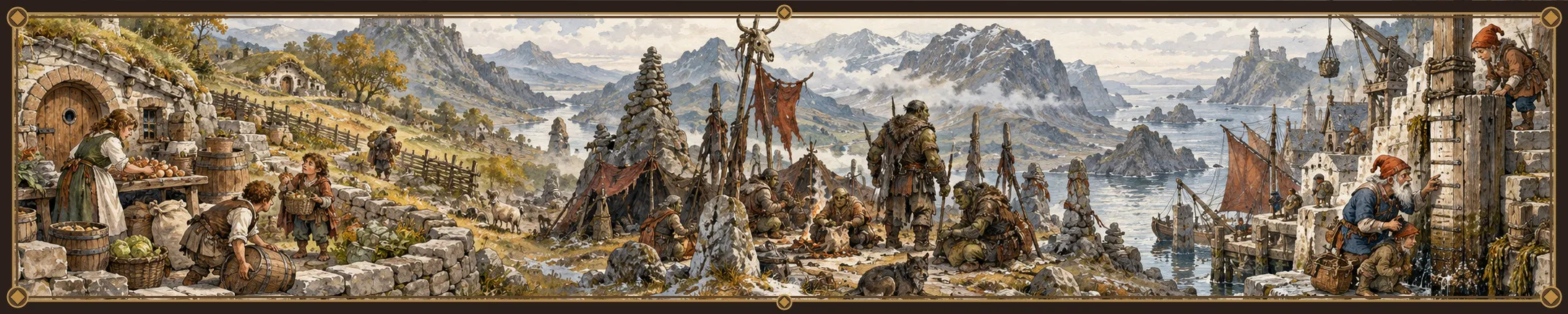
Ask the fold, and it will count you.
Ask the road, and it will walk you.
Ask the harbour, and it will sound you.
Not one of the three will let you in
for the asking.
Beyond the cradle-web, past the forests and the mountains and the river towns that think of themselves as the middle of the world, lies the far side, and the far side has peoples of its own, customs of its own, and a history that owes the cradle nothing. Three peoples share its dry country and its broken shore. In the sheltered folds the Halflings keep small rich worlds of terrace and cistern from being eaten by the hungry country around them, and by their own good years. On the scarps and the wind-scoured plateaus the Orcs walk caravans across land that kills the careless, with spears, cairns, and warning fires. On the fog-bound coast the Gnomes wrest a living from shoal and wreck-ground, and hang the wreckers who lie about the marks. They come of one deep stock, the same one as Humans, and each turned that inheritance to a different end: reserve, passage, exact reckoning. Over a hundred thousand years ago, in a long run of feuds, raids, and one real war, with each other and with the water peoples, they forced on each other the terms the far side still keeps, and their descendants still recite those terms rather than add to them. A writer who sets a story on the far side needs these three, because nobody there can buy, travel, eat, or drink without meeting at least one of them.
One Stock, Three Answers
All three peoples descend from the balanced adaptive field, the broad, flexible ancestry that also gave Caeldon its Humans. What Humans made of it in the cradle was roads and river towns: mixed ground, many neighbours, and custom piled on custom until a river valley could be held from a fortified quay. The far side’s peoples made something else of the same gift, because the far side gave them different ground. None of the three ever had a root in the cradle-web. Their homelands lie well outside the Elderweald, the Ironspine, and the Confluence, and each people grew up beside the other two rather than beside Elves, Dwarves, or Human towns.
The ground decided much. The Halflings had fertile pockets inside poor country, and learned to keep them, and to hold them. The Orcs had open, exposed distance with water scattered thinly across it, and learned to cross it. The Gnomes had a coast of straits and inlets that could feed a town or drown its boats in the same hour, and learned to read it. Each answer became a civilization, and none of the three became an empire. There is no fold-capital, no Orc king, no harbour that rules the coast. What there is instead is custom, a great deal of it, most of it about one question the far side has fought over for longer than any cradle lord has held a hall: what does a stranger at the gate get, and who must say so out loud?
How those answers look in any given year, who travels the roads, which halls are crowded, what the harvest was, belongs to the era. The atlas of each era walks the Folds, the Windscar, and the coast region by region. What follows is what does not change: the bodies, the households, the customs, fears, and treasures that run deep enough to survive every age.
Halflings: The Discipline of Enough
Halflings live where plenty has to be kept rather than taken. Their country is leeward basins, terrace belts, orchard folds, cistern-fed hollows, and sheltered interior valleys: rich pockets inside a much harsher land, where life depends on storage, rotation, careful water, and long knowledge of what a place can bear. Their first named homeland is the Leeward Folds, beside the open Windscar, and though Halflings live in similar terrace and cistern worlds elsewhere on the far side, the Folds are where their answer became a civilization.
They are not small Humans, and they are nobody’s comic relief. A Halfling is proud of exactly the thing larger peoples find hardest to understand: knowing how much is enough, and stopping there. They are not soft, either. A fold is a small rich place in hungry country, and Halflings have held theirs through swarm years, dry runs, and armed guests at the gate for well over a hundred thousand years. Pressed at their own door they are stubborn past sense.
The Body and the Fold
Halflings are small and sturdy, built for terrace work rather than long marches: for stooping over a vine row, setting a stone back into a retaining wall, carrying a basket of fruit up a flight of field steps that a taller people would take two at a time. They keep well on stored food through a lean winter. Most of them never live far from the fold where they were born, and many never want to. A Halfling’s sense of the world is the sense of one valley known to the stone, and of the bare saddles and dry spurs beyond it, which are simply where the world stops being worth keeping, and where the raiders come from.
A fold is a pocket of good ground held inside poorer country. Some are deep hollows with a spring at their head; others are long valleys whose slopes have been stepped from floor to rim with dry-stone walls. The orchards take the warm slopes, grain and garden plots the floors, and cisterns sit at the fold heads, cut into rock or walled in clay. The houses are not where a stranger expects them. They cluster along the upper edge of the terraces in close stone rows, store-rooms on the cool side of each, kept deliberately off the good ground, because ground that grows food is not for living on. And there are always terraces that nobody plants. A share of every fold lies fallow at any time, and it is the first thing a traveller notices and the last thing a Halfling will explain: a fold that plants everything has already started to die.
What threatens a fold mostly comes over the Lee Wall. In a swarm year the wind carries locusts off the Windscar in roaring clouds that strip a fold’s green in a day. Scorpions live in the walls of the bare saddles, hornets nest in the old orchard trees and drive pickers off their ladders, and hungry parties come down the Lee Road in hard years, some to trade, some to beg, and some to raid.
A Life Counted
The Halfling life is a counted life, and the count begins with the child. A Halfling is named at the first autumn count after its birth, when the household reckons it among the mouths the stores must feed. That is not a cold welcome but a warm one: to be counted is to be provided for, and an uncounted child would be a child the fold had not promised to keep. Babies are sung to sleep with a counting-song of the shelves, jar by jar.
Counting is household work long before it is anyone’s charge. Children learn to tally the shelves almost as soon as they can count, and a child who can say how many days of water the cistern holds is trusted with the cistern key before it is trusted with a knife. A young Halfling comes of age when the household first sets a share of its stores in their name at the autumn count, and with that share comes a voice at the commons. Marriage, too, moves a share. A new household’s portion of the reserve, and its portion of the fallow duty, is declared at the next count, and the two families' tallies are adjusted aloud so that neither side gains or loses in the telling.
The autumn count itself is the hinge of the Halfling year. At the fold’s cistern hall the reserve is counted aloud before the measure-keepers, and only what lies beyond it goes to market. Any household may challenge a figure. The tally is then recounted on the spot, and a challenger who turns out to be wrong owes a day’s labour on the walls. It is an old arrangement and a shrewd one: it keeps the counters honest without letting every grudge stop the harvest. A fold raided once reads out the raid’s dead with every autumn count for a thousand years. Then, after the count and before the planting, each fold meets as a commons. The terrace wards report on the walls, the cistern circles on the water, and the fold decides which terraces rest. A household that has quietly planted its fallow share is named there, in front of everyone, and that is usually punishment enough.
The rest of the year is upkeep. Walls are mended after every heavy rain. Cistern circles release water to the terraces in turn and clear the channels before the wet season. Orchard work runs from pruning to picking to drying and pressing, and orchard leagues share labour, presses, and drying floors between neighbouring folds. The table is fruit fresh and dried, grain, pressed and preserved stores, and garden food. A good Halfling table is generous and never lavish, and a writer will know a Halfling host by the moment, mid-meal, when the host stops bringing dishes and nobody at the table expects another.
Hospitality with Edges
Halfling hospitality is real, and it has edges, and the edges are declared. A traveller at a household door is fed without question. A party at the edge of a fold is a different matter. It is received at the fold market or at the cistern hall and told what the fold has declared it can spare, and a party large or armed enough may demand to hear it sworn.
The cistern halls are built for that difference. Each stands at its fold head, where the road comes in along the bare saddles, and receives its guests in a yard outside the terraces, so that a caravan can be answered, watered, and sent on without setting foot on the good ground. The guests are usually Orc escorts from the Windscar side, who camp at the terrace-edge grounds, trade at the market, rest, water by counted measure, and go on; or Gnome traders from the coast, whose arrivals are declared and whose loads are counted. Being received is not being let in. All three far-side peoples say it in one form or another, and the Halflings say it first.
The yard has its other side. Folds keep no warbands. In a dry run every fold keeps watchers on the saddles, and a horn from the rim sends children to the cistern hall and the young people to the walls with slings, pruning hooks, and boiling water from the cistern. In a hard year a fold calls in its kin from the neighbouring folds and hires guards, and every grown Halfling knows how to hold a narrow terrace stair with a sling and stones from the wall. The raiders the folds fear most are struck-name Orc bands that answer to no treaty-ground, who come at night by the saddles the watchers cannot see. Hired guards are a danger of their own: a fold that takes on sellswords in a hard year has to feed them, and a company that is fed well is slow to leave. The folds tell of the company that stayed a winter, then a second, and was only got out over the saddle when the whole fold stopped cooking for it at once.
Larger powers call all this narrow, cautious, or parochial, because they cannot imagine prosperity that refuses to grow. Halflings call it the reason there is still a fold. To them abundance is a discipline, not a spree, and its most dangerous moment is not the bad year but the good one, when a full storehouse makes every limit look unnecessary. The danger a Halfling names first is not drought or frost but too many mouths: more guests, more trade, more feasting than the fold can bear. It looks like prosperity until the reserve is gone. The worst thing one Halfling can wish on another is may strangers count your shelves.
The Turning Year
Halfling belief follows the year. There is no Halfling church and no clergy; observance is household and commons custom, and its god is the year itself. Reserve, sowing, and harvest are kept under Tamsel the Season-Weaver, who was born of the folds' long dependence on the balance of the harvest: not of fear, as some gods are, but of routine and reverence. The Halflings never prayed for time to stop. They prayed to honour its turn, and believed that if they neglected the rites of spring planting or the thanks of autumn storing, the cycle would break and the fold would eat its own reserve.
Tamsel changes with the season, a green-robed youth who smells of rain in spring, sun-browned and gold-robed in summer, crimson and brown and smelling of woodsmoke and stored fruit in autumn, pale and still as frost in winter. The planting rites open the terraces in spring. In autumn comes the thanks of storing, and the yearly Festival of the Turn celebrates the changing of the seasons; it is said that if the festival is kept with true joy, the Season-Weaver will smile and the harvest will be good. Every Halfling child knows the tale of the Long Summer, when Tamsel held the summer form for a whole year. The warmth never broke and the fruit never stopped, and the soil wore out, and the winter after emptied a fold’s stores to the last measure. It is the reason Halflings give for never spending the reserve on plenty. Tamsel is honoured, above all, by not taking more than the year can bear.
The folds keep small, stubborn heroes, mostly in proverbs and toasts. Hide it like the widow means hiding it where the raiders are standing, after the widow who hid a whole fold’s seed-grain in the cistern hall’s dry well while a band searched the house above. The last cup at the autumn count is drunk to the beehive, for the three brothers who held the lane to a cistern hall with roof-tiles and a hive. Children learn early about the slinger who held the saddle path alone against a struck band until the kin came over the ridge, and about the swarm-year fold that drove the locust bands into trenches of fire and burned them for three days without sleep.
Lifeways and Lost Folds
Halfling variation runs through lifeways rather than sharp biological branches. Foldward Halflings are most of the people. Leeward folk, of the measure-heavy inner folds around the great cistern halls, are the ones an outsider meets across a tally bench. Edgefold or Outfold households hold the outer valleys along the roads and live closest to outside traffic, its profits and its raiders.
Behind them stand older forms the folds remember as warnings. Early shelter-pocket Halflings, overgrown orchard-kin, and roadfold Halflings survive as historical or absorbed lifeways behind vanished terraces, abandoned reserves, and an inherited caution about measure. On the outer margins lie the Dry Folds, valleys whose terraces have gone to scrub and whose cisterns stand cracked and empty: the country of the Dryfold Halflings, whose last households walked away from cracked cisterns. Why the Dry Folds failed is argued over in every generation. Most Halflings take them as the plainest lesson in their world of what happens when a fold spends past its keeping, and the roadfold Halflings, whose measure did not outlast the road, are the lesson the Outfold households tell each other. Fold grandmothers say the Dryfolders sealed their last reserve into jars and buried it before they gave up, seed, saffron, and the old fold-silver, and every generation a few young Halflings go over the saddle with spades. Most come home with a fright and a scorpion sting, and tales of cold hearths that are still warm to the touch; now and then one is found at the bottom of a cracked cistern.
How the Commons Were Made
Halflings had lived in the folds for a very long time before they had a civilization. The Foldward Commons begin, c. 170,000–c. 152,000 BR, not when the first terrace was built but when the separate folds started to depend on one another: when water-sharing, stores, terrace upkeep, and the welcome given to strangers overlapped until no single fold could manage them alone. No conquering state came of it, and no fold-capital rose. Fold towns, orchard leagues, cistern circles, terrace wards, and protected market roads kept their own business. What bound them was the reserve and the oath to keep it: shared custom about stores, how many a fold can feed, and when water is released, and a common rule against waste and hoarding. It was not an early empire of small farmers. It was a civilization built around keeping enough, and holding it.
Its first great quarrel was with itself, and it was fought. In the Measure Cistern Reckoning (c. 154,000–c. 148,000 BR) good harvests and steady outside trade split the folds around the Cistern. The market houses wanted wider markets and open-handed feasts; the reserve-keeping houses, who held the cistern and the store-vaults, answered that plenty is when a fold is most in danger of eating its future. The quarrel hardened into a feud that lasted a generation. Store-vaults were raided at night to prove what lay in them, a keeper was drowned in her own cistern, and fold children still say that on still nights you can hear her counting under the water. Terrace walls were pulled down to spite a rival, and a whole slope slid in the next cloudburst. The reserve-keepers kept the cistern and the vaults; what the market houses won was the line between honest narrowing and false narrowing. A keeper may still shrink the welcome when stores, water, or ground truly demand it, but must open the vaults to the other houses and show the stores, and a keeper found lying about them loses the keys. The Commons remember it in one sentence: a fold may stay narrow, but not behind numbers nobody else may count. The stores the liars hid in those years were not all found, and the tale of a keeper’s hidden vault, cut into the terrace rock behind the cistern, has sent more than one young Halfling digging at night with a lantern. Out of that settlement hardened the Leeward measure orders (c. 146,000–c. 139,000 BR), the cistern halls, terrace counters, orchard tally-keepers, and the elders who speak for the reserves, whose weight rests on store counts that can be checked. They never became a separate state; the richest folds keep the most counters, and their counts are the ones most often believed.
The outside tested the same custom, with spears. At the Measure Cistern, in the Measure Cistern Crisis (c. 147,000–c. 143,000 BR), a hard travelling season drove more armed Orc escorts to one fold gate than the cistern hall could take. Escort camps spread along the saddle below the fold wall; the folds called in their kin and paid guards to stand on it. Water parties were stoned at the spring, a cistern guard was found with an Orc spear in him, and one night hungry escorts raided the terraces and were driven out by fold youths with slings and torches. In every fold they still tell of the cistern-keeper who climbed onto the hall wall and counted the reserve aloud to the escorts below, jar by jar, until they believed her. The escorts were stronger at the gate; the folds were stronger in the long run, because a fold drunk dry receives no one next year. The terms gave the far side one of its oldest customs, witnessed capacity: a fold that narrows its welcome must let the escorts' own people see the stores and the water, and give one of four answers: what can still be received, what must wait, where the party should be sent instead, and what will be done to keep them alive for a time. Those four answers are Halfling custom, and the Orcs later took three of them into their own. The ground below the wall where the camps stood is still called the waiting-field, and children dare one another to sleep a night there.
Orcs: The Sworn Road
Orcs are a people of hard country and long roads: escorts, warning runners, and well-keepers who walk caravans across land that kills the careless, without dense basin towns or deep halls to hide in. They are not distorted Humans, failed Dwarves, or wilderness raiders, and their history begins, and largely stays, far from the cradle. Their homeland is the Windscar Expanse: dry uplands, escarpments, basin margins, wind-scoured plateaus, and sparse caravan roads, divided between the more settled Rimward Basins and the more exposed High Scars. It is country where survival depends less on rich soil than on guarded passage, and on never pretending the land is tame.
Built for Distance
Orcs are tall, heavy-boned, and long-striding, built to walk all day under load and to bear wind, cold nights, and short water better than most peoples. They tire slowly. An old escort’s body carries the marks of every bad crossing, and the old are not shy about showing which scar belongs to which pass.
The land they walk is made of steps. In the High Scars long escarpment faces separate one bare shelf from the next, with scree fans, dry ravines, and a handful of passes between them; on a clear day the eye reaches enormously far, and a warning fire on one ridge can be read from the next shelf before a runner could cover half the distance. The wind is the first fact of life there, funnelling through the passes hard enough to strip a camp and carrying the dust of the lower basins in brown walls. Water is the second fact: a few seeps, cisterns, and catch-pools along the routes, each one known, named, and fought over. Below the scarps the Rimward Basins are shallow bowls with no outlet, their floors salt crust and cracked clay, their rims the living part, where runoff can be caught and stone cut and stacked into walls.
Most deaths in Orc country come from exposure on the open shelves, from rockfall and failing ledges, and from bad guidance: a warning not given, a delay not called, an escort that claimed knowledge it did not have. Dun dogs follow the herds and the stragglers for days, horned vipers wait at the edge of every shade on the basin floors, pan hyenas dig at any grave shallower than stone, and in a swarm year the locusts strip the grazing bare. But bad guidance is the death Orcs fear most, because it is the one a person chose, and almost everything in Orc custom follows from that fear. The dead of a warning never given do not rest: they rise as Cairn-Wakers and stand across the road with an arm raised to halt, and a captain who pushes past one meets a fury like a storm off the faces.
Kindred and Ring
The kindred is the household that matters, and it moves. Kindreds pitch their camps in the same places year after year, around strongholds and cisterns or on the sheltered side of ridges, and a family’s place in the ring is a matter of rank, and rank follows strength. On the scarps, life is lived along the routes rather than around towns: kindreds move between seasonal camps with their herds, grazing the thin grass of the shelves until it gives out, then moving on before the ground is spent. On the basin rims, life breathes in and out with the water. In the dry months households and herds draw in to the rims and crowd around the strongholds, walled spurs above a water source with a cistern cut into the rock below; after the storms they spread out again, and each stronghold shrinks to its keeping garrison.
Most adults have some share in escort or water work, even those who never captain a party. Food is lean and keeps: herd meat and milk, shelf antelope taken on the plateaus, dried and salted stores, a little hardy grain from walled terraces on strict water shares, and whatever the escort trade brings up from the folds and the coast. A stranger meets Orcs first as a party on the road or a watch above a ramp, and is received, if at all, in the open: fed from a declared share that everyone in the camp knows, and told plainly what the camp can spare. Whether an arriving party can be received at a stronghold is reckoned at the cistern, in front of the people whose water it is. The camp toast is two words, water first.
Cairns and Coming of Age
An Orc child is named into its kindred at the first gathering after its birth, before the camp and its remembered dead, and carries the kindred’s name before its own. A child’s first lessons are cairns: which stacked stone points the way, which marks a water hold, which records a death. Older children run messages between camps, and then warning runs, carrying news of storm, slide, or raiding along the warning ridges faster than any caravan moves; runners touch a wind cat’s claw before a long run. Kindred children race one another to a cairn and back in honour of the runners who outran storm and dun dogs to light a fire in time, and the loser is told the dogs would have had them.
A young Orc comes of age by carrying a full share of the kindred’s work for a season, on an escort, a warning run, or a cistern crew, with the whole kindred watching. Many first blood their spears then, on a dun-dog pack that has begun taking stock, followed back to its den. From then on they answer for their own word on the route. That is the whole of Orc adulthood in one phrase, and Orcs mean it literally: an adult is someone whose word about the road can get people killed, and who will be held to it. The oath that binds an escort to a caravan is sworn with a stone the captain carries to the end of the road and adds to the last cairn there.
Escort, Guard, Raid
In Orc country the line between escorting, guarding, raiding, and surviving is drawn with spears, and it is often the only quarrel that matters. An armed kindred on the road might be any of the four, and the same act, a share taken from a caravan the kindred brought through, can be an escort’s due or robbery at spearpoint depending on who tells it, and on who is stronger where it is argued. Escort captains are the heroes of Orc camp-tales and the sellswords of other peoples' tales, and the same captain may be both in a single season. Orc custom exists to keep debt and force out in the open, where hiding them gets people killed, and its oldest instrument is the retaliation custom.
A wrong between kindreds is never answered in secret. The wronged kindred declares its answer aloud at the next treaty-ground: what was done, whose line did it, and what it will take in return. The elders of the gathering hold the answer to the measure of the wrong. A raided herd is answered with animals, a broken escort with goods or a season’s service, and blood only with blood. Once the answer has been taken and reported back at a treaty-ground, the matter is closed, and raising it again is itself a wrong. An answer taken without declaration is not retaliation at all but a raid, and may be answered in its turn. Most answers an ordinary Orc ever sees are paid in animals, and a kindred too weak to take its answer seldom gets one. But when blood is owed, a kindred sends its best, and a young escort who rides out to take a declared answer from a stronger line, and comes back, has a name for life. Outsiders hear "retaliation" and think of endless feud; Orcs think of the opposite, the one custom that keeps a single quarrel from tearing every treaty-ground apart.
The treaty-ground gathering is where the whole of Orc public life happens at once. In the calmer months a kindred travels to its treaty-ground and pitches where its line has always pitched. For an ordinary Orc it is the one time in the year when most of the people they know stand in one place. Herds are traded, marriages arranged, young escorts taken on by captains, and news of every route exchanged. Escort terms are sworn, complaints heard, and answers declared, all of it before the whole gathering, because in Orc country a thing done where nobody saw it has, for all that matters, not been done.
The raiders the kindreds fear most are Orcs themselves: struck bands, formed around those whose names were cut from honour, who know every route and in a lean year fall on the parties they were not paid to guide. They answer to no route moot, and a kindred with an answer against one has no treaty-ground where it can be closed. A kindred that a struck band has bled sends a hunting party after it with the band’s old names written on a stick, and the hunt does not come home until the stick is burned or the hunters are under a cairn of their own.
The Dead and the Wind
Orc belief is local and kindred-kept rather than organized, and it has two gods, as the Windscar has two moods.
The dead belong to Ushkar the Ancestor-Warden, born of the kindreds' insistence that honour is remembered or it is nothing. An escort was worth what their line had done on the road before them; a kindred was worth the crossings it had held and the betrayals it had answered. To forget an ancestor, Orcs say, is to kill them a second time. Ushkar is seen as a tall figure of wind-scoured granite with a face that shifts between a young escort, an old treaty-keeper, and a weeping mother, carrying on his back the Stele of Names, on which every name that kept faith with him is cut. When kindreds gather at the treaty-grounds they keep the Reciting of the Names: the dead are named aloud with the crossings they held, and it is said that names spoken with true respect earn the kindred a year of safe passage. A kindred whose names are recited badly, or not at all, leaves with less honour than it came with, and everybody saw it. Among the names are the captain who took a whole caravan down the Shearline in a dust storm by the feel of the rope, and the escort who stood alone in a pass against a struck band while her charges got away, whose name the band itself is said to honour. Worst of all is to be struck: Ushkar can strike a name from the Stele, and a person struck is unremembered, their deeds unrecalled, their heirs owed nothing, vouched for by no treaty-ground. Along the cairn routes, old cairns raised where escorts fell bear names worn past reading, and Orcs call them the Warden’s tears.
A story is told on the scarps of an escort who tried to strike his own name from the Stele to escape his family’s broken oath, and of how the Warden came and made him remember, because the debt was part of his line and not a weight he could put down. Orcs tell it to the young as they would tell any lesson about the road: the past is a load you carry, and it is also what keeps you upright.
The wind belongs to Rakhal the Storm-Caller, born of the same people’s impatience with whatever has gone stale. In harsh country stillness kills: a camp that stays too long fouls its water, a route nobody tests becomes a route nobody can trust, and a pact kept out of habit after its terms have stopped being honoured gives false shelter. Rakhal is the scouring wind that shows which shelter is real, and he smells of ozone, dry rain, and hot stone. Camps light fires on the high ground as the windy season rises, and when lightning strikes a lone thorn on the shelves, kindreds say Rakhal has marked a place where someone once held. Beneath both gods, escorts and pacts keep their own rites of held passage and answered betrayal.
Two Countries, One People
Orc variation runs through harsh-land kindreds and route lifeways. The clearest living identities are Windscar, Rimward, High-Scar, and Open-Steppe or Far-Route Orcs. Where land and kin memory have lasted long enough these are branches, but in any era they show mostly in the work: escort, cistern-keeping, and camp discipline. Early harsh-land Orcs, broken route kindreds, storm-shelf Orcs, basin-refuge Orcs, and far-track Orcs belong to history or were absorbed, and old route memory, lost pacts, and abandoned refuges are their trace.
The deepest division is not of blood but of side. On the settled side, strongest in the Rimward Basins, stand the well-keepers, cistern guardians, reserve moots, and the answer bearers who give a declared reply to arriving parties: reserve-right. On the exposed side, strongest in the High Scars, stand route moots, cairn-line wardens, warning runners, escort captains, and the elders who keep the treaty-grounds: treaty-right. Orcs describe the two as one people with two duties, and each side suspects the other of forgetting half of what Orcs are. The two meet, often with hands on weapons, at the Oath Cistern, where a basin’s water and a thirsty escort’s spears must come to terms.
How the Pacts Were Made
Orc harsh-land life is older than any pact. The Windscar Pacts, the first named Orc civilization and the far side’s first inland founding, begin c. 180,000–c. 150,000 BR, late in the rise of the riverine Kavari Bankright Circles, when survival across the Expanse started to require agreement. Strongholds stopped acting only as local lifelines; escort duties, water access, route warnings, and seasonal movement overlapped until no hard-land community could stay a world apart. Neither a capital nor a conquering empire came of it. Known meeting grounds, sworn water and pasture, and an old custom of answering blood bound dangerous distance into a pact world, and the Pacts proved that the far side could raise a lasting civilization entirely outside the cradle.
Their first great split was a war. In the Rimward Passage War (c. 135,000–c. 128,000 BR) a hard dry cycle ran the basin reserves low just as traffic on the routes was heaviest. The Rimward strongholds began barring their gates to escorted parties; the High-Scar escort-bands saw betrayal, since passage had been sworn at the treaty-grounds, and came down the ramps armed to take the water. Season after season wells changed hands, and the dry country between them filled with the dead. Parties turned away from one well died of thirst before the next, the escorts read the scar vultures over the passes to learn who had not got through, and raiders who served neither side stripped both. Escort kindreds still raise their cups, before the first water of every crossing, to the escort-leader who held a captured well-head for nine days with her water-bearers dying around her; the rim strongholds still tell, with pride and without regret, of the stronghold that poured its last cistern into the sand rather than let the bands drink it. It is the great loss of Orc memory, and its dead lie under the oldest cairns.
Neither side won. The war forced the Pacts to name the two rights earlier custom had run together, reserve-right and treaty-right, and to swear new terms at the treaty-grounds: a stronghold may still shut a well that would truly fail, but wherever it can it must give a sworn party one of three answers, a small, guarded welcome, a later welcome on stated conditions, or a guided turn towards another well that can take them. They were three of the four answers the Halfling cistern halls had first given, now sworn into Orc custom, and a stronghold that turns travellers away with no answer at all invites the escort-bands back. It is no written code, but an oath kept because each side can still hurt the other. Each side then hardened around its own duty without breaking the Pacts in two: the rim into the Rimward Well-Keepers (c. 124,000–c. 116,000 BR), who carve on their cistern lips the names of the guardians who held a cistern through a drought siege; the routes into the High-Scar escort orders (c. 121,000–c. 112,000 BR), whose captains win their names running raiders down, and who swore in part to name the escorts who failed, so that the Cairn-Wakers could be laid. The wells that changed hands most often are still called blood-wells. Some were sealed and hidden by the holders who lost them, and the tale of a lost well, sweet and deep, under a cairn whose name has worn away, is told in every camp; a kindred that found one would be rich for a generation, and would have to hold it against everyone who learned of it.
Gnomes: The Exact Coast
Gnomes are a people of fine craft, exact reckoning, and measured courtesy, who wrest a living from a coast of fog, shoal, and wreck-ground. They are neither comic inventors nor softened Dwarves. Their precision is how they stay alive: on their coast a wrong mark drowns a crew. Their country is the working shore of the Tidelace Coasts, a coast of tidal straits, inlets, island chains, fog belts, and breakwater harbours, and the Soundchain Roads of stations beyond it. Their heroes are pilots and beacon-keepers rather than warriors, and their great losses are boats that did not come back, and whole harbours of earlier lines that now lie under the sea.
The Trained Eye
Gnomes are small, deft, and fine-handed, built for close work rather than heavy work. They are sure on stairs, quays, and wet rock, at ease in small boats and fog, and seldom live out of sight of the sea. Their eyes are trained rather than born keen. A Gnome child learns to read swell, cloud, and the marks on a gauge the way other children learn faces, and an adult Gnome looking out to sea is not admiring the view but reading it. The harbour saying is read twice, row once.
The coast they read is frayed rather than drawn: fingers of rock and long inlets, islands strung offshore with straits between them, sea-cut terraces climbing to the cliffs. Little of it is open sea and little is soft shore. Most of it is water a hull can use only with knowledge, channels threaded between shoals, straits that run like rivers at mid-tide and lie still at slack, harbour mouths safe for an hour and wreck-ground the next. Liveable coast here is made, not found. Breakwaters close the mouths of the best inlets, channels are cut and marked, sounding houses keep the depths and tides of every approach, and beacon lines pass warning from headland to headland. Behind the islands the marked inner channels that join harbour to harbour are called the Lacework, and a harbour child knows its marks before the names of its towns.
The sea takes more Gnomes than anything else. Fog: the great belt of the outer coast, the Long Grey, rolls in off open water with little warning and can lie on the straits for days, bringing stinging fogbells in by the thousand, when beacons are lit, bells rung, and nobody moves who does not have to. In the fog the drowned row back as the Grey Crews, hailing the living to follow them onto the shoals where they were lost, and pilot families say a pilot answers no hail in fog, however familiar the voice. Storm, which drives surge into the inlets and breaks in a night what the breakwater crews built in a summer. Moving ground, because shoals shift and channels silt, and a mark true last year may be false this one. Blackfin pods hunt the outer isles, and every breakwater has its conger and its crew a story about hands; a crew that brings in a conger longer than its own boat drinks free in every harbour of the chain. And the false mark: a beacon lit in the wrong place, a marker left unmoved to spare a family’s name, a channel declared readable that was not. Gnomes fear the lying sign more than any weather, because weather does not pretend.
The Harbour Family and Its Mark
A harbour town is built upward. The breakwater and quays sit at the waterline; on the first terrace stand the sounding house, the gauge house where tide gauges and timing instruments are made and kept, and the tide hall; above them the stone houses of the harbour families climb the cliff with walled terrace gardens between them; on the headland stands the beacon tower. Stairs join the levels more often than streets do, and a stranger’s legs will know a Gnome town long before their head does.
The household is the unit of the work. Sounding, pilotage, beacon keeping, gauge-making, and breakwater masonry pass down families for generations, each with its own pride and its own mark, cut on every post and marker it sets, so that every mark on the coast says who will answer for it. A Gnome is born into that mark and named with it, the sign its readings will carry in the sounding-house ledger. Children learn a tide table and a signal line about as early as letters. A young Gnome comes of age when a first reading of their own is declared at the tide hall’s bench, entered under the family’s mark, and stands unchallenged, and families keep that date as others keep a naming. From then on the family’s good name answers for that Gnome’s honesty as well as its own. A family rises or falls with its readings, and an incoming spouse learns the new family’s marks before being allowed to set one. The harbour curse, said low, is may your mark be doubted, and no Gnome says it in jest.
Around the craft families work fishers, net-menders, boat-builders, ropewalk crews, and quay hands. Food comes from the sea and the terraces: fish, shellfish, kelp, seabird eggs, small crops from the walled gardens, with stored grain and orchard goods traded in from the Halfling folds by counted exchange.
Tide Hall and Beacon Night
The Gnome year runs on the tide tables and the weather. In the calm months the breakwater crews rebuild, the sounding houses resurvey the approaches, and traffic moves. In the storm season the halls sit, the families mend, and the beacons burn through the long nights. In the storm season, too, every household of a beacon district owes a share of nights at the tower, whatever its craft, and a missed night is entered in the beacon ledger beside the family’s name, where it stays. Each season closes at the sounding house, where readings are compared and markers moved where rival families can watch.
The tide hall's elders sit at slack water, so that pilots and fishers can attend between tides. A day’s quarrels might run from a closed fishing ground to a repair duty each house throws on the next to a moved marker nobody will own, and the oldest sounding families' word weighs heaviest. Nothing on the list is small, because on this coast small things drown people. A town that lets a beacon fail or a marker drift is shamed before the whole coast, and that shame does more than any council.
The worst enemies of a Gnome harbour are the ones who move the marks. Wreckers on the outer headlands light false beacons in the Long Grey to draw ships onto the shoals and strip them, the living included; a sounding family that catches a wrecker’s fire sends its boats and its harpooners, and a wrecker taken by a Gnome harbour is hanged from the beacon he lied with. The beacon wardens who hunt them along the headlands carry no lamp at all, because a light on a headland is the very thing they are hunting. The coast honours keepers, not conquerors: the beacon-girl who kept her tower lit through three nights of storm with the timbers of her own house, for whom the youngest of the district carries the first stick up the stair on beacon nights; the old sounding-master who walked out along the wreckers' headland alone at night and put out every false fire with his hat.
Received Is Not Let In
A stranger at a Gnome harbour is asked, before anything else, who they are and what they carry. Being received is not being let in, and the hard line between safe entry, risky entry, and no entry at all is the heart of Gnome courtesy. Larger or harsher peoples find it fussy, delicate, or pedantic. On a coast where a wrong mark drowns a crew and a falsely generous harbour turns refuge into wreck, it is what keeps the edge liveable, and Gnomes regard a careless welcome as a kind of violence. It is also power: the harbours know the only safe channels, and can wait out anyone who does not, and sea-raiders who try a harbour mouth in a hard year learn, if they live, that a harbour that knows they are coming can simply put its marks out.
Along the Soundchain Roads the same habit takes the shape of station life. Each sound has a station of a few quays, a declaration house where parties are counted and answers written, store sheds and cisterns, a sounding house, and beacon towers on the headlands. An arriving party’s captain gives a declaration at the table: who travels, what they carry, where they mean to go, and who answers for them. The station gives one of the answers every station uses: received for transfer here; supplied and sent on under a pilot; held on stated terms until a named day; or sent on to a station that can bear it. Nothing crosses a quay unrecorded.
Clock and Tide
Gnome belief lives in harbour custom and the keeping of true marks, and an unkept beacon or a falsely read mark is close to sacrilege. Timed passage was long kept under Quennet the Clockmaker, born of the harbours' anxiety: the coast can be entered safely only inside narrow windows, and the Gnomes did not pray for calm seas but for time, a breath longer for the fog to lift or a signal to be read right. Quennet appears as a gaunt, stooped old Gnome in a coat of ticking pockets, carrying a brass watch whose hands run backwards, and where he passes a harbour bell is heard a moment after it swings. He is fading, because far-side tide tables carry timing now in declared and sworn form rather than in prayer, but harbour wards still say his name under their breath when a declared window has to be changed, and old gauges are said to stutter before a window fails.
Beside his shrines stand those of Maris of the Tides, born of the Decade of Storms from the shared plea of Gnome harbours and the coastal Humans of the Tidelace, and still belonging to both. Pilots back from a hard passage pay her toll of story aloud at the shrine, and once a year the Festival of the Tides brings a whole harbour down to the quays with flowers, shells, and stories for her. Harbour families hold that a Grey Crew is a boat lost without its passage told at her shrine. Pilots pray to both gods, and thank Maris when a window holds.
The Humans of that coast, whose hamlets stand on the beaches and coves between the Gnome towns and whose oldest tales begin on this shore, are a people of their own; their story is told with the Humans.
Lifeways and Drowned Harbours
Gnome variation runs through coastal lifeways and craft families rather than biological branches. The clearest living identities are Gaugeward, Tidelace, and Chainwake or Island Gnomes, shaped by harbours, gauges, fog, island chains, signals, and kept approaches. Behind them lie the lost: early inlet Gnomes, fogbelt Gnomes, drowned harbour kin, and outer-isle Gnomes, remembered in lost ports, old signal custom, and island songs. The coast keeps their remains in plain sight. Old breakwaters lie under the water, signal towers stand in the sea, and lost ports sit at the heads of silted inlets, a hazard to every keel and a lure to every diver. A gauge or sounding-glass brought up whole from a drowned harbour is worth more than its weight in silver, and the coast holds that the lost lines made them truer than anything made since; divers go down for them on a breath and a rope, among congers and broken stone, and every harbour has a stair where a diver’s family waits on the tide that did not bring them up.
How the Leagues Were Made
Gnome coastal life is old before it is a league. The Gaugeward Leagues form c. 165,000–c. 146,000 BR, when straits, inlets, cliff harbours, and island chains came to need the same knowledge, and signal practice, soundings, repair duties, and the line between safe and unsafe entry overlapped until no harbour could keep them alone. There was no sea-empire and no harbour-capital. Beacon chains, shared marks, and the shame of a failed beacon tied the coast together, and weight in each town went to whoever kept the approaches honest. The Tidelace did not become safe by becoming simple; it became livable by being exact.
Its first great quarrel came at the Sounding Gate, in the Sounding Gate Quarrel (c. 155,000–c. 149,000 BR), the first of the far side’s three great quarrels among its own. A run of bad seasons, heavy traffic, shifting shoals, and the Long Grey lying on the approach for days split the harbour houses that grew rich on ships, who wanted the approach open longer and bolder, from the sounding houses that kept the signal lines. Then the wrecks came. A laden ship went onto the bar in fog on a reading one house swore was good, and its crew drowned within hearing of the shore. Markers were moved at night; a beacon was lit on the wrong headland and a rival’s ship followed it onto the rocks; signal-keepers were beaten off their towers; rival houses hired wrecker crews to bring ships in on their own readings. For years the Gate was as much a battlefield as a harbour mouth, and harbour songs say the first Grey Crews seen off it were the crews of that feud, still rowing for a light that was never true. Gnome children are still raised on the tale of the house that moved a mark to drown a rival’s ship and drowned its own heir on it instead. The feud ended when the strongest League houses had lost too many crews and forced terms the lesser harbours had to take. Those terms set apart trustworthy exactness from proud pretence: a house may still close its approach when the water truly demands it, but soundings and marker changes are made where rival houses can watch and check them, and a house caught moving a mark in secret answers to the kin of anyone who drowns by it. A reading earns trust only if others may test it. The Tidelace calibration orders (c. 148,000–c. 132,000 BR) grew out of it, still inside the Leagues, sending boats out to recheck every mark after a storm, rowing the fog lines to keep the beacons lit, and hunting the wrecker bands along the headlands. The wrecks of the feud still lie on the bar at the Gate with their cargoes, and the bar takes most of the divers who go down for them.
Three Answers, One Custom
The three peoples learned their custom from each other, mostly the hard way. Orc escorts came down out of the wind to the fold gates with spears in their hands. Halfling carriers met Gnome boats on cliff-path beaches where raiders waited. Windscar parties arrived at Gnome harbours expecting to land, and found a shore that would not let them in. Out of these meetings, and out of the feuds of the Thaluren and the Kavari on the far waters, came the age the chronicles call the Far-Side Terms, c. 160,000–c. 98,000 BR: a long chain of feuds, raids, and wars, in which the stronger side dictated terms each time, and the terms that held became the custom of the far side.
Fold and Road
The Leeward-Windscar Terms (c. 160,000–c. 145,000 BR) were the first lasting terms between two far-side peoples, and they were made over graves. The first meetings were not trade between willing neighbours. They were thirsty, armed parties coming down off the saddles with dun dogs on their line, at the gate of a valley where the orchards were in fruit and the cisterns full. The Orcs carried more spears; the Halflings held the water and the stores. In the early seasons some folds were plundered, their terrace walls broken and their reserve cisterns drunk dry in a week, and some caravans were left to die outside shut gates with the water in plain sight. Fold grandmothers still bar the door a second time on the anniversary of the night the Windscar came over the Lee Wall; Orc kindreds name, at every treaty-ground, the gates that did not open. The killing ended in a bargain, because a plundered fold feeds no one next season and a betrayed caravan’s kin come back with more spears. Escorted parties are owed a welcome at named fold markets, cistern halls, and terrace-edge grounds, and a party that raids a market loses it at every fold on the saddle; but a welcome is not entry, and how much water, food, and room a party gets is the fold’s to say. From this the far side learned that a fold may be open without being eaten, and that sworn passage is not a key to everything stored. The plundered folds of the first seasons were never all rebuilt, and the dry cisterns under their broken terraces are said to hide what the fold-folk buried when they saw the dust of the war-bands on the saddle: seed-silver, store-tallies, and the old keys of the vaults.
Fold and Coast
The Halfling-Gnome line was quieter, but not safe. In the Leeward-Tidelace Measures (c. 146,000–c. 140,000 BR) fold carriers brought grain, fruit, and oil down the cliff paths to the coast, where raiders waited for laden carriers on the bare spurs and a landing safe at dawn could be wreck-ground by noon. Halflings counted stores, seasons, and how long a load would keep; Gnomes counted tides, weather, soundings, and whether a landing could honestly be reached today. Each thought the other’s caution careless, and they settled on counted loads for the fold and declared landings for the coast, two rules rather than one; the first carrier companies that hire out as escorts, half sellsword and half porter, came from those paths. Their clearest meeting place is the Counted Lee, a lee-side tally hall and transfer pier between fold and harbour. There, in the Counted Lee Timing Feud (c. 139,000–c. 136,000 BR), the harbour houses kept changing the landing day after the loads were on the beach; carriers waited on the shingle guarding grain against spur-raiders and gulls while the loads sweated and spoiled, a carrier party sent back up the paths in a storm was lost in a rockfall, and loads left overnight were plundered by wreckers who seemed to know exactly which beach to work. A carrier band lay in wait one night, caught a wrecker crew at the loads, and drove them into the surf with spades and pruning knives. The feud was fought with withheld grain and withheld boats until the Lee emptied for a season. The coast held the anchorage, and kept most of its right to change the day; the folds won their part only by showing they could take their grain elsewhere. The Leeward-Tidelace Timing Oath (c. 136,000–c. 134,000 BR), sworn at the Lee before the assembled carriers and crews, carried the settlement down the coast: when the harbour changes the day it says so at once, any load lost by the change is shown before both sides, and the two sides then bargain over whose fault it was. It is the custom with which Quennet’s fading began, and its toast is drunk by carriers and crews together after a hard landing: to the day that held, and the ones who died waiting for the ones that did not.
Road and Coast
The Orc-Gnome line was harder. The Tidelace-Windscar Approaches (c. 148,000–c. 138,000 BR) began when Orc escorts started reaching the coast regularly and found a shore that would not let them in. The Gnome harbour houses held every safe channel and could wait the Orcs out, and at first they did. Parties camped on open beaches with nothing between them and the gales; some tried the inner channels without pilots and went onto the shoals, and wreckers stripped what washed up. Escort-bands raided outlying sounding houses for food and water; harbour crews burned the boats the Orcs had bargained for. An Orc war-leader took a sounding house with a dozen spears and fed a starving beach camp from its stores for a month, and the harbour crews hunted her down the coast afterwards and hanged her from her own captured mast. The terms that ended the worst of it split arrival from entry: outer-shore reception and inner-harbour entry. A sworn party may demand to be met, counted, warned, supplied, made to wait, piloted, or sent on at named roadsteads and beach yards, but not to be let into the harbour where tide, weather, or crowding would make it a false kindness. The coast, holding the channels, kept more by the split; the Orcs won the right to be answered rather than left to rot on the shingle.
The place that tested it was the Answering Sound. In the Answering Sound Crisis (c. 141,000–c. 137,000 BR) gale after gale drove Windscar parties into the lee of the Sound while the inner channels along the coast were full, and the harbour-masters answered with warnings, holds, pilot shortages, and one more delay, each of which they were entitled to give. The parties camped on the shingle, short of water, while wreckers worked the outer islands and the blackfins and fogbells that follow a storm into the lee took anyone who waded out. Children were buried in the dunes above the Sound, and the escorts began to name them aloud at every new delay; the Windscar curse for a shut door, may you wait at the Sound, dates from those years. Some Orc war-leaders stopped arguing, seized boats, and tried the inner channels by force, without pilots, in fog. Some drowned in sight of the harbour they were trying to take; one band reached an inner quay and burned it before it was driven out, and its war-leader, carried back to the dunes with a hook in her side, is an outrage to the Gnome harbours and a hero to the Windscar escorts. The harbours held the pilots and the channels, and the outer shore stayed apart from the inner harbour; what the Orcs won with their dead was declared answerability: a delay must have a stated end, a shortage of pilots or room must be said openly, and passing danger must be kept apart from plain refusal. The Tidelace Answering Custom (c. 137,000–c. 135,000 BR) carried it along the whole coast, three plain answers instead of one vague one, and it held because both sides could still hurt each other: a harbour that broke it found convoys going to its rivals and burned beacons on its headlands, and an escort-band that defied a plain answer was treated as a war-band. The Gnomes then gave it a keeper in the Answerward Pilotage (c. 135,000–c. 129,000 BR), pilots sworn to the leading harbours, rowed out blind into the Long Grey to climb aboard among thirsty, armed strangers and tell them the coast’s answer. Pilots drowned, were thrown overboard by crews who disliked the answer, and were ambushed in their boats by the wrecker bands of the outer islands, among whom a pilot’s head fetched a bounty. When the pilots began giving orders far beyond the outer approaches, Windscar crews and smaller Gnome harbours together fought them back in the Answerward Overreach Feud, and the pilots kept a narrower charge.
Over the next tens of thousands of years the line calmed into routine trade along the Soundchain Roads, and found a subtler quarrel there: whether many small closings, each fair on its own, could add up to one shut door. The fighting over it, beacons thrown down, a Gnome pilot dead, burned convoys still unavenged, ended in the Soundchain Closure Terms: a harbour must name what kind of trade it closes, and where, and answer for whether all its closings together have shut one people out. The Turnwater Reopening Accord (c. 100,000–c. 98,000 BR) followed, the first time a far-side corridor reopened what it had closed under the same terms it had closed it by. It nearly died before it was sworn, when a beacon above Turnwater was put out on a convoy’s night and the convoy went onto the rocks below the cliff-stair; it was saved by a hunt, when escort war-crews and harbour boats tracked the wrecker band to a cave on the headland and found the convoy’s cargo stacked inside. The wreckers' hoard, the station keepers say, was not all found.
The Same Lesson, Three Times
Seen together, the far side’s history repeats one lesson in three accents. Each people first fought its own: the Gnomes at the Sounding Gate over exactness under pressure, with moved marks and false lights; the Halflings at the Measure Cistern over welcome under plenty, with raided vaults and a drowned keeper; the Orcs much later on the basin rims over passage under scarcity, with spears at the wells. Each time the settlement had the same shape. Each holder kept its say, and lost the right to vouch for itself. A fold may narrow, a harbour may delay, a stronghold may refuse, but each must say so where someone else can check it, because someone else has the spears, the boats, or the grain to make it hurt.
Those terms became the custom of the far side for the rest of its history. Later songs look back to them and add nothing new, and through the long unrecorded ages that followed, while the cradle lost its written record, far-side harbour ledgers kept their own count. That is why a far-side elder, to a cradle ear, always seems to be quoting something very old. It usually is.
How the three peoples live in a given era, whether a dry run has the cisterns falling, which harbour closed which cove, which escorts are crowding the terrace-edge grounds, belongs to that era’s atlas. The bodies, the counts, the cairns, and the marks do not change.
Tensions
-
A reserve for every need. Hard years bring armed Orc escorts, travellers, and neighbouring folds to the cistern halls asking for more than a fold has declared it can spare. The askers call bounded hospitality an excuse; the folds answer that a reserve opened for every real need is no reserve. An escort could take a fold’s terraces in an afternoon, and each hard year tests whether the memory of what a raided fold becomes is still stronger than hunger.
-
A company that will not leave. A fold that hired sellswords against a hard-year raid may find the company still wintering on its stores, and speaking of the fallow terraces as its pay; the fold’s kin in the neighbouring folds must decide whether to send their slingers.
-
Escort or raid. A share taken from a caravan a kindred brought through is the escort’s due to the kindred and robbery at spearpoint to some caravans. Which it is depends on who is stronger at the treaty-ground where it is argued, and it is never settled once.
-
Cistern or road. Since the Rimward Passage War, the well-holders of the basin side and the escort orders of the route side have balanced each other, and each suspects the other of forgetting half of what Orcs are: the escorts say harsh land is to be held, not tamed; the well-holders that a people who only move cannot keep the water everyone needs.
-
The well under the worn cairn. The hidden wells of the passage war are still sought in every dry year. A kindred that finds one under a cairn too worn to read must hold it against two strongholds, an escort order, and the struck bands who watch the finders' camp.
-
Whose honesty. Every reading entered under a family’s mark is answered for by the whole family, and the coast has no settled way for a household to disown a doubtful reading without disowning the reader.