Chapter 17. The Threads of History
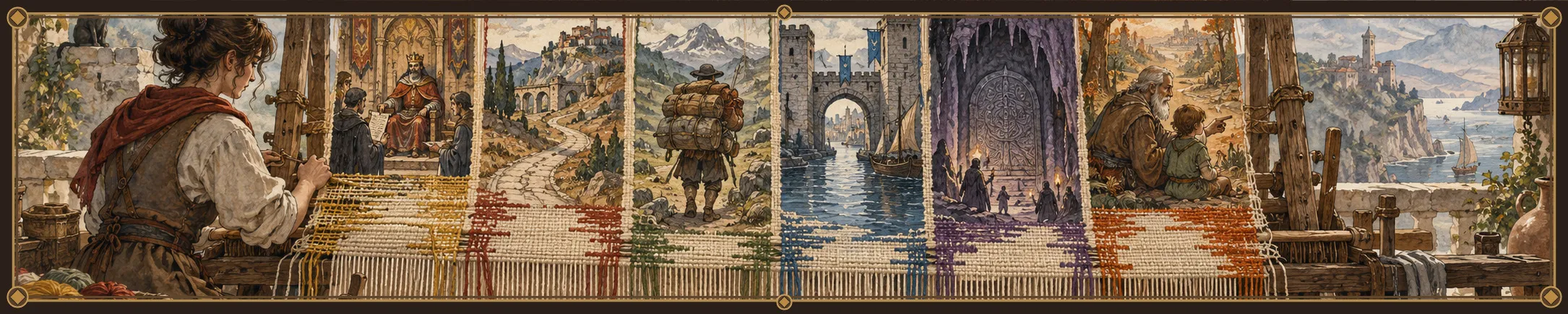
No flood comes down a new channel.
Every water runs where older water ran,
and the bank it breaks was raised against
a flood your grandmother’s grandmother saw.
The ages tell when things happened and what else was happening at the time. They do not tell why the world that came out of them looks the way it does, or why its people still kill each other over a ford, a seam, or a door in the deep. For that the historian has to follow threads rather than ages: old quarrels that run through many ages and many peoples, each beginning in a first wrong, a first war, or a first catastrophe, and none of them ever settled. Six such threads run through Caeldon’s deep past. Most of the feuds and wars of later times pull on one or two of them, and a quarrel that seems new is usually an old knot come round again. This chapter follows each thread from its first knot to the edge of the Medieval Era. The ages the threads run through are told in The Ages of Caeldon, and the elder worlds where most of them begin in Worlds That Came Before.
Who Counts and Who Records
Who counts, and who decides? On Caeldon a people has long counted only if someone strong enough wrote it down or accepted it; a people left out has only what it can defend with its own hands. A household, a warren, or a whole people may be present for a hundred thousand years and still, in the eyes of whoever holds the roll, not be there. The thread begins in an elder world that carved its words in stone and kept armed wardens to make them bite, and it runs through every later power that picked up its tools, usually without knowing where they came from.
The Archive and the Warrens
The archive world, which rose c. 235,000–c. 175,000 BR, ruled by the carved word and the warden’s spear: it cut every promise, debt, boundary, and name into stone, and the communities whose names were cut owed their protection to the keepers who cut them, and to the wardens those keepers fed (see Worlds That Came Before).
The Goblins were among those it entered. Warrens that kept the gaps under its roads were cut into its rolls as warranted peoples, and for the first time since the loss of their seams Goblins held a place outsiders could read; then, in the Unlisting of the Warrens, c. 180,000–c. 150,000 BR, the rolls froze, the warrants lapsed, and the wardens drove the warrens from the gaps with fire and spear (their losses are told in The Bridge Peoples). No single decree did it; thousands of small choices by keepers with every reason to favour the houses that fed them did. It is the first dated sign of a civilization hardening past what the living could bear, and the culverts the warrens lost still hold what they left behind when they fled.
The Oath-Craft Passes to the Water
When the archive-cities sealed themselves with their oaths inside, in the Last Keeping, c. 150,000–c. 120,000 BR, not everything was sealed in. Keepers who would not let the old craft die came down to the river and taught it to the Reedfolk Floodkeeper Houses, who took the sworn name as a living act rather than a shut roll and kept it through the long silence that followed (see Peoples of the Water).
Far from any archive, the Sepulchre-Kin made the opposite mistake. In the Unburial War, c. 110,000–c. 80,000 BR, their burial houses turned the power to name and hold the dead into a weapon against one another, and their great Record-engine, taught by a last census that the living could be kept as the dead are kept, preserved its own people to death. A people that counts only while it is written down can be lost when the roll closes. It can also be lost when the roll will not let go.
The River-Lords
In the Corridor Ages the thread came to the Human powers. The Goblins answered their next loss, the frontier lords' habit of treating ruined ground as anyone’s to take, with the Iron Compacts, c. 20,000–c. 9,000 BR: armed companies holding a road, a ruin, or a gate under a warrant that is both their protection and their leash, because what a lord grants he can tear up. On the Lower Serath, the great river houses ended a bloody inheritance feud on the quays by swearing who counts for how much, and making it stick. In the Serathic Oath of Layers, c. 19,000–c. 18,000 BR, they refused to choose one people’s idea of growing up and swore three thresholds at once: Protection, Stewardship, and the full oath, drawn where the river houses wanted them.
Then, at the very end of the deep past, made people forced the question again. The awakened Wrought, c. 1,500 BR–c. 200 CR, were valuable property in the eyes of those who held them, and a person cannot be owned. What won them a place was sanctuary and an oath: the workshops that hid them in their walls while the Unmakers searched, and that became the Mending Orders, swore before kin, neighbours, and gods that a mended Wrought was still the same person who came in. The oldest tool of the thread had found a new use.
By the threshold of the Medieval Era the thread had left frontier towns where who counts depends on who holds the walls, Goblin households driven out the day a warrant is torn up, Wrought still fighting to be counted as a people more than a thousand years on, the Unsworn Dead who linger at the record-house until their death is written, and Reedfolk houses that say, in every lord’s hall that will listen, that the oath-craft the river-lords boast of was theirs first. A Goblin household whose warrant is torn up has one road left, and it leads into the ruins.
Roads and Crossings
Who keeps the way open, and who profits from it? Caeldon’s roads are older than any power that now takes a toll on them. Each age has fought for the same routes, no one who held one has ever let it go willingly, and the toll goes to whoever holds the crossing this year.
The Colossal Roads and Their Oaths
The Upland Colossal world, which rose c. 260,000–c. 195,000 BR, built the first great roads on Caeldon, and its own peoples found many of their crossings murderous to keep. In the Swearing of the Crossing-Charges, c. 230,000–c. 190,000 BR, its road-keepers bound the Troll lines that already lived at those crossings to keep them, for passage-dues, by oath. It was the first time separate ravine families became one order.
Then the colossal world withdrew, c. 198,000–c. 160,000 BR, and its roads were left to the weather, the beasts, and the bold. The road-keepers stopped answering; the Troll lines kept the charges anyway (see The Bridge Peoples). A crossing-oath had outlived the world it was sworn to, and the Troll houses that keep it treat that as their title.
Keepright
The same withdrawal sent smaller survivor lines out onto the abandoned roads. In the Walking of the Unkept Roads, c. 175,000–c. 140,000 BR, some began walking them in seasonal circuits, keeping what the storms broke, and became the Salvage Peoples and their first order, the Edgeway Kindreds. Groups that came back to the same works for generations claimed them by keepright, and nobody challenged it until younger lords put armed men and sealed grants on the same roads (see Worlds That Came Before).
So from the same moment two peoples claimed many of the same roads: one by holding the crossing, the other by walking the route. Where they still meet, Troll oath and kindred mark often record the same danger in different words, and whose hold is stronger at a shared crossing is rarely settled.
Debt on the Roads
Ages later the Human corridor powers built over the same country, and they built with other people’s strength. Ogre camps held by debt in the Chain-Camps, c. 18,000–c. 8,000 BR, worked the corridor roads, walls, and floodworks, and Humans and Dwarves drove the Headwater Exchange Roads, c. 16,000–c. 8,000 BR, over the foothill country partly on Ogre backs; the gorges claimed their share of the builders. The roads are still walked. Some of their sections carry the marks of the camps that built them, some burden houses still hold the old debt-ledgers, and Ogres say the road cuts where whole camps died are bad places to stop at night.
By the threshold of the Medieval Era a single crossing could carry a Troll oath sworn to a vanished world, a kindred’s keepright, a burden house’s unclosed ledger, and a lord’s sealed grant, each held by whoever was strong enough to hold it that year. The thread left crossings held by force and repaired by the weak, Troll tolls taken in the name of no one living, highwaymen and the Crossroad Hanged, the Rattlecut Dead on the worst stretch of the Headwater road, and sellsword companies that hire out to hold a crossing for a season’s tolls and are paid off or hanged when it changes hands. The caravan songs of the Headwater road are of ambushes in the gorges and of the guard who held a narrow stretch alone until the last wagon was through. At the failing Greyspan in the Greyford Reach, every quarrel on the thread meets at one bridge.
Burden and Bonded Labour
Who carries the weight, and what are they owed? Again and again the powers of Caeldon have needed a people’s backs or hands and given that people no say. The same wrong comes back under new masters, and every people it touched found its own way to fight it.
The Furnaces and the Deep
The thread begins in the furnaces. The Ash-Furnace world could not run without Kobold knowledge of air, heat, and collapse, and in the Vent-Houses of the Furnace World, c. 250,000–c. 168,000 BR, it bound Kobold vent-kin into hereditary houses with a say over whether a furnace could safely be fired, for as long as the masters chose to listen. As the world tipped into its burning the masters stopped listening, and the vent-houses died in the shafts they had warned of, with the Ogre ash-camps that hauled the fuel. The survivors who fled downward found protection turn into debt, debt into bonded service, and service in the worst houses into captivity (see The Bridge Peoples). It was the beginning of the old habit in which Kobold skill is sent for while Kobold freedom is distrusted.
Hearth-Weight
The Ogres made their own custom against hungry strength long before anyone used it against them. In the Long Hunger, c. 195,000–c. 160,000 BR, when starving camps broke into hunger-bands, the surviving households bound their strength to hearth-weight: the vulnerable fed before the strong, and strength that takes without carrying stripped of respect.
It also left a weakness later powers found. A people whose custom says strength must carry the vulnerable can be pressed into carrying almost anything, so long as someone else holds the food, and that is what the chain-camps did. Around c. 15,000 BR the camps along the Headwater roads turned hearth-weight outward into the Hearth-Weight Compacts, terms any employer had to accept before a band would work (see The Bridge Peoples). They did not end debt-bound labour, but they gave the camps something to fight it with, and by the end of the span the great Headwater road works could not be built without them.
Labour That Could Not Refuse
The Dwarven holds had long built mindless workframes for the worst deep work, much of it once done by Kobold vent-kin in bonded service, and the two peoples remember differently whether the frames were built to spare the Kobolds or to stop paying them. In the Spread of the Predecessor-Frames, c. 16,000–c. 2,000 BR, the Headwater roads carried the frames out of the holds and across the corridor world, and each owner pushed them towards more self-direction, until, in the Awakening of the Wrought, c. 1,500 BR–c. 200 CR, the labour that could not refuse woke up.
Each people this thread touched found its own way to fight it: the Kobold Underhouse Compacts, whose crews all walk off a shaft at once; the sworn terms of the Ogre camps; the sanctuary and the sworn word of the Wrought houses. Each asks the same question in its own words: does carrying, keeping, or making a thing give a people any say in it? Some answer with violence of their own. By the threshold of the Medieval Era the thread had left Ogre camps that down tools and bar the stores, Kobold crews who walk off the vents together, Wrought fighting over who may mend them, estates and war-captains posting rewards for runaway Wrought they say they own, and frame-strippers picking over every battlefield for a frame that lies still. In the Broken Marches a fugitive frame is either hidden or sold, depending on who finds it first.
Water and Who Keeps It
Who may decide about living water? On the rivers and coasts, the water belongs to whoever remembers it truly, or so the oldest water peoples hold. Later powers have simply taken it, and written down that they did.
The town keeps a roll of the river. The river keeps no roll of the town.
The Oldest Water Orders
Reedfolk flood-keeping became an order very early, in the Founding of the Floodkeeper Houses, c. 210,000–c. 182,000 BR. Nothing stood over the Houses; they were held together by oaths sworn across moving water and the duty to warn of floods, and a house was trusted if what it vouched for stayed safe through water that never stayed still.
On the far side, the resident freshwater people of the tributaries reached the same kind of order by growing into it rather than founding it. In the Consolidation of the Bankright Circles, c. 190,000–c. 160,000 BR, Kavari bank councils, pool-kin households, and nursery keepers on linked channels began settling quarrels by the same reasoning and honouring one another’s closures, until the Kavari could speak with one voice across a whole river, and turn out with one line of spears.
The Closed Water
Then blight killed the oldest Thaluren spawning water, in the Closure of the First Nesting Confluence, c. 178,000–c. 162,000 BR, and split the Thaluren between the Blightward Keepers, who hold that a poisoned holy water must still be guarded, mourned, and owed, and the Open-Run Concords, who hold that the return must move when survival demands it.
The runs had to find new water, and the two sides fought over the first of it in the Second-Channel Feud, c. 160,000–c. 156,000 BR. When a turned-aside run then pressed into Kavari nursery-water, the Kavari held it out with their own bodies for a whole season, and the Gravel Oath Accord, c. 153,000–c. 148,000 BR, named the Twofold Waters: a channel may be return-water and dwelling-water at once, and as dwelling-water it belongs first to the people who raise their young in it (see Peoples of the Water).
Knowledge Without Say
On the cradle’s rivers the thread ran the other way, from shared keeping towards a guarantee held with armed boats. In the Lower River Absorptions, c. 30,000–c. 8,000 BR, the Human river towns took what the Reedfolk houses knew without giving them a say in it: some houses were taken in on fair terms, some driven into fen and shoal to raid the towns that took their reaches, and some drowned behind embankments raised for stronger towns (see Peoples of the Water). What changed was not skill but who decides, and the drowned reed cities still ring their shrine-bells under the silt.
Nothing in that span was decided the same way twice, so each stretch of river carries its own outcome: here a Reedfolk pilot’s office the town still honours, there a hereditary duty of service, elsewhere only a family everyone quietly asks before the spring rise. The thread leaves the Medieval Era sacred waters more than one people will kill for, blood-feuds over return water among Thaluren and Kavari fought with spears in the shallows while run-followers circle the estuary mouths, the River-Given walking up out of the Serath when the spring rise falls, and river towns that swear their guarantees and still ask the Reedfolk first.
The Deep World
Who abandoned whom below? The oldest enmity on Caeldon began underground, in a flood that drowned the upper caverns, drove refugees into the dark, sealed roads with the living still behind them, and set two peoples at war over the same sacred stone.
The Threshold Before the Flood
Before the catastrophe the deep world was tense but whole. On the edge of the Stonewake Compact, c. 345,000–c. 340,000 BR, a threshold had taken shape between the root-caverns of the upper Roothollows, where an ancient underworld branch of the Elves lived, and the stone ways the Dwarves of Stonewake kept. Its routes, reservoirs, and root-stone crossings joined the living roots to the hewn stone. In the First Roothollow-Deep Contacts, c. 340,000–c. 335,000 BR, the two peoples crossed it out of need and read it differently: the Elves as a way of memory and refuge reaching down below the forest, the Dwarves as a defended passage that must be kept open if the deep was to stand.
The Drowning Bloom and the Seals
In the Roothollow Rupture, c. 335,000–c. 328,000 BR, the Drowning Bloom flooded, severed, and later overgrew much of the upper underworld, destroying the ways, cutting off survivors, and turning failed rescue into permanent memory. In the Sealing of the Upper Roothollows, c. 328,000–c. 318,000 BR, the ruined passages were sealed, abandoned, or barred, with their dead inside, because the same ways that might carry survivors out could also kill those who tried to keep them open. A lost homeland that can still be entered is one kind of wound. One that stays near and stays shut is harsher, and the sealing left the catastrophe for ever unfinished.
The survivors banded together below as the Gloamroot Covenant, c. 324,000–c. 318,000 BR, an order that held its place by what it could still protect, because rescue from a wider world had once failed to come. The older Stonewake Compact, which met the flood already formed, tightened its hold on the ways, reservoirs, and archives the flood had put at risk. Each had a deep custom that the catastrophe had wounded: the Gloamroot duty of refuge, now remembered as an accusation, and the Stonewake sealing authority, which let the keeper on the spot seal first and answer for it after.
The Heartwell
The two went to war at the Rootstone Heartwell, a deep water source, a crossroads of the ways, a structural anchor, and a remnant of the older underworld all at once. Both sides were reaching for it from c. 322,000 BR, and the Heartwell Struggles, c. 320,000–c. 314,000 BR, followed, fought by lamplight in the water-chambers: Gloamroot war-bands came down the root-ways in silence to strike at the basin doors, and old route keepers can still show the side-passages where a band waited a whole root-year in the dark for one hour at a door, while Stonewake wardens held the doors with spear and shield. For the Gloamroot, the Heartwell was bound to refuge and to the right of the deep Elves to belong below after they had been abandoned. For Stonewake, it was bound to water and the duty to keep the deep standing. Each side read it through its own deepest wound, and each swore by its own deep god against the other, the Last Chamber for the Gloamroot and the Measured Seal for Stonewake. The dead of that war went down into the flooded galleries below the chamber, Dwarf and Dark Elf together, with their arms and their house-silver.
The wound did not stay below. In the Bitter Root Histories, c. 318,000–c. 305,000 BR, the Dark Elf memory of abandonment became a grief every Elf inherits, and many Elves came to remember the Heartwell less as a war over water than as a place where Dwarven keepers withheld mercy. In the Burdened Seal Histories of the same span, the Stonewake memory of necessary closure spread through the Dwarven holds: the keeper who shut the deep gate with refugees still on the far side, because what came behind them would have taken a hundred halls, sung as a hero in Stonewake and named a murderer by the Dark Elves. Ages later, when Dwarves nearer the Headwater met Humans, they told the same histories once more, to explain Dwarven severity to outsiders.
The forced labour of the deep, which bound the Kobold refugees of the burning furnace world, joined the thread afterwards and was never fully ended. By the threshold of the Medieval Era the thread had left the old grief of refuge and sealed doors around the Heartwell, the Seal-Knockers still knocking behind Dwarven seals, the Burden-Stays grown into the stone of the oldest refuges, Elf-Dwarf hatred older than any living throne, and labour in the deep that some call protection and others captivity. The sealed hollows were rich before the water came, the tale goes, and every few generations a band from the forest edge tries the Sunken Stairs by night with picks and rope; the grove hunters track them, and no hoard has ever come up the treads.
Elder and Young
Who is the true heir of the old orders? Elves and Dwarves held their realms for hundreds of thousands of years before Humans built anything like them. When the Humans rose, they rose fast: they borrowed from their elders, outgrew them in places, took their borderlands, and were hated for it.
Stone and Canopy
The oldest rivalry of the thread is between the elders themselves: the verge wars of the Elderweald-Ironspine frontier, c. 410,000–c. 385,000 BR, over whether a people endures by living with the land or by mastering it, and the prouder contest of the Courts of Stone and Canopy, c. 375,000–c. 355,000 BR, between the Crownbough houses and the holds (see The Elder Peoples). The rivalry of beauty against endurance never ended in conquest, its trophies still hang in each other’s halls, and every younger people that came after met the elders through it.
The Young Lordships
The young came very late. Humans emerged c. 300,000–c. 220,000 BR, stayed small and local through the Elder Worlds and the silence, and became a civilization only in the Founding of the Confluence Marches, c. 40,000–c. 20,000 BR. Then they rose quickly, and each of the elder peoples met them in its own way.
In the Headwater foothills, the Headwater Alignments, c. 28,000–c. 14,000 BR, made Humans and Dwarves rich, and set them quarrelling over the spoils. The bond grew from usefulness rather than kinship or shared ritual: iron, worked stone, and road knowledge came down from the holds, and grain, carriers for the outer roads, and Human spears to keep the mountain approaches clear went up from the basins. It taught both sides to fight over adulthood, too, from the Headwater Fosterage Feud, c. 24,000–c. 23,000 BR, to the Rite of Two Oaths that answered it (see Humans).
At the forest edge, the Elderweald Border Pressures, c. 26,000–c. 10,000 BR, set Human settlers and lords pushing axes and fire into the Elderweald against the Wood Elves who held it: a cut mark on a trunk, then an arrow in the woodpile, answered with firebrands and hired swords, and settled stretch by stretch by whoever was stronger there. To one side it was how a growing basin world made room; to the other it was the murder of living ground. It was never only a quarrel over land. It was over what counts as rightful dwelling at all, down to how a death in a mixed settlement is finished.
In the Crownbough approaches the meeting was formal from the start. After the first contacts, c. 18,000–c. 10,000 BR, the Crownbough Embassies, c. 16,000–c. 8,000 BR, met Human lords with admiration and contempt, and brought older High Elf ceremony, refinement, and magical shaping to a younger power that admired them, imitated them, and resented them for being admired. The Elven houses expected deference; the Confluence learned from them without accepting that learning meant bowing. Over the last eight thousand years of the deep past, as the Confluence Rise made the Human world a great power, that contact hardened into a lasting rivalry over rank and the right to rule.
By the threshold of the Medieval Era the thread had left young lords pushing into elder borders with steel and bargains. Younger sons ride into elder borders for glory and plunder, and some come home with an Elven blade or a hold-forged hoard; along the Elderweald a felled grove-tree can start a border war that outlasts the lord who ordered it.
Where the Threads Cross
The threads run apart only on the page. In the world they cross, and a place where several meet is where blood is likeliest to be spilled. A Lower Serath lord’s hall that rules on a Reedfolk channel stands on who counts and on who keeps the water at once. A Headwater road built by chain-camp Ogres, guarded by a Troll oath, and kept in places by an Edgeway kindred carries roads, burden, and the young lordships' debt to the holds in a single stretch of stone. A Kobold crew in a deep hold lives on the burden thread and the deep-world thread together, and a Wrought who learns that the frames it descends from may have taken Kobold places in the holds finds two threads tied in one knot.
The threads also share their pattern. In every one of them a power needed what a people knew or carried: Kobold vent-craft, Troll crossings, Ogre strength, Reedfolk channel memory, Goblin knowledge of the gaps, the work of frames. In every one, that power was slow to give the people a say, or gave it and took it back when it was strong enough to. And in every one, the people built its own answer and kept it, with its own custom and, when it had to, its own spears, so that by the threshold of the Medieval Era almost every quarrel on Caeldon could be argued in more than one people’s words, and was usually settled by whoever was stronger.
Tensions
-
Oaths owed to no one. Troll crossing-oaths outlived the colossal world they were sworn to and have been kept on the Trolls' own word ever since. Younger powers see a toll with no visible lord behind it, and no one now alive is strong enough, or sure enough, to end it.
-
An outcome per reach. The Lower River Absorptions decided nothing the same way twice, and a town that buys or seizes a reach inherits whichever outcome came with it.
-
The only ones who saw. The Kobolds are the only living people who served the ash-furnace world from inside it, and their vent-memory is the nearest thing anyone has to an account of its burning. Few outsiders have ever asked for it, and fewer have paid for it.
-
The Heartwell remembered. The hatred between Dark Elves and Dwarves over the Rootstone Heartwell is older than any living throne, and each side remembers it through its own deepest wound: refuge refused on one side, a necessary closure on the other. Each people has taken its own side’s telling more readily than the other’s.
-
Recent experiments. Elven courts remember the Human kingdoms as recent experiments, and Dwarven holds remember being their teachers. The Human powers that outgrew both in places have never accepted either memory as the meaning of the bond, and push into elder borders for glory and plunder.