Chapter 4. The Dissonance
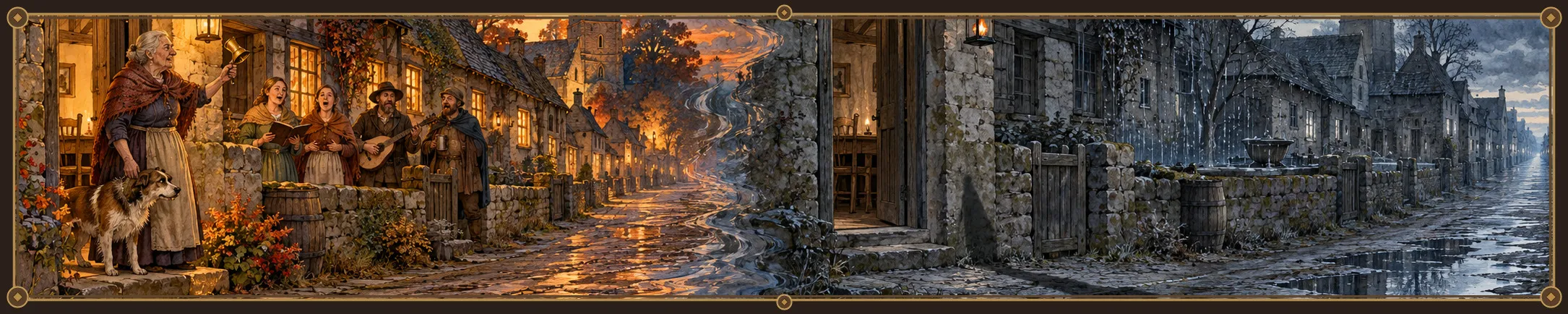
Of the low world I write only what I was told, by two who came back and did not agree. Both said it was our own country. Both said it was a little too low. Neither would say what they had heard there, and one of them would not sleep without a bell in tune beside the bed.
On the Space Between Places
Every place in the world has a second, and nobody has seen it. The Material Plane sounds as the chord of the ten Primes, and everywhere else in the cosmos the Veil swallows the reflection of that chord, as fog swallows an echo. In one place it holds it: close against the world, a little out of tune and lower. That held reflection is the Dissonance. Its hills are the world’s hills and its rivers the world’s rivers, its towns stand where towns stand and its houses have the same rooms, and all of it is wrong, darker, drained of colour, a half-step off in every sound. It is no plane of its own and no tier of the cosmos. It is the world’s own shadow, sounding wrong, and what lives in it is the worst thing a mortal can meet within the world’s reach.
This chapter tells the truth of the Dissonance: what it is, how it is entered and felt, what lives there, and what holds it off. Almost none of it is known in the world, where the Dissonance survives as tale, sealed book, and the word of the rare survivor; what people know and believe is told in What People Know. The chapter ends with how to bring it into a story, in Bringing Horror into the World.
The Held Reflection
The cosmos is a chord, and the Material Plane is where all ten of its notes sound together. Every sound casts an echo, and so does the world. The Veil, which is unmanifested possibility, takes in that echo everywhere and dissolves it, so that the planes beyond hear nothing of the world but its pull. Only where the Veil lies hard against the Material Plane does the echo hold, and there it holds badly: a little lower than the note that made it, a little out of tune, the way a voice comes back from a well.
The Dissonance is that held echo given place. Every place of the mortal world has its reflection there: hills, rivers, roads, towns, the inside of a house. Each is recognisable and each is wrong. Its colours drain towards one hue. Its light is the light of a day that never quite began. Its sounds are the sounds of the world sung by someone who cannot find the note. The copy is not a memory, and not a world of the dead; it is the world as the Veil holds its sound, so it changes when the world changes, slowly and never quite in step. A town burned a year ago may still stand there, thinning; a road cut last spring may be only half there yet.
It is not a tier. The Anchors, the Harmonics, and the Resonant Zones are the layers of the cosmos, and the Veil is the space that holds them in reach of one another. The Dissonance is something the Veil keeps of the world, nothing more and nothing less, and nowhere else in the cosmos has one.
The Maze of the Beat
Two notes almost alike, sounded together, do not blend. They swell and fade against each other in a slow throb that musicians call the beat. The Dissonance beats against the true world in the same way, and its places swell and fade with it. A street is there, then thins to nothing, then returns longer than it was. A corridor repeats. A door opens on the room just left. A hill that took an hour to climb takes a morning to come down. Distances never add up, and the one who walks the Dissonance as if it were the world, trusting the shape of the land they know, walks a maze without end.
Its laws are the world’s laws, out of tune. Every Prime’s current runs there as it runs here, but each is detuned by a different amount, and the amount changes from region to region as the beat moves. Where Ignis runs flat, fire burns cold. Where Terra’s pull is weak, water climbs. Somewhere a word is heard before it is spoken. None of this is chaos. The differences follow the beat of each region and repeat with it, so a traveller who learns a region’s beat can learn its physics, and the few who came back did so by learning it. The Dissonance is different from the true world in nearly everything, and arbitrary in nothing.
Crossing Over
Crossing into the Dissonance is exactly as hard as crossing the Veil, and under the Veil’s own laws. Intention decides where a traveller arrives, Resonance where the way is easy, Cost what the crossing takes, and Drift what happens to those who lose their purpose. A traveller who could cross to the Crucible could cross to the Dissonance.
What keeps the world out is not the threshold but what lies beyond it. The beings of the Dissonance are unimaginable, very different from anything of the true world, and very dangerous. Nearly every journey into it ends in death, in something worse than death, or in never finding the way back: and that last is true even of those who know how and where they came in, because the place they came in by has swelled and faded since. Those who have gone and returned are so few that each is a story.
Ways In
Off-Key Places
Where the world’s pitch has been bent, the Dissonance lies closer and the threshold is lower. Such off-key places are made by atrocities and by great old workings: deeds so large or so wrong that the true note of a place never recovered. Six are known on Caeldon, each by tale more than by visit, and each is kept by someone who holds the true note against it.
The Hollow Bell, in the Ironspine, is the walled-up bell hall of an empty upper hold. Its last smiths, after the deep war with the Dark Elves had emptied it, cast a bell from every metal the hold had left, the names of its dead cut on the rim, to call the dead back; they cast it wrong, and rang it once, and what answered was not the dead. On certain nights the stone hums, a little under any note a Dwarf can sing.
The Unsung Field, on a shelf of the High Scars, is a bowl of grassland where a band was slaughtered and its names were never recited. The grass grows in spirals round a centre that is never where it was, and under the Scars' dry wind blows a second, lower wind from another quarter, felt in the chest more than on the skin. Scavengers will not cross it.
The Drowned Choir, on the outer Tidelace Coasts, is a cove where a crew caught in a storm sang a working to turn it and sang it out of key. At slack water the shore is heard from beneath: shingle, gulls, a hull knocking on a quay that is not there, and now and then voices singing, all of it a little lower than the sea that makes it.
The Turning House, on a side river of the Confluence Basins, is a mill whose miller set an off-key working on the wheel to meet a lord’s levy, and ground on it for a generation. The river has long since left the race, and the wheel turns anyway. Inside, every door opens on the grinding floor.
The Quiet Orchard, in a small fold of the Leeward Folds, is a Halfling hamlet that shut its gate on starving walkers in a dry midwinter, struck them from its count, and died before the spring. Its orchard blossoms in autumn and fruits in midwinter, no sound carries among its trees, and every count made in that fold comes out wrong.
The Long Stair, in a low hill of the eastern Elderweald, is a stair of living root grown by a circle of Wood Elf groves in the sealing years, to reach the kin left below the Roothollows. Somewhere in the working the note went wrong. The stair goes down further than the hill is tall, and does not arrive.
Others certainly exist that nobody has named. And a place the Dissonance lingers in can become one (see Signs on the Surface).
Dissonant Magic
A working cast in tune reaches along the currents of the Primes towards its effect. A working cast out of tune on purpose reaches the other way, towards the Dissonance, and that is dissonant magic. Its cost is taken from the caster’s own Pattern: each working leaves the caster a little further from their own note, easier to hear from the other side and harder to call back. It is taught nowhere openly. The few who know it learned it from the dead, from sealed books, or from something that answered, and some of the old faiths keep such books under seal as a warning against the next caster.
Its workings are few, and every one of them turns a true-note practice inside out. Where a keeper sings a song through, the caster sings it a half-step low; where a household speaks its dead by name, the caster says a name with one sound changed; where a fold keeps its count, the caster counts wrong on purpose. Done at an off-key place, a low song sung through an hour opens a door. An ear to cold stone and one note held just under true lets the caster hear the other side, and lets the other side hear them. A hand closed over a flame puts out a room’s light as a Quencher would, and a count got wrong on purpose makes a stair that is one step longer every time it is climbed. A name spoken low into an open door calls, and the caster chooses only whether to call, never what answers. Every working is paid for from the caster’s own note, and it shows: a shadow that falls a little late, a voice that does not quite match the mouth, a sleep troubled by a grinding floor or an orchard fruiting in midwinter. The sealed books hold one working meant to mend, which needs someone who knew the caster before to speak their name truly through many nights, and it rarely works.
Accidental Doors
Rarely, and never twice in the same way, the beat and the world line up by chance, and a door stands open for a moment where no off-key place has been. Most such moments pass unnoticed: a cold minute in a lane, a dog that will not go on. Now and then something crawls out.
What Does Not Open It
Folk belief has its own list of what opens the way: grief, fever, the wrong song, too many sleepless nights. None of them can. What they do is put a person off their own pitch, and a person off their pitch can hear the Dissonance, be drawn towards it, and dream of it. Folk belief has the danger right and the door wrong.
Signs on the Surface
Where the Dissonance presses close, or where something of it has come through, the true world shows it in the ways a dark, distorted copy fed back into a song shows in the song.
The first is dread before sight. A pressure in the chest, an unease without cause, animals refusing a road: felt before anything is seen, as a sound too low to hear is felt in the body. Dogs go under beds. Horses stand sweating at the turn of a lane and will not be beaten past it.
Then come the dead spots, places where light, sound, or warmth simply go out. A lantern burns and lights nothing. A shout makes no sound. A hearth gives no heat to a hand held over it. Beside them stand the overloaded spots, where something is too much: a light that hurts, a smell that will not leave, a room too warm in winter.
Then the impossible phenomena, new things belonging to neither world, as distortion makes new tones out of a clean one. Rain falls upwards in one yard. A shadow is cast towards the light. A voice comes from an empty well and knows the listener’s name. They are different in every encounter, and each follows one law of its own, so a careful witness can learn to read them.
The Dissonance also works on people. Those already off their pitch, the grieving, the fevered, the sleepless, hear it first, are drawn towards it, and dream of it. This is sympathetic resonance, and it is why every off-key place has its tale of someone found at dawn walking towards it, and why its keepers watch their own bereaved. The first to walk towards the place are the first lost.
Last, if the Dissonance lingers long enough, the place takes its pitch, and becomes an off-key place itself: a new door.
The True Note
What holds the Dissonance off is not force but tune. It is cancelled, not drowned: the true note held against it. Two notes almost alike beat against each other; sound the true one clearly enough and the false one thins beneath it.
The true note is whatever restores a place’s own pitch. Names spoken aloud, every one. A bell rung in tune. A song sung true and through, the way the oldest keepers taught it. The right count kept. A hearth tended in the old way. The keepers of the six off-key places all do some version of it: the Ironspine household that reads the empty hold’s dead before the wall each year, the Windscar escorts who recite their own dead aloud while the Unsung Field is in sight, the Tidelace wardens who call a true reading across the cove at slack water, the village that sings the reaping song through at the mill threshold, the fold that counts the dead hamlet aloud each autumn, the grove that sings its laments faultless at the head of the stair.
Loud noise, fire, and weapons do nothing. Fire feeds some of what lives there, and becomes part of the makings of others. The only defence that works is to be more fully what the true world is, and the defence must be kept up: a dead spot cleared after many nights of singing returns where the singing stops.
What Lives There
Many kinds live in the Dissonance, most born of the reflection itself and each with its own name. Three are known well enough to be named in the tales. Others have never been named, and some may have an origin nobody knows. All are met on the surface only where the Dissonance presses close: in off-key places, and at the rare door that opens by chance.
Deepswells
Deepswells are never seen first. They come as dread: a pressure in the chest that swells as they near, then a throb in the teeth and the soles of the feet, slow and even, like a great bell struck far below the ground. Water in a cup trembles in rings and dust walks on a table. Those who say they saw one at the end speak of a darkness larger than the room it stood in, or of the room itself leaning inwards and breathing. A Deepswell is drawn to whatever sounds most like the world it copies, a lit house, a beating heart, a held breath, and it does not hurry; survivors say it was the slowness that broke them. Close by, it cracks old mortar and stops the breath in a sleeper’s chest. Those it reaches are not found. The swell falters while a song is held true, and rises again whenever a voice breaks.
Quenchers
Quenchers feed where light, sound, and warmth go out, and leave dead spots where they have fed. One is seen, if at all, as an absence: a place where the light stops short, shaped a little like something that crouches, or a person turned away. It feeds slowly and returns. A byre gets one dark corner, then two; a hamlet’s evening songs grow shorter each winter; a count at the year’s end turns up fewer voices than names, and no one can say who is missing. It seems to prefer the small and the steady, a lamp kept every night, a voice that always sings at the same hour. More fire only feeds it. The dead spots it leaves last for seasons or years, and those who stand in one too long go quiet and cold themselves.
Offnotes
Offnotes are the makers of impossible things, and never the same shape twice. An Offnote is not a creature that causes a strange event; it is the strange event with a will behind it: a stair one step longer each time it is climbed, a pond whose reflection shows the house without its people in it, a song from the next room in a voice everyone knows and no one can place. What sets it apart from a mere oddity is that it notices. The upward rain follows the one who steps out of it; the shadow turns its head. Most of its makings seem meant to draw someone closer, and those it draws in are rarely seen again, or come back changed in some small, wrong way, a shadow that falls a little late. Some who tried to bargain with one learned dissonant magic in the trying. What breaks a making is to name the thing aloud for what it truly is and keep saying what is real.
What People Know
Almost nothing. The rule elsewhere is that the closer a thing lies to the Material Plane, the more is known of it, and the Dissonance breaks it: it lies closer than anything, and is the least known thing within the world’s reach. Beside it the Veil is common knowledge.
A handful of scholars, a few old faiths with sealed books, and the rare survivor speak of it, under names that vary: the low world, the wrong side, the echo that answers. What scholars write is guesswork from the few who came back, and those few rarely agree. Even most Veil-Walkers know it only by rumour, if at all. Those who know more refuse the fare, and will not speak of it unless forced, and forcing them brings its own complications.
Ordinary people know none of this. They know the tales of their own country’s off-key place, if they live near one, and the customs that keep it: the reading, the count, the song. They know that some corners are cold for no reason and some roads the horses will not take. They know ghost stories, and the Offnotes hide among them, because the few true ones are told the same way as the many that are not. Folk belief has its own explanations: that a Deepswell is the grief of the drowned come up to be heard, that a Quencher is a dead person’s last breath that never found its song, that banging pots through the night keeps the quiet ones away. The first two are guesses nobody can test. The third is wrong, and the villages that trust it learn so.
Bringing Horror into the World
Caeldon is a world of wonder. The Dissonance is its one lawful door to outright horror, and it is shut for every story that does not open it. A work can use the Dissonance as fully as it likes, or never; neither changes the world for the works around it.
Keep it rare. Off-key places are few, dissonant magic is taught nowhere, and accidental doors almost never open. The horror is worth more for its rarity, and the world stays a place of wonder because the Dissonance is not under every bed. A ghost story need not be the Dissonance; most are not, and the frightening ones may be the ones that are.
Keep it lawful. The Dissonance is different from the true world, never arbitrary. Each region of it has a beat and each beat its physics; each Offnote’s making follows one law; the true note works every time it is truly sounded. A reader who has watched the laws hold will fear the moment they are learned too late, and a character who learns them has earned their way out. What the Dissonance must never do is change its rules to suit the scene.
Dread before sight. Its own order of signs is the order of a good horror story: first the unease, the animals, the pressure in the chest; then the dead spot and the wrong warmth; then the impossible thing; and only last, if ever, anything to see. Its beings are best shown through what witnesses feel and what they find afterwards. A Deepswell that is described has already lost half its weight.
The defence is to be more fully human. Swords and fire fail here, and what works is the oldest, plainest thing a community does: say its names, sing its songs through, keep its count, ring its bell in tune. That turns horror into a story about memory, faithfulness, and the cost of a gap in either. The off-key places were made by forgetting, by lies told to the count, by a working pushed past its note; they are held off by remembering, by the true count, by the song sung as it was taught.
The vulnerable hear it first. Sympathetic resonance gives every Dissonance story its first victim and its hardest choice: the grieving, the fevered, and the sleepless are drawn towards the danger, and a household must watch its own bereaved. A character who has lost someone is the one who hears the voice from the well.
Nobody knows. Characters meet the Dissonance with folk belief, half-wrong customs, and the rumour of a sealed book, never with this chapter. A scholar who understands it is rarer than one who has seen a god. Let characters name it wrongly, explain it wrongly, and survive, when they do, by the custom whose reason they never knew.
The shapes it takes. Most stories that open the Dissonance take one of a few shapes, and each sets its own scale. The keeping: an off-key place, its keepers, and the year the true note slips (a reader who falters, a name too few, a song taught to someone too young). The caster: someone who learned dissonant magic and is paying for it in their own note. The door: something that came through where no door should be, and a place that is beginning to go quiet. The crossing: someone who goes in, for a reason worth more than their life, and the slim road back. The crossing is the rarest, and the hardest to end well.
Tensions
-
The sealed books. A few old faiths keep books on dissonant magic under seal as a warning. Every generation someone argues they should be burned, and someone else that burning them would only leave the next caster to learn it from the dead.
-
A guide who will not go. A Veil-Walker who once crossed into the Dissonance and came back is the only guide who could lead a party out of it, and is offered more than any guide has been paid to go in again. It has not said no.
-
The hamlet that is getting quieter. A Leeward Folds hamlet near the Quiet Orchard has had three winters of fewer voices at the count, dead spots in the byre, and children who dream the same orchard. Its elders say a hamlet does not become an off-key place, and want no one told.
-
Pots in the night. Some villages bang pots through the night against the quiet ones, and trust it. The few who know better say only a true note thins a Quencher; telling a village that its custom does nothing means telling it what it is up against.
-
A bargain with a making. Some who bargained with an Offnote for its makings came away knowing dissonant magic, at the price of their own note. Whoever learns it so knows something no sealed book teaches, and is already easier to hear from the other side.