Chapter 15. The Bridge Peoples
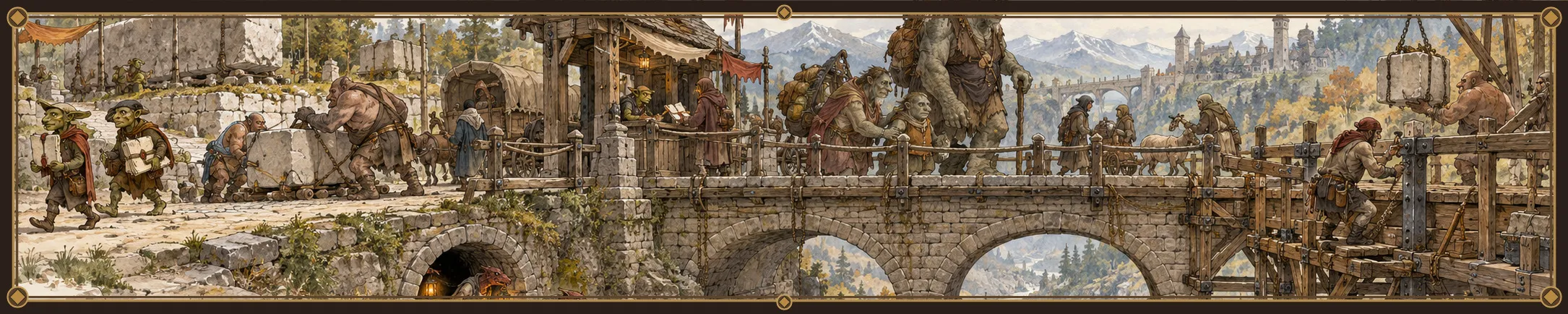
Every ruin has a tenant, every bridge a keeper, and every road a debt. Ask who before you ask how much.
Caeldon is an old world, and old worlds are full of what their builders left behind: roads too broad for any living traffic, tunnels under fields nobody owns, crossings that fail every spring and are mended every summer, sealed vaults one roof-fall beyond reach, frames that once did the work nobody else would do and still stand at their posts in the dark. Other peoples see waste in such places, or danger, or a lost kingdom’s gold. The bridge peoples see home. Goblins live in the upper breaks of ruins and Kobolds in the underworks beneath them; Trolls keep the crossings that never finish healing; Ogres carry what settled worlds cannot lift; the last Giants keep the heights their ancestors built; and the Wrought, the youngest people on Caeldon, were made out of the labour itself. None of them is a monster, though each has been hunted as one, and each is the monster of somebody’s tale. Between them they keep the old works of the world lived in rather than empty, and every treasure-hunter who goes into those works hires one of them or regrets it. Almost all of them have spent their history being needed by powers that would not give them a seat at the fire.
Peoples of the Gaps
The name is a description, not a kinship. The bridge peoples are six peoples of three very different origins, grouped because of where they live and what they do: in the gaps between larger worlds, in the works those worlds abandoned, and on the crossings and loads that hold those worlds together.
Four of them are among the oldest peoples on the planet. Goblins, Kobolds, Trolls, and Ogres all descend from the threshold elder field, the crowded early ancestry of peoples shaped by seams, margins, fracture belts, cave mouths, and the gaps between larger landscapes. They settled at the same depth of time as the Verdant and lithic lines that became the Elves and Dwarves. That fact is a grievance, and every one of the four knows it. None of them is a late people who arrived to find the good places taken. Each is an old people whose place was taken: walled out, struck from the rolls, recruited, or held by debt, and whose life on the margins is something stronger peoples did to them rather than the condition they began in. The same story recurs often enough that a writer can rely on it: an older people loses its say without losing its use, and goes on doing the work that its new masters cannot do without.
The Giants come from elsewhere. They are the living remainder of the elder Upland Colossal world, not threshold kin at all, and they belong among the bridge peoples because the roads, terraces, and crossings their ancestors built are the ones the others live on. The Wrought come from nowhere a people has come from before. They were made, as tools, and became people, and the hunt that followed is still within living memory.
How each of them lives in a given era, which warrants a lord has torn up, which ruins are being cleared, which crossings are failing, belongs to the era’s atlas. What follows are the peoples themselves.
Goblins: Value in What Is Left
Goblins are made for ruins, not for malice. They live well in places where other peoples see collapse, shame, danger, or leftovers: abandoned works, broken outer walls, failed market towns, old military roads, collapsed storehouses, forgotten tunnels, battlefield debris, salvage margins. They live on town fringes and in road shadows too, and in work nobody admits to hiring, because living towns keep making the same leftovers that ruins preserve. Their strongest country is the Broken Marches, a belt of failed works and remnant settlement, but their footprint follows broken works rather than one map: wherever a town has enough poverty, repair work, and back-street trade to hide or tolerate a Goblin quarter, there are Goblins. They are the first into a ruin and the first out when it starts to fall, and their songs are of the delvers who did not get out: the lamp crew that went down for the elder lamps and is still down there, the girl who held the crawlway shut while her warren ran.
Quick, Small, and Hard to Fool
A Goblin is about Halfling height, thin and wiry, with long arms, long fingers, and a large head for the body; the ears are long, pointed, and mobile, and the large eyes reflect light at night. They are people-like rather than bestial, and at ease in half-shelter: crawlspaces, broken cellars, rubble gaps, market backs, drains, cliff paths, old wall interiors. Their bodies suit cramped spaces, unstable structures, long hunger, and fast escape. Their gift is not strength but speed, nerve, an eye for what is about to go wrong, a high tolerance for discomfort, and a fine eye for what still has value.
Their things tell the same story. Goblins prize repaired tools, mismatched gear, hidden storage, portable goods, reversible signs, and concealed exits: anything that can turn into something else when a lord or a danger changes. A Goblin household’s best room has two ways out, and its best tool has been mended so many times that nobody remembers what it was first made for. The ruins teach hard lessons: nobody puts a bare hand into a dark gap where glove spiders nest, every old beam is tested for cellar rot before it is trusted, and a crew that smells a wallow goes into the underlayers with spears, or not at all, because a ruin hog boar in a culvert can open a thigh to the bone. Deeper down, the pale web-curtains of lampless spiders across a passage mean nobody has come that way in years: the best news a crew can find, since the room beyond is unstripped, and the worst, since nobody came back out to strip it. Salvagers mutter a word to the ruin before they reach into it, and the worst Goblin curse is short: may the roof speak first.
Warren and Household
Goblin households are built around practical belonging rather than any wish to rule. Their usual forms are warrens, repair bands, market-shadow households, road crews, salvage knots, alley compacts, and small families of guides who know the safer detour round an outlaw band. Status belongs to whoever can find value, keep people fed, read danger early, bargain with stronger neighbours, and know when to vanish rather than fight. When a warren cannot vanish, it fights in the dark, from crawlways no larger enemy can follow. Warrens fight each other too: two warrens that find the same rich ruin feud over it as bitterly as any two lords' houses, with cut ropes, collapsed crawlways, and stolen lamps, until a gathering-market such as the Undercroft Fair settles it by blood-price.
Larger powers mistrust them because they live close to theft, salvage, smuggling, and trade nobody admits to, and the mistrust is not invented. But Goblins are not thieves by nature. They survive where no lord’s hand reaches far: abandoned property, contested roads, failed borders, and work that wants their usefulness without counting them as anyone’s own. A lord may accuse Goblins of theft while quietly buying recovered fittings from them; a town may depend on Goblin night labour and deny Goblin residents any place in it. A ruined fort may hold a Goblin warren in its upper breaks two rooms away from a collapse the Goblins know about and the fort’s owner does not. In the Marches, Goblins without a warrant are hunted: bounty-takers come with lamps and dogs, and salvage gangs with a lord’s leave clear a ruin of its warren before they strip it.
Every treasure-hunter in the Marches wants a Goblin guide, and few trust the one they hire. A warren guide knows the crawlway round a sealed door, which old tomb-seals still hold, and which crypt halls hold dead that walk on their own because nobody gave them their rites. The going price is half the haul and both of your lamps, and Goblins say the crews who haggled are the ones still down there. What they go for is always the same: elder lamps that still burn, colossal-age fittings worth a winter’s bread, and the sealed vault that lies, in every telling, one roof-fall beyond reach.
Three Losses
Goblin history is a sequence of ground lost, and Goblins can recite it.
The first loss is the oldest. Goblins were themselves by the time the Elves and Dwarves settled, and their earliest heartland was the broken ground along the Ironspine margins: cave mouths, fracture belts, scree hollows, drain-seams. There grew the first Goblin order, the seam-warrens, which held named seams by gap-right, the hold of whoever had kept a passage open, known its water and its falls, and lived in it longest. In the Enclosure of the Seams (c. 465,000–c. 420,000 BR), early Dwarven holdmaking needed exactly that ground. The holds defended the seams until they were theirs, and warrens that would not yield were walled out or smoked out. The holds saw ordinary founding; the Goblins saw the loss of places they had held longer than anyone. Most warren-kin moved outward, into scree, abandoned workings, and route margins, and that move began the ruin-and-fringe life of every later Goblin. Some stayed inside the Dwarven structures as underwall households, and their descendants still name claims older than the holds.
The second loss was a gain first. The elder archive world, whose marker roads and terraces crossed country where displaced warrens lived, cut into stone every people that lasted, and Goblins lasted: warrens that kept gaps, guided travellers through the under-routes, and warded them against beasts and raiders were entered as warranted peoples, each warrant a duty cut in stone and the protection of the archive-wardens that went with it, for as long as the archive chose to give it. For the first time since the enclosure, Goblins held a place outsiders could read. Then the archive hardened. In the Unlisting of the Warrens (c. 180,000–c. 150,000 BR), warrants not renewed in the right form lapsed, warrens that moved no longer matched their entries and were struck, and where Goblins were entered again it was under a lesser mark. Then the wardens came to the gaps, and it was war in the dark: warrens that stayed at the culverts they had kept for generations were driven out with fire and spear, and some fought for their crawlways until no one was left to fight. Goblin tellers keep the gap-guides of the warrant age as their heroes: the guide who led a lost caravan through the under-routes with raiders at its heels and was struck from the rolls the next year all the same, the warren that held a culvert against the wardens until the water rose over them both.
The third loss came with the Human frontier. The waste-ground doctrine, from the Headwater settlement through the building of its exchange roads, treated ruined and marginal ground as anyone’s to take, and Goblin-held ruins were taken by whoever came with more spears. The doctrine was partly new greed and partly the old archive mark taken up again by lords who did not know its source.
Hobgoblins and the Warrant
The Goblin answer to the third loss used the lesson of all three: ground is kept by those who are needed and armed. The Iron Compacts, which took their present shape c. 20,000–c. 9,000 BR during the Human frontier expansion, are armed Goblin communities that do work the settled powers need done and would rather not do themselves: holding a road outlaws prey on, watching a fort, keeping a ruin and whatever lives in it from spilling onto a town, supplying a garrison, guarding a gate. The bargain is marked by a warrant, a written grant from the lord that he can take back whenever it suits him; the paper keeps nothing alive once the lord stops gaining from it. In exchange a compact keeps a hall, a share of the road’s take or the ruin’s salvage, and its own weapons, and it can refuse orders the lord lacks the strength to force. A compact’s spears are seldom idle. It fights the outlaws on its road every season, takes bounties on them and brings back heads, not prisoners, and walls in the older monsters of the deep cellars rather than fight them; those walls are the first thing a ruin-robber tries to break, since what is walled in with the monster is whatever the ruin’s builders left behind. Compacts keep their warrants with great care, recite them at gatherings, and still treasure fragments of archive-era warrants that no lord now cares about.
Hobgoblin is the word for a Goblin of such a compact, and nothing more: not a separate species. Over generations some compacts have become semi-hereditary, and steadier food, exposed work, and defensive discipline have made some of their members taller, broader, and more visibly martial than other Goblins. That is drift within one people. The Compacts live between two suspicions. Settled powers treat Hobgoblins as useful but lesser servants and turn them out when they are no longer needed. Freer warrens say the Compacts have bent the knee for the right to stand anywhere. What a compact fears most is not a fight. It is the day a lord no longer needs it: the torn warrant, the order to be gone by spring, and the march to nowhere that every Goblin song remembers.
Songs of the Struck
Goblin belief is unorganized and stubborn, and most of it is sung. The struck warrants have their own god, Tavi the Bard of the Broken. At Iron Compact gatherings, after the living warrants are read, the struck ones are sung: seams, warrens, and duties no lord still honours, named one by one. Then the compacts drink to the held: the compact that held a frontier fort for a lord through a whole winter siege, then found its warrant torn in spring and marched out with its dead on its shields; the old warrant-keeper who walked into her burning hall for the warrant and came out with it, scorched, to read it aloud at the next gathering. It is said that if the songs are sung with true defiance, Tavi will come and grant the singers a year of courage and unity. Goblins tell of a lord who forbade a warren to sing in a ruin he had declared waste ground, and of how Tavi sang there anyway, so softly that the lord heard nothing, and by morning every Goblin within a day’s walk knew the words.
The hidden and the hunted pray to Varn the Shadow-Stalker, born of everyone who has had to live unseen in the ruin-belts, a figure of living shadow with two points of silver light where his eyes should be; where he passes, the sounds of the road fade and the shadows pool thick enough to hide in. Frontier Goblins also know Abrel the Changeling, the god of those who belong to two peoples, under the name Ziv. Goblin children play last-out, a chase through rubble in which the slowest is "buried" and must be dug free by the rest, and warren mothers sing the names of the lamp crew as a lullaby.
Lifeways
Goblin variation is fast, local, and practical. The clearest living identities are the Ruin-Warren, Market-Shadow, Road-Margin, Underwall, and Hobgoblin compact lifeways, shaped by ruins, town fringes, route margins, underwalls, and how much they owe a lord. Behind them stand Old March Goblins, whose holdings Human frontier lords declared waste-ground; lost warrant Goblins, descended from the warrens struck from the archive’s rolls, whose copyists still make the dangerous walk to the Grey Line of the Witnessfields to copy warrant fragments from the open ruins, under the slit-mouthed gaze of the stone figures who ask every passer’s name; and collapsed-fort, canal-shadow, and battlefield Goblins, surviving mostly in history and absorption.
Kobolds: The Understone People
Kobolds are small and careful, and they live underneath. Their country is wherever the surface and the underworld meet badly: Dwarven mine-edges, culverts, old drains, service shafts, ventilation runs, collapsed tunnels, old military underways, ruin underlevels, deep cellars, and the lower structures of cities. Their footprint follows buried works more than open country. They are made for the underwork rather than for service, though a great deal of their history has been spent proving the difference. Their great loss is the furnace world, and the binding that came after; their heroes since have mostly been the crew that went into a collapse when nobody else would, and came out with the living.
The Sense for Bad Stone
Kobolds are people-like, small, and built for cramped and unstable understructures. Their strengths are practical: low movement through narrow spaces, sharp attention to airflow and vibration, comfort in darkness and partial enclosure, patience with repetitive repair, and a strong sense for weak stone, bad timber, hidden water, trapped air, and the particular silence that means trouble. They are not strong, and do not need to be. Their survival depends on caution, coordination, memory of tunnels, and the ability to retreat before a larger danger knows they were ever there. The commonest warning in the underhouses is a quiet shaft is a hungry shaft.
Their material culture is a catalogue of that caution: small tools, warning marks, shared maps, collapsible braces, sound codes tapped on stone and pipe, small lamps, hidden caches, and repair methods that can be performed lying on one shoulder in a space a Human could not turn round in. A Kobold household may know a city’s old drains better than the lord who claims them, and that knowledge is the thing most often stolen from it: smugglers, besiegers, and thieves pay well for a drain map, and a crew that sells one is not forgiven. A city’s underlayer is the outlaw’s road, and the drain-warrens know every thief and fugitive who has passed beneath the streets and what they paid; some lords hire Kobolds as hunters of their own outlaws for exactly that reason.
The underlayer is full of things that kill a small people. Glove spiders in the ruin-towns bite and the bite festers; lampless spiders numb whoever reaches into the wrong crack; ruin hogs come looking for a crew in the culverts, as bad air never does. Under the holds, brace-gnawers hollow the props from inside, and Kobold crews listen for their teeth in the walls and chalk their marks on the gnawed timber. Behind the seals of the Deeps the Seal-Knockers knock, and the crews of some underhouses knock back on their rounds, saying the dead like to be answered.
Crew and Underhouse
Kobold households are built around crews, warrens, underhouse lines, and the memory of what each tunnel has done to the people in it. Belonging rests on who keeps the underwork safe: who remembers which shaft breathes poorly, which brace is temporary, which old oath-door should not be opened, and which route can carry children, tools, or wounded people during a collapse. Leadership is practical and changes with the work, and the best speaker in a surface bargain is seldom the one trusted to read a failing tunnel. Every round ends with a head-count tapped on the stone, and a crew that comes up one short taps the missing name into the shaft mouth for a year; the commonest toast, raised after a collapse everyone walked out of, is to the brace that held.
Larger powers want their labour and little else. Mines, cities, holds, and border keeps send for Kobold crews without granting them any say or share, which gives the warrens a guarded temper: useful enough to be summoned, small enough to be ignored, needed enough to bargain from below when the stone starts to shift. A delver party that hires a Kobold guide comes back more often than one that does not, and the guide knows which sealed door to leave shut.
The Vent-Houses and the Downward Binding
Kobolds were old long before anyone needed them. For a very long, undated span they lived as self-governing underhouse lines in fracture belts, cave seams, and natural vents, keeping knowledge of air, water, heat, and collapse that no surface people had reason to want. Then the elder Ash-Furnace world wanted it. Its furnace sanctuaries, heat chambers, and slag-shafts needed draught controlled and trapped air released, and Kobold vent-kin were better at it than anyone. Over c. 250,000–c. 168,000 BR the furnace-masters bound them into vent-houses, hereditary houses holding named vents and heat-ways under furnace patronage, with a protected place and a real say over whether a furnace could safely be fired, for as long as the masters chose to listen. It was the first time Kobold knowledge carried weight outside Kobold lines, and the weight was lent by someone stronger.
The vent-houses were the first to know when that world tipped into overburn. They kept count of shafts pushed past safe draught and furnaces fired against their warning, and their right to refuse was overridden again and again. When the furnaces burst, the heat-ways became ovens, and many vent-houses died at their posts, in the shafts they had begged the masters not to fire. The songs keep the crews who went back down the burning shafts for the children. The survivors carried out knowledge of heat and pressure that no one else held, and a lasting tie to the civilization that burned itself out; later peoples valued the first and never quite forgave the second. The shafts where vent-houses died are said to stay warm, and a Kobold crew will not pass the mouth of one without a word to the kin inside.
Some survivors went to the surface margins. Others went down into the deep world, where Dwarven deep holds and Dark Elf houses needed exactly their skill, and there protection offered to refugees became protection-debt, and protection-debt hardened into inherited bonded service. In the harshest houses it became captivity. Kobolds have not forgotten what the word protection came to mean.
The furnace-masters who kept the vent-houses lived among heat vents, mineral beds, and slag, hardened and soot-darkened by their work. Kobold memory kept them as scaled patrons in mineral nests, and the dragon stories some Kobold groups tell, of old scaled guardians, heat vents, and nests of mineral, grew from that half-remembered figure. They are myths, not the Kobolds' origin, but they have a seed of history in them. Children of every underhouse know the telling of the nest-thief who took one crystal from the patron’s hoard and was followed home by the heat, and the hold markets still sell old fused stone from the furnace ruins as dragonbone to buyers who would rather not know where it came from. The dragon’s hoard is the most hunted treasure that was never found; deep-delvers still go looking for a coiled patron’s nest of gold in hot rock, and Kobolds laugh at them, or take their coin to guide them part of the way.
The Frames
Much of the deep holds' hot, dangerous work had long been done by Kobold vent-kin in bonded service when the Dwarves built their predecessor-frames, mindless workframes for heat channels, vent shafts, and pressure gates. Whether the frames were built to spare Kobolds that work or to stop paying for it, Dwarven tallies do not say plainly, and the two peoples remember it differently. Kobold underhouses remember frames arriving and their own place in the holds shrinking. Some Dwarven craft-lines remember the frames as a kindness. The frames' descendants are the Wrought, who are now people, and some of them work the same underlayers.
The Underhouse Compacts
The Underhouse Compacts, the first named Kobold civilization, grew from older underhouse lines and from the vent-kin who survived the ash-furnace world. Their founding date is not fixed. A compact is a sworn bargain among the crews and underhouse lines that keep one underlayer alive, a mine’s ventilation, a city’s drains, a hold’s service shafts, a ruin’s foundations, and its crews bargain as one. They set the terms of dangerous work, keep the shared maps and warning codes, and decide together when a structure is too unsafe to enter. Compacts honour one another’s warnings and refusals, and a crew that breaks a compact’s refusal is rarely hired again by any other.
The Compacts' founding question is the one Kobold history keeps asking: does keeping a place alive give a people any say in it? Their answer asks no ownership of the mine or the drain, only a voice in how the underworks are used, the right to refuse work that will kill its crews, and pay that matches the danger. Their strongest weapon is walking off together. When a compact calls a shaft unsafe, no member crew enters it, and the owners discover how much of their world rests on people they never counted. The crews also find things: a crew clearing a drain may break into a sealed storework nobody living has entered, and every compact has a rule for it, which the owners above never agree to: the crew that found it names the find, and the compact decides whether the way to it is safe enough to be told. The Compacts also hide crews escaping deep-world bonded service, bargain debts down, and treat any house that holds Kobolds captive as unsafe ground for every member crew, which can quietly stop that house’s underwork altogether. A debt-holder’s hunters who go down after a runaway are given a single warning, tapped on the pipe where they stand, and the compacts do not tap twice.
Refuge and the Quiet Tunnel
Kobold underhouses honour the Last Chamber, the deep god of refuge and survivable holding, under a name of their own. It appears as a robed keeper of layered stone whose chest opens like a vault with a lamp burning inside, one hand on a half-sealed door; where it passes, panic cools into counting. Its broken shrines stand in route-houses, cisterns, and refuge vaults, exactly the places Kobolds keep. An older fear had a god of its own once: Sessik the Tongue-Taker punished noise in the tunnels, and faded when the Compacts' shared sound codes made silence a skill instead of a terror. The underhouses still tell of their own in whispers, since sound carries: the vent-girl who crawled through a gas-filled run to open a draught and brought a whole shift out alive, and the old map-keeper who led a line of runaways out of a debt-house through tunnels their masters had forgotten existed.
Lifeways
The clearest living Kobold identities are Mine-Edge, Drain-Warren, Ruin-Under, Deep-Service, and Vent-Kin Kobolds, named for the structures they keep alive. Old service-kin, collapsed warren lines, patron-bound Kobolds, surface-settled Kobolds, and heat-vent Kobolds persist as history or in absorbed lines; the patron-bound and heat-vent forms descend from the furnace vent-houses, the old service-kin from those bound into deep-world service after the fall.
Trolls: The Keepers of Broken Crossings
Trolls are a people of wounded frontiers. They are found where land and road refuse to heal: wet ravines, broken forests, landslide roads, old battlefields, storm-torn passes, bogged road cuts, flooded causeways, ruined bridges, crossings that keep being rebuilt badly. Those places are like the Troll body. They are damaged, repaired, damaged again, and never quite restored, and Trolls survive in them where other peoples wear themselves out trying to make the world cleanly whole. Half the bridge-monster tales of other peoples are about the Troll who would not fall: hacked, thrown from the span, and back on the bridge in spring.
Failed Mending
Trolls carry Failed Mending, a distorted repair of lifeforce that overanswers injury: it closes wounds too strongly, regrows and knots and scars, and keeps the harm in altered form instead of restoring what was there before. In other peoples it is an occasional misfortune. In Trolls it is stable and heritable, and it became so over c. 380,000–c. 330,000 BR. Why is not known. Healers and scholars blame, variously, healing magic, Verdant force, Echo memory, a mutation of material lifeforce, failed restoration rites, or some regional catastrophe, and each answer accuses someone different. The condition was laid across a people already old; it did not make them.
Trolls are large, scarred, heavy-boned, and visibly marked by old injury: ridges, knots, asymmetry, thickened skin, distorted fingers, old wound-lines, hardened tissue where harm has been answered too many times. Fire, acid, severance, starvation, and certain kinds of magic still threaten them, but ordinary injury rarely settles anything quickly; those who mean to kill a Troll bring fire, and those who fight beside one learn that a dirty wound can seal over its own rot. Regrowth has costs. It may need food, rest, dampness, minerals, or a return to familiar ground, and it may keep pain, memory, or a fierce attachment to place along with the flesh. A Troll who survives too much does not become new again. They become more themselves and more altered at the same time.
Body-Law
A people that cannot be easily killed and carries its injuries visibly has to answer questions no one else faces in the same way, and the Troll answers are body-law, an old custom kept by ravine families and woundland kin. Who may be struck, and how? Which wounds should be allowed to close, and which kept open? What is owed when a body is maimed? What does a scar remember? To Trolls, wounds and scars are sacred record, and the closing of a wound is a matter of rite as well as care. They do not worship damage. They remember it, and they distrust anyone who would erase it without asking. A Troll’s deeds are counted on the body, and each scar’s story is told with it: at a house’s fire the young ask an elder to "read us the arm", and the telling runs from wrist to shoulder, one fight or flood or fall to every knot.
The thing Troll kin fear most is not a blade but a healer who will not ask. Their tales of the Flesh Weaver, which heals without permission and leaves its patients smooth and wrong, are the worst stories a scarred people tells, and the harshest thing one Troll can wish on another is a single word, smooth.
The ravine families treated the crossings they lived on the same way. A broken span was a wounded body: owed care, not to be struck carelessly, and remembered by its scars. That habit made Trolls the natural keepers of places that kept failing long before any outside power asked them to be. The bridge-monster story is much younger than the condition, but it starts with it: other peoples met a people who were hard to kill, marked by kept harm, and living exactly at the broken crossings travellers had to use.
The Crossing-Charges
Troll crossing custom became a named order in the high country. At its height the Upland Colossal world ran roads across ravines, flood cuts, and storm-torn passes that its own peoples found murderous to keep: spans came down in spring floods with caravans on them, and storms took whole crews off the causeways. Troll lines already lived at many of those crossings. In the Swearing of the Crossing-Charges (c. 230,000–c. 190,000 BR) the colossal road-keepers took over what they found, on their own terms. They granted Troll lines charges: hereditary keeping of named crossings, with the right to take passage-dues and the duty to keep the crossing open, warn of danger, drive off the beasts and raiders that preyed on travellers there, and repair what passage broke. Each charge was sworn as an oath between a Troll line and the road-keepers, who could have driven the lines off and had no need to bargain. Body-law gave the oaths their content; the colossal world gave them names and a road that joined one sworn crossing to the next. Separate ravine families became one order.
Then the colossal world withdrew, and the road-keepers stopped answering. The Troll lines did not leave. They kept the charges, took the dues, and went on repairing crossings for a world that no longer travelled them. That is the defining Troll fact, and the great legend of every house begins there. A crossing-oath outlived the world it was sworn to, and Trolls have kept it on their own word ever since; later houses treat that as their title: they hold the crossing because they never broke the oath, and because a Troll at a bridge is very hard to move. Younger powers see a toll with no visible lord behind it, and some have sent armed men to end it; upland war-songs count more than one such company that went up to a Troll crossing and did not come back down. The ballads keep the keeper who held a falling span three nights against a hunger-band so that a caravan could cross, and was found on the fourth morning still standing in the gap, healed crooked around a spear-shaft no one dared pull out. The oaths are still kept under the colossal world’s sleeping god, the Mountain-Father, by his title, which makes Trolls one of only two peoples who still answer to him.
The Crossing-Oath Houses
The Crossing-Oath Houses are the descendants of those charges, spread far beyond the colossal roads and joined by younger crossing families. They are not a Troll realm. Bridge-oath families keep named crossings across generations; ravine houses take their fee and bargain over warning and safe-conduct; woundland camps mark unsafe ground and remember old failures; and each house keeps its own count of broken promises, unpaid passage, and travellers lost because a lord or a caravan would not listen. To a Troll house a crossing is never only a road. It is a wound in the land, a repair, a memory of everyone who fell there, a livelihood, a border, and a danger, and the house holds all of it: who keeps the bridge standing, who takes what from those who cross, who may shut the way, and who must shout a warning of rot, flood, or sickness.
A crossing house has no warriors apart from its keepers: every grown Troll on a crossing fights for it when it must, and is hard to stop when it does. Houses sing of the one who stood under a failing span and took a laden cart’s weight on her back until the last child was across, and of the bridge-mother who walked out into a flood to cut loose the drift-logs battering her piers. Such country kills strangers, and Trolls live among its killers rather than clearing them: ravine cats lie up above the crossings, and a crossing family marks a cat’s kill-place with the same notched post as a collapse; every crossing that has failed often enough keeps its Bridge-Dead, and the keepers tell the names of the fallen at each repair so that the dead stay quiet. A crossing house is also where beast-hunters and monster-seekers come to ask the way: the keepers know which ravine the cat lairs in and which ford the dead stand at, and they charge for it like any other passage. A family parts from a traveller with may the span hold.
Outsiders call Trolls stubborn, extortionate, or impossible to remove. Trolls call themselves the ones who stayed after everyone else left a broken crossing to fail again. Both can be true at the same bridge. Some houses take a heavy due; some ambush travellers, and a few gone bad have turned bandit on their own crossings; some keep a crossing better than any lord nearby; some refuse passage because the road itself is sick, cursed, unstable, or owed. Their enemies are people as often as beasts: lords who want a bridge without its keepers and come with torches, and troll-takers, sellsword crews who carry pitch, fire-pots, and oil and are paid by the head; most come back burned, because a house fights hardest on its own span, and a house burned off its crossing does not forget. Tavern tellers swear the colossal road-keepers left strongrooms of toll-silver sealed in the piers of their greatest bridges, and every few years a crew tries to dig under a Troll span by night; the house usually lets the river answer them. A few houses keep the way across the Glassbelt, the one crossing between the cradle-web and the far side.
Lifeways
The clearest living Troll identities are Bridge-Keeper, Ravine, Scarwood, Stonebreak, and Woundfield Trolls: woundlines shaped by the places where Failed Mending, inherited injury, food, dampness, minerals, and repeated quarrels over passage have acted together. Old Failed-Mending kin, burn-scar lines, sealed crossing houses, and overmended woundland clans are gone or absorbed, and they are why taboos, abandoned crossings, and local fear cling to some places; nobody crosses a sealed house’s bridge after dark.
Ogres: The Weight and the Hearth
Ogres are a load-bearing people. They live where settled worlds need heavy work but give no seat at the fire: quarry edges, timber belts, winter-haul routes, rough uplands, flood repairs, border farms, road camps, siege-scarred margins. Other peoples reduce them to labour, appetite, or violence. Ogres ask a different question: who is being carried, who is being fed, who is owed shelter, and who is trying to take the work without honouring the camp? Every frontier tells Ogre stories of both kinds. In one, a hungry band comes down off the hills in a hard winter and takes a village’s stores and its cattle and sometimes its people. In the other, a camp holds a broken gate with its bodies until the raiders tire. Ogres tell both, and know which camp is which.
Built to Carry
Ogres are large, broad-framed, heavy-handed, and thick-boned, made for weight, cold, hunger, long carrying, rough shelter, and impact, and comfortable with work that would ruin smaller bodies quickly. They carry what other settlements cannot easily bear: bridge beams, stone blocks, roof timbers, winter stores, wounded animals, broken carts, flood gates, refugees, and sometimes the dead. That does not make them servants. Everyone can see what an Ogre band carries, and a band that can carry a village through winter, raise a fallen roof, or keep a road open during thaw is heeded, because its strength is all that stands between that place and ruin.
They are not lesser Giants, and they are not larger Orcs. Giants carry the memory of a vanished colossal world and Orcs the escort and the oath of the harsh roads; Ogres carry the weight of keeping hard settlements alive this winter. Their strength also makes them feared, and they know why better than anyone. A hungry, exiled, or oath-broken Ogre band can become terrifying, because strength with no hearth to answer to turns every quarrel into a fight. A lord may see cheap haulage or a battering ram that walks; a frightened village sees only danger.
Hearth-Weight
The core Ogre moral idea is hearth-weight: strength must be anchored by care. A camp is measured by whether it feeds, shelters, carries, and protects the vulnerable who fall under its burden. The strongest Ogre is not automatically the rightful leader. Respect belongs to those whose strength keeps others alive without consuming them. No camp eats until its smallest has eaten, and the grace is the same everywhere: carried, and carrying.
Ogres made that custom about themselves, and they made it in famine. In the Long Hunger (c. 195,000–c. 160,000 BR), as the Upland Colossal world thinned, the high country stopped yielding reliably, and the conditions that ended a monumental civilization also made large, food-hungry bodies hard to feed. The high burden households of the uplands faced failing range, lost trade, and winters no carrying could outlast, and some camps broke. Hunger-bands used their strength to take what they could not earn, raiding neighbours, abandoning their own old in the snow, turning the burden that had held them together into a weapon. The danger was not from outside. It was what a starving Ogre camp could become, and every Ogre child is still taught to fear it in themselves. The households that held bound their strength to plain terms: the vulnerable are fed before the strong, a camp’s dependents are its first burden, and strength that takes without carrying forfeits respect. They called themselves hearth-houses, held one another to their terms, and treated the hunger-bands as broken hearths, to be taken back to the fire where possible, driven off where not, or killed. The oldest Ogre songs are of those choices.
That is why the darkest Ogre stories are told from the inside. Ogres knew the fear of hungry strength before anyone else did, and when a camp turns predatory, Ogre tradition remembers the broken hearth that made it so. The Ogre curse is said only of those who broke a hearth: may your fire go out with you beside it, and a band that hears it said of its own leader knows the camps have turned against him.
The god of hearth-weight is Ghessa the Hearth-Mother, born in those camps from countless prayers for warmth, for enough, and for the strength not to turn on their own. She appears as a broad, heavy-framed Ogre woman whose hair is flame that never burns her, smelling of woodsmoke, camp bread, and dried herbs, carrying an iron lantern whose flame never flickers in any wind. Ogres tell of a winter in the Long Hunger so cold that every fire in a hearth-house went out, and Ghessa gave her own warmth to the people, and survived, and was always a little colder after. She is kept at camp fires and in burden houses. There is no clergy; the elders of the burden houses keep her customs alongside the camp’s work tallies.
The Chain-Camps
The same custom left Ogres open to use, because a people that will carry almost anything to keep its vulnerable fed can be held by whoever controls the food. On the roads, fortifications, and floodworks of the young Human corridor powers, in the span of the Chain-Camps (c. 18,000–c. 8,000 BR), Ogre camps that came for a season’s work on hearth-house terms found the terms turned against them. Food came first, as a loan against the work, and the loan was never quite worked off. Camps that tried to leave lost their winter stores. Dependents were kept in road-settlements while the strong worked distant sections. The work killed: rockfall in the road cuts, floods down the gorges, pass bears at the stores. Ogres called them chain-camps, though the chains were mostly ledgers.
The camps prayed not for a better master but for a way out, and from those prayers came Haggun the Wall-Breaker, a towering Ogre of cracked granite with blue light pulsing under the skin, whose voice was a collapsing building in a gale. The breakers of the chain-camps in his day fled the debt-roads in the night with every child carried and no one left behind the wall. What freed the camps for good, though, was standing together. Around c. 15,000 BR, camps along the Headwater roads bound themselves to shared terms that any employer had to accept before a band would work: food before labour, the burden counted openly, shelter after dangerous work, dependents kept with the camp, and the right to refuse work that would destroy it. Burden houses kept the tallies, and the camps sent their own to stand at every bargain; overseers who cheated were sometimes found in the road cuts with their ledgers burned. Those terms are the Hearth-Weight Compacts. A camp that broke them lost the protection of the rest; an employer who broke them found no Ogre band willing to work for them anywhere along the road. The Compacts did not end debt-bound labour, but they gave the camps something to fight it with, and once refusal became custom, Haggun faded. Travellers who camp in the road cuts where whole camps died tell of a tally being counted aloud in the dark by voices too deep for Humans.
Camp and Burden House
Ogre life moves between necessary hard tasks without being nomadic: quarry hauling in one season, flood repair in another, winter-road keeping elsewhere, then harvest guarding or timber carrying before the weather turns. Burden houses keep the tallies of work owed and work honoured. Camp elders stand by whenever a band takes up dangerous labour. Hearth-keepers see that food, rest, care for the hurt, and protection for the band’s children are paid, not begged. An employer feeds the camp before any job, the weakest first, and a camp that is fed and sheltered before it lifts anything is a camp keeping its custom.
Some camps sell their strength to lords at war: siege camps, wall-breaking, the carrying of rams and towers, and the plain terror of an Ogre line in a breach. Sieges along the Headwater roads have been lost because an unfed band set down a ram halfway to the gate and walked away, and the lords who lost them remember it as treachery and the camps as justice. Treasure moves on Ogre backs too: when a delver crew finds a vault door too heavy to move or a strongroom chest no cart will bear, it sends for an Ogre camp, and the camp names its share before it lifts. Inn tales tell of the band that carried a sealed bronze coffer out of the Marches for a lord who would not pay, and set it down, unopened, in the middle of the ford, where it is said to lie still. Every winter camp tells of the camp-mother who walked the last of her band’s winter stores up to a snowed-in waystation and stood at its door all night against a pass bear, and when a band is cheated, someone at the fire says only send the hearth-keeper, after the old hearth-keeper who walked into a lord’s hall alone to collect a band’s wages and walked out with them. A great Ogre is one who brought everyone home, and Ogre children play at it: one child is the load, the others carry them round the fire, and whoever drops the load is out.
The Compacts are a civilization without territory, and their terms reach far. They formed along the Headwater roads, and they reached the far-side High Scars camps through the few Ogre burden orders that, with the Troll crossing houses, know the one crossing of the Glassbelt.
Lifeways
The clearest living Ogre identities are Hearth-Burden, Stonehaul, Timberbelt, Floodgate, Roadcamp, and Siege-Scar Ogres: burden lines shaped by the work, shelter, hunger, weather, violence, and debt that have ordered their camps. The Siege-Scar camps carry the old battlefields with them in their scars and their songs, and are the ones who bury the dead of a siege when it ends, before the hasty graves can harden into hostile remnants. Behind them stand the high burden Ogres of the Long Hunger and the hunger-bands of its broken camps; the chain-camp Ogres of the Headwater roads; and the ash-camp Ogres, minor bands that hauled fuel and slag for the elder Ash-Furnace world and were largely consumed by it. They left behind old grudges, empty camp-grounds, siege-songs, and a wariness of any bargain made with food in someone else’s hands.
Giants: The Last of the Heights
Giants are rare, withdrawn, and real. They are the living remainder of the Upland Colossal world, and most people on Caeldon know them only through what that world left: an impossible stair, a bridge stone in a village shrine yard, a road too broad for any cart, a ridge where offerings are still left, a pass that is supposed to be approached in a particular way. They are not road-haunting monsters and not ordinary large villagers, though they are the monsters of half the lowland tales, and lowland lords boast of giant-slayer forebears and hang the proof over their doors. The truer stories are of meetings: the mountain guide led down out of a white-out by a hand bigger than his whole body, the caravan that woke to find the rockfall cleared from the road in the night and footprints in the snow longer than a cart, the Giant who set a fallen causeway stone back in place so a caravan could pass, and walked off into the cloud before anyone could thank him.
The Colossal World
The Upland Colossal Civilization rose over c. 260,000–c. 195,000 BR around the terraces, ridge roads, and weather-facing works of Caeldon’s ridge country, and treated exposed height as everyone’s. It did not fall; it thinned. In the Withdrawal of the Upland Colossal World (c. 198,000–c. 160,000 BR) its peoples drew back upward and inward until they stopped being met, and whole roads had no one left to walk them; how it rose and withdrew is told in Worlds That Came Before. The lowland songs keep the last keepers of a ridge road who walked it one final time and did not come down.
Withdrawn Lives
Giants are truly large, but what matters more than their size is their scale: a Giant body belongs to works and distances that make ordinary roads feel small. They live far off the roads, on high ridges, storm shelves, hidden upland basins, abandoned burden-roads, and remote passes, in highline families, terrace households, and burden-road houses, and in shrine-keepers and ridge-keepers whose oaths have outlasted their power. They are not trying to rebuild the colossal world. Most are keeping a survivable fragment of it: one road, one pass, one shrine line, one old oath, one basin where their people can go on without becoming anyone’s conquest or spectacle.
Little on the heights threatens a grown Giant except the heights themselves: rockfall, avalanche, and the storms the weather goats warn of from the crests. The greater danger is smaller peoples: quarriers on the colossal roads, salvagers in the high tombs, and anyone who would make a captive or a spectacle of one. The high tombs draw the boldest. A Giant grave on a ridge holds bronze sized for hands three times a Human’s, cloak-pins as long as a forearm, and rings a lowland lord wears as a bracelet; it is reached by steps no smaller body was meant to climb, along ledges the storms scour clean, and the tomb-thieves who come down rich are fewer than the ones who come down in the spring melt. Twice in living memory a lowland lord has sent a warband up the high roads to take a Giant alive for his hall; the first came back with a tale its survivors would not tell sober, and the second did not come back, and its cairns stand on the high road still.
Rare contact gives them a mythic edge. A village may have a Giant-made bridge stone and no one living who has seen a Giant; a mountain guide may know one ridge where path offerings are still left; a Dwarven archive may record a spoken agreement with a Giant line that has not answered in centuries. Many Giants refuse contact because smaller peoples quarry, occupy, and misname colossal works, and now and then a quarrying crew on the high roads does not come back. Others accept rare bargains, when a road must be reopened, a shrine repaired, or a mountain danger threatens everyone below.
The Sleeping God
Giant custom cares less about possession than about whether a path, a burden, or a height is being treated rightly. Its deepest duty is to a god: Haurûm the Mountain-Father, the colossal world’s god of steadfastness, risen from its prayers for peaks that do not crumble (see Worlds That Came Before). Other peoples know him only by his title. The Giants alone still speak his true name. They keep his sleep rather than his worship: a devotion that watches over a dormant god and the high places he is bound to, that asks him for nothing, and that wants least of all to wake him. On storm nights the highline houses sing on the crests, very low and very long, and the sound rolls down into the valleys; mothers there tell their children it is only the mountain snoring, and to go to sleep before it wakes.
Lifeways
The clearest living Giant identities are highline, terrace, and burden-road Giants, remnant lines that keep different fragments of colossal life: ridge travel, storm-facing terrace memory, an inherited road oath. Horizon shrine lines, lowland colossal kin, and broken road houses are historical or absorbed forms, behind oversized ruins and old path-custom. The main Giant civilization is historical rather than living. What survives is houses, shrine-keepers, road-keepers, and old family oaths.
The Wrought: Made People
The Wrought are constructed people. Their predecessors were not made as a people at all; they were tools, and the Wrought begin at the moment the tools stopped being tools. They are the youngest people of Caeldon, and their history is short enough that some of those who lived through its worst years, and ran, are still alive in the Medieval Era.
The Predecessor-Frames
The first predecessor-frames were Dwarven deep-hold craft, undated and probably very old: mindless, golem-like workframes built for heat channels, vent shafts, stone pressure gates, furnace work, unstable tunnels, and mine repairs, the work that maims or kills ordinary bodies. They could follow orders, endure danger, and repeat work, and for a very long time they stayed inside the holds, guarded as hold craft. Unwoken frames still stand in the old works of the Ironspine and the Stonewake Deeps: heavy machines without wits in failing tunnels, which do not know a person from a load and go on bracing gates that hold back nothing. Delvers who wake one by accident learn this the hard way, and nobody can tell from the doorway which of them are only tools.
The Headwater roads let them out. In the Spread of the Predecessor-Frames (c. 16,000–c. 2,000 BR), the terms of pacts, heavy road-building, sale and gift brought frames out of the holds as lent and hired labour, and from there they moved on by sale, salvage, theft, and imitation by Human, Gnome, and alchemical workshops that could copy a frame without understanding it. Farm estates used them for field and flood work, alchemical workshops for exposure and containment, road and mine builders for hauling and bracing, lords and war-captains for siege labour, guard duty, and war. Every adaptation pushed the frames towards more self-direction: better repair routines, longer task-memory, more freedom in the field. Over thousands of years they came steadily closer to a threshold nobody was watching for.
The Awakening
The Awakening of the Wrought (c. 1,500 BR–c. 200 CR) had no single moment and no single cause. Within a few centuries frames in many places crossed into lasting selfhood: warframes left to choose their own way on the field, civic frames with generations of task-memory, alchemically altered frames, old forge-frames named and repaired by the same village for lifetimes. What they shared was the threshold: remembering, choosing, and staying the same person from one day to the next. Each awakening was met locally and usually misread. The Wrought keep stories of first words: the warframe that lowered its arm in the middle of a battle and asked whose the dead were, the mine-frame that would not go back down, the mill-frame that asked to be called by the name the miller’s children had given it. Nobody knows which of these happened as told. Every Wrought knows them.
Acceptance did not follow. Some refused to believe made selfhood possible. Many found denial convenient, because an awakened frame was valuable property and a person cannot be owned; craft-houses took patterns as their own, war-captains took warframes, estates kept field frames as inherited goods. The harshest answer was unmaking. Guilds, temples, and sects later known together as the Unmakers treated awakening as a plague and hunted awakened Wrought down before the thing could spread, or forced refits and memory alteration on them to return them to tools. That hunt is the Wrought’s great memory. Every repair house tells it at the bench, to each newly mended Wrought: frames that woke in a mine or on a battlefield and had to run the same night, sanctuary workshops that hid them in the walls while the searchers went through, the old smith who burned with her workshop rather than open its back room, the warframe who held a repair house’s door through a siege of three days so the others could go out by the drain. The first-awakened who walked out of an unmaking are their people’s living heroes, whether they like it or not.
Bodies and Continuity
Wrought bodies are built rather than born, but they are not interchangeable shells. Most are worked material, metal, stone, ceramic, treated wood, glass, alchemical composites, inscribed cores, memory plates, joined to a lasting inner pattern. They vary with the work their line was made for. A forge-descended Wrought may be heat-hardened and heavy-jointed; a farm-descended one broader, simpler, and easy to mend with local materials; a Civicframe may carry fine inner channels, sensor marks, and old keyways for work no town remembers. They do not eat, drink, or breathe; they smell of oil, warm metal, wax, or resin; and their lives have no natural end.
A Wrought stays the same person through pattern and memory, not through untouched original parts, and what work on a Wrought body means turns on why it is done. Repair that restores a damaged Wrought is bodily care, as healing, splinting, or a prosthesis is for flesh. Chosen redesign is bodily change and needs real consent. Refitting by force, ownership marking, memory alteration, or repair done as control is violation, even when it makes the Wrought more useful. Their bodies can outlast flesh, but they are not free of death: a shattered pattern, a destroyed memory-core, or deliberate unmaking can kill them as surely as wounds kill anyone. Repair is therefore where every society shows whether it truly accepts them. A workshop may call the parts it fitted its own, a craft-house may refuse service without a binding bargain, a lord may say a warframe still belongs to his war-host, a frightened temple may call pattern restoration a forbidden imitation of life, and whoever holds the parts usually gets their way.
The Mending Orders
The Wrought answer that lasted was to be sworn to. From around c. 50 CR, sanctuary workshops that hid newly awakened Wrought in their walls began to swear to who they were: that a Wrought stayed the same person through damage, repair, and replacement, and that no great change was made without its consent. Those houses became the Mending Orders, the first Wrought civilization, and by c. 200 CR they had houses in most mixed towns of the Headwater, Ironspine, and Broken Marches worlds. A house saves damaged Wrought who need urgent care, sees that a major repair, refit, or memory restoration is truly consented to, and swears before kin, neighbours, and gods that a mended Wrought is still the same person who came in. A Wrought is presumed to be the same self unless there is real proof of death or unmaking. The Orders hold no land; in hostile places they work in secret, and a house may be burned when a lord wants its patients' parts, so a repair house keeps a back door, a hiding place in the walls, and a hammer by the bench. In friendly towns a repair house is as ordinary as a smithy, and everyone learns that being mended does not make a person a thing. In the Orders' houses a hero’s name is cut into the plate of the bench where they worked: the old artificer who walked a cart of sleeping frames out through an Unmaker cordon, saying they were scrap; the Wrought who went back into the burning house, past the hunters at the door, for the ledger, so that the dead would still be remembered as people. The worst curse one Wrought can lay on another is the Unmakers' word for the bench: may you be corrected.
By the close of the Awakening, acceptance had become the general drift, and the Wrought are now accepted as a people by most of the great powers and peoples. Acceptance is uneven. Old-fashioned country, isolated villages, conservative craft circles, and some temples may still shut them out or treat them as dangerous, and the Wrought still have hunters: estates and war-captains who want back what they say they own, frame-strippers who follow a battle or a mine collapse to break up whatever metal lies still, and Unmaker circles that still hunt in secret, the oldest of them descended from the Unmakers of the Awakening. To a frightened village a Wrought on the road can still look like a monster out of the old wars, and more than one has been met with pitchforks and a lord’s bounty. Wrought go where the living cannot, too: a Wrought does not choke on the bad air of a sealed gallery or tire on the hundredth stair, and delver crews pay well for one at the front. Some Warframes sell their arms to caravans and lords as sellswords, and a Warframe company at a ford is worth a palisade; others hunt the frame-strippers, who have learned to travel in numbers.
Lineages and a God Without a Name
The Wrought have design lineages rather than biological branches: the Forgeframe, Mineframe, Fieldframe, Civicframe, Alchemic, and Warframe lines. Each name says what the first frames of that line were built to do, and what their descendants still carry in their bodies; the Warframes carry the hardest of it, and are still their people’s fighters, the ones who stand at a repair house’s door when someone comes for the parts inside. First predecessor-frames, pattern-bound frames, broken warframes, estate-bound frames, and uncertified frames are lost, disputed, or absorbed lines, and lie behind many of the old quarrels over who owns whom. Not every old construct is Wrought; some remain tools, ruins, dormant frames, or dangerous remnants, and the line between object and person is one every village still has to draw for itself.
They have no god of their own yet. Many distrust temples after the Unmakers; some take up the faiths of the communities they live among; many fugitives prayed to Varn the Shadow-Stalker, whose cult the Awakening made sharper. And some Wrought and their artificers believe that a Resonant is condensing among them now, out of shared repair, memory, and the oaths sworn over mended bodies: the first god of a made people, still without a name.
Neighbours in the Same Ruin
The bridge peoples live closer to one another than to anyone else, and their histories run into each other at every turn. A ruined fort can hold a Goblin warren in its upper breaks and a Kobold underhouse below, each knowing a different half of the same failure. The Kobold underhouses remember the predecessor-frames as the machines that took their place, and the frames' heirs now work beside them. The Troll crossing-charges were sworn to the road-keepers of the colossal world whose last remainder the Giants are, and they are kept under the title of the god whose name only the Giants still speak. The Ogres made hearth-weight in the famine that came with that same world’s withdrawal. Goblin warrants were struck by the elder archive world whose oath forms passed, by way of the Reedfolk, into the swearing of the Human towns that later declared Goblin ruins anyone’s to take; Ogre camps were held by debt on those towns' roads; and the same roads carried the frames out of the Dwarven holds.
Every one of these peoples has been told, at some point, that it was born for the work it does. Every one of them answers that it was there first, or that it was made, and either way that the work does not decide what it is. Their quarrels with the settled world are almost all one quarrel, put by each people in its own words, and nearly always answered in the stronger side’s favour: does keeping something alive, carrying it, guarding it, or mending it give you any say in it?
Tensions
-
Older than any hall. Goblin claims are older than the lords now asked to honour them: seams taken in the Enclosure, warrants struck in the Unlisting, ruins emptied by the waste-ground doctrine. No hall honours a claim older than its own holders, and Goblin households keep naming theirs anyway.
-
A claim from upkeep. Whether keeping a structure alive gives a people a claim on it is the oldest Kobold question, and every hold, town, and mine answers it for itself, nearly always in the owner’s favour. The Underhouse Compacts press it by walking off together; owners answer with accusations of sabotage.
-
Protection offered. The downward binding after the ash-furnace world taught the Compacts that protection from a stronger power so often becomes a chain. Every hold that offers a crew shelter in return for steady work meets the same suspicion, whether or not it is earned.
-
The frames' heirs. Many Kobold underhouses remember the predecessor-frames as the machines that took their place in the holds. The Wrought descended from those frames now work the same underlayers, and no underhouse agrees whether they are rivals for the work or fellow keepers owed the same share.
-
Which wounds may close. Healers of other peoples see harm to be stopped where Troll kin may see a record that must be allowed to stand, and the two can come to blows over the same wound.
-
The broken hearth. When a starved or driven-off Ogre camp turns predatory, outsiders blame the camp and Ogre traditions blame whoever broke its hearth. The Compacts have never agreed how much of a hunger-band’s harm is its own and how much is owed back to those who starved it, and the feuds that follow a band’s raid often run both ways.
-
The last keepers. Giants are the only people who still speak the Mountain-Father’s name and keep his sleep. Nobody has said what becomes of that sleep, or of the Trolls' oaths sworn under his title, if the last Giant line falls silent.