Chapter 2. The Resonant Zones
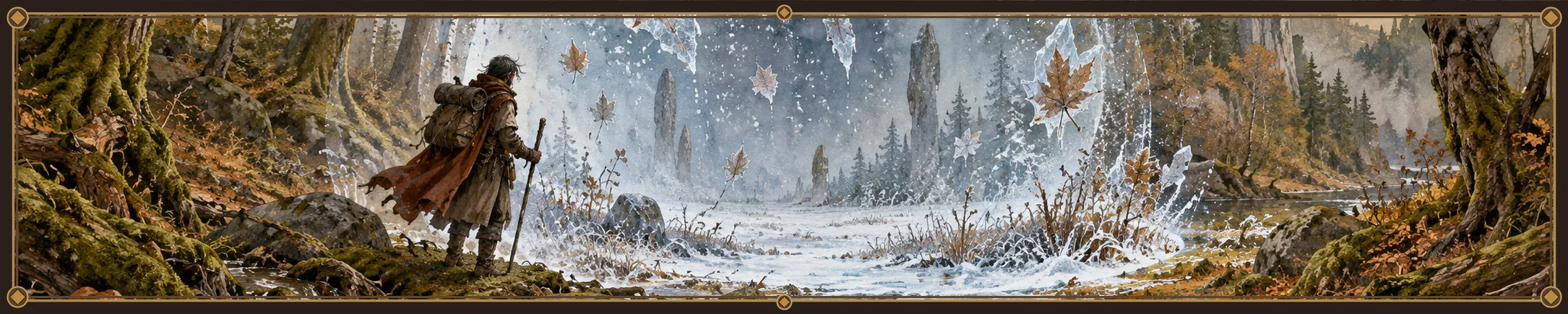
If the fire burns blue, put your own fire out.
If the well will not lie, hold your tongue.
If the wind has a voice, do not answer its call,
for the one who is calling died young.
If the town stands still at a noon that won’t end,
walk softly, walk softly, and leave it unsung.
Songs of the Sheaf Road
There are places where the world forgets its own rules. A field where fire burns blue and cold, and the cinder underfoot crunches like snow. A spring so pure that a lie spoken over it turns the water black. A road where the traveller casts two shadows, one of them a stranger’s, cast years ago by someone long dead. A town where the sun has stood at the same angle since before anyone living was born, and the people in the street are caught mid-stride. These are the Resonant Zones, the places where a Harmonic has pressed through the Veil into the Material Plane and, for an hour or for an age, made the local law its own. They are the nearest most mortals ever come to the planes behind the world, and they are dangerous, beautiful, useful, and sometimes hungry. Their laws are strange, but they are laws: a zone does the same thing to the tenth traveller as to the first, and those who learn it live.
This chapter tells what the zones truly are. People live beside the zones, but what makes them is hidden, and nobody in the world can prove the account given here. What people know and argue is told in What People Know.
What a Zone Is
A Resonant Zone is not a plane. It is an intersection: a bounded place, the size of a room or of a valley but never of a world, that lies within the Material Plane and obeys the logic of a Harmonic. Its physics are hybrid, and the proportion matters. The schools grade zones by how much of the local law the Harmonic has taken over. In a faint zone, a tenth to a third of it, the Harmonic is a chill in the air, a sense of having been here before, a slight bending of light, and most people pass through without knowing. In a moderate zone the effects are plain to anyone: fire burns a different colour, time runs a little fast or slow, thoughts seem louder. In a strong zone, where most of the local law has given way, gravity turns over, the dead speak, objects change their nature, and the unprepared are in danger. In a total zone the Harmonic has taken everything, and the place is in effect a pocket of the Harmonic itself, set down in the world. Few who walk into one unprepared walk out.
Even the strangest zone keeps one law of the world it sits in: it creates nothing from nothing. Its fire that freezes, its water that heals, its sound that sets into crystal, its ideas that take bodily form are all existing energy and matter redirected, stored, converted, or turned inside out. Ask where a zone’s power is coming from, and the answer is always somewhere: the heat of the traveller’s body, the life of the land around it, the matter of the room.
Zones share four habits. They are unstable: most do not last, some vanish within hours, others endure for centuries, and only a rare few become permanent, depending on how strong the bleed is and how steady the ground. They are local: they have edges, and an edge can be walked up to and stepped across. Their physics are hybrid, the Harmonic’s law laid partly over the world’s. And they are sensitive: they answer to mortal will, feeling, and magic, so that a strong-willed traveller can sometimes resist a zone or turn it to use, and a frightened one can make it worse.
They are also classed by how long they last: an ephemeral zone is gone within hours, often called up by a magical event or a surge of feeling; a transient one lasts a season, tied to a tide or a solstice; a persistent one lasts centuries and can be lived beside and harvested; and a permanent one is so settled that it may be mistaken for an ordinary feature of the land.
How Zones Form
Most zones form naturally, where the Veil is already thin and the place already leans towards the Harmonic. A volcano is aligned with the Crucible, an ancient library with the Eternal Record, a still pool with the reflections of the Whispering Trace, a crossroads with the possibilities of the Shifting Path. A battlefield is aligned with the shouted commands of the Binding Song, which is why the Grammar of War wakes there; its other pull, towards the Scourge, is a different thing, a thin spot towards a plane of lack and not the bleed of a Harmonic. Where the alignment is strong and the Veil weak, the Harmonic seeps through.
Some are made by accident. A fire mage who draws too much from the Crucible in one place can leave a field of cold fire behind. A necromancer who draws too heavily on the Whispering Trace can pin the Echoes of the dead in place. A mage who handles time too roughly can stop a town’s clock. Mages call this artificial formation, and the schools warn against it in every generation: the danger is not only in drawing too much, but in working too long in one place at one Harmonic’s frequency, with a chant, a rune, or a rite that matches it too well.
A few are imposed on purpose. A Resonant, or very rarely a Steward, may set a zone on the land as a sign, a gift, or a punishment, and such zones are steadier and stronger than natural ones, though they too only shape energy that already exists. A healing power aligned with Aqua might set down a place where wounds close at once, by supplying or redirecting lifeforce; a war-god aligned with Ignis might set down one where weapons never dull, by constantly renewing their structure. The Primes impose nothing; a force does not leave signs. Cast-Outs do: there are zones whose physics have been bent for no purpose but torment.
The Shape of a Zone
Nearly all zones share the same shape, and a writer who knows it can recognize a zone they have never read about.
A zone has an edge, and the Veil around it takes on the zone’s character. Around the Cinder Fields it is cold and brittle, like walking on broken glass; around the Ageless Spring it is thick as honey; around the Silent Court it is a web of chains and scales. Crossing that edge has its own price, and the price takes the zone’s form: instead of the ordinary forgetting the Veil exacts, a traveller entering the Fields grows numb and forgets why they came, one entering the Grammar of War feels bound to obey orders they do not remember being given, one entering the Mirror of Regret forgets their own achievements in the face of what they lack.
A zone has a gate in the world: the kind of place it is reached from, which is the kind of place it leans towards. The Fields are entered from volcanic vents and scorched battlefields, the Truthwell from wells and springs and sacred groves, the Ghost Step from old roads and pilgrim paths, the Stopped Clock from clock towers and ruins and the sites of temporal magic.
A zone has residents of three kinds: natives, adapted to its law so well that they cannot easily live outside it, who usually guard it as a sacred place; the caught, visitors who stayed too long, panicked, or died there and became part of the zone, frozen, drowned, absorbed, or looped; and keepers, wardens, guides, or jailers, whose work is to hold the zone’s balance or its prisoners.
And a zone has a lesson, which travellers repeat in almost the same words wherever they go: come with a purpose and keep it, carry something that reminds you who you are, do not linger, and remember your name.
A Natural History of the Zones
The known zones are catalogued by their parent Harmonic, and a tour of the catalogue is a tour of what each Harmonic means. None of the recorded zones belongs to one place on Caeldon. Each is a kind, recorded wherever the conditions for it come together, and the same kind may be found in a far valley and in the cellar of a ruined town.
From the Crucible
The Crucible is energy, heat, and transformation, and its zones are fire turned strange.
The Cinder Fields are the most famous of them: the Crucible’s energy turned inside out, so that fire consumes heat instead of producing it. A persistent zone of strong override, they are found in volcanic country, on scorched battlefields, and where great workings of fire once burned. The flames are translucent blue and burn without fuel in flickering patches across a flat expanse of grey cinder that crunches underfoot like packed snow. The light is spectral, the shadows sharp and tinged with blue, and even the sun looks dim and far away. The air is bitterly cold and dry and smells of ozone, burnt metal, and winter frost. There is no roar of flame, only a low crackling hiss like ice cracking on a frozen lake, and the silences between are worse. What the cold fire consumes, it preserves: wood does not turn to ash but to splinters like glass, and the trees and buildings it has taken stand as blackened, frozen silhouettes. And the fire moves towards warmth. A living body is a beacon to it and a campfire a magnet, and the stronger the heat, the faster the blue flames creep towards it.
The Fields have natives, the Frost-Burned, hermit-guardians with cracked, blue-tinged skin, pale unblinking eyes, and breath that always shows. They draw their strength from the blue fire itself and cannot leave the zone without freezing solid; they speak in whispers, because loud sounds stir the flames, and they hold the Fields sacred as the place where fire and ice are one. Cold-salamanders of blue flame and frost slither through the cinder hunting heat; larger Frost-Wyrms can drain the warmth from a creature in moments, and Cinder-Moths swarm warm bodies. Some say the fire itself has a kind of awareness. Travellers caught by it stand among the dead trees as statues of ice and cinder, faces locked in surprise; a few can be revived if warmed fast enough, most cannot. People come for what the Fields yield: cold fire, captured and used in alchemy and enchantment and to forge metals that resist heat; cinder glass, sharp and durable, made from what the fire consumed; and the cold itself, which keeps anything left in it. They are told to keep moving, light no fires, and never stare into the blue flames, which some find hard to look away from. Those aligned with Ignis hold the Fields up as a caution: this, they say, is what comes of drawing on fire without giving back. Delvers who gather cold-fire tell of the camp that lit one torch too many and was found at dawn as grey, frost-split shapes around a blue flame, and of the salamander-hunter who wore a coat of their hides and never felt warm again.
The Storm Heart is a perpetual lightning storm in which the order of things is literally turned over. Lightning does not fall here; it rises from the ground and strikes upward into the clouds. The zone is a flat plain of blackened, glassy earth fused by countless strikes, cracked and veined with glowing energy, with natural crystal spires that channel the bolts. Its light comes in blinding, strobing flashes with near-darkness between, its thunder never stops, and the lightning does not crack but whines. Hair stands on end, sparks jump between objects, and gravity is weakened or reversed in patches, so that rain, debris, and travellers can float up into the storm’s core. The storm feeds on motion and heat: movement draws lightning, warmth draws bolts, and everything in the zone conducts, metal, water, and flesh alike. Its Storm-Walkers, with skin crackling with static and hair floating like a halo, ride the lightning to travel and speak in bursts. The Struck are visitors who were hit and survived, marked with glowing branching scars, and drawn back to the storm until they become part of it. Thunder-Wyrms swim through the bolts and Storm-Hawks with wings of lightning dive from the clouds. Smiths come for storm-steel, metal forged in the storm that holds and gives back charge. They are told to carry nothing of metal, move slowly, stay low, and lie flat when the charge builds. Weaponsmiths pay a fortune for lightning-tempered steel, and the songs remember the smith-hero who rode the upward bolts to the storm’s core and came down with a blade that still crackles.
The Forge Deep is a pocket of slowed time inside a volcano, among deep magma chambers or the sites of ancient fire: a vast cavern of slow magma rivers, anvil-like formations of obsidian, and forges the size of halls. Its light pulses with the fire’s slow rhythm, its heat is a weight on the body rather than a burn, and a hammer stroke rings for minutes. Time runs far slower inside than outside, so that an hour in the Deep may be a year in the world above. Heat does not leave anything once it is there, so cooling takes generations; metals that will not join anywhere else fuse perfectly; and the longer a smith works on a thing, the more of their will and Pattern goes into it, so that a blade worked for a decade remembers its maker. Its Smiths of the Deep, with skin like cooled lava and eyes of molten gold, never hurry; they cool over centuries rather than age, will live as long as they go on forging, and give centuries to a single work. Coolers manage the release of heat, for if the cooling is disrupted the stored heat erupts and destroys the zone. Smiths and artefact-makers come for what can be made nowhere else: alloys that never rust, weapons that never dull, objects heavy with long intent. The price is time. A week below may be decades or centuries above, and the apprentice who climbs out may find everyone they knew long dead. The Smiths teach every newcomer the same thing first: nothing here can be hurried. The songs tell of blades from the Deep that never dull, and of the apprentice who went down for a week to finish one and came up to find her kingdom gone, her name a legend, and the sword she made already lost.
From the Surging Deep
The Surging Deep is water, flow, and life, and its zones are life in excess and water that remembers.
The Drowning Garden is a submerged forest where breathing runs backwards. It is found in deep lakes, flooded forests, and coastal caves: a dense wood of towering kelp, coral trees, and flowering water plants, its floor a carpet of moss and sand dotted with anemones, its fish moving between the branches like birds. Light comes down in dancing beams and the depths glow blue-green. The water is warm and tastes of salt and minerals, and air-breathers can breathe it, while the plants of the Garden would suffocate in the open air above. Everything floats a little; walking is possible, swimming natural. And everything grows fast. Plants put on inches in an hour, wounds heal quickly, and the body ages: a day in the Garden may cost a week, and at the bottom, a lifetime may go in an hour. Its Gill-Folk, green to deep blue, webbed and gilled, tend the forest as gardeners, speak a singsong tongue like bubbling water, and live rich, full, short lives. The Air-Drowned are visitors who panicked and tried to hold their breath, and now float near the surface in a suspended drowning, unable to breathe either element; the Overgrown stayed too long and sprouted coral. Herbalists come for plants found nowhere else, the sick for water that heals though it ages, and the curious for water that lets an air-breather breathe beneath the surface for a while once carried out. The Garden asks one thing of all of them: to give up the instinct to hold their breath. Herb-gatherers tell of the girl who went down to the bottom of the Garden for a flower to save her father and climbed out an old woman, the flower still fresh in her hand.
The Tidal Mirror is a pool that reflects not the present but time. It appears in still lakes at dawn, deep pools beneath waterfalls, and coastal lagoons, a circle of water ringed with smooth stones, flat as glass and unrippled even in wind, darker than the world around it. A traveller who looks in does not see their face as it is but as it was years ago or will be years hence, or sees the place itself as it was centuries ago or will be when it is dust. The offset is fixed for any pool, set by the water’s depth. If the reflection shows a sunset, the shore is bathed in sunset light at noon; if it shows a fire, the air smells of smoke. Things dropped in are swapped for their counterparts from the reflected time, so that a coin thrown in may come back an ancient one, and a traveller who goes into the water goes into that time and stays there until they surface. The water also keeps the memories of everyone who has ever looked into it. Its Echo-Divers, pale as wet paper with black eyes, live partly in the past and warn every visitor not to look too long; the Surface-Walkers, often the Echoes of those who drowned there, walk on the water and lure travellers to step out onto it and fall through. The Drifters are those caught in the reflected time, visible in the water and unreachable from the shore, ageing at its rate. People come to retrieve a lost heirloom or letter, to see someone they lost one more time, or to glimpse what is coming, and the ones who come back are the ones who chose the present over a better-looking time in the water. Fisherfolk tell of the widow who saw her drowned husband alive in the reflected tide and walked in to reach him, and of the raider captain who drew a sword out of the water from the past, only for it to crumble in his first fight.
The Blood River is life without balance. An ephemeral zone of strong override, it wakes in fertile valleys, on ancient battlefields, and near great sources of life and death, and runs as a thick crimson flow that does not merely move but pulses, beating in time with the heart of the strongest creature near it. Its banks are soft and rich and crowded with oversized plants feeding on it, the air is heavy with iron, copper, and wet earth, the ground throbs underfoot, and its sound is not rushing water but a slurping, gurgling heartbeat. A sip of it closes a mortal wound, regrows a limb, or cures a disease at once, and grants a surge of strength. Every healing is taken from somewhere: the river drains the life of the land around it, crops wither, animals die, and the soil on its banks turns to ash. It is addictive, and withdrawal brings rapid ageing and death. Its Hemophages, pale, red-veined, and black-eyed, guard it as its priests and hunt travellers to feed it; the Bloated drank too much and are turning into the river; Blood-Eels and web-spinning Blood-Spinners hunt its banks. It calls to the living. People come to heal a dying loved one or to cheat death, and most learn that every healing it gives was paid for by the land around it, and in the end by the drinker. Its tales are of bargains: the mother who carried her dying son to its bank and came home with a healthy child and a withered farm, the warlord whose warband drank and fought for a season without a scratch, then turned to red water on the march home.
From the Iron Backbone
The Iron Backbone is structure and stability, and its zones are stone that sings, weighs, and moves.
The Crystal Spire is a permanent zone of total override on high peaks, in deep caverns, and at sites of ancient stress in the rock: a towering spire of faceted crystal, amethyst, sapphire, and quartz, rising from a floor of glassy stone. There, sound is not a vibration but a substance. It does not fade; the crystals absorb it and keep it, so that a whisper spoken a century ago is still in the walls. The light comes from the crystals and pulses with the sounds they hold, a low hum glowing amber, a shriek flashing white. Every footstep makes a chord, every word echoes layered with the voices of those who spoke before, and silence is painful. The crystals hold the sounds and the sounds hold the crystals, so that a crystal silenced shatters, and a chain of them can bring down the structure around it. Its Crystal Singers, translucent and faceted, speak in chords and harmonies rather than words, and spend their lives curating the sounds, keeping what matters and silencing what is dangerous; deeper in, Lattice Guardians, merged with the crystal, keep the most dangerous sounds from ever being released. Visitors who could not bear a frequency wander broken, making painful noises that draw worse. What the Spire yields is sound in solid form: shards that burst with a stored scream, gems that carry a whisper across a distance, and crystals that hold the last moments of a dying person and play them back. The wise move quietly and say nothing they would not want kept. Treasure-seekers come for the crystals that hold old voices, a king’s last order, a lost song, a murderer’s confession, and the tale of the thief who shouted when a shard cut him and brought the whole spire down on his band is told to every apprentice harvester.
The Gravity Well is a transient zone where the Backbone’s mass collapses towards a single point. It forms in deep mines, collapsed caverns, the bases of great mountains, and the sites of old magical collapse: a vast bowl or a shaft that seems to drop forever, its ground cracked and compressed, with stones and dust hanging in the air and drifting slowly inward. Weight rises towards the centre, from double at the rim to crushing at the heart. Colours darken, light sags, shadows stretch long towards the middle, the air is thick and hard to breathe, a shout comes out as a whisper, and stone groans constantly under the strain. What moves is hard to stop and what is still is hard to move. Wood grows hard as iron and water turns to crystal ice, and time slows near the centre, so that a minute there may be an hour outside and a day in the Well weeks in the world. Its Weight-Bearers, squat, thick-boned, with skin like compressed stone, work it as a quarry and build things there of impossible strength; spindly Floaters scout its lighter edges; the Crushed, visitors who went too far in, are pressed into the stone like fossils, still aware. Prospectors come for Well-Iron and other compressed metals, salvagers for what the Well has pulled in, and for all of them the climb back out is the hardest part. Salvagers say the bottom of the Well is paved with what it has taken: armour, carts, the hoard of a fallen hold, and the stone faces of those who went in after it, still watching.
The Flux Maze is structure that will not hold still. In deep caverns, ancient ruins, and the foundations of great mountains, it is a labyrinth of stone corridors that rearranges itself around whoever is inside, as if it were thinking: stairs lead to ceilings, doors open on solid rock, the floor tilts as the walls move, and the sound of grinding stone and clicking locks never stops. It anticipates its travellers, closing the most logical way before they can take it; it tightens when they are afraid and opens when they are calm; and it remembers every path they have taken and will not let them retrace it. Its Stone-Walkers, with skin like polished granite and eyes lit like the magma veins in its walls, move through the stone itself, guide and test in equal measure, and speak in riddles. Rarer beings have learned to bend the Maze, opening corridors or guarding exits for a toll or a riddle. At its unstable heart, it is said, lies a Stone-Heart that lets its bearer feel every weakness and shift in the ground. Some live within its walls: there are settlements in the Maze reachable only by those who know the song of the stone. The ones who get out, travellers say, are the ones who stopped trying to solve it and learned to move with it. Treasure-seekers say the Maze keeps the hoards of everyone it has eaten, and the tale of the delver who mapped it for thirty years and was found dead clutching a map of a different maze keeps most of them out.
From the Unbound Gale
The Unbound Gale is motion and freedom, and its zones are wind that speaks, wind that is mute, and air that holds up whatever believes it can fly.
The Whispering Winds blow through a high pass, a canyon, or the ruins on a windy peak, an open country of jagged rock, wind-carved cliffs, and bent trees, too exposed for any building. The wind there never stops, and it speaks. Every gust carries fragments of conversations, last words, confessions, and songs from centuries past, in a thousand tongues, some of them dead; a voice from a battlefield smells of smoke and iron, a voice from a wedding of flowers and wine. Every sound made in the valley is caught and repeated, a whisper heard days later and a shout for years, and voices from different times converge, so that a traveller may hear something said a thousand years ago and something not yet said at all. The voices are not neutral: some encourage, some despair, and a strong one can take hold of a listener and speak through them. And the wind carries everything off again, scattering any voice a traveller tries to hold. Its Wind-Listeners, stone-skinned and long-eared, keep their eyes covered and live by hearing; the Lost Voices are visitors whose bodies are gone and whose voices have joined the chorus. People come to learn what no book holds, to speak with the dead, or to listen for one particular voice, and those who find it are the ones most likely to stay listening too long. Treasure-seekers listen for the dead telling where they buried their hoards, and the tales say the winds tell them gladly, and lie as often as not.
The Silent Gale is the Gale’s paradox: a wind of hurricane force that makes no sound at all. It strikes high passes, canyons, and open plains in storms, a transient zone that comes and goes with the weather. Trees bend and snap without a crack, rocks shatter without a clatter, debris flies in soundless arcs, and the ground is scored with parallel grooves by the silent blast. A scream vibrates in the skull and never reaches the air; the only sounds are a traveller’s own heartbeat and breath, heard through the bones, and a painful fullness in the ears. Spoken magic fails entirely, and so does spoken liturgy: a working that depends on a spoken word does nothing, while gestures, runes, and focus objects still work. Worst of all, the wind gives no warning before it strikes. Its Mute-Walkers, wiry and wind-polished, speak in signs and feel one another through the ground, and hold the zone sacred as a place where the world’s noise is stripped away; its predators, the Wind-Ghosts, are disturbances in the air that hunt by the vibration of a living body. Most people in the Silent Gale were caught by a shift in the weather; a few go in on purpose to lose pursuers or to sit in absolute silence. Afterwards, what they say they missed most is a friend’s voice. Outlaws know the Gale as a place where no hue and cry can follow, and the tale of the bandit band that hid in it from a lord’s riders and was never heard from again, in any sense, is told in every outlaw camp in the hills.
The Sky Isles are a scattered archipelago of floating land, from rocky outcrops to great masses of earth, covered in wind-swept grass and stunted trees with roots hanging in the open air, where waterfalls pour off the edges and turn to mist before they land. The sky is a vivid blue, the air thin and sweet with high flowers, and the islands chime faintly as they drift. There, gravity answers to belief. A traveller who believes they are heavy sinks; one who believes they are light floats, and can walk on air or climb stairs that are not there. The islands drift wherever the shared attention of those on them points, and spin or stall when it scatters. A fall is not fatal unless the faller believes it will be. But a traveller who loses focus, or sleeps without anchoring their mind to the island, drifts away. Its Sky-Walkers, slender and bright-eyed, rest without ever letting go of their anchor, and speak softly, because loud voices unsettle the islands; the rarest of them can hold an island in place against everyone else’s drift. Even its birds steer by thought. Visitors come to fly, to clear their heads, or to escape the weight of the world, and the ones who come back have learned that doubt, not weight, is what makes a person fall. The tale everyone knows is of the boy who flew between the isles on a dare and fell the moment someone shouted that he could not fly; the ones who make the crossing now go in silence.
From the Dreaming Veil
The Dreaming Veil is imagination and dream, and its zones are where dreams stop waiting for sleep.
The Lucid Wastes are a desert built by the mind that walks in it: grey sand like ash in dunes that rise and fall like breathing lungs, pierced by black spires like broken teeth, under a light with no sun that seems to come from the traveller’s own anxiety. They open in deserts and other places of isolation and sleeplessness, and they answer to fear. A fear of falling turns the sand to a sinking pit; a fear of the dark puts out the horizon; guilt becomes a shadow that follows. The more afraid the traveller is, the deeper the sand, and the more the Wastes feed on that fear, the worse they grow. Faceless Night-Markers, the shapes of a traveller’s own fears, stalk them, and can be dispelled only by overcoming the fear that made them. Travellers who give in become part of the terrain; the rare few who master their fear can reshape the Wastes as they please, and guide others. Nobody chooses the Wastes the first time, for people fall in through a nightmare that will not end; some go back on purpose, to face one fear, and come away knowing exactly what they are afraid of. Those who came back speak of meeting the beast they feared most as children, grown to the size of their fear; the ones who killed it say it was the hardest fight of their lives, and that no one else saw the blood.
The Nightmare Nexus is where the nightmares of many minds run together. An ephemeral zone of total override, it wakes in places of mass trauma and great fear, or out of the shared dreaming of a sleeping town: a labyrinth of impossible geometry whose architecture mimics the inside of a mind, a hall of eyes, a room of teeth, a forest of screaming trees, under a flickering, hostile light where shadows leave their owners. Whispers come in the voices of people the traveller knows, saying things they never said. The most feared thing in a mind becomes the zone’s chief predator, and the fears of different dreamers merge into worse things than any one could make. The only defence is to realize that one is dreaming. Lucidity does not make the Nexus obey; what it has dreamed has flesh and stays solid. But a lucid traveller can wound that flesh and fight back, and what the Nexus gives a body remains when it is carried out: the hide, teeth, and bone of a slain nightmare can be worked like any other material. Those it consumes lie comatose in the waking world, their minds caught in their worst dream. The ones who return have learned to recognize a dream while it is trying to eat them. Plague years and long sieges are when the Nexus feeds best: whole towns have woken screaming from the same dream, and songs tell of the city where the shared nightmare walked out into the streets and had to be fought with swords.
The Muse’s Studio is a workshop where ideas take bodily form. A persistent zone of moderate override, it settles in abandoned theatres, quiet attics, and the places where great art was made: easels lean against walls that are not there, tables float, canvases stretch across the ceiling, and the floor is littered with sketches, broken instruments, and half-built machines. The air smells of oil paint, ink, clay, and wood shavings. A sketch drawn there becomes a real painting, a melody hummed floats as a visible ribbon, and a story told aloud raises its characters, because the zone turns the matter, light, and sound at hand into the shape of whatever is imagined with enough force. It does not tell genius from madness. A moment of boredom gathers dust into a heap; a flash of anger draws heat and grit together into a shard of glass. Whatever is made is a rough draft, and fades or rusts if it is not finished. Its Muses, shifting figures of colour and voice who embody the aspects of making, encourage and tempt in equal measure. Visitors who lose the power to make anything at all stand frozen in grey dust. Artists come to break a block or make a masterpiece, and some stay for years while their bodies wither elsewhere. They leave having seen what their stray thoughts would build, given matter to build with. The tale of the painter whose fear of wolves came off the canvas and ate him is told in every workshop that has heard of the Studio; so is the tale of the sculptor who carved a guardian there that still walks the hills.
From the Eternal Record
The Eternal Record is memory and knowledge, and its two known zones are its opposites: a record of what never was, and a record kept too well.
The Lost Archive is the Record turned inside out. It grows in abandoned libraries and forgotten ruins, and above all in places where knowledge was deliberately destroyed: an endless maze of twisting shelves, stairs to nowhere, and floors deep in loose pages, lit by books that glow or lie in darkness. It holds every book that was never written, every letter that was burned, every song hummed and never set down, every buried truth, and every history that could have been. The books are not fixed. A history rewrites itself to the reader’s expectations or fears; two books may merge into a new and unstable one; and reading does not inform, it implants, so that a reader does not learn about a battle but remembers fighting in it. The deeper a traveller goes, the more of their own memory the Archive takes to feed itself. Its Librarians, parchment-skinned with inkwell eyes, try to order the chaos and warn against obsession; visitors who stay too long turn into books, and are shelved with the rest. Scholars come for lost knowledge, the bereaved for lost memories, the stubborn for the truth, and those who leave with their own past intact have seen how easily it could have been rewritten. Scholars tell of the reader who found the book of the life she should have had and came out believing it, and of the thief who went in to steal a lost spell and came out remembering a childhood that was not his.
The Memory Palace is the Record made private: a mansion of the mind, built in deep meditation chambers, in ruins, and at sites of great pain. It takes the shape of the person who enters it, a library for a scholar, a fortress for a soldier, a sprawling playhouse for a child, and its rooms glow with the feeling of the memories they hold, gold for joy, dim blue for grief, shadow for what has been pushed away. Memories there are rooms and objects that can be walked through, touched, and moved; one locked in a vault cannot be forgotten, one left in a drawer can be lost with the drawer. Everything kept there is kept perfectly, and that is the danger: a painful memory stays as painful as the day it happened, and the deeper a traveller goes into their own past, the harder it becomes to form new memories or to come back to the present at all. Its Curators, shaped like younger selves or idealized loved ones, keep its order and will not open the rooms of what has been repressed. People use it to recover what they lost, lock away what hurts, or store what they must know, and the danger they all describe is the same: the rooms are easier to stay in than the present is to return to. The tale told of the Palace is of the widower who built a room for his wife’s last summer and went back every night until he forgot the way out, and of the spy who locked his secrets there so well that his torturers learned nothing, and neither did he.
From the Shifting Path
The Shifting Path is possibility and chance, and its zones show the future too many ways, too randomly, or too clearly.
The Forking Road is a crossroads where every step splits the world. It appears at junctions, at places of decision, and where history itself once divided: a flat plain of grey stone that fractures into roads paved with cobbles, light, water, or bone, intersecting, looping, and merging towards different horizons. Light comes from where the paths cross, and shadows are many, showing the traveller’s silhouette at other ages and in other states. The traveller sees the outcome of every road they did not take, and the other selves who took them; every possible end of a conversation is heard at once. Probable paths glow gold and unlikely ones flicker violet. A firm choice snaps the branches back into one, and looking too hard at any one path destroys it. Its Wayfinders step sideways between branches to avoid danger and guide the lost; its gamblers feed on high stakes. People walk the Road hoping for a better future, a mistake undone, or a missed chance found again, and most come back judging the choices they made differently. Wayside tales tell of the soldier who walked the Road looking for the branch where his brother lived, found it, and could not leave it, and of the brigand who used the Road to slip every ambush until he met himself waiting on the other path.
The Probability Fog is a rolling mist in which luck is the only law. It gathers on foggy moors, at crossroads at dawn, and wherever an outcome hangs in the balance, and hides not just the way but the result of every action. A step may move a traveller a mile, a sword may turn to water in the hand, a door may open onto yesterday, a torch may shed darkness instead of light. The ground changes from stone to moss to water to flowers within a few paces, the smell changes every few breaths, and sounds arrive late, backwards, or not at all. Distant possibilities meet in it, so that a traveller may meet another version of themselves. Its Drifters, adapted to the chaos, have forms that shift with every step and treat the whole place as a game. Visitors who have a run of extraordinary luck there should expect it to turn, because the Fog balances its scales; those who are transformed and cannot change back become part of it. Gamblers and the desperate come chasing a lucky break, carrying one object they know well and checking that it is still the same, and those who come out have stopped planning and learned to adapt. Gamblers tell of the beggar who walked into the Fog and came out a lord’s heir, and of the lord who followed him in and came out a goat.
The Prophecy’s Edge is the Path narrowed to one blinding point. It forms on high cliffs, at old observatories, and at the places where peoples have always gone to read the future: a vast flat plateau with a mirror-like ground, ending at a precipice beyond which hang silent, translucent images of what is coming, battles, coronations, births, and deaths, against a horizon of light. The air is thin and cold and smells of old parchment, and something ticks like a clock that cannot be stopped. The traveller sees the most heavily weighted future with near-perfect clarity, from their own next step to the fall of kingdoms centuries away, and is pressed hard to act in keeping with it. This is not predestination but songline pressure at its fiercest: the line can still be broken, but every step against it costs more, and looking reinforces what is seen. Its Seers, with white or golden eyes, move as if already walking the path they have seen and speak only of what will happen. The Compelled are visitors acting out their parts, their wills pressed almost flat; the Blind are the rare ones who closed their eyes, and stumble terrified through the zone trying to break the cycle. People climb to the Edge to learn their future, and pay for the answer afterwards, in the effort of every step they take against it. The Edge is in half the hero-songs: the champion who saw his death there and rode out to meet it anyway, the queen who saw her city burn and spent forty years making it not quite come true.
From the Binding Song
The Binding Song is language and binding, and it has more known zones than any other Harmonic: four places where words carry their full weight.
The Silent Court is a round chamber of polished black stone with a raised dais at its centre and empty benches around the walls, found in old judgement halls, abandoned temples, places of ordeal, and the sites of great oaths and broken ones. Translucent weights float in its air, one for every word spoken. A lie falls like a heavy thud and lies like a stone in the mouth, adding weight to the speaker; a truth rings like a clear chime and feels like light, and makes the speaker lighter. A promise made there forges a physical chain between the one who made it and the one who heard it, which tightens if the promise is broken. The more deceit in the room, the heavier everything grows, and empty chatter is painful, like swallowing glass. Its first law is silence: nothing may be said lightly, and whatever is said binds. Its Judges, masked in obsidian, carry scales that weigh every word and never speak. The Burdened kneel or crawl under the weight of their own lies until they confess; the Light-Bringers, who have kept every oath and said nothing they did not mean, float above the floor. A monastery stands within one such Court, whose monks study the weight of words. People come for a judgement the strong cannot buy, to swear an oath that cannot be broken, or to confess, and leave lighter or heavier according to what they said there. The tales of the Court are of oath-breakers dragged there by their enemies and crushed under their own words, and of the sworn brothers whose oath made there held them together through a war and dragged one down when the other broke it.
The Name Bound is the Song narrowed to names. It is found in old archives, judgement halls, places of oath-taking, and wherever an identity was forged or stolen: stone corridors lined with scrolls and tablets, sigils glowing underfoot, doors sealed with wax bearing names, glyphs drifting in the air like dust and chains of glowing script hanging between things and beings. Most beings with a stable identity carry a True Name there, a reference fixed to who they are, which floats above them in glowing letters and cannot be hidden. Beings whose identity is fluid, shared, or unstable may have none. To speak someone’s True Name there is to command them, and they must obey or suffer pain, paralysis, or death; every agreement made in the zone binds; and to speak another’s name without leave is itself punished, with muteness or lost memory. Its Scribes, with quills for fingertips, record every name and contract and speak only in declarations. The Bound move like puppets for whoever holds their name; the Nameless have hidden theirs and steal others', and there are thieves of names who sell them. Visitors come to seal a bargain, win back a stolen name, or learn an enemy’s True Name. They bring a false name and never speak their own, and whatever else they take home, they guard their own name more closely afterwards. Name-thieves are the terror of the tales: the sorcerer who stole a warlord’s True Name and rode his army home, and the village that hid its children’s names under false ones for a generation after a Thief passed through.
The Grammar of War wakes only around a battle fought with fierce conviction, and fades when the fighting stops. In it, orders become physical law. "Hold the line" makes soldiers immovable; "charge" lends impossible speed; at the order to dig in, the trenches deepen, and at the order to fortify, walls rise. A shouted order leaves a brief luminous afterimage in the shape of the word, and a command passing through the ranks feels like a wave of pressure. The force of an order follows the speaker’s conviction, the number who believe in it, and the speaker’s rank, so that a king outranks a captain and a beloved leader outranks a tyrant; clear, simple orders are stronger than complicated ones; and two generals shouting opposite commands make the world stutter, soldiers freeze, the ground cracks, and the air shimmers. Spectral Word-Generals, commanders of past battles in the armour of a dozen ages, repeat their last orders forever. The Commanded carry out the last order they received until they fall, so that a soldier told to hold may stand until he dies of thirst; the Disobedient keep their own will among comrades who have lost theirs. In a zone made of command, silence is the most frightening thing there is. Survivors give orders more sparingly afterwards, having seen what one can do. Veterans of a battle the Grammar woke in tell of the general whose one shout of "Hold!" froze both armies until the crows came, and of the herald who learned to speak there and was hired by every warlord who could pay.
The Truthwell is a body of water that rejects falsehood: a round stone basin, worn smooth by centuries and often carved around its rim with old runes of binding and ordeal, enclosing a deep shaft of unnaturally pure water. It is found at ancient wells and springs, in sacred groves, and where oaths have been sworn for generations. When the truth is spoken there, the water is cool, clear, and restoring. When a lie is spoken, it reacts at once and in proportion: it may boil and scald, freeze and trap, turn a churning black or a searing red, or rise up to choke the speaker, and the air fills with the smell of sulphur, rot, or burning hair. A promise made while drinking from it binds, and if it is broken the water rises and drowns the one who broke it. The Well judges only what is said aloud, so a truth held back is no defence, and silence before its question is taken as a lie. Its Water-Robed, stone-skinned, with eyes like its surface, hold it as a sacred trust. The Choked, liars it drowned, hang preserved in the water as warnings, their Echoes held there until their lies are confessed or named. Water from the Well can be carried away, and anyone made to drink it can speak only facts. People come to end a quarrel beyond doubt, to swear an oath, or to confess, and most leave having said aloud something they had kept even from themselves. Feuding houses drag one another to the Truthwell, and the tale of the chieftain who swore his innocence there and went under, still swearing, is the one every child knows.
From the Whispering Trace
The Whispering Trace is death, reflection, and remnant, and its zones are where the dead and the might-have-been still walk.
The Ghost Step is a stretch of road where the past has folded back over the present. It is found on ancient roads, forgotten pilgrim routes, and battlefields, a transient zone of moderate override: the present looks washed out, sepia and grey, while the road’s own echo shows it as it was, paved and busy, in faded spectral colour. The traveller walks in the footsteps of everyone who walked it before, casting their own shadow and a second, fainter one. Every step wakes an older one, a boot from a forgotten age or a running child; woodsmoke from a fire that burned centuries ago drifts across the road; and the ground feels thick underfoot, as though weighed down by countless travellers. The echoes are half solid, like cold mist, and a violent one, a battle replaying, can knock a traveller down. They grow stronger with the traveller’s own feelings, fear calling up the frightened dead and peace the content ones. Its Path-Echoes repeat their routines forever, a soldier marching, a merchant haggling, taking no notice of the living. Some visitors forget they are alive and walk on with the dead until they become echoes themselves; strong echoes can follow a traveller off the road and haunt them. Pilgrims who follow Umbra walk it on purpose, to keep the dead from being forgotten, and come off it knowing how many feet wore the road before theirs. Every old road with a Step on it has its ghost-march: the lost army that passes at dusk once a year, and the tale of the boy who fell in step with it and was seen marching with it the next year, and the next.
The Soul Anchor is the common name for a zone where the Whispering Trace has become a prison. There is no detachable soul in this cosmos, and scholars use the name carefully; what the Anchor holds is the Echo a person leaves at death, the remnant of their Pattern. It forms on ancient burial grounds, at sites of mass sacrifice, in forgotten catacombs, and where a powerful Echo was bound against its release: a land of broken monuments, shattered headstones, and dead trees under an iron-hard ground, with the static of trapped remnants shimmering in the air and a low drone like a million voices begging. When a being dies within it, its Echo does not soften, scatter, or pass into Record. It is caught and pinned within a few paces of where it fell, and made to replay its last moments, or its life, over and over, aware enough to suffer the repetition and too damaged to move on. The more Echoes the Anchor holds, the stronger it grows. It can be broken only by a particular rite, by resolving the business that holds its prisoners, or by giving them a stronger path into Record. The Anchored flicker on their chains, grasping at travellers as liberators or as new prisoners; its keepers, constructs or remnant beings, reinforce the chains and keep the loops turning. The trapped Echoes give off a potent remnant energy that can be harvested for magic, and they hold secrets of what they saw. People come to free a loved one, to pry a secret from the dead, or to study death, and the first rule of the place is not to die there. Songs tell of the daughter who went into an Anchor to free her father’s Echo from the death he kept repeating, and of the necromancers who keep Anchors as prisons for their enemies' dead.
The Mirror of Regret shows the life a person would have lived had they chosen differently. An ephemeral zone of strong override, it appears in still lakes at dawn, polished obsidian pools, abandoned bathhouses, and places of great loss: a small, perfectly still pool or a great standing slab of black glass in a misty, featureless void. The reflection is always brighter and warmer than the world around it, and always better. It shows not the future but the counterfactual past, aimed at the one choice the viewer most wishes they could undo: the child who was never born, the friend who did not die, the road not taken, with its sounds and smells reaching across. It cannot be touched or changed, and the longer a viewer stares, the more it pulls at their Pattern. The Broken sit beside it whispering to the reflection until they fade into it; some wake in the world believing they are the person in the glass. The Acceptors, who looked, accepted the pain, and turned away, warn others and help them leave. Guilt draws most visitors there before they ever decide to go, and those who manage to turn away usually make peace with the life they actually have. Songs tell of the old knight who looked into the Mirror, saw the farmer he might have been, and smashed it with his sword; the shards grew back by morning, and he was found among them.
From the Frozen Moment
The Frozen Moment is time and stasis, and its zones are three degrees of stillness: a life that cannot change, a moment that cannot end, and a vault where seconds are ages.
The Ageless Spring is a permanent zone of total override, usually in a deep, secluded valley or among ancient ruins: a small round pool whose water glows softly from within, ringed by moss that never grows tall, flowers that never wilt, and trees in perfect health whose leaves never fall. The light is a golden twilight that never changes, and shadows neither lengthen nor shorten. There is no wind and no insect sound, only the trickle of the spring, which seems to loop endlessly. The water feels cool and heavy, like quicksilver. Inside the zone, time does not pass: nothing ages, nothing rots, and nothing heals, because the body has stopped trying to repair itself, so that a cut made there stays exactly as it was until it is tended outside. Those who drink live on without ageing, and without growing or changing either. The stillness is anchored to the spring itself, and if it is destroyed or covered, time rushes back all at once, often as sudden ageing or decay. Its Lingerers, those who drank and chose to stay, look exactly as they did when they drank, however many centuries have passed, and form small communities that guard it; a village beside one such spring is known where the old never die. Others drank and are trapped, wandering its edge while the seasons change outside. Guardians made by Resonants or by the Lingerers keep anyone from tampering with the water. Seekers of immortality come, and people carrying a dying loved one, and people hiding from the years, and those who walk away without drinking have usually decided that a life that cannot change is not worth keeping. Songs tell of the spring-village where the grandmothers have been grandmothers for three hundred years, and of the raiders who came to take the water and went home old men, their wounds still open.
The Stopped Clock is a pocket where time has simply halted at one instant. It is found in abandoned villages, old clock towers, the sites of powerful temporal workings, and places where someone tried to preserve a great moment. A town caught in one stands exactly as it was when the zone formed: a baker mid-knead, a child mid-laugh, rain hanging in the air like glass beads, chimney smoke frozen in curling ribbons, a dropped cup hovering above the floor. The light keeps the angle it had at that instant, so that a sunset may burn on the horizon forever. The colours look faded, and the only vivid thing in the place is the traveller, who moves through air as thick as setting glue while everything else stands still. The silence is absolute, not of emptiness but of a thousand held breaths. And the frozen are aware. Their eyes cannot move and their hearts cannot beat, but their minds run on, watching the traveller walk among them. Anything a traveller moves stays where it was put, and when time resumes the change goes with it: a moved knife may stab someone who was never stabbed, a shifted foot cause a fall that never happened, and the temptation to rearrange the frozen street for a better ending is overwhelming. Invisible Gloom-Leeches, born of the frozen people’s despair, feed on it and deepen it. At the centre stands the Clock-Keeper, the local anchor of that one Clock, often the shade or remnant of whoever made it: a mage whose working ran away, a grieving parent who wished for one more moment. Frozen like the rest, the Keeper can speak to a visitor in thought, and is usually remorseful, desperate, or mad. If the Keeper is destroyed, persuaded to let go, or brought to accept the cost of time resuming, the Clock collapses and time runs on, and a Keeper whose zone causes paradox, or keeps a rightful ending from coming, may draw the attention of the Stewards who guard the order of time. Visitors come to take back a lost treasure, to look on a moment of history, or to find the Keeper and bargain for the zone’s release, and they remember the frozen eyes following them. Ruin-delvers tell of a Clock that holds a royal wedding feast, gold on every table and the bride’s eyes following every thief; the ones who took the gold say it was the worst thing they ever did. For the people inside, the perfect moment is a prison.
The Time Lock is a zone built on purpose: a vault of dilated time, drawn from the Frozen Moment, in which a single second lasts a thousand years outside. Time does flow in it, unlike the Stopped Clock, but at a crawl so slow it might as well be still. It lies in deep vaults, ancient treasuries, and sealed temples: a vast underground chamber of massive walls, iron doors, and sealed alcoves, without decoration, its shelves holding objects wrapped in cloth, sealed in resin, or cased in crystal, its floor of interlocking plates engraved with sigils of time. Everything has the patina of great age though nothing has aged. The light is a dim, thick glow; a shout arrives as a long groan minutes later; and under it all is a deep thrum like the Lock’s own heartbeat. The Lock was made by whoever first understood that some things are too dangerous to destroy and too dangerous to leave in the flow of ordinary time: a cursed blade that kills whoever touches it, a plague without a cure, a prophecy that must never be read. Its Bronze Sentries, tall figures of living bronze with featureless masks, perceive time at the Lock’s rate, so that the world outside is to them a blur of incomprehensible speed; they move only when they must, speak through gestures that take hours and the slow chiming of their armour, and count every object in their keeping as a threat to existence. The Interred, the things and beings sealed within, are as dangerous as on the day they were sealed, and will bargain, threaten, or deceive anyone who comes near to get out. The Lock opens only from inside, with the Sentries' consent, and no key, spell, or force breaks it from outside. Visitors come to lodge a dangerous object, retrieve a sealed one, or consult the Sentries about a threat nothing else can hold, and the shortest visit costs ages outside: those who come out find their world has long forgotten them. The tales say the Lock keeps the worst things of every age, and that the Interred whisper bargains through the bronze to any thief who comes near; the songs never say whether anyone accepted.
Living Beside a Zone
Zones are hazards, but they are also ecologies. Cold-salamanders hunt the thermal inversions of the Cinder Fields; fish breathe air and mammals breathe water in the Drowning Garden; birds in the Sky Isles steer by thought rather than instinct. Every zone with a long life has creatures that belong to it and to nowhere else, and many have peoples, the natives described above, whose bodies and customs answer its law so closely that the rest of the world seems to them hasty, noisy, rigid, or blind.
Mortals harvest them too. Cold fire from the Cinder Fields is used in alchemy and to forge metals that resist heat. Water from the Ageless Spring keeps whatever it touches; water from the Truthwell is carried away to make people speak the truth. Storm-steel, Well-Iron, cinder glass, crystals full of stored sound, nightmare bone, metals fused in the Forge Deep: much of what a mortal world calls a wonder was carried out of a zone by someone who knew how to go in and come back. Zone-delvers are a known kind on Caeldon: they come back rich, changed, or not at all, and every zone-edge inn has its wall of names for those who went in last season. Lords pay well for what they carry out, and hang those who sell it to a rival. And strong exposure to a zone can leave its mark on a person, a trait imprinted by the zone’s law that stays after they leave.
Where a zone is persistent or permanent, people sometimes settle beside it and adapt to it, as river people adapt to a river. A village lives around an Ageless Spring, and its old do not die. A monastery stands in a Silent Court, its monks studying the weight of words. A settlement keeps house within the shifting walls of a Flux Maze, reachable only by those who know the song of the stone. These communities live by the zone’s effects and guard it against anyone who would close it, and they are often the best guides to it and the least willing to see it shut.
When a Zone Grows
The greatest danger is not any zone’s particular law but expansion. A zone that grows too large or too intense can begin to consume the Material Plane around it and turn it into an extension of the Harmonic. The signs come by small steps: its edge moves outward a little, its effects grow stronger, creatures of the parent Harmonic begin to arrive, and at last it no longer needs a thin Veil or a careless mage to sustain it. A zone that has become self-sustaining is no longer a wound in the world. It is the beginning of a different world.
There are four known ways to hold one back, and none of them is free. Counter-resonance spends an opposing Harmonic against it, as the stillness of the Frozen Moment is set against a zone of the Crucible. The Veil at the zone’s edge can be reinforced by ritual or by an artefact made for the purpose. The zone can be starved, its flow from the parent Harmonic cut off, which is both difficult and dangerous. Or a Resonant can be asked to seal the breach, and a power that seals a breach is owed worship or service afterwards. Whichever way is chosen, someone pays, and the people who live by the zone are usually the first to pay.
What People Know
Of every tier of the cosmos, the zones are the one people know best, because they can walk up to its edges.
What Is Known
Where a zone lies, what it does, and what it costs are often known precisely. Harvesters know how long a body can stay in the Cinder Fields, settlers know the hours of their spring, and carters sing their warnings from road to road, as Songs of the Sheaf Road does: what to do and what to leave alone, never why. The names this book gives the zones are the records' names; the people who live near one call it by a name of their own, and their knowledge rarely travels further than their road.
What Is Argued
Why a zone is as it is, nobody knows for sure. Local faith reads it as a god’s sign, gift, or punishment, and is sometimes right; craft lore reads it by what can be harvested from it; rival schools explain it by their own roots; and a Harmonic bleeding through a thin Veil is one scholar’s account among several. Two peoples beside one zone may hold it to be a sanctuary and a wound, and nobody can settle it by looking. What becomes of a zone’s natives when it fades is argued as well: scholars hold that they thin and drift back into the Harmonic the zone came from, where travellers may meet them again, changed, but nobody has followed one there to be sure.
Tensions
-
Zones that will not stay small. Any Resonant Zone can grow until it sustains itself, and the mortals who have settled zones such as the Ageless Spring live by the very effects that holding it back would end.
-
Moments held against time. Each Stopped Clock is held by its Clock-Keeper, often the remnant of whoever made it, and ends only if the Keeper is destroyed, persuaded to let go, or brought to accept the cost of time resuming. For the people frozen inside, the perfect moment is a prison, and the one who can end it is the one who wanted it kept.
-
The frozen are watching. Whatever a visitor moves inside a Stopped Clock stays moved when time resumes. A rearranged street can save a child or kill a stranger who was never in danger, and the people frozen in it are aware of every hand that touches them.
-
What the Lock keeps. The Time Lock holds things too dangerous to destroy, and its Interred are as dangerous now as the day they were sealed, and want out. It opens only from inside, at the consent of Bronze Sentries who count every artefact a threat to existence, may seal in anyone they judge a threat, and hear no plea.
-
Truth by the jar. Water from the Truthwell compels whoever drinks it to speak only facts, and it can be carried away. Whoever holds it can draw the truth out of anyone made to drink.
-
A future that leans. Whoever looks out from the Prophecy’s Edge sees the most heavily weighted future and is pressed towards it, and every look strengthens the line. Knowing the likely end makes it far harder to change, and a ruler who sends someone to look has made that future more likely.
-
What the dead are worth. The Echoes trapped in a Soul Anchor give off a remnant energy that can be harvested for magic, and they hold the secrets of what they saw. Releasing them ends their suffering, and ends the harvest and the secrets with it.
-
The river’s price. A sip of the Blood River closes a mortal wound, and every healing it gives drains the land on its banks. Whoever drinks to save the dying is spending the fields along its banks, and its priests hunt travellers to feed it.