Chapter 9. The Schools of Magic
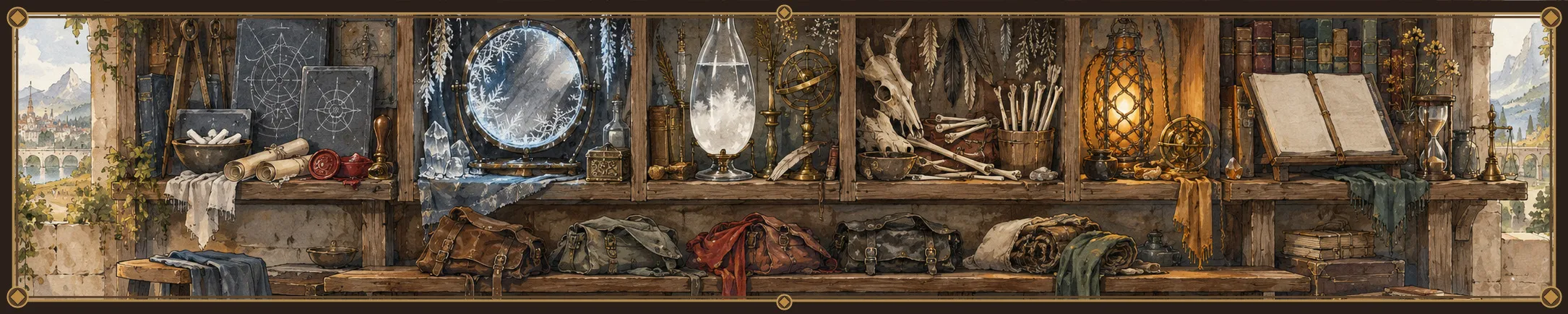
Every school begins with a question. The Crucible asks what a thing becomes when it burns; the Backbone asks what holds; the Binding Song asks what a word is worth. Learn the question before you learn the working, or the working will answer it for you.
The Primer of Ten Questions
Very few mages think about Prime energies when they work, any more than a mason thinks about the weight of the world when she sets a stone. They think in schools: bodies of practice, handed down from teacher to student, that gather the workings which recur often enough to deserve a name. The schools are where theory becomes a trade, and where a trade becomes a reputation. Ten of them grow directly from the ten Harmonics, the conceptual realms through which Prime energy becomes reachable and intelligible, and each carries something of its Harmonic’s character into the hands of those who learn it: the Crucible’s impatience, the Backbone’s patience, the Binding Song’s love of the exact word. Fifteen more are compound disciplines, built where several energies are braided together so often that the braiding has a craft of its own. None of them is forbidden by the laws of magic. Some are forbidden by people, in some places and some ages and not in others, and that difference, between what magic permits and what people will stand for, runs through every school in this chapter. So does the trade in them: every school has its hired hands in sellsword companies and lords' halls, its delvers' fears in the elder ruins, and its heroes and horrors in the songs.
This chapter tells each school’s true root. Mages know their schools well as practice; the roots beneath them, the Harmonics and the Prime energies, are hidden from nearly all of them. What they know and believe of their own arts is told in What People Know.
What Makes a School
A school exists because pure metaphysics is too abstract to train anyone in. Nobody can teach an apprentice "Ignis with Zephyr in support"; a teacher can teach her to light a lamp with a fingertip, then to stir dead coals back to a cooking fire, then to draw the heat out of the stones around her and hold it ready. Schools gather the patterns that recur in practice, the Harmonic a tradition draws on most, the methods it favours, the Prime blends that keep turning up, into disciplines that can be named, taught, hired, feared, and argued about.
Teachers count a tradition a school of its own when it can answer four questions: which Harmonic or Prime blend it is rooted in, which Prime energy dominates it, what kind of transformation it performs most reliably, and why its practitioners hold it distinct from the schools beside it. Each of the ten Harmonic schools answers the first question with one Harmonic and has one dominant Prime, often with others in support. The fifteen compound schools answer it with a blend, because no single Harmonic is wide enough to hold them.
Schools are not divided into real magic and forbidden magic. Necromancy, sacrificial rites, coercive arts, and the other occult traditions belong to the same order of things as the most respected crafts of hearth and hall, and their danger lies in use, cost, and what they do to the people around them, not in some separate category of magic. Even conjuration only calls, gathers, or briefly holds together what already exists.
Who Finds It Easy
School difficulty is not universal. The teachers of the schools grade how open each school is to each species in four bands. Band A, Intuitive: compatibility is high from the start, and early training succeeds reliably. Band B, Workable: compatibility is moderate, and routine training produces competent practitioners. Band C, Demanding: efficiency and safety suffer persistently, and a master’s close eye is needed. Band D, Severe: the school is structurally high-risk for that body, and only exceptional cases succeed without serious harm. These are bands of access, not of rank, and a species can be Band D in one school and Band A in another.
Some broad tendencies hold across the world. Schools rooted in Aqua, Imago, and Memoria come easier to lifeforce patterns built for adaptation and recovery. Schools rooted in Terra and Verba come easier to bodies that retain pattern well and hold structure. And the volatile schools, Storm and Sacrificial Magic and some branches of Dominion, are hard for nearly every species unless it carries some special tolerance.
How a School Fails
Schools are also how a failure is named. When a working breaks, the temples, craft masters, lords' scribes, and war-captains who write such things down note first the method that broke and then the school’s signature: what that break becomes in the world. The same lost gesture means one thing in a fire-working and quite another in a dream-working. Each section below ends with its school’s signature, because a writer who knows how a school fails knows a great deal about how it is feared.
Crucible Magic
The Crucible is the Harmonic of energy, heat, and transformation; each Harmonic’s realm is described in The Planes. Crucible Magic takes its law from there: change requires heat, pressure, and release. Its dominant energy is Ignis, often supported by Zephyr and Terra.
Its practitioners see fire not merely as destruction but as the force that shows what a thing can become once its impurity is burned away. The school prizes courage, precision, and restraint. Every student is told on the first day that raw fire is easy and useful fire is difficult, and the best of them do not simply ignite: they temper, refine, and direct. A village fears a fire-mage because it has seen fire loose: a war-mage on the walls can end a siege, and the same war-mage with the wrong wind burns the town he was hired to save. Sellsword captains pay more for one Crucible caster than for a dozen crossbows, a raiding band that brings one brings the burning, and beast-hunters burn what steel will not kill. The school is taught in ember collegia known for battle-casting and fine thermal control, in severe ash monasteries that teach discipline through endurance of heat and meditation at the furnace, in the guild tradition of the Nine Hammer Forges, where smith-mages learn the school through metal, at the temple-school of the Cinder Basilica, where sacred flame is studied as both purification and punishment, and in glass-kiln workshops given over to lenses and fused materials.
Ordinary people meet it at the hearth. A fingertip laid on a wick, and the wick takes; a palm held over the grey bed of last night’s fire, and the coals redden as if someone had blown on them, which is how camp wardens restart cookfires before dawn without striking new flame. The scholars call these Sparktouch and Coalwake. A little further along, a Crucible mage learns to pull warmth out of the stones around her and gather it at a point, leaving frost on the surfaces she robbed; to send a crawling line of ignition along a rope or a trail of pitch; to brand a sigil into wood or flesh; to fill the air with hot stinging ash. At the far end of the school stand the workings that end sieges: a hurled sphere that blooms into one orange detonation over a gate trench, a burning palisade drawn across an avenue, impact-masses rained into a valley mouth like falling suns, which the school’s own teachers call memorable for all the wrong reasons. The songs praise the smith-mages who tempered a whole muster’s blades the night before a battle, and mock the young adept who held a swelling fire-core one heartbeat too long. And there are the workings of mercy and their cost: cauterizing fire held to a wound, and the purging flame a plague priest uses to burn corruption out of flesh that no other treatment can save, at the risk of killing the patient if the impurity cannot be cleanly separated.
The school marks those who practise it with burns, fever, heat damage, and scarred nerves. When a working runs away from its caster it fails by thermal runaway and flash-vent collapse: a burst of heat, burns, and an aftermath in which the air itself feels spent and hard to breathe. Those who contain such failures cool the place and get the air moving before anything else.
Ask what the fire wants and it will tell you: everything, now. The art is to give it less, later, and exactly where you meant.
Surging Magic
The Surging Deep is the Harmonic of water, flow, and life. Surging Magic learns its lesson there: life survives through movement. Water that does not flow stagnates; blood that does not circulate kills; healing that does not rebalance becomes swelling, rot, or parasitic growth. Its dominant energy is Aqua, often supported by Imago and Memoria.
The school’s philosophy is continuity, adaptation, and measured generosity. A Surging mage is taught that not every wound should be closed by force and not every poison fought head-on; often the right answer is to redirect, dilute, flush, or restore the proper movement of things. Much of the world’s healing begins here, and every sellsword company that can afford one keeps a hedge-healer who can flush a wound and slow the bleeding long enough to reach a hospice. River and sea folk know the other side: a ford-keeper with the gift can drag a raiding party into the mire before the first blow, and many coasts will not let a Surging mage stand on the sea wall, for the stories of a sea driven ashore by a temple at the end of a siege. The school is taught at the Tidelore Hospice of Maris, a harbour hospice kept under the name of Lady Maris of the Tides, the sea god of the Tidelace Coasts, and famous for its healing arts and maritime survival magic, at a disciplined riverbank seminary built around flow-control and communal healing, in the temple-hospital of the Hall of Circulating Mercy, where healers learn how much of their own life they can spend, and when to stop, at the Salt Archive on the coast, which studies sea-magic, salinity, and cleansing rites, and above all in the informal river traditions of the floodplain houses, which teach practical water- and body-magic to whoever lives by the water.
Its workings are quiet and wet. A traveller holds an empty flask in the morning mist and it fills with clean water drawn from dew; river scouts cross under a sudden low screen of vapour that softens the light and hides them from the archers on the far bank; a rescuer standing in a boat draws a drowning child towards her along the current without going into the river. A messenger runs across a flooded ford with the water stiffening under each footfall like wet sand. Assassins pass through a cistern hall under a liquid hush that swallows their footsteps. In the healer’s hands the same art flushes venom out through sweat and vomit before it reaches the heart, and washes the mud and splinters out of a spear wound without anyone scrubbing at it. The hardest Surging working of mercy is the one the healers dread: a life drawn from the healer’s own body to save another’s, paid directly from reserves, which kills healers who do it often, and loses badly across species. Fisher villages tell of the healer who gave away so much of herself through one plague winter that she was buried before the spring.
The poison wants to sit. Do not fight it where it sits. Open the way out and walk it to the door.
When a Surging working fails, it fails by flow inversion and pressure surge: drowning pressure, swelling, fluids forced where they should not be. Those who contain it relieve the pressure and give the water somewhere to go.
Backbone Magic
The Iron Backbone is the Harmonic of earth, structure, and stability. Backbone Magic is the magic of what holds: foundations, supports, walls, bones, braces, and everything that prevents collapse. Its dominant energy is Terra, often supported by Verba.
Its practitioners value patience, geometry, and reliability, and they distrust brilliance. In this school the highest compliment is not that a working was clever but that it was sound. In a siege a Backbone mage on the wall is worth a hundred spears, and attackers aim their first stones at whoever is holding it together; miners and treasure-seekers want one beside them under old roofs, where elder ruins fall in and bracing fails. Hold-folk still drink to the mason who held a falling gallery up with her hands on the stone until the last child crawled out. It is taught in pillared academies in garrison towns that specialize in fortification, in the Stonewright Guildholds, where builders and mages train side by side, in the subterranean Rootvault Cloister, devoted to endurance and the study of the shaking earth, in bastion colleges on fortified borders, and in the funerary tradition of the Tombmaker’s Archive, which builds enclosures meant to last, and whose tomb-seals grave-robbers and delvers have cursed for centuries.
A Backbone mage’s work is felt more than seen. A defender stamps on a slick parapet and the ground under her boots goes hard and gripping. A palm laid on a groaning pit-prop spreads the strain through the timber so that a mine roof stands long enough for the miners to get out. Fingers run along a crack in a wall and the stone draws itself together, closing the breach before rain and frost can widen it. An architect-mage lays a hand on bedrock and listens to how the mass carries its load, and hears the hidden settling that would have brought down a tower’s new wing. The school sets bones before the healers knit them, which is painful, and it reads old stone for the history of its fractures, so that a seeker can learn where a doorway was sealed two generations ago. At its heaviest it raises shells of earth-force over retreating patrols, closes a breach in a curtain wall beneath an enemy’s ladders, and, rarely, and almost never allowed outside open war or the bringing down of a ruin, sends a violent tremor through foundations and the walls on them; villages fear that last, because a careless quake-working breaks the cottages behind a wall as surely as the wall.
Overuse locks joints and worsens old injuries. When a Backbone working fails, it fails as weight fails, in rigidity lock and anchor fracture: crushing forces, fields that pin bodies where they stand, brittle breaks. Containment means releasing the structure without letting it all come down.
Gale Magic
The Unbound Gale is the Harmonic of air, motion, and freedom. Gale Magic teaches that stillness is temporary and movement is life. Its dominant energy is Zephyr, often supported by Lux or Ignis.
Its mages learn to read force before they learn to impose it. Wind, breath, momentum, and pressure become lessons in timing rather than strength, and a Gale mage prefers redirection to collision and momentum to endurance; the school values adaptability, swiftness, and freedom from overcommitment. It is taught at the cliffside school of the High Aerie, on the road with the itinerant Road Colleges, which teach travel-magic and courier arts, aboard ship among the Sail-Sages, in the breath-discipline of the Monastery of the Open Lung, and in the city Skyglass Towers, whose wind-readers watch the weather and whose duel-mages hire out to settle quarrels on the rooftops. It is the magic a village sees most often go by, a rider who never tires, a stranger who steps off the mill roof and drifts down like seed, and the magic that fails most suddenly.
Gale work is the sound of moving air where none should move. A sailor turns a hand and the lamp-smoke in a cramped cabin streams out of the port without the flame so much as bending. A medic clears choking ash from around a burned man with a sweep of the arm. A scout who slips from a tower falls the last span as slowly as a seed. A courier runs through crossfire with the wind at her back and none in her face; a whispered message threads across a ruined courtyard to the one ear meant to hear it; a commander’s own breath steadies, and with it the breathing of the frightened recruits around him. The heavier workings lay invisible steps through open air, throw a short-lived bridge of compressed wind over a gap so that acolytes can reach trapped pilgrims across a broken stair, and shear through ranks with blades of moving air. In still air the larger workings grow expensive. Road-tales tell of the courier who ran the burning causeway with the warning in her mouth while the arrows bent away from her, and the bandit queen of the high passes who came down the cliff faces on the wind and was gone before the caravan guards had their bows strung.
When Gale Magic fails, it fails by momentum shear and trajectory whip: its force goes in directions nobody chose, flinging debris along unpredictable lines. Those who contain it break the wind and damp its vectors.
Dream Magic
The Dreaming Veil is the Harmonic of imagination, art, and dreams. Dream Magic begins from the conviction that perception is never neutral: what people fear, desire, imagine, and remember shapes the forms they are willing to accept as real. Its dominant energy is Imago, often supported by Lux, Umbra, or Memoria.
Dream-workers treat the mind as terrain and symbol as leverage, and they draw a hard line between cheap deception, which hides a fact, and true dreamwork, which changes the frame through which a fact is experienced. They do not make anything imagined real. Bringing a dream across into waking matter obeys the Dreaming Veil’s own deeper law: a strong dream-symbol must gain pattern, cross through a thin place, and be steadied by memory, art, ritual, repeated recognition, or sustained emotion, and the most Dream Magic can do is encourage, shape, interrupt, or help steady that process. This is why most of the school stays perceptual, symbolic, or bound to sleep. Manifestation is rare, costly, and risky; unstable dream-forms fade when waking reasserts itself, and overfed ones, fed by fear or grief more than lucidity can govern, can turn obsessive, parasitic, or nightmare-shaped. The school is taught in veiled ateliers where painters, illusionists, and dream-readers study together, at the dream-temple of the House of Silk Sleep, by the travelling performers of the Mirror Caravan, in the secretive Nocturne Theatre, where staged realities train casters, and at the Lantern Baths, retreats where guides teach controlled descent into shared visions, and where the deepest pool is kept chained. A dream-worker frightens a village more than any sword does: a sword leaves a wound that can be seen, and a dream-worker can leave a household sleepless for a season, or a lane where something walks at dawn that no one remembers dreaming. Mercenary captains pay well for one who can turn a night attack into panic; tomb-breakers pay more for one who can tell a sealed hall’s true door from the one it dreams.
Its smallest workings are the ones nobody notices. A courier’s face shifts a little, enough to pass for tired household staff. A guard turns towards a whispered name that was never spoken. Candlelight glows on a rehearsal stage with no heat and no wick. A watch-room grows heavy-eyed; a corridor seems to go on and on, sapping the nerve of those pursuing down it; corners deepen into shapes that make an interrogation room quietly unbearable before anyone has said a word. Deeper in, the school builds whole dream-places, as when healers make a safe shared garden of sleep for those who cannot bear their own memories, and it can take a dream away entirely, devouring a child’s repeating terror so that the child sleeps clean, at the risk that the dream-worker takes the fear in with it.
Dream-workers pay in corrupted sleep, in symbols that bleed into waking life, and in a blurring of what is real. A failed Dream working brings symbol bleed and perception fracture: illusions that will not fade, and people who no longer know who or where they are. It is contained with anchors to reality and onlookers' accounts compared against one another until the true one is agreed. Fireside tales keep the masked woman who walked into a raiders' watch-fire ring, sang once, and left the sentries cutting at each other’s shadows.
Record Magic
The Eternal Record is the Harmonic of knowledge, history, and memory. Record Magic rests on the idea that nothing can be mended, avenged, or inherited without memory. Its dominant energy is Memoria, often supported by Verba.
Its mages concern themselves with patterns that endure: names, forms, histories, procedures, and the traces of what a thing was before damage or forgetting changed it. They are archivists, restorers, teachers, and lore-keepers, and the ones a lord sends for when a killer must be named; even their battle-magic tends to work by restoring an earlier state, holding something crucial unchanged, or dragging a hidden memory into the light. Murderers, forgers, and tomb-robbers fear them, and the powerful keep them close or have them quietly killed; salvage crews hire them to read worn elder inscriptions and the warnings over sealed doors. The school is taught at the Mnemonic Conservatories, the most respected schools of pattern-recovery and living memory, in cloistered archive-monasteries, at the House of Copper Leaves, which inscribes memory into recoverable storage, in the Halls of Memory, houses of sworn rememberers who hold what was said at oath-takings and blood-price settlements, and whose word has hanged men and started feuds, and at the Pale Librarium, which recovers damaged texts, relics, and inherited forms of working.
A Record working steadies what is slipping. A shocked onlooker, a hand on her brow, holds the order of what she saw long enough to remember the ring on the killer’s hand before the detail goes. A scholar marks the one manuscript crate worth saving in a fire, and finds it again by feel through the smoke. A sworn truce crosses wet mountain passes with its ink unharmed. A thief-taker looks at a drawer and sees, faintly, that it was opened after midnight and closed again. Apprentices tie the steps of an emergency to the smell of lamp oil and copper, so that the smell brings the steps back when panic would not. Oath-keepers fix sworn words to the act of speaking so that later tampering shows. Family heirlooms are listened to, and a blade gives up enough of its history, coloured by the reverence and grief of those who carried it, to settle a quarrel over who inherits. At the deathbed, the last thing a dying person saw can be held a little while, to name a killer or to say farewell. And the school can soften without erasing, letting the first turmoil of a terrible memory drain away so that a child who saw a massacre can breathe and speak, though done too often it blunts grief that needs to be felt and memory that needs to be exact. The tales Record mages tell each other are of memory gone wrong: the vault-keeper who walled a whole family’s past into a reliquary and could not get it out again, the scribe-mage who restored a tomb’s warding text one line wrong.
A failed Record working brings recall recursion and imprint overload: memory loops, false recollections echoing back as true. It is contained by grounding the caster in the present and quarantining the record that went wrong.
Path Magic
The Shifting Path is the Harmonic of possibility, chance, and the future. Path Magic is not the art of commanding fate. It is the art of reading the branching conditions of the possible and leaning on them. Its dominant energies are Lux and Aion, often supported by Zephyr.
Its practitioners believe most situations hold several possible outcomes, and that those outcomes do not weigh the same. The school therefore values timing, judgement, and intervention at the smallest point that will serve; its teachers say that a Path mage seeks the hinge, not the hammer. It is taught at the Wayhouse of Seven Roads, a practical school for scouts, guides, and campaign diviners, at the Observatory of Sundered Dawn, which studies timing and conjunction, along the old shrine roads of the Pilgrim Maps, which teach wayfinding as sacred discernment, at the quiet Coinless Hall of odds-readers, whose pupils end up at the elbows of sellsword captains, smugglers, and dice-players, and by the Lantern Steps, town teachers who train spies, thieves, and lords' envoys in narrow-path judgement. That is why warbands want one: a captain pays well for a reader who knows which ford is watched, and outlaws pay better for one who can spoil the trail behind them. Villages are warier, because luck that bends one way has to come from somewhere.
To a Path mage, the moment shows its seams. A scout looks down three alleys and knows which wall will not fall first. A negotiator sees three ways to calm a room before opening her mouth. A climber stops with her hand an inch from a hold, certain that the stone is rotten. A thrown knife slips past a shield’s rim instead of striking flat; a column of refugees keeps its heading through midnight snow towards the right pass; a lockpicker who should have snapped the pick feels the instant widen just enough to catch the tumblers. Some workings show only what has just been lost, as when an envoy realizes the exact word that would have kept a warlord’s sword sheathed, a breath too late. At the heavy end the school can draw a brief run of impossible good timing for a small band reaching an inner gate, expensive and brittle, shattered by one strong contradiction, or veil a person’s future in fog so that omen-readers cannot read it, which makes the envoy harder to anticipate but not one bit safer. Old soldiers drink to the scout-witch who led a beaten company out through the only gap in the ring, and to the gambler-mage who tilted one throw too many and was found under a fallen beam on a windless night.
A failed Path working brings branch overload and decision lock: contradictory outcomes, timing that slips out of joint, a caster frozen between futures. Containment narrows the branches and stills the decision.
Do not push the cart. Find the stone under the wheel, and move the stone.
Binding Magic
The Binding Song is the Harmonic of language, law, and connection. Binding Magic begins from the premise that definition is power: to name correctly is to distinguish, to distinguish is to order, and to order is to create reliable consequence. Its dominant energy is Verba, often supported by Terra and Aion.
Its practitioners are oath-speakers, sealers of tombs and treasure-vaults, ward-makers, envoys, and the hard hands of lords and temples. They are few, and a lord who keeps one at his side makes sure his neighbours know it. They value exact language and distrust improvisation, because in this school one slipped word binds the wrong thing, or binds the right thing badly. Ruin-delvers hire them to read the old seals on elder ruins before anyone forces a door, because a seal may hold in something worse than it keeps out, and villagers fear them for their tongues: one who learns your true name can lash you, silence you, or call you from your bed. The school is taught at the Concordium of Glass Tongues, an old academy of oathcraft, where students learn to speak a binding without one stray syllable, by the Binding Choirs, kept in great lords' halls, where binders train their voices together and swear their workings to the lord who feeds them, at the House of Seals, sealers of tombs, vaults, and things better left shut, whose oldest seals still hold on ruins whose builders are forgotten, at the Hall of Given Names, a sacred tradition of naming rites and true names, and in remote covenant abbeys where monks practise vow-magic and binding liturgy.
Binding work sounds like an oath sworn in a lord’s hall and feels like a closed door. A courier passes a finger along the seam of a letter-tube and speaks a short formula, and the tube is now closed until released, so that opening it without release is a breach the closure resists; the spell does not make the tube unbreakable, only makes tampering obvious. A binder names a panicked man by his full name, his father’s name, and the oath he is sworn to, and he stops and looks at her, unable not to. Two merchants swear their delivery terms before an oath-keeper, who binds into the promise the knowledge that it was made willingly and in hearing. A ward-maker walks the edge of a plague quarter speaking a line of binding, and the edges become exact, so that the stronger wards laid later have a clean line to hold. A lord’s binder silences a hostile invoker before the curse is finished. A lender hands over a sealed token that grows warm as repayment comes due. A ceasefire is sworn under a binding that makes knowing betrayal physically painful, and bodyguards swear an oath that will burn them on the instant if they turn traitor. And a vault sealed for centuries opens when a delver finally recovers the true founding name of its gate, because what only the correct name governs answers to nothing else. Ballads still mourn the binder who held a burning gate with one word until the word killed her, and whisper of oath-breakers who swore on the Song itself and were followed home.
Binding is strongest on willing, informed, exact agreements and weakens wherever consent was coerced, wording is vague, or the one who swore could not understand the promise. When it fails, it fails by clause snap and law rebound: oath recoil that lashes back on the caster, a binding fastened on the wrong person, consequences spilling onto bystanders. Containment cuts the broken line of the binding and has whoever set it release it.
Say what you mean, and only what you mean, and say it once. The Song keeps every word you give it, and it does not keep them kindly.
Trace Magic
The Whispering Trace is the Harmonic of death, reflection, and remnant. Trace Magic concerns what remains after departure, damage, death, or loss. It does not command death itself. It works with the soft residue events leave behind: shadows, echoes, the scent of presence, the pressure of feeling after the feeling has gone, the loosening of attachment. Its dominant energy is Umbra, often supported by Memoria and Aion.
Its practitioners are trackers, mourners, spies, undertakers, scholars of ghosts, and those who work at the thresholds of absence, and they are taught restraint above everything, because too much force in this school becomes erasure rather than release. Villages send for a trace-reader when a house starts whispering or a child goes missing in the woods, and lords send one after a thief who left no tracks; the same arts serve the thief. It is taught at the House of Quiet Footfalls, a school for thief-takers, scouts, and those who would rather not be seen, at the Grey Lantern Mortuary, where undertakers study lingering presences, among the Veiled Steps, a monastic order of mourning houses, by the Echo Wardens, wandering readers who hunt hauntings and the residue of bad workings, hired by villages that hear their dead at night, and at the Dusk Archive, whose scholars study remnants and memorial objects.
Trace work is the art of the space just behind things. A scout presses into a doorway’s shadow and the patrol’s eyes slide off her. A hunter crouches at a fork in a tunnel and feels, in the faint chill of displaced warmth, which way someone fled within the hour. A messenger crosses dry leaves without leaving a clear trail; a knife-fighter leaves behind her a fading copy of herself, so that her opponent strikes where she stood a heartbeat ago. A mourner-priest walks into a house and knows which chamber held the deathwatch. Thief-takers stand in a room where a murder was done and hear the last of a shouted name still pressed into the walls. In dim light, a death-reader sees where a vanished ritual circle once lay. And the school’s gentlest work is release: an undertaker hushes a wailing hall so that last rites can be heard, and a frightened remnant clinging to a house is gently untied, so that the house stops whispering. The songs keep the shadow-thief who left a lord’s treasury through the dusk with the crown under her cloak, and the mourner-priest who untied the dead of a lost battle one by one, and took a whole winter to do it.
Trace Magic attracts suspicion more readily than most, because it stands so near to death and to concealment. When it fails, it fails by remnant adhesion and fade inversion: ghostly residues that stick to the living, contamination of the kind that gathers near the dead. Containment isolates the remnant and purges the bleed.
Frozen Moment Magic
The Frozen Moment is the Harmonic of time, stasis, and permanence. Frozen Moment Magic holds that duration can be weighted, stretched, or arrested without breaking time. Its dominant energy is Aion, often supported by Terra, Memoria, and Umbra.
The school values control of pace over dramatic reversal. Its practitioners are conservators, guardians, vault-makers, duellists, and scholars of deterioration, and they do not seek to undo events: they seek to hold them, delay them, or keep them until the right moment. Even its boldest working of the kind reaches back only a few heartbeats, forcing a fresh wound towards the body’s state just before it, before blood loss and shock have settled. The school is taught at the Stillglass Conservatory, a school of preservation and artefact suspension, at the Vault of Slow Bells, which specializes in fields of delay and protected storage, by ascetics of a winter cloister who use stasis for contemplation and endurance, at the Hour-Locked Tower, a war school whose time-adepts are hired by lords and sellsword captains to hold a breach or win a duel, and at the Archive of Untarnished Things, whose conservators preserve relics, documents, and bodies.
A Frozen Moment working is a held breath. Dust drifting over a collapsed archive slows to a hang in the air so that conservators can read where everything fell. Hunters lay a hand on a carcass and the meat keeps until camp. A diver reaches a sunken latch on one breath that lasts longer than it should. A duellist steals the rhythm from an enemy’s front foot, and the lunge arrives a fraction late. A thief stops a needle trap at the instant before it fires and lifts it out. A soldier with a gut wound lives long enough to reach the surgeons because the wound has been made to wait. A surgeon’s blade stays perfectly still through shaking fear. An archivist carrying a lamp through a sealed vault holds its flame down to almost nothing, still alight. At its greatest the school keeps relics in a stillness deeper than any ordinary preserving, and makes the work and wear inside a place lag behind the world outside it. The songs love its duellists, like the masked blade who killed three men before a dropped cup could reach the floor, and shook for a week after. Its vault-makers are loved less: their sealed rooms and time-locked chests hold some of the richest grave-goods in the old barrows, and delvers who crack one open say the danger is not the lock but the held moment when it breaks, when every blow it held lands at once and the arrow stopped in a doorway a lifetime ago still flies.
When it fails, it fails by stasis pocket fracture: zones of slowed time, brittle snaps where held time breaks, impacts that were delayed arriving all at once. Containment buffers the time and thaws it in stages, and villages wall up the pockets of slowed air such failures leave and tell their children not to play there.
The Compound Schools
The other fifteen schools are blends. They are no less real for being compound; they are simply too wide for any single Harmonic to hold, and most of them stand where the deepest questions of ordinary life are asked: how to heal, how to grow, how to make, how to protect, and what may be done to the living and the dead.
Vital Magic
Vital Magic braids Aqua, Imago, and Memoria to restore a living body in flow, form, and pattern at once, on the principle that healing is not merely sealing flesh; heal only one of the three and the patient survives badly or not at all. It joins compassion with clinical severity, and teaches that every healing is a negotiation with cost, compatibility, and consequence, and that there is no free restoration. A good Vital healer is worth more than a company’s horses, and is treated like it: sellsword captains pay one a full share, warlords carry them off as plunder from a sacked town, and a healer who travels alone is asking to be taken for ransom. Its great schools are the College of White Vessels, the most respected school of surgical and restorative magic, the research Hall of Living Pattern, the battlefield and plague-care Red Mercy Hospices, the quiet Gardens of Returning Breath, and the city Anatomist Halls. A lament is still sung for the surgeon who kept a besieged lord alive by spending her own strength, day after day, and died the morning the gates were opened.
A Vital healer closes a shallow spear cut by coaxing its edges back together; knits a noble’s hand with so little scarring that its dexterity survives; makes a broken shin walkable days sooner than nature would; steadies the rhythm of a crushed soldier’s heart until he reaches the hospice; and on a riverbank forces breath back into a drowned child, who coughs and lives. Venom is drawn out into a poultice that blackens as it fills. Blood lost in surgery is refilled from the healer’s own reserve, from donors, or from stored compatible supply. The school’s failure is overcorrection and form mismatch: tissue that grows wrong, healing that turns against the body, the road that leads, if forced again and again, to Failed Mending. Its containment is to stabilize the body before anyone tries again.
Close it, yes. But ask whether it remembers what it was before you close it, or you will make it something else.
Nature Magic
Nature Magic blends Aqua, Terra, and Imago, and teaches that life is never solitary: every living thing grows among others that shelter it, feed it, choke it, and in the end eat it, and so control is a dangerous word. Its gardeners, grove-wardens, herbalists, druids, and the hedge-witches who keep a village’s fields alive guide, encourage, redirect, and prune rather than command, and value patience, reciprocity, and long consequence. It is taught in the forest-bound Green Cloisters, the woodland Root-Halls, which send wardens to guard groves that loggers and raiders covet, the Vine Conservatory of rare and poisonous flora, the agricultural Orchard Houses, and the marsh school of the Mossbound Archive. A farmer wakes a seed in her palm to learn whether the grain survived the winter; a sacred orchard opens all its blossoms on the feast day; a warden halts poachers at a grove’s edge with roots that close round their ankles; retreating villagers turn a lane into a bleeding choke-point of thorn. Bandits give the old groves a wide berth, and delvers cut their way into overgrown halls through thorn that was grown to keep someone out. When it fails, it fails by growth overshoot and ecosystem imbalance: invasive bloom, roots that strangle what they were meant to hold, soil exhausted overnight.
Morphic Magic
Morphic Magic, Imago with Aqua and Terra and often Memoria or Verba, holds that most forms are negotiations, not absolutes. Bone can be lighter, skin harder; a body can learn to breathe in new conditions; a wall can become a doorway if its structure is persuaded to accept another arrangement. It draws healers, spies, scouts, beast-workers, sculptors, and the makers of horrors in roughly equal measure, and it is one of the most admired and most mistrusted disciplines in the world. It is taught at the House of Second Shapes, in surgical schools where its theory meets medicine, in rural hedge-circles known for beast-form rites, by the practical Doorwright Guilds, who reshape stone, wood, and walls, and whose skills thieves and besiegers pay twice the price for, and, infamously, at the Glass Menagerie, a house of extreme experiments in hybrid form, burned out by its neighbours more than once and rebuilt each time somewhere quieter. An agent becomes a dock clerk for one dangerous afternoon; a scout becomes a fox to slip under siege debris; divers search a drowned shrine with gills; a blank wall opens into a narrow breathing tunnel for a prison break. Properly practised it saves lives and opens impossible paths; improperly, it leaves people who can no longer remember their original shape. A shape-worker is feared like a wolf in the fold, and every district has its tale: the miller’s wife who came home from the hedge-rites with a hare’s eyes. Those who stay too long in a beast’s shape run with the beasts, and beast-hunters are paid to tell one from an ordinary wolf before the farm decides which it wants dead. Its failure is uncontrolled transmutation drift, unstable forms and incomplete returns, contained by anchoring the form and reversing it in stages.
Frost Magic
Frost Magic, Aqua, Terra, and Aion with Umbra in support, treats cold as discipline made visible. Heat scatters, melts, and releases; frost binds, slows, preserves, and makes every weakness audible as a crack. In everyday life it stores food, eases travel, shapes ice-sculpture, and keeps people alive in hard weather; in war it is feared for turning motion itself into an enemy, and because it preserves as easily as it mutilates, a glacier temple and a torture cellar may rely on the same principles. It is taught in the northern war-colleges of the Rime Bastions, the contemplative Glass Winter Cloister, the White Quarry's ice-architects and road-builders, the Snow-Lantern Houses of survival magic, and the feared fellowship of the Pale Cutters, who sell their frostcraft to lords for torture and execution. A messenger runs across rain-slick roof tiles on footholds of rime; refugees cross a chasm over a bridge that was not there a few breaths earlier; a retreating mage seals an alley with translucent blue ice. Its practitioners suffer cracking tissue, numbness, and slowed circulation, and it fails by brittleness surge and cold-lock fracture, contained by careful warming that guards against shock. Northern hall-songs keep the frost-knight who held a mountain pass through a whole winter night behind walls of ice and his own blood, and delvers who crack the old blue-iced crypts for their grave-goods know that the thaw, not the ice, is what kills.
Storm Magic
Storm Magic, Ignis with Zephyr and Aqua, is the school of unstable convergence: great force arises when several tensions are held just long enough to break together. It draws battlefield mages, ship-wardens, weather-priests, and reckless prodigies, prizes nerve and timing, and is infamous for backlash, because its power lies in controlled imbalance. It is taught in tower schools built at storm-prone heights, aboard the sea-trained Fleet of Black Pennants, who sell their storms to whichever fleet pays, pirate or prince, at the severe Hall of Charged Breath, in Monsoon Halls that convene only in the violent rains, and among the Thunder Priories, which treat storms as divine trials. Sailors reef their lines because the air smells of a storm still below the horizon; a drought shrine coaxes enough cloud to save a planted terrace; harbour chains crackle and become untouchable as invaders climb them. Its practitioners shake, suffer irregular hearts, and carry burns from charge in hair and skin, and it fails by charge harmonics collapse, lightning chaining from body to body, contained by grounding and by breaking every conducting line. Fleets and warlords pay for storm-callers, and everyone else fears them; the coasts sing of the sea-witch who called the storm down on a raiding fleet and went under with it.
Forge Magic
Forge Magic, Ignis with Terra and Verba, holds that matter can be taught: heat opens it, structure supports it, and definition gives it lasting purpose. Its practitioners see enchantment not as decoration but as a purpose hammered into a made thing so that it stays, and they value workmanship, repeatability, and respect for their material, aiming at tools, arms, seals, devices, and artefacts that survive use. It is taught at the Nine Hammer Forges, where smithcraft and magic are inseparable, the city Brass Collegium, where the ward-lamps, lock-charms, and gate-bars of half the walled towns around it are made, the practical Ember Anvil Guild, who sell to any sellsword company that pays in coin, the Runefire Workshops of inscribed and triggered objects, among them the tomb-traps that delvers curse, and the secretive Deep Kiln Vaults of relic-making. It is the magic most people own a piece of, and the one most often looted: barrows and fallen holds are full of blades that still keep their edge, lamps that still light at dusk, and doors whose old trigger sigils still spit fire at the wrong hand. A field smith brings a dented breastplate to working heat without a furnace; a single master’s blow does the work of three; a blade’s edge is quenched while its spine stays soft; a tainted melt is cleansed before a whole batch is lost. Its failure is the most patient of all, matrix brittleness and enchantment fracture: hidden breaking-points, made things that fail long after they leave the forge, which is why its containment is to quarantine the object and test it under stress. Smiths still tell of the widow who tempered her husband’s sword for his killer as a gift of peace, and the blade that broke in his hand at the ford.
Warding
Warding, Terra with Verba and Lux, is the school of saying no with structure. It exists wherever a community needs to keep danger out, contain what must not spread, or define where safety begins, and its architects, temple guardians, siege engineers, tomb-protectors, and household protectors think like besiegers: where a ward is thin, what it was told to keep out, and where it will break first. It is taught at the fortress-school of the Bastion Seminary, the domestic and urban House of Thresholds, the Sanctum Engineers' Guild, hired builders of warded keeps and vaults paid in gold by whoever expects a siege, the temple-trained White Door Abbey, and the Vaultward Archive of relics, prisons, and dangerous repositories. A plague house is marked at its threshold before stronger quarantine is laid; grain stores stay free of rats through a whole winter; a lantern knocked over in a library goes out at a line on the floor instead of becoming a blaze; only monks carrying the right prayer token may pass into the archive. Ward-craft matters beyond its schools: in the Roothollows, the survival and warding orders of the Gloamroot Covenant hold much of that people’s defence and its strength. Wards are also what stands between a delver and the treasure. Elder ruins still keep wards laid generations ago, and a delver’s first lessons are ward-chalk, a long pole, and patience; raiders pay ward-breakers well, and a keep whose wardstones are spent is a keep about to fall. A failed ward suffers threshold inversion, trapping the allies it was meant to shelter and admitting what it should exclude, and is contained by releasing its keys under control and resetting the perimeter.
Lightweaving
Lightweaving, Lux with Imago and Verba, treats perception as something that can be composed. Its practitioners think like heralds, painters, players, priests who stage a rite, and the illusionists of a great lord’s hall; they care less for private dream-logic than for shared visible meaning, and they do not merely fool the eye but build an experience the watcher can inhabit. It is taught at the Prism Conservatory, the Hall of Mirrors and Banners, kept by great houses for ceremonial illusion and the art of looking stronger than you are, the Radiant Workshops of festival spectacle and the battlefield tricks that sellsword captains pay for, the Lantern Opera, and the Glass Scriptoria of projected signs and doctrinal images. A watchtower writes a glowing instruction down the length of a wall; healers mark in light the wounded who must be carried first; a company’s banner hangs bright above it through the smoke so that reinforcements know their friends; a small force shows a ridge full of marching torches at night. Heralds still boast of the one who made a half-starved hold look like a garrisoned town for three nights until the relief came. When it fails, it fails by projection drift and facade lock: false scenes that persist, identities misread, contained by dispelling the image and establishing sight-lines that can be trusted; villages avoid a mill where a dead lightweaver’s feast still glows in the windows at dusk.
Conjuration
Conjuration, Verba with Zephyr and Imago and often Terra or Lux, is the art of making presence answer. A conjurer names what is wanted, opens a path for its arrival, and imposes enough pattern that the called thing appears in usable form: a real object summoned from elsewhere, nearby material gathered into a temporary construct, or an energy-shape held together long enough to serve. Calling a thing from elsewhere usually means taking it from someone, so a serious conjurer learns whose goods may be called as carefully as the magic, because a lord or a wronged neighbour will make them pay for a mistake. It is taught at the cosmopolitan Open Hand Conservatory, in transit towers in the great trade cities, at the distrusted Hall of Borrowed Forms, where more than one failure has walked out of the door on its own, by the travelling Rope Colleges of scaffold, bridge, and shelter, and in the White Circle Halls, where lords and temples send when they want stolen goods called back or a thief’s hidden loot dragged into the light. An engineer under fire calls her own repair hammer back from the wagon; a caravan mage sweeps roadside gravel up into a chest-high shield; miners draw seep-water out of a collapsed shaft with three slow, floating bearers; a lord sends a sealed message across the city as a bird of folded light. Hedge-conjurers ride with sellsword companies to throw bridges and pull wounded men out of the line, and every infirmary has the tale of the conjurer who walked a whole infirmary out through a gate cut in the chapel wall while the town burned behind them. Bad conjuration does not fail gracefully. It arrives malformed, or hungry, or attached to something the caster did not intend, and a village that has seen one of the ill-called wants the conjurer gone; and its signature is anchor slip and construct dispersion: things dropped, manifestations that waver, objects that arrive in the wrong place.
Augury
Augury Magic, Lux with Aion and Memoria and often Umbra or Verba, treats the future as a field of pressure rather than a fixed script: signs gather round likely outcomes, choices cast shadows ahead of themselves, and great intentions and disasters can be felt before they arrive. The art lies in reading those pressures without mistaking desire for certainty. Because augury tempts rulers, warlords, merchants, and the frightened, it has a long history of abuse; some augurs only advise, and others steer a lord by dressing a likely future up as destiny, and more than one war began because a seer swore it would be won. Villages fear the augur who reads death: when one stops at a door, the house starts counting its sick. It is taught at a glass-roofed hilltop observatory of celestial augury, by the itinerant Forked Mantle Houses of road-omens and battle-timing, who hire out to caravan masters and sellsword captains, at the temple-college of the Lantern of Seventh Dawn, among the merchant augurs of the Ledger of Tides, and in the secretive Veiled Choir, which studies the futures people are afraid to ask about. A caravan master watches a prepared candle flame gutter and steady to learn whether leaving before dusk lessens the chance of ambush; border guards know which pass will see blood by sunset because the crows have already chosen it; a warehouse district sleeps under bells keyed to ring on the probable nights of arson. A lord’s augurs wear a veiling working before they read famine signs, so that they do not become useless with dread. Its failure is forecast echo entrapment: obsessive looping and misfired timing, contained by cutting off the foresight and grounding the augur in the present.
Dominion Magic
Dominion Magic, Verba with Imago and Lux and often Umbra or Aqua, rests on a brutal premise: if language can define reality, then language, image, and pressure can define behaviour. Its mages study authority, compliance, fear, the breaking of a self, and the ways a mind comes to take a command for its own. Some peoples teach limited dominion openly for battlefield control, order in a lord’s hall, guarding captives, or breaking up a crowd; others ban most of it as a direct attack on personhood; even where it is tolerated it rarely escapes suspicion, because its cleanest techniques are still coercive by design. Most people meet it from the wrong end: a warlord’s voice that turns a frightened levy into a charge, a cult preacher whose flock will not go home, a lord’s questioner in a cellar. Villages drive out a suspected will-breaker faster than a thief, and sellsword captains will not hire one, because no one can tell afterwards whose orders the company followed. It is taught at the Brass Hall, a royal academy that trains a king’s captains, gaolers, and questioners, the elite Mirror Colleges, the secretive Pale Choir Houses of obedience cults, more than one of which has burned with its converts' kin outside holding the torches, in wardens' barracks, and in the barely tolerated Quiet Halls where nobles and spymasters hire will-breakers. A guard snaps a word and the knife hits the floor before the suspect has decided to drop it; a hostage looks calm and willing while the negotiations go on; a tense food line becomes a chanting march within three sentences. Its practitioners suffer damaged empathy, intrusive thoughts, and the fracturing of their own boundaries, and it fails by command reflection and will backlash, coercion that ricochets onto the caster, contained by breaking the hold of the command and restoring consent. Children play at the shepherd-girl who stayed on her feet when the whole square knelt.
Blood Magic
Blood Magic, Aqua with Imago and Aion, is one of the most feared and misunderstood schools, because it treats lineage and vitality as usable structures rather than sacred untouchables. Its most disciplined practitioners insist that blood is power not by superstition but by biology, memory carried through time, and inherited compatibility, and even responsible use is dangerous: every transfer leaves a mark, every borrowed reserve comes due, and every lineage-working risks consequences beyond the present. Blood mages are dreaded for what they can do with so little: a bloody rag left behind after a brawl is enough for some workings to find you again. Sellsword companies pay well for a vein-healer who keeps men standing through a battle, and pay again when those men wake years older. It is taught by the secretive Crimson Ledger, concerned with lineage custom and inherited compatibility, the battlefield Vein Houses, whose students follow sellsword companies from war to war, the Red Chapel, which permits closely supervised sacrificial healing, a hematists' hall in an old surgical school, and the Kin-Table Circles, family traditions that guard their techniques within their lines. A mother finds her child in a burning manor by a pulse of shared blood; a medic tightens a scout’s torn vessels and buys him the time to reach surgery; a veteran lends his strength to a comrade through a thread of blood during a retreat; claimants to a house’s seal are tested for the blood before it passes to them. Besieged towns still name the healer who bled herself white to keep the defenders on their feet until the relief came, and was buried before the feast. Its failure is lineage resonance backlash, stress running through inherited pattern and draining the vital reserves of everyone it touches, contained by halting the transfer safely and triaging.
Sacrificial Magic
Sacrificial Magic, Aqua with Imago, Verba, and Ignis and often Aion, is built around exchange under pressure. Where other schools spread cost across place, preparation, technique, and time, sacrificial practice collapses it into one question: what are you willing to spend right now? The answer can be blood, pain, breath, memory, years of life, treasured objects, sworn service, or living beings, and so the school’s reputation varies more wildly than any other. Some temples allow only willing offerings; some warbands permit a soldier to bleed for a working on the battlefield but kill anyone who sacrifices a captive; some cults reject every restraint. Of all the schools it is the one whispered about at the well: a missing child near the dark of the moon, a stranger who buys a lamb and asks no price, ash and old blood on a hill-stone, and the torches come out. It is taught in the temple colleges of the Red Altars, which keep their rites to an old rule, the offering freely given before the whole community, in the war-chapels of the Ember Vows, where sellswords and garrison knights learn wound-fuelled battle magic, at the severe House of Ash Debt, and in hiding by the hunted Hollow Counting Houses and the Knife Choirs, whom temple hunters and bounty-takers track from cellar to cellar. A cornered mage opens a palm and a failing ward flares to twice its strength for a few desperate heartbeats; village defenders cut their thumbs into one basin to raise the flood-bank before the river breaks; an old war-saint spends the rest of his good years in a single dawn to hold a bridge. The songs keep the shepherd-girl who burned years of her life to hold a ward across the pass until the raiders turned back, and the sellsword captain who swore his whole company into a debt for one night’s victory, whose men’s grandchildren are paying it still. Its practitioners grow used to pain, corrode morally, and are depleted in body, and it fails by debt spike and extraction overshoot: rapid depletion and a cascade of collapse, contained only by stopping at once and isolating the debt.
Necromancy
Necromancy, Umbra with Memoria and Aion and often Aqua, begins from a simple claim: death changes a being but does not erase all its structure at once. Bodies remain; habits remain; trace-patterns remain; obligations remain. Necromancers study what persists and what can still be guided, preserved, questioned, or put to use after life has ended, and all of it without souls, which the world does not have. In some lands necromancy is a sacred funerary art, in others a way to work the dead or a last resort on the battlefield, and elsewhere a hanging crime; the school is morally unstable rather than inherently profane, and the difference usually lies in consent, in the treatment of remains, and in whether a working keeps dignity or strips it away. It is taught in the city Sepulchral Colleges, in ash monasteries devoted to proper death rites, in the Black Tally Halls, town halls of the dead that train corpse-namers, battlefield dead-counters, and the necromancers a lord sends after a murderer, in the river-temples of the Quiet Harbours, where the drowned are recovered, named, and questioned before burial, and among the Bonewright Guilds, which teach corpse-labour done with a lord’s or a temple’s leave, ossuary building, and the keeping of graveyards against thieves and the restless dead. What villages fear is plainer: a stranger who lingers by the graveyard after a battle, a fresh grave found open, a corpse that does not stiffen, and someone runs for the priest and the rope. A temple necromancer stills a crypt where hasty battlefield burials have begun to scrape at their slabs; a field mortician makes a fallen captain whole so the family can see him before burial; a clan calls an ancestor into a prepared chair to end a quarrel over a boundary stone; plague workers send a walking bier-servant into the trench with the infected dead so that no living hand must carry them. Its practitioners grow fascinated by death and lose their sense of smell and touch, and it fails by remnant agitation and corpse-command collapse, contamination and hostile remnants, contained by a funerary seal and a cordon. Ford-villages still tell of the gravecaller who raised the dead of a lost fight to bar a ford for a few breaths while the living fled.
Sanctified Magic
Sanctified Magic, Lux with Verba, Aqua, and Terra and often Umbra, treats magic as covenant made practical: a blessing is an alignment of body, place, and purpose; a consecrated field is a promise kept by force of light; a consecrated blow is judgement delivered through a weapon that has agreed to mean more than metal. It is the nearest thing to what many cultures call holy magic, though it can be learned outside the clergy, and its users are priests and war-priests, knights sworn to a god, hospital orders, shrine-keepers, exorcists, and city templars. Some rely mostly on their own training; others act as conduits, for the current of a Prime reached through alignment, or for a Resonant willing to supply power and steadiness. It is taught in the knightly Radiant Chapterhouses, the temple hospitals of the Houses of Mercy, the fortified Choir Bastions, the Halls of Consecration, temple houses fed by the towns whose word decides who may keep a shrine, drive out spirits, or ward an oath, and who send hunters after those who do it without them, and the pilgrim schools of the Lantern Altars. A priest marks the defenders before dawn and their line holds where it should have broken; refugees pass around a consecrated child that none of the soldiers can bear to strike first; after a battle the wounded kneel in rows while a priest walks among them praying, and they mend. Its practitioners burn out in devotion, scar around their vows, and collapse after miracles that reached too far, and it fails by vow overload and consecration burn, a crash of devotion and a backlash of light, contained by discharging the vow and easing the liturgy down. When no patron answers, the whole cost falls on the priest, and villages have watched one fall grey and shaking at the end of a single exorcism. The songs keep the hermit who walked into a haunted fen with a lantern and a bell and laid its dead, whose bell is now carried as a relic.
The Common Spells
The common spells are the workings a school’s teachers name most often: the ones an apprentice is drilled in, a temple or a hospice writes down, and an ordinary household is most likely to meet. They show how each school’s magic looks, sounds, and feels when it is worked, and they are not the whole of any art: a spell is only a working that recurs often enough to deserve a name, and the art reaches as far as its laws allow, not as far as its lists.
A school’s spells carry its root. Every spell of a Harmonic school draws on that one Harmonic and its dominant Prime, so that all the Crucible’s spells move heat and all the Path’s lean on the branching of the possible; the spells of a compound school draw on its blend, some leaning on one of its energies more than the others. The access bands are graded for a school, not for a single spell, so a people for whom a school is Severe meets danger even in the small ones. People who are not scholars describe a working rather than name it.
Crucible Magic
Crucible spells feed on ambient heat, fuel, and the caster’s own reserves; the larger ones draw on fire, furnaces, or stored heat.
-
Sparktouch. A tap of the fingertip and tinder, oil, or a wick takes flame, as when a scout lights a lamp in a windless ruin without flint. It does poorly on wet fuel.
-
Coalwake. A palm held over fading coals gathers their last heat until they redden into a cooking fire again; fuel that is fully cold or spent stays dead.
-
Heat Draw. An open hand pulls warmth out of the stones and air around it and gathers it at one point, often to arm a later working; overdone, it frosts nearby surfaces and can injure flesh.
-
Kindle Thread. A finger traces a line, and ignition crawls along oil, pitch, rope, or a marked surface, so sappers can light several fuses from one hidden point. A damp gap breaks it.
-
Fire Dart. A pointed hand snaps out a small bolt of flame, quick enough to break a duellist’s concentration; heavy rain and strong fire wards weaken it.
-
Cinder Spray. A fanned hand throws a short arc of stinging, burning fragments that blind and set loose material alight, enough to clear a ladder top. It endangers allies and does little against plate.
-
Searing Brand. A touched sigil burns into flesh, wood, or metal and stays as a mark, as a beast-hunter sears her mark into the flank of the man-eater thrashing in her snare, so the next village will know it. Only simple sigils take without a ritual.
-
Ashen Blind. A burst from the hand fills the air with hot ash and soot that sting the eyes and hide a retreat for a few heartbeats; wind outdoors tears it away.
-
Flame Lash. Fire shaped into a flexible whip cracks out from the arm or a rod, keeping raiders from a threshold; it is hard to hold in close rooms and water breaks it.
-
Flash Flare. A palm bursts with heat and light that blinds, signals, or exposes ambushers in a dark alley mouth. Closed eyes, helms, and turned backs blunt it.
-
Ember Step. The caster crosses a short gap in a shower of sparks and heated momentum, slipping past a shield line; it is not a true leap through space and fails across blocked or warded ground.
-
Boiler Breath. A drawn breath comes out as a cone of scalding vapour that drives boarders back from a hatch. It strains the caster, and damaged lungs make it dangerous.
-
Smelter’s Hand. A gloved touch softens metal enough to bend or wrench, as when trapped captives heat iron bars and pull them aside. It cannot make a poor alloy good.
-
Temper Weapon. A hammer-and-heat working at the anvil, or a quick field temper, toughens a blade or tool edge, lastingly when properly finished; bad metal still limits it.
-
Furnace Skin. The caster’s body gives off punishing radiant heat that blisters anyone who grapples close. It exhausts quickly and can burn allies in close order.
-
Soot Ward. Smoke thickens, clings, and lingers where the caster shapes it, until an escape route vanishes behind a curtain of black soot; strong wind tears it apart.
-
Burnout Pulse. A compress-and-release gesture overfeeds a weak flame so that it gutters and dies, putting out a row of lamps in a breath. Strong fires flare up first.
-
Pyre Circle. A sweep of the hand raises a disciplined ring of fire that blocks advance or hallows a burning-place, as priests do around plague dead before purification. It needs room and dry ground.
-
Magma Vein. A long invocation forces deep heat up through faults and seams in a sudden line of eruption across a pass. It is extremely dangerous and works only where deep heat already lies.
-
Kiln Seal. A touch drawn along a seam fuses clay, glass, ceramic, or stone into a hard, lasting closure, as barrow-robbers fuse shut the looted relic jars before the long road home. It is poor on organic matter and moving surfaces.
-
Scorch Line. A forward stroke burns a lane of fire across the ground that cuts off a stairwell or forces movement; broken ground interrupts it.
-
Ignition Cage. Two hands close bars, arcs, or panels of flame around a target, as hunters on the Wrongwood’s burned ground box in a wrong-born beast until spears can finish it and the pyre is built. Agile targets may get out before it closes.
-
Cauterize. Controlled heat held against a wound seals bleeding when pressure fails, long enough for real healing to follow. It is painful, scars badly, and does little for deep internal bleeding.
-
Glassflash. A heat burst through scattered sand or dust fuses it into blinding flashes and shards, a desert fighter’s answer to cavalry; it needs mineral dust and is dangerous in wind.
-
Fever Cast. Heat driven into a living body brings flush, weakness, delirium, or a climbing fever, dropping a guard into a sweating collapse without open flame. Healers can counter it if they catch it early.
-
Forge Pulse. A palm on metal sends a measured heat wave through it that reveals hidden cracks or softens joints, so an armourer can check a breastplate before battle. It is poor on living tissue.
-
Inferno Mantle. Fire masses orbit the caster or flow around her in arcs, a crown of circling flame for attack and defence; rain, close interiors, and exhaustion cut it short.
-
Blast Furnace. A pocket of intensified working heat lets smiths run a field forge at full heat far from any works. It must be fed by fuel, ambient heat, or another draw.
-
Phoenix Surge. Great reserves are spent for one last burst of casting after the caster seems exhausted, leaving her drained, shaking, or dangerously overheated.
-
Ashfall Veil. Hot ash rains over a street or courtyard, turning it into a choking grey curtain that stings exposed skin and sows panic; weather disperses it and sealed armour resists it.
-
Controlled Detonation. Stored heat or pressure is released in a blast of chosen size, enough to bring down one gate tower without shattering the wall. Misjudged geometry brings friendly harm and collapse.
-
Purging Flame. Purifying fire held by touch, or a long temple rite, burns disease, rot, or corruption out of flesh or matter at serious cost; if the impurity cannot be cleanly separated, it kills the patient or destroys the object.
-
Hurled Bloom. A hurled sphere of compressed heat blooms into one broad orange detonation above a gate trench. Tight spaces endanger the caster’s own side.
-
Rolling Ember. A rolling ball of dense, sun-hot fire is steered down a bridge approach or through ranks; rain, deep water, and fire wards wear it down fast.
-
Burning Palisade. A continuous wall of roaring flame rises across an avenue and punishes anyone who crosses. Strong wind bends it, and prepared heat shields can breach it.
-
Swelling Core. An unstable core of fire is held and grows hotter until it is thrown or triggered, as a battlemage lets the charge swell behind the parapet and lobs it into the siege-ram crew; holding it too long is a classic way to die young and embarrassingly.
-
Sunfall. A major battle working, held for many heartbeats or worked as a war rite, rains blazing masses into a valley mouth like falling suns, as a war-mage breaks a monster charge, and leaves fires behind. It is overkill in confined places and memorable for all the wrong reasons.
Surging Magic
Surging spells feed on nearby water, moisture, the body’s own flow, and the caster’s reserves; healing and cleansing workings often spend or redirect lifeforce as well.
-
Cupfill. A hand on an empty vessel draws clean water into it from mist, dew, or a nearby stream, as a traveller fills flasks before a hard climb. It cannot make water where there is none, and poisoned sources serve poorly.
-
Mist Veil. An open hand lifts a screen of vapour that hides sight, softens light, or cools the air, enough to hide a river crossing from archers on the far bank; strong wind tears it apart.
-
Current Pull. A sweeping draw drags a body or object along the water’s flow, or makes a short pull of its own, so a rescuer can haul a drowning child to the boat without going in. Strong anchors and rough ground resist it.
-
Water Needle. A pointed finger fires a narrow, hard jet that stings, cuts, or punctures, as when dock wardens sever a burning ship’s rope line. It needs water to hand and weakens over distance.
-
Foam Shield. Two churning hands raise dense, cushioning foam that softens falls and slows arrows, letting flood crews leap from a collapsing quay. Sustained heat or slicing pressure collapses it quickly.
-
River Step. A stepping rhythm briefly stiffens the water underfoot, so a messenger outruns the bandits by crossing a flooded ford they dare not ride; it fails in deep, violent surf or under heavy armour.
-
Drown Whisper. A whispered hush lays a damp, liquid quiet over a room or lane that swallows voices and footsteps, as assassins use to cross a cistern hall. Hard consonants and clanging metal still carry somewhat.
-
Purge Poison. A touch following the pulse restores the body’s flow and drives toxins out through sweat, vomiting, or bleeding, as a field healer forces venom from a bitten scout. It does less against magical curses.
-
Cleanse Wound. A hand held over the injury washes dirt, rot, and contamination out of the flesh, clearing mud and splinters from a spear wound before deeper care; it neither seals the wound nor restores lost tissue.
-
Thread the Vein. A touch that follows the pulse, sometimes guided along a fine needle or thread, reopens blocked circulation so blood returns to a crushed limb. It is dangerous where internal bleeding runs unchecked.
-
Blood Quiet. Pressure on the right points calms the flow and tightens the vessels, slowing dangerous bleeding enough to keep a wounded captain alive on the way to a hospice; a fully severed major vessel needs more help.
-
Draw Thirst. An open bowl or a palm raised to the air gathers dampness towards the caster, as explorers coax enough condensation from cave air to wet cracked lips. Dry cold and true desert noon defeat it.
-
Salt Ward. A blessed circle of salt sets a cleansing boundary that keeps rot, vermin, and lesser corruption from stores, bodies, and preserved goods, as ships' surgeons guard medicines on humid voyages. Strong magical corruption ignores it.
-
Brine Lash. A whipping arm strikes with salt water that stings eyes, wounds, and bare skin far worse than fresh, driving smugglers off a wet gangplank. It does little against sealed armour or constructs.
-
Tide Pull. A sidelong draw throws a moving foe off balance like a sudden side current, as a duellist yanks an attacker off line just before the lunge; rooted or very heavy targets resist it well.
-
Undertow Grip. A downward draw drags at feet and ankles as if a hidden current had caught them, so marsh-folk drag a raiding party knee-deep into the mire before the first blow is struck. It is weak on dry, rocky ground without moisture or soft earth.
-
Siphon Fever. A touch beside a water reservoir bleeds excess heat out of a body, as a plague healer draws burning fever into bowls that steam beside the bed. It can overcool, especially children and the weak.
-
Flow Sense. A hand over the source reads hidden movement in rivers, blood, pipes, or drains, so the well-keepers of a besieged town find where the enemy has dammed the spring channel without digging up the whole line. Still water and stagnant tissue give weak readings.
-
Surge Mend. A directed touch speeds early closure and knits shallow injuries, fast enough for frontline healers to keep soldiers standing; it is not enough for shattered bone, missing flesh, or deep organ damage.
-
Floodgate. A trigger phrase or released hand looses a sudden burst from a vessel, warded cistern, or gathered store, as defenders blast a stairwell clear from rooftop tanks. Without preparation it has little to release.
-
Breath of the Deep. A touch to the chest eases panic and stretches each breath, letting divers reach a sunken lock without surfacing. It grants no lasting gills and fails if the subject is already drowning.
-
Current Cage. Encircling hands bind a target in rotating bands of water that hobble movement, as guards hold a fire-wielder until proper shackles arrive; it needs enough water, or a strong ley-fed caster, to keep its shape.
-
Wash Memory. A touch to brow and pulse lets the mind’s fresh turmoil drain away without erasing what was seen, so a child who witnessed a massacre can breathe and speak. Repeated use can blunt needed grief or the sharpness of what was seen.
-
Mirror Pool. A gaze into still water shows a nearby person, place, or linked scene, as temple watch checks a downstream shrine in its font. Rippling water, lying surfaces, and poor sympathetic links distort the image.
-
Scour Channel. A directed flush drives water hard through a wound, pipe, or conduit to clear it, as a healer flushes infected matter from a puncture before sealing it. Misjudged force can tear fragile channels.
-
Lifebalance. Hands linked in a circle share out the vitality left among several wounded, so after an ambush a healer keeps three wounded scouts alive and none collapses while another holds a reserve. It creates no vitality and can dangerously weaken the healthiest.
-
Red Tide. Blood-rich fluid, drawn from battlefield runoff or living bodies, is turned into brutal blows and terror, as a desperate war-mage makes a slaughtered ford into a weapon. It is often taboo, dangerous, and weak where no blood is at hand.
-
Aqua Reliquary. A chanted blessing stores healing charge or cleansing flow in prepared water for later use, and delvers pay a hospice’s price for such vials before going under the hill, where no healer will follow. The charge leaks over time and spoils in an impure vessel.
-
Tidal Burst. A centred burst throws a ring of water pressure outward that sweeps foes away, clearing boarders from a dock edge in one surge; it works best near water and is dangerous on narrow ledges.
-
Mercy Drain. A touch passes the caster’s own life into someone dying, as a temple medic keeps a child alive through the night by giving away months of her strength. Repeated use kills healers, and works poorly across species.
-
Wavetread. A step blessing spreads a supporting flow under the feet so water yields yet holds, letting a shrine guard run across a harbour mouth to a burning ferry. Violent surf, whirlpools, and broken ice make it far less safe than it sounds.
-
Shorebreaker. A great tide chant or long coastal rite drives an overwhelming wall of water against a shore, fleet, or river town, enough, sailors say, to have erased a harbour kingdom nobody can place on any coast, when the temple it besieged answered with the sea itself. It demands immense water, preparation, and indifference to the devastation.
Backbone Magic
Backbone spells draw on the structural mass of stone, earth, and built surfaces, with the caster supplying alignment and making up any shortfall from her own reserves.
-
Stone Grip. A stamp or a palm to the ground packs loose footing into firm, unslipping footing, so a defender can brace on a slick parapet before the ram strikes. It does poorly on ice, polished metal, wagons, or bog.
-
Brace Beam. A touch and a spoken brace spread the strain through a failing beam, pillar, or frame, holding a mine roof up long enough to drag out the men caught when brace-gnawers hollowed the props; it cannot save material already shattered or rotten through.
-
Wall Stitch. Fingers or a tool traced along a seam knit cracked stone, brick, or packed earth back into one load-bearing line, as a town mason stitches the breach the raiders' ram opened before they come back at dawn. Mismatched materials and large gaps weaken it.
-
Foundation Sense. A palm on stone listens to how the mass carries its load and finds strain, voids, and hidden settling, as a delver’s mage hears the hollow under a ruin’s floor before anyone steps onto it. Strong magical interference and moving machinery muddy the reading.
-
Anchor Mark. A spoken mark with a touch, or an inscribed sigil, binds an object to the surface beneath it against sliding or tipping, securing a loaded wagon in a mountain crosswind. It is weak on anything airborne or resting on loose debris.
-
Gravel Shot. A sweeping hand flings a close fan of grit and stone fragments, enough to drive lightly armoured intruders back down a narrow shaft; it needs gravel or rubble to hand unless loaded beforehand.
-
Earth Buckler. A raised forearm pulls loose earth and rubble into a curved shield that takes blows and missiles, as a field engineer blocks the first volley before a rampart rises. Bare polished floors and ship decks give it little to work with.
-
Load Bearer. A spoken balancing charge spreads weight across a structure’s supports so no one point takes too much, keeping an overloaded bridge from snapping during an evacuation. It cannot make support where none exists.
-
Bone Set. Pressure guided by touch draws broken or displaced bone back into place so that healing, such as Vital Magic, can safely follow. It is painful and poor on shattered bone without a surgeon’s help.
-
Pillar Rise. A pointing hand drawn upward thrusts a column of earth or stone from the ground, giving support, an obstacle, or a firing perch above a broken gatehouse; it is weak in loose sand or on floors with no ground beneath.
-
Seam Lock. A touch along a fitted join presses it tighter against splitting and prying, used on doors, armour seams, and fitted stone, as hold-folk close the passage the thieves came in by until no tool can find purchase. It does not mend badly misaligned joins.
-
Weight Sink. A directed palm binds a foe more heavily to the ground, so a shield-bearer can drag a charging enemy off balance before the clash. It is weak on anything flying or held off the ground.
-
Rampart Line. A sweeping line gesture or a staff traced across the field throws up a low ridge of earth or rubble for cover, as sappers raise a defensive lip before archers reposition; it suits open ground better than paved interiors.
-
Iron Posture. A disciplined breath and stance stiffen and root the caster’s frame against shock, recoil, and being thrown back, letting a gate guardian hold against a battering surge. Overuse can lock joints or worsen old injuries.
-
Keystone Ward. A touch to the keystone or lintel, or an inscribed sigil, reinforces the load of an arch, gate, or doorway, as a temple entrance stands through tremors once its ward is reawakened. It does little if the walls themselves are failing.
-
Cage of Earth. Two enclosing hands close stone, packed dirt, or rubble around a target, trapping a fleeing horse-thief waist-deep before the alley mouth. It is dangerous in unstable caves and weak against escapes that bypass space.
-
Quarry Hand. A touch traces a fracture line and the stone parts cleanly along it, letting a stonewright lift a usable slab from bedrock whole; it fails in chaotic stress fields and irregularly faulted crystal.
-
Bulwark Mantle. A binding stance wraps the caster in dense force like an invisible shell of overlapping plate, as a breach-warden walks through arrow fire to rebar a gate. It slows movement and drains endurance fast under repeated blows.
-
Rooted Stance. A set of the feet and a held breath anchor the body into the ground against pushes and throws, as a duellist holds the centre of a bridge; it helps little if the ground itself moves or collapses.
-
Burial Seal. A seal spoken over a closed threshold, or a long mortuary rite, shuts a tomb or vault with heavy finality, as grave-keepers seal a plague vault after last rites, and the village prays no grave-robber ever breaks it and wakes what lies beneath. It must not be used on spaces that still need air or living access.
-
Mass Transfer. A touch on two objects shifts felt weight from one to the other, so engineers can take the load off a snapped axle long enough to mend it. It is dangerous if the receiving structure cannot bear the burden.
-
Fault Break. A touched trigger or prepared sigil sets off a controlled fracture at a known weak point, letting sappers bring down one tower stair rather than the whole wall; a misread fault line brings uncontrolled collapse.
-
Siege Brace. A spoken reinforcement over a wall section spreads each heavy impact through a wider mass, so a fortress weathers a few more ram blows while reserves move up. It buys time, not endless durability.
-
Stone Memory. A palm on worked stone reads its old fractures, carvings, and pressures, as a delver learns where a hidden doorway was walled up two generations ago, and how hurriedly. Fire, magical rewriting, and heavy erosion blur the record.
-
Grasping Ground. A gesture at the ground makes soil and stone rise and clench around ankles and legs, pinning a burglar in a courtyard short of the wall; polished floors, deep water, and airborne targets defeat it.
-
Avalanche Call. A long-armed release, guided by reading the terrain, drives an unstable slope down from a chosen point, as mountain defenders bury a pursuing warband in snow and scree. It needs unstable mass already there and is highly dangerous to allies.
-
Sanctum Core. A planted core stone and a spoken anchor set a lasting foundation for later wards and shelters, as colonists prepare the central stone of a refuge before winter. It is slow, costly, and poor on temporary or unstable sites.
-
Bastion Shell. A sweeping gesture layers earth-force into a shared shell around several allies, letting a retreating patrol cross open ground under a volley. Large moving groups strain it quickly, and it is open to attack from below.
-
Breachstone. A barrier of solid stone heaves up from earth, bedrock, or prepared stone, closing a breach in a curtain wall beneath an enemy ladder team. It needs real structure to draw on, or a large reserve in its place.
-
Stone Spikes. A thrust at the ground drives jagged teeth of stone up through a chosen patch, turning a cavalry lane into a field of sudden fangs; loose sand and timber floors resist clean shapes.
-
Bedrock Shudder. A major working or deep fault rite releases a violent tremor that shakes foundations and brings standing walls down, as one forbidden quake topples a fortress moat wall. It is catastrophically indiscriminate and rarely tolerated outside open war or the bringing down of a ruin.
Gale Magic
Gale spells feed on moving air, breath control, differences in pressure, and the caster’s reserves; still air makes the larger workings costlier.
-
Breeze Call. A turn of the finger or a guided whisper stirs a gentle current that clears smoke or cools a room, as a sailor clears lamp smoke from a cabin without killing the flame. It is weak in sealed spaces and in the chaos of a storm.
-
Dust Sweep. A sweep of the arm pushes ash, dust, grit, or smoke aside in a directed stream, letting a medic clear choking ash from burn victims; it only moves harmful vapours and never destroys them.
-
Thistledown Descent. A reflex at the moment of falling, or a quick spoken phrase, thickens the air around a falling body so a scout who slips from a tower drops the last stretch slowly enough to live. It fails on massive loads or when worked too late.
-
Windstep. A forward lean and a released breath cut drag and add a push of air behind, so a courier dashes through crossfire to a gate chain; it is poor on cramped footing and sharp turns.
-
Air Shield. A raised forearm sets a curve of pressed air that turns aside arrows, sparks, and dust, as a skirmisher weathers the first arrow rain on the way to cover. Heavy bolts, stones, and point-blank blows break through.
-
Gust Lash. A snapped hand strikes with compressed wind that knocks, staggers, or cuts, enough to throw a raider sideways into a bridge parapet; anchored or very heavy targets shrug much of it off.
-
Vacuum Snap. A pinch-and-release collapses a small pocket of air into a concussive pop beside a target, breaking an archer’s concentration at the moment of loosing. It is weak in turbulent air and dangerous to fragile hearing.
-
Whisper Carry. A whisper into a cupped hand rides a guided thread of air to its listener, so two scavengers keep in touch across a haunted courtyard without raising their voices; high wind, crowd noise, or an unknown route degrade it.
-
Breath Steady. A touch and guided breathing calm panic and settle the body’s rhythm, as a commander steadies frightened recruits before they break. It cannot cure mortal choking, poison gas, or a pierced lung.
-
Slipstream. A hand drawn along the line of travel thins the air’s drag on a moving body, mount, or missile, letting riders on urgent dispatch cover ground with less fatigue; dense obstacles and erratic missiles unsettle it.
-
Sky Hook. A hooking gesture yanks a light object through the air along a chosen line, as a sailor snatches a dropped line back before it goes overboard. Heavier loads need anchors or several mages.
-
Wingless Leap. A burst from bent knees adds lift and carry to a jump, so a thief clears a broken gap between rooftops; low ceilings and unstable landing ground make it poor.
-
Pressure Lance. A forward jab fires a narrow stab of condensed air that bruises, pierces soft matter, or topples balance, enough to knock a ritual knife from a cultist’s hand. It fades fast with distance and does little against heavy armour.
-
Crosswind. A lateral sweep sends a hostile side wind to spoil aim, formations, banners, and flame, as wall archers throw an enemy volley off line before it flies; it is weaker indoors and against firmly grounded ranks.
-
Scatter Cloud. An open palm breaks the hold of fog, gas, smoke, or insects and drives them apart, clearing blinding smoke around a wounded standard-bearer. Done badly, it merely moves poison or smoke onto someone else.
-
Funnel Ward. A ward traced across a corridor or narrow pass turns it into a wind channel against anyone approaching, making a stairwell an exhausting climb for pursuers; it is hard to hold on open ground.
-
Storm Nose. A deep inhalation sharpens the sense of pressure, damp, static, and shifting fronts, so a captain delays departure before the horizon even darkens. Magical storms and enclosed cities give false readings.
-
Aerial Pivot. An arm cut through the air in mid-leap catches and redirects the fall, letting a rooftop runner twist cleanly towards a narrow ledge; it helps little where there is no room to turn.
-
Deflection Ring. A circling hand raises a revolving shell of air that nudges missiles off their line, so a thrown knife skims past a duel-mage’s shoulder. Heavy, slow missiles and attacks from several heights at once weaken it.
-
Cyclone Grip. A spiralling draw traps a target in a tight column of rotating air that steals footing, as a ranger catches a fleeing thief at a canyon mouth; large, braced foes can muscle through.
-
Wind Bridge. Two linked points become a brief path of compressed air over a narrow gap, more a guided crossing than a platform, as acolytes cross a broken stair to trapped pilgrims. Unsteady walkers and heavy armour strain it badly.
-
Thunder Run. A running charge gathers speed and ends in a thunderous concussive impact, enough for a skirmish captain to break a shield line; it is hazardous in tight quarters and punishes the caster if posture fails.
-
Spiral Lift. An upward corkscrew of the hand raises the caster or an ally on rotating air for a short climb, as a healer is lifted onto a wagon roof to reach a wounded passenger. Very heavy loads and low ceilings defeat it.
-
Pressure Crush. Two compressing hands collapse the air inward on a target from several sides, pinning a large beast until the net team closes. Armour, braces, and open ground reduce its force, and gentle use is difficult.
-
Calm Pocket. A protective cupping gesture carves a pocket of still air out of turmoil for lanterns, surgery, aim, or speech, as ship surgeons keep a bandaging space steady through a gale; very large storms wear it away quickly.
-
Horizon Stride. A marching cadence smooths breath and stride so travel wastes less effort, letting rangers cover far more ground with an urgent warning. It does not remove the need for food, water, or sleep.
-
Tempest Shear. A broad cutting sweep looses slicing bands of storm wind that shred cloth, skin, and exposed surfaces, as a storm adept cuts banners and lines to break a formation; it is hard to control near allies, and solid cover blunts it.
-
Open Way. A forward thrust of pressure blasts apart shutters, stuck doors, debris, and light blockages, as rescue crews clear a jammed exit before smoke overcomes those inside. It is unreliable on heavily barred stone gates without other magic.
-
Hanging Air. A lifting gesture holds a target in balanced pressure so it rises, sinks, or hangs unsupported, as a thief floats silently up to a high balcony; sideways movement is poor without other motion magic.
-
Skyborne. A self-correcting envelope of lift and balance wraps the target and allows true sustained flight, as a battlemage rises above the shield wall to strike into a siege trench. Strong storms, close spaces, and sudden panic can make control collapse fast.
-
Sky Stair. Step by step, invisible treads of compressed air form across open space for slow, deliberate travel, as a war-priest crosses a battlefield above the mud and blood. It is slower than flight and dangerous if concentration breaks over a long drop.
Dream Magic
Dream spells feed on the caster’s focus and feeling and on the target’s own perception; workings in sleep draw heavily on dreaming, memory, and the weight of symbols.
-
Soft Glamour. A brief working on the caster’s own face, sometimes with a touch to a mirror, shifts her features just enough to pass the raider-lord’s gate as one more tired kitchen drudge. Close inspection and touch often pierce it.
-
Phantom Sound. A pointed finger plants a single believable noise at a chosen spot, so a guard turns towards a whispered name no one spoke; repeated, it grows easier to recognise as false.
-
False Candle. A palm cupped as if around a flame shows the look of candlelight with no heat or fuel, so a treasure-hunter leaves one burning in a side passage and whatever hunts by light goes the wrong way. It is an image of light and does not truly illuminate.
-
Mask of Ease. A quiet working, often carried in a charm or perfume, makes the caster seem calm, harmless, or familiar, so a spy walks through a warband’s camp too ordinary to question; suspicion returns sharply where there is real cause to doubt.
-
Mirror Trick. A snapped gesture throws off a moving double or a false trail of motion, and a thief seems to dart left while slipping right. It fools the eye far better than touch or smell.
-
Dream Dust. A dusting from the hand, or powder burned in a censer, loosens waking focus into drowsiness until the guards over a raider-lord’s treasure room grow heavy-eyed while the thieves come over the roof; strong pain or fear resists it.
-
Hallway Lengthen. A stretching working makes a corridor or lane seem far longer than it is, so pursuers lose time and nerve in a passage that never ends. Touch or measured pacing can reveal the trick.
-
Shadow Bloom. A working sent into a corner deepens its shadows into suggestive shapes that unsettle onlookers, so the hut where a captured outlaw is held grows corners that move, and he talks before dawn; strong, clean light suppresses it.
-
Phantom Crowd. A broad scene-working fills a space with false figures and motion, so raiders hesitate at a farmstead yard that suddenly seems full of armed kin. Close bodily contact soon reveals the emptiness.
-
Fear Shape. Held eye to eye, it draws an observer’s private fear out of their own mind into a visible outline, as when a cruel interrogator’s hidden terror stands in the doorway. It is weaker on disciplined minds that know their fear.
-
Memory Lantern. A light kindled at the brow casts a recent memory as a waking image, as a survivor of a raid shows the elders the faces of the men who fired the granary; it shows what is remembered, not guaranteed truth.
-
Sleepwalk Path. A guiding hand leads a sleeper through simple movement without waking them, as a child is led still asleep out of a burning dormitory. Dangerous ground breaks it or wakes the sleeper in panic.
-
Lucid Step. A slow descent into sleep lets the caster enter her own dreams fully aware, as a dream-worker goes down into her sleep to find what has been hunting the village children there; fatigue, fear, and interruption can distort the way in.
-
Veil of Elsewhere. A veil laid over a scene makes it seem another place entirely, so a wounded sellsword trapped in a collapsed mine sees a sunlit orchard instead of the dark, and stops screaming. Strong smells, touch, and temperature can contradict it.
-
Borrowed Face. A face-copying working, often aided by a mirror and a token, wears the full likeness of a specific person, as an assassin walks into the feast hall wearing the face of the lord’s own cupbearer; voice, gait, and intimate knowledge still betray.
-
Whispering Bed. A long whisper at the bedside seeds suggestive dreams in a sleeper, so a wavering sentry dreams, three nights running, of leaving the postern unbarred. It plants a direction more easily than an exact command.
-
Nightmare Snare. Locked eyes or a sleep rite trap a target in looping fear images, as an enemy mage panics in the same impossible corridor repeating around him. It is risky and widely thought cruel or abusive.
-
Dream Bridge. A group sleep rite joins several sleepers in one shared dream, so the scattered kin of a besieged hold can meet across distance to plan the breakout; if one dreamer panics, the fear spreads quickly to all.
-
Symbol Lock. A long binding hides a truth behind a recurring symbol, such as red birds and broken stairs, that must be read or dissolved to reach it. Those who do not know the symbol may never recover the truth.
-
Muse Call. Breath and focus summon a flood of unstable but fertile inner imagery, as a skald forces out the song of the battle before the victory feast, and does not sleep for three nights after; it can bring on obsession or a distracting rush of ideas.
-
Phantom Pain. A directed working convinces the body it has been struck, chilled, burned, or cramped, so a duellist drops her blade as illusory fire races across her hand. Hardened minds can partly disbelieve it.
-
Unmake Mask. A sweeping gesture strips nearby glamours, borrowed faces, and lesser identity veils, as a lord’s dream-worker strips the borrowed faces from the spies at the feast; strongly anchored disguises resist it.
-
Dreamwalk. A descent into sleep carries the caster through dreamspace towards a chosen sleeper, as a dream-guide reaches a child lost in recurring nightmares. It is dangerous without a prior link or strong mental discipline.
-
Hall of Mirrors. Through eyes or a mirror, a target is made to face several versions of the self at once, as a prince sees coward, tyrant, martyr, and heir arguing in one reflecting hall; it can heal with insight or break identity.
-
Waking Mirage. A strong, long working holds an illusion in full daylight and under active scrutiny, so a breached gatehouse stands whole in the besiegers' eyes while the defenders wall up the gap behind it. It is costly and hard to maintain against touch and contradiction.
-
Name of the Hidden Self. Guided introspection, or a dream or mirror rite, reveals a deep private truth as an image or dream speech, as a hesitant initiate at last sees what explains her calling. The revelation may come as metaphor rather than plain statement.
-
Night Garden. A long shaping working raises a large, coherent dreamscape that holds together, as healers give the survivors of a massacre one night in a quiet garden instead of the burning hall; emotional shock can make parts of it mutate or collapse.
-
Identity Slip. Locked eyes or a whispered name loosen a target’s certainty about who they are, so an impostor stumbles over the name he stole. It is highly dangerous, often abusive, and can cause dissociation.
-
Story Shell. A narrative weave builds a layered illusion whose every detail follows one story, so a bandit chief rides into a false parley where every banner, guard, and campfire of the waiting lord’s camp agrees with every other; contradictions crack it quickly.
-
False Dawn. A heartening working, sometimes through a lantern, gives exhausted minds the feeling of morning and renewed beginning, so survivors endure a last night watch. It must not stand in for real rest indefinitely.
-
Dream Eater. A touch on a sleeper devours a dream and takes fragments of its imagery and feeling into the caster, as a dream-worker eats a child’s repeating terror so the child sleeps cleanly; she may absorb the fear, grief, or obsession with it.
-
Veil Collapse. A forceful stripping, or the shock of a struck bell, drops every dream-form in an area at once, as a besieged theatre loses all its false walls in one brutal reveal. The sudden collapse disorients allies as well as foes.
-
Fond Seeming. Voice and gaze wrap the target’s view of the caster in warmth and trust, so a gate clerk waves a stranger through because she suddenly seems entirely reasonable. It compels no obedience, and targets often feel violated when it breaks.
-
Seeded Notion. Spoken words plant a plausible course of action that feels like the target’s own good idea, as a patrol captain decides to inspect the east yard instead of the open gate; outlandish, self-destructive, or plainly alien notions fail more often.
-
Oncoming Dread. A shock of terror is thrust straight into the imagination until retreat or paralysis feels urgent, and hardened raiders break when they see their own death coming down the hall. Battle discipline, rage, and long familiarity with terror blunt it.
-
Tangled Sense. A wide working, often with bells, smoke, or mirrors, floods a group with clashing cues and dreamlike doubt until a shield line turns on itself, unsure where the enemy stands. It is messy near allies and weaker on single-minded targets.
Record Magic
Record spells draw on the memory traces, records, and patterns already present and on the caster’s concentration; damaged or conflicting records force her to spend more of her own reserves.
-
Recall Thread. A touch to the brow holds a fading memory in clear order before it slips, so the one survivor of a roadside ambush keeps the raider-chief’s ring in mind before shock wipes it away. It cannot recover what was never noticed.
-
Archive Mark. A touch or an inked sigil tags an object so it stands out to the caster’s later memory or to search magic, as a delver marks the one chest worth dragging out before the tomb roof comes down; marking too many things at once weakens it.
-
Page Seal. A hand swept over the pages guards text against damp, fading, insects, and the slow wear of time, as couriers keep the truce-scroll between two warring clans dry through wet mountain passes. It cannot save pages already ash or pulp.
-
Pattern Glimpse. A touched reading shows how an object, surface, or arrangement stood a short time before, so a thief-taker sees that the strongbox was opened after midnight and closed again; frequent changes blur the picture into uncertainty.
-
Mnemonic Knot. A spoken anchor or a knotted cord ties a fact to a repeated sensory cue, as delvers bind the way out of an old working to the smell of lamp oil and copper. Too many knots tied in one mind tangle with each other.
-
Remembering Ink. Ink and speech worked together fix a spoken account to the moment of its speaking, so a captured raider’s confession is inked and no lord can scratch out the names he gave. It preserves what was said, not whether it was true.
-
Restore Script. A touch to the page or stone rebuilds damaged writing from fragments and faded impressions, as delvers bring back the half-worn warning cut above a sealed door before anyone puts a bar to it; meaning burned away cannot always be inferred from ash.
-
Echo Reading. A touched reading draws the residue of repeated action from tools, benches, and rooms, so a scribe-mage finds that the knife was whetted an hour before the killing, not in the heat of a quarrel. Busy places give overlapping noise.
-
Heritage Sense. Touch and close study pick out lineage marks and inherited craft habits in objects and bodies, as a delver learns that the sword pulled from a barrow came from a royal forge-line and is worth more than the barrow’s gold; adoption, forgery, and mixed traditions confuse the reading.
-
Memory Vault. Sealing concentration, or a reliquary or token, stores a memory outside the active mind, safe from fatigue or intrusion, as a courier locks a king’s message away before riding through bandit-held passes. Poor storage can warp its feeling and order.
-
Lesson Imprint. A teacher’s touch or a recitation settles freshly learned knowledge so it holds under stress, as medics fix a new triage order in apprentices before battle; it strengthens retention but does not replace understanding.
-
Name Retrieval. Inward focus, sometimes on a token or portrait, follows the remaining trace of a forgotten name back from the edge of memory, as a diplomat recalls a dead king’s title in time to address him correctly. Names never well learned resist it.
-
Record Stitch. A chant over a circle of signs reassembles a broken sequence of events from scattered notes, accounts, and traces, as a lord’s huntsmen work out how raiders took the keep over four rooms and a stair, and who let them in; contradictory or false accounts yield competing versions.
-
Preserve Form. A touch, or a rite worked over a chest or case, holds a body, text, relic, or sample in its present pattern against time, keeping a murdered chieftain fresh until his kin arrive to see the wounds for themselves. It delays decay and cannot reverse ruin.
-
Truth Residue. A finger traced along a text finds where a lie, forgery, or false account has written over an earlier pattern, as a hold-elder’s scribe spots the altered line in an inheritance roll before two brothers go to war over it; it reveals the disturbance, not always the original truth.
-
Pattern Restore. A touch and a calling-back return damaged material towards a recent intact state, restoring a shattered ceramic seal well enough to read its mark. Missing matter still limits the result.
-
Ancestral Murmur. A quiet, listening touch draws faint memory and feeling from heirlooms, bones, and long-kept family objects, as a family blade whispers enough of its old battles to tell which of two claimants is the true heir; the impressions are fragmentary and coloured by reverence or trauma.
-
Truthline. A touched reading follows the trace each hand has left on an object, tracing a stolen reliquary from a market broker back to the tomb robbers. Frequent trade or deliberate laundering muddies the line.
-
Forget Gate. A gating working, or a lock of word and token, sets chosen memories behind a threshold against casual intrusion or accidental recall, so a captured scout keeps the hidden camp from the warlord’s irons; severe shock, deep magic, or self-made confusion can weaken it.
-
Burden Shelf. Guided transfer moves traumatic recall into a ritual vessel so a person can function without reliving it constantly, as a survivor sets aside the worst of a massacre long enough to testify. It does not heal by itself and may delay needed grief.
-
Reconstruction Circle. A long rite rebuilds a scene from many memory traces, fragments of what people saw, and object residues, as temple hunters replay a cult’s ritual murder in the cellar where it was done, and learn how many knives there were; false accounts contaminate it.
-
Legacy Binding. Teacher-led transfer, or a rite sealed into an archive reliquary, preserves a technique so it can be relearned exactly generations later, as a dying swordsmith binds the tempering of his blades into his apprentice before the raiders reach the forge. It keeps form better than genius, and improvised artistry still fades.
-
Continuity Ward. A ward chanted over a bench or workshop keeps a delicate process from drifting off its pattern, as a hedge-alchemist holds a venom cure at exact stages while the bitten hunter turns grey on the bench; it cannot save a process built on bad assumptions.
-
Last Sight. A touch at the deathbed holds a dying person’s final memory for a farewell or to name a killer, as a murder victim’s last sight is kept long enough to name the one who struck. It captures only what survives clearly to the end.
Path Magic
Path spells draw on the caster’s focus, her sense of timing, and the press of possibility around her; far-reaching or high-stakes pathworking often needs maps, tokens, or omen anchors as well.
-
Waymark. A brief glance, or a touch to a map, makes the safest route through a nearby space stand out, so a delver sees which passage avoids the vault that will collapse first. It works only on paths that truly exist.
-
Open Choice. A spoken question, sometimes over a coin, lays several workable options side by side before acting, as the go-between sent to the outlaws holding a miller’s daughter sees three ways to talk them down before she says a word; in chaotic crises it may show only the least bad choices.
-
Misstep Sense. A reflexive flicker of warning, or a caution charm worn ready, signals a stumble or bad choice just before it comes, halting a climber the instant before she trusts rotten stone. It is vague on long-term mistakes and weak when many errors overlap.
-
Lucky Angle. A snapped working in the blink of an eye nudges position and timing so a simple action goes a little better, and a thrown knife slips past a shield rim instead of striking flat; it cannot make absurd chances certain.
-
Path Thread. A shared sense of direction, or a chant over a threaded map, keeps a person or group bound towards a chosen destination through fog and confusion, as refugees hold to the right mountain pass in midnight snow. A false destination brings false confidence.
-
Fork Glimpse. A focused pause shows a few likely outcomes branching from the present, as a duellist sees that one feint draws a counter and another an opening; highly disciplined foes and unstable magic muddy the branches.
-
Missed Window. A backwards glance reveals an opportunity that has just closed and whether another may come, as an envoy learns, a breath too late, the word that would have kept the warlord’s sword sheathed. It does not reopen the lost chance.
-
Right Turn. A point-and-choose, or a compass held in hand, tips a search or pursuit towards the true direction when routes look equal, so wardens take the ravine path over the decoy ridge trail; it weakens when the quarry deliberately scrambles the routes.
-
Second Chance. A reflexive correction stretches the usable instant after a small mistake, letting a lockpicker catch the tumblers after a slip that should have snapped the pick. It cannot undo a disaster already complete.
-
Crossroads Halt. A spoken arrest, or a marked junction, lays hesitation over a decision point, so a charging mob falters at the gate instead of rushing through fire; fanatics and berserkers may push through.
-
Pilgrim’s Pace. A walking cadence, or a staff-led march rite, keeps a traveller’s rhythm efficient over long roads, as a pilgrimage column reaches shelter before the mountain storm breaks. It does not replace rest, food, or water.
-
Unseen Exit. A quick searching glance reveals overlooked doors, hatches, climbable lines, and neglected openings, as delvers sealed in by a rockfall find a crawlway hidden behind the burial shelves; it cannot show exits that do not exist.
-
Fortune Tilt. A twist of the finger or the turn of a coin nudges a narrow margin of chance the caster’s way, and a coin toss, loose beam, or glancing arrow breaks as she needs. Overuse brings backlash, overconfidence, and wild swings of luck.
-
Hunt Line. Crouched over the sign, the pathworker reads which of many tracks is freshest and most promising, so beast-hunters pick the man-eater’s trail out of a dozen old ones around the sheepfold; quarry that splits, vanishes through space, or doubles back by magic confounds it.
-
Favourable Wind. A spoken route blessing, or a travel token, aligns timing and small luck along the way, so a messenger finds every gate opening just as needed. It is not always literal weather control.
-
Moment Catch. A snap of focus, or a held breath, tightens awareness around the one beat that matters, letting a bodyguard intercept a hidden dagger at the instant of release; it is taxing in long battles and poor against wholly unknown threats.
-
Omen Thread. A chanted binding ties a symbolic sign to a future warning, so a commander knows that ravens gathering at dawn mean the eastern road has failed. Ambiguous symbols weaken the reading.
-
Converging Roads. A shared meeting working, or a rite over map and token, quietly bends separated travellers towards the same place or hour, so lost allies each choose the same ruined chapel; strongly opposed intentions can defeat it.
-
False Trail Burn. Worked backwards while moving, sometimes by sacrificing a trail token, it collapses the likely pursuit paths behind the caster, as outlaws buy half a night’s lead on the lord’s hounds by spoiling the likeliest lines. Expert bloodhounds and strong counter-divination may still find the true line.
-
Predicted Blow. Locked eyes or a guard stance read an opponent’s next committed attack once intent has narrowed, so a duellist slips outside a thrust before it begins; feints, great speed, and alien tactics reduce its accuracy.
-
Turning Point. A tactical pause or a study of the map picks out the action or word most likely to decide a tangled moment, as a commander sees the bridge must be held a little longer, not the hill. It may point to a brutal truth the caster cannot achieve.
-
Probability Fog. A veiling working or masking charm clouds the outcomes around a target, muddying omen-work and path-reading, so an envoy crosses hostile land hidden behind uncertain futures; it makes the target harder to anticipate, not safer.
-
Window of Passage. A focused working, often with a sandglass or clock, shows the brief safe moment to cross patrol lines, traps, storms, or contested ground, as a rescue band crosses a bandit camp’s open ground in the three breaths between the sentries' turns. If no safe window exists, it shows none.
-
Destined Lane. A strong line-drawing working opens a short run of unusual timing where needed things align just long enough, carrying a small strike team to the inner gate on a streak of impossible luck; it is costly and brittle, and one strong contradiction shatters it.
Binding Magic
Binding spells feed on spoken authority, exact wording, consent, inscribed structure, and the caster’s own reserves; the stronger ones lean on sworn agreement, seals, or ground already bound by oath or seal.
-
Seal Mark. A spoken formula, traced sigil, or line of wax across a latch declares a chest or satchel closed until released, so when a delver seals the grave-gold before the long climb out, a thief in the company betrays himself by the broken sigil. It is weak against brute force and on containers with torn or unclear edges.
-
True Address. Naming someone correctly by full name, lineage, or oath cuts through their panic and makes them hear that they are truly called, as a bounty-taker’s binder stops a fleeing horse-thief in the mud by naming him, his father, and his village. Concealed identities and crowds blunt it.
-
Word Lock. A phrase bound to a touched lock or vault door keeps it shut until that exact phrase is spoken; a dead lord’s treasure-vault answers only to a phrase lost with him, and delvers have dug at its door for three generations. Overhearing, skilled mimicry, or a misremembered phrase undo it.
-
Bound Word. A spoken vow over a live promise, often before a hedge-priest or oath-keeper, binds into it the knowledge that it was made willingly and in hearing, so two sellsword captains who swear to share a ruin’s loot can neither later deny it. It does little to punish betrayal and is weak when consent is coerced or wording vague.
-
Circle of Bargain. A boundary declared over a drawn ring turns the space into an agreement where named acts are allowed or forbidden, so a blood-feud between two houses ends inside a ring where only the named champions and their named blades may strike. Broken boundaries, contradictory terms, or unwilling participants unravel it.
-
Name Lash. A sharp spoken name or sworn title becomes a cutting verbal blow, hardest when the naming is most exact, as a temple’s binder brings down a fleeing relic-thief by speaking the vow he broke and the name he swore it under. Unnamed beasts, masks, and false identities shrug much of it off.
-
Tongue Still. A direct spoken prohibition, or a sealed charm pressed to the throat, lays a brief silence on someone’s voice, as a delving company’s binder stills a cult priest’s tongue in the barrow mouth before the curse is finished. Thought and movement stay free, and those who sign or work without song resist it.
-
Covenant Thread. Joined hands and a spoken vow weave a faint shared awareness of the bond, so two scouts sworn to warn each other feel whether it still holds. It controls no one and frays fast when the agreement is insincere.
-
Command Posture. A barked command carrying real authority makes a body halt, kneel, or freeze for a moment, as a caravan’s binder drops a charging bandit to his knees a stride short of the wagons. Those far beyond the binder’s authority, alien bodies, and berserkers resist it.
-
Line of Binding. A walked perimeter or chalked line with exact wording fixes where a ward or zone begins and ends, as a ward-maker marks the edges of a plague quarter before stronger wards are raised. Shifting ground, crowds, smoke, water edges, and ruins resist definition.
-
Word of Silence. A spoken ban fixed to a doorway or inscribed in a chamber forbids any speech not allowed inside it, so a warlord seals his war-room and only his chosen captains may speak while the raid is planned. Open streets, battle noise, and wordless signs escape it.
-
Burden of Promise. A vow sealed by hand over written terms ties itself to the body, so knowing betrayal brings pain, choking pressure, or burning tension, as both sides of a ceasefire swear before hostages change hands. It needs informed assent and clear wording.
-
Summons Line. A spoken or written summons, or an attuned bell or seal, lays a pull on a named party towards a place or a lord, as a lord’s binder, with raiders at the walls, calls his sworn sellswords out of the lower-town taverns and up to the gate. It needs a real tie of oath or service and weakens on ground held by a hostile power.
-
Seal of Exclusion. A marked threshold resists anyone lacking the required name, role, token, or permission; a barrow-king’s tomb is sealed against all but bearers of his line’s copper sigil, and the delvers who found the sigil walked in, while the ones who forged it did not. Poorly chosen terms shut out allies or leave loopholes.
-
Contract Brand. A touched signet or inked sigil marks parties to a live bargain, often visibly only to trained eyes, as a sellsword company bears a brand showing who is under pay and sworn to mutual defence, so no turncoat slips into the camp at night. It marks rather than punishes, though reluctant bargains can make it painful.
-
Syntax Cage. Bindings spoken or written around a target build a conditional prison that holds while its conditions stay true, as delvers who woke something in a barrow keep it caged so long as no blade is drawn, no false name is spoken, and the chalk ward-line stays unbroken. Contradictory wording collapses it, and clever prisoners exploit careless phrasing.
-
Word of Refusal. A spoken refusal or released sigil asserts a stronger binding over the place that denies a lesser working leave to act, as a treasure-house binder snuffs a thief’s lock-breaking spell the instant it is cast. Raw force, wild surges, and alien effects with no shape of words resist it.
-
Debt Token. A charge spoken into a coin, ring, knot, or strip of parchment stores an obligation, so a sellsword who owes a blood-price wears a ring that warms as the day of payment nears. It cannot enforce what was never truly agreed.
-
Name Anchor. A binding spoken or inscribed over a doorway fixes identity within it, fraying disguises and false names, so a temple gate unmasks a shape-thief trying to walk in under a dead priest’s name. Beings with fluid, shared, or layered identities resist it.
-
Binding Chain. A spoken holding-word or released chain sigil turns a command of stillness into visible or unseen constraining force, as a binder riding with bounty-takers chains a fleeing outlaw’s legs to the command to stand where he is. Beings without a word-shaped identity, or with power far beyond the binder’s own, break it.
-
Geas Thread. A geas spoken over a compliant or weakened target, often with a token, binds them to a narrow task, as a captured spy is sent back carrying a message instead of a knife. Broad or immoral commands degrade into illness or confusion rather than obedience.
-
Field of Command. A declaration made with authority, or an inscribed pillar released, makes a rule such as "no drawn steel" hold over a room, so at a parley between feuding houses a hedge-binder can forbid violence in the hall. Broad commands cost far more, and mass resistance shreds it.
-
Oathfire. A flame vow sworn over candle or brazier charges a promise with retaliation, so bodyguards entering a royal chamber know treachery will burn them on the instant. It feeds best on recent, explicit, willing vows.
-
Chorus of Seeing. A shared chant or refrain led by one binder joins many voices in confirming a single binding, so a dying chieftain’s heir swears before all his war-captains at once and no rival can later say the oath was never given. Dishonest, confused, or hostile voices weaken or unsettle it.
-
Price of Passage. A threshold binding spoken over a gate or inscribed on a lintel sets who may cross and how; a shrine bridge over a haunted gorge lets pass only pilgrims, envoys, and the unarmed, and no warband has crossed it in living memory. Overly complex conditions become hard to hold.
-
Revocation Rite. A spoken release naming a binding’s grounds, giver, and conditions unthreads it cleanly instead of tearing it, as a delver who has dug up a tomb seal’s old terms ends it without breaking it, and the dead behind it stay asleep. It cannot safely revoke unknown terms or a greater binder’s work.
-
Iron Circle. Seals and conditions laid over a prepared chamber build a prison of rules, so a thing called up by a careless conjurer can neither cross the ash lines nor strike the unnamed while a rider goes for a binder strong enough to end it. Mindless force and beings that answer to no binding of words resist it.
-
True Name Opening. Speaking the exact founding name of a seal, gate, or working makes it open or collapse, as a ruin gate sealed since the elder days opens when a delver finally scratches its founding name out of a broken lintel. Guesses, partial names, and titles usually fail.
-
Covenant Pillar. A long chant or rite anchors oaths and duties into a pillar, stone, or arch, as two hill clans swear the truce that ended their war into a standing stone at the ford, and every chief since has renewed it there at midsummer. Without repeated renewal and living respect it decays into mere symbol.
-
Last Command. A senior binder speaks a last, heavy denial that forbids a gate, crossing, or act, sometimes for generations, as in the last moments of a breach a gate is forbidden to open until named heirs return centuries later. It is costly, hard to revoke, and leaves lasting strain on binder and site, and a poorly worded one cripples rightful use too.
Trace Magic
Trace spells feed on shadow, lingering emotion, recent traces, and the caster’s own reserves; dusk, quiet spaces, and places of loss make them stronger.
-
Shadow Fold. A cloaking sweep of hand or hood deepens the darkness in a recess and turns eyes away from it, so a scout can vanish into a doorway while a patrol passes. Bright direct light undoes it quickly.
-
Cold Trace. A hand laid on the ground reads the faint chill and absence left by someone’s passing, telling bounty-takers which tunnel an outlaw fled down within the hour. Crowded or sun-warmed ground muddies the trail.
-
Footfall Blur. Wrapped around the body or charmed into a boot sole, it softens footsteps, prints, and small signs of passage, so a messenger crosses dry leaves without leaving a clear trail. Broken branches and larger disturbance still show.
-
Afterimage. A quick step sheds a fading false figure behind, so a knife-fighter’s opponents strike where she stood a heartbeat ago. It fools only the eye; touch and smell still find her.
-
Grief Sense. A quiet pause, or a candle held still, lets a mage feel recent bereavement, violent loss, or unresolved mourning in a person or place, as a mourner-priest finds the room that held the deathwatch. It reads the feeling, not its cause.
-
Echo Tap. A palm pressed to a wall, or an ear at a bell or shell, hears sound pressed into a place by strong events, such as the tail of a name shouted at a murder site. Busy public places blur into overlapping noise.
-
Scent Unmake. Brushed air or a smear of ash and herbs scatters and confuses smell, so fugitives cross a kennel yard without giving the hounds a clean line. Fresh blood and heavy musk still leave some trace.
-
Lantern of Remains. A lantern flame or conjured hand-light shows faded presences, emotional scars, and old magic in dim light, revealing where a cult’s ritual circle stood before they scrubbed the cellar floor. It shows traces, never the whole story.
-
Veil Step. With each soft step the mage slips through dimness with lessened presence, crossing torchlit gaps where shadows overlap. It is no invisibility under hard scrutiny or noon light.
-
Mourners' Quiet. A spoken hush, or bell and censer, damps wailing, hysteria, and panic in a room, so undertakers can let last rites be heard. It calms the moment but heals nothing.
-
Ash Memory. A touch on ash and scorch reads the last moments of a burned thing, as a charred letter gives up enough of its final lines to name the sender. Total destruction leaves little to read.
-
Fade Mark. A wiping or dusting gesture makes a chalked sign, footprint, or surface trace vanish fast, as smugglers erase dock symbols before inspectors arrive. Deep carving and official inscriptions resist it.
-
Lingering Hand. A slow reach, often over a relic, lets a weak remnant move a small thing or finish a tiny unfinished impulse, as a dead scholar’s habit turns one page farther. It summons no true ghost.
-
Shadow Thread. A hand on the shadows reads the darkness a quarry displaced or kept moving through, letting night hunters follow a fugitive down alleys after rain has washed out the footprints. Bright, open ground thins the thread.
-
Pall of Dusk. A wider cloaking, sometimes anchored by a circle rite, dims sight, colour, and recognition across an area, sinking a graveyard into grey half-light while wardens move. Used carelessly, it blinds allies too.
-
Revenant Warning. Sensing beside a corpse, or a chain of candles, warns whether its death residue may harden into a hostile lingering presence, so after a battle the priests burn one body before nightfall instead of burying it with the rest. It foretells risk, not certainty.
-
Release Knot. A knotting-and-cutting gesture or grave-thread rite severs a weak remnant from a place, body, or object so it can soften and leave, as when a child’s frightened remnant is gently untied and a house stops whispering. Deep trauma and deliberate bindings resist it.
-
Ghost Light. A fingertip or lantern holds a cold pale light that guides without heat or smoke and often shows disturbed traces, as delvers' guides use in collapsed catacombs so as not to wake what sleeps there. It makes a poor torch in storm or glare.
-
Silhouette Bind. A pointed finger pins someone’s shadow to a wall or marked floor, freezing a fleeing thief in place. Diffuse light and broken ground weaken it.
-
Memory Ash. Ash scattered over an onlooker or a scene frays a recent memory, blurring its sharpness and order, as a spy dulls what a guard glimpsed. It is dangerous to the one it touches and does little against strong memories or written records.
-
Last Breath. A touch at a dying person’s mouth or throat, or a vial held to catch it, keeps their final words for a brief later hearing, so a son arriving too late still hears his mother’s warning. It cannot supply words never formed.
-
Funeral Sleep. A lulling working beside a corpse or through a whole chamber quiets twitching, disturbance, and weak restlessness, keeping a burial hall peaceful through a night vigil. It is not a full exorcism.
-
Trail of the Lost. A held token or garment follows the fear, panic, or grief left by someone who vanished rather than their physical tracks, so rescuers find a lost child before frost. It fades once the lost one grows calm.
-
Dusk Gate. A threshold working opens a narrow way through liminal shadow between nearby dark places, so an undertaker passes from chapel crypt to graveyard wall unseen. It needs paired shadow, threshold, or dusk and fails under sudden light.
Frozen Moment Magic
Frozen Moment spells feed on the caster’s own reserves and a firmly anchored pattern of the present; long preservation work leans on prepared containers, vaults, or stable focus objects.
-
Slowfall of Dust. An open palm, or a lens held up, makes drifting dust and debris settle almost not at all, so delvers can read the tracks in a collapsed tomb before the falling dust buries them. Strong wind breaks it.
-
Chill Arrest. A touch and a stilling phrase, or a wrapped seal, pauses rot, melt, or spoilage for a short while, keeping a hunter’s fresh meat sound until camp. It delays the process without curing its cause.
-
Held Breath. A hand on the chest slows the body’s urgency so one breath lasts longer, letting a diver reach a sunken latch in a single descent. It cannot save someone already starved of air too long.
-
Lag Step. A pointed finger makes someone’s movement fractionally late, enough to steal the rhythm from a duellist’s front foot and ruin the lunge. Very fast or well-drilled fighters can compensate.
-
Moment Seal. A pinching gesture holds a small trigger at the instant before release, so a thief can freeze a needle trap and lift it out safely. It works best on small, defined mechanisms such as locks, latches, and spring traps.
-
Delay Wound. A hand over the wound or a sealed bandage slows bleeding, swelling, and collapse, keeping a soldier with a gut wound alive until the surgeons. It is no healing and can breed false confidence.
-
Winter Coat. Wrapped around a body or anchored into a cloak or blanket, it slows the loss or gain of heat, helping caravan guards cross a bitter pass on less fuel. Extreme elemental assault overwhelms it.
-
Still Edge. A touch on the handle holds a blade or instrument perfectly ready without tremor or drift, so a surgeon’s scalpel stays steady through shaking fear. It steadies readiness, not aim or strength.
-
Pause Flame. A pinch-and-hold gesture or lantern focus slows a fire almost to stillness without putting it out, keeping delvers' last lamp alive while they cross a sealed vault. Large blazes overwhelm it.
-
Suspended Drop. A pinpoint focus traps a droplet, spark, or insect in mid-air, as a poisoner’s drop is caught mid-fall above the lord’s cup. It suits only very small things for very short spans.
-
Age Quiet. A slow stroke along a surface, or a rite over its case, slows fading, weathering, and wear, keeping a ceremonial banner vivid for another generation. It preserves; it does not restore.
-
Thickened Second. Quicker than a blink, an instant stretches for the mage, so a duellist reads a triple attack as slow, separate beats. The world does not stop; it only feels wider.
-
Anchor Now. A spoken grounding phrase or hand pressed to the heart pins attention to the present and checks panicked rashness, as a commander steadies a line in the first shock of a breach. It cannot remove fear, only keep it from outrunning judgement.
-
Stasis Band. A wrapping gesture or bound cloth holds a limb, wound, or object in slowed motion, so healers can still a crushed arm before carrying the patient. Strong force breaks through in time.
-
Frozen Threshold. A touch or rite on a doorframe keeps a door, hatch, or seal from ordinary wear and decay, so a barrow door stays sealed and untarnished for years, until the delvers come. It does not make the threshold unbreakable.
-
Lasting Bloom. A touch to the stem keeps a plant or cut flower fresh beyond its span, so a coronation garland stays perfect through a long ceremony. It does not replace water or sunlight forever.
-
Slow Torrent. A working across an area makes time feel thick within it, slowing pursuers on a bridge approach to a near-wading pace. The fastest missiles may pass before it fully takes hold.
-
Preservation Vault. A long chamber rite builds a room of lessened change for relics, bodies, or fragile dangerous materials, as a monastery keeps saintly remains and brittle documents in one sealed crypt. It needs a stable room and upkeep.
-
Arrested Blow. A reflex intercept drags an incoming strike or arrow into slowed time, robbing it of force, as a bodyguard catches an assassin’s knife short of a king. It works on one attack, not a barrage.
-
Hourglass Ward. A ward or fixed inscription stretches sudden force into drawn-out pressure, so a gate survives the ram long enough for braces to be set. It blunts the spike but may still leave crushing strain.
-
Cold Span. Linked to another working, often by clock or sandglass, it slows that working’s spending so it lasts longer, as a hedge-mage keeps the ward on a besieged hall alive through a second night. It cannot sustain a spell with nothing left.
-
Quiet Decay. A broad stilling over a surface brings wear and ruin near to standstill, keeping a flaking mural intact until scaffolds go up. Collapse already in motion may only slow.
-
Museum Sleep. A long reliquary rite holds a relic, corpse, or document in deeper stillness than ordinary preservation, as a dragonbone fragment waits unchanged for safe study. It is hungry for power and unsuited to living use.
-
Frozen Moment. At severe cost, a master holds a narrow scene in near-complete stillness, as a warden freezes a falling gate while hundreds flee beneath it. It reaches only a tightly bounded area or event, and overloading it risks backlash or collapse.
-
Quickened Pulse. A touch thins someone’s experienced time so they move and react faster than the world around them, a duellist closing, parrying, and striking before the crowd sees what moved. It burns stamina and leaves trembling exhaustion.
-
Honeyed Hour. A focused working or sprung trap thickens time around a target until it lags behind the world, so a charging beast seems to wade through honey while archers loose calmly. Strong will, momentum, and anti-time wards loosen its grip.
-
Borrowed Time. A touch or a quick battle prayer gives someone a brief margin to keep acting through injury or collapse, as a medic carries the last of the wounded out before his broken leg gives way. The margin is repaid in shock, pain, or later failure.
-
Chronal Step. The mage steps one movement ahead of the present and vanishes from one side of a spearwall to appear behind it in the same heartbeat. It is short, disorienting, and dangerous through wards or unstable ground.
-
Rewind Wound. An immediate touch forces fresh harm back towards the body’s state a few heartbeats earlier, closing an arrow wound before the victim finishes falling. It works only on very recent injury and cannot restore what is already lost.
-
Delayed Cast. A prepared spell is set half a moment outside ordinary sequence and released later on a trigger, so a battlemage walks into an ambush with fire already waiting in his hand. Held too long without a stable trigger, it drifts, leaks, or misfires.
-
Stolen Hour. An area working or tower-clock rite robs a site of time so that erosion, work, or motion inside lags behind the outside world, as scribes hold back a burning archive room while they carry the shelves clear. Living minds and chaos resist it.
-
Time Lock. A locking working or interval rite seals a door, wound, chest, or spell in a fixed state until the right trigger or a set interval, as a dead king’s hoard-chest will not open until the seventh dawn after his burial, and his heirs' swords are out long before. Heavy disruption cracks it, and badly set intervals are notoriously embarrassing.
-
Stopped Clock. For a brutally brief interval the world nearly stops around the mage, letting an assassin cross a chapel, take a key, and return before one bell note ends. It is among the most dangerous common chronal workings and cannot be held long without severe backlash.
Vital Magic
Vital spells draw on the healer’s own reserves, the patient’s lifeforce, compatible donors, or stored vitality; deeper restoration always carries a real bodily cost.
-
Close Flesh. A touch, or a needle and thread held as focus, coaxes the edges of a simple wound back together, as a field surgeon seals a shallow spear cut. It does poorly on filthy wounds or missing flesh.
-
Clean Stitch. Fine, patient touch knits tissue in better alignment and with less scarring than plain closure, saving the dexterity of a damaged hand. It needs a cleaner wound and more concentration than Close Flesh.
-
Bone Mend. Hands held over a set bone, or linked to its splint, speed the knitting of a fracture, so a beast-hunter’s leg broken by a boar bears weight days sooner. Shattered bone still needs support and time.
-
Blood Refill. A direct transfer, or one passed through a vessel, restores lost blood from the healer, donors, or stored reserves, as a healer spends her own reserve to carry a guard through surgery. Between different peoples much of the transfer is wasted.
-
Pulse Stabilize. Hands at chest and wrist steady rhythm and circulation against shock after terrible trauma, keeping a crushed soldier alive on the way to the hospice. It buys time without mending the injury.
-
Fever Ease. A touch at brow and chest, or a cooling basin rite, draws off dangerous heat without stripping the body’s defences, seeing a child through a burning night. Overused, it leaves the patient too cold or weak to recover.
-
Toxin Draw. A touch and a slow pull, or cupping over a basin, drags poison out into a poultice, sweat, purge, or vessel, as a viper’s venom drains into a blackening dressing. Some magical venoms bind too deeply for it.
-
Breath Recall. Hands at mouth and chest force rhythm, clear the airway, and remind the body to breathe, so a drowned child coughs back to life on the riverbank. It cannot repair ruined lungs alone.
-
Nerve Quiet. A touch at the pain, or a finger traced along the nerve lines, damps acute pain and panic-spasm so a patient can be treated without thrashing. Too much numbness can hide worsening injuries.
-
Tendon Set. Guiding hands at a joint restore the tension and seating of torn or displaced tissue, putting back a dislocated shoulder without lasting slackness. Badly shredded tendons still need long recovery.
-
Organ Steady. A working laid over the whole torso keeps failing organs from total collapse, so a healer can hold crushed lungs and a bruised heart working through the night. It is often temporary unless the deeper cause is treated.
-
Scar Soften. Massage and touch, often repeated over sessions, ease the stiffness and pain of old scars, giving a veteran back the full bend of a hand thought ruined. Visible scarring does not wholly vanish.
-
Sight Mend. A delicate, slow working over the eyes repairs damage where enough remains, giving a scholar blinded by shards back blurred but usable sight. An eye that is wholly gone cannot be replaced.
-
Hearing Mend. A touch at ear and jaw, or a rite in a quiet chamber, repairs ruptured or stunned hearing, so a siege crewman hears again after a war-mage’s thunderclap burst beside him. Long-dead nerves are much harder to restore.
-
Burn Knit. A cooling, knitting touch, often with salve, halts further loss in burned tissue and coaxes shallow layers to regrow, saving a smith’s arm after a furnace splash. Deep burns stay dangerous and prone to infection.
-
Blood Match. A working over two people, or a bowl with samples of each, briefly aligns their vitality so healing loses less across peoples or lineages, letting an elven healer aid an orc mercenary safely. Very distant kinds still mend poorly.
-
Lifeline Bridge. Linked hands or a shared cord open a living channel for strength to pass between two conscious people, as a parent sustains a wounded child until help comes. If one is too weak, both may collapse.
-
Reserve Tap. A hand on a prepared vessel or reliquary draws its stored vitality, as healers drain a temple’s stored reserves on the night after a raid, when the wounded outnumber the hands. Badly kept reserves may be degraded or contaminated.
-
Pattern Recall. A touch over the whole form, sometimes with a mirror or portrait, reminds the body of its undamaged shape so a jaw broken by a war-hammer heals true rather than crooked. It works best when the old shape is known and not long lost.
-
Limb Hold. An immediate working, or a wrapped vessel, slows decay in a severed limb so surgeons can still reattach a hand carried across a battlefield infirmary. Time is short, especially in heat.
-
Sickness Gate. A body-wide gating working slows disease along its routes of spread, as a plague healer keeps a lung fever from reaching the blood. It contains; it does not promise a cure.
-
Crisis Borrow. A direct touch pours the healer’s own reserves into a dying patient to cover sudden failure, keeping a prince alive through an operation. Overuse maims or kills healers.
-
Reknit Face. Fine, slow tissue work, often before a surgical mirror, restores damaged features and expression, so a girl burned when raiders fired her village regains her own face instead of a scarred mask. It is difficult, slow, and emotionally hard on the patient.
-
Trauma Partition. A working across the whole body walls off shock so one catastrophic injury does not bring down the rest, as a hunter mauled by a pass bear is kept from sliding into death while the others carry him down. It only buys time and complicates later care if held too long.
-
Vital Sweep. Hands passed over the body, or a basin, mirror, or chart studied, read the life-pattern for hidden bleeding, blockage, or strain, finding a ruptured spleen in a rider thrown in an ambush where no wound shows. It finds, but does not heal.
-
Parasite Expel. A purging working, or a herb and basin rite, makes the body hostile to worms and invasive magical organisms, forcing marsh-fever larvae out before they reach the spine. Deep or egg-laying infestations may need repeated work.
-
Regrowth Spur. Directed growth, fed by nourishment, quickens new skin, nail, or shallow flesh enough to close a dangerous burn. Organs and whole limbs are beyond it, and forcing the same wound again and again risks Failed Mending.
-
Living Equilibrium. A circle of patients joined by chant shares strength among them so no one falls into fatal want, as a healer keeps a handful of survivors alive through a freezing night. Used recklessly, it weakens the whole group.
-
Heart Recall. A jolting touch to the chest forces the heart back into rhythm or restarts it after recent collapse, as a duel victim’s pulse returns after sudden shock. Long deprivation or catastrophic damage defeats it.
-
Return from the Brink. A desperate touch or full rite spends great lifeforce to drag a patient from the final threshold, as a master physician saves a stabbed queen. It is among the most dangerous healing outside divine work and often costs the healer permanently.
Nature Magic
Nature spells feed on living plant mass, fertile soil, moisture, and the caster’s own reserves; forcing growth where the land cannot support it grows costly and does damage.
-
Seed Wake. A touch to the soil or a rite over a bowl of seed makes a kernel sprout at once, so farmers can tell which grain still lives after a raid burned the granary roof. Dead or exhausted seed does not answer.
-
Root Grip. A hand pressed to the ground sends roots bursting up to bind feet and legs, as wardens stop poachers at a grove’s edge. It needs living soil or prepared roots.
-
Verdant Sense. A quiet pause, or a staff or branch held still, feels the living plants nearby, their health and broad kind, as a druid feels the roots that have split the vaults of a ruined hold and knows which floors will not bear a delver’s weight. It reads life better than exact species.
-
Leaf Veil. A sweeping gesture, or a pouch of seed thrown wide, raises a sudden screen of broad leaves for cover or shelter from wind, and scouts vanish behind it. It needs plant matter or strong growth nearby.
-
Bark Hide. A touch, or a smear of sap or salve, toughens skin like living bark against cuts and scrapes, so a grove-warden wades through thorn and a wounded boar’s tusks without flinching. It dulls touch and stiffens movement somewhat.
-
Vine Lash. A whipping arm, sometimes seeded at the wrist, sends out a fast-growing vine to snare or strike, snapping a bandit’s weapon arm aside from a few paces off. Sterile ground and paved stone courts weaken it.
-
Sap Draw. A hand on bark pulls moisture and nourishment through the plant, as a healer coaxes medicine-rich sap to the surface. It can weaken the plant drawn from.
-
Bloom Call. Song or a raised hand makes prepared plants flower on command, as a sacred orchard opens its blossoms on a feast day. Out of season it does poorly without heavy support.
-
Thorn Rise. A hand to the ground raises barbed growth from brush, hedge, or turned earth, so retreating villagers turn a lane into a bleeding choke point. Bare stone and frozen ground resist it.
-
Fungal Lantern. Spores touched to a damp wall grow into a dim, cold glow, so delvers can light a mine tunnel where a flame might wake the bad air. Bright or dry places stunt it.
-
Canopy Shade. An upward gesture spreads leaf cover overhead in moments, so outlaws vanish from the eyes of the lord’s hawks under sudden living shade. It needs branches, vines, or fast-growing support.
-
Pollinator’s Friend. A floral lure or hive-linked rite draws helpful insects or steers them to chosen plants, as orchard keepers call the bees to rescue a poor bloom. It cannot override a collapsed ecology.
-
Harvest Blessing. A chanted field blessing or seasonal rite improves yield, hardiness, and ripening, squeezing one last healthy crop from a hard year. It cannot redeem poisoned or exhausted land alone.
-
Rot Balance. A working across ground, garden, or marsh steers decay towards dead matter and away from the living, so a blighted orchard’s rot is driven back into last year’s windfall and the living trees are spared. It redirects decay but never ends it.
-
Hedge Wall. A barrier working grows shrub, thorn, or roots into a living wall in moments, closing a lane before mounted raiders arrive. Thick stone courtyards limit it unless soil seams run through.
-
Bramble Maze. Snarling growth confuses the way and punishes anyone who pushes straight through, as a sacred grove hides its inner shrine among hostile tangles. Fire and axes can still break it down.
-
Forest Memory. A hand on a trunk reads an old grove’s damage, regrowth, and root memory, so wardens learn where loggers came in long after the trails have healed. Young woods remember less.
-
Herbal Purge. A touch on herbs, or a rite over mortar or brew, draws out their healing strength, readying fever-bark within the hour instead of over days. Overused, it intensifies toxins too.
-
Predator Bloom. Aggressive growth, sometimes lured with blood or meat, turns plants carnivorous and hostile for a short while, as marsh vines become hunting tendrils around an intruders' camp. It is dangerous to allies and hard to control once fed.
-
Graft Skin. A touch merges living plant matter with flesh to cover or protect a wound, as bark grafted over a bear-mauled beast-hunter’s wound keeps him alive. Infection, rejection, and pain are real risks.
-
Root Bridge. A spanning gesture weaves roots into a crossing, brace, or support, carrying refugees over a washed-out stream. It is steadiest with living roots anchored at both ends.
-
Season Spur. A chant over orchard or field pushes growth towards budding, fruiting, or hardening, so orchard keepers can bring in fruit before an early frost. Pushed too far, it weakens the next season.
-
Spore Cloud. A burst from the hand or a fungal bed releases spores whose effect depends on the strain, from medicine to sleep to harm, as a cave mouth fills with sleeping spores and the bandits who come for the hermit’s hoard wake bound. Wind and damp shape where it spreads.
-
Green Renewal. A long chant or communal seasonal rite feeds spent soil with energy, nourishment, and living structure at high cost, saving a famine-worn village’s last field. It cannot undo deep poison or salt blight alone.
-
Symbiosis Knot. A link between two living things binds them into shared support, as a healing tree sustains a wounded beast through the night. Ill-matched pairs weaken each other.
-
Latent Spur. A touch, or a totem or feeding rite, draws out an adaptation already latent in a plant or beast, giving a hunting hawk keener night sight for one pursuit. It cannot turn a creature into something wholly alien.
-
Living Grove. A long chant or circle rite wakes a stand of plants into coordinated defence, so sacred trees shift, block, and grasp to protect a shrine. Old, deep-rooted groves answer far better than sparse young growth.
-
Verdant Reclamation. A chant or long rite over a ruin sets aggressive life loose to take it back, so an abandoned watchtower is overgrown and uninhabitable within a season. Occupied or maintained places resist it.
-
Heartwood Sanctuary. A long ritual or night’s vigil founds a lasting living refuge that shelters those within its covenant, as a grove hides and feeds refugees. It demands an ongoing relationship, not a single use.
-
Great Bloom. A night’s vigil or multi-circle working sets a whole region into overwhelming flower, as a valley erupts in impossible bloom to feed pollinators and mark a sacred age. Its ecological cost can unsettle food chains, water, and soil for years.
Morphic Magic
Morphic spells usually feed on the existing pattern of the body or material being reshaped, a clear model of the form intended, and the caster’s own reserves; the deepest transformations demand far more.
-
Light Reshaping. A few breaths of self-shaping, or a rite before a mirror, shifts face, voice, colouring, and small features while the person beneath stays recognisable, turning a spy into a fish-seller on the raider-lord’s quay for one dangerous afternoon. It fools the eye, not deep magical scrutiny or long intimacy.
-
Broadened Frame. A touch, or a rune-belt woken, spreads a body or object’s structure across a larger frame, as a smith swells his arms and shoulders to lift a fallen beam. Large growth is costly and strains floors, joints, and clothing.
-
Compacted Frame. A touch or compression sigil presses an object into a smaller shape without shedding its weight, so thieves can carry a strongbox out under a coat. Very dense things resist, and shrunken targets feel oddly heavy.
-
Beast-Skin. The mage rewrites herself into a known animal, keeping her mind and some memory of human skill, as a scout becomes a fox to slip under siege debris. Full transformation takes significant reserves, and tools, speech, and planning falter in deep beast forms.
-
Gillbreath. A touch reshapes lungs and throat so a person draws air from water, letting divers search a drowned shrine without surfacing. It does nothing by itself against cold or deep pressure.
-
Wall-Cling. A touch or climbing charm alters grip, limb tension, and balance so someone walks walls and ceilings, as a tomb-robber crosses above a pressure floor. Dust, grease, and brittle surfaces still betray it.
-
Stone Persuasion. Hands pressed and moulding over a short chant coax stone into a new stable shape, such as a door, arch, channel, or seal, so delvers open a passage into a sealed treasure vault where a blank wall stood. It reshapes stone already there and cannot conjure missing support without cost.
-
Wall-Way. A chanted opening softens a section of solid wall into a narrow passable channel, as a prison break turns impossible stone into a cramped tunnel. Warded or load-bearing walls resist, and abuse risks collapse.
-
Flesh Mask. A fuller disguise than Light Reshaping reworks scars, hand texture, and the carriage of weight, letting an infiltrator pass as a dead noble’s cousin across a banquet table. It needs a detailed model of the false form and is uncomfortable and tiring to hold.
-
Elastic Form. A brief self-working, or stretch oil rubbed in, makes the body supple, compressible, and resistant to blunt blows, so a thief slips between the bars of a treasury window too narrow for a shoulder. Blades still cut, and the movement looks uncanny.
-
Ringing Skin. Wrapped over the body, sometimes with dust and oil, it hardens skin and muscle until they ring like rock, carrying a war-mage through spear thrusts. Movement slows, and shock still injures beneath.
-
Beast Speech. A touch, or a shared meal rite, reshapes throat, ear, and understanding enough to trade simple meaning with animals, as a beast-hunter asks the crows where the man-eater lies up by day. It carries simple meaning, not abstract thought.
-
Other-Form. Drawing on deep reserves and strong control, a full transformation turns a creature wholly into another, as a battlefield transmuter makes a siege ogre a plodding ox to break an assault. It is risky to body and mind, above all on the unwilling or for very alien forms.
-
Dragonhide. A combat working lays scale-like reinforcement over the skin against heat, cold, or abrasion, so a champion takes dragonfire on his arms and lives. It is exhausting, and the scales are often painful to raise and shed.
-
Many-Shaping. Fed by massive reserves, several memorised forms, and unbroken concentration, it lets a master flow from falcon to hound to noble without returning to her own shape between. It is among the most unstable morphic workings and blurs identity if held too long.
Frost Magic
Frost spells feed on ambient moisture, heat pulled out of their surroundings, stable structure, and the caster’s own reserves; dry heat makes them far costlier.
-
Rime Mail. A shell of insulating rime and layered ice-film wraps the caster or a touched ally, so a caravan guard can cross a burning breach in sudden white ice. Heavy blows and fierce flame crack it, and it stiffens joints and fingers.
-
Freeze Water. A hand over the surface, or a longer shoreline chant, locks a pond, stream, or flooded room into ice firm enough to walk on. Fast rivers, deep channels, and warm, fouled water resist a clean freeze.
-
Splinter Shard. A dense shard of compressed frost glitters into being and flies, piercing and then bursting into splintering cold, enough to drop a pursuing hound. It needs moisture or prepared ice, and thick armour blunts the burst.
-
Rime Step. A safe foothold freezes under each step across slick or unstable ground, letting a messenger run rain-slick roof tiles without slipping. It does poorly on superheated metal and unstable magical surfaces.
-
Snowblind. A sweep of the hand fills a street or courtyard with glittering frost glare and cutting white haze, so defenders vanish while raiders stumble into each other. Wind disperses it and sealed visors resist it.
-
Ice Bridge. A thick span of anchored frost grows between two supports over many heartbeats, carrying villagers fleeing a raid across a chasm that had no bridge moments before, while the raiders' horses balk at its edge. Warm wind, siege engines, and repeated shocks weaken it.
-
Frost Rampart. A broad wall of thick, translucent blue ice rises for cover or containment, sealing an alley while civilians escape behind it. Sustained heat and siege blows break it down fast.
-
White Breath. A forward exhalation, or a breath through a staff, throws a fan of freezing air and ice that flash-chills flesh and fluid, freezing a tunnel’s front rank solid for a heartbeat. Hot, dry air weakens it, and it endangers allies close by.
-
Glacier Spike. A long, dense spike of glacial force drives through everything in its line, piercing and freezing at once, punching through shield and breastplate in one white crack. Stone cover and layered wards can break its momentum.
-
Hailstorm. A skyward working, or a weather-knot rite, brings a barrage of ice pellets and stone-cold shards down on a courtyard or field line, striking helmets like slingstones. It is strongest outdoors and weak under solid roofing.
-
Glacial Prison. Layered ice snaps shut around a single target, holding it still and bleeding away its heat, as when a charging berserker is stopped inside a clear, screaming coffin. Large creatures and fast movers are harder to catch whole.
-
Brittle Curse. A touch or gaze drives cold into an object or body until it loses its give and fractures under ordinary strain, so one hammer blow shatters frozen chain links. Thick living bodies resist, and full effect usually needs repeated blows.
-
Winter Shroud. A veil of muffled falling frost, dampened sound, and low visibility closes around a patrol or camp, a whispering curtain of snow before a night raid. In warm climates its sudden chill can give it away.
-
Blizzard Call. A long chant pulls wind, snow, and suspended ice into one coherent killing storm, a commanded whiteout that closes a fortress valley within the hour. It is costly outside cold climates and can spiral out of control in mountains.
-
Deep Freeze. A reliquary rite locks a relic, corpse, chamber, or wound into suspended cold for preservation or denial, sealing a plague crypt in blue ice until a cure is found. The longer the sleep, the more dangerous a careless thaw.
Storm Magic
Storm spells feed on ambient charge, moving air, moisture, and the caster’s own reserves; prepared storms, high places, and conductive surroundings ease the personal cost.
-
Static Kiss. A snap of the fingers, or a touch of a metal ring, delivers a painful electric sting that irritates, signals, or breaks concentration, making a thief’s hand flinch from the lock at the crucial moment. Insulated or well-grounded targets barely feel it.
-
Storm Scent. A slow, tasting breath reads charged air, pressure tension, and coming weather, so sailors reef their lines before the storm shows on the horizon. City clutter and magical turbulence give false readings.
-
Rain Draw. An upward pull gathers moisture into a local mass of mist, cloud, or heavier rain, as a drought shrine coaxes enough cloud to save a planted terrace. It is weak in truly dry air.
-
Thunderclap. A clap of the hands releases a concussive burst that stuns, deafens, and breaks formations, knocking boarders off a gangplank with one report. Stone halls can amplify it dangerously.
-
Flash Arc. A pointed finger sends a short leap of lightning to a target or between nearby conductors, enough to shock a guard off an iron latch. Dry, insulated targets take less of it.
-
Spark Net. Crackling charge spreads across connected metal, wire, or water, so harbour chains become untouchable as invaders climb them. It needs a conductive path and endangers allies on the same network.
-
Cloud Veil. Gathered vapour darkens a lane, courtyard, or patch of sky with dense storm haze, hiding a beaten warband’s retreat and preparing heavier storm work. Strong crosswinds tear it apart.
-
Charged Spear. A bolt is hurled along a weapon or conductive line, turning a pike line into a lightning channel into a charging beast. Without a good line it fades quickly.
-
Pressure Wall. Compressed stormfront air stops missiles, smoke, and bodies across a small frontage, so archers watch their arrows flatten against nothing. Heavy artillery and long force can break it.
-
Chain Flash. Once one conductor is struck, lightning leaps on between nearby targets, shocking a clustered boarding party in turn across wet deck planks. Grounding, spacing, and dry insulation stop the chain.
-
Storm Lash. Cutting wind and charge whip out in one striking line from the hand or a staff, opening a gap in a shield wall. Hard grounding weakens its lightning.
-
Downburst. An overhead slam drives descending force down on a small patch of ground like a storm column punching downward, blasting siege ladders back from a wall. It is risky near structures or allies.
-
Blue Vein. A touch charges a weapon, staff, or shield with stored lightning until it crackles, a spearhead alive before the first charge. Poor materials may crack or arc unpredictably.
-
Thunder Mark. A pointed mark, or a daub of conductive pigment, brands a target so the next strike or storm effect finds it easily, as a siege crew paints one gate section for the next lightning call. Cleansing, grounding, or concealment weaken it.
-
Squall Run. Body and storm force align, carrying the caster at speed through wind and rain, across a flooded street faster than arrows can follow. It is unstable on slick stone and crowded decks.
-
Cyclone Eye. A centring working opens a brief calm circle inside surrounding chaos, where healers can work on a storm-tossed deck. It comes easier inside an existing storm than in dead-still air.
-
Forked Crown. Several lightning branches are gathered and held ready, so a war-mage can stand with three bolts waiting while choosing targets. Holding the charge strains control and invites backlash.
-
Deluge Burst. Water pressure and impact shock are released in one smashing burst, turning a breached floodgate into a weapon against the raiders wading through it. It needs a mass of water or a prepared reservoir.
-
Storm Cage. Rotating wind, rain, and current close around one target, holding a renegade lightning-caster with a price on her head until the bounty-takers bring the shackles. Heavy grounded targets and wards against movement resist it.
-
Cloudbridge. A semi-stable platform of charged mist spans a small gap, letting priests cross a broken shrine span during a storm rite. It is short-lived and unsafe under heavy loads.
-
Ball Lightning. A wandering sphere of unstable current drifts near the caster, denying a corridor to the lord’s hunters. It is unpredictable and dangerous in confined spaces.
-
Sky Rend. A slow call draws one high strike down from prepared clouds or a charged sky, using a watchtower beacon as its path into the siege tower rolling up below. Without a prepared sky it may fail or fall far short.
-
Storm Shepherd. A long chant or a tower or fleet rite leans a whole weather front onto a chosen course, sparing one harbour by turning the storm onto the pirates' anchorage up the coast. It guides major weather rather than commanding it.
-
Thunderwake. A violent pressure wake trails behind a moving charge, mount, or vessel, so cavalry break pursuit as rolling shock hits the chasers' front line. It is hard to control among allied formations.
-
Monsoon Call. A long chant pulls heavy rain and hard wind over a district for flood, concealment, or blessing, as a temple ends a drought at the price of washed-out roads. It endangers crops, roads, and weak buildings.
-
Tempest Wrath. A full storm assault of wind, lightning, and pressure is unleashed over a battlefield, enough to break a siege line, and nearly kills its maker in the backlash. It is among the least safe battle workings in common use.
-
White Line. A forward discharge drives one concentrated line of charge through air and grounded bodies, spearing three soldiers in a doorway with blue-white light. Poor grounding, wet allies, and reflective metal make it as dangerous behind the target as before it.
-
Lightning Strike. A pointed hand calls a near-vertical bolt down on any point in sight, and an enemy standard erupts in white fire. It is strongest outdoors and unreliable under heavy roofing, in deep caves, or in null weather.
-
Storm Tether. A sustained link to the sky allows strike after strike rather than one, so a storm adept can walk the field dropping bolts as the enemy scatters. It is demanding to hold and broken by lost sight or counter-weathering.
-
Briar Arc. One discharge forks into several jumps across nearby conductors, and a whole shield knot convulses when its first man is struck. Good spacing, insulating cover, and separating wards limit its reach.
Forge Magic
Forge spells feed on forge heat, prepared materials, stored charge, and the smith’s own shaping effort; the better the workshop, the less personal reserve is wasted.
-
Heat Forge. A hand on the metal, or a woken forge bed, brings work to exactly the right heat, so a sellsword company’s smith can mend split mail between two days of fighting with no furnace nearer than a day’s ride. Heat alone cannot make bad metal good.
-
Quench Line. A traced finger, or a water-trough focus, cools one chosen edge or seam while the rest stays hot, setting a blade’s edge while its spine remains workable. Poor timing can still warp the piece.
-
Temper Bind. A slow cooling bind settles a finished piece’s inner balance against later stress, so shield rims survive a campaign without cracking. Overbinding makes the material brittle.
-
Rune Seat. A long preparing touch readies a surface to hold inscription and charge without tearing or misfiring, as an artificer readies a bronze plate for a trigger sigil. Cheap material still limits it.
-
Fit Perfect. An aligning touch, sometimes through a jig or frame, settles jointed parts into ideal contact, so a delver’s half-rusted key finally seats in the sealed door of a barrow hall. Missing parts and warped material still need correcting by hand.
-
Hammer Echo. Worked with the blow itself, or through an echo rune on the hammer, the force and intent of one strike repeat through the piece, one master stroke doing the work of three. Repeated echoes can overshape delicate work.
-
Anvil Hold. A touch on the bench holds a workpiece still and true under stress, cutting, and shaping, so a delicate frame stays straight while punched and riveted. Very large work still needs clamps and support.
-
Flux Cleanse. A working over the crucible purges slag, impurity, and bad mixing from a melt, saving a tainted batch before it is lost. It cannot fully rescue mixtures that are incompatible at heart.
-
Edge Wake. A slow stroke along the edge, or over a sharpening stone, realigns and corrects a blade, as beast-hunters renew dull spearheads before going after the thing that took the shepherd. It is maintenance, not the restoration of a ruined edge.
-
Grip Oath. A vow of hand and tool binds a tool to its owner, so a smith’s hammer answers perfectly to one apprentice and poorly to a thief. It is weaker when the owner barely uses or values the tool.
-
Brace Plate. A surface working strengthens armour, braces, housings, or frames under load, so wagon armour survives a mountain descent that would crumple ordinary plating. Overstiffening costs flexibility.
-
Trigger Sigil. An inscription binds a simple stored effect to a touch, phrase, or pressure, as a barrow-builder’s sigil bursts into flame when the first grave-robber lifts the lid. Complex triggers soon become unreliable.
-
Lockwork Memory. A long touch to the gears teaches a mechanism its proper sequence, so the old lock on a hold’s treasure door stops jamming after a century of neglect. Broken parts still need repair.
-
Spark Wheel. Contained charge drives a small engine, light, or mechanism, letting an artificer run a pump in a flooded cellar without animal labour. It suits small devices, not whole foundries.
-
Weld Seam. Controlled heat fuses compatible materials into a clean joint, as defenders weld the split chain of the river boom before the raiders' boats come back on the tide. Dirty surfaces or a poor fit weaken the seam.
-
Voice of Iron. An ear or hand laid to worked metal hears where it wants to fail, so an armourer rejects a breastplate that would split at the next blow. Decorative plating can hide the truth.
-
Inscribed Purpose. A purpose inscription fixes one narrow, lasting function into an object, such as the lamp of a watchtower on a haunted road that relights at dusk and dims at dawn. Overbroad functions collapse into weak gimmickry.
-
Hardcase Shell. A reinforcing working toughens a crafted item against impact and wear, so a messenger’s case survives the fall when his horse is shot from under him. Pushed too far, it can add brittleness.
-
Workshop Calm. A working over the whole room steadies heat, noise, motion, and minor interference, so smiths finish the new gate-bars while the siege rams pound the wall outside. It cannot fully suppress catastrophic accidents.
-
Artefact Feed. A direct feed, or a charging stand, tops up an enchanted item from prepared energy or stored reserve, as a ward-staff is recharged before a long patrol. Incompatible charge can warp the item.
-
Smelter’s Test. A read of a sample, or a furnace assay, judges what a material can safely become, as star-iron looted from a fallen hold is found fit for tools but not swords. Hidden curses and foreign alloys may escape it.
-
Forge Ward. A ward laid over the bench shields a workpiece from hostile magic, impurity, and interference while it is being made, so a relic blade cannot be sabotaged in reforging. It usually covers only one piece or bench.
-
Living Alloy. A touch lends metal flexibility without loss of strength, so a gate bar flexes rather than snaps under a ram. The effect fades, and repeated flexing still fatigues the piece.
-
Master Temper. A full temper ritual aligns heat, stress, and purpose so precisely that a campaign sword can equal a house relic. It needs a worthy base piece and skilled craft behind it.
-
Reliquary Make. Long preparation, or a deep kiln or vault rite, readies a vessel to store magic without leakage or corruption, fit to carry a saint’s charged bone fragment. Very strong contents still need periodic care.
-
Enduring Mark. A patient inscription cuts a sigil meant to outlast generations of use and weather, so boundary stones keep their founding seal centuries after the mason’s death. It belongs only on settled surfaces and intended meanings.
Warding
Wards feed on inscribed structure, clearly defined boundaries, stored charge, and the caster’s own reserves; permanent wards depend heavily on their anchors, materials, and renewal.
-
Threshold Mark. A finger or chalk mark defines a doorway or line so later protective magic has a clean edge to bind to, as a plague house is marked before quarantine wards are laid. Vague or shifting thresholds weaken what follows.
-
Lesser Ward. A quick working or inscribed sigil guards a door, chest, or room against casual intrusion, tampering, or minor harm, keeping drunks out of a healer’s chamber overnight. It is not meant to stand against siege force.
-
Alarm Seal. A touched seal, sometimes linked to a bell or token, tells the warder the instant a boundary is crossed or disturbed, so a moneylender wakes the moment a thief lifts the lid of his strongbox. It warns but does not stop anyone.
-
Dust Circle. A drawn ring of salt or ash and a spoken chant set a minimal boundary around a ritual, keeping a street rite clear of jostling crowds. Strong force or deliberate sabotage still breaks it.
-
Firebreak Sigil. A marked or carved line stops flame from crossing it, so temple guardians keep a lantern accident from becoming a library blaze. Huge furnace or magical fire can overwhelm it.
-
Bolt Ward. A shielding working blunts arrows, bolts, and other missiles entering a doorway or small frontage, so defenders survive the first volley while the shutters close. Siege engines and heavy close throws still threaten it.
-
Keyed Passage. A threshold chant lets only chosen tokens, signatures, or people through, such as bearers of the abbot’s prayer token at a monastery’s treasure vault. Badly chosen keys can be copied or stolen.
-
Pest Bar. A working along sill and seam makes a boundary feel hostile to vermin, keeping grain stores free of rats through winter. It works less well on larger beasts or magical vermin.
-
Quiet Room. A hush laid on the threshold dampens sound crossing it, so a council can debate in secret unheard beyond its walls. It stops ordinary sound better than violent magical shock.
-
Circle Against Rot. A chalk or salt circle and a short chant hold back mould, corruption, and creeping contamination, guarding a sickroom through the damp season. It slows corruption but cannot purify a severe infestation alone.
-
Blinding Line. A mirror-sigil line flashes anyone who crosses it, so tomb robbers stumble blind the moment they pass the crypt seal. It deters rather than holds.
-
Faithful Wall. A long chant across the whole surface lends an existing barrier endurance and structural loyalty, so a renewed flood wall holds one more night. The wall must already stand and be basically sound.
-
Boundary Echo. A touch to an active ward reads where, when, and how it was recently tested, telling wardens which window was probed at midnight. It reads pressure and disturbance better than identity.
-
Sanctified Ground. A blessing chant or temple consecration hallows a shrine or courtyard against lesser hostile presences and makes profane acts harder there, so wounded refugees can rest at a roadside shrine. It is strongest where people and rite stand behind it.
-
Lockstep Ward. A route-defining chant forces anyone entering a passage into a predictable path or rhythm, driving invaders down a trapped central lane. Agile or airborne intruders may bypass it.
-
Weather Shield. A canopy working softens wind, rain, and hail over a tent or small building, keeping a field infirmary dry through a coastal storm. It is not full control of the weather.
-
Mirror Gate. A reflective threshold turns weak hostile magic or directed force away, so a curse rebounds off a chapel door onto empty courtyard stone. Strong or diffuse effects may only partly reflect.
-
Refusal Ring. A ring mark or boundary inscription bars the unnamed, uninvited, or disqualified, letting only named mourners into a burial vigil. Its criteria must be exact or loopholes appear.
-
Guardian Lattice. A long multi-node rite links several wards so a breach in one wakes or strengthens another, as a lord’s treasury ties its alarms, locks, firebreaks, and a pair of ward-hounds into one web, and the thieves who broke the first lock met all the rest. Complex lattices need careful design and upkeep.
-
Containment Square. A marked floor and stone anchors box a dangerous object inside fixed limits, so a cursed relic dragged out of a barrow is boxed where it lies until the temple can send a cart and a priest. It is only as strong as its anchors and surface definition.
-
Hostile Step. A trapward punishes anyone crossing a forbidden line with pain, shock, heat, or jarring force, throwing grave robbers back from the inner line. Badly keyed, it injures allies.
-
Wardstone Charge. A charging rite stores defensive power in a durable anchor for later wards to draw on, so a keep’s old wardstones carry it through a siege. Overcharging can crack the stone or leak power.
-
Emergency Seal. A desperate closing working, or a prepared door trigger, slams an area shut under immediate threat, sealing a plague chamber the instant containment fails. It often traps friend and foe alike.
-
Sacred Exclusion. A consecrated denial bars beings of a specific category or profane state, as a sanctuary turns away the blood-soaked and oath-broken. It needs a meaningful definition, not vague prejudice.
-
Layered Sanctuary. A multi-stage build raises overlapping defences with separate triggers, so a reliquary hall survives fire, intrusion, and curse because each layer answers a different threat. Complexity adds upkeep and points of failure.
-
Siegebreak Ward. A long fortification rite strengthens structure, denial, and impact resistance together, letting a city gate outlast three rams and a fire assault. It is expensive and usually fixed to one site.
-
Prison of Conditions. A chanted rite holds a target only while stated rules hold, such as silence, naming, stillness, or position, trapping a summoned entity until someone speaks its release. Poorly written conditions become escape routes.
-
Great Threshold. A long walk of the bounds, or a ceremony lasting most of a day, sets a durable boundary around a whole site, making a monastery valley one protected sacred domain. It needs a real site identity and a network of anchors.
-
Household Grace. A hearth and threshold blessing keeps quiet everyday protections over a dwelling, holding warmth, warning of intruders, deterring vermin, and keeping calm, as an old healer’s cottage stays protected without looking fortified. It is no military defence.
-
Final Bulwark. Stored reserves are released to keep a collapsing ward alive through catastrophe, so a sanctuary holds one last night of assault and fails at dawn. It often ruins the ward network and anchors that feed it.
-
Mantle Ward. A light personal field of structured resistance wraps the caster, so an alley ambusher’s first knife skids off invisible geometry around the ribs. It is far weaker than heavy ward-shells against siege force and sustained blows.
-
Forestall. A reflex gesture collapses an unfolding spell before it resolves, so a hurled gout of flame dies in the air as blue ward-lines slash its forming core. It needs line, timing, and a grasp of the hostile spell’s shape.
-
Unpicking. A directed working unbinds, drains, or scrambles an existing magical effect until it falls apart, as a warder strips the geas from a prisoner’s chains. Deeply anchored rituals, divine sponsorship, and workings as great as a town’s walls resist it.
-
Turnaside. A structured ward-face catches a directed hostile spell and throws it back or aside, so a curse rebounds into the sorcerer who sent it. Diffuse effects and overwhelming magical mass are hard to turn.
-
Grey Ring. A field working starves active magic inside a bounded ring, so duellists step into dead grey ground where only steel and muscle matter. It is exhausting, fixed in place, and resented by allies whose spells fail inside it.
Lightweaving
Lightweaving spells feed on ambient light, reflective surfaces, symbolic intent, and the weaver’s concentration; dim or visually chaotic places raise the cost.
-
Glow Script. A finger or stylus writes visible light into the air or onto a surface as a message, sigil, or display, as a watchtower sends glowing orders down the wall line. Strong daylight makes it hard to read.
-
Halo Mark. A pointed hand sets a bright symbolic marker on someone for identification or ceremony, as healers mark the wounded who must be carried first. It is obvious, and so useless for stealth.
-
Colour Shift. A wash of the hand changes the apparent colour of a surface, garment, banner, or room, so fleeing outlaws turn their red cloaks to the lord’s blue and ride straight through his pickets. Texture and weight stay as they were.
-
Prism Flash. A sudden flash splits light into blinding fragments and rainbow shards, dazzling guards as a prisoner rushes the door. It is weaker in darkness without a light source to break.
-
Banner Image. A stable heraldic or sacred image rises above a company or place, so reinforcements can find the allied company through smoke. It shows identity better than fine detail.
-
Luminous Veil. Idealised light drapes a figure, smoothing flaws and heightening chosen qualities, as a high priest enters the hall in sanctified radiance. It flatters the look but changes nothing beneath.
-
False Torchline. Marching lights or distant lit positions appear on a far ridge, making a small force look far larger at night. Sound and heat do not match unless other means supply them.
-
Glass Echo. A false angle or duplicate position flickers along a line of reflection, so an archer misjudges where the target truly stands. It works best with mirrors, glass, or clear lines of light.
-
Story Panel. A short moving scene of light plays on a wall or in the air for teaching, warning, or ceremony, as a village elder shows the children what came out of the barrow the last time it was opened, and which road to run. It suits prepared or simple scenes, not improvised complexity.
-
Mask of Office. A touch overlays a person with visible signs of rank, role, or duty, so a false herald walks into the enemy camp wearing every sign of a lord’s envoy. Skilled observers still test behaviour and real authority.
-
Radiant Outline. A sweep of hard light traces hidden or invisible shapes, outlining a concealed assassin against a wall. It reveals where something is better than who it is.
-
False Door. A convincing but intangible doorway or architectural feature appears on a wall, so pursuers waste crucial moments at a painted exit. A touch reveals the fraud at once.
-
Mirage Stage. Several anchored images build a layered visual set for performance, ritual, or deception, turning a square into a battlefield tableau for a victory festival. It needs space and steady viewing angles.
-
Sun Thread. Several lights are linked into one moving symbolic design, as the beacon towers of a valley weave one warning sign above it when a warband comes up the road. Rough weather and heavy obstruction spoil it.
-
Revealing Beam. A pointed beam of focused light makes one thing impossible to ignore, so in a lord’s hall the bloody knife on the table becomes the one thing no one can look away from. It draws attention but does not compel belief.
-
Glory Mantle. Visible radiance gathers around the wearer, heightening awe and stature, so a war-chief looks almost mythic as the host raises him on its shields. Hollow or cowardly conduct can still puncture it.
-
Phantom Procession. Moving ceremonial figures, banners, and ordered pageantry pass along a street or hall, as at the memorial for the border wars the fallen march again in light. It works best in formal, expected settings.
-
Mirror Array. Reflections and apparent positions multiply, so a duellist stands amid shifting false selves. Touch and attacks that strike a whole area bypass much of it.
-
Sign of Peace. A sacred or authoritative symbol blazes above a crowd and presses it towards calm, so rioters hesitate under the old peace sign. It works best on crowds willing to respect the symbol.
-
Righteous Glare. Hard directed light strips away concealment and exposes its target, laying hidden saboteurs bare under interrogation light. Reflective shields and screens can blunt it.
-
House of Light. Projected walls and surfaces form a room-sized pavilion, so two warlords can parley under a roof of light on the burned field between their hosts. It gives appearance and orientation more than real shelter.
-
Image Lock. A chanted binding ties an illusion to a surface, object, or trigger phrase so it returns again and again, like a hidden mural that appears only at the right oath. Wear, vandalism, or broken triggers ruin it.
-
Splendour Screen. A polished, radiant appearance hides a crude or damaged reality, so a raided, half-burned hall looks unbroken to the envoy sent to see whether its lord is weak. Physical contact reveals the truth beneath.
-
Beacon of Claim. A sign of a lord or a place blazes visible across a valley, as a fort retaken from raiders signals its victory back to the host. It declares a claim but does not enforce it.
-
Courtly Facade. Convincing, polished detail alters how a person or place appears, so a wounded ruler seems composed for one necessary audience. It needs active upkeep under scrutiny.
-
Shatterimage. A held projection collapses into blinding, glittering scatter, as a false wall bursts into fragments when an escape route is taken. The illusion is destroyed in the process.
-
Prismatic Cathedral. A long chant builds a great sacred structure of light and symbolic geometry, so a conquered city sees a peace rite held in a cathedral made only of light. It is costly and usually short-lived unless heavily anchored.
-
Radiant Doom. A public doom in light exposes and defines someone before an assembly, often at a judgement in a lord’s hall or a temple, as a sign names a false penitent’s betrayal. It shows what a community believes, which is not always the truth.
-
Glass Veil. Light, expectation, and edges bend until the hidden one no longer registers as present, so a spy crosses a gallery while guards stare past him. Sound, scent, footprints, and disturbance still betray him.
-
Deep Glass Veil. Concealment holds even while the hidden one moves, fights, or works magic, though every action strains the weave, so an assassin stays unseen through a duel she starts. It is costly and easier to track by means other than sight.
-
Flawsight. A touch to the eyes attunes them to the stress, missing reflections, and bent light that hidden things leave behind, so a warden can look straight at an invisible knife-bearer. It finds hidden forms better than their detail, especially in crowded or reflective places.
-
Unmasking Eye. Eyes opened by the working see through layered glamour, disguise, and simple concealment to the forms and distortions beneath, revealing mask, disguise, and hidden wound at once. It is taxing, socially disruptive, and overwhelming in highly magical places.
Conjuration
Conjuration costs vary by spell, but most draw on the caster’s reserves together with something already there: an ownership bond, a known route or anchor, a named task, or nearby material to gather.
-
Called Tool. A spoken recall opens a short, rightful path home for a personal implement, so an engineer under fire calls her repair hammer from the wagon. Wards, too much distance, or muddled ownership defeat it, and it is no tool for theft.
-
Gathered Shield. A sweeping hand pulls dust, splinters, gravel, or debris into a compact defensive plate, a chest-high barrier against arrows on a roadside. It is weak where there is nothing to gather, and sustained blows quickly drain the caster.
-
Lantern Frame. A finger traces a circle and a simple floating vessel of light forms, holding glow, heat, or a message, as delvers float three of them down a flooded crypt stair to see what waits below before anyone wades in. Strong wind, wards against light, and distracting glamours unsettle it.
-
Water Bearer. Nearby water lifts from its basin into a hovering carrying form that follows simple commands, as miners draw seep-water out of a collapsed shaft. It needs existing water, and fouled or mixed liquids behave unpredictably.
-
Stone Servitor. Loose rock or masonry assembles into a rough labouring figure for carrying, bracing, or pushing, enough to raise a fallen lintel off trapped workers. Its hands are clumsy, and stairs and ladders defeat it.
-
Ember Hands. Existing flame gathers into small handling shapes that carry coals, light braziers, or start prepared burns, lighting a line of campfires along a refugee column without torches. It needs nearby heat, and rain weakens it sharply.
-
Rope of Arrival. A temporary hanging line forms between two visible anchors for descent, hauling, or crossing, so scouts drop from a broken watchtower to the courtyard. It is for loads, not fighting strain, and poor anchors stay dangerous.
-
Pack Frame. A harness or floating frame wraps around cargo and spreads its weight, so a salvage crew can bring a cracked bronze idol down a mountain whole. It eases the strain rather than removing weight, and sudden shocks collapse it.
-
Messenger Shape. A spoken message takes a simple visible body, a bird, ribbon, lantern mote, or folded sigil, for one delivery, as a besieged lord sends word over the enemy camp to his vassals when no runner would get through alive. It holds little complexity, and name-binders or omen-readers can intercept it.
-
Summoned Ladder. Nearby wood, bone, rope, or even hardened light assembles into a climbable form, used by burglars and constables alike to reach upper windows. It is only as safe as its material, and high winds or moving walls trouble it.
-
Tent of the Road. Canvas, branches, dust, rope, or light-film are pulled into a weather-shedding shelter, raised by surveyors before freezing rain reaches a pass. It is a shelter, not a fortress, and severe storms need real anchors or wards.
-
Hunter’s Decoy. Shadow, dust, foliage, or light shapes a false animal or figure that draws eyes away, as poachers send a phantom stag through the brush and slip away the other side. Skilled trackers notice the missing scent and weight.
-
Armoury Recall. A named call along a prepared line draws the right weapon from an arsenal, chest, or rack into hand, so palace guards summon shields the instant the bell rings. It needs prior keyed preparation, and warded armouries can refuse it.
-
Manifest Blade. A short-lived weapon is held together out of light, ash, dust, or water pressure, long enough for a disarmed envoy to cut a hostage’s bonds with a pale knife. It cuts only while held, an emergency weapon rather than a duellist’s masterpiece.
-
Circle of Return. A chanted arrival circle brings back marked tools, packets, or assigned people along a known route, cycling sandbags and repair kits between wall teams without runners. It is not true teleportation; the route must exist, and interruptions on it matter.
-
Beast Tether. A whistled bond call brings a trained animal, mount, or familiar by the safest route and holds it to command, so a rider trapped in a ravine summons her horse. It cannot override terror, injury, or a severed bond, and wild animals answer poorly.
-
Bridge of Borrowed Timber. Loose wood, wreckage, roots, or poles assemble into a crossing for foot traffic and light carts, as retreating troops span an irrigation cut and burn it behind them. It cannot invent support where none exists, and overloading it kills.
-
House Key Avatar. A key-turn working calls up a simple domestic servant keyed to one household’s layout, fetching books from the upper stacks for an elderly scholar after a fall. It works badly outside its home and can be hijacked if its key-pattern is stolen.
-
Word of Banishing. A spoken dismissal, backed by counter-naming and the binder’s authority, collapses unstable summons and hostile constructs, as a hired conjurer tears apart an ill-called thing in a burning mill before it can follow the miller’s children out. Solid, independently sustained matter is harder to dismiss.
-
Reaching Hand. A pointed hand shapes a small force-hand that lifts, carries, or handles light objects across a room, plucking a key off a shelf beyond the bars. Fine locks and heavy loads remain beyond it.
-
Silent Drudge. A spoken task calls up an invisible labouring construct that follows narrow instructions, as a thief empties a noble’s coin-chest one purse at a time with a servant no guard can see. It is literal-minded, weak, and unsafe around complex hazards unless carefully directed.
-
Seeking Darts. Several pale darts of force form and seek a named target along the cleanest line, even around a corner after a fleeing mage. Strong wards and defences that disperse force can blunt or scatter them.
-
Porter’s Plate. A stable hovering platform carries cargo, the wounded, or ritual tools, as delvers float a wounded comrade out of a barrow on a plate of pale force, the dead still knocking behind them. Stairs, narrow passages, and sudden drops upset its balance.
-
Telekinetic Grip. A stronger force-hand shoves, pins, lifts, or tears things free at a distance, yanking a fleeing rider from the saddle with no rope in sight. It is crude beside real hands and can crush fragile things.
-
Familiar Call. A whispered bond call brings a familiar into attendance, a minor spirit-construct that wears a creature’s form or a made body, as a night courier calls her owl-shaped familiar from hiding. The familiar must already exist as a bond; this is recall, not creation.
-
Slipped Step. With a snap, the caster shifts a fraction off their place in the world, reappearing a stride away or letting a knife pass through empty air. It is erratic in heavy wards, tight walls, and unstable magical zones.
-
Folded Threshold. A cut in the air opens a brief two-point path through folded space for the caster and one companion, from a tower stair to a chapel balcony. It costs substantial reserves and is dangerous if the far side is poorly known or blocked.
-
Distant Arrival. At very high cost, or on stored transit charge, the caster and companions arrive at a prepared destination, as archmages flee a burning citadel for a distant tower. Poor knowledge, wards, or unstable ley risk misarrival; the longest jumps need grand confluences at both ends.
-
Transit Circle. A permanent built circle links prepared sites for repeated passage, keeping an empire’s cities joined across mountains and winter sea. It is built work, not improvisation; once mapped it is a prize armies fight over, and circles between distant cities must sit on grand confluences, so such networks are few and fiercely held.
-
Wide Gate. A visible paired portal opens and holds long enough for many people or loads to pass, as a sellsword company ringed on a hilltop steps out through a gate into the forest behind the besiegers. It is hard to conceal and disastrous if its anchors shift mid-use.
Augury
Augury spells read the pressure of possibility through prepared media such as candles, dice, bells, birds, and star tables, fed by the caster’s own reserves and concentration.
-
Omen Candle. A prepared flame is lit and watched: its steadiness, fracture, or flicker shows danger or a good opening, as when a caravan master asks whether to leave before dusk. It gives direction, not detail, and the reader’s own feelings can bend it.
-
Dice of Inclination. Marked bone dice or tokens thrown over a map weigh several short-term choices, so smugglers can pick which ford to risk past the lord’s riders. It needs clearly defined options and fails when the future is chaos or every choice is poor.
-
Silver Thread. A forward gesture draws a thin luminous line, seen only by those who follow it, through a dangerous place such as a trapped ruin. It shows the best route now, and moving enemies or shifting ground soon spoil it.
-
Battle Weather. A glance across the field, or a rite over the war map, forecasts the coming fight’s emotional climate, warning a captain that panic will rule the next while. It reads momentum, not casualties or brilliant improvisation.
-
Crow Reckoning. Under open sky the augur reads scavenger flight and shifting shadow to learn where death will gather, as border guards learn which pass will see blood by sunset. It overreads plague country and battlefields.
-
Window of Best Passage. A timing reading over clocks or an hourglass names the best moment to act within a set span, and thieves wait for it to the breath before moving through the manor’s west gallery. It narrows risk without ending it, and acting outside the window makes things worse.
-
Mercantile Auspice. A glance over ledgers, or a long rite at the trading table, reads likely prices, spoilage, and demand, so a merchant house buys grain now because the river road will close to raiders within the month. Sudden wars and deliberate magical interference defeat it.
-
Death Hour. A touch at the bedside judges when someone already doomed is likeliest to die, letting healers triage a plague ward before dawn. It works only on futures already weighted towards death, and timely help can still change them.
-
Dream of Branches. A guided sleep with incense and symbolic anchors plays out several strong futures as symbols, as when a regent sleeps in the omen chamber before choosing alliance or war. The symbols mislead the untrained, and repeated use breeds obsession.
-
Ruin Sign. A site reading gathers signs of strain and marks the weakest point in a structure, house, or plan, as a delving company’s augur marks which pillar of a drowned hall will give first, and the company crosses on the far side. It sees near failure better than slow decline.
-
Red Thread of Betrayal. Read over a group or a circle chart of names, it marks where loyalty is likeliest to break, showing a sellsword captain that his cousin, not his lieutenant, will turn first. It shows strain, not guilt, and people can resist it.
-
Borrowed Tomorrow. A reflex working gives a flash of foresight a heartbeat before danger lands, enough for a duellist to twist aside from a stab. It is exhausting, and repeated use brings migraines, hesitation, and timing drift.
-
Fortune Theft. A quick working with exchange tokens steals good luck from one nearby outcome for the caster or an ally, as a gambler’s die lands well while her neighbour’s fails. Someone always inherits the worse branch, and many peoples call it predatory even where it is tolerated.
-
Doom Weight. A cursing gaze, or a rite over an effigy, presses a target towards the worst branch already possible, as when an executioner takes the wrong stair in a palace fire. It needs an opening, and discipline, wards, and counter-augury weaken it.
-
Prophet’s Veil. An augur veils herself with cloth and calming symbols before strong prophecy, so that reading famine signs does not leave her crippled with dread. It softens fixation on one vision but does not prevent every obsession.
-
Hazard Bell. A bell or chime is keyed to ring as a predicted kind of danger draws near, so a frontier village sleeps under a bell keyed to raids; it rang twice last winter, and both times the riders found the palisade manned. It answers broad kinds such as fire, raid, or betrayal, not every unknown.
-
Star Ledger. A long observatory reading sets celestial omens against the fortunes of houses, kingdoms, and seasons, so a kingdom can begin floodworks years early. It is good for seasons and years, poor for daily detail, and false star tables ruin it.
-
Choice Scar. A touch or hidden sigil marks someone who has just made a world-shaping decision, so later auguries can follow its consequences, as a rival prophet marks a newly crowned queen. It is ethically dubious, and many lords forbid it to all but their own seers.
-
Pendulum of Workings. A swinging pendulum or lens senses active magic and residue nearby, telling a delver at once that a vault door was last opened by spell, not key, and that he should stop before touching it. It shows presence and rough character better than school or intent.
-
Lost-Thing Trail. Named aloud or held through a token, a known object’s strongest trail is followed, as a lord’s mage tracks a stolen signet through three alleys of thieves' stalls. Wards, false copies, and crowded markets blur it.
-
Living Bearing. Focused on a name or a lock of hair, blood, or an icon, it finds the likeliest path to a known living person, as a ranger finds a missing child before the snow closes. Concealment, false trails, and warded thresholds break it.
-
Far Eye. A mirror-bowl or remote working opens a window onto a place the caster knows well, so a siege council can watch an enemy tower without sending a scout. Privacy wards, illusion, and poor knowledge of the place spoil it.
-
Basin Watch. A basin of still silvered water or a mirror holds a live view of a person, place, or thing as it moves, letting an archmage follow a rebel march. Good wards, false doubles, and countermagic distort it or send back dangerous reflections.
Dominion Magic
Dominion spells draw on authority itself, a commanding voice, office and regalia, the pressure of a crowd, or a clear line of sight, together with the caster’s own reserves.
-
Snapped Order. One short spoken command lands with binding force before the hearer can think, as a caravan’s guard mage snaps "Drop it" and the bandit lets the knife fall into the mud. Strong wills, wards, and orders against self-preservation resist it.
-
Silence of Dissent. A spoken command weighs a room or square against open contradiction, so a tyrant’s herald reads a new tax to a hushed square. It makes vocal opposition hard and costly but does not end resistance.
-
Kneeling Pulse. A stamp on the floor sends an obedience shock through the bodies nearby, and a charging crowd buckles to one knee before the gates. It works on massed groups better than on prepared elite fighters.
-
Borrowed Courage. Raised over a banner, it takes nerve from one group and pours steadiness into another, as a commander drains a mob to steady a tired shield wall. The borrowed morale fades fast and leaves the drained hollow.
-
Puppet Step. A gripping gesture seizes a body’s next movement, forcing a stumble, a turn, or a strike aside, as an assassin’s wrist turns at the last heartbeat. Pain, discipline, and training against compulsion break it.
-
Loyal Mask. A touch to the face lays calm, assent, or devotion over someone’s outward manner, so a frightened hostage looks willing through talks. It shapes performance more than conviction, and sharp eyes see the strain beneath.
-
Crowd Sway. A few spoken sentences amplify a crowd’s strongest current towards fear, calm, anger, or obedience, turning a tense food line into a chanting march. A mood wholly alien to the crowd costs enormously to hold.
-
Sleep of Compliance. A low, rhythmic voice, sometimes helped by incense, lulls someone into a soft state where commands meet less resistance, as captors do before interrogation. It suits exhausted minds, and violent resistance risks a seizure.
-
Confession Pressure. Under spoken questioning, concealment grows so costly that the subject feels bodily driven to speak, as a captured raider names the steward who opened the postern before his nose and ears begin to bleed. It forces disclosure, not truth.
-
The Unseen Hour. A passing glamour lets onlookers see an event without grasping that it matters, so thieves lift a relic from the altar in front of a dozen worshippers who later swear nothing happened. It blunts understanding, not sight, and repeated use breeds suspicion.
-
Chain of Office. Waking regalia or holding a rite of office binds obedience to rank, title, and sworn role, until conscripts cannot ignore their general’s voice. It is strong in sworn hierarchies and weak among outlaws, loose raiding bands, and peoples who bow to no one.
-
Voice of the Throne. A ruler’s spoken command carries across a hall with ritual inevitability, as when a queen halts a coup in one sentence and every sword arm hesitates. It fails spectacularly if her right to rule is already broken.
-
Severed Refusal. An intimate touch cuts someone off from the inner impulse to say no, so a cult recruiter turns one talk into a binding initiation. Judgement remains, but the ability to stop is gone; many regions outlaw it explicitly.
-
Gilded Devotion. Gaze and speech wrap obedience in admiration and awe, so a bodyguard order truly believes its bondage is honour. It often curdles into hatred once broken, and existing contempt resists it.
-
Turned Blade. A snapped working bends hostile intent at the moment of decision, so a blow goes wide, hesitates, or finds the wrong foe, as an assassin’s angle turns half a degree. Holding a fight longer needs repetition or stronger bindings.
-
Public Shame. A public accusation turns a crowd’s moral gaze into weakness and exposure, so a thief cannot pocket the idol while the whole temple watches. It is weak where the onlookers do not share the norm.
-
Consent Theft. A whispered working reframes a choice so obedience feels self-chosen, and a captured smuggler believes she volunteered the names of her whole crew. It is among the most reviled dominion workings, because it poisons the line between willing action and coercion.
-
Mob Fever. A short rally speech, or a bonfire rite, fuses a crowd’s grievance into coordinated aggression, turning market unrest into a palace march. Once loosed it is hard to steer, and blowback on the speaker is common.
-
Idol Gaze. A consecrated statue, seal, or mask keeps people feeling watched and judged long after the caster has gone, as a golden mask set up in a conquered market makes every public word against the conquerors hard to say. Breaking or desecrating the idol weakens it.
-
Skimming Gaze. A focused stare, perhaps through a circlet or mask, reads the surface of nearby thoughts and feelings, so an interrogator sees which name made a prisoner panic. Deep memory and disciplined silence stay hidden.
-
Command of Stillness. A spoken command of stillness overrides a body’s urge to move, locking a fleeing spy halfway through a window. It holds people best and is weaker on animals, unnatural creatures, and great momentum.
-
Quelling Voice. A measured voice, or a bell, incense, or banner rite, lowers anger, panic, and grief until a crowd is governable, and a riot pauses for the food wagons. It soothes without curing the cause, and violence often returns.
-
Usurped Will. A sustained domination, or a rite bound to a throne, chair, or chain, replaces someone’s choices with the caster’s commands, so a duke signs an order his hand will not stop writing. It is invasive, unstable, and notorious.
Blood Magic
Blood spells feed on the caster’s own blood or a prepared blood sample; the stronger ones draw directly on vitality, lineage, or stored life.
-
Blood Sight. A touch and a breath of scent read recent blood nearby, its direction, or a kin trace, so trackers know a wounded fugitive passed an alley within the hour. Old dried blood in crowded places is hard to read.
-
Vein Open. A touch along the line of a vessel coaxes stalled blood back into motion, as when a healer saves a crushed hand before the tissue dies. It is dangerous near untreated ruptures.
-
Vein Seal. Pressure on the right points, or a sealed bandage, tightens vessels and slows bleeding, buying a wounded scout time to reach surgery. It cannot save a severed artery on its own.
-
Lineage Call. A drop of blood or a family token pulses towards close kin nearby, guiding a mother to her child through a burning manor. It weakens across adopted, broken, or magically altered lines.
-
Crimson Thread. A blood-linked touch or a tied cord joins two bodies to share vitality or burden, so a veteran lends strength to a comrade in retreat. A poor match harms both.
-
Heritage Pulse. A blood sample read at an altar or over a family roll confirms shared ancestry or line membership, as when claimants to a house seal are tested before it passes. It confirms blood, not a rightful claim; who inherits is still settled by kin and the strong.
-
Sacrificial Spur. The caster opens her own palm and spends the blood for an instant surge of power or strength, enough for a trapped mage to raise one last barrier. Repeated use soon cripples.
-
Blood Mark. A drop of blood, fresh or inscribed, tags a target so later tracking finds them easily, as a beast-hunter tags a shapeshifter with a flick of blood before it breaks for the woods. Washed or altered blood weakens the link.
-
Coagulate. A touch, sometimes with a clotting powder, makes spilled blood clot at once, letting surgeons stop bleeding across a wide wound. Used blindly on internal bleeding it is dangerous.
-
Borrowed Strength. A clasped hand or shared blood token pours vigour into an ally at the giver’s own cost, keeping a shield-bearer standing at the door. It drains unevenly and can drop the donor once the crisis passes.
-
Linebreaker. A counter-working, or a rite that cuts a sample, severs the resonance of hostile kin-based or blood-tagged magic, so a captive prince breaks the blood-lock tracking him. It does little against magic that is not of blood.
-
Hemalock. Directed at the vessels, it seizes blood pressure and muscle until a berserker drops to one knee as his limbs refuse to surge. It is extremely risky and taboo in many traditions.
-
Vital Debt. A hurried working or blood-ledger rite holds off a lethal consequence for later repayment in weakness, age, or collapse, so a dying courier lives to deliver his warning. The debt always comes due.
-
Ancestor’s Claim. An invocation of the bloodline briefly wakes a family trait or inherited memory, such as a house’s old blade-instinct for one decisive exchange. It can wake buried weakness or ancestral trauma too.
-
Scarlet Compass. A needle over a blood sample or basin pulls towards a blood-marked target across distance, leading marshals after a fugitive noble through half the city. Running water, ritual cleansing, and countermagic disrupt it.
-
Sanguine Shield. The caster’s own blood hardens into a defence of living vitality around her, enough to survive a first volley. It costs real reserves and leaves her staggering afterwards.
-
Inheritance Knot. A long family rite, bound at cradle or grave, fixes a trait, gift, or weakness within a line, as a house binds its resistance to one poison for generations. It is ethically fraught and often abused.
-
Blood Price. The same working taught under Sacrificial Magic. Blood mages pair it with almost any other blood working, which makes it dangerous to overuse.
-
Pulse Theft. A touch or a hooked line steals vigour from a weakened target, as a desperate killer draws strength from a dying foe to keep fighting. It is extremely taboo and weak against healthy, resisting targets.
-
Kinbound Oath. A vow sealed in shared blood makes betrayal weigh heavier than an ordinary promise, as exiled siblings swear return to one another. Coerced blood makes an unstable and often cruel bond.
-
Red Memory. A reading over blood relics or preserved remains draws out ancestral feeling and fragments of memory, as a dead hero’s vial reveals fear at one forgotten name. It gives impressions more often than a story.
-
Lifeline Mortgage. A desperate binding trades future vitality, years, or recovery for impossible power now, so a healer saves ten lives in one night and wakes years older. The later cost can be devastating and hard to measure.
-
House Ward. A blood working at the threshold, or a full estate rite, keys protections to a bloodline, so a manor knows its returning heir despite false seals. Mixed lineages and hidden heirs leave loopholes.
-
Crimson Resurrection Fraud. A touch forces warmth, pulse, or movement into a dead or dying body, as a tyrant’s household shows him on the walls once more after his death, so the besiegers do not storm before dawn. It is no true resurrection and serves deception or denial.
Sacrificial Magic
Every sacrificial spell is paid for with something given up, and what is spent varies by spell: the caster’s blood or years, a donor’s life or breath, a treasured possession, a vow, or the meaning stored in a place.
-
Blood Price. A quick cut of the palm, or blood drawn from a basin, gives a burst of power to a spell worked in the same breath, as a cornered mage doubles a ward for a few heartbeats. Repeated use brings dizziness, collapse, and miscasting long before death.
-
Ashen Bargain. A treasured object, written vow, or keepsake thrown into flame burns into power matched to what it meant, as a prince burns his signet to fuel an escape rite. Meaningless junk burns hot but weak.
-
Years to Flame. A vow spends part of the caster’s own future life to make the present working blaze, as an old war-saint spends his remaining good years in one dawn holding a bridge. The years lost are rarely known, and repeated use ages body and reserves.
-
Heart Tithe. A touch or a tithe circle draws a measured pulse of life from a willing or restrained donor and sends it into healing, protection, or harm, as three guardians keep a queen alive through a fever night. Poorly matched donors waste much of it.
-
Pain Lens. Acute pain, endured or inflicted, sharpens a spell so it cuts cleaner or holds truer, as a ritualist tightens wire around his arm to hold a surgical barrier still. It works only while the pain stays controlled; overload becomes noise.
-
Feast of Knives. Many small bloodlettings pour into one basin and pool into a single great communal working, as villagers cut their thumbs to raise a flood-bank wall. Poor coordination weakens everyone for nothing, and infection and panic are common.
-
Victim’s Gate. A knife-and-circle rite uses a severe offering to force open a breach or working beyond the caster’s skill, as a cult kills a captive to break into a sealed tomb and the treasure the barrow-king took with him. It is infamous; most peoples treat it as murder and worse, and kill the caster if they can.
-
Altar Surge. Offerings stored in a consecrated altar are released later in one controlled burst, as a temple empties a year’s votive reserve into the city shield during an assault. Badly kept altars leak, draw hostile attention, or explode.
-
Bone Fuel. Processed bone, marrow salts, or remains burn into heat and working power, keeping a besieged smithy’s forge alight on bone-char once the coal runs out. Many communities accept animal bone but call human remains desecration without consent.
-
Wound Covenant. A shared cut binds several people to bear a spell’s cost together in their bodies, as three healers survive a night of mass casualties. The weakest still often pay worst, and treachery within the link is catastrophic.
-
Harvest of Breath. A siphon over a crowd, or a smoke-circle rite, takes breath and stamina rather than deep life, as a lord’s war-mage drops a starving mob at the granary gate to feed the barrier line. Large drains can still kill the weak, sick, or wounded.
-
Red Battery. Blood-backed power is charged into a prepared vessel to carry and spend later, as smugglers bring sealed red ampoules to power silence wards at a border. Stored charge decays, grows unstable, and turns ugly if kept too long.
-
Funeral Debt. A vow of future service, mourning, or repayment, spoken before kin and neighbours, becomes power now, as a poor district pledges years of shrine labour to hold plague wards through winter. The debt is real, and unpaid it falls on bloodline, household, or temple.
-
Choir of Offerings. A formal choral rite layers blood, incense, coin, memory, and oath into one great harmonised working, as on the eve of a siege every quarter of a city brings a coin, a drop of blood, or a name to the altars and the walls' wards blaze through the first assault. Complexity is its enemy, and a misbalanced choir fractures into cascading side effects.
-
Lifespan Bridge. A touch or deathbed rite carries a span of life from one person to another, as an old king gives his last winter to his heir. Consent and compatibility are central; forced bridges are notorious for instability, madness, and horror.
-
Hunger Engine. A spell or construct is bound to stay strong for as long as it is fed, as a fortress holds an impossible storm wall while prisoners are bled into its cistern. It always demands more than promised, a classic cult and war-crime technology.
-
Ruin Feast. A desecration rite devours a place’s stored vows, burials, and memory in one catastrophic burst, as a fleeing usurper burns his own crowning hall into a firestorm rather than let rebels take it. It ruins the site for good, and backlash marks its users for generations.
-
Mercy Offering. A willing community spreads small, survivable losses of blood and breath across many people, so one desperate healing does not kill a single donor. It still costs and can break the frail, but it is widely defended as ethical when done openly.
Necromancy
Necromantic spells draw on what the dead leave behind, the lingering residue of a life, bone and preserved tissue, funerary objects and grave-soil, together with the caster’s own reserves; fresher remains are easier to work.
-
Grave Quiet. A spoken funerary command, or incense and bells, settles restless remains back into stillness, as a temple necromancer calms the hasty burials of a raid that have begun to scrape at their slabs. It fails where bodies are being desecrated or a stronger command still holds them.
-
Corpse Stitch. Hand and thread bind torn tissue and loose bone in a dead body, so when the warband comes home a field mortician can return the raid-captain to his kin whole before the pyre. It restores form, not life, and burning or fragmentation limits it.
-
Mourner’s Lamp. A lamp lit with a prayer gathers the last feeling of the recently dead into a funerary flame showing fear, unrest, or peace; over a drover murdered on the road the flame gutters red, and the grave gets iron and ash as well as a prayer. It gives mood, not conversation, and violent deaths read noisily.
-
Last Motion. A touch to a corpse replays its final movements, how it turned, struck, or fell, so a dead gate-guard’s arm comes up in a shield-block and his lord knows the gate was forced, not opened by a traitor. It shows motion, not motive, and heavy damage corrupts it.
-
Bone Listener. Fingers read old stress, illness, and injury in a skeleton, so ruin-delvers learn from the spines and hands in a barrow pit that it held the slaves of an old mine, not the warband the songs promised, and no grave-goods worth the digging. Deaths that touched only soft tissue elude it.
-
Pall of Stillness. A shroud laid with ash or cold slows rot and insects around a corpse, letting a caravan carry its dead through three days of bandit country to consecrated ground. It delays decay without reversing it, and heat and damp wear it out fast.
-
Ancestor Seat. A named invitation settles a family remnant into a prepared chair, mask, or relic to answer a few questions, as two feuding clans call up the ancestor who set the old boundary stone, and the losing side draws steel before the seat is cold. It cannot tell what the dead never knew, and repeated use wears the remnant away.
-
Wakeful Bier. A touch and a spoken command make a corpse walk under simple orders, as plague workers have a bier-servant carry contaminated dead to the trench. It manages no fine work, speech, or initiative, and old skeletons obey worse than the newly dead.
-
Funeral Path. A processional working shows the safest road for carrying the dead without drawing scavengers or hostile remnants, so a burial party crosses a battlefield at dusk without waking the wrong dead. It finds the cleanest path, not a guarantee.
-
Ash Messenger. A handful of cremation ash, released with a spoken message and a true name, drifts to a named tomb or shrine, carrying word to a family shrine that raiders took a son, long before the body can be carried home. Wind, warded cemeteries, and confused names misdirect it.
-
Marrow Sentinel. A bone circle binds a skeleton to a fixed watch around a tomb or hall; bone guards still walk the outer halls of a catacomb whose keepers fled the plague, and delvers time their steps before they slip past to the treasure niches. It suits repetitive rounds, not adaptive fighting, and hard blows or sanctified disruption break it.
-
Sepulchre Lock. Sealing words tie a tomb or coffin’s stillness to the dead inside, so forcing it open is loud and hard, as a noble family seals its inner crypt after grave-thieves strip the vault next door of rings, swords, and bodies. It resists intrusion better than demolition.
-
Borrowed Hand. A touch animates a single severed or skeletal limb for small tasks, as a thief-taker has a dead fence’s hand show which loose hearthstone it reached for most, and the stolen silver is under it. Weak memory leaves it clumsy, and sanctified spaces often smother it at once.
-
Grave Choir. A choral invocation binds many faint whispers of the dead into one wall of warning, lament, or spoken names, so a barrow sings the names of its dead when robbers enter with drawn steel, and the whole valley hears it. It carries collective memory, not nuance, and battlefields are too noisy for it.
-
Remnant Interrogation. Questioned within the hour of death, a fresh remnant answers directly before it fades, as a lord’s necromancer asks a courier killed on the road which brigands took the dispatch case and which way they rode. Answers reach only what the dead perceived, and brutal use shreds the remnant for good.
-
Last March. A drummed or chanted cadence moves a group of corpses in one final act of hauling or withdrawal, as defenders have their fallen drag the wounded behind the gate. It is exhausting, controversial, and collapses if the bodies are too damaged.
-
House of Still Servants. A long installation rite binds a set of domestic dead to repetitive chores such as carrying water and tending lamps, as an ossuary monastery keeps its lower halls with consenting dead. Widening their tasks risks drift and uncanny imitation of life.
-
Carrion Warning. Soil, feathers, insects, and scavengers become a web that warns of fresh death or coming slaughter, so a camp knows its pickets are struck when the crows turn at once. Sterile or warded places tell it little.
-
Life Drain. A touch or a grave-thread across a short gap tears life from a living body for the caster, an ally, or a store, as a grave-thief rises from a duel while his opponent collapses grey. Overdraw can kill unpredictably.
-
Bone Spear. Sharpened bone flies in a piercing burst, as screaming white spears burst from a crypt’s wall niches at intruders. It needs bone nearby or carried, and solid stone cover blunts it.
-
Bone Armour. Carried remains or nearby bones wrap their wearer in articulated plates of snapping rib, as a battlefield necromancer advances beneath a shell of rib and plate. It is noisy, unnerving, and seldom tolerated outside war or grave labour.
-
Corpse Burst. A dead body, triggered on sight or by a hidden grave-sigil, explodes into bone shrapnel, rot, and shock, turning an alley into a storm behind a fleeing necromancer. It is gruesome, widely forbidden, and deadly at close quarters.
-
Grave Rot. A blighting touch or curse-mark turns the logic of decay on living flesh, so a champion’s sword arm blackens and goes numb mid-fight. Strong healing and early cleansing can still stop it.
Sanctified Magic
Sanctified spells feed on spoken liturgy, sanctified symbols, the assent of the faithful or a sworn vow, and the caster’s own reserves; divine sponsorship can carry much of the cost.
-
Steadfast Sign. A spoken blessing marks a band with steadier aim and nerve against panic or curse, as defenders a priest marked before dawn hold a line that should have broken. It sharpens disciplined action, not genius or luck.
-
Stayed Hand. A touch blessing makes violence against its bearer feel deeply wrong, so soldiers cannot bear to strike a consecrated child first. Determined killers and mindless hazards push through, and it weakens once the protected one attacks.
-
Vowlight Ward. A touch or a woken shield boss wraps its bearer in sacred force that turns blows and hostile magic aside, golden light flaring off each arrow in a storm of them. It does nothing for poison already in the blood or ground giving way.
-
Kindled Palm. One glowing hand passes healing directly through touch with great control, as a battle chaplain closes a spear wound on the temple steps. It still costs life force; precision does not make the healing free.
-
Litany of Mending. A shared prayer spreads restoring force across many wounded, as the injured kneel in rows while a priest walks among them. It is slower than emergency triage and weaker on the dying.
-
Cure Affliction. Touch and prayer, sometimes with clean water, reassert healthy sacred order over curse, poison, disease, or corruption, as a pilgrim priest burns plague-sweat out of a village elder. Deep-rooted conditions need repeated treatment or ordinary care.
-
Sworn Clarity. A quick self-invocation or weapon prayer sharpens a warrior’s judgement and timing for one crucial exchange, so a templar’s blade begins striking exactly where the abomination leaves itself open. It often fails if she acts against her vow.
-
Judging Stroke. A prayer loads a weapon blow with radiant judgement that bursts on impact, and the self-raised corpse at the gate comes apart in light under a war-priest’s hammer. It is strongest on corruption, undead, and oathbreakers but still harms ordinary foes.
-
Paired Vow. A shared touch rite links two allies so injury and strain fall on both, as a sworn knight takes half the curse meant for the child behind him. Used recklessly, it saves the protected and kills the protector.
-
Dawn Lantern. A raised symbol or chapel lantern glows like sunrise, raising morale and making despair harder to accept until a plague ward stops panicking. It cannot erase grief or terror, only keep them from ruling the moment.
-
Consecrate Ground. A boundary prayer walked along the edge orders a place spiritually, hindering corruption, panic, and the rising of corpses, until the dead around a shrine stop stirring at night. It needs renewal, and polluted or blood-soaked ground fights back.
-
Turn the Restless. One ringing invocation, or a bell-and-circle rite, floods undead and hostile remnants with sanctified pressure, so delvers who woke a crypt of bone labourers live because their hired priest gets one invocation out and the dead stagger back. Well-made servants such as Marrow Sentinels, and strong old Echoes such as the Word-Generals, resist or merely recoil.
-
Exorcism. A banishing chant or long rite drives out curse-threads, possessing traces, and false identities, as a child speaking in dead voices is returned to herself. It is exhausting, often traumatic for the host, and dangerous when the invader is deeply woven in.
-
Radiant Lance. A forward thrust hurls a spear of white fire at a distant foe in clear sight, dropping a fleeing cult standard-bearer from horseback. It needs line of sight and burns brightest against the corrupt or oathbroken.
-
Oathbright Steel. A blessing makes a blade, hammer, or spear shine, strike harder against corruption, and resist fouling magic, until an ordinary sword cuts revenant mail like wax. It works best on weapons already tied to oath or office.
-
Pale Watch. A circular invocation raises a slow-turning ring of pale guardians around a camp that catches curse-work and spirits, as pilgrims sleep while a haunted moor mutters outside. It does not stop siege engines or ordinary arrows.
-
Mass Blessing. A public blessing spreads courage, steadiness, and light healing over a crowd, so a city square kneels and rises ready rather than broken. It is broad but shallow beside focused healing or battle prayer.
-
Circle of Mercy. A circle marked on the ground makes a healing zone where panic eases, pain lowers, and healing spells work cleaner, and field surgeons save far more lives in the mud. It protects and heals but is not invulnerable.
-
Noonbreak. A raised symbol bursts with noon-bright sacred light that blinds, scatters corruption, and breaks lesser undead, as a corpse-host collapses back down a crypt stair. Careless use dazzles allies, and sealed darkness-wards weaken it.
-
Guardian Host. An invocation raises a few radiant warrior forms of golden vow-light that guard a line and strike corruption, fighting beside a shrine’s defenders until dawn. They are sustained liturgical constructs, not souls or beings.
-
Martyr’s Stand. A desperate battle vow spends future recovery on present endurance, so a gate-knight with broken ribs holds a breach while children pass behind him. The debt falls due afterwards, and many die once the stand ends.
Access, Reputation, and Fear
No school is dark in itself, but some are suspected first. Blood Magic, Necromancy, Sacrificial Magic, Dominion Magic, and Trace Magic attract suspicion most readily, together with certain branches of Dream, Augury, Nature, and Sanctified Magic, and every one of them holds both acceptable and unacceptable practice. A school taught openly in one age or region may be secret, taboo, or hunted in another. The laws of magic do not change between them. What changes is what people are willing to pay, and who they are willing to let pay it.
The schools therefore travel badly: a Dominion mage trained openly in a king’s hall may cross a border into a country that burns those who use the same working, and a healer whose hospice permits watched sacrificial healing may find the witch-finders riding in behind the next town’s priests. Which schools are taught where, and to whom, and what an ordinary household is likely to meet of them, belongs to each era, and is told in that era’s account of magic in ordinary life.
What People Know
A mage knows her school as a trade: its workings, its teachers, its costs, and how it fails. What lies beneath it, she knows as her school teaches it, and no two schools teach it alike.
The Harmonic Schools
Each Harmonic school claims a root and names it in its own way; The Primer of Ten Questions asks their questions rather than answering them. What a root is, a realm, a god’s gift, a principle, a craft secret, the schools dispute from place to place, and that each draws on one Harmonic carrying one Prime’s current is known only to a few teachers in the highest circles of scholarship.
A student learns the question before the answer, and most never need the answer: a fire mage who can temper a blade does not need to know what the Crucible is. That is why the schools can disagree so deeply on their roots and still agree on their workings, and teachers who move between schools learn to keep the working and leave the explanation at the door.
The Compound Schools
The compound schools were found in practice, by braiding what worked. Their blends of Prime energies are the records'; the schools describe their arts by what they do, healing, growing, warding, binding, and clergy who practise Sanctified Magic hold all its power to be their god’s. The names of schools and spells in this chapter are the scholars' and teachers' names, and later eras trace the roots more exactly, though none to the end.
Tensions
-
A sacred art or a crime. One people puts the dead to work at its lord’s order; another burns whoever raises a corpse. The laws of magic are the same in both, and the same funerary work is honoured in one valley and hanged for in the next.
-
The coercion that is tolerated. Some peoples teach limited Dominion openly, for battlefield order, a lord’s hall, guarding captives, and breaking up crowds; others ban nearly all of it as an attack on personhood. Even where it is tolerated, its cleanest technique is still a command that a mind accepts as its own, and sellsword captains will not hire a will-breaker.
-
Who may be spent. Some temples allow only willing offerings; some warbands permit a soldier to bleed for a working but kill anyone who sacrifices a captive; some cults reject all restraint. Sacrificial Magic is where what magic allows most openly parts from what people will stand for.
-
Weighted futures. An augur may advise, or may present a chosen future as destiny to steer a frightened ruler. Augury is respected where caution is valued and feared wherever prophecy becomes a weapon, and more than one war began because a seer swore it would be won.
-
The original shape. Morphic Magic saves lives and opens impossible paths, and the same discipline makes grafts, monsters, and people who no longer remember who they were. Few schools are so admired and so mistrusted at once.
-
The marked decision. Augurs can mark a person who has just taken a world-shaping decision so that every later reading can follow the pressures spreading from it. Many lords forbid the practice to all but their own seers, because it makes private consequence easy to watch.
-
The stolen luck. Fortune taken from one outcome and given to another is never clean, and someone nearby usually inherits the worsened branch. Many peoples call the working predatory even where it is tolerated.