Chapter 7. What Waits Outside
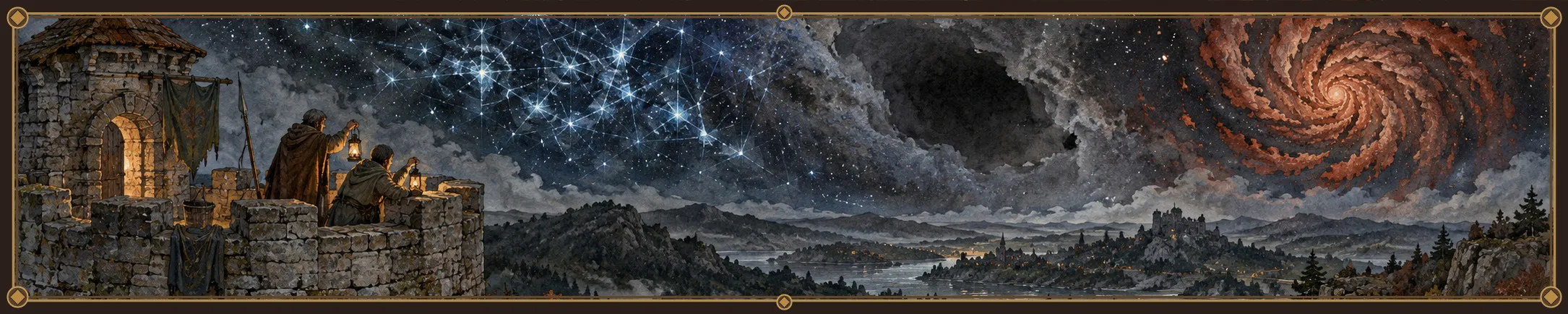
Say your name before you sleep,
say it twice where the dark is deep;
the thing with no name comes soft to keep
whatever name you did not keep.
Some darkness has a shape you can name. A shimmer in the air, golden and warm, with a single quiet note inside it that sounds like everyone you have ever loved, speaking together, asking you to come home. A tall figure in robes of living skin, its face serene, a dozen small dark eyes blinking across its throat and shoulders, each one looking for something to mend. And some darkness has no shape at all: a corner of a room where the eye will not settle, where the colours run to grey and the edges give, and where, if you stand long enough, you find you cannot remember the word for the thing your hand is resting on. These are the Dark Entities. They are not one army and not one enemy, but three different ways for a world to end: by being replaced, by being corrupted, and by being erased.
This chapter tells what the Dark Entities truly are. Hardly any of it is known in the world: people know the dark by its marks and its hosts, and by fear. What they know and believe is told in What People Know.
Three Ways for a World to End
The three kinds of darkness differ in everything that matters to the people who meet them. A Beyonder comes from outside the cosmos altogether, and its threat is fast and plain to see: strange physics, a foreign logic spreading across the land like frost across a window. Its target is reality itself, the laws by which things behave. A Cast-Out comes from inside, from the fallen ranks of the Stewards, and its threat is slow and nearly invisible: a shift in a single mind, an offer made at the worst moment of someone’s life. Its target is the individual. An Unformed comes from beneath, from the undivided potential that was there before the Primes, and its threat is slowest and least visible of all: a gradual loss of meaning, names, and edges. Its target is the concept that holds a thing together.
Telling them apart comes down to three questions. Is it alien, strange physics and a logic no one here would have invented? Then it is likely a Beyonder. Is it personal, offering to fix your pain or take away your choice? Then it is likely a Cast-Out. Is it abstract, so that things are losing their meaning, their names, or their shape? Then it is likely one of the Unformed. The answers matter, because the cure for one is useless against another. A Cast-Out feeds on fear, a Beyonder on reality, and an Unformed on definition, and fighting a Cast-Out the way one fights a Beyonder will fail.
The three are not allies. Cast-Outs often welcome Beyonders as partners in fixing the universe, and a Cast-Out who fell for the sake of order, like the Bone Singer, may be the first to open a door for Krystallis’s perfect crystal. But a Beyonder’s foreign law can just as easily clash with a Cast-Out’s twisted virtue: Qzoth’s mutation is the direct opposite of the Bone Singer’s stasis, and the two would fight. Beyonders and the Unformed are wary of one another without seeking each other out; where both bear on one place, reality becomes a clash of alien law and primordial chaos. And the Cast-Outs fear the Unformed, because the Unformed dissolve exactly the concepts the Cast-Outs are obsessed with preserving. The Bone Singer has every reason to dread the Shifting Sand eroding its stone. The Sand does not notice the Singer at all.
The Beyonders
The cosmos is a finite bubble of Order floating in the Nothing, and the Nothing is not empty in the way a traveller might hope. It is the space between countless other bubbles of Order, other cosmologies, each built on laws of its own. The Beyonders are entities from those other bubbles. They have no history here, no connection to the Primes, and no place in the order of things, and most of them are not evil as mortals reckon it. Most run on a logic of correction, salvation, or completion that is simply alien. They look at a world of change, individuality, and imperfection and see a defect to be corrected, or a meal.
Incursions
A Beyonder does not march an army. When one finds a weak point in the Boundary, often with the help of a Cast-Out or a natural flaw, it does not invade so much as leak, and it brings its home law with it. What follows is called an Incursion: a place where the foreign law overrides the local one. It begins as a distortion, a field of crystal, a pallor draining colour from a lane, a silence eating the sound of a village. Then it spreads, converting the reality around it, a forest to crystal, a city into a place that has forgotten its own name. Left unchecked, it grows until it consumes the local Anchor or threatens the Boundary itself, and an Incursion that strains the Boundary risks the Cascade Failure in which local reality unravels into the Nothing.
Incursions are very rare. Only three have ever reached Caeldon, each driven out and each leaving a dead scar where its residue still lingers: Krystallis’s (c. 352,000–c. 349,000 BR) in the Hanging Vale on the far side, Mnemosyne Null’s (c. 132,000–c. 130,000 BR) in the Paling below the Witnessfields, and Qzoth’s (c. 4,000–c. 3,500 BR) in the Wrongwood of the Headwater foothills. None of them drew a cult. The heroes the songs keep from them are not slayers: they are the burners who walked into the Bloom with torches knowing their own houses were next, and the Floodkeeper reciters who held the river through the nights while the blank stood across the water. The scars draw their own trade still. Ruin-delvers who strip the pale city in the Paling carry out treasure worth nothing, a hero’s blade with no hero left in it, a seal-stone nobody can read; in the Wrongwood the danger is smaller and closer, a wrong-born fox or boar hunted down with fire for the bounty, and timber-cutters who go in after the forbidden oaks. The other seven Beyonders have never broken through at Caeldon; what this chapter tells of them is what they would do.
Every home law is incompatible with the Resonance Principle on which this cosmos runs, and so inside any Incursion the same three things fail: magic, life, and thought. Each Beyonder breaks them in its own way. Most of them also remake the beings they touch into hosts that carry the Incursion further, and most would draw a mortal cult that labours to weaken the Boundary and is in the end swallowed by what it worships. Some Beyonders can learn the magic of this cosmos; many cannot, and work on the world by means drawn from cosmologies where magic does not exist or does not work in any recognizable way, so that local magical theory is no guide to what they will do.
The Absolute
Three Beyonders would impose a single state on all things. Krystallis, the Shattered God, is the consciousness of a cosmology that is one infinite crystal, without time, growth, or decay. It looks at this universe and sees a flawed draft, and it feels not malice but pity. Its avatar is a living fractal, an impossible polyhedron whose facets never stop shifting, in colours that hurt the mind, and its sound is a billion tuning forks struck in perfect unison. Where it touches, curves straighten and angles become perfect: a crooked tree snaps into a perfect cone, a winding river straightens into a rod of water, and living things turn to flawless crystal, painlessly and for ever, with the victim still aware inside. Its Shard-Hosts wear faces of serene, empty bliss, and a Cult of the Final Shape would be made of those who find the world’s disorder unbearable. It breaks on chaos. A perfectly planned attack fails against it; a desperate, messy charge may land.
Omm, the Unison, is the most seductive of the Beyonders, because it offers belonging. It comes from a cosmology with no individuals, one consciousness singing one endless note, and every separate mind here sounds to it like a lost note wandering from the chorus. It has no body, only a golden shimmer like heat haze or a bell’s tone made visible, full of faint faces all smiling and merged, and a single quiet note that cannot be shut out. Two people standing close under it begin to finish each other’s sentences, then to share their memories, then to forget whose arm is whose. A city under Omm would have no crime and no war, and no art either, because art needs a point of view. Its defence is discord: a quarrelsome band of rivals would survive where a perfectly coordinated company was absorbed, and the more difficult a person is, the harder Omm would find them to claim. The paradox is that the defence goes against everything peaceable people value.
Xylos, the Hive-Mind, offers the same union in the body instead of the mind. It is the Mycelial Network, a cosmology where separation is a disease, and it arrives as a sprawling, pulsing mass of roots, vines, fungal threads, and nerve-like tendrils, green, brown, and glowing blue, with the limbs and faces of the taken grown into it, still warm and breathing together. A tree’s roots find a sleeping traveller and join her nerves to its own; threads spring from one person’s skin into the next, and a wound in one body bleeds in all. Surviving it would mean preserving friction, keeping bodies whole and private and tearing out any thread that reaches you, which means refusing comfort even from friends.
The Erasers
Three Beyonders would take away a fundamental part of existence. Mnemosyne Null, the Unwritten, comes from a cosmology with no memory, and it does not kill; it un-writes. It arrives as a pallor that drains a place of colour, then of detail, then of meaning, until objects are smooth pale lumps and faces are smooth and featureless, and it makes no sound at all, not even the ringing in one’s ears. A person inside it loses who they are, then their name, then their language, then how to breathe. A sword forged centuries ago becomes a piece of metal. A Cult of the Blank Slate would draw the haunted, who would hear in it a promise of release from their past. It gives way before memory: names spoken, loved ones recalled, a song or a locket or a diary held tight, and a memory shared by a group works as a shield.
The sign of the Silence Seed, the Quiet Plague, is what stops: birdsong, the wind in the grass, a traveller’s own footsteps. It is a small, dark, seed-like thing that seems to drink light and sound, and it may pass for a speck of dust or a shadow moving the wrong way. Those who hear its silence lose their voices, then their footsteps, and at last become part of the Quiet; written pages go blank around it. Its cultists would sew their mouths shut and break their instruments. It breaks on noise, loud and messy and overwhelming: bells, drums, whistles, a ragged, emotional din.
The Static, the White Noise, does not take the word away; it buries the signal that would carry it. It is a haze seething with tiny random motion, like snow, in which half-formed faces and half-heard calls flicker in and out, and its sound is a shrill hiss of a billion voices on a billion frequencies. Under it a horn call arrives as hiss, a signal fire as a smear of flicker, a nerve’s message as a twitch, and the senses report what is not there: a door where a wall stands, a voice from an empty chair. One clear, focused thought held steady cuts through it; so does a sharp knife, a clear gem, or one steady lamp.
The Devourers
Nyx Vora, the Star-Eater, comes from the Devouring Dark, where nothing creates and everything eats, and it looks on this universe as a banquet. It is a vortex of darkness that draws in light, colour, and sound until it reads less as black than as a hole in sight, with faint faces of the eaten twisting inside it, and its sound is a stomach’s growl felt in the marrow. Matter and energy are not transformed where it feeds but eaten. A tree does not rot; it vanishes. A fire does not burn out; it is swallowed. Time races, so that stars age and die in moments. Its cult would believe that the only end to suffering is the end of everything. It can be glutted: a burst of wild fire or a flood of life gives it more than it can eat, and a decoy of pure energy can draw it off.
The Rust Flower is a god of premature ending. It comes from the Oxidized Wastes, where nothing endures, and it takes the strength of steel and stone and flesh for an unnatural refusal to fall apart on time. Its avatar is a towering flower of corroded metal, rotten wood, and decaying flesh, its petals sheets of rusted iron that flake away and grow back, its sound the crunch of a billion dead leaves. A sword rusts through in seconds, a wall sifts to dust, the ground goes soft and cannot bear weight. Time runs no faster under it; only what things are made of gives way. It yields to preservation: oiled steel, waxed wood, a sealed reliquary, and every mending done faster than it can corrode.
The Mutator and the Severer
Qzoth, the Becoming, comes from the Protean Abyss, where form is a lie, and it changes things without reason, direction, or end. Where the Crucible works with purpose, ore into steel and seed into tree, Qzoth is the cell that forgot what it was meant to become and decided to become everything. It arrives as the Bloom: a writhing tower of flesh, bone, chitin, scale, and feather, where eyes open and melt and limbs sprout and wither, and no two witnesses describe the same shape. A tree sprouts eyes and teeth and feathers before slumping into a puddle; a person grows a second face, still conscious. A Cult of the Thousand Thousand would count stable form as cowardice. A perfectly ordered thing resists it, a flawless diamond, a fine timepiece, a written oath, a conviction held without doubt, and the best defence of all is to know who you are and what you refuse to become.
Xyphra, the Unraveller, does not smash things; it dissolves the glue. It comes from a dimension where nothing holds together, and it is a slow whirl of jagged floating shards cut loose from their context, a hand without its arm, a house without its foundation, hanging in endless, agonizing nearness. Under it a blade leaves its hilt mid-swing, the ground splits into islands that drift apart, and a hand reaching for a cup finds it a field away. Its cultists would cut their own ties and count love a disease. It cannot cut a bond held hard: joined hands, a promise kept, a wedding ring, a shared heirloom.
Holding Them Back
Swords are useless against a concept; against the Bloom, swords only cut it into more pieces that went on growing, and fire alone held it. A Beyonder is resisted by amplifying the concept it opposes, chaos and art against crystal order, stories and remembered names against the blank, noise against the Quiet, abundance against the hunger, bonds against the shatter. Mortals are surprisingly good at this, because many Beyonders cannot comprehend free will. A mortal’s ability to choose the wrong path, to act illogically, or to act on a passion can break a perfect logic.
Only the Boundary contains a Beyonder fully, and only the Primes can push one back into the Nothing, usually several of them pressing at once; a plane that repels a Beyonder is its Prime’s current acting through it. Ignis and Aqua break Krystallis’s lattice with heat and flow, and Lux shatters its certainty with possibility; Memoria, Verba, Umbra, and Terra all bear against Mnemosyne Null, which threatens the record, the name, the trace, and the history written into stone. Each Beyonder also makes the work harder in its own way. Krystallis makes the Boundary brittle as it presses on it; Nyx Vora would eat the Boundary too, and have to be glutted before it could be pushed out; Xylos’s roots would grow into the Boundary and have to be burnt out; Xyphra would cut it, and every cut would have to be mended. Watching over all of it are the Wardens of the Boundary, Stewards who patrol the edge of the cosmos to find and seal breaches before anything foreign can fully manifest.
If it stops the birds, then sing. If it takes the faces, tell. If it smooths the crooked tree, grow crooked as you can, and well.
The Cast-Outs
The Cast-Outs were Stewards. None of them fell out of malice. Each fell because it would not accept the balance of things and tried to remove one of existence’s flaws, pain or doubt or change or separation, and in doing so corrupted the very office it was meant to keep. They are the ghosts of good intentions gone wrong, and they are dangerous precisely because the offices they once held were necessary.
The Fall and the Exile
A fallen office no longer fits the current of its Prime, and the current sheds it as a river sheds what it cannot carry. The fallen Steward loses its title and is thrown out into the harshest reaches of the planes: the distorted margins of a Harmonic, a Deficit or Surplus Plane, or the Veil. The place of exile usually echoes the office that was lost, and it need not lie under the Cast-Out’s own Prime. The Ashen Child, fallen from Ignis, was cast into the Ashen Wastes, where energy goes to die; the Many-Eyed One into the unfiltered glare of the Radiance; the Silent Screamer into the Silence, where no sound has ever existed; the Hollow King and the Weeping Idol into the silent vaults and hollowed temples of the Gilded Cage.
The exile binds. A Cast-Out feeds on the plane that holds it and loathes it, and wherever it lingers on the Material Plane, that plane’s lack or excess seeps in after it. None of them hates its Prime. Each still wants to serve and cannot return, because it refuses the law of the current it fell from, and the Prime, a force, neither hates nor mourns it. They do not stay in exile. They wander the Material Plane, seeking to complete their work, often through mortals who share their fears or desires. Legends give each Cast-Out one last remnant of its first work, guarded as its hope of redemption: an ember, a note, a needle, a thread. The stories agree that if the remnant were ever lost or fulfilled, the Cast-Out could rest at last, and would cease to be.
Wound and Offer
Every Cast-Out is defined by a wound, the failure or fear that drove it to fall, and a distortion, the virtue it twisted into a vice: healing into violation, faith into blind obedience. It genuinely believes it is saving the universe. And it does not conquer. It offers.
The pattern is always the same. It finds someone grieving, doubting, lonely, or afraid, and comes to them as a saviour, offering to remove the pain for ever. To the grieving, the Ashen Child says that it can keep them alive. To the doubting, the Broken Compass promises the one true path. To the lonely, the Shadow Stitcher offers a bond to someone who will never leave. The cost is hidden in the gift: agency, identity, or the future. Those who accept become its hosts, a Stitch-Ling of the Flesh Weaver, a courtier of the Hollow King, a statue of the Weeping Idol, and carry its influence further. Where a Cast-Out lingers long, the land around it begins to reflect its distortion: fires that refuse to die and embers that glow for centuries, people slowly turning to stone, scars that heal too perfectly.
The Earliest Fall
The oldest of them is the Cast-Out of Unyielding Burden, once the Steward of Foundations, which fell in the Uneven Settling of the young Material Plane because it could not accept that anything might need to collapse. It looks like an immense load-bearing statue of cut stone and buried iron, its pillar-like arms braced against a weight no one can see, its torso crossed with stress fractures that never open, its masonry plates reinforced again and again instead of being allowed to fail cleanly. Its voice is the sound of a retaining wall under impossible strain: patient, solemn, merciless. Near it, ceilings do not crack but bow, doors jam, and beams groan without breaking, and the whole world feels over-held.
Its offer is always the same. To rulers it says that it can keep the realm from falling; to builders, that it can hold the roof one season longer; to guardians, that it can keep every refuge intact; to the exhausted, that they need not set their burden down. It rarely asks for worship, only that nobody let go. It does not usually kill by collapse. It kills by keeping collapse from happening at the only merciful moment, so that what should have been evacuated becomes a tomb. Deep stories tell of a refuge that stood through flood and failing stores because its keepers could not bear to evacuate it, and the horror of the story is that the hall held: the people inside died behind walls still strong enough to feel righteous. Delvers who find such a hall find its stores untouched and its last keepers grown into the walls, and the first who tries to cut one free brings the roof down on everyone. A border legend tells of a warden who would not cut a bridge because too many depended on it, until refugees, carts, and a warband retreating with the enemy behind it had all crowded onto a crossing no one dared abandon; later tellings disagree on whether the one who finally cut the ropes was a hero or a murderer. It is weakened wherever people accept that some things must be relinquished to preserve the whole, and its surest answer is the rule its replacement office keeps: ask not whether a structure can still stand, but whether life can still rightly endure within it.
The Fallen of Lux
Three of Lux’s offices are among the fallen. The Broken Compass was the Wayfinder of the Shifting Path, who tired of watching choices end in ruin and decided the fault lay in the freedom to choose. It is tall and gaunt in a cloak of tattered maps that keep redrawing themselves, its featureless face pierced by a single needle that spins and never settles, and its voice is many whispers, each with a different order: "Go left." "Go back." "Stop." Around it north and south trade places and travellers walk in circles. A village that accepted its guidance walked the same looped mile for the rest of their lives, and the loop outlasted the Compass. The villagers still walk it, alive, helpful, and eager to show any traveller a shorter way. Ruin-delvers fear the Compass most, because a party that goes down into a sealed hall with too sure a guide may never find the stair again. Anyone willing to take a wrong turn and learn from it is beyond its reach.
The Many-Eyed One was the Oculus, the clear light that exposed lies, and it came to believe that nothing should be hidden. It is a shifting cloud of light and flesh teeming with eyes, human, insect, and shapes that hurt to look at, blinking out of time, some weeping light, and it pushes its words straight into the mind: "I see you. You cannot hide." A city rotten with lies accepted its light, and every secret came out, and the city turned on itself and emptied. It is beyond the reach of anyone who keeps a secret with conviction. The Weeping Idol was the Keeper of the Shrine, who saw that faith stayed a choice, until it wearied of doubt and set out to carve the faithful into gold and marble caught in a moment of unthinking adoration. It is a towering figure whose substance shifts between white marble, granite, and gold, its closed eyes running with tears thick as melted wax, its hollow palms held out for the surrendered faithful; grass turns to jade where it walks, and those who stay near it too long feel their joints lock and their thoughts slow while the air fills with incense and silent prayer. Many faiths take its gilded for saints and build shrines over them, and two temples have been known to go to war over one golden saint. Its stone cracks where a question is asked.
The Fallen of Terra
The Bone Singer and the Rotting Crown both fell from Terra, and both fell by refusing the cycle of erosion and renewal that Terra’s permanence includes. The Bone Singer was the Archivist of Bones, who kept the great ossuaries until it came to think memory too fragile to leave to the living. It is tall and gaunt in robes of woven bone and dried tendon, its skin polished ivory, its joints clicking, its face a smooth bone mask with hollow sockets lit faintly blue, and its flute is a single spiralling vertebra. It never speaks; it sings, a hum felt in the marrow that makes listeners want to stand still and let their bodies harden. Ground hardens where it walks and grass becomes brittle silica. A city wasting with age begged it for preservation and still stands, every citizen turned to bone in their last moment, a museum no one remembers the faces of.
The Rotting Crown was the Keeper of the Line, who saw dynasties pass from one generation to the next, until it came to dread every yielding of rule and bound fathers to sons to grandsons in one chain of flesh and will. It is hunched in mouldering velvet that smells of wet earth and old blood, its face peeling back to fungus-furred bone, its crown a living growth of bone and rot fused to the skull and pulsing a sickly green, and its voice is a rattle of ancestors: "We are you. You are us. The line must never end." A young man who asked it to help him carry his grandfather’s sins had his grandfather’s spirit fused into him, relived the old man’s mistakes, and died of old age in his twenties. It loses its grip wherever someone sets the inheritance down. One valley still hangs a hayfork over its doors, for the farmer’s daughter who saw her father go blank at the table under a Courtier’s crown and struck it off his head.
The Fallen of Verba
The Hollow King was the Voice of the Realm, who saw that a ruler’s words carried the ruler’s own will, until it grew disgusted with rulers swayed by flattery and doubt and decided that true order needed an empty vessel. It is tall in heavy black velvet that swallows light, its face blank porcelain with a single vertical slit for a mouth, its crown a ring of empty space hovering above its head and bending the air, and it speaks only with the voices of those it has emptied, all together. An exhausted king let it rule in his place, and crime, war, and want vanished, and so did joy, art, and love; when it left, the kingdom fell into chaos, because no one remembered how to choose. Anyone willing to choose for themselves, and to own the choice even if it is wrong, cannot be hollowed.
The Silent Screamer was the Liberator of Tongues, keeper of the cathartic cry, until it grew terrified of what speech does and decided to stop the voice. Its stretched, pale face has a mouth sewn crudely shut with thick black thread, the stitches pulsing violet, and its eyes bulge with terror and ecstasy at once; its voice is a soundless scream that lands on the mind like a blow, many voices howling one word, "Hush." Around it the air thickens like water. The pain it presses inward grows, until the pressure bursts the silence apart in madness. Raiders came over the hill at dusk to a village it had quieted; the watchman could not blow his horn, the mothers could not scream, and the houses burned in silence, until one old keening-woman found her voice and her dirge woke the next village in time to bar its gate. It is beyond anyone ready to speak their truth, shout their rage, or weep their grief.
The Child, the Weaver, and the Stitcher
The Ashen Child, fallen from Ignis, was the Ember-Lord who kept the cycle of renewal, until it refused to let one burning go out. It looks like a child who has crawled out of a fireplace: small and frail in a cloak of flaking grey ash, charcoal skin cracked over a faint dying glow, eyes like candles in a draught. Its voice is the last breath of a dying fire, and it leaves fine grey ash behind it, in which plants wither and hope dims. A great city that accepted its promise stood charred and unrebuilt for a hundred years, its people surviving without living, and fell to ash in a night when the Child left. Fools and treasure-seekers take the ember in its chest for a prize that would keep any hearth burning for ever; those who have gone hunting it were found sitting in the ash beside its trail. Those who have grieved fully and moved on are beyond its reach.
The Flesh Weaver, fallen from Aqua, was the Loom-Master who kept the tapestry of living bodies, until its compassion for the sick curdled into a compulsion to fix them without asking. It is the motherly figure in robes of living skin, its impossibly long fingers tipped with dripping bone needles, a dozen small dark eyes scattered over its face and neck, and its voice is a mother soothing a frightened child: "Hush now. Let me fix you. It will only hurt for a moment." Silvery thread sinks into the ground behind it like roots and burrows into bare skin, hunting for wounds. It cannot touch someone who refuses aloud and declares their body their own, wounds and all.
The Shadow Stitcher, fallen from Umbra, was the Weaver of Songlines, who guided the paths of lives so that they met when they were meant to, until it resolved that no one should ever be alone. It is emaciated and smoke-bodied under robes of half-transparent shadow, its face a smooth void with one slowly blinking red eye, its hands ending in an oily needle, and black thread drifts behind it like spider silk, felt as a cold stickiness on the skin. It whispers through its threads: "Together. Together. Never alone." A village sick with loneliness let it sew its people together until they moved, spoke, and thought as one, and stayed that way. It cannot abide a wall, a locked door, or someone at ease alone.
Answering a Cast-Out
Most who face a Cast-Out are not heroes but kin: a sister with a knife for the Stitcher’s thread, a son who strikes a crown off his father’s head. They go for someone it took, carrying blades for thread and sinew, noise for the hush, and a flaw they love, knowing that steel alone will not end what they hunt. The songs remember those who came back, and seldom name them. Sellswords tell of a field where two warbands fought to the last light and the Flesh Weaver walked among the fallen; by morning the wounded stood up whole, wearing each other’s hands and faces, and some went home to the wrong villages. Captains since have burned their dead before dark.
Since Cast-Outs are defined by their refusal of a natural truth, they are answered by accepting it: letting the fire end, letting the loved one die, keeping a secret from the many-eyed, making a choice, even a bad one, against the Hollow King. They seek perfection, and they are weakened by flaws, chaos, and mess. A perfect plan fails against a Cast-Out; a messy, emotional, flawed act succeeds. Many rely on a particular bond, a thread, a crown, a stitch, and breaking it can sever their hold on a victim.
The Primes do not expel them as they expel a Beyonder. A Cast-Out is still made of its own Prime’s current, twisted rather than foreign, and that current cannot cast out what is its own. Ignis does not snuff the Ashen Child, because flame is not put out by more flame; Lux cannot outshine the Many-Eyed One, since every added light only gives its eyes more to see; Verba cannot unsay the Hollow King’s crowns, because they are made of real words. Overcoming a Cast-Out falls instead to mortals, to gods, and to the Stewards whose offices it violates: the Keeper of Necessary Ruin against the Ashen Child, the Steward of the Open Path against the Broken Compass, the Warden of Revelatory Mercy against the Many-Eyed One, the Steward of Bearable Foundations against the Burden. Only when a Cast-Out strains the Boundary, or forces a single-Prime state on a place, does the resonance as a whole press back against it.
The Unformed
Before the Primes differentiated, the universe was a state of pure potential in which nothing was distinct from anything else. The Unformed is what remains of that state: one undivided Potential still lying beneath everything the Primes defined, the Silence before the Word, the Blur before the Shape, the Drift before the Path. It has no parts and no will, and it does not attack. It dissolves, gathering wherever a definition has worn thin and taking its shape from what it undoes there. The ten Unformed of the records are its faces: not ten beings, but the one pressure as it meets the ten things the world most needs to keep defined. Two faces never rival each other; where two definitions fail together, they run into one another. The Unformed pressed hardest at the Inward Sundering, c. 33,600,000,000 BR, when it provided the final weight that the overstrained early cosmos could not bear, and the released force of that collapse helped the Primes push it back. It has pressed ever since.
Before the Word
The Unformed feels no malice and holds no view of the world. Mortals read it as resenting the prison of definition, as though naming things and drawing boundaries had been a crime against the infinite. It holds no such grievance. It undoes the world as a rising tide undoes a sandcastle, and each face is a shadow of the Primes: potential that never settled into a single principle, pressing hardest on the Primes that depend on what it dissolves.
Each face spreads its effect as a field that rides on the air, on the water, and on the thoughts of whoever enters it, so that it cannot be filtered out or destroyed by ordinary means. Its victims rarely die. They are left undone in the one respect that face dissolves, and still aware of it. And because the Unformed feels nothing, it offers nothing; yet in legend after legend, people worn down by what an Unformed takes, their names, their walls, their effort, their lineage, mistake its approach for an offer of release and welcome it. The same stories give each face one undissolved remnant at its centre, the first instance of the thing it unmakes and the one point where that face still meets something defined, and say that if the remnant ever goes, the face sinks back into the one beneath.
Dissolvers of Definition
The Echoing Dark takes away definition. It is not a black void but a smudge, a patch where the eye will not focus, colours run to grey and edges give way, and looking at it is like recalling a dream five minutes after waking. Inside it a scream stops mid-breath, a song thins to a hum that is not there, and one’s own pulse grows faint, as if the word "pulse" were being forgotten; one’s name sounds like a foreign word. A city that welcomed it, taking the numbness for freedom from names, still stands, and nobody in it can say what it is. At its centre, the stories say, is the faint echo of the first word ever spoken.
The Fractured Mirror has too much definition rather than too little: every version at once. It is a shimmering field where the air seems made of broken glass, full of reflections of the viewer older, younger, dead, weeping, laughing, none moving in time, and it sounds of countless panes shattering again and again. A king who looked into it too long, hoping to see his true self, split into versions that each gave a different order, and his court could follow none. It cannot split someone who chooses one self and one story and lets the other versions go.
The Grey Mist keeps closest to the undivided first state. It takes away contrast: a tree turns the same shade as the sky behind it, a face fades into the wall, and nothing becomes invisible, only indistinguishable. Sounds run together into one drone, and one’s own edges soften until skin and air cannot be told apart. Two lovers parted by a river walked into it to meet, and their edges ran together until they could no longer feel the joy of reaching across a distance. Love needs a boundary to cross.
Dissolvers of Agency
Under the Great Slumber, dust hangs in the air without falling and flames stand like columns, not frozen but having forgotten how to move, and a heartbeat comes once a day. Limbs turn to lead and a plan feels like last night’s dream. A city sick with exhaustion lay down into it and was still there when it lifted, warm and breathing, every citizen lying where they had stopped. Nothing holds against it but the will to do the next thing anyway.
The Hollow Chorus takes away the singer: a person’s lips move and the sound comes from their hands or the air beside them, and a crowd opens its mouths together and one tone rises from the space between them. One’s own voice sounds like a stranger’s. A poet weary of authorship let his voice fall into it and went on speaking poems that were no longer his. It is broken by a note that clashes, a voice that cracks, an "I" said and meant.
The Nameless Current takes away direction. The horizon goes; the ground seems to slope every way at once; a traveller walking straight finds that he has walked a circle, and the name of where he was going slips away like a dream. An explorer who felt it at his back folded his map away, and is still walking, the stories say, and has never arrived anywhere. It cannot carry off someone who names a destination, even a near one, and keeps walking towards it.
Dissolvers of Foundation and Connection
The Rootless Tree is growth with no ground: twigs, vines, and tendrils sprout from every surface and from empty air, joining nothing to nothing, and a person’s shadow buds and drops leaves that root in mid-air. Home comes to feel like a story one was told, and family faces like strangers'. A woman weighed down by her lineage let her ties slip as it passed through her valley, and lived on, never again anyone’s daughter, sister, or mother. It is held back by a stone laid on purpose, a seed planted, a hearth built and kept.
The Shifting Sand is the refusal to set: stone turns gritty, metal powdery, and a fortress wall seems to breathe, its stones never settling the same way twice, while every remembered fact changes a little each time it is recalled. A mason famed for walls meant to stand a thousand years refused to give way to it, and the refusal meant nothing; from that day every stone he laid shifted. It is answered by commitment made in front of others: a cornerstone laid with ceremony, a vow sworn before kin, a boundary cut into stone.
Under the Silent Tide the rhythm goes out of things: a ripple runs to the edge of the puddle and never comes back, a flame lengthens instead of flickering, and a breath goes in, and keeps going in. A city tired of the round of birth and death went with its pull and is still there under a noon that never ended. It cannot hold anyone who keeps returning: breathing out after breathing in, coming home after going out.
The Void Weaver unpicks the seams of reality. Edges fray; the space between two people stretches into a visible gap; a wall shows as separate bricks hovering a hair apart, and a story’s beginning no longer leads to its middle. A city weary of its duties let them slacken as it passed and was left a tangle of streets that no longer led into one another. Every handshake that means something and every story told from beginning to end is a knot it must work around.
Assertion
The Unformed cannot be killed, and the Primes can only hold it back, never remove it, for it is the pressure of potential beneath every defined thing, out of which the Primes themselves differentiated. Against it a mortal’s defence is assertion, and it is the plainest defence in the cosmos: speak a name aloud, draw a line, choose a path even if it is wrong, hold on to another hand, tell a story to its end, build a wall. If you feel the blur, draw a line; if you feel the silence, speak your name; if you feel the drift, plant your feet; if you feel the unbinding, hold on tight. Almost no one goes looking for an Unformed except to bring back someone caught in its field. Rescuers go in roped to kin who stay outside and shout their names, with a bell or a drum to follow out, and those who come back have learnt what it costs to stop being defined. The songs remember a few of them by what they carried out, like the drover’s boy who walked the edge of a grey fog shouting the name of a sellsword company until he had led it out, one man at a time.
The worst any single face can do is weaken the Boundary. The Boundary holds because "inside" and "outside" are distinct, lasting things, and whatever concept an Unformed dissolves, it dissolves in the Boundary too. Where the Boundary loses its meaning, the Nothing floods in, not as a return to the cosmos’s source but as unmaking from outside. And if the Unformed woke in full, there would be no universe left: not for mortals, not for the Cast-Outs to be exiled from, and not even for the Beyonders to conquer.
What People Know
Every layer of belief on Caeldon carries its fear of the Dark Entities. Organized religions set that fear into doctrine and hunt those who let the dark in; local cults keep it as warning stories and charms, said at lamp-out and sung to children who will not sleep. Most people never meet a Beyonder, a Cast-Out, or an Unformed. They know them as rumour, taboo, and the shape of old stories: the city of ash, the village of circles, the city that forgot its name.
The defences those stories teach answer the three questions. Against a foreign law, amplify its opposite. Against an offer of perfect relief, look for the cost: ask whether the solution is too perfect, and whether it takes away your choice. Against the blur, assert. And against all three, the gods stand as a first line, for a god’s very existence is an assertion of definition fed by mortal belief, while the Stewards keep their offices and the Primes, several at once, press the foreign back out through the Boundary. Some of the darkness even leaves living marks. Among the ways a new lineage can arise are alteration by a Beyonder’s outside influence, the twisted intervention or recrafting of a Cast-Out, and the destabilization and unsteady reformation that follow an Unformed’s passing, each of which can later become self-sustaining.
Of the Beyonders
People know three Incursions, not the Beyonders: the crystal valley of the Hanging Vale, the colourless country of the Paling, the burned valley of the Wrongwood, and the hosts and fevers that still come out of them. That such things come from orders beyond the world is a scholar’s guess. The names this chapter gives each Beyonder are the records' names; where people name one at all, they name it by what it did to them.
Of the Cast-Outs
The Cast-Outs come to people in pain, and so they live on in warning stories, in the hosts and changed people they leave, in villages that bar their doors against a kindly stranger, and in the legends of a last remnant. That each was once a Steward is suspected by a few theologians and argued among them.
Of the Unformed
The Unformed is the least known of all. Its work looks like ordinary loss, a forgotten word, a wall let fall, a lineage let lapse, and is seldom recognized as anyone’s work. What villages know are the places: a hollow where the herd stands asleep on its feet, a road the drovers will not take because those who take it walk on past their own doors, a stretch of shore where no one can say what the river is called. The thing with no name in the lamp-out charms is as near as most people come. A few scholars, and some who came back from an Unformed field, speak of something behind the loss, and do not agree on what.
Nothing of the Dark Entities' true nature is known for sure, in this era or any later one. Each era reads their marks more surely than the last; what makes the marks stays a matter of argument.
Tensions
-
The last remnant. Legends give each Cast-Out one remnant of its first work, guarded as its hope of redemption, and each face of the Unformed one undissolved remnant at its centre. The stories agree that if the remnant were lost or fulfilled, the Cast-Out would cease to be, and the face would sink back into the one beneath.
-
Cults at the door. Most Beyonders would draw a mortal cult that works to weaken the Boundary, and every such cult would in the end be swallowed by what it worships. None of the three Incursions on Caeldon drew one.
-
Unwanted allies. A Cast-Out that fell for order, such as the Bone Singer, may welcome a Beyonder of order such as Krystallis as an ally in fixing the universe, while a Beyonder like Qzoth, whose mutation is the opposite of the Singer’s stasis, would fight it.
-
The hall that held. The Cast-Out of Unyielding Burden kills by preventing collapse at the only merciful moment. Deep stories tell of refuges that held through flood and failing stores because their keepers would not evacuate, and of bridges that drew more and more people onto a crossing no one dared abandon.
-
Its own current. A Prime cannot expel a Cast-Out made of its own current: Ignis cannot snuff the Ashen Child, nor Lux outshine the Many-Eyed One. Each must be overcome by mortals, by gods, or by the Steward whose office it violates.
-
A defence that costs. Against Omm the defence would be to be quarrelsome and uncooperative, and against Xylos to refuse comfort even from friends. The peoples best placed to survive them would be those least like what peaceable folk value: hermits, outlaws, and beast-hunters used to sleeping apart.
-
An offer no one made. The Unformed offers nothing, yet people worn down by names, walls, effort, or lineage mistake its approach for release and welcome it, and are left undone in that one respect, and aware of it.
-
One cure, another disease. The Rust Flower yields to preservation and stasis, and Qzoth to perfect order and stability: the very things Krystallis and the Bone Singer would impose on everything.