Chapter 8. How Magic Works
The fire was in the wood before the spark,
the rain was in the cloud before the cup;
ask a healer where the mending came from
and watch her count what she gave up.
The Book of Small Mendings
Hold a palm over a dying hearth in a cold room and ask it to burn, and the coals will brighten, and the room will grow colder still. Nothing in Caeldon comes from nowhere, and magic least of all. It is not a gift the gods made, nor a trick the clever discovered, but a force woven into the world as surely as weight or time: everywhere, unevenly, and always on the same terms. A spell does not create. It finds energy that already exists, moves it, turns it from one kind into another, and gives it a new shape, and something is always lost on the way. That one law sits under every working in this book, from a village healer closing a cut to a temple choir sanctifying a hill. Everything else follows from it: what magic draws on, what it costs, why one caster finds easy what kills another, and why every lord, elder, and temple in the world has something to say about who paid. The laws never bend; that is what makes magic worth fearing, and worth fighting over.
Magic is the part of the hidden cosmos that people know best, because they use it every day. What they know is its practice. This chapter also tells what lies beneath the practice, and that is hidden; what people know and argue is told in What People Know.
The First Law
The first law begins where the healers' verse begins: the fire was in the wood before the spark. Magic is a universal force present throughout the cosmos. Mortals did not make it, gods did not make it, and no ritual summons it into being. It exists as part of reality, as gravity and time do, and what it allows is narrow and exact. A living being or a divine power can use it to access energy that is already there, to transfer that energy from one place to another, to convert one form of energy into another, and to reshape how energy is expressed in the world. That is the whole of it. A fireball is heat gathered from somewhere and released somewhere else; a healed wound is vitality moved from one body, or one herb, or one god’s current, into torn flesh; a ward on a door is structure and definition fixed in place by someone who paid to fix them.
From that one law the rest follow. Magic is everywhere, but not everywhere equally concentrated or equally easy to reach, so place matters. No transfer is perfectly efficient, so casting always involves loss, and the loss is a real part of the price rather than a rounding error. Species, individuals, and methods differ in how efficiently and safely they move energy, so affinity matters. And the energy has to come from somewhere, so every working has a source, and the source has a say in what the working can be.
The last of the laws surprises newcomers most. Divine magic obeys the same principles. A priest’s blessing is not an exception carved out of the world’s order; it is a special case within it, distinguished not by its law but by its source. The energy may come from the current of a Prime, open to whoever stands aligned with that Prime’s principle, or it may be supplied directly by a Resonant. The Primes themselves are not among magic’s users. They are the forces it is drawn from, as a river is the water and not one of the swimmers.
Writers new to Caeldon sometimes take the first law as a limit, and it is one. But it is also a source of wonder of a particular kind, the wonder of a world that can be understood. A mage who knows where the heat came from can guess what the room will feel like afterwards; a healer who knows whose vitality closed the wound can guess who will be tired tomorrow. Every spell leaves a ledger, and the world can be read through its ledgers.
Where the Force Lies Close
Magic is universal, but access to it is uneven, and most of a practitioner’s craft is knowing where the force lies close to hand and how to reach it without paying more than the working is worth.
Ley Lines and Nodes
The great exception to evenness is the ley line. A ley line does not create magic; it is a channel along which the ambient force lies nearer the surface, easier to reach, easier to shape, and more densely available. Casting near one is easier, cleaner, steadier, and can be carried to a larger scale than the same casting a day’s walk away. Where lines cross, people raise shrines, holds, and mage-towers, for the same reason that towns gather at fords, and they fight over them. Many a ruin on the old roads was a keep on a crossing, taken, burned, and taken again by whoever wanted its magic, and delvers still dig in such places for the charged stones the last defenders never spent.
Where one or more lines knot, intersect, or narrow through high-coherence terrain, such as old stone, high ground, or a ridge that has stood unbroken for an age, they form a ley node. A node is not simply a thicker stretch of line. It is a pressure basin, a place where access, the responsiveness of conversion, and the scale a casting can bear are all raised together. Practitioners sort nodes into three tiers. A minor node will carry a village rite, a ward-stone, or a well-charm. A major node is stable enough to support a city, a great shrine, or a school of mages. A grand confluence, rare as it is, makes possible what no single caster could attempt: large-scale enchantment, long-range gates, wards that cover a region.
A node can be overdrawn. Overdrawing does not destroy the universal force, any more than a crowd at a well empties the water table, but it desynchronizes the local flow. The signs are familiar to anyone who has worked at a busy node during a festival or a siege: castings lag a heartbeat behind the gesture, conversions come out unstable, and then, for a while, the node falls silent and nothing drawn there will hold. A village whose well-charm fails on the same night its healer’s hands go cold knows that someone nearby is drawing too hard.
Lines That Move
Ley lines are not fixed forever. Their positions drift over long timescales in response to pressure from the wider cosmos, to geological change, to the scars of great rituals, and to sustained divine activity. Practitioners describe four regimes of movement. Some lines lie in dormant stability, shifting so little over generations that grandparents and grandchildren cast at the same stone. Some show seasonal breathing, widening and narrowing in a predictable rhythm through the year. Most settled country lives with secular drift, a slow directional migration over decades and centuries. And a few have known shock displacement, an abrupt rerouting after some extreme event, when a line that ran under a temple in the morning runs under a pasture by night.
Because of this, long-term ley maps are guesses. Line-walkers who know their trade draw a line as a broad corridor and a node as a wandering patch, and the best of them sell their charts dearly, to mages and to ruin-delvers hunting a dead node under some fallen keep. People who live on a line expect it to wander: a ward-stone set on a line must be reset as the line slips away, and the cost of resetting it is one of the quiet costs of living near power. A shrine whose line slid away from it, leaving its wards dead and its tombs open, is an old sorrow in many songs.
The Place Itself
Away from the lines, and often along them too, a caster draws on what the surroundings hold: heat from air, flame, or stone; pressure and movement from wind and water; the vitality of a living place; and whatever other ambient conditions suit the working. This is why no spell is equally easy everywhere. A fire-working that is simple beside a forge is wasteful in a snowfield; a working of flow that comes easily on a riverbank may be dangerous in a dry cellar. Good practitioners read a place before they cast in it, the way a sailor reads a sky.
Some places bend the laws hard. Where a Harmonic presses through into the Material Plane and overwrites its local physics, in a Resonant Zone, magic of that Harmonic’s kind may be amplified past safety, and other kinds may be stunted or turned against the caster. In zones where the Whispering Trace runs strong, necromancy is amplified and dangerous and draws attention its caster did not want, and healing magic does little, because the dead cannot be healed. Where the Verdant Expanse, the Surplus Plane of growth, lies close, decay-magic backfires and life-magic swells until it threatens to overgrow the one who works it. The laws are the same everywhere; the ground they act on is not.
Plants and animals are real sources too, because each carries a lifeforce pattern of its own. Medicinal herbs, prepared teas and tonics, animal vitality, cultivated groves, sacrificial livestock, and carefully harvested biological material are all drawn on, above all in healing, alchemy, nature-work, blood and sacrificial traditions, and the everyday small mendings of village life. Such sources are less efficient than a clean transfer between compatible members of the same species. They are also easier to obtain, easier to justify to the neighbours, and much safer than draining a person.
The Body as Channel
A caster can also use their own body as the conduit. This does not mean the body makes magical energy; the first law holds. It means the caster supplies a channel, a regulating pattern, and sometimes part of the energy cost, paid in bodily strain or in lifeforce itself. This is the most immediate method there is and the most flexible, the one every caster falls back on when nothing else is to hand. It is also the most dangerous. Repeated overuse injures, exhausts, and kills, and the old mages who still have steady hands are, as a rule, the ones who learned early to draw from something other than themselves.
Stored Charge
Magic can be stored, much as water is stored behind a dam, and then discharged, transferred, or used to support a later casting. Storage changes everything it touches: the keeping of a hold, war, healing, travel, the making of artefacts, every kind of long preparation. But storage is only controlled delay, never perfect stasis. Stored charge decays in three ways. It leaks, dissipating slowly through the boundaries of its container. It drifts, reconfiguring internally until it is harder to discharge cleanly. And it takes up noise, contamination from environmental turbulence, nearby casting, or careless handling. How fast it decays depends on the quality of the container, the purity of the source, the turbulence of the surroundings, and how long it has sat. As a broad rule, a concentrated store decays faster than a diffuse store of the same total charge, unless stabilizing arrays hold it.
Practitioners grade a store in four condition bands. Fresh charge discharges at high output with little noise and no surprises. Aged charge has lost some output but is still reliable. Unstable charge is noisy and wasteful and should be used only with corrections. Spoiled charge is no longer fit for precision work and is unsafe for anything that matters. Spoiled charge is a ruin-delver’s oldest trap: a charm-stone left a thousand years in a sealed hall looks no different from a fresh one, and the delver who lifts it bare-handed may lose the hand. Experienced crews test old stones with a dead stick before they touch them, and sell the safe ones dear.
No medium is best for everything. Crystalline matrices hold dense charge for a long time when properly warded, and are favoured for archival reserves. Inscribed metal lattices buffer charge on a large scale and bear repeated discharge, and so carry the standing wards of halls and holds. Living reservoirs, seeded groves and bonded organisms, regulate gently and with little noise but give up charge slowly. Liquid suspensions and alchemical vials travel well and keep poorly, the field-healer’s and the soldier’s store. Untreated organics, wood, cloth, and bone, are cheap and everywhere, and leak and spoil fast. A lord who hires mages for a siege wants to know what charge they carry and in what condition: a cart of vials gone unstable can do the enemy’s work for them, and siege-camps have burned that way.
The Gods' Share
Divine magic obeys the same laws as every other kind; only the source differs. The energy may come from the current of a Prime, open to anyone aligned with its principle, or from a Resonant, or more rarely a Steward, who chooses to supply it. Because the energy comes from beyond the caster, divine casting is safer for the mortal, less dependent on the caster’s own reserves, and steadier while it lasts. Its weakness is dependence. A Prime does not refuse anyone, but a caster can fall out of alignment with it. A patron can refuse, withdraw, or simply be absent. That difference, between a current that is always there for whoever stands in it and a patron who decides, is the subject of a later section.
The Ten Energies
Beneath every school and every tradition lies a deeper classification, which most practitioners never think about, any more than a miller thinks about gravity while the wheel turns. The ten Prime energy classes are the metaphysical foundation of all magic, one for each of the ten Primes. They are not symbols or poetic associations. Scholars hold that a spell which cannot be traced to one or more of them does not belong to this world’s magic at all.
| Prime | Energy class | What it governs | Where a caster meets it |
|---|---|---|---|
Aion |
Temporal |
duration, sequence, rate, persistence |
slowing, hastening, preservation, the control of decay |
Aqua |
Vital-fluid |
flow, circulation, adaptation, transfer |
waterworking, cleansing, the flow of healing, diffusion |
Ignis |
Transformative |
heat, excitation, combustion, release |
fire, ignition, reshaping by heat, destructive conversion |
Imago |
Morphic |
form, identity, adaptation, metamorphosis |
shapeshifting, bodily restructuring, the restoration of form |
Lux |
Revelatory |
illumination, clarity, perception, possibility |
light, unveiling, guidance, seeing truly |
Memoria |
Imprint |
retention, continuity, patterned recall |
preservation, restoration, memory-work, inherited structure |
Terra |
Structural |
mass, stability, endurance, boundary |
stone, reinforcement, containment, anchoring |
Umbra |
Attenuative |
fading, obscuring, remnant, release |
concealment, dampening, trace-work, softened endings |
Verba |
Definitional |
naming, syntax, law, formal order |
runes, bindings, oaths, command |
Zephyr |
Kinetic |
motion, pressure, spread, momentum |
windworking, propulsion, redirection, acceleration |
Pure and Compound
In theory a spell may draw mostly from a single class. In practice nearly every real working is compound. A stable effect usually needs one dominant energy, one or more supporting ones, and a method suited to the change being attempted. A healer closing a wound is moving vital flow, but guiding that flow into the right shape is morphic work, and making the new flesh remember what it was is imprint. That is why the energy classes are the deepest layer of theory but rarely the everyday language of practice.
When a compound working draws on several classes, each is weighed separately against the caster’s affinity for it. A caster with a strong feel for heat and a weak one for flow, attempting a working that uses both, handles the heat cleanly and loses a good deal of the flow, and both losses count against the price. The weakest affinity in a compound working sets a practical ceiling on its stability, because a caster cannot govern what they do not feel. A single poorly felt component can unsettle an otherwise well-controlled spell. This is why specialists stay efficient inside their own domain even in compound castings, and why generalists pay a moderate toll on everything. Neither is better; it depends on the shape of the caster.
The Ladder of Crossing
Turning one class of energy into the expression of another always costs something in the crossing, and teachers in many traditions picture that cost as a ladder of five rungs, set by how the two classes stand to each other.
At the top, shaping within one class, making a flame hotter or narrower, costs very little, though never nothing. Next come the harmonious pairs, whose functions complement each other so that each carries the other: Aqua with Imago, adaptive flow supporting the change and repair of form, the root of most healing; Memoria with Verba, in which named things hold and remembered things persist, the root of oath and archive; Terra with Umbra, in which structural endurance and slow fading sustain each other, so that decay is governed rather than suffered. A harmonious pairing loses little even at moderate affinity, is steadier than either energy alone, and tends to consolidate itself under pressure rather than come apart. Below them are the compatible pairs, neither harmonious nor resistant, through which a moderate share bleeds away. Then the resistant pairs, whose functions do not oppose each other violently but fail to reinforce each other: Ignis with Memoria is the received example, combustion’s impulse to release set against retention’s impulse to hold, so that each partly undoes the other, much of the energy is wasted, and whatever was meant to be preserved holds poorly. Resistance produces waste, not danger.
At the bottom stand the three resonant oppositions, pairings whose core functions directly contradict each other, one driving a process while the other resists, reverses, or erases it in a way the energies cannot reconcile. Aion against Ignis, persistence against combustion, must be constantly reasserted as each half suppresses the other; small castings work, large ones tend to collapse. Lux against Umbra, revelation against obscuring, needs exceptional affinity in both, or one simply overpowers and wastes the other. Terra against Zephyr, structure against motion, shears or seizes in the middle of the casting as each erodes the other. These are the same oppositions the cosmos shows on a larger scale, in the Crucible against the Frozen Moment and the Unbound Gale against the Iron Backbone. An opposed crossing loses almost everything, and what survives is unstable.
The oppositions are not forbidden. Disciplines exist to manage them, and some practitioners make their names doing so. But an opposed working does not fail cleanly. It functions, and the unresolved tension comes out as involuntary side effects, and it scales unpredictably: a small casting may barely register the instability, while the same pairing at greater power spirals past any caster’s governance. Pushing more power into an opposed conversion does not yield more result. The excess escapes as backlash.
The rung is only where a working starts. A method suited to both the source and the intended result carries energy across more cleanly; an ill-suited one spills it, and a damaged or hostile channel turns the spill into failure. Structures laid down beforehand, cut runes, drawn ritual geometry, a focus tuned in advance, lose less than a conversion improvised under stress. Two limits hold on every rung: no conversion is ever perfect, and none loses everything unless the working collapses outright.
The Named Traditions
Some compound pairings recur often enough to have earned common names and lines of teachers, though they are not formal schools and cultures sort them differently. Storm-Forge pairs fire and wind in mutual support, combustion driving propulsion, heat shaped by moving air, the forge-work of smithing peoples and weather-workers alike, and warbands pay well for a Storm-Forge smith. Oath-Inscription joins retention and formal naming to fix a commitment into lasting record, and is at home among oath-keepers, priests, and lore-keepers; an oath-stone cut this way still binds the heirs of a broken pact, and blood-feuds have been fought over who swore what upon it. Healing-Shift, adaptive flow guided by morphic intent, closes wounds, repairs organs, restores form, and is the most widespread compound tradition in the healing arts. Stonelocking reinforces structure with temporal persistence: walls that resist ageing, anchors that hold across generations, tombs that do not settle. A practitioner who names any of these will be understood almost anywhere.
Lifeforce
Living things carry a special form of energy, and every healer, blood-worker, and grave-keeper in the world has to understand it before they understand anything else.
Species are not made by the Primes. They arise by natural evolution or by adaptation to a plane, and as a line of descent forms, it takes on a characteristic balance of Prime energy. That settled balance is its lifeforce: the animating charge that sustains life, growth, repair, endurance, and the continuity of a living body. It is more than health in a physician’s sense. It is the energetic basis that lets a body stay alive and recover from injury at all.
Lifeforce is not a soul. The world has no souls to weigh, and lifeforce is neither a moral essence nor proof of spiritual purity. It is an energetic and biological principle, not a theological judgement, and a monster’s lifeforce is no darker than a saint’s. Writers who reach for the familiar language of souls will find that Caeldon answers its questions differently: what survives a death is pattern and trace, not a person in another place, and what a healer moves is life, not spirit.
Signatures
Every species carries a distinct lifeforce signature. Members of a species share its general pattern, and each individual varies within it in strength, stability, and compatibility, so lifeforce has both a species-wide identity and a personal profile. The same is true of animals, plants, and every other naturally arising living thing; each of their lines took on its own balance of Prime energy as it formed.
The consequences are practical. Healing within a species is the most efficient there is. Healing across species is possible but loses more. And the closer two species stand in energetic design, the easier healing and transfer become between them.
A second distinction matters as much. The lifeforce pattern is the species-shaped template that defines who is compatible with whom. Vital reserves are how much usable vitality a particular person has to spend right now. Two sisters may be perfectly compatible, and one may still be too exhausted, starved, wounded, or overextended to heal the other safely. Reserves are drained by injury, disease, overcasting, chronic strain, starvation, and above all by repeated healing work.
The Compatibility Bands
Healing works by transferring or guiding lifeforce to restore a damaged living system. It is powerful, and it is dangerous, because a healer who repeatedly spends their own lifeforce on others risks draining themselves to collapse or death. Healing is not free restoration. It is costly rebalancing.
Healers' schools and temple healers measure the fit between giver and receiver in four compatibility bands. Band I, Concordant, covers transfer between members of the same species: low loss, stable outcomes. Band II, Adjacent, covers related kinds: moderate loss, generally manageable. Band III, Taxing, brings heavy loss and frequent side effects. Band IV, Hostile, is extreme mismatch, for emergencies only. Even Band III is not worthless; cross-species healing is reduced in efficiency, never made useless. A Band IV healing is what a desperate company asks of whatever healer is at hand when its own has fallen, and the side effects are what the camp-songs joke about afterwards, if the patient lives. And the band is contextual. Method, condition, contamination, and the skill of the practitioner can shift a case by one band either way, and a lineage long altered by magic may test a band higher or lower than its species would suggest, depending on how stable the alteration has stayed.
Beings who do not fit the ordinary pattern, among them hybrid lines, magically altered bloodlines, extreme shapeshifters, artificial beings, corpse-servants, and the Beyonders from outside the cosmos, are judged by how they behave, not by what they are called. A healer asks whether a stable lifeforce signature exists at all, whether the being’s continuity sustains itself or is propped up from outside, whether a transfer produces predictable results, and whether the risk of contamination can be managed. Where those answers fail, temple healers and the healers' schools treat the being as Band IV until a safe method is found. Healers who did otherwise, laying hands on a corpse-servant or a wanderer touched by a Beyonder, are the cautionary tales of the trade.
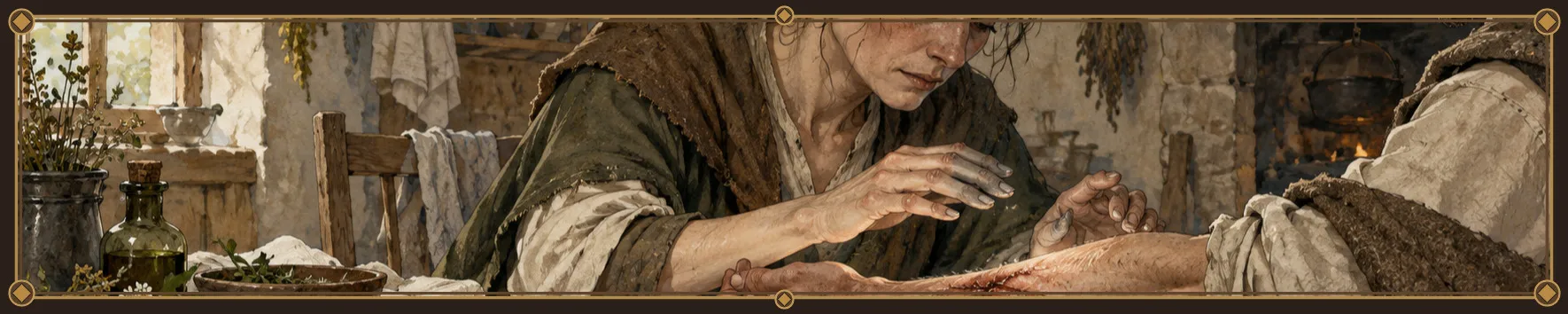
The boy’s arm was laid open from wrist to elbow on a scythe. I washed it, put my left hand on his shoulder and my right along the wound, and waited for his pulse to find mine. It always comes as warmth first, up from my own chest and down the arm like hot water poured slowly, and then a tightness at the edges of the cut, as if someone were drawing a lace.
The skin crept together while his mother held the lamp. There was a smell like crushed green stems. When it was done the cut was a pink seam and I was cold to the fingertips, and I sat on their step and drank their broth and did not trust my legs for an hour. Same people, same blood: it is the cheapest mending there is, and it still cost me the afternoon.
The Book of Small Mendings
Plants and Animals
Because plants and animals carry lifeforce of their own, they are real healing sources, and this is why medicinal plants restore strength, why some broths, tonics, and teas genuinely invigorate, why one herb affects different peoples differently, and why certain animals, organs, and extracts are prized in restorative traditions. What passes between them and the patient is not symbolism alone but the meeting of one living pattern with another.
The two are not alike. Plant lifeforce is diffuse, stable, and gentle, suited to gradual restoration and long recoveries, and safe for repeated low-intensity treatment. Animal lifeforce is denser and more reactive, closer to the pattern of other moving bodies, and so better for acute intervention in a short window, but it carries a greater risk of mismatch if used again and again across incompatible kinds. Both are safer than predatory extraction from an unwilling person and far more available in ordinary life, and both are less efficient than a clean transfer between compatible members of one species. Compatibility improves when source, recipient, and method share some Prime alignment, which is why an experienced herbalist chooses not only the plant but the hour and the hands.
Failed Mending
Healing forced too hard can go wrong in a way that has its own name. Failed Mending is a distorted healing pattern in which lifeforce repair overcorrects instead of restoring the body’s clean prior form. Wounds close too strongly, tissue regrows unevenly, scars stay physically meaningful, and repeated injury can leave a body tougher, stranger, more knotted, or more bound to the place it was hurt. The harm is not undone; it is kept, in altered form. It appears most often when the same wound is forced to heal again and again, when aggressive regrowth is pushed past what the body can settle, or in wounded places where damage and repair keep recurring. Once set in, recovery is compensated at best: the body works, but it does not return to what it was.
In most peoples it is an occasional misfortune. In the Trolls alone it became stable and heritable, during the long span remembered as the Stabilization of Failed Mending, c. 380,000 to c. 330,000 BR; why in them, and only in them, nobody knows, and Part IV tells what the inheritance has meant to them.
Bodies and Affinity
Bodies are not neutral channels. The lifeforce a species took on as it arose has biological consequences: some bodies conduct certain workings easily, some resist certain energies, and others can use a school at all only by paying higher loss, greater strain, or a greater risk of failure. Biology shapes how efficient a caster is, how steady during the casting, how well they bear backlash, how fast they recover, and which schools or Prime blends come naturally.
The Shape of a People
Each species has a broad magical profile, and species-wide tendencies are real even though no two members are identical. A people shaped more strongly by Aqua and Imago may produce more healers, adaptive casters, and nature-workers; a people with stronger Terra and Verba may produce more warders, builders, and binders. Other patterns are recognized too: a natural alignment with Zephyr and fast, mobile casting; with Lux and perceptual or liturgical magic; with Umbra and Memoria and the disciplines that stand near death. These patterns explain why magical traditions differ from people to people without making them mere cultural habits.
For practical purposes, the teachers of the schools judge a species' profile along five independent axes. Conduction is how easily the body channels power. Retention is how well it holds a complex pattern without drift. Recovery is how quickly strain clears. Tolerance is how much stress it absorbs before injury. Interfacing is how cleanly it exchanges lifeforce with patterns not its own. No species is ranked better or worse at magic on these axes; they are differently shaped for different costs.
Species also carry natural resistances, protective traits rather than immunities, where a lifeforce pattern rejects a class of outside influence: hostile influence over the mind, alteration of the body, magical contamination that behaves like disease, or particular Prime pairings. Resistance shows as weaker effects, slower onset, shorter duration, or a caster having to put in more. No mortal species is universally resistant, and strong resistance in one domain usually trades against vulnerability in another.
The same principle reaches past the peoples. Plants and animals have their own Prime-shaped tendencies, which is one reason herbalism, alchemy, husbandry, and beast-derived medicine have real magical consequences rather than working by the comfort of tradition.
The Shape of a Person
Within a species, individuals differ again: in the size of their reserve, the quality of their conduction, their sensitivity to ley lines, their tolerance for pain, the responsiveness of their nerves, their control of their own emotions, and their fit with particular methods. One person is born with a fierce affinity for storms and no endurance; another, with moderate gifts and an unshakeable steadiness, becomes the better mage in practice.
Affinity is not a single talent but several, and it helps to keep them apart. Efficiency is how much energy is lost. Control is how precisely a working can be shaped. Safety is how likely backlash is. Scale is how much power can be moved before the body fails. Recovery is how fast strain, fatigue, or internal damage mend. School access is which traditions come naturally, which come hard, and which feel against the grain. A caster may be highly efficient and fragile, powerful and inaccurate, safe and steady and weak, or broadly gifted and exceptional at nothing, and each of those is a different kind of life.
Limits and Mutation
A body can only move so much energy safely. Past that point it overheats, seizes, bleeds, damages its nerves, stresses its organs, overloads its senses, and runs its vital reserves dry, and repeated overcasting brings slow degeneration. This is one reason not every mage can scale up to battlefield magic: with all the theory and training in the world, the body may simply fail before the spell is finished.
Chronic pressure can change the body itself. Magical mutation is a persistent change to lifeforce pattern, physiology, or both, caused not by ordinary inheritance but by long-term residence in highly active ley country, repeated overcasting, ritual exposure to unstable compound energies, inheritance from lines repeatedly altered by magic, or dark practices that scar continuity and then settle. Practitioners distinguish adaptive mutation, more function at an acceptable cost; unstable mutation, gains that come and go and fail unpredictably; and degenerative mutation, decline that outweighs any benefit. Some adaptive mutations become stable bloodline traits. Inheritance is possible but not certain, and many mutations show only when the same pressure that made them returns.
The Ways of Casting
A spell is defined not only by what it does but by how the caster reaches and shapes it. Method governs speed, control, scale, rate of loss, safety, repeatability, and how easily the working can be broken. It is why one mage can hurl fire with a shouted gesture while another needs a wand or a prepared sigil for the same effect.
The Methods
Direct will shapes magic with little visible mediation beyond focused intent. It is fast, flexible, and hard to predict, and also demanding, hard to stabilize, and dangerous at scale; it belongs to emergencies, duels, and the naturally gifted or heavily trained.
Gesture helps the body impose structure on a working: direction, timing, the rapid modulation of force. It is quicker and clearer than ritual, and easy to break if the caster is bound, wounded, or knocked off balance.
Speech defines and stabilizes. It is the method of bindings, commands, oaths, liturgy, and precise instruction to forms prepared in advance, and it improves clarity and repeatability, at the price of vulnerability to silence, distortion, panic, and lost breath.
Runes and inscriptions move a working’s structure out of the caster and into stable form. They suit storage, delayed release, warding, artefact-making, and anything that must endure after the caster has left; slow to prepare, they are often safer and more efficient than improvisation for lasting work.
Ritual trades speed for scale, stability, symbolic weight, and the sharing of a burden among many. Healing circles, the sanctifying of sites, major conjurations, weather-working, and long-range divination are ritual work, and ritual makes otherwise impossible workings possible, though it is vulnerable to interruption.
Focus objects, among them staves, wands, rings, mirrors, blades, censers, bells, masks, and reliquaries, improve efficiency and safety, hold stored charge, standardize a favourite working, or open a school a caster could not otherwise reach. They are common for a plain reason: bodies alone are unreliable under stress.
Blood and the bodily medium, blood, breath, bone, pain, or direct touch, bring intimacy and potency, raise the cost, and raise fear and suspicion with it. They are at home in healing, blood magic, sacrifice, domination, and some necromantic and oath-bound workings.
Prayer and liturgy count as a method when they work as a stable symbolic and relational structure. They overlap with speech and ritual but depend on relationship, alignment, and sacred authority, and they serve divine support, sanctification, communal blessing, vow-magic, and work against corruption.
Environmental conduction uses the surroundings as the apparatus: drawing through ley lines, channelling a storm front, casting through a hearth, a river, or a standing stone, making the site part of the spell. It lowers personal cost and raises scale, and ties the working to its place and its weather.
No method is best. Will favours speed, gesture control, speech definition, runes persistence, ritual scale, focus consistency, blood potency, and prayer aligned support. A caster also chooses between improvised casting, fast, reactive, wasteful, and dangerous, and prepared casting, slower, steadier, more efficient, and repeatable, and a trained battle-mage moves between the two as the moment demands.
Peoples have their preferences here too, though nothing is compulsory. Species with high conduction and quick reflexes lean towards will and gesture; species with high retention towards runes and prepared work; species that interface well towards ritual and group methods; species of lower tolerance towards focus-assisted or liturgical channels, for safety. In mixed societies methods hybridize, one people’s stability practice married to another’s speed.
Braided Work
Mixed-method casting combines two or more methods in one working to gain their strengths and cover their weaknesses. In layered casting one method anchors the structure while another drives the output. In braided casting two methods run together and reinforce each other. In chained casting they hand off in sequence, as when a ritual sets up a working and a gesture releases it. Gesture with speech gives fast precision; rune with focus gives lasting stability; liturgy with ritual gives large communal effects; environmental conduction with a focus gives scale under local control. Mixed work is powerful and sensitive to failure, and its characteristic danger is phase mismatch, when the timings of the methods drift apart and amplify loss or backlash.
Breaking a Caster
Every method can be interrupted, and each fails in its own way. Gesture breaks under restraint, imbalance, or pain. Speech and liturgy break under silence, choking, panic, or distortion. A focus can be knocked from the hand, shattered, or put out of tune. Runes and ritual geometry can be smeared, inverted, or contaminated. Environmental casting can be denied its site. And direct will breaks under fear, overload, or induced confusion that scrambles its sequence.
Competent practitioners answer with redundancy, and train at least one fallback that fails in a different way from their first: breathing locks and anchor phrases against panic; small-gesture variants against a bound arm; silent signs and pre-bound short phrases against a stopped mouth; nested geometry, warded inks, and guard circles against a smeared line; paired backup foci and a bare-hand form against a broken staff; mobile conduits, stored reserves, and more than one mapped site against a denied place. A caster who has none of these is a caster who has not yet been ambushed.
The Price
Cost is not a rule added afterwards to keep magic in check. It follows from the first law: something must power the spell, some share is always lost, and the act of control itself strains the one who does it. Every school emphasizes different costs. None escapes cost entirely.
What Is Spent
The most familiar price is the caster’s own immediate reserve, and it shows as tiredness, tremor, dizziness, headache, slowed thought, clumsiness, and collapse. It is the least exotic cost and never the only one.
Some magic, healing and sacrifice above all, spends something deeper than fatigue. When lifeforce or vital reserves are used directly, the bill arrives as shortened endurance, weakened recovery, early ageing, vulnerability to disease, chronic frailty, or death. This is the plainest reason why restorative magic is not free.
Spells take from the world around them too: the heat from a room, the moisture from air and soil, the green from a field’s plants, the vigour from animals, the charge from a gathering storm, the steadiness of a ley-rich site, the stored power of a shrine’s ward-stones. This gives magic consequences for the land and for war. A village that heals its sick all winter may find its herb-gardens thin in spring; an army that casts heavily in one valley leaves the next army less to draw on.
Some workings depend on prepared tools, inscribed media, offerings, foci, catalysts, or costly works of stone and metal, and these are costs even when the caster’s body is barely taxed. A wizard with no chalk, no anchor, and no charged mirror may know the ritual perfectly and still be unable to cast it.
What It Leaves
Even a successful working can leave numbness, bleeding, burns, frostbite, disorientation, involuntary spills of emotion, brief blindness or deafness, nausea, gaps and fragments in memory, or a convulsive aftershock. These are what separate controlled power from spectacle without consequence.
Years of casting leave marks of their own: chronic exhaustion, tremor, scarred channels, damaged senses, infertility, broken sleep, flattened feeling, warped affinity, dependence on ritual aids, and a shortened life. Each school leaves its own signature on its practitioners, as the next chapter tells.
Some of this cannot be reversed. Permanent harm comes when repeated strain outruns the body’s power of repair, or when a single extreme event scars the core channels, and it most often takes the form of channel scarring that raises every future loss, irreversible damage to the senses, chronic arrhythmia or tremor, warped affinity that stays warped, lost fertility, and a lower ceiling on what can be moved at all. Healers grade it in three classes: Class I, Residual, lasting impairment that still allows limited practice; Class II, Disabling, a major loss of safe casting capacity; and Class III, Terminal, a progressive collapse in which further casting is an immediate threat to life. The classes follow what the caster can still safely do, not how they look. Many a burnt-out war-mage at Class II lives on as a sellsword company’s charm-maker or a lord’s tutor, and a Class III mage who casts once more is the stuff of last stands in the songs.
Treatment helps, but clean restoration is never guaranteed. Acute overload often recovers with rest and compatible intervention; repeated small damage can usually be improved but not erased; scarred channels are managed rather than cured; and injuries that touch identity or continuity must be stabilized before anyone tries to restore them. Healers distinguish clean recovery, where function returns without lasting penalty, compensated recovery, where it returns with ongoing management, and palliative recovery, where symptoms ease and capacity stays lowered. Some treatments trade one cost for another, recovering throughput while narrowing tolerance; and restoration forced again and again on the same injury can tip into Failed Mending.
Watching for Overuse
Overuse is a condition that can be detected, not only a judgement made after the fact. Masters, temples, and war-captains watch four signs: throughput drift, more input needed for the same output; recovery lag, exhaustion that lingers and stability slow to return; control variance, familiar forms growing unsteady; and symptom persistence, side effects that no longer clear between castings. They test by a test-casting under a master’s eye, by comparing how a caster’s channels answer now with how they answered in health, by timing the recovery after each working, and by checking for contamination after dangerous work. They speak of four risk bands: Green for ordinary strain, Amber for early signs of overuse and a lighter load advised, Red for a high risk of collapse and a recommended suspension, and Black for critical instability, emergency intervention only.
Because overcasting can maim bystanders and bring down walls, whoever holds a place tends to forbid it there, and makes the forbidding stick with whatever force they have. The rules are few, plain, and rarely written down: great magic only with the leave of the lord, the temple, or the elders; rest after burning out once; a master answers for an apprentice’s backlash; whoever damages a hall, a field, or a well with a failed working pays for it, in coin, in service, or in blood; and a caster in the Red or the Black may be stopped by force, if anyone nearby is strong enough to try. A lord watches the casters in his hall and his war-band, captains their own on campaign, temples their priests and sworn casters, and masters of a craft their journeymen at the forge and the quarry. What moves them is fear for their own walls and people, not the caster’s soul. A sellsword company under siege lets its war-mage go into the Red, and sometimes the Black, because the alternative is the wall coming down; the companies that survive such nights tell of it ever after, and those that do not are remembered by the scorch on the stones. A caster who works on after a Red warning and hurts someone pays as a careless man would; one who pushes into the Black without need is treated as having struck the blow. A lord’s favoured caster rarely pays the full price, and a wandering one often pays more.
When a Working Breaks
When casting fails, the cost rises sharply, because the energy has lost its guided path. It discharges wildly, strikes the wrong target, converts into the wrong thing, rebounds into the caster, collapses the structure of the spell, damages the site, or contaminates the caster with the very force they were trying to move. Backlash is often worse than the intended cost.
Where failures are written down at all, by temples, craft masters, lords' scribes, and the captains of war-bands, the learned describe a failed working in a fixed order, so that one house’s account can be read by another. First comes the method that broke: a direct-will failure loops and surges and rebounds into the caster; a broken gesture misdirects its release into whoever stands in the arc; a corrupted phrase leaves a malformed binding with an echo; a broken rune leaks from its anchor and may detonate later; a broken ritual sends a feedback shock through every participant; a broken focus bursts and returns its surge into the hand that held it; a broken blood-working leaves a link that will not let go; a broken prayer collapses or inverts its blessing; a broken conduction snaps back through the land itself; and a broken braid of methods escalates in several directions at once. Second comes the school’s signature, what that break becomes in the world, for the same failed gesture produces quite different hazards in fire-work and in dream-work. Third comes a severity band: Strained, a working degraded but mostly controllable; Fractured, control partial and collateral spill likely; Cascading, failure spreading faster than correction can contain; Catastrophic, the working with no coherent path of control left, and evacuation and quarantine the only sensible answers. Last come the containment actions taken. An account that names all four can be read in any hall that keeps such accounts.
Patrons and Currents
There is not one set of laws for mortal magic and another for divine. What separates them is where the energy comes from.
Traditional magic is casting that relies on the caster’s own training, chosen method, access to the surroundings, stored charge, bodily channel, and ability to shape the working. It is the magic of scholars, hedge-mages, battlefield adepts, ritualists, artificers, and most ordinary practitioners, and it tends to prize technique, preparation, efficiency, and the careful management of personal risk. Its look is formula, diagram, focus, rune, and practised gesture.
Divine magic is casting supported or empowered by a power beyond the caster: the current of a Prime, reached through alignment rather than granted; a Resonant able and willing to supply power directly; or, rarely, a Steward acting within its office. The mortal still supplies intention, ritual form, symbolic language, a bodily channel, and a reading of the situation, but the burden of energy may be carried, in part or in whole, by the divine source. Drawing on a Prime’s current, a Resonant, a sanctified current, or a ritual channel maintained by divine attention, it is often safer, steadier, more sustainable in a crisis, and better at costly liturgical effects such as blessing, consecration, and work against corruption. Its look is prayer, liturgy, vow, sacred symbol, consecrated place, and the relationship between a caster and what they serve. These are differences of style and access, not of physics, and many casters stand somewhere between the poles.
What Patrons Do
The Primes are not patrons. A Prime’s current is open to whoever stands aligned with its principle; it does not choose, refuse, or withhold. When Prime-aligned casting falters, the cause lies in the caster’s alignment, in the conduit, or in the place, never in a Prime’s will.
Patrons, the Resonants and rarely the Stewards, are another matter, and patronage is a relationship rather than a mechanism. Observers describe four modes a patron may be in. A stewarding patron gives stable support tied to clear doctrine and long formation. A covenantal patron gives support contingent on vows, rites, and obedience to a temple. An instrumental patron gives support intermittently, at strategic moments or in service of an agenda. A withholding patron gives less or nothing, because of conflict, misalignment, corruption, or a damaged conduit. One patron may move between modes over time. And divine silence does not always mean rejection. It may mean distance, a quarrel between powers over the matter, a disrupted channel, or a deliberate choice not to act.
Divine power is gained by accepting dependence. If a patron refuses, withdraws, is absent, is weakened, or is displeased, or if a caster falls out of alignment with a Prime’s current or loses the conduit to it, the expected supply may simply not come. Divine magic is often stronger in the moment and less independent over a life than learned craft. A war-priest whose blessing fails in the middle of a battle is the oldest of the temple tragedies: the light goes out, the line breaks, and the songs argue for ever over what he did to deserve it.
What the Current Does to the Vessel
Divine casting lightens the personal toll without removing it. The body still channels the working, the mind still interprets it, and a miracle beyond the channel’s tolerance can still burn, break, or kill the one who calls it; of two priests serving the same power, one may carry the current cleanly and the other burn out. A divine working can also leave bodily overchannelling, emotional overwhelm, sacred obligation, vow-debt, or a crash after the miracle ends. Safer does not mean free.
Over years, divine channelling leaves durable marks. Practitioners speak of channel hypertrophy, greater throughput within a narrower margin of tolerance; vow-scarring, a loss of flexibility around whatever was sworn; a tilt of identity towards the patron’s moral reflexes; dreams heavy with symbol; crashes of depletion after channelling; and a drift of dependence in which casting without a sponsor grows harder. Not all of this is sickness, and some of it is adaptation in trained clergy and disciplined orders. Risk rises when throughput outruns recovery, when doctrine is coercive, or when a caster channels through an unresolved contradiction. Temples and orders watch the health of a channel in three bands: Integrated, stable and manageable; Strained, with recurring symptoms that call for rotation, rest, or re-attunement; and Fracturing, dangerous, with judgement impaired and collapse near. The health of a temple’s channels is a matter for its elders as much as for its healers. A fracturing priest is what villages fear most from a faith: the hermit-seer preaching fire at the crossroads, the holy knight who can no longer tell a heretic from a child.
Miracle, Liturgy, and Spellcraft
Temples separate three things that look alike. A miracle is a working in which the decisive burden of energy is carried by divine sponsorship, producing an effect beyond what the caster could do unsponsored. Liturgy is a fixed rite using a temple’s own symbols, words, offices, or the assent of the gathered faithful, with or without divine sponsorship. Spellcraft is method-driven casting by trained technique, with energy from personal, environmental, stored, or other non-patron sources. So a miracle can happen outside liturgy, liturgy can happen without a miracle, and spellcraft can imitate the style of either without being a god’s work.
When a claimed miracle is disputed, the temples that care to judge it ask three questions. Source: where did the decisive energy come from? Form: was the temple’s own rite used? Leave: did the worker have the temple’s or the god’s leave over the matter touched? Quarrels gather around false claims of miracle, liturgy performed without a temple’s blessing, and spellcraft passed off as a god’s command, and they are settled less by the questions than by which temple, lord, or crowd stands behind the claimant; a hedge-priest with a real miracle can still be driven out by a temple with none. The bones, rags, and rings of a proven miracle-worker are worth more than gold: relic-thieves break into shrines for them, rival temples raid each other to carry them off, and forgers sell their fakes on every pilgrim road.
Some workings feel divine to the people who see them, mass healing, the smiting of corruption, the sanctifying of ground, protective blessing, exorcism, the miracle that steadies a breaking line, because they benefit so much from trust, blessing, consecration, moral authority, and a strong stabilizing source. They can still be described in ordinary magical terms; they are simply easier, safer, or more trusted when worked through a god. And divine sponsorship is not automatically benevolent. A cruel Resonant, a dark cult, or a tyrannical sacred order can pour divine-scale support into sacrifice, domination, curse-work, holy war, purification by violence, or sanctified atrocity, and villages near such a shrine learn to fear its night processions, the missing children, and the holy riders who come out under a god’s banner to burn a neighbour’s harvest. Divine magic is differently sourced and differently understood; it is not morally different in kind.
Dark Magic
Where the cost of a working falls on others, magic becomes dark. Dark magic is not a separate substance, nor a separate school, but a classification of use. A working is called dark when it inflicts its cost on the unwilling, violates someone’s bodily or mental autonomy, desecrates the dead, unsettles a whole environment, corrupts its caster over time, or pursues power without any acceptable restraint. Dark workings obey ordinary magical law: they need energy, lose it, depend on source and method, and are shaped by biology, place, and training. What marks them is how they obtain their power, through predatory extraction, coercion, desecration, catastrophic shortcuts, or exchanges no decent people will tolerate. Dark magic is defined less by how it looks than by who pays the bill.
Its common forms are sacrificial casting, domination and the violation of minds, coerced blood-work, the abuse of corpses, plague- and rot-magic, curse-work, the theft of fortune, forced transformation, and great rituals that devour a site. Any of these may be allowed, forbidden, secret, sacred, or ordinary, depending on the people and the circumstance. The marks that most readily make a people call a working dark are unwilling donors, forced transfer of lifeforce, the overriding of a mind, mutilating transformation, desecration of grave or shrine, large-scale drain on the land, a hidden price paid by others, and corruption that outlasts the spell.
No school is dark in itself. Blood Magic, Necromancy, Sacrificial Magic, Dominion Magic, and Trace Magic attract suspicion most readily, and certain branches of Dream, Augury, Nature, and even Sanctified Magic do too, but each of these schools holds both acceptable and unacceptable practice. A working distinction is simple enough to carry anywhere: dangerous magic is risky to cast; dark magic is unacceptable in whom it harms, what it violates, or what it turns its caster into. Some magic is both. Some is only one.
Forbidding and Hunting
Few peoples forbid a school by name. They forbid harm, and whoever holds the place does the forbidding: a lord, a temple, the hold-elders, a clan’s custom. How hard it falls depends on who did the working and to whom. A lord’s own caster is judged gently, a hedge-witch harshly, and a stranger worst of all. Across most of Caeldon dark acts fall into four rough grades. Restricted acts are done only with the leave of whoever holds the place, and under their eye. Conditional acts are tolerated in war, in great need, or in a rite a temple blesses. Prohibited acts are forbidden whatever the reason, save to stave off the end of a people. Atrocity-class acts are an outrage against the person and the people: coerced sacrifice, forced extraction of lifeforce, remaking a person past recognition, and large-scale predatory rites. Their casters are hunted, and every hand is turned against them. Those who hunt them know these acts by their effects and by what the survivors tell, and few of them know what the scholars say these workings do beneath. This is how one people can put the dead to work at a lord’s order while another burns whoever tries, without anyone’s physics being wrong.
Where someone takes the trouble to look, an accusation needs signs, not only an evil name. Often no one takes the trouble: a village’s fear, a lord’s anger, or a stranger’s bad luck is enough. Those who do look read a site for residue, the shape of the drain, and scars in the ground’s channels; look for what the victims share; feel for contamination and hear those who knew the victim before; weigh what several onlookers saw and what a skilled caster’s instruments read; and watch the accused attempt the working again under guard. Careful elders and temple-priests want two kinds of sign before they maim or kill. A frightened crowd wants none, and the witch-finders who ride from village to village for the bounty want only a body to show. Those who judge distinguish negligent overreach, unsafe but not predatory; knowing prohibited use; predatory intent, the deliberate exploitation of unwilling targets; and atrocity practice. Punishment runs from a blood-price paid to the victim’s kin, a branded or broken hand, loss of place, or exile, to long confinement under a temple’s watch, and atrocity-class casters are killed where they can be caught, by fire, drowning, or the sword. The powerful, or those with powerful patrons, buy their way down the ladder more often than not.
Catching them is dangerous work. A necromancer on the run leaves corpses armed to burst on the road behind him, a blood-witch has the village’s own sons for a shield, and a cornered dominion-caster turns the hunters on each other. Temples and lords hire mage-hunters for the work, sellswords with a gag, a binding cord, and a hedge-priest along, and pay them by the head.
Corruption and Its Inheritance
Some dark practice changes the one who does it: blunted feeling, a growing appetite for stronger costs, damaged empathy, bodily degeneration, ritual dependence, warped affinity, isolation, and a growing susceptibility to certain Harmonics or to dark entities. None of this needs to be a punishment from anywhere. It is what repeated predatory practice does to a person, and the fireside tales are full of such casters: the healer who learned to take as well as give and could not stop, the necromancer-lord whose tower stands empty above a village that still bars its doors at dusk. Healers and temples grade it in four bands. Taint is early drift, reversible with supervision and abstinence. Entrenchment is a recurring predatory reflex and distorted channels, partly reversible. Dominance is stable dependence on dark methods, with high relapse and real social danger. Irrecoverable is persistent predatory compulsion or catastrophic corruption of the channels, where containment comes first. The band is set by observed harm, recurrence, and the evidence of the channels, never by confession alone.
Cleansing is a staged intervention, not a single rite: stabilize, halting active harm and isolating the contaminated channels; de-load, removing accumulated residue and predatory feedback; re-attune, rebuilding safe channel behaviour under supervision; and verify, confirming control and the risk of relapse before release. Taint often recovers cleanly, Entrenchment with conditions, Dominance under long supervision, and the Irrecoverable are usually contained rather than restored. A failed cleansing does not prove moral failure; often the damage has simply crossed a structural threshold.
Dark practice can leave heritable changes in lifeforce when the alteration persists across generations: a raised susceptibility to contamination, sudden spikes of affinity, a poor tolerance for certain cleansing rites, chronic instability when casting under stress. Not every descendant of a corrupted line is compromised, and inherited alteration is treated as a biological and energetic condition, not as guilt. The wiser healers and elders therefore separate lineage status, the inherited condition; conduct status, the harmful acts actually done; and risk status, how closely the person must be watched. The distinction is meant to stop the hunting of whole bloodlines. Fear does not always listen, and a family with a tainted ancestor is still driven out of many villages.
All of this varies. One people puts the dead to work at its lord’s order, burns every blood-worker it catches, celebrates its war-priests' smiting, and treats mind-binding as worse than murder. Another burns whoever raises a corpse, keeps sacrificial offerings in its temples as a matter of course, lets its lords bend minds in their own halls, and treats curse-work as ordinary inherited vengeance. The laws of magic are the same in both. What an ordinary person in a given era can expect of magic, and what the custom of that era allows, is told in each era’s account of magic in ordinary life.
The Rare and the Half-Divine
Between ordinary mortals and the divine powers lies a thin layer of exceptional individuals, related to magic but not the same as it.
Mythic traits are rare abilities or dispositions that appear in otherwise ordinary members of a species: uncanny luck, kinship with beasts, a sense for dreams or for death, an affinity with storms, the ability to hear truth, a gift for finding the way, an unusual memory. They are real, rare, usually narrow, socially significant, and distinct from trained magic, and they never make anyone divine. A trait is inherited when it recurs in a family, line, or species; awakened when it lies latent until stress, maturity, ritual, or crisis brings it out; and imprinted when strong exposure to a Resonant Zone, a divine event, a planar anomaly, or a cursed place leaves it behind. Traits always have a cause; they do not appear without pressure, inheritance, exposure, or some other real condition. They belong to no single people: some are shared across species, some lean towards particular peoples, and a few are tied to one people, line, region, or event. A person may be an ordinary non-caster, a bearer of a trait, a trained mage, both, or neither. Many heroes of the old songs were trait-bearers rather than mages: the tracker who never lost a trail, the shield-bearer no arrow would find, the girl who could hear the beast in the dark before it moved.
A demigod is the child of a Resonant and a mortal: much rarer than any trait-bearer, superior to ordinary mortals in strength, speed, intelligence, endurance, symbolic force, or lifespan, and still mortal and far from invincible. Their superiority does not pass down. A demigod’s children are ordinary mortals unless some separate cause intervenes, so demigods are one-generation infusions, not founders of endless divine lines. Most trait-bearers are not demigods, and a demigod may show trait-like gifts; cultures confuse the two, but the world does not. As a rough guide the ladder runs from the ordinary mortal, through the bearer of a trait, the trained mage, and the trained mage who also bears a trait, to the demigod, and above the demigod to the Resonants and Stewards. The Primes are not on the ladder at all, since they are what every rung draws its power from. A clever mage can still defeat a trait-bearer, and a demigod may be far weaker than a great Resonant.
Both matter to the people around them. A trait-bearer may draw prestige, fear, taboo, attempts at selective breeding, a lord’s restriction, religious interpretation, recruitment, or persecution, and a demigod draws all of these more strongly, with cults, panic among ruling houses, prophecy, and upheaval besides.
What People Know
What Practice Knows
The first law is known by everyone who has worked magic or watched it worked, in the form the healers' verse gives it: the fire was in the wood before the spark, and someone pays. Practitioners know where the force lies close, what each working costs, which bodies take to which arts, and how a working breaks, often precisely, because their teachers' records tell them. Healers know the compatibility bands from their failures, temples know the questions of miracle, liturgy, and spellcraft from their quarrels and the bands of a channel’s health from their clergy, and witch-finders know the signs of dark work from the bodies they have shown. All of it is knowledge of what magic does.
What Theory Argues
Why it does so is argued. The ten energy classes are a scholar’s theory, and few practitioners have heard of them. Where the power comes from, the schools explain differently, by their own roots and by the Prime a scholar is aligned with. Clergy hold that their god gives them everything, and most never suspect that some of what they channel is a Prime’s current, reached through their own alignment. The account in this chapter is what is true; the schools' accounts come nearer it or stray from it, and each later era’s account comes nearer than the last, without ever arriving.
Tensions
-
Lineage or conduct. Dark practice can leave heritable changes in lifeforce. The wiser healers and elders separate lineage status from conduct and risk, so that descendants are watched rather than condemned, but wherever an altered bloodline lives, its neighbours test that separation, and a family with a tainted ancestor is still driven out of many villages.
-
Whose miracle. Temples ask where the decisive energy came from, whether their own rite was used, and whether the worker had leave over the matter. Spellcraft can imitate the style of a miracle, and such quarrels are settled less by the questions than by who stands behind the claimant.
-
A moving line. Ley maps are guesses, and a node is a patch that wanders with its lines. Whoever holds a node by the sword holds ground that will not stay where it was taken, and a shrine whose line slid away is left with dead wards and open tombs.
-
The silent patron. A patron’s silence may mean rejection, distance, a quarrel between powers, a disrupted channel, or a deliberate choice not to act, and the priest whose prayers go unanswered cannot tell from the silence which it is.
-
After the Red. A caster who works on after a Red-band warning and hurts someone pays as a careless man would; one who pushes into the Black without need is treated as having struck the blow. Whether a given night was need is decided afterwards, by others, and a lord’s favoured caster rarely pays the full price.
-
Two kinds of sign. Careful elders and temple-priests want two kinds of sign before they maim or kill a caster for dark practice; a frightened crowd wants none, and witch-finders paid by the head want only a body. The schools that draw suspicion are the ones whose practitioners stand accused first.
-
Trait or god-blood. Cultures confuse strong mythic traits with demigodhood, and the confusion carries weight: a trait-bearer taken for a demigod draws cults, prophecy, and dynastic panic that a trait alone never would.