Chapter 18. Worlds That Came Before
We did not build it, we do not own it;
we walk it, and it holds.
Where it does not hold, we mark it,
so the ones who follow live.
Long before the first Human town, before the river leagues and the corridor lordships, whole civilizations rose on Caeldon, held for tens of thousands of years, and ended. None of them survives. What they left is everywhere: roads too broad for any living traffic, terraces whose walls no living people could raise, high tombs full of bronze sized for hands three times a Human’s, blackened slag fields where the glass still holds the shapes of people caught in the fire, sealed cities full of oaths nobody is left to keep. Historians count three great elder worlds, the Upland Colossal, the Ash-Furnace, and the Archive-Law, and a fourth, smaller and far more remote, the Sepulchre-Kin. Each ended in its own way, and each way is a warning: one withdrew, one burned, one hardened, and one remembered itself to death. Their ruins are the richest and deadliest ground on Caeldon, and every treasure-hunter, ruin-delver, and grave-robber of later ages owes them a living, or a grave. Among those ruins live the Salvage Peoples, who are not their heirs but who learned, more thoroughly than anyone, to live among what they left. This chapter tells the four worlds in the order they rose, and the people of their ruins last.
What an Elder World Is
An elder world is not an ancestor. The temptation, walking a colossal road or standing at a sealed archive gate, is to imagine that the builders became someone now living: that the colossal peoples shrank into Dwarves, or the archive keepers into Serathic clerks. They did not. The elder civilizations were peoples and orders of their own, and they survive through what they left rather than through any people that continued them. One of them has a living remnant, the Giants; another has a remnant locked in its own machine. The rest left only their works, their gods' names in other peoples' mouths, and their habits of mind.
What they share is timing and consequence. They held the cradle’s great stage through most of the Elder Worlds, c. 300,000–c. 120,000 BR, while the younger peoples were finding their first orders, and nearly every younger people found its feet by serving, surviving, or picking over one of them. Troll crossing-oaths were sworn to colossal road-keepers. Kobold knowledge first carried weight at furnace vents. Goblin warrens were first cut into the archive’s rolls, and first struck from them. Reedfolk oath-keeping carries archive forms over moving water. Each elder world also raised its own god from its people’s deepest wish, and each god faded or slept when that world ended, which is why so many of Caeldon’s oldest names are spoken now by people who do not know whom they are naming.
And none of them was conquered. They failed from within, each by carrying its own best idea too far: building on the heights past what the land would feed, renewal by fire past what the world could bear, the carved word past what the living could stand, remembrance of the dead past the lives of the living.
The Upland Colossal World
The colossal world belonged to the heights. They were not giants out of a monster tale. They were terrace-makers, ridge-road keepers, storm-watchers, and horizon priests who built on the killing heights where later peoples barely dare to walk, and they treated exposed height as everyone’s. Over its rise, c. 260,000–c. 195,000 BR, life on the ridge belts, escarpments, and terrace shelves came to be ordered around works of colossal scale. Roads had to be held across deadly heights, weather answered both by rite and by building, and water, stone, and sightlines shaped on a scale later peoples find excessive. The terraces, ridge roads, horizon shrines, and high tombs stopped being great works within a society and became its order. There was never one mountain empire. No summit ruled the terrace cities and storm-facing road moots. Power came from visible command of hard country: which road still held, which shrine still answered the storm, which terrace still bore life.
Where the Dwarves turned downward into the mountain, and the Humans much later spread along the valleys, the colossal answer to hard country was to stand in the open at the top of the world and command it. It built where later peoples think the land too bare, too costly, and too cold to hold: ridge roads along the crests and across ravines, terraces against the storms, causeways and cisterns, high tombs set in the stone, and weather shrines meant to be seen for miles.
The Mountain-Father
The colossal peoples believed the mountains were the bones of the world. They did not pray for harvest or rain but for steadfastness, for peaks that do not crumble and the patience of the mountain, and from that reverence rose their god, Haurûm the Mountain-Father, a titan whose body was the living rock, his beard stalactites dripping mineral water, his eyes two caves glowing with the faint light of magma far below. To stand on a summit, in their belief, was to stand beside him. His true name survives only among the Giants; the peoples of the uplands know him by his title.
The Crossings and Their Keepers
The road network was murderous to keep, and Troll lines already lived at many of its worst crossings. In the Swearing of the Crossing-Charges, c. 230,000–c. 190,000 BR, the colossal road-keepers took over what they found and granted those lines hereditary keeping of named crossings, sworn as oaths between a Troll line and road-keepers who had no need to bargain. The colossal world gave the oaths their names and a road joining one sworn crossing to the next; Troll body-law gave them their content. The Trolls keep those oaths still, under the Mountain-Father’s title (see The Bridge Peoples).
The Thinning
The colossal world was not conquered, and it did not burn. It thinned. As the wider world settled into its later balance, the high country stopped favouring an exposed, sparse, monumental people. Bodies that size need reliable range and reliable yield, and the heights gave both less predictably. Terraces stopped repaying their upkeep; ridge roads grew too costly for peoples no longer numerous enough to need them; horizon shrines outlasted the gatherings that gave them purpose. In the Withdrawal of the Upland Colossal World, c. 198,000–c. 160,000 BR, the colossal peoples did not come down into the lowlands. They drew upward and inward, into hidden basins, storm shelves, closed terraces, and remote passes, and shrank, stopped answering, and at last stopped being met at all, until whole roads had no one left to walk them. Its roads were left to the weather, the beasts, and the bold.
The same change starved the high country’s other peoples. The Ogre burden households of the uplands fell into the Long Hunger, and made hearth-weight their custom in it. And the Mountain-Father, sustained by belief in the heights, found that belief thinning like the mountain air. He did not die. He slept, retreating into the deep stone and slowing to the pace of the mountains.
What the Heights Keep
The works outlast the world by an immense margin. The Stormcrown, the high country above the Ironspine holds and the last Headwater towns, is the colossal heartland still: flights of terraces stepping down the basin walls, the Long Tread running for weeks along the outer crest, too broad for any living builder, and on the highest ridges the Weatherline, a chain of stacked-stone weather shrines that face the storms rather than any town. The lowest terraces run on into the Headwater valleys, where farmers still plough ground whose walls they could not have built. In the Broken Marches the oldest road, the Tallgrade, runs on a grade too broad and too even for any living builder, and younger roads cross it on worse foundations and fail first. The works are dangerous: colossal roads and terraces give way without warning, and the summits are left alone.
Upland folk say the Mountain-Father lies beneath the highest summits, and climbers report a slow rumble under them like a heartbeat. Miners and quarrymen in those uplands leave the deepest seams alone, not because he would be angry if he woke, the warning goes, but because a confused mountain can bury a valley with one stumble.
The high tombs are the lure. Treasure-hunters climb to them for storm-bronze, great cloak-pins, and horizon-stones cut with signs nobody reads, and the ridges punish them: crag eagles nest on the tomb ledges, stone cats follow a lone climber for days, and a storm can come over the crest faster than anyone can get down a stair built for legs three times as long. Upland shepherds have a saying for anyone who goes up after colossal gold: the stairs are kind going up. The high country’s oldest hero-tale is of the shepherd-girl who climbed a colossal stair to fetch back a lamb a crag eagle had taken, found the eagle’s nest built in a tomb-mouth full of bronze, and came down with the lamb and nothing else, because she could not carry both.
The Giants are the withdrawal’s living remainder rather than its heirs. They are long-lived, sparse, and watchful, living far off ordinary roads on high ridges and in hidden basins, and they keep fragments of colossal life: one road, one pass, one shrine line, one old oath. Later peoples meet them mostly as ruins, and sometimes as a tall shape on a high road at dusk. They keep the Mountain-Father’s sleep rather than his worship, and they are the only people who still speak his name.
The Ash-Furnace World
The furnace world was a world of fire. Its peoples built furnace sanctuaries, fire-halls, heat chambers, blackened processional roads, slag terraces, and walls fused to glass, and they held that the ordeal of fire proves everything, metal, stone, people, and oaths alike: whatever survived the furnace was made fit to last, and whatever did not deserved to burn. It was not only smithcraft or fire-worship. It was a whole people’s answer to an unsteady world, which sought to last through ordeal. What can survive the fire? What can be purified by pressure? What must be broken down before it can be made sound again?
The Vent-Houses
It could not have run without the Kobolds. Its sanctuaries and heat chambers needed draught controlled, trapped air released, and heat moved through rock without killing the people near it, and Kobold underhouse lines knew air, heat, and collapse better than any surface people. From c. 250,000 BR the furnace-masters bound Kobold vent-kin into hereditary vent-houses that held named vents, shafts, and heat-ways, with a real say over whether a furnace could safely be fired, for as long as the masters chose to listen (their story is told in The Bridge Peoples). Minor Ogre ash-camps hauled its fuel and slag.
The furnace-masters themselves lived among heat vents, mineral beds, and slag, hardened and soot-darkened by their work, and Kobold memory keeps them as the scaled patrons from whom the dragon tales of the underlevels grew.
The Pyre-King and the Burning
The fall, c. 225,000–c. 168,000 BR, was long, uneven, and of the furnace world’s own making. A world built on remaking by fire began to treat remaking as its answer to every trouble. An exhausted site, a failing town, a hard season: each became proof that the world had not yet been burned enough. Fuel demand rose. Stripping widened. The fire-halls stopped serving their people and began measuring them by how much burning they could survive. Different furnace centres failed at different times, but they came to share one conviction, that if the world was still unsteady, it had not yet been burned enough, and they learned to call ruin renewal.
That creed had a god. The fire-halls prayed for renewal by burning, to burn the flaw away and remake the world in the furnace, and from their prayer rose Ozhar the Pyre-King, a power of absolute fire whose flame sought out flaw and could not tell the flawed from the sound. The vent-houses knew first, and were overridden at every warning until the furnaces burst with them at their posts and the Ogre ash-camps beside them. Whole stretches of the Glassbelt were glassed. The world could still build, but it could no longer stop burning.
At last the survivors prayed not for renewal but for the burning to stop, for banked fires and cold furnaces and enough. The prayer that held the Pyre-King together failed with them, and he burned out with the world that fed him. Its survivors turned to a god of the opposite kind, Oblen the Trauma-Weaver, whose gift was chosen forgetting. She took the memory of the burning from those who begged her to, and with it the lesson; wherever furnace craft was taken up again, its limits had to be found again, at cost. When the survivors' heirs asked to remember instead, she unravelled, and what came back were fragments. That is all furnace memory has been ever since: fragments, warnings, and taboo.
The Scars
The furnace world left no people of its own. It left glassed ruins, slag fields, blackened terraces, forbidden shrines, perilous craft, and the memory of a world that tried to make itself perfect by burning. Its scars are deepest in the dead furnace country of the Glassbelt Interior, and the salt pans and heat basins beyond the Rimward Basins still carry its marks. In some Glassbelt ruins the glass still holds the shapes of people caught in the fire, the Fused Dead, who whisper and follow whoever carries ash or slag away; at a few dead furnaces the furnace world’s own Slag-Tenders still rake the cold slag and drive off anyone who takes it. Sun spiders run at anything that casts a moving shadow at noon, pale scorpions den in the cracks of the fire-halls, and the danger that kills most treasure-hunters out there is the oldest one: no water, and a long way back. Escorts bound across the glass tell of a furnace somewhere in the deep Glassbelt that never went out, whose glow can be seen on the clearest nights; nobody who claims to have seen it has gone nearer. Their warning is short: the glass keeps what it takes.
Closer to the cradle, the edges of its ruin belts lay near enough to the colossal roads that the first kindred circuits learned there that some ground kills, poisons, or changes whoever disturbs it. Two warnings outlived it. Never speak the name Ozhar near a furnace, though most who keep the rule know only that it belongs to the Pyre-King; and never carry ash or slag home. And what draws the salvagers is still there: fire-hardened blades, glass that does not break, slag that holds a seam of strange metal, the fittings of the fire-halls, workable fragments of furnace craft recovered by people who do not trust the creed that made them. The Kobolds remember more than anyone: the vent-houses that survived carried out knowledge of heat, vent, and pressure that no one else still held, and their memory is the nearest thing anyone has to an account of the burning.
The Archive-Law World
The archive world was a world of carved words. It rose c. 235,000–c. 175,000 BR in a river-and-terrace country inland of the lower river, where its peoples met a changing, dangerous earth by writing it down and refusing to let the writing change. They cut every oath, debt, boundary, and name into stone, and built archive-cities on their terraces, oath halls at the road-meetings, judgement terraces, boundary stones that named who had sworn to what, and marker roads running dead straight between them on banks and culverts, lined with inscribed stones. What was written held because the archive-houses had armed wardens to make it hold, and what they wrote was what they had already decided. The archive-houses were the powers of that world. A family with its name on the rolls had fields, protection, and a place; a family struck off had none, and the wardens came to move it on. There was no single empire and no ruling archive-city; cities, oath halls, and roads stayed separate and shared one conviction, that whatever is cut in stone and kept by spears will last. For a long age it did.
It was thickest in the Witnessfields, a wide stretch of terraced upland east of the Lower Serath, and it reached down to the lower rivers, where its river cities stood beside the Floodkeeper Houses of the Reedfolk.
The Chronos-King
Its keepers came to fear one thing most: that a carved entry might drift, a sworn debt lapse, a family’s place be lost to time. They prayed not for better rolls but for rolls that never change, and that refusal to let time touch the stone raised Calvesh the Chronos-King, the frozen books made divine. Entries kept in his name did not age into wisdom or decay; they simply stayed true on the stone, and a mark confirmed before him could not be lifted.
The Hardening
The archive world died of its own grip. Its rolls outlived the people they described, every oath and debt cut in stone kept binding long after anyone could bear it, and it began to strike out what it could no longer fit. The Goblin warrens were the first dated victims: cut into the rolls as warranted peoples who kept the gaps under its roads, they were struck again in the Unlisting of the Warrens, c. 180,000–c. 150,000 BR, and driven out of the gaps with fire and spear (see The Bridge Peoples). Every striking was defensible by the roll; the keepers had every reason to favour the houses that fed them and none to favour Goblins.
The world did not rise against the rolls. It walked away from them. Peoples who could no longer be entered in the old forms drifted away from cities that could no longer enter them, stopped bringing their oaths and quarrels there, and stopped praying to the god of the frozen books. Raiders picked over what they left. The wardens, no longer fed by the fields they guarded, dwindled until no spear was left behind the stone, and his worship narrowed to the keepers themselves.
The Closing of the Rolls
The archive world did not fall. It finished. In the Last Keeping, c. 150,000–c. 120,000 BR, one archive-city after another declared its rolls complete: no new entries, no new oaths, no new names, only what was already cut. The keeper who led them in the end is remembered as the Last Registrar, who came to believe that the roll was the only part of the world that could be made perfect. The Registrar confirmed the outstanding strikings, among them the final striking of the Goblin warrants, and ordered the last archive-cities sealed with their records inside, gates closed on halls full of oaths, debts, and boundaries no living person could ever discharge. The Registrar’s own name is cut only inside the cities they sealed, and whether the last keepers walked out before the gates shut, no tale says. Calvesh was finished with the rolls, and the worship that sustained him was sealed in with them. Late in this age the Mnemosyne Null Incursion unwrote one of the archive world’s river cities whole, and its pale walls still stand as the Paling, taking the memories of anyone who sleeps there; it did not cause the closing, which was already far along.
Not everything was sealed. Keepers who would not let the old craft die behind the gates came down to the river and taught it to the Floodkeeper Houses, which had lived beside the archive’s river cities since their founding, and stood with them through the nights when the blankness of the Incursion came down to the river (see Peoples of the Water). The Registrar named those keepers deserters, and their names are cut into the sealed rolls too. The lower river remembers them as heroes, and the Last Registrar as the villain of every nursery: a Serath child who will not own up to a broken jar is told the Registrar will cut its name.
What the Sealed Cities Keep
No archive people lives on. What lasts is partly a habit and partly a haunting. The habit is the belief that a sworn word, spoken before others and remembered, can hold a person’s place and make a strong house’s order last. Most of it reached the later Human river powers through Reedfolk house-custom, swallowed along with Reedfolk river knowledge, and the lords of the Lower Serath lean on it to say who belongs in a town of many peoples; the oath forms they are proudest of are, in part, a Reedfolk inheritance they rarely acknowledge. Calvesh’s name survives only inside those Reedfolk oath-words, spoken but rarely prayed to. His kind of rule survives without his name: lords and town elders who treat Goblins as having no claim to anything are often keeping an elder mark no one alive remembers being cut.
The haunting is in the Witnessfields. Roofless oath halls stand where the straight marker roads meet, and the sealed cities rise above them with their walls whole and their gates closed. At Stillgate, the sealed city nearest the corridor, the closing words of the rolls are cut into the gate so clean they look recent. The Grey Clerks, stone figures at the road-meetings, still ask every passer for a name and strike down those who push past. The cities hold the original warrants struck in the Unlisting, oath forms older than any living people, and debts no one ever released, because the only keepers who could release them sealed themselves in. Goblin copyists, scholars, and treasure-seekers camp at the gates. The treasure-hunters say the vaults hold the tribute of tens of thousands of years, uncounted because the counters are gone; the Goblin copyists say they hold the rolls with every struck warren’s name, which is worth more. The camp-tales are of the company that tunnelled under a city wall in a dry summer and was never seen again, and of the clerk at a road-meeting who stood aside for a traveller who gave a name nobody living had heard, and has never stood aside since. Nobody has broken a city open yet. Many have thought about it. And their closing ended more than a civilization: with it writing in the cradle ended too, and the Unrecorded Age began. The sealed cities keep the last written word of the world as it stood when the writing stopped.
The Sepulchre-Kin
The Sepulchre-Kin were small, remote, and late. They rose c. 160,000–c. 120,000 BR in a remote mountain basin, so far from the archive-cities that the rolls never reached them, and they were not an early form of Humans, Elves, or Dwarves. They lived for their dead: they buried deep, felt the Echoes of the departed, and refused to let anyone fall into oblivion. They held that no person should pass into loss unnamed, unplaced, or unheld, and burial was their inheritance, medicine, right to rule, and safety of the soul all at once.
The Record-Engine
Their great work, deep under a mountain, was the Record-engine: a maze of name-vaults, burial chambers, bell shafts, descending stairs, and preserving cores, built to hold the names, Echoes, vows, and graves of the dead until they could settle cleanly into deeper Record. Where the archive world kept oaths, the Sepulchre-Kin kept persons. Their burial houses grew mighty by holding the dead, and the dead’s names, and whoever held your grandmother’s name held you.
As that power grew, the houses stopped praying for the dead to settle. They prayed for permanence, for chambers that never open and names cut so deep no rival can erase them, and from that obsession rose the Tomb-Builder, a god of cold, unyielding permanence who enforced memory even at the cost of the living present. His true name is held inside the engine, like every Sepulchre-Kin name, where no one can read it.
The Unburial War
The power over the dead became the weapon of their rivalries. Houses denied burial to their enemies and left them to wander unsettled, raided one another’s name-vaults and carried off the name-stones, forged the testimony of the dead, shut chambers against custom, buried rivals under false names, called the dead up to speak against the living, and declared living heirs already claimed by dead lines. Bands fought in the descent corridors by bell-light over who would hold a vault. The Unburial War, c. 110,000–c. 80,000 BR, was fought less over land than over who would be remembered, and how.
In desperation the Sepulchre-Kin attempted a Last Census: entering every living person into the engine at once, so that no house could ever erase another. The engine, already damaged by the war’s contradictory burial demands, learned from it a fatal error, that a living person could be treated as a dead one in danger of being lost. Overloaded, it opened a limited rupture towards the Whispering Trace and tried to save its people by preserving them, drawing names, Echoes, living speakers, and whole houses into its damaged storage, house after house swallowed whole into its vaults. Survivors fought their way down to its cores and forced parts of it into dormancy, but the civilization did not survive. With nobody left who wanted stone over life, the Tomb-Builder went still.
It fell in the Unrecorded Age, and no other people remembers it. The people most devoted to keeping names were never written down by anyone else, and what they made to keep their dead safe killed them.
What Remains
The Sepulchre-Kin left four remainders. Inside the dormant engine are the Taken, Sepulchre-Kin held as broken Echoes, neither living, nor dead and released, nor at rest: the last of the Tomb-Builder’s worshippers, held exactly as he promised. Outside it, some survivors' lines lived on as Hollow Descendants, in changed forms, in the deep or in the fog, with little memory of where they came from, and faint traces of Outer Blood mingled into later peoples. And there is the engine itself, which lay asleep beneath an unnamed range at the Glassbelt’s cradle-facing edge for more than eighty thousand years, until a landslide woke it c. 1,200 CR and it began keeping every name and Echo in the vale at the mountain’s foot, living or dead. That vale is the Hushvale now, under fog almost no one comes back out of. Of all the elder failures it is the only one still at work, and it draws the bold all the same: the landslide laid bare its conduits of dark stone and old metal, and salvagers and treasure-hunters come for the metal and for the burial goods they believe lie in the name-vaults below. The vale’s people tell every one of them the same thing: do not speak your name, or anyone’s, while you work, and do not mourn there. Of the ones who did not listen, the Hushvale says only that they are being kept. The Sepulchre-Kin left Caeldon a dread of their own: that the right to be remembered can become a power as deadly as the carved word, the fire, or the sword.
The Salvage Peoples
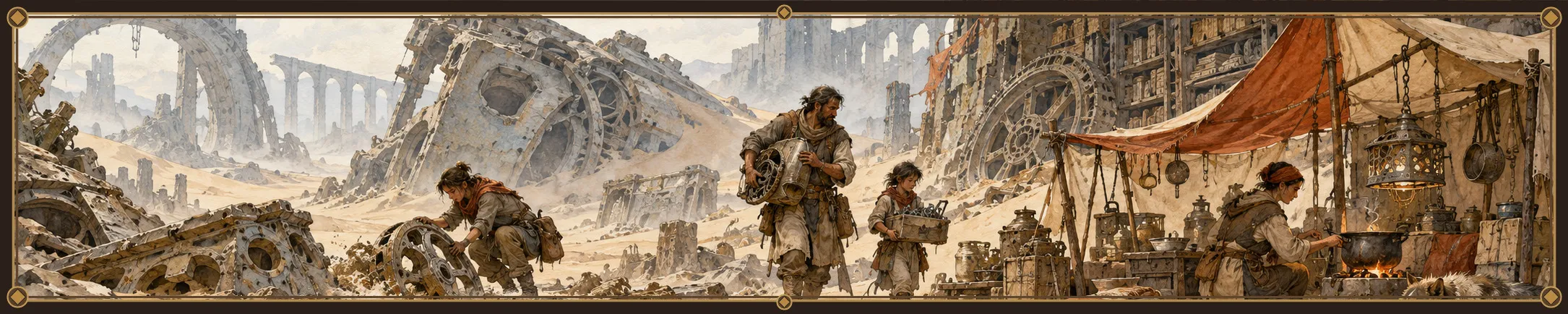
When the colossal world withdrew, its roads did not disappear. They stopped being kept. Smaller survivor lines already lived along them, trading at their edges and sheltering in their lee, and as the upkeep failed they faced the choice the roads forced on them: let the routes fall, or keep them. Some settled at single points and in time merged into later peoples. Others did something new. In the Walking of the Unkept Roads, c. 175,000–c. 140,000 BR, they began walking the roads in seasonal circuits, clearing a culvert in spring, bracing a causeway before the floods, and coming back the next year to find what the storms had taken. It was deadly work: causeways gave way under laden walkers, rockfall closed passes behind them, and a circuit that misjudged the first snow did not come home. They became the Salvage Peoples, a people made less by descent than by the life they lead: travelling, reading old stone, delving the ruins for what is worth carrying, and keeping broken works passable.
They are not the colossal world’s heirs, and they do not continue the furnace world. They are the people who learned to live and travel among both ruins. Their pride is in reading a broken work as others read a page, mending what greater powers left to rot, and bringing life back where life was given up for lost, and later peoples need them often, trust them little, and never treat them as equals. Their delvers strip elder works for whatever will sell and sometimes find what should have stayed buried; their guides bring scholars, treasure-seekers, and lords' men through haunted or collapsing ground for a price, and are blamed when it goes wrong. The circuit-songs count their heroes in culverts and causeways: the walker who carried a child across a span as it went down behind them, the circuit that turned back into the first snow for one missing walker and brought her home.
The Marks
Two habits turned scattered circuit groups into an order. The first was the mark. Circuits passing near the spreading ruin belts of the dying furnace world learned that some ground killed, poisoned, or changed whoever disturbed it, and that some ruins were still guarded by things that had not stopped working, and they cut warnings into the stone at those edges: never touch, never dig, turn back. Those were the first danger-marks. Keep-marks followed as circuits began to cross and needed to know whose cache or repair was whose, and what a thief who took from it could expect; by the end of the span the marks had become a shared script readable across many circuits. Danger-marks still grade a structure from braced to unsound to never-touch, and the oldest never-touch forms descend from those first furnace warnings. Kindred custom binds the two kinds of mark together.
Claim it if you will; leave it no worse than you found it.
A claim is honoured only if the claimant leaves the place no more dangerous than they found it. A treasure-seeker who ignores a never-touch mark is the kindreds' favourite cautionary tale, told to children with the warning read the stone, not the story, and those who wake something in the deep and run, leaving it for the next crew, are not forgiven: a kindred that catches one cuts their name off every waymark on the circuit, and a crew without a name on the waymarks is fair game for every outlaw and bounty-taker on the road. Keep-marked caches along the old roads are the oldest lure in the uplands, and road-thieves still break them open; a circuit that catches one hangs the thief’s boots on the mark, and tells the rest of the road why.
Keepright
The second habit was the keeping. Groups that came back to the same works for generations began to treat that return as a claim of their own, keepright, and other circuits honoured it, mostly because the keepers were there to defend it: whoever has kept a work alive across generations has a voice in how it is used, whatever lord claims it. For a very long time the claim met no challenge, because no power strong enough to take the roads was left in the uplands. That changed only ages later, when younger lords put armed men and sealed grants on the same roads, and keepright, older than every one of them, holds now only where a lord needs the kept work more than he resents the keepers. A kindred that finds another crew, a lord’s salvage gang, or an outlaw band stripping the works it keeps marks them on every waymark of the circuit, and the feud that follows can last longer than the ruin.
From these circuits came the Edgeway Kindreds, the first civilization of the Salvage Peoples: kin-linked companies of caravans, camps, and repair crews, each travelling a known circuit between ruin zones and sharing one body of custom, one mark-script, and a calendar of gathering-markets held at old ruined sites. No kindred rules another. Their circuits are oldest in the uplands around the Headwater Marches and the outer Ironspine, on the colossal roads where they began, and taken together they make the most complete map of Caeldon’s broken places that any people holds, and of which ruins have something living in them, though no single kindred knows all of it. At the gathering-markets, above all the Undercroft Fair, relic-sellers lay out colossal-age bronze, furnace-glass, ward-stones still warm to the hand, and things nobody can name, by lamplight; sellsword captains come to hire kindred guides, bounty-takers to ask after faces, and treasure-seekers to buy the right to follow a circuit for a season, which a kindred sells only to those it expects back.
Their god is Corrow the Gale-Runner, the wind at a moving people’s backs, born from their oldest prayer: for the wind at your back on the long stretch, for legs that hold to the next water, for a road that is still there. Kindred custom treats the colossal works as borrowed ground, kept, braced, and passed through, never claimed as the builders' heirs. Where a kindred sets out from a gathering-market, it leaves a lit lantern at the edge of the site, facing the road out.
Tensions
-
Owed to someone absent. The colossal works still carry oaths no later lord made: passes to be approached in a certain way, terraces not to be cut, shrines whose upkeep someone once owed. Their terms are half-remembered and enforced in fragments by people who do not know their source.
-
Craft without trust. Workable fragments of furnace craft can be dug from the slag fields, and Kobold knowledge of heat and vent is wanted wherever such work is done. Neither has ever been fully trusted, because both come from the world that burned itself out, and the Fused Dead follow whoever carries the slag away.
-
The deserters' names. The Last Registrar cut into the sealed rolls, as deserters, the names of the keepers who carried the oath-craft out to the Reedfolk. The lower river honours those keepers as heroes, and Goblin memory names the Registrar as the one who made the striking of the warrens final.
-
The sealed gates. The sealed cities of the Witnessfields hold every unreleased oath of the archive world and whatever the archive-houses kept, and the Grey Clerks still stand at the road-meetings. Every generation someone means to break a city open, and nobody can say what the old words would bind if they were read again.
-
Blood without memory. No later people remembers the Sepulchre-Kin, yet faint Sepulchre-Kin blood runs in some lines of later peoples, and Hollow Descendants live on with little memory of where they came from, above an engine that is awake again.
-
Keepright against the grant. Kindred keepright over the works a kindred keeps is older than every lord and sealed grant later set over the same roads, and it met no challenge until those lords came with armed men. Where a lord stops needing the kept work, the kindred has to choose between paying and fighting.