Chapter 10. What Makes a People
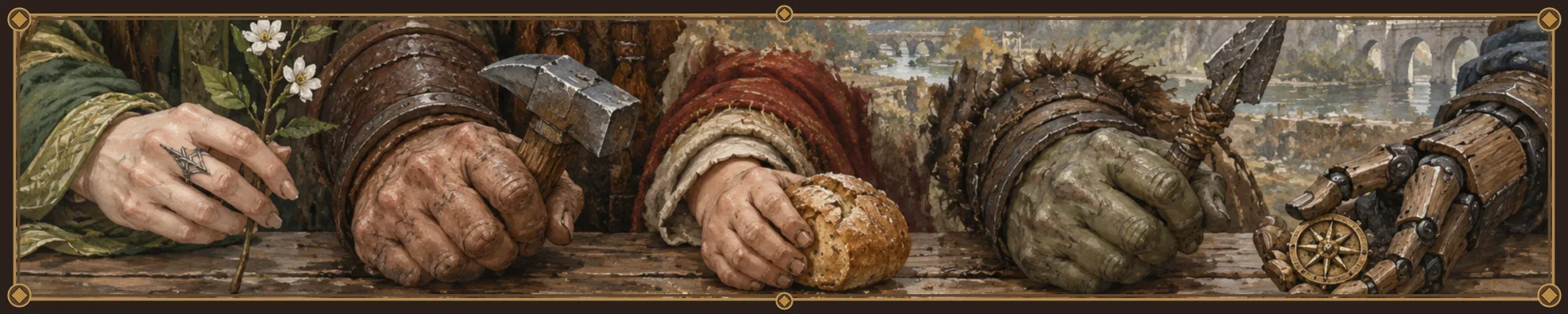
A person is a person from the first breath, and this hall will hear nothing to the contrary. What the hall weighs is what the person may carry: a place behind the walls, then a boat or a debt held under an elder’s eye, and last the full oath, a name for others to swear by. Ask the Elves when, and they will say not yet. Ask the Dwarves, and they will say when it has set. Ask the mother, and she will say now. The river houses have heard all three, and the river houses set the line.
The Casebook of Three Layers
A traveller who crossed Caeldon end to end would meet Elves who reckon their history in hundreds of thousands of years and Goblins who reckon it from the last ruin they made a home of; Dwarves who will not call a child finished for years after its birth and Humans who name theirs within days; people of flesh, people descended from stone, and people built in a workshop by other hands who woke one day and would not be put back. The world does not sort them neatly, and its peoples quarrel, sometimes with knives, about where one kind ends and another begins, about who counts as grown, and about whether someone who has been broken and mended, or has come back changed from a sealed gallery or a long captivity, is still the same person at all. The words in this chapter are the ones the rest of the book uses to keep those quarrels clear. They are plain words, kept strictly: a branch is never a civilization, a lifeway is never inherited, a person is never a soul, and the difference between them is often exactly what the people involved are fighting about.
Kinds of People
A species is a broad kind of people sharing an inherited nature, whether biological, metaphysical, or constructed. Elves are a species; so are Humans; so are the Wrought, whose nature passes through design and repair rather than birth. In ordinary speech the word is people: the Dwarves are an old people, and the cradle-web is home to many peoples. "Species" is the healer’s and the scholar’s word. The word "race" is not used of any of them, by anyone careful.
No species was made by the Primes. Each arose in one of a few ways. Most came by natural evolution on Caeldon itself: Humans, Reedfolk, Orcs, Halflings, Gnomes, the Thaluren, and the Kavari among them. The two oldest peoples came by planar adaptation, descending from ancestors shaped by another plane’s pull on the Material Plane and slowly tamed into fully material life: the Elves from Verdant-marked stock, the Dwarves from stock crushed into shape under the Iron Backbone. The Wrought were made, or rather their predecessors were, as mindless working frames, and became a people only when those frames woke into self-awareness. A few groups that live among the others, such as the Salvage Peoples of the ruin-belts, are less one clean species than a people-complex, drawn together by descent and by long lives lived in the same broken places.
Whatever its path, as a lineage formed it took on its own settled balance of Prime energy, and that balance is its lifeforce. Every people has its own signature, shared in broad shape by all its members and varied in strength and steadiness from one individual to the next. Lifeforce is not a soul or a moral essence. It is the animating charge of a living body, the thing that lets it grow, endure, and mend, and its species-shaped form is why some peoples lean towards particular kinds of magic. It also governs healing between peoples. Healing within one species is the surest and the least wasteful; between related peoples it works with noticeable loss; between very different ones it is possible but costly, and healers who serve mixed towns learn the difference early, sometimes at a bedside where the patient did not live to teach them. Broths, tonics, and herbs work because a plant or animal carries a living charge of its own, and different herbs act differently on different peoples for exactly that reason. The workings of lifeforce belong to the chapter on how magic works; for a writer of peoples, the point is that a body’s kind is written into how it heals.
Where the Peoples Came From
The deep history of Caeldon’s peoples is not a story of three or four clean origins. The early Material Plane was crowded: with ancestor stocks, with side-lines that survived and side-lines that did not, with elder civilizations that rose and vanished, and with peoples bent hard by one Harmonic or another in the long ages of upheaval before the world settled. The ladder runs, roughly, from the first living or half-living beings, through elder species shaped by a single Harmonic, to survivor lineages that came through the world’s great inward change and adapted to the calmer world after it, to the fully settled peoples of later history, with a long tail of lines that vanished, dwindled, or scattered. Most of what lived then was ancestor to no one. Its bones still turn up in cliff-falls, mine-cuts, and flooded quarries, too large, too many-jointed, or half stone, and are sold at fairs as the bones of monsters slain by heroes nobody can name.
Between about 700,000 and 500,000 BR the first durable lineages of Caeldon took hold in its great regions. In the canopy-and-root country, life ran towards long life, growth, and binding to place; in the mountain-and-depth country, towards density, endurance, and weight; in the lower basins and broken uplands, towards mixed and shifting forms whose meaning would only show much later. The regions became ancestral fields, and four of them matter most to the living peoples:
| The Verdant elder field |
Growth-heavy, place-bound stocks: rooted lines, flowering lines lifted high, thorned lines hardened by hardship, dim lines living under the roots. Most did not survive. The Elves are the disciplined survivors of that wild tangle. |
| The lithic elder field |
Stone-hard, deep-pressed stocks: seam-dwellers, peoples of the crushing deep, ridge-folk who weathered like stone, peoples of the fault lines. Most failed, turned to stone, broke apart, or were absorbed. The Dwarves are the survivors who adapted. |
| The balanced adaptive field |
Peoples of the gentler middle of the world, bent less by any one overwhelming force: basin gatherers, upland wanderers, shore-folk, sheltered valley folk, drifters of the margins. Humans are its boldest line; Halflings, Gnomes, Orcs, Reedfolk, the Thaluren, and the Kavari are other answers within it. |
| The threshold elder field |
Stocks of the broken ground between the other fields: fracture belts, cave mouths, ravines, scree, wash margins. Goblins, Kobolds, Ogres, and Trolls are its strongest survivors. |
The last of these is worth a writer’s attention. The threshold peoples settled about as early as the Elves and Dwarves, roughly 500,000 to 425,000 BR, and their strength was holding what others gave up: the crossing that keeps failing, the underway that keeps flooding, the load no settled people will carry. They were not born outcasts; they were made outcasts. They were driven to the edges only later, by powers that had built on the crossings they had first made safe, and a Goblin warren-mother can tell you, at length, whose great-grandmothers held the ford before the lord’s bridge was ever thought of.
Beneath all of them lie the vanished: the terrace-builders of the Upland Colossal world, the oath-carvers of the Archive-Law world, the fire-masters of the Ash-Furnace world, and the death-workers of the Sepulchre-Kin. Their stories belong to the deep past, but their roads, scripts, slag, high tombs, and buried engines are part of what every living people inherits, and they are why the medieval world is full of places worth the danger.
Branches, Lineages, and Regional Peoples
A branch is a durable inherited difference within a species. It may be biological, ecological, magical, or constructed, but it is always inherited, never only learned or chosen. The Wood Elves, the High Elves, the Thorn Elves, and the Dark Elves are branches; so are the Ironspine and Stonewake Dwarves. In everyday speech people say kindred, or stock, or use their own people’s word, and almost nobody says "subspecies" outside a scholar’s notes.
Humans are the striking exception. They form regional peoples, the Confluence, Headwater, Serathic, and frontier or Mixed-March populations, shaped by settlement, roads, the river, and trade, not by descent. A Serathic Human is Serathic by where she lives and whose oaths she keeps, not by blood, and a Headwater family that settles in the river towns and swears to the river houses becomes Serathic in a generation or two.
A lineage is a line of descent at any scale, from a single family or clan to the deep-time First Material Lineages from which the oldest peoples descend. Among the Wrought it also means a design lineage: the line of frames a design came down through, Forgeframe or Fieldframe or Warframe. A lineage is never another word for a branch. A family can be ancient and still be one family; a branch is a whole population changed.
Mixed Lines and Marked Lines
Not every inherited difference makes a branch, and not every child of two peoples makes a new one. Where two peoples have lived side by side long enough, children of mixed descent can become a recurring and widely accepted part of life: frequent enough that kinship, inheritance, oath, and local custom have to make room for them across generations. Such a stable mixed line is not a species, but it is more durable than an occasional pairing. The clearest on Caeldon is that of Human and Elven descent. Human-Elf children are rare overall, easiest to sustain with the settled High Elven line, and common enough in some frontiers, lords' halls, and corridor towns to need ordinary customs of naming, guardianship, and inheritance. They are accepted in many societies without being reduced to one people-category, and how they are read depends on local custom, branch inheritance, upbringing, and the temper of whoever holds the land.
Children of Human and Orc descent are different: rare individuals rather than a line. Orcs and inland Humans never meet, since the two halves of the world touch only at the one crossing of the Glassbelt, so such children are born only where the crossing kindreds' routes meet Windscar escorts, or on the Tidelace coast where far-side Humans live.
Two other kinds of inheritance cross species lines altogether. Some hereditary lines sit easily with order, sacred charge, high claims, and preserving powers, marked by long exposure to clarified sacred force, by steward-touched thresholds, or by oath-bearing houses; their people tend towards presence and conviction, and are the ones who stand when the line breaks. Other lines bear an inherited breach-mark, wound-memory, or dark-threshold alteration, survivor lines shaped by old rupture zones and the three Incursion scars; their people bear fear and stigma well, and walk where others will not. Both kinds are uncommon but known, most common among Humans though possible among every established people, usually hereditary, able to skip generations, and variable in how visibly they show. Rare new lines of either kind can still begin after a great metaphysical event. Neither predicts how anyone will behave, though both are routinely read as if they did: the first are made into banners for some lord’s right to rule, the second are watched, and blamed when the well goes bad.
Ways of Living and Orders
A lifeway is a recurring way of living. It can shape identity as strongly as any inheritance, but it is not inherited, and it can cross branches and even species. The Highhold and Gatehold Dwarves are real and recognizable, with their own habits of weather, haulage, and trade, but they are lifeways of exposed holds, not separate kinds of Dwarf; a Gatehold family’s grandchildren raised deep in the mountain would be ordinary hold Dwarves. Goblins of the ruin-warrens and Goblins of the road margins differ in nearly everything they do and remain one people.
Culture is a shared way of life seen from the inside: language, custom, values, ritual, art, food, oaths, the practice of magic, memory, and the shape of the world in a people’s eyes. A society is narrower, a concrete gathering of people at one time and place: this town in this generation, this camp this winter.
A civilization is a durable order with its own customs, powers, and memory, lasting beyond any single settlement or ruler. It need not hold land. A hold-world under a mountain is a civilization; so is a league of river towns, and so is a web of houses that owns no ground at all but keeps its oaths, its tallies, and its grip on the roads it holds. A civilization that sits inside another is a civilization within it, as the Stonewake Compact is within the hold-world of the Ironspine. Every one of them is held together by custom, oath, kinship, and the strength of its great families, and none by written rules; where something is written down, it records what the strong have already decided. The names civilizations give themselves (Compact, League, Concord, House, Holds, Circles, Courts, Pacts, Commons, Covenant, Keepers, Marches, Orders, Kindreds) are proper names, as loose as any old title. A Compact need not be a treaty and a League need not have members who signed anything; each name describes its people only roughly, and what each one actually is must be learned from the people who keep it.
Why the Peoples Differ
The same words apply to every people, but they do not fit every people the same way, and the unevenness is the point. Among Elves, branch and civilization line up more closely than anywhere else: each of the four branches has a civilization that keeps, hardens, or turns its inheritance, and still an Elven branch is inherited peoplehood while its civilization is custom, memory, the right to rule, and the houses that hold power. Dwarves differ more by hold, depth, and neighbours than by birth, so their civilizations matter more than their branches. Humans are divided far more by custom, fosterage, and the age at which they count someone grown than by any reckoning of descent. Goblins, Kobolds, Trolls, and Ogres live in many local lifeways and compacts without great states. The Wrought are sorted by design lineage and by who will accept them, not by ancestry.
Lifespan shapes the pattern too. Long-lived peoples tend to have few branches, slow divergence, and long unbroken memory: Elven and Dwarven histories reach farthest back and hold only a handful of living branches. Short-lived, mobile, or hard-pressed peoples throw off many local forms, lifeways, and vanished or absorbed populations. A constructed people diversifies through design, repair, and the slow history of its acceptance instead of through birth. The living divisions of each people show it:
| Elves, very slow |
Wood, High, Thorn, and Dark Elves, each with a civilization of its own. |
| Dwarves, slow |
Ironspine and Stonewake Dwarves; Highhold and Gatehold as lifeways. |
| Humans, fast |
Confluence, Headwater, Serathic, and frontier or Mixed-March regional peoples. |
| Halflings, moderately fast |
Foldward, Leeward, and Edgefold or Outfold. |
| Gnomes, moderate |
Gaugeward, Tidelace, and Chainwake or Island. |
| Orcs, moderately fast |
Windscar, Rimward, High-Scar, and Open-Steppe or Far-Route. |
| Reedfolk, moderately fast |
Floodplain, Marsh-Reed, Shoalway, and Estuary. |
| Thaluren, slow to moderate |
Tidebound, Blightward, Open-Run, and Outer-Route. |
| Kavari, moderate |
Bankright, Gravelbraid, Pool-Kin, and Coldrun. |
| Goblins, fast |
Ruin-Warren, Market-Shadow, Road-Margin, Underwall, and the Hobgoblin compacts. |
| Kobolds, fast |
Mine-Edge, Drain-Warren, Ruin-Under, Deep-Service, and Vent-Kin. |
| Trolls, moderate and distorted |
Bridge-Keeper, Ravine, Scarwood, Stonebreak, and Woundfield. |
| Ogres, moderate |
Hearth-Burden, Stonehaul, Timberbelt, Floodgate, Roadcamp, and Siege-Scar. |
| The Wrought, not by birth |
Forgeframe, Mineframe, Fieldframe, Civicframe, Alchemic, and Warframe. |
Every people also carries layers of what it used to be. Branches and civilizations emerge, merge, fragment, vanish, transform, or survive only as ruins, taboos, absorbed peoples, old distinctions of rank, and old names: the haunted hold no one dares to take, the grove whose song no living Elf can finish, the road cairns of a kindred that is gone. They do not all develop in parallel: a people may have an ancient bodily baseline, a later first civilization, still later secondary branches, and lifeways that are mostly a matter of region and custom. The peoples of any one era are the living top layer of that history, not the whole of it. Under the Wood Elves lie proto-Elven lineages that survive only in ritual memory and in overgrown root-halls nobody living built; under the Dwarven holds lie lithic ancestor lines and lost pressure holds; behind every Human region lie older peoples of the basins and the roads whose names nobody kept, and whose barrows the plough still finds.
What Drives a People
Bodies and homelands are only half of what separates one people from another. The other half is what a people defends first, what it sacrifices first, and what it mistakes for wisdom when the raiders are at the gate. Every people of Caeldon has such a heart: something it will die for, something it runs from, something it sings about at the fire. It does not make every member think alike. It describes the default leanings a people lives under, which individuals, branches, and civilizations can sharpen, soften, or turn in another direction, and which history, sacred force, and geography can bend. A Dwarf hold sealing a flooded gallery with its own people behind the door, an Orc escort turning back into a storm for one straggler, a Halfling fold barring its gate in a locust year: each is a people’s leaning made into a deed.
A few rules hold for all of them. Every people is a real people with self-interest, love, fear, cooperation, conflict, and variety inside it, never an allegory. No people is morally pure: there is no wholly benevolent people on Caeldon, and none whose nature is evil. Peoples differ by weighting, not by one exaggerated trait. And each people’s great strength and its characteristic failing grow from the same root: the courage that holds the pass is the stubbornness that will not open it.
The differences are easiest to see along a few lines: adaptation against endurance, expansion against boundedness, duty against preference, keeping against changing, the order of the whole against the freedom of the hearth, and the short horizon against the long. The peoples whose leanings are best known sit along them like this:
| Humans |
Highly adaptive, moderately expansive, leaning to preference over duty, willing to change, short in horizon. Strong at turning unsettled mixed country into places people can live, such as a ford town where four peoples trade; prone to restlessness, quick to seize a chance and much less reliable about what they will keep once the wind changes. They fight for land, kin, and name, and their feuds outlive the quarrel that started them. |
| Elves |
Bound to long memory and to place, little given to expansion, held to duty through attunement, long in horizon. Strong at keeping meaning, place, and name alive across spans no Human remembers; prone to turning inward, slow to yield, set on preserving what no longer fits the living world. They fight slowly, for groves and old ground, and do not forget. |
| Dwarves |
Bound to endurance, little to moderately expansive, centred on duty, exacting in how a hold is ordered, long in planning. Strong at endurance that outlasts mountains; prone to hardening life into exact forms of rightful place, rightful age, and rightful making until there is no room left to breathe. They fight for the hold and the line of the dead beneath it, and fear most the deep that must be sealed. |
| Orcs |
Heavy with duty, moderately adaptive, uninterested in conquering land for show but hard to dislodge from a road they have taken, open about who owes what, medium in horizon. Strong at carrying a shared burden through country that kills the careless; prone to hardening escort and guard into heavy, controlling bonds, where the line between escort and raid is drawn by whoever is stronger. |
| Halflings |
Bounded, little expansive, shaped by reserve and enough, strongly keeping, ordered by the fold. Strong at full cisterns, full lofts, and no hunger for more land; prone to defensive narrowing, where wise reserve becomes a closed door. They fight rarely, but hard, for the stores and the fold’s mouth. |
| Gnomes |
Highly adaptive, held to duty through careful reckoning, ordered by the sounding house. Strong at bringing many boats, voices, and signals home together through fog and shoal; prone to over-measurement, where careful exactness turns into exclusion, endless qualification, or a town too refined to breathe in. They fight the sea more than any neighbour. |
| Thaluren |
Bound to the return, held to duty through rightful return and held waters, keeping through communal clutch duty, long in horizon. Strong at a return that holds across unlike waters, generation after generation; prone to sanctified rigidity, where the guarding of spawning grounds hardens into refusing anyone else a share of the water. |
| Reedfolk |
Bound to the remembered water, ordered by house and channel. Strong at keeping life and memory alive in shifting wet country; prone to opacity, what they keep hard for other peoples to read or fit into outside orders. |
| Kavari |
Bound to home waters, keeping through nursery care. Strong at making rivers into lasting homes without freezing them into simple property; prone to a defensive dwelling-right that collides with the passage, sanctuary, or return that other peoples demand. |
| The Salvage Peoples |
Highly adaptive, changing what they find through reuse, practical, short in horizon. Strong at living off the bones of dead worlds; chronically neglected, needed by later powers and distrusted for the improvisations that make them good at it. |
Mixed lines have leanings of their own. People of Human and Elven descent often move between unlike rhythms of life and belonging more easily than either parent people expects, and are held back chiefly by being treated as go-betweens, compromises, or proofs of contact before they are treated as persons. People of Human and Orc descent often endure hard roads and heavy expectations better than anyone predicts, and are reduced, as often, to hardness, suspicion, or usefulness. The paired sentence is the whole method, and a writer can use it for any people: this people is strong at this because it puts that first, and vulnerable to this other thing because the same priority hardens or overreaches.
What a Person Is
Every people of Caeldon has its own words for the self, and many of them are old words for a soul: spirit, breath, shade, the thing that leaves. They survive in prayers, in curses, in the names of places. The world itself knows nothing of the kind. There is no detachable, immortal soul-object in any being on Caeldon. What people call the self is a continuity: a living, changing pattern that acts in the world, leaves traces in it, and may be kept in the deep memory of the cosmos. A few of the highest scholars call the doctrine Resonant Continuity, and almost nobody else has heard of it. It is the ground under every argument in this book about who someone is, though those who argue rarely know it.
Pattern, Echo, and Record
The continuity has three layers, which are phases of one process rather than three substances.
Pattern is the living shape of a person: their thought, temper, moral reflex, bonds, and the particular resonant cadence that makes them recognizable. It changes through growth, grief, learning, and choice while staying recognizably itself. It is strongest on the Material Plane, where free will and long development of the self are most robust.
Echo is the imprint a Pattern leaves on the world: in the people bound to it by love, enmity, or oath; in the places where it did something that mattered; in objects soaked by repeated intent; in rituals, names, and memory. Echoes are real but partial, weighted by feeling and shaped by context, so that a battlefield and a family shrine may both keep something of the same person in very different tones. Where the Veil runs thin or turbulent, Echoes form more readily and twist more easily, and a ford where a hundred men drowned is not a place anyone crosses at night.
Record is the deep keeping of coherent Echoes in the cosmos’s own memory, the Eternal Record. It is not a prison for spirits or a hidden afterlife. It is memory, and its quality depends on whether the Echoes that reach it are coherent, reinforced, and uncorrupted.
Memory, then, is not decoration. To remember someone is not only to honour them; it shapes how coherent their Echoes remain.
Death and What Remains
Death is not the departure of a soul. It is the failure of a Pattern to keep governing itself, usually marked by a burst of intense Echo, followed by the slow spreading of what coherence remains into Echo and Record. What survives is not all or nothing. It can be a faint residue on the air of a room, a strong but narrow fragment, a broad and coherent complex of traces, or, rarely, continuity clear enough in Record to attempt a restoration.
That is why the rites of the dead matter as much as they do on Caeldon, and why the dead who are denied them so often walk. Every people buries, burns, returns, or otherwise finishes its dead, and beneath the different rites the same need recurs: that the dead be seen to the threshold, that they do not wander, that something of them be kept. Over long ages that need gathered into a god of its own, Ennor the Grave-Watcher, honoured at gravesides across the cradle-web under many names, who keeps watch so that the dead leave a trace instead of vanishing twice. The mourners did not know they were tending Echoes. They were.
Restoration, where it is possible at all, is the rebuilding of a person from surviving Echoes and trustworthy Record. It is not retrieval. Some restorations bring back a living person with gaps; others bring back someone unsteady, someone their own kin quarrel over, or someone who comes apart the first time grief or fear presses on them.
Change, Succession, and Partition
Because a Pattern changes all the time, ordinary change never threatens it. What holds a person together, in the doctrine, is not perfect recollection but a set of enduring invariants: a person’s foundational vows and binding commitments, their lasting bonds and enmities, their characteristic moral reflex under pressure, and the resonant cadence by which they are known across their life. Continuity is strongest when these hold one another up.
When one to three of the four are severed at once, by force, transformation, or grave harm, the person’s continuity is disputed: they are partly who they were. When all four are severed at once, the original identity is lost, and the being that remains is a successor: carrying the original’s memory, Echo heritage, and Record ancestry, but a new person. There is no sliding scale. A being is in continuity, in disputed continuity, or a successor, and as long as one invariant holds, something of the person holds with it.
Two rare acts end an identity by will. In voluntary succession a person knowingly accepts the dissolution of all four invariants together, ending one identity and beginning another; those who do it understand it through their faith as a rebirth or a final vow, and no one marks it but kin and faith. In voluntary partition a person deliberately divides their living Pattern into two or more lines at once. The original is then partition-ended, which is not death; each resulting being is a partition-successor, a new person who remembers being the one before. Forced on someone unwilling, partition is among the gravest harms there are: it destroys a person without killing them, and leaves the beings that result unable to take back what was taken.
No one settles any of this by those names. Whether someone was reborn, whether the one brought back is the one who died, whether the man who came home from the war is still himself: families, faiths, and neighbours answer by custom and belief, and the next village may answer the other way. What they ask is whether kin will still count the person as their own, and they go by oaths, conduct, and what people saw.
Why It Matters to the Peoples
The doctrine belongs to a few scholars, but its consequences run through the life of every people, who meet them without its words. Dwarven culture, shaped by ancestors who changed so deeply in surviving that some lines denied they were the same people, built its public life around proofs: kin who speak for a life, the memory of the line, and the work of the hand. The proofs are tested in the Proving of the Unbroken Line, called when a Dwarf comes back changed out of a sealed gallery or years of captivity, or when a rival says openly that someone is no longer who they were; the hold’s elders and crafters sit in the great hall, the strongest kin weigh heaviest, and the hold watches in silence. It never asks whether someone is still a Dwarf, only whether they are still the same one. The Wrought stay the same person through pattern and memory, not through untouched original parts, so that repair is healing and refitting by force is harm. Elves return their dead to a living whole larger than any one life. Human custom separates being a person from being able to carry an oath.
And it explains the darkest magic on Caeldon, though few who fear that magic know so. Dark practice does not need a soul to violate a person. It attacks continuity itself: forcing Echoes out before their time, splicing unrelated Echoes together, overwriting a person’s invariants by coercive naming or binding, forging another’s continuity to wear their identity, scarring the paths to Record so that nothing can be reconciled. The deepest harm is not killing. It is identity forgery, and what custom forbids, where it forbids anything, is the part of it that shows: magic used on a person to change how they behave. Elders, priests, or a lord in his hall know it by its effects, a changed temper, a will no longer the person’s own, what people saw, and a binder caught at it is driven out, drowned, or burned. Where it has been at work, a person may still seem whole, and no one can trust that they are. Whoever holds the archives and silences those who remember can decide who a person was, and a lineage can be erased without a single death.
Ordinary Life First
Every people in this book is described first by what it eats, mends, celebrates, teaches, inherits, bargains over, mourns, builds, protects, and repeats, and only then by its wars and monsters. That is not a rule of tidiness. It is how the peoples themselves live: crisis breaks into an ordinary life; it does not replace it. Then comes the bad year: the wolves at the fold, the raid on the road, the flood that brings the drowned back. A writer who knows how a Dwarven family tends a child through its long years in the stone cradle, behind the most doors, where an enemy would reach last, or what a Human village keeps in its granary against the bad year, knows what a war would actually threaten, and what a people would give up last.
The chapters that follow describe each people as a kind: its body, its life, its fears and its treasures, and the customs that run deep enough to survive from one era to the next. How each lives in a given era, who rules it, where it lives, and what it is fighting over that year, is told in that era’s book, and changes from one era to the next.
Tensions
-
Back by whose word. Restoration rebuilds a person from what survived, and how much of the one who died comes back varies. No one settles it but kin and faith, and one household welcomes home a person its neighbours would bury again.
-
Proving the binding. Custom forbids binding or naming a person into obedience, and punishes what people can see: a changed temper, a broken oath, a will no longer the person’s own. Those who punish it rarely know what such a working does beneath, and a binding that leaves no visible mark goes unpunished.
-
Debts of the one before. Some faiths teach that a person may die to an old life and be born to another, and a few truly let go of all that made them who they were. No one marks it but kin and faith, so debts, oaths, and marriages follow the name, and the creditor and the new person each think the other is lying.
-
Two who remember swearing. After a partition, both beings remember swearing the same oaths and owning the same land. No custom has an answer for them, whoever holds the debt, the land, or the oath chooses which of the two to believe, and the feud between such a pair can outlast both.
-
A bridge before a person. People of Human and Elven descent can move between unlike rhythms of life more easily than either parent people expects, and are treated as go-betweens, compromises, and proofs of contact before they are treated as persons in their own right.
-
Marked and watched. Lines at ease with sacred order are made into banners for some lord’s right to rule; lines marked by old breach pressure meet suspicion that hardens into estrangement and makes them easier to use. Neither mark predicts how anyone will behave, and both are read as though they did.