Chapter 12. Humans
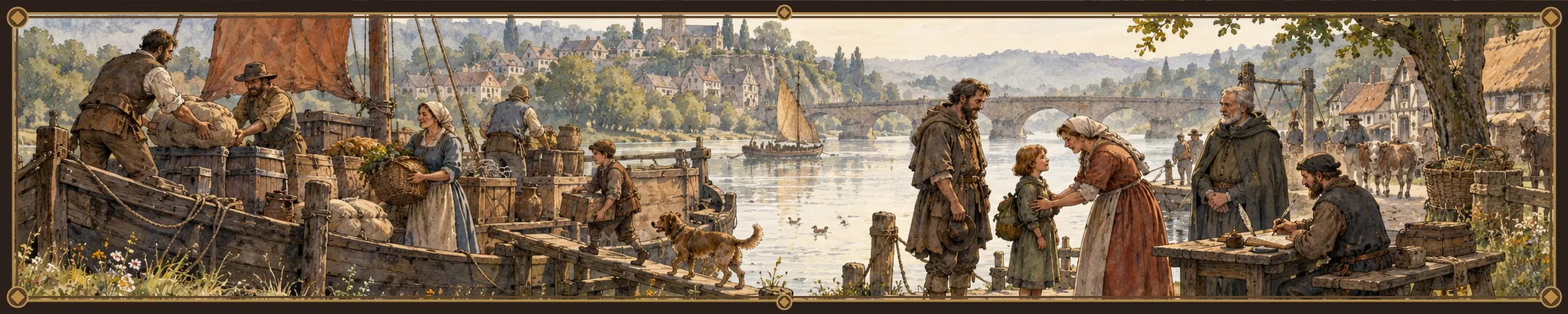
We name them in a week
and wed them in a summer,
we bury them in a lifetime
and the river doesn’t wait;
the Elves are still naming theirs,
the Dwarves have not yet set them,
and we have crossed and come back
and written down the date.
The Towpath Sayings
Humans have no great inheritance to lean on. They do not descend from the abundance of another plane like the Elves, nor from stone shaped by the Iron Backbone like the Dwarves. They arose on Caeldon itself, by ordinary evolution, in the country where several worlds meet: river basins, foothills, coasts, and the borders between forest and mountain. What they inherited from that country was not one deep gift but many shallow ones, and an unusual readiness to use them. They mature fast, live short, bright lives beside their elder neighbours, change their customs within a few generations, and push, more readily than any other people, into country that is not yet theirs. Much of what a stranger sees of the cradle-web in any era is Human work laid over older ground: a road, a palisade, a market at a crossing, a granary on a rise above the flood, a gibbet at the crossroads, and a stubborn trust in what has been sworn aloud and written down. Their alehouses are full of heroes who did one great thing and died young, and more than any other people they will walk into an elder ruin for what might lie inside it.
A People of the Edges
Humans emerged long after the oldest Elven and Dwarven peoples had settled, between about 300,000 and 220,000 BR, and not in one dominant niche. They belong to the broad balanced adaptive field of Caeldon’s ancestry: the peoples who arose nearer the gentler middle of the world, bent less by any one overwhelming force than the Verdant or lithic extremes, whose gift was to make do: to mix, move, change their ways, and make dangerous ground livable. That field held basin gatherers, upland wanderers, shore-folk, sheltered valley folk, and drifters of the margins. Humans are its boldest line. They became decisive in history not by being first or strongest, but by being the boldest gatherers, founders, and road-makers of mixed lands. Far away, the same field produced the Halflings, who turned towards full stores and the small sheltered world, and the Gnomes, who turned towards careful reckoning and the keeping of difficult coasts.
The first Human country was the meeting of two kinds of land: the deep, fertile lowlands of the Confluence Basins, which supplied growth and settlement, and the steep headwater country above them, which rewarded movement, guarded passage, and local wit. Humans never had to choose between the two. Their first strength was becoming native to the meeting of them. Between about 220,000 and 90,000 BR that meeting grew into one country of linked valleys, widening rivers, and foothill approaches, shaped to reward the people who could live in both before any Human lord stood in it. It was not empty ground. On the wet margins of the basins the Reedfolk were there first.
The same shape runs through all of Human history: the basin supplies depth, the edge supplies daring, and together they make a people unusually able to turn changing conditions into advantage. Humans still favour that kind of country: river valleys, coasts, foothills, mixed uplands, and borderlands, wherever several kinds of land, roads, and neighbours meet and moving, trading, and starting over pay better than one deep craft. That is much of why they are the most varied people on Caeldon. It does not make them better than their neighbours. Elves inherit forests older than memory and Dwarves holds cut to outlast them; Humans move faster, vary more, and change rulers more readily.
The First Man
At some point in that long emergence, Humans woke. The god who remembers it is gone, but the story of him is not. In the mixed country between basin and headwater the first Humans lived, at first, by hunger, fear, and instinct, with no sense of a self apart from the band. Then something shifted: a hunter looked at his prey and saw a challenge; a mother looked at her child and saw a future; someone looked at the stars and saw meaning. That awakening, shared by a whole people at once, gathered into a god: the First Man, the first conscious step from survival into Human becoming.
He had no fixed age, gender, or likeness. To a hunter he seemed the perfect tracker, to a gatherer the perfect provider, to a child the protector, always shifting and never quite in focus. He gave no answers and granted no powers; he asked questions, and his voice, the old stories say, did not command but invited. Look. Choose. Become.
And the more Humans became, the less they needed him. They did what Humans do. Basin and foothill bands grew apart in custom, speech, and way of life; the hunter had his own traditions and the farmer his own gods; people began to honour the powers of their own place and work rather than one awakened humanity. The First Man did not die. He came apart, scattering into the countless smaller figures of Human story, the Muse and the Trickster, the Hero and the Sage, the Mother and the Father, and his name went with him. No people, record, or rite keeps it now. Many Human peoples still tell of a First Man or a First Woman who taught Humans how to be Human, and no two tellings agree on a name. Some say the voice that urges a person to choose, to be better, to become, is his echo still, and that the old dream of shedding one’s skin and stepping into a new life is a visit from him.
Body and Pace
A Human body has no particular gift. It does well in many climates and on many diets, works hard, heals ordinarily, and wears out early by the measure of the elder peoples. What marks Humans as a kind is pace. They mature, marry, move, and change faster than anyone around them, and their customs are built for it. A Human child is named within days of birth and handed work, a place, and duties early. That makes them quick to fill new country, and it is the source of a friction that never quite ends with the Elves, who are slow to count anyone grown, and the Dwarves, who guard their oaths closely: to an Elf a Human child is named before anyone could know who it is, and to a Dwarf it is counted before it has set.
Where Humans live among other peoples, their coming of age tends to split into stages rather than happen all at once. A young person may work, travel, and carry messages on a lord’s or an elder’s word years before they may swear, inherit, or bind in their own name. That compromise was learned on the mixed frontiers, at a ford where three people drowned, and it has since become one of the ordinary shapes of Human custom.
Most Humans live close to land and water: farming, fishing, or working a road or a river, and eating what the work brings. Bread, porridge, and ale come from basin grain; barley and oats from the hills; fish from the rivers and coasts. And most villages lose someone every few years: to grey wolves at the fold in a hard winter, to raiders, fever, or the spring rise, a child to a heath adder in the long grass. What they eat, what they grow, and how they work change with the eras, and each era’s book tells how.
The Shape of a Human Life
Humans are driven, as a people, by adaptation more than endurance, and where they stand beside the other peoples is set out in What Makes a People: strong at turning unsettled country into places people can live, quick to seize a chance, and less reliable about what they keep once the wind changes. They fear wolves at the winter fold and, worse, their own dead: the Unsworn Dead of the basins, the drowned who walk out of the Serath, the hanged at the crossroads.
Gathering and Founding
For a long age the basin-headwater Humans had no lords at all, only a shared temperament. Between about 120,000 and 50,000 BR valley paths were walked until they were expected, foothill crossings were remembered, and lowland settlements, marcher bands, and guarded approaches came to count as parts of one widening country rather than as strangers. Kinship began to reach farther than the band. The idea that won, and has defined Humans since, is that a people lasts by binding unlike places together, not by making them alike.
Most of that age is a silence, the Unrecorded Age, and what Humans remember of their deep past came to them by voice. Their story of the First Man is one of the things that survived that way: the title passed on, and the name did not. The age left other things behind, and the plough and the delver’s spade still turn up its graves and hoards.
The first Human civilization, the Confluence Marches, was founded between about 40,000 and 20,000 BR across the basins and the headwaters together: river towns behind palisades, basin farms, marcher strongholds, and the roads between, held together by no crown but by shared habit, the same gods, the same oaths, and the same way of ending a quarrel, by sworn word, blood-price, or the sword. On the lower river, towns that each held their own reach of water and swore to treat one another’s carriers as their own became the Serathic League, between about 22,000 and 16,000 BR, the first Human towns on a river to hold together longer than the houses that founded them. The history of those orders, and of the small wars between them that no one bothered to name, belongs to the deep past and to each era’s book.
Centres and Edges
Humans build by joining a settled heart to a restless edge: granary towns behind, march-holds and road-forts in front, where the fighting is. The working household is the base of it: a farming family in a village of a few dozen households, a ferry or barge family on the river, a road family in the foothills, often fostering a child from across some border. A stranger in Human country sees it at once: fields running down to water, a granary, and at the nearest crossing a walled market with a mill, a shrine, and an oath-house, and in a hard year a gibbet whose hanged nobody will bury.
Power over all of it is split among whoever can make it stick. Lords hold land and take grain; towns are run by their richest houses, who keep the market and punish their own; march-towns take what the crossings will bear. Every lord keeps fighters, and most villages keep a few spears and a horn. When two houses fall out, the feud is fought with burned barns, ambushed carts, and arrows from the hedges, until one side can no longer pay its sellswords. Where no lord rides, a village pays beast-hunters for a wolf pack or a pass bear at the waystation, and the young who want more than a field go off as sellswords, bounty-takers, or tomb-breakers. A few come back rich, and buy a mill, and tell it every night for the rest of their lives; the many who did not are a name on the shrine wall and a mother at the window.
What they go after is the cradle’s oldest wealth. The Headwater hills are full of barrows of forgotten chiefs, and every valley knows one that has never been opened and one that was, and what walked out of it; the dead of a robbed and unrited grave rising of their own accord are the commonest ending of a tomb-breaker’s tale. Plague pits are worse, since the dead in them sleep until a spade wakes them, and digging for the coins in a plague pit is the classic fool’s death of the basin towns. Lords post bounties on outlaw captains, on wolf packs that take children, and on the things that come down from the Wrongwood, and pay in silver and sometimes in land; a commoner who brings in the right head can end the year a knight.
The deep world taught Humans caution. They have met the Dark Elves, and some regions remember it bitterly, but never as the Headwater, Elderweald, and Dwarven borders have known their neighbours. Most Human communities know the world below through descents that did not come back, wrong turnings, wells bricked up at the bottom, and grandmothers' warnings. Every basin town has its story of the treasure-seeker who went down after Dark Elf silver, and of what was heard knocking under the stones afterwards; those stories teach Humans which ways down are better left shut, as the ford that drowns in spring and the wood the Elves will not yield taught them which crossings can be trusted and which must stay watched.
In the cradle-web, a marriage, an inheritance, or a sale of land is sworn aloud and written down, and the dead whose deaths were never sworn come back as the Unsworn Dead. The habit has a long ancestry, and part of it is argued over: the love of written oaths came down from the vanished archive world, and most of it reached the river through the house-custom of the Reedfolk, who were keeping the water by memory long before the first roll was written. The oath and the roll are the Human answer to their own short memory, and the roll records what the strong have already decided. A Dwarf proves who they are before the hold-elders; an Elf by a grove that remembers; a Human by a copy, and if the copy is wise, a second one kept somewhere else. When the two copies disagree, the side with more friends and more spears usually keeps the field.
Meeting the Older Peoples
The Human rise was shaped from the start by uneven contact with older peoples, each of whom taught a different lesson, and most of the lessons were paid for in blood.
On the forest edge, from about 38,000 BR, Humans learned the cost of cutting into a living wood: the Wood Elves were not an obstacle to be cleared but a people whose dead lay in the ground the settlers wanted, and old trunks there still carry Human arrowheads grown deep into the bark. In the foothills, from about 34,000 BR, contact with the Ironspine grew into Caeldon’s first lasting alliance of Humans and Dwarves, grounded in bargained passage and repeated usefulness rather than kinship, and the holds and the marcher lords have fought outlaws and winter on the same roads ever since. In the High Elven houses, from about 18,000 BR, Humans met a standard of refinement older than their whole history, and answered it with admiration, imitation, condescension returned, and rivalry. How each of those meetings went is followed in The Threads of History. Dark Elves, when met at all, were feared as rare and dangerous powers from below.
On the lower rivers the Reedfolk were there first, and Human river towns grew by bargaining with them, depending on them, pushing them aside, and partly absorbing them. Much of what the river towns know about channels, crossings, and floodable land, they know because someone of the older people told them.
Custom for Mixed Lives
The friction of pace gave Humans their most distinctive customs, and the first of them came out of a feud. Faced with mixed households, Human communities have tended to swear several thresholds rather than force everyone through one gate.
The first famous case came out of the Headwater Marches, about 24,000 to 23,000 BR. A Human foster child raised partly among a community of the Ironspine Holds was famous on the road before the quarrel began: when bandits came down on a hold caravan in the Rattlecut gorge, the youth cut loose the lead mules, got the wounded under the rock overhang, and held the narrow path with a spear until the hold’s escort came back. The Human kin, and half the valley, expected the Dwarven elders to give the youth the full oath in return. The elders refused: brave, they said, and trusted, but not yet settled enough to carry oaths that bind road, line, and hold. The Human kin closed the ford below the hold to Dwarven traffic; a hold escort came down to open it, and in the scuffle in the shallows a Dwarf and two villagers drowned. For a season the waystations stood empty and the bandits came back to the road, raiding both sides without fear, and it was the bandits, in the end, who brought the feuding kin back to the same table. The hold was the stronger party and its caution carried the day, but the Human kin held the ford, and they won something real: the fosterling was named before the gathered settlement as a trusted member of the frontier community, and the full oath waited. Travellers crossing that ford at dusk are still warned not to answer if someone in the water asks the way to the hold.
Within two thousand years the compromise had become custom. Under the Headwater Rite of Two Oaths a young person swears twice. Working right comes first, sworn at the settlement gate before the gathered households: the youth becomes a trusted worker, apprentice, messenger, caravan-hand, or road servant under an elder’s eye, and holds a place everyone can see, but no inheritance, no binding oaths, and no share in the community’s heaviest debts and feuds. Oath-right comes later, when the young adult is thought ready to swear binding oaths, take a full place in house or line, take up a full inheritance, bear a sword in their own name, and take up a kinsman’s feud. Many a Headwater youth’s first deed after the second oath is a hunt: a bandit band, a wolf pack, a pass bear that has learned the stores, or a kinsman’s killer on the road. The rite did not end the disagreement between Human and Dwarven ideas of growing up. It held it still.
The lower river went further, and harder. About 19,000 to 18,000 BR, a merchant house in a Lower Serath river town of Humans, Elves, and Dwarves died out with its heir still young by one people’s count and already grown by another’s, and each set of kin claimed the house, its warehouses, and the child. The feud was fought in the open: warehouses burned, a laden barge was cut loose onto the Lying Shoals, sellsword crews came, and a whole night of fire ran along the waterfront. That brought the great river houses, who held the markets and the river-gates, down the river in force, and on the town landing, with their boats drawn up behind them, they swore the Serathic Oath of Layers, three thresholds at once:
| Protection |
Food in a famine, a place behind the walls, and a house that will avenge them, given to everyone a town takes in, even when everything else is unsettled. |
| Stewardship |
The right to hold property, debts, or goods in trust under an elder’s eye or within limits: a boat, a stall, a debt. |
| The full oath |
The day a person takes on the heaviest duties of town, oath, and line in their own right. |
The child was given Protection and Stewardship, the warehouses were held in trust, and the kin who would not accept it were driven out of the town. The layers leave room for a household or a line to count its own members in its own time, and forbid any of them to go below the floor the towns guarantee, because the great river houses have the boats and the spears to stop them, and the layers serve those houses first. The strongbox the merchant house was said to hold was never accounted for, and divers still go down at the Lying Shoals to look for it.
The same difference of pace runs through every close meeting between Humans and the elder peoples. On the Elderweald’s edge, a death in a mixed settlement was finished twice, the body returned in the Wood Elf manner and the mourning held in the Human one, because Humans needed their dead seen and spoken of in public where the Elves needed return. In the halls where Humans and High Elves married, a child of both sides who mattered to great houses set Human eagerness for a named heir against the High Elven conviction that a child may matter immensely without yet being ready to be shown, and the houses learned that an heir and a grown person do not always ripen on the same day.
Children of Two Peoples
Human-Elf children, rare overall, are common enough in some frontiers, lords' halls, and corridor towns to need ordinary customs of naming, guardianship, and inheritance. Human custom names them early; their growing-up is usually slower and more uneven than Human parents expect, and Elven kin may read them slowly or never. That is one reason the Headwater Marches and the Lower Serath were early to count a young person grown for one thing and not yet for another. Human-Orc children are rarer still, individuals rather than a line, born only where the crossing kindreds' routes meet Windscar escorts or on the far coast, since Orcs and inland Humans never meet.
Regional Peoples
Because their identity rests on region and custom rather than descent, Humans form regional peoples, not branches. The Confluence, Headwater, Serathic, and frontier or Mixed-March Humans are shaped by settlement, roads, the river, trade, and mixed contact, and a family that moves among them changes its people by changing its oaths and its neighbours. Behind them lie older peoples who survive only as layers of origin: early populations of the broken country, the old Confluence baseline, lost road peoples, and enclaves that lived too close to the deep. What divides Humans from one another is custom, fosterage, and the age at which they count someone grown, far more than blood.
Belief and the Dead
Human belief is the most organized and the most varied on Caeldon. In the corridor world of the cradle-web it is shaped by an organized faith, the Sworn Accord, under which Anvelle the Harvest-Mother and Serovan the River-King stand first, and whose oath-houses stand beside the markets at the crossings. Beyond the corridor, country shrines and household gods are tolerated rather than entered. On the frontiers, people who live between peoples pray to Abrel the Changeling, whom some Human tellers call the First Man’s successor: where the First Man taught Humans how to be Human, Abrel teaches people between peoples how to be themselves.
Beneath all of it lie the old seasonal rites and the rites of the dead under Ennor the Grave-Watcher, who keeps watch so that no name is lost. Human mourning wants to be seen. A Human death is finished when it has been seen, spoken of, and remembered in public, by a community that will carry the memory on, and those rites are kept with care, because Human dead do not always lie still. After a hard spring the River-Given walk up the Serath’s ferry ramps towards their old doors, and on the Headwater road the Rattlecut Dead stand in the gorge spray on the day the river takes the road.
Magic in Human country is a thing seen rarely and talked of for years. Every valley has a cunning-woman it needs and fears in equal measure, and every bad harvest someone is accused of the ill wish; it is seldom true. The sight of a real working, fire blooming over a ford in a war-mage’s hands or a priest’s word that turns the walking dead back to their graves, is the story of a lifetime for those who saw it. How Humans worship and bury in a given era, and which gods they call on first, is told in that era’s book.
The Burned Valley
The great loss and the great deed of Human song are the same story. In the Qzoth Incursion, about 4,000 to 3,500 BR, Qzoth’s Bloom broke out in a Headwater farming valley, and bands of Humans from the valleys round it, the first fire-orders, burned it back, their own sick and their own houses with it; the valley’s last town was burned by its own people with the Bloom inside. The valley is the Wrongwood now, and the farmers below it still hunt its Kindless Broods with fire. A lord who has slain something out of the Wrongwood has a song made for him whether he wanted one or not, and the old hunters say to bring back the head and never more.
The Far Coast
Not every Human lives in the cradle-web. In the Unrecorded Age, between about 120,000 and 40,000 BR, while most Humans were slowly gathering in the Confluence basins, small bands drifted outward along coasts and river mouths over tens of thousands of years, and some reached far-side shores. Nobody recorded the journey and nobody remembers it.
Their descendants live in the fishing hamlets of the Tidelace Coasts, on the beaches and outer coves between the Gnome harbours: timber houses above the tide line, boats drawn up on the shingle, drying racks, and a shrine to Maris of the Tides at the water’s edge. They fish close inshore from small open boats, gather shellfish and weed, and sell their catch at the nearest quay, and some crews hire on to Gnome craft. They have their own sea-stories and weather-lore, but no story of where their people came from. Their oldest tales begin on that shore, and none of them mentions the basins, the Sworn Accord, or any land behind the sea. They live under the harbour rule of the Gnome sounding houses, their boats tallied in the harbour ledgers like anyone’s, with no hand in making it. Their boats go out into fog, and their drowned come back in it as the Grey Crews, hailing the living to follow. Maris, born from the plea of Gnome and Human alike in a time of storms, is nearly the whole of their religion.
Other far-shore Humans may live on coasts no one has charted, but the Tidelace hamlets are the only ones known. No Human caravan or settler crosses the Glassbelt between the two halves of the world, and the Humans of the far coast do not know that the cradle exists.
Tensions
-
The age of binding. Human custom names a child within days and counts them early; Dwarven and Elven neighbours think that premature. The Rite of Two Oaths and the Serath’s several thresholds give the difference a working form, but neither side thinks the threshold sits in the right place: Human families ask why their children should wait on another people’s clock, and their neighbours ask why Human custom lets anyone bind so young.
-
The far coast. The Tidelace hamlets live under the sounding houses' harbour rule and have no hand in making it, and no memory of any other order to bring to it. Whether they will be drawn further in, as wards and families of the sounding houses, or keep their own weather-lore and the little say they have apart from it, is undecided.
-
The floor beneath the household. The Oath of Layers lets households and lines count their own members in their own time, but forbids any of them to go below Protection. Where a family’s own word on a member and the river houses' floor disagree, both claim to be the one that knows the person, and the river houses have the boats.
-
Read as hardness. People of Human and Orc descent are few, born only where crossing routes and escorts meet, and are read chiefly as proof of the crossing’s quarrels, as labour, or as danger. They endure hard roads and heavy expectations better than either parent people predicts, and are rarely given credit for anything else.
-
The barrow that was opened. A band of treasure-hunters opened a Headwater barrow last autumn and sold its gold in three towns before the dead in it began walking the valley at night. The valley wants the gold back in the barrow and the breakers hanged; the lord who bought the best of it has hired the same thieves again, this time to make the barrow quiet.