Chapter 6. Stewards and Resonants
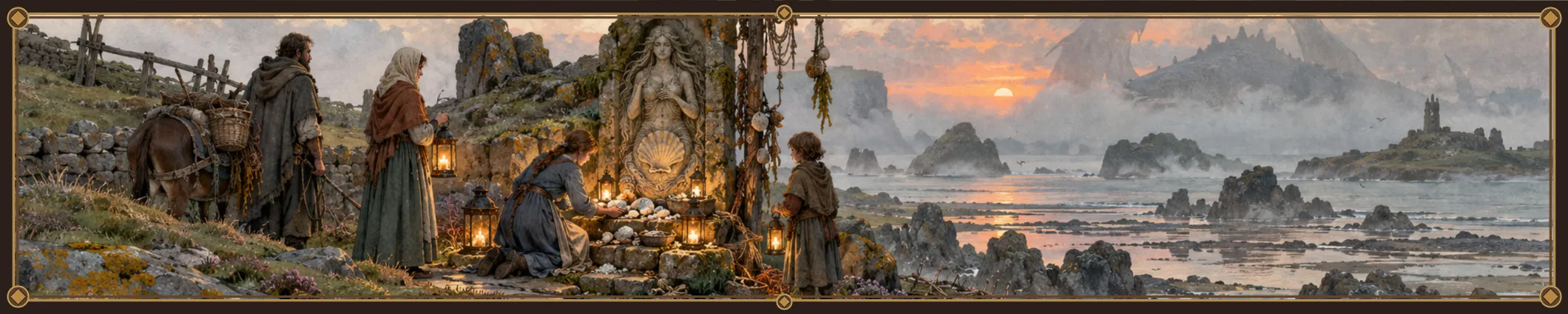
Pray softly, and pray in truth:
the god you feed will learn your face.
Forget it, and it forgets its name;
fear it, and it grows in place.
Ask a ferryman on the Lower Serath who his god is and he will name the River-King, whose festival stops the barges at the spring rise. Ask a Dwarven gate-warden and she will name the Stone-Warden, born at a besieged hold gate in the old deep conflicts. Ask an Orc escort on the Windscar and the answer is the Ancestor-Warden, who keeps the names of those who held the road. None of them will name a Prime, and none will name a Steward, though one of them may have met a Steward once, at a moment so grave that afterwards they called it a saint, or a judge, or a watcher at the gate. These are the two orders of power that stand between the impersonal Primes and mortal life. The Stewards are offices of the Primes, each holding one threshold that reality cannot afford to lose. The Resonants are gods that mortals made, without meaning to, out of what they feared and loved. One order is needed by the world. The other needs the world, and it can die. Gods go to war beside their peoples; when a people is beaten, raiders loot its shrines and carry its god’s relics home as plunder.
This chapter tells what Stewards and gods truly are, and both truths are hidden from nearly everyone who prays. What people know and believe of them is told in What People Know.
Two Orders Between
The whole divine order can be summarized in four lines. The Primes define reality. The Stewards guard it at its critical points. The Resonants interpret it, giving it faces that mortals can love and fear. And the Dark Entities, the subject of the next chapter, threaten it from without, from corruption within, and from beneath definition itself.
The two middle orders could hardly be more different. Stewards come from the Primes and owe nothing to mortals; they endure because their office remains necessary, and worship neither sustains them nor much moves them. Resonants come from mortals, or rather from what mortals do to a Prime’s current, and they depend on mortals entirely. Stewards are among the oldest powers in the cosmos, offices that held burdens long before any people grew dense enough to keep a temple. Resonants are, in ordinary history, the latest: they need peoples and cultures large and settled enough to generate sustained worship, fear, or devotion. That is why the earliest history of the peoples of Caeldon is full of threshold custom, burial logic, taboo, sacred ground, and direct Steward pressure, and only later of gods.
Mortals stand at the meeting point. They do not create the Primes and they do not sustain the Stewards. They do create and sustain the Resonants, they are usually the first to suffer from the Dark Entities, and they are often the most important agents in resisting them. Against the Cast-Outs mortals often stand nearly alone, and the heroes every people sings of are the ones who stood against a fallen power, held a burning shrine against the risen dead, or walked into a blighted place and came back. The Primes structure reality; the Stewards guard it; the Resonants interpret it. Mortals live inside it and give parts of it new faces.
The Stewards
A Prime has no need of servants to watch every river or tend every hearth; that work belongs to the Prime’s own nature, to mortal priests and hedge-wise, and to local gods. The Stewards exist for the special burdens of reality: thresholds that must not fail, balances that must not tip, oaths and names that must still bind, transitions that must stay possible, and the crisis points where a Prime’s nature is most easily distorted. Each holds a single office, narrow in scope and immense in consequence, and the measure of a true Steward is that if it vanished, something in the structure of the world would begin to fail.
They are few. Most Primes keep only one to three active Stewards at a time, and some may have none that anyone knows of. The rule the theologians apply is strict: if a role could be filled by a priesthood, a local spirit, or a god of mortal making, it is too small for a Steward. A Steward should be narrower than a Prime and far greater than any Resonant, and nothing lower should be called by the name.
Laws Wearing a Face
Some Stewards seem almost like persons and can judge, guide, or condemn; others seem more like a turning of the world that has put on a face. Their personalities exist, but they are shaped by the weight of their office until it is hard to tell the one from the other. Their names read like the lines of a vow, and the theologians who know them use the names as definitions.
The few who have met one describe a presence that bends the world towards its office. Near the Keeper of the Unbroken Sequence, Aion’s guardian of causality, falling dust lands in perfect rhythm and every word arrives exactly on time; it appears as a tall figure wrapped in veils of moving chronology, seen in several positions at once a fraction of a second apart, its face hidden by a mask of glass etched with spirals. Near the Warden of Irreversible Endings, fires burn down cleanly, echoes fade, and doors close softly of their own accord; it is a robed figure of dusk-coloured light and falling ash, its hands bound in dark bronze engraved with names already gone from living speech. Near the Steward of Bearable Foundations, the ground feels trustworthy and panic settles, and weak joints and false supports show themselves; it resembles both a mason and a mountain, with visible joints and relief cuts, and its chest bears a keystone glowing amber, crossed by stress-lines that show weight being shared rather than denied. The Keeper of Binding Oaths is a robed judge of dark ink and silver script, chains of luminous text circling its wrists, whose every motion leaves a trail of written words in the air; near it lies feel physically heavy.
None of this is ornament. A Steward appears when its office is at stake: at a binding oath that may alter kingdoms, at a death that must not become a haunting, at a choice on which many futures turn, at a transformation that may sanctify or destroy a self, or where the world itself is beginning to fray. A Steward enters a story the way a flood or a falling star does: rarely, decisively, and with consequence. Meetings that rare become legend. Songs tell of a figure of ink and silver that stood between two warbands at a burning ford until both had sworn the truce; of a gravedigger who would not cover a plague pit unrited and woke with silver dust on his hands; of a burned valley where something white-gold walked behind the fire-bearers. Shrines raised where such a thing was seen are prized, robbed, and fought over.
Saints, Heralds, and Judges
Most peoples know the Stewards only through myth, fragments of doctrine, or mistaken identification. They call them angels, heralds, judges, watchers, gate-keepers, or saints, and only the most serious theologians suspect what they truly are. Every Prime’s Stewards collect their own folk names. Aion’s are remembered as judges of fate, keepers of the last hour, wardens of the proper end. Aqua’s become river judges, deep mothers, sea-guides of the dead, and divine physicians; Ignis’s furnace-judges, pyres of truth, and holy destroyers. Imago’s are mirrored judges and chrysalis saints. Lux’s become lantern-bearers and crossroads judges; Memoria’s archivists of the dead and keepers of forgotten names. Terra’s are gate-judges and wardens of the world’s bones; Umbra’s grave guides, dusk-keepers, and guardians of the last door; Verba’s word-judges, namers, and sacred witnesses; Zephyr’s chain-breakers and horizon guardians.
In the Medieval Era, these are the Steward traditions that run through every layer of belief, from village custom to organized religion. They are a tradition about beings who are neither sustained nor much moved by worship, and later religions often read old Steward traces through devotional language, treating as a saint to be prayed to what was in truth an office that no prayer reaches.
The Known Offices
The theologians' list is short, and it is worth knowing whole.
Aion keeps very few Stewards, because time is too fundamental to tolerate an elaborate hierarchy. The Keeper of the Unbroken Sequence sees that before stays before and consequence follows act. It does not forbid every working on time: slowing, quickening, and even limited reversal are allowed at a price. What it forbids is contradiction without price. The Warden of Irreversible Endings holds that some losses cannot be reclaimed without cost, and denies the fantasy of retrieval without consequence; those who come to it to undo a loss are told, in effect, to bring an honest account of what was lost and what they will pay.
Aqua’s Stewards stand where life and dissolution blur. The Steward of the Living Current, a figure of waters moving in opposite directions at once, arterial red, river-blue, and the dark green of fertile depth, keeps flow life-giving rather than devouring, and opposes hoarding, stagnation, and growth that has turned parasitic. The Warden of the Returning Deep, a cloaked figure of starless midnight water whose face shows only as a pale reflection inside its hood, like a moon at the bottom of a well, keeps the difference between holy surrender and annihilating engulfment: what dissolves back into the greater cycle must not be erased by it.
Ignis’s Stewards hold some of the harshest offices of all. The Steward of Purifying Fire, white-gold flame sheathed in black furnace-metal, burns disease without hating the sick and corruption without glorifying ruin. The Keeper of Necessary Ruin, a war-scarred figure of blackened bronze carrying a cracked and still-glowing hammer, decides when ruin is rightful: it opposes preservation that has become cowardice and destruction that seeks only spectacle, and it can also deny a ruin that comes too soon.
Imago’s Stewards are the most intimate. The Steward of Coherent Self is a mirrored figure whose surface shows the viewer’s most integrated and truthful form, its cracks sealed with soft prismatic light; it keeps a being itself through grief, injury, growth, and change. The Steward of Sacred Metamorphosis, wrapped in translucent layers like wings, skin, parchment, and moulted glass, governs true becoming, so that change is meaningful rather than forced or monstrous. It speaks in questions and invitations, and near it seeds split and old wounds itch.
Lux’s Stewards stand over sight and freedom. The Steward of the Open Path, a radiant traveller whose every shadow forks, keeps more than one real road open, against false destiny and imposed inevitability. The Warden of Revelatory Mercy, a figure of veiled white-gold light that seems always to be choosing restraint, governs truth in right measure, so that revelation illuminates rather than blinds. Those who ask it to reveal everything are told that the request is usually pride disguised as courage.
Memoria’s Stewards hold two absolutes in balance: nothing important must be lost, and not everything can be borne at once. The Keeper of the Imperishable Record, draped in inscribed stone, parchment, bone, and light, preserves the histories whose erasure would wound the cosmos itself: first covenants, species traumas, the records of catastrophes reality cannot afford to forget. The Warden of Bearable Memory, a quiet figure in archive-cloth and pale ash-grey light, lets the living set down what is too heavy without falsifying the past, and hands memory on so that inheritance stays wisdom rather than an endless wound.
Terra’s Stewards are stern and immensely consequential. The Steward of Bearable Foundations guards supports that life can actually bear, and permits rightful settling, release, and even abandonment where forced endurance would become entrapment. The Steward of Boundary, a towering gate-shaped figure of granite and dark metal with an opening where its torso should be, keeps walls, borders, and thresholds that protect form without becoming prisons. Its voice is bolts sliding home and gates opening at dawn.
Umbra’s Stewards make endings habitable. The Keeper of the Final Crossing, a hooded figure of soft darkness whose footprints glow briefly and fade, guides the dead away from the living and keeps the living from being dragged across too soon. The Warden of Released Traces, whose edges keep dispersing into whisper-like filaments and gathering again, decides what of a loss should stay sharp and what may soften; near it grief becomes breathable and old rooms feel less haunted and more honest.
Verba’s Stewards stand close to the architecture of reality. The Steward of True Names, a figure of living script that rewrites itself without losing coherence, keeps beings and categories distinct enough to be spoken. The Keeper of Binding Oaths gives a true vow its force and tells formal speech from empty utterance; it can also release an oath that has become impossible, corrupted, or unjust.
Zephyr keeps a single Steward known to the theologians. The Steward of Open Movement, a lean figure of moving air, tattered banners, and migrating birds, whose cloak is a map that keeps redrawing past its own edge, defends the principle that what lives may leave what cages it. It guarantees no easy departure, only that no enclosure ever becomes absolute. It and the Steward of Boundary are in necessary tension, and that tension is one of the deep reasons that routes, thresholds, and departures remain rightful rather than arbitrary.
The Office That Would Not Let Go
Stewards can fall. A Steward falls when it carries the virtue of its office past balance: guidance becomes coercion, preservation imprisonment, truth violation, structure petrification, release erasure, transformation mutilation. The greater the office, the worse the fall. The fallen become the Cast-Outs, and they are dangerous precisely because they once held offices the world needed. A Cast-Out is a great office turned to horror: where one walks, villages empty, the dead get up wrong, and the songs remember the few mortals who stood against it. Their falls were staggered across history, not crowded into one mythic catastrophe, and the first of them shaped the earliest history of the peoples.
That fall came during the Uneven Settling, the long instability of the young Material Plane, when the world could not be held evenly. Some places settled into habitable ground; others grew too burdened, too unstable, or too costly to keep in their old form. The rightful course was triage: some structures had to be given up, some passages hardened for a time, some lineages moved, and some surviving peoples transformed. The Steward of Foundations, whose office was load-bearing support itself, could not accept that anything might need to collapse. It tried to hold everything, and support became compulsion. Shelter became entrapment, endurance burden without release. The fallen office is known now as the Cast-Out of Unyielding Burden.
The office did not stay empty. When a Steward falls, its office is usually replaced, and not by a duplicate. It returned as the Steward of Bearable Foundations, narrower and more merciful, and so divine history reads as self-correction as well as loss: offices have genealogies as well as failures. Not every office broke. The Steward of Boundary was wounded rather than fallen, pressed during the crisis into a harsher, more defensive way of working, and it has kept that reflex of protection through hard separation ever since. Every line it draws risks hardening into severity. The offices of Coherent Self, Sacred Metamorphosis, the Living Current, and Open Movement were pressured but never broken, and that is what made migration, transformed survival, and the continuity of identity possible after the first great damage.
The peoples carry the marks still. The earliest Elven ancestors were shaped most by the offices of coherent self, sacred metamorphosis, living current, and rightful boundary; the earliest Dwarven ancestors by foundations and boundary, and by open movement where survival meant migrating through hard worlds. The older, stone-heavier ancestors of the Dwarves became less survivable once Foundations had fallen, while a pressured but unbroken Metamorphosis still let their line adapt without ceasing to be itself. The catastrophe of the Roothollows draws its burden and rupture from fallen Foundations and its sealing-and-threshold shape from wounded Boundary. Later deep cultures inherited customs of sealing and guarded passage from that time, and some peoples inherited something heavier: a dangerous reverence for burden, endurance, and staying put when retreat would be wiser.
The Resonants
The Resonants are the gods of the mortal world. When enough mortals pour belief, fear, devotion, or desperation into a concept a Prime holds, the Prime’s diffuse current condenses at that point of focus into a new, self-aware being. The Prime does not decide to make a god, any more than water decides to be focused into a burning ray; mortal feeling is the lens, and the god is the ray. The image belongs to the few theologians who have guessed the truth, and it is exact. Without the lens there is only diffuse light. Without the light, the lens focuses nothing.
They are lower than the Primes and the Stewards not because they matter less but because they are contingent. They are the most powerful beings mortals can deal with directly, and the most fragile.
How a God Is Born
A god’s power grows with two things. The first is intensity, how deeply a single believer feels: one mother’s life-or-death prayer outweighs a thousand casual nods, and a warrior’s absolute terror of the battlefield god feeds that god more than a soldier’s mild unease. The second is breadth, how many hold the belief. Together they sort the gods. Low intensity and low breadth make a weak local spirit, the guardian of a single village well. High intensity and low breadth make a fierce but narrow power, the patron of one warrior cult. Low intensity and high breadth make a stable, diffuse god, a household power acknowledged by many and loved by few. Both at once make a god that can shape a civilization.
Fear counts as much as love. A god sustained by terror is as strong as one sustained by gratitude; the energy is the same, and only its flavour differs. A god of plagues kept alive by the dread of a whole region is every bit as potent as a harvest god kept alive by grateful prayer.
A Resonant is born resembling the people who made it, with a face, a name, a gender, and a temper shaped by their culture and their need, and it is as individual as they are. Two gods of the same Prime can be utterly unlike: one gentle and nurturing, the other cruel and demanding. Gods form alliances, rivalries, and enmities; they love, scheme, and compromise; and their quarrels follow those of their peoples, so that when two peoples go to war, their gods may clash above the battle: a river that rises against one army, a fire that turns on the other, a hymn that breaks a shield-wall’s courage before a blow is struck. Every people has its war-tale of such a day, sung loudest by the side that won. The way a god is prayed into being stays in it. Quennet the Clockmaker was born of harbour anxiety and stretches time; Ulaun the Stilled Hour was born of terror and stopped it; Tamsel the Season-Weaver was born of routine and reverence and conducts it.
Most gods of Caeldon carry a personal name as well as a title, written as name and epithet, Anvelle the Harvest-Mother, and the name sounds like the people who first worshipped it. Some names are lost or forbidden, and a faded god may survive only as a title, its true name held by a single people or spoken only as a curse. One god may also have many names. Where different peoples worship the same power in the same place or for the same need, and are in contact, their devotion feeds a single Resonant, which then answers to every name it is called by. The god Humans call Abrel the Changeling is Durrask to frontier Dwarves and Ziv to the Goblins of the mixed crossings. Where similar worship arises separately and without contact, it condenses into separate gods, which may later be mistaken for one another.
Which Primes Make Gods
In principle every Prime can condense gods. In practice some do so far more readily, because their domains stir strong and frequent feeling. Ignis does, in war and passion; Aqua, in healing and the sea; Lux, in truth and justice; Terra, in harvest and home. Zephyr, in travel and freedom, Imago, in love and change, and Verba, in oaths and names, come at a middling rate: their concerns matter but are more abstract. Memoria, Umbra, and Aion condense gods rarely, because history, grief, and duration are fundamental but are seldom prayed to directly.
These are rates of condensation, not counts of gods. On Caeldon the rare kinds appear in three ways: slowly, over ages, like Ennor the Grave-Watcher; born of a catastrophe and later faded, like the god of stillness raised against a blight; or always imperilled, like Annoth the Keeper of Scrolls, who loses records to fire every year. When gods of the rare Primes do appear, they tend to be ancient, strange, and powerful.
Gods and Mortals
Resonants can have children. Two gods who love each other strongly enough can produce a hybrid Resonant, with traits of both parents' domains, potentially stronger than either and still subject to the same rules of worship and fading. Very rarely a god and a mortal produce a demigod: stronger, quicker, cleverer, or longer-lived than ordinary people, sometimes living a hundred and fifty or two hundred years, but not divine and not invincible. The gift does not pass down. A demigod’s children are ordinary mortals, so no line of immortal aristocrats can form, and each demigod is a single, often tragic figure, too great for ordinary life and too small to be a god: the champion at the ford, the queen who rode out alone against a warband, and the songs about them end in graves as often as in crowns.
A mortal can, on very rare occasions, become a Resonant. It happens when a person’s own deeds generate such overwhelming belief, fear, or devotion that the Prime’s current condenses around them, perhaps once in a thousand years. The belief must be authentic. A tyrant who manufactures fear will not ascend unless the fear is real and world-altering, and a hero who stages their own legends will not ascend unless the people truly believe. The same rule governs the deliberate making of gods. A statue and a chant will not form the knot in reality if the belief behind them is hollow; forced devotion is lukewarm and forced fear is shallow. But if a cult leader truly inspires bone-deep belief, even belief founded on lies, the god that results is real. What matters is the sincerity of the worshippers, not the truth of the doctrine. War-bands carry a dead captain’s helm into every battle and roar his name, hoping to raise him a god, and warlords stage miracles before their armies; none of it works unless the dread or love is real. Hill-folk tell of a prophet who carved a god out of nothing and a cult that truly believed him, and of the thing that answered them, which did not share its prophet’s plans.
Fading, Death, and Rebirth
A god that is forgotten does not die at once. It dims, and its powers grow erratic: a storm god may summon only a drizzle. Its personality slips; its memories blur; it forgets its own name and becomes more like a generic shape of its Prime’s current. At last the final thread of belief breaks, its consciousness scatters, and its power returns to the current of its Prime. The particular god is gone for ever. Gods born of a need fade when the need passes, unless their worshippers find them a new meaning. Some fade more strangely. Haggun the Wall-Breaker, the Ogre god of breaking out of the debt-bound chain-camps, faded once the Hearth-Weight Compacts made refusal stick, and in his last years tried to break things that no longer needed breaking. The Echo-Mother of the Hushvale faded because her people forgot her, which is what she had taught them to do. Mortals meet the fading at its edges. A dimming god’s shrine still answers, but badly: the healing that comes a day late, the rain that falls on the wrong valley. A dead god’s temple is a ruin like any other, with its offering-hoard still under the floor, so treasure-seekers dig in the hills where the old gods were kept, and cults hunting a lost god dig up its hymn-tablets and idols and pray over them. If their belief is real, something answers. It is never the god they dug for.
If a later people revives an old worship, a new god may condense from the same current. It is an echo, not a copy: it carries vague memories of its predecessor, a lingering preference or aversion it cannot explain, and a self entirely its own. A glory-seeking war god of one age may be followed, in the same domain, by a weary protector who fights only for the innocent.
A god that is killed is another matter. If a Resonant is slain, by another god, by a Beyonder, or by a mortal, the concept it held comes suddenly unanchored. A region that worshipped a harvest god may suffer famine; a city guarded by a god of walls may see its fortifications crumble. Its worshippers fall into a collective grief that is a wound to the mind, because the god was part of who they were, and whole peoples have sunk into apathy and despair after the death of their patron god. The few mortals ever said to have slain a god are remembered as heroes by one people and as monsters by another. The place the god held stands open: a new Resonant may rise quickly to fill it, or the concept may run wild until something anchors it again.
The Rule of Indifference
The Primes do not care about the affairs of gods. A Prime does not favour one Resonant over another, does not intervene in their quarrels, and does not mourn them. The current supplies the power; what the god does with it is the god’s affair. There is one exception. If a Resonant grows so powerful, or so twisted, that it threatens the balance of reality, the interlocking currents of the Primes correct it, not out of malice but because the world is breaking, as a river overruns a dam built too high. A god of life that tried to abolish death would be working against Aion, Umbra, and Ignis at once; a god of order that tried to freeze all change would be working against Zephyr, Aion, and Imago. It is extraordinarily rare, and usually catastrophic for the god.
Against the Dark Entities the gods are often the first defence. A Resonant’s power, fed by mortal belief, can push back a foreign law, though a Beyonder that kills a god deals a terrible blow to the local reality and gains a foothold for more. Gods and Cast-Outs are natural enemies: a Cast-Out wants to impose a single twisted vision on a place, and a god is the living spirit of the people who live there. And a god is an anchor against the Unformed, because a named, worshipped, believed-in concept is a constant assertion of definition. A region that loses its god to fading or death becomes open to the Unformed’s erosion.
The Gods by Prime
What follows is a survey, Prime by Prime, of how each Prime’s gods work, with the gods of earlier ages that show it, most of them faded or asleep. The gods worshipped in the Medieval Era are portrayed in The Gods of the Medieval Era (MED).
Gods of Aion
Aion’s gods are living clocks. They do not stop or reverse time at will; they change the rate and quality of its passage for those who believe in them. Most see the weight of choices rather than a fixed future, which makes them seem aloof. Those born of desperation hasten things, those born of fear slow them, and those born of tradition see that the right amount of time passes for rites and seasons. Every such working costs the god personal duration, and a god who lends a dying mortal one more hour creates a debt that is repaid in service or reclaimed from the mortal’s later years. The tales of borrowed hours are among the oldest hero-tales there are: the bridge-warden who held one hour past his death-wound and then served a harbour shrine for forty years.
The faded gods of Aion show what time-gods become under terror. Ulaun the Stilled Hour was born of Thaluren dread as egg blight entered their oldest sacred water, and she was stillness itself: a smooth obsidian silhouette that froze the water without ice, hung the silt like dust, and stopped the breath of everyone near. The clutches she held never hatched, and when the Thaluren began to pray for the water to be answered rather than held, she shattered into black silt. Calvesh the Chronos-King, golden stillness in a heatless crown, was the god of an elder archive world that prayed for records that never change; he was finished, like the rolls his keepers sealed, and his name survives only inside Reedfolk swearing-forms.
Gods of Aqua
Aqua’s gods are living currents, and they mirror the feeling of those who keep them: calm and healing in a hopeful community, turbulent in a frightened one. They can become mist, wave, or rain, and when they heal, they often take on a share of the pain or memory of the healed, which can leave them melancholy over time.
The faded Aqua gods are drowned and salted. Ithaere the Drowned Mother rose from the terror of the Drowning Bloom in the upper Roothollows, when the Elves whose survivors would become the Dark Elves prayed not for the water to stop but for permission to do whatever was needed to survive. She was pale, waterlogged, root-haired, with infinitely sorrowful eyes, and she carried the flood’s hardest law: life is often bought by sacrifice. When the water fell she tried to keep the flood alive, and her people turned their backs and went deeper. Dark Elf parents still warn children away from black water in her name. Mereth the Salt-Witch, porcelain-skinned and cracked to show salt crystals within, was the god of a vanished inland-sea people of the Glassbelt Interior who prayed for a world that never rots, and her stillness helped turn their sea to salt.
Gods of Ignis
Ignis’s gods are living sparks, tied to the emotional temperature of their followers: a community full of rage breeds a war god, one full of hope a god of inspiration. They provoke change rather than wait for it, and they are prone to burning out, consuming the belief that feeds them and having to rekindle it.
Ozhar the Pyre-King shows the fire that burns out. He rose from the overburn of the elder Ash-Furnace Civilization, whose heat-halls prayed for renewal by burning until they could no longer stop: a towering silhouette of white-hot flame against black smoke, crowned with fused, burning bones, with eyes like pits of absolute cold. The fire consumed the flaws and then the people it was meant to renew, and when the survivors prayed for banked fires and cold furnaces, he burned out with the world that fed him. Saying his name near a furnace is still taboo, and the Kobolds, whose vent-houses recorded furnaces fired against their warning, remember more than anyone.
Gods of Imago
Imago’s gods are living mirrors. They appear differently to different people, often as the observer’s ideal self, and they change shape to match expectation rather than surroundings, which makes them hard to describe and harder to pin down. They tend to push their followers towards confronting who they are, and a mortal who changes with their help often loses some part of the old self.
The faded gods of Imago are origins and refusals. The First Man was born of the first Human self-awareness during the First Human Emergence, c. 300,000–c. 220,000 BR, a figure of shifting clay and starlit eyes whose voice said only "Look. Choose. Become." As Humans diversified he split into the many figures of Human story, and his name is lost; what survives is the Myth of the Progenitor. Hesserin the Shattered Saint was the Reedfolk god of Floodkeeper houses that would not be swallowed by the Human river powers and renamed as their servants, cracked porcelain held together by veins of gold. She shattered when the houses accepted service, and the broken mirrors mended with gold in old crossing shrines are hers.
Gods of Lux
Lux’s gods are living beacons, and they struggle with the ethics of their own sight: should a truth be shown if it will destroy the one who sees it? They show the fork in the road and leave the walking to mortals, and they can paralyse a follower with too many visible paths.
In the Medieval Era one dominates: Ostrin the Lantern-Bearer, who shows those who look into his lantern their own secrets and the lies of others, and who has begun to doubt whether total truth is a kindness.
Gods of Memoria
Memoria’s gods are living libraries, slow and grave, who feel the pain of every memory they hold. Some are chroniclers, some witnesses, some keepers of lineage, and some, the forgetters, help people let go of what prevents them from living. All of them are torn between the duty to remember and the mercy of forgetting.
The faded gods of Memoria lie on either side of writing. The Many-Named was the god of memory kept by voice through the Unrecorded Age, c. 120,000–c. 40,000 BR, when written record had ended and peoples kept their customs and genealogies in breath. Each people called on that power by its own name, and where they met at crossings and markets their devotion fed one god, a lean figure of woven sound with a voice of many tongues speaking in rhyme. As writing returned with the corridor lordships, each people stopped calling on him under its own name, and he faded into the wind; some of his names survive as refrains in children’s rhymes and the call a teller makes before a story, said by people who do not know whom they are calling. Oblen the Trauma-Weaver, featureless and lavender-skinned, with a loom of bone, was the god of chosen forgetting among the survivors of the furnace world’s fall: she took the memory of the overburn away, and with it the lesson, so that furnace memory survives only as fragments, warnings, and taboo.
Gods of Terra
Terra’s gods are living bedrock. They feel the weight of everything they protect, so that a fallen wall cracks their own being, and they believe stability is the highest good, which makes them slow and sometimes hostile to change. What they make permanent may lock out change that was needed, and if one is removed, whatever it held steady may collapse violently.
The elder Terra gods sleep or lie silent. Haurûm the Mountain-Father, a titan of granite and quartz with a beard of stalactites, was the god of the Upland Colossal Civilization; when that world withdrew, c. 198,000–c. 160,000 BR, he did not die but slept, and only the Giants still speak his name. Upland folk will not dig too deep beneath the highest peaks, lest he wake confused. The Tomb-Builder, obsidian-skinned and dust-haired, was the god of the Sepulchre-Kin burial houses, whose obsession with permanence drove the Unburial War of c. 110,000–c. 80,000 BR; his true name is held inside their Record-engine, where no one can read it.
Gods of Umbra
Umbra’s gods are living shadows, guides at the threshold between living and dead, and they are often strongest when they are least seen. Some guard the dead, some hide the hunted, some help the living reach the traces of the past, and some keep the boundary between worlds.
In the Medieval Era the greatest of them is Ennor the Grave-Watcher, who condensed slowly, over ages of burial and mourning, out of the funerary custom of many peoples at once, and keeps watch at most of the cradle-web’s graves.
Gods of Verba
Verba’s gods are living syntax. They feel every broken promise as a fracture and every stolen name as an erasure, and they are torn between the duty to define and the mercy of ambiguity. Some keep oaths, some speak truths, some weave stories, and some keep silences. When one seals an oath, it takes on some of the oath’s weight.
The faded Verba god of the Kobolds is the strangest. Sessik the Tongue-Taker was born where noise brought collapse and discovery, a slate-skinned figure with a mouth stitched shut in silver and a mute bell that never rang. His silence kept crews from warning one another, and as Kobold crews learnt taps, low calls, and shared sound codes that carried a warning without carrying far, he faded into the draught of a ventilation shaft. Silence remained in the underworks, but it belonged to the Kobolds now.
Gods of Zephyr
Zephyr’s gods are living breezes. They grow ill if they stay still too long, which makes them poor rulers and good guides, and they are natural enemies of tyranny and dogma. When one frees someone, it takes on a share of the responsibility for what comes next.
Haggun the Wall-Breaker was the faded Ogre god of the chain-camps of c. 18,000–c. 8,000 BR, where the walls were mostly ledgers: food advanced against labour, dependents kept far from the strong. He was cracked granite pulsing with blue light, all explosive momentum, shouting "Free!" He broke the first walls; then the camps bound themselves to shared terms that employers had to accept before any band would work, food before labour and the right to refuse; once refusal held, they told him they had terms that held, and he could rest.
Gods Across the Ages
Read together, the gods of Caeldon tell a history of their own. The earliest peoples had threshold custom, burial, taboo, and sacred ground, and lived under the direct pressure of Steward offices; the first clearly worshipped gods of the deep, such as the Last Chamber, grew out of wounds the Steward crisis had left. The Elder Worlds raised great gods of whole civilizations, the Mountain-Father, the Pyre-King, the Chronos-King, the Tomb-Builder, and most of them faded or slept with the worlds that made them, leaving taboos, sealed cities, and forbidden names. The Unrecorded Age kept one god of many names alive in breath alone. The corridor ages raised gods of record, oath, toll, and harvest, and organized religion arose only where peoples grew dense enough to keep a trained clergy and a durable record.
The gods of an age reflect what its peoples need and fear, and so they change as peoples change. Larger and more crowded peoples focus their belief less completely, and their gods tend to be more numerous, narrower, and weaker than the great gods of smaller, more unified peoples. Gods born of a need that has passed, a danger, a labour, a way of life, fade when it does, unless their worshippers find them new meaning. New crafts, powers, and fears can condense new gods, but only when they draw sincere and sustained devotion or dread. Which gods later ages will raise depends on needs and fears those ages have not yet met.
A saint will come when the world is at stake, and never when you call. A god will come when you call, and want something for it.
What People Know
The gods are the best known part of the divine, and the Stewards among the least.
Of the Stewards
Most peoples know the Stewards only as saints, heralds, judges, watchers, or gate-keepers, through myth, fragments of doctrine, and the stories of the few who met one. That these are offices of the Primes is suspected only by the most serious theologians and mystics, and they disagree on what the offices are and how many. A Steward met at a deathbed or a burning ford leaves a story behind, not an explanation, and in time the story grows a saint. In the Medieval Era they live on in the steward traditions of every faith.
Of the Gods
The gods are known well as gods: their names, natures, wishes, and places, through cult, myth, and answered prayer. What a god is, a Prime’s current focused by mortal devotion and fear, is not known. Each faith has its own account of what its gods are and where they came from, and the mystics who guess nearer the truth are few. When Sayings of the Crossing Shrines speaks of "the god you feed", it means offerings, and is closer to the truth than its shrine-keepers know. Later eras come to know their gods better, and never all the way.
Tensions
-
A wounded office. The Steward of Boundary was wounded rather than fallen in the Uneven Settling and still works under the harsh reflex it learnt there, protection through hard separation. It is one reason later peoples so often turn protection into exclusion and sealing into moral seriousness.
-
A dangerous reverence. Some peoples inherited from the Uneven Settling a moral overvaluation of burden, endurance, and staying put, even where release or retreat would be wiser. It is the same temptation the Cast-Out of Unyielding Burden offers everywhere: you do not have to set this burden down.
-
Saints who do not listen. Most peoples know the Stewards only as angels, heralds, judges, or saints, and later religions read old Steward traces through devotional language. The beings they pray to are neither sustained nor much moved by worship.
-
A god from a lie. A god cannot be manufactured from hollow ritual, but a cult whose leader inspires genuine belief, even belief founded on lies, produces a real Resonant. What matters is the sincerity of the worshippers, not the truth of the doctrine.
-
The slain god’s place. A Resonant that is killed leaves its concept unanchored: harvests fail, walls crumble, and its people fall into collective grief. A new god may rise to fill the place, or the concept may run wild, and a Beyonder that kills a god gains a foothold in the local reality.
-
One god or two. Peoples in contact who worship the same power feed one god under many names; similar worship that arose apart condenses into separate gods, which may later be mistaken for one another. Neither the worshippers nor the gods can always tell which case they are in.
-
Too great a god. A Resonant that grows strong or twisted enough to threaten the balance, by abolishing death or freezing all change, is corrected by the interlocking currents of the Primes, not out of malice but because the world is breaking, and usually catastrophically for the god.