Chapter 5. The Ten Primes
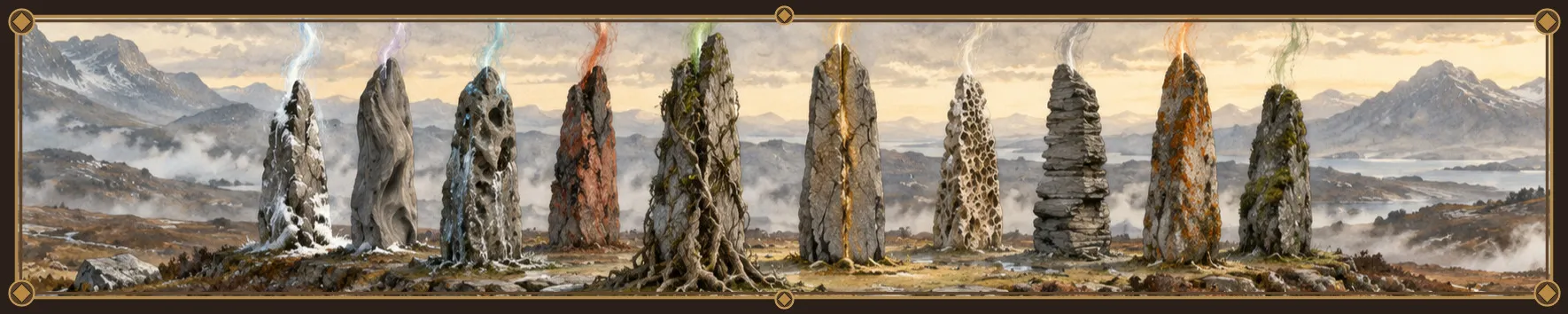
Ten there are, and none will hear,
none will hate and none will hold;
plant by Terra, burn by Ignis,
tell by Memoria what was told.
The Primes are not gods. A prayer for rain is never addressed to them, and none would be heard if it were. They are the ten fundamental forces of reality, and the cosmos is their interplay: Terra’s structure under every stone and bone, Aqua’s flow in every river and vein, Ignis’s fire in every hearth and every change, and seven more beside them, down to the wind of Zephyr that keeps anything from standing still for ever. They are like the notes of a chord. Each note can be named and heard alone, but only the ten sounding together make the music, and the music is the world. A Prime takes no side and grants no favours. What it offers instead is a grain to work with, and every people on Caeldon has learnt, in its own way, to live along that grain. This chapter takes the ten one at a time: what each is, the plane in which its current runs purest, the marks it leaves on the ordinary world, and the ways the peoples of Caeldon have found to meet it.
This chapter tells what the Primes truly are, and it is the most deeply hidden truth in this book. Nobody in the world knows it whole. What people know, believe, and argue of the Primes is told in What People Know.
From Seed to Symphony
In the beginning, so far as the word means anything, the universe was one undifferentiated state holding the potential for all ten Primes, and they were not yet distinct. It is called the Seed, or the Original Potential. As the universe expanded, that single potential could no longer hold itself as one, and it differentiated, one Prime after another, in the Great Unfolding. The Primes are therefore not ten separate powers that came together and agreed on a world. They are ten aspects of one cosmic substrate, drawn apart and held in tension.
Terra came first, and for a time Terra was the whole of the universe, held alone in a dormant, static state. Aqua followed, then Ignis, and the order went on until all ten were present. Read in sequence, the order sounds like an argument: first substrate, then flow, then transformation, then measurable time, then revelation, trace, meaning, identity, memory, and last of all unbound motion. Each stage was incomplete. A world of only Terra is a dead rock; a world of only Aqua, a formless ocean. A cosmos with Ignis but no Aion can change but cannot measure change. Before Aion woke, events had sequence but no duration, and so the first date anyone can give is the date of its waking, c. 35,000,000,000 BR. By c. 34,700,000,000 BR all ten were awake, and the differentiated order was fully present.
The waking was not peaceful. As each Prime came into its own, its current pressed on the others, and the first great strain of the cosmos lay between the first two: structure pressing towards rigidity, flow pressing towards adaptation. Out of that long negotiation the earliest Harmonics stabilized, not as sources the Primes came from but as mediations that eased the tension between them, and the later Harmonics formed the same way as each new Prime added its pressure. The whole strained field of gradients they shaped is the subject of another chapter. What matters here is what the waking left behind. With all ten present, the Primes no longer stand in a sequence but in a web. Remove one and the others do not vanish, but reality breaks. Without Aion, time loops or freezes. Without Imago, beings lose any sense of self and blur together like a hive. Without Zephyr, the universe becomes a still sculpture. Without Verba, meaning dissolves into noise. And if every Prime failed at once, the universe would not simply stop; it would collapse into paradox, or slide back into the undivided potential it came from.
The Primes are mighty, but they are not all-powerful. Each acts only within its own domain: Ignis cannot make a memory, and Memoria cannot light a fire. Their strength is their resonance, and their weakness is the same. A chord of ten can be wounded in any one of its notes, and a wound in one cripples the rest. If Aion were silenced, Memoria would have no new moments to keep and Zephyr no future to move towards, and the universe would become a frozen snapshot.
Forces, Not Persons
The first thing a writer needs to know about the Primes is what they are not. They do not listen, choose, judge, love, or hate. A Prime does not reward the faithful or punish the wicked, does not take a side between two gods or two kingdoms, and does not mourn. When the pages of this book say that a Prime "opposes" something, or that its current "runs against" it, they mean what a natural philosopher means when she says that water runs against a dam: the two cannot occupy the same place, and one of them will give.
Few people on Caeldon could say this much, and those who could still speak of the Primes as if they were persons, because that is how people speak. A Tidelace pilot says the sea "wanted" a ship. A Headwater mason says Terra "will not forgive" a wall built without footings. Destroying a library is called an offence against Memoria, and building a wall without a gate an offence against Zephyr. Nobody who has studied the matter believes that Memoria takes offence. The saying is a way of naming what such acts do to the world: they work against the grain of a force that does not stop pushing.
Two things blur the line, and both are rare. The first is the avatar. Where a breach must be sealed or the resonance is under great strain, a Prime’s current can condense into a figure that mortals can stand before: a towering shape of living granite, a tall form of white-gold light, a figure written in moving script. Those who meet one remember it as a guide and are seldom the same afterwards, for a mortal mind is not made to hold the whole of a Prime; the songs keep the few who came back, like the herder who walked down from the heights speaking only in riddles. An avatar is the current made visible, not a mind behind the current, and those who have met one describe it the way they would describe weather. The second is the gods. When mortals pour enough feeling into a concept a Prime holds, the current condenses into a new being that does think, feel, and choose. That being is a Resonant, not the Prime. The next chapter is about them, and the gods the medieval world prays to are portrayed in The Gods of the Medieval Era (MED).
Terra
Terra is earth, structure, and permanence: the principle that holds the universe together against dissolution, and the frame on which every other force builds. Its sign is the mountain or the pillar, its saying that structure is the prerequisite for everything. Without it energy would scatter for want of matter to contain it, water would spread for want of banks, and fire would burn without fuel. Terra is the patience of stone and the weight of the earth, the bone that gives a body its shape, and it was the first of the ten to wake.
Its permanence is not absolute, and to forget this is a dangerous mistake. Even the hardest stone is worn away by wind and water. Terra’s endurance includes erosion: the mountain becomes sand, the sand becomes soil, and the soil becomes the foundation for new life. What Terra holds, it holds so that something can stand on it; it is not the force that keeps a ruin from falling. Every one of its fallen Stewards, described in a later chapter, fell by forgetting exactly that.
The Iron Backbone is Terra’s Harmonic, the skeleton of the cosmos. Each Prime’s Harmonic is named with it here; what each is like to stand in is told in The Planes.
On the Material Plane, Terra’s presence is felt more than seen. The ground grows firmer; loose soil compacts underfoot and sand hardens towards sandstone. The air seems heavier. Stones hum with a low vibration, mountains seem to breathe, and a deep stillness settles, the silence of bedrock that has not moved in a million years. Bone and stone and the sense of physical stability all come into the world from the Backbone.
Peoples meet Terra wherever they build or plant. The cornerstone of a new building is laid with ceremony. A vow is carved into stone and set in a sacred place, so that it is held to the endurance of the stone. Pilgrims climb a sacred mountain to take its patience into themselves, or sit in a cave in total silence, listening to the hum of the earth. The rite most easily forgotten is the last: deliberately dismantling a structure that has outlived its purpose, in line with Terra’s own cycle of erosion and renewal. Masons, farmers, gate-wardens, and anyone on whom others depend work along Terra’s grain. A field’s marker stone is set with blessing and blood, and moving one in the night is sacrilege as well as theft; more feuds between neighbouring houses begin at a shifted stone than at any insult. Stone that endures is also stone that is fought for, and a hold gate kept through a siege is sung for a thousand years. Its current condenses gods readily, because harvest and home stir strong feeling: Anvelle the Harvest-Mother of the Human basin farmers, Kerrund the Stone-Warden at the Dwarven hold gates, the severe deep gods of the Held Covenant, and, asleep beneath the high peaks, the Mountain-Father of a vanished colossal world.
Aqua
Aqua is water, flow, adaptation, and life: the force that carries nourishment from the deep to the surface and takes the shape of any vessel it is poured into. Its sign is the spiral wave or the droplet, its saying that flexibility is survival. Where Terra builds the vessel, Aqua fills it; where Ignis transforms, Aqua dissolves and renews. It is the great connector, the medium through which nutrients, flow-borne traces, and life itself travel, and it was the second Prime to wake.
Water is often mistaken for weakness because it yields. Yet water always wins. Given enough time it carves a canyon through granite, and given enough pressure it crushes anything that would hold it. Its cycle is the great cycle of the world: evaporation, rain, runoff, the sea. Nothing in that cycle is lost; everything is moved and changed. Those who dam the flow of life, by hoarding, by refusing to change, by blocking what should pass, build up a pressure that sooner or later breaks through. River-folk tell of the lord who dammed a valley for his mills, and of the spring flood that took the dam, the mills, and his hall in one night.
The Surging Deep is Aqua’s Harmonic, the circulatory system of the universe.
In the ordinary world, Aqua shows itself in dew that forms out of nothing, in liquid that runs with unnatural speed or pools in impossible shapes, and in a thrumming like a heartbeat that runs through ground and water together. Its flow is in every vein: blood, healing, and the processes of the living body all come into the world from the Deep. Its waters also carry flow-borne traces of what has passed through them. A drinker at the right river can sense what its water once carried, a drowned village upstream or a crossing long past; this is not memory, which belongs to Memoria, but the river’s own residue. At the Blood River, a Resonant Zone where Aqua’s life and Umbra’s death run together, the meeting turns dangerous.
Peoples meet Aqua in rites of giving back and letting go. Water is poured on the earth in thanks for rain, a share returned to the cycle. A lantern or a flower is floated down a river to carry away a grief or a secret. A person is immersed to mark a new beginning or the washing away of a past, and dancers advance and fall back with the tide to learn adaptability. Fouling water is felt as working against the force itself, and poisoning a well is the foulest desecration a raider can commit: a spring that never fails is sacred ground, whoever holds the valley holds it, and a feud begun over one is rarely ended by anything but blood. On the coasts the gods of the sea are called down on wreckers who show false beacons. Healers, sailors, farmers, and artists who know the fluid nature of feeling work in Aqua’s grain, and its current condenses gods easily, because healing and the sea stir intense and frequent feeling: Maris of the Tides, kept by coastal Humans and Gnome harbour towns alike, and Serovan the River-King of the Serathic towns, and, faded now, the flood-born Drowned Mother of the Roothollows and the Salt-Witch of a vanished inland sea.
Ignis
Ignis is fire, energy, and transformation: the spark that turns ore to steel and seed to tree, and potential into reality. Its sign is the flame or the hammer, its saying that destruction is the precursor to creation. No sword is forged without melting the metal first, and no forest renews without the fire that clears it. Where Terra provides structure and Aqua flow, Ignis provides the spark, and without it the universe would be a cold, unchanging void. It was the third Prime to wake, and with Terra and Aqua it completed the substance of the material world.
Ignis is feared for its destructive capacity, and rightly. But the pain it brings is not cruelty; it is the price of change. The seed must break to sprout. The ash of the old becomes the soil of the new. What Ignis runs against is not life but stagnation: anything that seeks to remain unchanged for ever.
The Crucible is Ignis’s Harmonic, the engine of the universe.
On the Material Plane, Ignis’s nearness is heat haze and a rising temperature, dry materials that catch of their own accord, metal that glows red, and a pulse like a heartbeat of fire in ground and air. Lightning is the Crucible resonating with the sky. A volcano is so aligned with the Crucible that it is a natural place for fire’s resonances to gather. In people it shows as a restless need to act, to make, or to change. In the Cinder Fields, a Resonant Zone where Ignis and Umbra meet, fire burns cold.
The rites of Ignis are rites of exchange. Wood or oil is thrown into a fire in return for its warmth. A person is "forged" in fire, symbolically or in earnest, to mark a transformation. Dancers flicker like flame, never holding a shape for long. The ashes of something old are scattered to make room for the new. No prayer at an altar of Ignis has ever been answered, and those who keep its customs know it. A hall’s fire kept burning since its founding is its luck; to carry off a rival’s coals, or put out a hearth in a raid, is the deepest insult one house can give another, and many a feud is counted from the night a hearth went cold. Artists, inventors, warriors, and anyone who makes something new from the ashes of the old work along its grain. Its current condenses gods readily in war and passion. The Ogre hearth-god Ghessa the Hearth-Mother is one of its gentler condensations, born of famine winters and small fires that had to last. Ozhar the Pyre-King is one of its most terrible: the god of an elder furnace world that could no longer stop burning, whose name is still forbidden near any furnace.
Aion
Aion is time, not as a clock counts it but as the river of becoming: the force that lets a seed become a tree, a thought become a memory, and a star ignite and die. Its sign is the serpent eating its tail, or the hourglass; its saying is that change is the only constant. It is called the Eternal Now, because it is neither the past, which is memory, nor the future, which is potential, but the moving point between them where the past dissolves and the future is born. It was the fourth Prime to wake, and its waking is where measured history begins.
Aion carries cause before effect. Without it events would happen all at once, or not at all, and the universe would be a jumble of unrelated happenings. Its harshest lesson is that nothing lasts, and it is a liberating truth rather than a cruel one, since it is what gives life its urgency. No alignment with Aion lets a being live for ever, which would be a curse of stasis, or go back and change the past, which would unravel the continuum. Paradox strains it, and the universe, trying to heal a paradox, often does so catastrophically. Those who try to step out of the flow pay for it, and the tales are full of them: the lord who would not leave the water of an Ageless Spring and lived on beside it unchanged, his battle-wounds open and never closing.
The Frozen Moment is Aion’s Harmonic, and its nature surprises those who expect the plane of time to rush. It is the anchor of the universe: the place where moments are held long enough for history, continuity, and consequence to exist at all.
When Aion’s current runs close in the ordinary world, time misbehaves. A flower may bloom and wither in a few heartbeats; a cup may cool at once, then warm again. Ghostly images of the moment just past, or of a probable one to come, flicker at the edge of sight, and a deep, rhythmic tick, like a giant heart, seems to sound through the air. Where time has been handled too roughly, a whole town’s clock can stop; the Time Lock, a vault of dilated time where things too dangerous to destroy are held, is Aion’s current used as a prison.
Aion is honoured in the rites that mark endings: funerals, harvests, the closing of any chapter of a life. Its oldest custom is the hourglass left in a sacred place to run out and then be turned again, and its simplest is a moment of silence, taken only to be in the present without trying to hold it. Its current condenses gods rarely, and the ones it does condense tend to be ancient, strange, or short-lived. Quennet the Clockmaker of the Gnome harbours, who stretches a closing tide-window by a breath, is fading as far-side timing custom takes over his work. Tamsel the Season-Weaver of the Halfling folds keeps the turning year. The Thaluren god of stillness raised against the egg blight, and the god of an elder world’s frozen rolls, both faded long ago; the sealed cities of that elder world still lure treasure-seekers who do not always come back at the pace they went in.
Lux
Lux is light and possibility: the principle of revelation that makes the hidden visible, and shows that there are many roads where there seemed to be one. Its sign is the lantern or the sunrise, its saying that freedom requires sight. A choice made in darkness is not a true choice, since no one can freely choose a path they cannot see. Its epithet is the Radiant Way, and it was the fifth Prime to wake.
People often call Lux the power of truth, but that is a simplification. Lux deals in clarity. A murderer’s knife is as visible in the light as a healer’s salve, and what is done with the seeing belongs to whoever sees. Light illuminates without imposing. Its other half is mercy: not every truth arrives at once, because a fragile mind can shatter under total illumination, and Lux’s light is tempered by its balance with Umbra, leaving shadows where they are needed. When that balance is lost, the light itself becomes the danger. Too much light blinds as surely as darkness, and of all the Primes, Lux and Terra have each lost the most offices to that kind of excess: three of their Stewards are among the fallen.
The Shifting Path is Lux’s Harmonic, the open current where what the universe will become is still undecided.
In the ordinary world, Lux makes colours vivid and details sharp, and shadows shrink. Hidden things show themselves: a lost key glints in the grass, a liar’s tell becomes obvious, a door appears in a wall where no one had noticed one. Roads and corridors seem to multiply, as though the light were revealing options that were always there. A gentle golden warmth suffuses the air, like sunlight on bare skin. In people it is the sudden sight of a path not seen before.
Lux is met at thresholds of choice. A lantern is lit in a dark place for the courage to see clearly. A question is written down and burnt, so that its answer can be sought in the open. People stand at a crossroads, real or figurative, to acknowledge the many roads before them, and keep vigil through the night to watch the sun come up. Explorers, scholars, and seers work along its grain. Light reveals, and not everyone wants to be seen: those who carry hard truths into a lord’s hall are as often hanged as heeded, and the songs that keep a truth-teller usually end at a gallows or a burning. In raided country the dawn vigil is no rite at all; the household that keeps a lamp lit and a sword by the door until sunrise is the one still there in the morning. Truth and justice stir intense feeling, and its current condenses gods readily; the most widely called on in the Medieval Era is Ostrin the Lantern-Bearer, the severe, blind god of the Serathic towns, called down on lords who fleece the road and let the bridge rot, and feared by the innocent nearly as much as by the corrupt.
Umbra
Umbra is shadow and the trace: the principle of what remains. It is the footprint, the scar, the echo after the sound, the dent a body leaves in a pillow after it rises. Its sign is the silhouette or the footprint, its saying that nothing truly disappears, and that depth requires contrast. Light without shadow is flat; presence without absence means nothing. Umbra is the negative space that gives the positive its shape, and it was the sixth Prime to wake.
Death belongs to Umbra, but not as an enemy of life. Every action leaves a mark and every ending a space, and Umbra keeps them. Its mercy is release: not every trace is held for ever, some wounds must heal and some ghosts be laid to rest, and Umbra’s hold loosens into release without the trace being destroyed. Lux and Umbra are a pair. Without shadow, light is blinding; without light, shadow is absolute.
The Whispering Trace is Umbra’s Harmonic, the shadow of the universe and its archive of loss.
A haunting is the Whispering Trace resonating through a place. When Umbra’s current runs near, shadows lengthen and deepen until they seem soft to the touch; faint sounds from the past replay, laughter, footsteps, voices no longer there; a cool stillness settles, like the drop in temperature at twilight; and there is a quiet like that of a room someone has just left. In people it is the weight of absence, or a whisper that should not be there. At the Whispering Winds, motion carries the voices of what has passed, where Zephyr and Umbra overlap.
Umbra is honoured at doorways and graves. People stand at a threshold to acknowledge those who have passed and those who remain. They light a candle in a dark place and let its shadow be a reminder, walk an old path in silence, listening for those who walked it before, or speak a painful memory aloud and let it go, trusting that the trace is kept without the living being held to it. Desecrating a grave, denying death, and holding on to what should be released all count as working against it, and those who do it find the traces holding on to them instead. Every tomb-thief and barrow-delver knows the stories, and the bold ones still go in, because old tombs hold grave-gold and elder blades, and some hold dead sentinels that have kept their watch since the burial. After a battle or a raid the dead are found, named, and buried before anything else is done, because the dead left unguided harden into something hostile; every country has a field or a ford where that was not done, and nobody crosses it after dark. Undertakers, mourners, and keepers of the dead work along its grain. Its current condenses gods only slowly, and its greatest god shows how: Ennor the Grave-Watcher, whom most cradle-web peoples honour at their graves under names of their own, condensed over ages of burial rather than from any single grief.
Verba
Verba is language, order, and meaning: the force that turns noise into speech and sensation into a world of named things, the grammar behind "this is a tree" and "if this, then that." Its sign is the scroll or the lyre, its saying that meaning is the foundation of reality. Where other Primes provide the substance of existence, Verba provides its syntax: the rules by which things relate, the names that give them identity, and the laws in which the universe’s behaviour is written. It was the seventh Prime to wake.
Words can lie, and Verba does not prevent it. A name can be false and a law unjust; a lie can be perfectly coherent and a truth incoherent. What Verba holds is coherence: that words fit together, not that they are true. That is why it stands beside Lux rather than above it. Lux shows what is there, and Verba names what is seen; between them, meaning is made. Its pair is Imago. Order gives form and potential gives freedom; too much of the first is tyranny, and too much of the second is madness.
The Binding Song is Verba’s Harmonic, the bond beneath every people’s oaths and names.
When Verba runs near in the ordinary world, thought sharpens and confusion lifts. Words may appear in the air, glowing letters that form sentences, poems, and oaths. A low hum fills the room, like a thousand books being read at once, and there is a silence of attention, the silence of someone listening hard. Speech, bargains, and the bonds between people all come into the world from the Song, and on a battlefield its shouted commands can press through hard enough to make a zone of their own.
Verba is honoured in naming and swearing. A true name is spoken aloud where others can hear it. A solemn promise is sealed in words so that it stands in Verba’s order; those who want a god to watch the oath and hunt down the one who breaks it swear by an oath-god as well. In many lands a child’s true name is spoken once, over the cradle, and never again aloud, and tales of name-thieves are told to every child who chatters to strangers. A sacred text is recited, a falsehood confessed so that its weight is lifted, and some sit in silence to hear what is meant but not said. Lying, oath-breaking, and the use of words to deceive are the offences. Because a word can bind, words are feared: a skald who puts a name in a song makes a hero of it, the one left out is soon forgotten, and a curse laid by the dying is believed above any other. Skalds, heralds, teachers, and envoys work along its grain. Oaths and names matter deeply but are abstract, and Verba’s gods come at a middling rate: in the Medieval Era, Iskel the Scribe of the Silent keeps oaths in the corridor’s oath-houses, and Tavi the Bard of the Broken is the Goblin god of a history no lord would write down.
Imago
Imago is identity and potential, the pull of every self towards the self it could become: the caterpillar’s turn to the butterfly, the child’s to the adult. Its sign is the chrysalis or the mirror, its saying that the self is a journey, not a destination. Imago is not who a being is now but who it could be; it is the question "what if?" that every self carries. Its epithet is the Mirror of Becoming, and it was the eighth Prime to wake.
Growth is uncomfortable, and Imago makes no apology for it. The shell must break for the insect to emerge, and the old self must give way for the new one to be born. Every being holds many potential selves, and the work is not to pick one but to bring them into a whole. Imago is the most intimate of the Primes; a self frozen in place weakens it directly, and a being that refuses all change lessens its hold. Those who reach for a new self before they are ready are the stuff of village warnings: every shape-changing country knows the Skin-Lost, who wore a beast’s form too long and now run with the beasts.
The Dreaming Veil is Imago’s Harmonic, the sanctuary of the mind and the nursery of the universe, where new ideas are born before they are tested in the world.
Dreams are the Dreaming Veil resonating with the Material Plane. When Imago runs near in waking life, plants bloom in a few heartbeats, a stone becomes a gem, a rusted sword comes up polished, and a faint inner voice urges change, growth, becoming. Where its current condenses into an avatar, those who meet it see themselves, but better, stranger, or more complete, and hear their own voice made clearer; it gives back only riddles and questions, because it reflects rather than speaks. Where Imago and Umbra meet under dangerous conditions, at the Nightmare Nexus, nightmares take flesh.
Imago is met in rites of masks and mirrors. A mask representing a false self is worn and then broken to show the true self underneath. A seed is planted, or a new work begun, to mark the possibility of change. Dancers act out the chrysalis, from enclosure to emergence. A person stands before a mirror and speaks their true name. In many lands the hardest of these rites comes at the edge of adulthood, when the young go out alone, with a beast to face or a night in the wild to survive, and come back with a new name or not at all. On the Headwater frontier, young people of mixed households wear masks for the selves they were told to be and burn them, and the god they burn them for is Abrel the Changeling, whom Dwarves call Durrask and Goblins Ziv. Imago’s current condenses gods at a middling rate, and they tend to be gods of becoming and its failures: Abrel at the crossings, Saerith the Mirror-King at the High Elf courts, whose image of finished perfection is a prison for anyone who tries to match it, and, faded long ago, the nameless god born of the first Human self-awareness.
Memoria
Memoria is memory, history, and narrative: the principle that the past does not vanish, that the deeds of the dead are not forgotten, and that the story of existence runs as one thread from the first moment to the last. Its sign is the book or the rings of a tree, its saying that the past is the foundation of the future. Where Umbra keeps the trace, Memoria keeps the meaning: Umbra is the footprint in the sand, Memoria the story of the journey that made it. It is also called the Undying Archive, and it was the ninth Prime to wake.
The archive is honest. It keeps the glorious and the shameful alike, and does not edit, censor, or judge. It also has two weaknesses that every scribe on Caeldon understands. A record destroyed before it is kept is lost for good. And a convincing lie, written as truth, can enter the record looking exactly like a true memory. Memoria’s mercy is that not every memory has to be carried. The archive keeps the memory; the person can set it down. Aion moves forward and Memoria looks back, and between them they make the narrative of existence.
The Eternal Record is Memoria’s Harmonic, the memory of the universe.
Books, traditions, records, and ancestral wisdom all come into the world from the Record. When Memoria runs near, objects seem to hum with their own history: a table feels heavy with every meal eaten at it, a sword with every swing. Ghostly impressions of what happened in a place flicker at the edge of sight, a dance here, a battle there, a child’s laughter that has not quite faded. The air thickens with significance and smells of old paper, dried ink, dust, and rain on stone. In people it is a forgotten memory surfacing unbidden, or the weight of the past pressing in.
The most sacred rite of Memoria is the Telling: gathering to share the stories of the dead so that their memory lives on. Around it stand others. A memory or a lesson is written down and placed in an archive. A candle is lit for those who have passed. A path the ancestors walked is walked again. A painful memory is spoken aloud, so that its weight is released to the archive while its truth is kept. Destroying records, silencing those who saw, and falsifying the narrative are the great offences, and destroying a library is the classic example of sacrilege; the gaps such acts leave tend to reopen, and the murdered man who saw too much is named again by his grandchildren. Memory is also what keeps a feud alive. Kindreds that forget nothing avenge everything, and a name struck from the telling is a worse death than a sword. Historians, storytellers, and archivists work along its grain. Memory is rarely the subject of direct worship, and Memoria’s gods are few and often imperilled: Annoth the Keeper of Scrolls, god of the corridor’s scribes, is always losing records to fire and seizure, and Ushkar the Ancestor-Warden keeps the names of Orc kindreds who held passage and strikes the names of those who broke it. The god of memory kept by voice through the Unrecorded Age, who answered to the names of many peoples, faded when writing returned.
Zephyr
Zephyr woke last. It is wind, freedom, and unconstrained motion: the force that carries seeds to new soil, disperses smoke from a fire, and sweeps away the stale air of stagnation. Its sign is the feather or the kite string, its saying that motion is the essence of life. It is the breath that fills the lungs and the gale that fills the sails, the force that proves to every being that no wall is high enough and no cage strong enough. Without it the universe would be a stagnant pool where heat does not dissipate and scent does not travel.
It is often mistaken for chaos. The line is a fine one: motion without direction is aimless, and a wind that blows everywhere blows nowhere. Freedom is not only the ability to move but the ability to choose where to go. Its pair is Terra. Stability needs a foundation, but life needs to move, and too much of either is stagnation or ruin.
The Unbound Gale is Zephyr’s Harmonic, the breath of the universe and the carrier of thought and inspiration.
Zephyr’s signs in the ordinary world are motion without cause. Dust motes dance in impossible patterns, leaves swirl with no source, flags snap taut where there is no wind. The air pressure drops a little and the body feels light. A sudden gust smells of ozone, rain, or distant storms, and sometimes there is a strange quiet, as if the wind were holding its breath. In people it is the sudden urge to leave, to travel, to change course.
Zephyr is honoured in rites of letting go and setting out. A kite is flown high so that the wind can carry off a wish or a worry. A feather is left on a high place for the wind to take, as a sign of the leaver’s resolve to be free. Dancers move like the wind, and a deep breath is let out slowly in thanks for air. A chain or a lock is broken in ceremony; where the chain was real, a runaway’s broken fetter hung in a high place is a shrine, and chain-masters have burned more than one such place to the ground. Sailors whistle for the wind and throw it a coin or a lock of hair, and a ship becalmed too long looks for whoever on board has offended it, and sometimes that sailor goes over the side. Caging others, denying the right to leave, and building a wall without a gate are the offences. Travellers, explorers, runaways, outlaws, and anyone breaking free of confinement work along its grain. Travel and freedom stir real but abstract feeling, and Zephyr’s gods come at a middling rate: Corrow the Gale-Runner, the wind at the backs of the Edgeway Kindreds, who cannot stop moving; Rakhal the Storm-Caller, the scouring wind of the Orc Windscar; and, faded, the Ogre god who broke the walls of the chain-camps.
Pairs, Triads, and the Web
No Prime is understood alone, and after the ten names the first thing to learn is how they lean on one another. Five pairs of tension hold the web taut. Lux and Umbra make visibility between them. Terra and Zephyr are stability and movement. Ignis and Aqua change and adapt, and make steam, weather, and life. Verba and Imago are form and freedom. Aion and Memoria are the moment passing and the moment kept. A sixth pairing runs across these: Imago drives the self to evolve, and Umbra preserves the trace of the self that has passed.
The pairs combine into larger chords. Terra, Aqua, and Ignis, matter, fluid, and energy, make the material world. Verba, Imago, and Lux, thought, self, and insight, make consciousness. Aion, Memoria, and Zephyr, duration, the past, and motion towards the future, make the flow of history. And Imago, Terra, and Zephyr, who one is, where one stands, and where one goes, make the living being. The Harmonics show the same habit of working in threes: the Crucible, the Surging Deep, and the Iron Backbone together sustain life, while the Whispering Trace, the Eternal Record, and the Frozen Moment together are what make undeath possible, by preserving a remnant of the dead past its natural release.
The web also explains why the Primes cannot simply be cut apart and studied. Ask what Aqua is "against" and the answer is the dam, the frost, the poison, the Silent Tide that takes the return out of every rhythm. Ask what it is "with" and the answer is Terra, which channels it, Aion, which it embodies as flow, Imago, which gives its change a shape. Every Prime is defined as much by its neighbours as by itself.
Living Along the Grain
Mortals stand where all ten Primes meet, and they are the only beings who experience the whole of the resonance. A person’s potential self is Imago, held in a body that is Terra and named by Verba. Their freedom to move is Zephyr and their freedom to choose is Lux, within the time that is Aion and the past that is Memoria. Aqua and Ignis keep them alive, and Umbra keeps what remains when they are gone. Through art, love, war, and discovery, mortals give the Primes back to themselves, and steady them in doing so.
Nobody on Caeldon worships a Prime as a person who grants favours. They are honoured instead through alignment custom, the layer of belief that every people shares beneath its gods: seasonal rites, planting and harvest observance, fire-lighting customs, oath forms, burial practice, and taboos whose breaking counts as sacrilege. Most people never think of it as worship. It is simply how things are done properly, and it varies more by region and way of life than by people. Human basin villages keep the seasonal custom of sowing and harvest beneath all their gods. Wood Elves of the Elderweald take only fallen wood, walk paths open, and leave water where it runs. Halflings of the Leeward Folds keep an alignment custom of bounded plenty, and never spend the reserve on a good year. Orc escorts keep a custom of held passage and answered betrayal. Trolls keep body-law, in which wounds and scars are sacred record. On the Tidelace coasts an unmaintained beacon or a falsely read mark is close to sacrilege, and the Salvage Peoples write their custom in waymarks: a ruin left no more dangerous than it was found is a ruin honoured.
None of these peoples is asking a Prime for anything. They are doing what plain sense advises near any Prime. They fight all the same, and bitterly, for the ground where a Prime is felt: a spring, a peak, a hearth-fire that has never gone out, a grave-field older than memory. Such places are held by whoever is strong enough to hold them, shrine-raiders are hated everywhere, and a people that loses one remembers it for generations. Do not try to stop time, freeze the wind, or erase a memory, because those who do find themselves working against the world itself: the mage who tries does not anger a god, the working simply turns, and the songs about such mages end badly. When the dammed river bursts or the gateless wall is torn down by those it penned, villages call it the Prime’s anger. It is not anger; what breaks is what was built against the grain. Near Ignis, accept change; near Terra, stand firm. And above all, do not expect a Prime to solve anything. A force takes no side. What it offers is the grain of the world, and those who work with it find in it the tools to solve their troubles themselves.
Ask the river nothing. Learn its fall, and build your mill where it is steepest.
What People Know
Of everything in the cosmos, the Primes are the least known. They are felt only as the order of things and never met, and every account of what they are is inference.
What Custom Knows
Ordinary life honours the Primes without studying them. Alignment custom, seasonal rites, oath forms, burial practice, and taboo carry what every people has learnt of the grain of the world, and the breaking of a taboo counts as an offence against a Prime. Most people never think of any of it as worship, and could not say what a Prime is. The rare meeting with an avatar is remembered as a guide, or as weather, and changes the one who met it; it explains nothing to anyone else.
What Scholars Argue
What the Primes are, how many there are, and whether they are persons or forces is argued only in the highest circles of scholarship, and argued there rather than settled. Accounts differ by school, by faith, and by the Prime a scholar is aligned with. Some come close to the truth this chapter tells; none holds it whole.
Names and Numbers
The ten names used here are the records' names. Out in the world each people, faith, and school names the powers its own way. The March-Town Primer teaches the corridor’s children ten names and ten sayings, and its "none will hear, none will hate" is nearer the truth than most of what is taught, though few of its teachers could say why; other peoples count and name the powers otherwise, or not at all. Later eras guess better than the Medieval Era does, and still only guess.
Tensions
-
Pressure from within. Cast-Outs such as the Bone Singer, who would set everything in Terra’s stone, strain towards a single-Prime state. The other Primes' currents press back against the imbalance only once one strains the Boundary or forces such a state on a place; short of that, nothing in the balance of the Primes stops it.
-
A concept un-named. If one of the Unformed dissolved the concept a Prime holds, as the Echoing Dark could un-name time, that Prime would lose its function and fall dormant until the universe was differentiated anew.
-
Back into the Seed. If the Unformed succeeded altogether, the Primes would not die. They would merge back into the single Seed they came from, and the universe would lose its complexity and become a static, undifferentiated void.
-
A foreign law. A Beyonder with a sufficiently alien concept can overwhelm a Prime once the Boundary is breached, pressing the Prime’s law onto ground where it does not apply. A breach is usually sealed only by several Primes pressing at once.
-
Paradox. Time can be slowed, hastened, and in rare cases reversed at a cost, but a true paradox strains Aion itself, and the universe’s attempts to heal one are often catastrophic.
-
A guide no one can hold. Where a breach must be sealed or the resonance is under great strain, a Prime’s current can condense into an avatar. Those who meet one are changed, and the meeting is dangerous, because a mortal mind is not made to hold the whole of a Prime.
-
A force takes no side. The Primes will solve nobody’s troubles. Those who live along a Prime’s grain find tools in it; those who try to stop time, freeze the wind, or erase a memory find themselves working against the world itself.