Chapter 14. Peoples of the Water
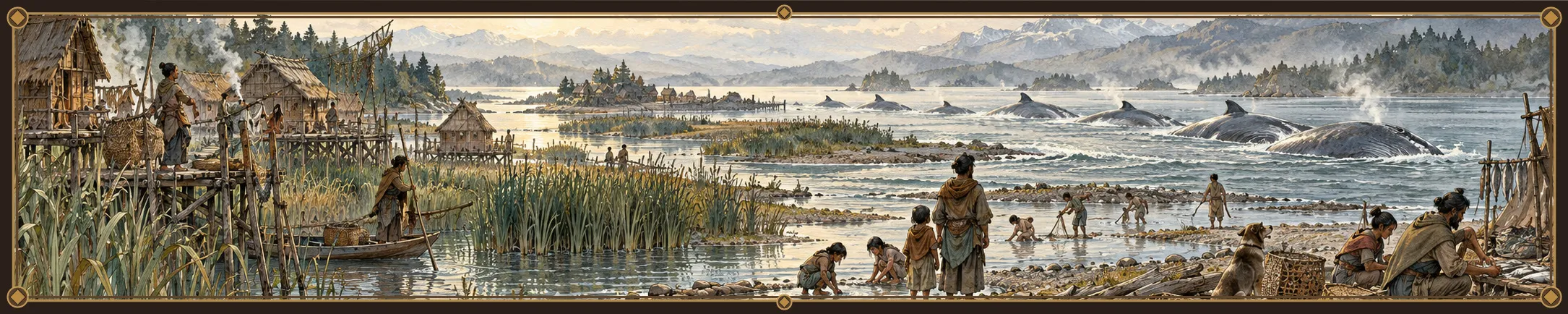
Name the flood that took the willows,
name the ford that learned to lie;
the river keeps no count of its years,
and so we keep them, you and I.
The Reedmere Tellings
Land peoples draw their borders on solid ground and fight about where the lines should run. The water peoples of Caeldon cannot, because their ground will not hold still. A channel moves in a lifetime, a ford becomes a scour hole in a single spring, a sea road runs where the current runs and nowhere else, and the water itself kills: floods, drowned crossings, great catfish in the deep holes, sharks off the river mouths. Three peoples have made custom out of that, and each has made a different custom. The Reedfolk of the lower rivers hold that the water belongs to whoever remembers it truly. The Thaluren of the sea hold that it belongs to the return, the long climb upriver that every generation must make to be born. The Kavari of the freshwater tributaries hold that it is simply home, and that a home is not a road for anyone’s passing, and they back that with barbed spears in the shallows. The first live in the cradle-web, under Human towns that need them and pushed them down; the other two share the rivers of the far side, and need each other less than they would like. Where their answers meet in one channel, Caeldon has some of its oldest and bloodiest quarrels, and the drowned cities, sunken wrecks, and pearl-beds that draw thieves and divers to the water to this day.
Three Ways to Hold a River
All three water peoples descend from the balanced adaptive field, the same deep ancestry that gave Caeldon its Humans and the far-side peoples of fold, scarp, and shore. They did not come out of it as one water people that later split. They came out along separate lines, each shaped by a different way of the water. The Reedfolk line belongs to wet country in general, where land and water trade places with the seasons. The Thaluren are a migratory line, a sea people whose lives are completed only by going upriver. The Kavari are a resident river line, who never leave the freshwater their villages stand in. Because the three are kin in origin and strangers in habit, their quarrels are never about whether the others are people. They are about who has the right to decide.
Each of them also differs from its land neighbours in a way a writer should keep in mind. None of them holds territory in the landward sense. A Reedfolk house does not own its channel, a Thaluren run does not own its river, and a Kavari bank council does not own its pool. What each holds is a say in how the water is used, made good by memory, by the return, or by care, and in the end by enough people on the bank to turn others away. Outsiders who think in fields and walls keep mistaking all three for weak, elusive, or merely local. They are none of those things, as more than one lord’s war-barge has learned on a crossing that was not there.
How the water peoples live in any one era, which reaches have Reedfolk pilots, which runs are climbing which channels this season, which closures are in force, belongs to that era’s book and its atlas. What follows is what each people is, in every era.
The Reedfolk: Those Who Remember
The Reedfolk are a lesser people of the wet country, at home where land and water never settle which is which: floodplains, reed marshes, shifting shoals, estuary mouths. They are not a branch of Humans, Elves, or Dwarves, though their history is tangled with all three. Their strongest country lies in the lower Confluence Basins and the Lower Serath, the heart of the cradle-web’s Human river world, and the oldest fact about them is that they were there first.
A Body for Moving Ground
Reedfolk are plainly different from their neighbours but nothing like monstrous. They are lean and sure-footed, easy on slick banks, in mud, and in reed, and they bear long humid labour that leaves other peoples exhausted. Moving water, immersion, marsh-fever, rot, and long damp seasons trouble them less than anyone else in the lower rivers. Their difference shows in what they can do rather than in how they look: they move through reeds and shallows without splashing, walk a false crossing without hesitation, and feel the water’s movement and the softness of a bank through their feet, the hidden change in a channel that a stranger will not see until the boat is aground. Their voices are low and carry over water. They eat fish, eel, waterfowl, eggs, reed roots, and grain traded from the dry fields, and their hunters net wild geese from the reed by night.
They live where the land is least willing to be settled. Reedfolk households stand on stilts at the water’s edge and on reed islands between the towns, and they fish, cut reed, and guide boats through channels that will not stay put. Where Elves root slowly in one place and Dwarves endure under stone, the Reedfolk are built for a life on ground that moves.
The water kills, and the Reedfolk know every way it does. The spring rise takes landings and children; a mud turtle takes the fingers of a careless hand in an eel-trap; the deep fen under a clump of fen pitchers will not bear a foot; the great catfish of the deep holes pull dogs and swimmers under. Their heroes are the ones who read it right when it counted: the pilot who brought a laden barge through the Reedmere on a flood night, the keeper who led a whole stilt village across a false crossing in the dark.
Who Remembers the Water
Reedfolk life is ordered around remembered water. Kin and house matter, but the right to lead rests above all on who remembers truly: who can read a flood year, who knows which crossing is false, who can turn a channel without losing the people whose road it was. Their households gather in flood-keeper houses, channel leagues, reed-city kin, shoal communities, and the shrine-keepers of the salt-facing mouths.
The centre of every house is its roll. After each spring rise, a house’s keepers go out to sound the channels before anyone trusts last year’s marks, then add the year’s water to the house’s remembered roll at its crossing shrine. Whatever else a house writes down, the roll is spoken aloud each year in a steady chant, and children learn their house’s flood years by heart, the way children elsewhere learn the names of kings. Each house speaks its own heroes into the roll with the years: the keeper who rowed through the night of a great flood from stilt-house to stilt-house, calling every family out before the water came, and was never found. When the rise comes in the dark, the oldest keeper calls her name at the landing so that she will row once more.
Marriage between houses is sworn at a crossing shrine, and it carries a test. The incoming spouse is taught the new house’s channels, and is counted of the house only once they can tell its false crossings from its true ones. A channel quarrel goes to the keepers of the houses concerned, who swear their memories under the old forms. The memory that matches the water as it now runs usually wins; where the water is unclear, the larger house’s does, and the smaller house may take its grudge into the reeds for a generation. That is the Reedfolk view of truth, and of power, in one breath: a memory is proved by the river, when the river will say.
The fens are also where the hunted go. Smugglers, outlaws, and runaways vanish into the reed-islands with a Reedfolk guide or not at all, and the lords' bounty-takers who follow them hire Reedfolk trackers of their own. A house that guides both, in different seasons, is common, and is trusted by neither. Outlaw raiders who settle in the fens without a guide’s leave are another matter: when they raid the stilt villages and the barges, the houses lead them out onto ground that will not hold them, and every few years the eel-men find a rusted sword in the silt and hang it in the house shrine beside the names of the keepers who did the leading. Reedfolk fight seldom and never in the open, and fen children are told, as a bedtime story and a promise, of the town boats that chased a house into the fens and ran onto crossings that were not there.
The Oldest Oaths
The Floodkeeper Houses took shape c. 210,000–c. 182,000 BR, when Reedfolk settlements began to gather around trusted crossings, shrine sites gained longer memory, and house lines kept flood years and shifting banks long enough that the wet-country communities of a whole lower-river world came to know one another. Command did not come first; houses did. No reed-city ever stood over the others. The Houses were held together by old oaths sworn across moving water, the duty to warn of floods, and the old right to turn a channel, and a house that broke an oath found every channel-guide in the reach suddenly forgetful. They were old long before the Human basin world existed. When Humans came to the lower rivers, they did not come to empty ground.
The Houses also keep the oldest oaths in the river world, and they are not wholly their own. As the elder archive world shut its rolls and sealed its cities, in the long span called the Last Keeping (c. 150,000–c. 120,000 BR), keepers who would not let the old craft die behind the gates came down to the river and taught it to the Houses, and some brought rolls, oath scripts, and the forms of marker-stones with them; the last keeper named them deserters and cut their names into the sealed rolls too. When the blankness of the Mnemosyne Null came down to the river, those keepers stood with the Houses through the nights and recited aloud everything they carried, and the pallor stopped short of the water. The night is still kept on some Reedfolk reaches as a vigil, each house reciting its dead aloud until dawn. The Houses did not become an archive world. They took what fitted their own life, the sworn name as a living act rather than a shut roll, oath forms that could be spoken over moving water, the habit of making a claim plain before it could be honoured, and they kept it, bent to floods and channels, for more than a hundred thousand years.
Swallowed
The second great fact of Reedfolk history is what Human river powers did with them, and it was not a war, though there was no shortage of force. In the Lower River Absorptions (c. 30,000–c. 8,000 BR) the Houses were bargained with, learned from, hired, married into, bullied, quietly bypassed, and at last called local custom rather than lords of the water. Human towns along the Basins and the Serath needed exactly what the Houses knew: which channels move, which banks fail, which flood years can be lived through, which crossings lie about their depth. For a long time it was a fair trade. What changed was not skill but who decides. Once the river towns could swear guarantees among themselves and enforce them with armed boats and sellswords, the question of who may decide about water parted from the question of who actually knows, and Reedfolk say became Reedfolk service.
Some houses were taken in on fair terms and live on inside the river towns. Some were driven off the reaches worth fighting over into fen and shoal, where they shared the reeds with river-thieves and outlaws driven there by the same towns, and answered with raids of their own, cutting levees in the flood months and barges loose in the night. Some drowned, in the plainest sense: the drowned reed cities and lost cutbank settlements of Reedfolk memory belong to this span, when weirs and embankments raised for stronger powers sent the flood onto Reedfolk reaches and swallowed people whose warnings no one strong had to heed. Every house has a version of the keeper who warned the town upriver three springs running, was not heard, and went down with her house when the embankment sent the water. And the old oath forms went into Human river custom with the houses, so that the swearing the river towns are proudest of is partly an unacknowledged Reedfolk inheritance. Some houses say so. Serathic lords rarely agree, and they are the stronger.
The drowned reed cities are still there, under silt and new channels. Their shrine-posts break the water at low summer, and on flood nights their shrine-bells are said to ring under the water. Eel-men, river-divers, and treasure-seekers from the towns go down after their shrine silver and the household goods the water took, by rope and lamp in the low-water months, and the great catfish of the Serath lie up in the drowned streets, larger than a barge pole; a diver who meets one in the silt does not always come up. The Reedfolk call the diving grave-robbing and curse those who sell what comes up, and some houses keep the old channels into a drowned city secret for exactly that reason. On some low-summer nights a light moves among the posts, and no house will row out to learn whose it is.
Because nothing in that span was settled the same way twice, a Reedfolk house’s place differs from reach to reach: here a pilot’s office the town still honours, there a house that owes service by inheritance, elsewhere nothing but a family that everyone quietly asks before the spring rise. A house keeps count of the service it gives even where the town it serves does not. Out of the whole long mismatch, knowledge without say, came the sharpest Reedfolk claim, which they make in every lord’s hall that will hear it: the river belongs to whoever remembers it truly, not to whoever was strong enough to swear the guarantee. Reedfolk grandmothers still tell of pilots who took a cruel town’s barges into the Lying Shoals and swam home alone, and bargemen of the lower river still curse a careless steersman with may a Reedfolk pilot love you.
The River Remembered
Reedfolk belief is a keeping of memory. River-memory rites and the shrine-keepers of the estuaries honour the river as it is remembered, and keepers of flood-memory are heeded as much for devotion as for knowledge. There is no Reedfolk god of the water, and they want none. They grant that Serovan the River-King exists, the god the Human river towns credit with their Law of the River, and pointedly refuse him the water; they say most of it is flood-keeper knowledge with a Human seal on it. They lay their restless dead by naming them on the water, and hold that every one of the River-Given who walks out of the Serath onto a landing is a charge against whoever moved the channel. Their oldest saying is put to anyone who builds against the flood: the river is older than your grandfather and will outlive your grandson. Their worst curse is to wish someone a crossing nobody remembers.
What they keep instead of a god is a memory of loss. During the Absorptions, houses that saw what service would mean, that a house could keep its people and its knowledge and still lose itself, prayed not for safety or victory but for the strength to remain what they were. From that prayer came Hesserin the Shattered Saint: a tall, gaunt figure of cracked porcelain held together by veins of glowing gold, her face a mosaic of shards. She gave her followers the strength to refuse, and they felt every ounce of the pressure they refused. When the surviving houses accepted service and began to pray for respect and for their children’s safety instead, she shattered, and the current carried the pieces away. In some old crossing shrines a mirror of broken glass, set back together with gold, still hangs above the water, and it is said that whoever looks into it sees their own cracks and the gold that holds them. Reedfolk tell of a flood-keeper who would not let her house’s name be written into a guarantee as service, whom Hesserin gave the strength to refuse, and whose house was bypassed anyway. They tell it as a story about sacrifice and the cost of truth.
Lifeways and Lost Houses
Reedfolk variation runs through wet-country lifeways rather than biological branches. The clearest living identities are Floodplain, Marsh-Reed, Shoalway, and Estuary Reedfolk, each shaped by a different water: broad flood basins, reed marshes, shifting shoals, salt-facing mouths. Behind them stand older or absorbed forms: older channel Reedfolk, the drowned reed cities, cutbank houses, salt-reed kin, and inland fen Reedfolk, whose traces are lost settlements, altered channels, and old lower-river memory. Reedfolk identity is strongest wherever remembered change becomes custom, navigation, household duty, and ordinary survival, which is to say on every reach where a boat still needs a pilot.
The Thaluren: The Long Return
The Thaluren are an ancient ocean people, and "sea-elves" is a misnomer for them: they are no branch of the Elves. Their homeland is the Tidebound Reaches of the far side, a world of reef and kelp settlements, open current roads, island margins, and the estuaries that lead inland. Most of a Thaluren life is lived at sea. But a Thaluren is not born at sea, and that fact shapes everything else.
Born Upriver
A Thaluren is longer than a Human and leaner, with a long, smooth body built for current, swimming with the whole body and the legs together, low fins along the forearms and the backs of the calves, long webbed hands and feet. They breathe water through gill-slits along the neck and ribs and can breathe air for some hours, which is how they speak with land peoples and how they survive the shallow reaches of a river climb; dry air and sun crack their skin within a day. A Thaluren rising out of the shallows is taller than most Humans. They are oviparous, and their eggs are laid in sanctified spawning waters up the rivers. Every generation is completed by a return.
Sea life is ordinary life. Settlements sit in reef shelter and kelp-shadowed water, submerged or half-sheltered dwellings gathered where the current is gentle and food is close. People fish, gather shellfish, tend the shoals, and travel the current roads to visit kin, settle quarrels, or attend a gathering at an island edge. The sea is not kind: pods of blackfins hunt the outer water, and a run that meets one turns aside and gives it water. The year, though, turns on the return. As the spawning season nears, a settlement’s run gathers along the outer shoals; its Clutch-Watch Circle confirms who is going and in what place in the line; messengers swim ahead to give notice at the mouths and upriver. The run crosses into brackish water, where the run-followers, the sharks of the current roads, close in; climbs the river on a declared day; and lays its eggs in an accepted spawning ground under the eye of Sanctuary Custodians, who stand over the gravels with spears and nets against the egg-takers, and count a lost clutch as a debt. Reproduction is public. Nobody spawns alone, and nobody’s clutch is a private matter. Afterwards the adults return to the sea. The young who survive come down later, in their own time, and the settlements send escorts to the mouths to keep them in close bands and drive the sharks off with spears and noise. Every settlement keeps the name of an escort who turned back into the sharks alone so that a band of young could reach the Kelpshade, and whose spear, if it is ever found on the sand, is to be left where it lies. At the sea the circle accepts each young one, naming its clutch and its water, before any household takes it in. The household comes after.
Run and Clutch
A Thaluren belongs to a parent-line, a clutch, a hatch-water, and a run as much as to a household, and those are the things a stranger is asked first. Any Thaluren met on the current roads is asked which run they came up with and which water they hatched in. A Run-Watcher can be asked to confirm the answer, and a false one is remembered for generations. An adult who takes up care of another clutch’s young declares it before the circle, and is then counted in that clutch’s duties as though born to them, so that adoption is not a private kindness but a public duty taken on.
The Returning Concord, the first Thaluren civilization to carry a name, is not a sea kingdom. It is a people bound not by borders but by a journey, held together by kinship, old oaths across great distances, and sworn offices rather than a throne. Run-Watchers remember which lines climbed first and where, vouch for a line, and speak when quarrels break out over who climbs and when; one from a great settlement is heard over one from a small. Sanctuary Custodians keep the spawning grounds against blight, defilement, and egg-raiders, and have the last word when the beds are in danger. Clutch-Watch Circles say who is kin. Sea-Settlement Speakers speak for the ocean settlements where most Thaluren live, and bargain with the upriver sanctuaries. Redirection Assemblies, once rare gatherings called when a run was blocked or blighted, now meet far more often, and every meeting is a quarrel. Beside the offices swim the escorts, young spears who guard the runs on the outer roads, with no office, only a name, and a name earned against a blackfin pod is sung in every settlement the run passes. Its creed says a line proves itself by care, not strength; in practice the larger sea settlements and the keepers of the holiest sanctuaries decide whose care counts.
Outsiders tend to meet the Thaluren first through closed passages and spawning restrictions, and think them severe. They are, in fact, a deeply communal people whose strongest values are the unbroken return, a share in the work, and sworn care for vulnerable life. Their first question of a stranger is not whether they are friendly but whether they know how to behave near return water, and a stranger who does not is a danger to the unborn, whatever their intentions. The Thaluren know the sea floor of their coasts as land peoples know their fields, and where every ship went down; land peoples come to them to dive for coin-chests, bells, and cargo silver. Most runs refuse, because the drowned dead belong to the water. Thaluren hate wreckers above all other land folk, and a wrecker’s fire on a headland near a run’s road has more than once been put out by figures rising from the surf at night.
The Closed Water
The great wound of Thaluren history is the First Nesting Confluence, their oldest sacred spawning water. In the span c. 178,000–c. 162,000 BR, eggs laid there began to fail to blight, clutch after clutch dying in the gravel, and the keepers could no longer hold that rightful return to the oldest water was enough to keep life. Its laments remember the custodians who stayed at the failing gravels season after season, turning blighted eggs by hand until the last clutch failed. It was more than a disaster. It asked where holiness lay: in the place, in the return itself, or in the survival of the next clutch. The keepers first tried narrower timing, stricter watch, and heavier rites to save the old water; only when the danger proved permanent did the assemblies begin accepting other channels. The confluence was closed to ordinary return, and the people’s answer split in two.
The Blightward Keepers hold that a poisoned holy water must still be guarded, mourned, and owed, never abandoned, even when it can no longer be used. A Blightward custodian lives the inverse of an ordinary Thaluren life: for a span of seasons they keep a watch-station in freshwater below a closed or suspect water, reading the water where it enters and leaves and reciting names, and go home to the sea only when another custodian takes the watch. They stand guard with spears where other Thaluren would rather not look: against pearl-thieves who dig in the closed reaches by night for the blighted pearls that fetch a high price downriver, against egg-takers, and against the curious who kneel at a still pool and do not rise. The still pools hold silt like smoke in windless air, and some who go in after a thief are found floating a spear’s length inside the edge, eyes open, neither drowned nor living; the custodians' warning to their young is four words long, never kneel, never drink. A clutch that fails to blight is not left unnamed. Custodians name it at the water where it failed, as a circle would have named it had it hatched, enter it in the Keepers' roll, and recite its name there every season for as long as the watch is kept. Blightward Thaluren give their run, their hatch-water, and the failed clutch their line remembers when they introduce themselves. A custodian who comes home is treated with respect and a certain distance, as someone who has lived too long beside a wound.
The Open-Run Concords hold that the return may move to other waters, provided it carries its debt towards the poisoned source, because standing guard while the young die is another kind of failure. Before a run is sent up an unknown river, water-scouts swim it: young Thaluren who climb a strange water alone or in pairs, through egg-takers, low pools, and the spears of other peoples' banks, to learn whether it can hold a clutch. Some do not come back, and their names are given to the waters they died finding. An Open-Run household gives its hatch-water with the debt attached, hatched in one channel, owing another, and each return season it sends one of its own, in turn, upriver with the run’s elders to name the closed water aloud. The oldest of them may know the old water only by its name. Being chosen to go is a family honour and a family burden at once.
The first great quarrel between the two came in the Second-Channel Feud (c. 160,000–c. 156,000 BR), over the first new water to keep clutches alive, and it was fought in the water. Blightward bands blocked the approaches and drove clutch-bearers back towards the sea; Open-Run escorts broke the blocks by force; runs on both sides lost clutches to the fighting as well as to the blight, and egg-takers fed well on the beds left unguarded while the guards fought. The laments tell of an escort who held a narrows alone until the clutch-bearers behind her were through, and of a Blightward keeper who swam the whole length of the channel naming the dead of the old confluence aloud, with spears around her, and was let pass. The Open-Run settlements held the channel; the Blightward side could not take it, but could make it bloody every season, and that bought it terms. The Second Channel is accepted only on sufferance, never in full, and only while it keeps living clutches, counts them, names its tie to the closed source, and keeps a lasting debt of care towards it, all sworn again at every after-season gathering. That debt is memory-debt. Every turned-aside return still owes it, and only the custodians of the closed water may call that water healed. The Second Channel’s gravel still gives up broken spear-points after a hard rise.
A Faith Without a God
Thaluren belief is the Way of Return, the only organized religion on Caeldon with no god at its centre. Its question is whether a return is rightful; its doctrine is the old rule of return; its pilgrimage is the run itself, and its holy places are the return-waters. It needs no separate priests, because the Concord’s own offices are its sacred ones. The hum a custodian sings over a clutch is the same in every water and has no words.
It was not always godless. When the blight struck the old confluence, the Thaluren called on Ulaun the Stilled Hour for stillness, and the stillness she gave held their clutches in a prison from which they could never hatch. When she faded, the faith that survived kept the rule of return and refused the god. Thaluren do not deny that gods exist. They hold that return-water must not be entrusted to one, because a god can be asked for the water to stop, and the return cannot. A Thaluren curse has only three words, may you stay, and is said of anyone who would close a water out of spite. Gods may be respected in other peoples' waters; at the estuaries a Gnome or Human may honour Maris of the Tides on the bank, but no one calls on a god over the climb.
The Thaluren also carry a memory of the open ocean that no other people shares. Beyond the farthest runs lies the sea of their oldest stories: the whale-like deep-witnesses, vast and slow and never done growing, and the squid-like devourers that break the current roads. A run that does not come home is often laid to a devourer, and on the farthest roads the Outer-Route lines feel the Unreturned, the lost runs, keep pace with them in a cold patch of water, and count aloud until it falls behind. No run goes past the outermost roads.
Lifeways of the Run
Thaluren variation runs through run-lines and the custom of return, not separate water-kinds. The clearest living identities are Tidebound, Blightward, Open-Run, and Outer-Route Thaluren: lifeways shaped by claimed waters, a poisoned spawning ground, turned-aside runs, outer routes, and different answers to rightful return. Old run-lines, closed-water branches, failed alternate runs, deep-reef Thaluren, and estuary-bound Thaluren linger as historical or absorbed forms in vanished sanctuaries, ruined channels, and disputed return claims, and a turned-aside run may still find an old sanctuary abandoned by some earlier line nobody remembers, its gravel still ringed with offering shell-work.
The Kavari: The River as Home
The Kavari are neither Thaluren nor a river branch of the Reedfolk. They are a resident freshwater people of the far side’s tributary braids, gravel runs, spring-fed side channels, rootbank villages, and deep pools, and they live in the same rivers the Thaluren climb. For most of the year a Kavari bank village sees no Thaluren at all. To the Kavari, that is the natural state of things, and the return season is the exception.
Bank, Pool, and Nursery
Kavari bodies are practical rather than spectacular: strong of breath, fine in their sense of current, easy in cold freshwater, sure of grip in slick places, with a feel for sediment, the push of the water, and a channel about to shift. They can live on land, but kept dry for long they sicken with the drying sickness, and a long drought leaves them scarred. Out of the water they move with a rolling, careful gait and sit with their feet in the river whenever they can. They eat fish, crayfish, freshwater mussels, lampreys caught in baskets on the spawning runs, smoked egg-takers, water plants, and the produce of bank gardens, and they live longer than Humans, often past a century.
Kavari bear live young, born in the water: a mother’s childbed is a sheltered nursery pool, and she nurses the newborn there for a season before it joins the other young of its water. The young grow in protected nursery waters, sheltered coves, rootbank pools, gravel chambers, and side channels kept by the households beside them, and they have many enemies: floods, cold winters, silt that brings the nursery-water sickness, and egg-takers, long ambushing fish that nose into the gravel in spawning season. The largest egg-takers are the river’s monsters to a Kavari child, old and scarred and longer than a boat, and a keeper who spears one of those in the gravel at night is a hero of the bank for life; its jaws hang over the nursery pool until they fall to pieces. Mothers in the nursery pools hum the same short lullaby along every river: the bank is high, the water is low, the spears are at the braid. A Kavari’s worst fear is a nursery that falls quiet.
A Kavari river is home, food, nursery, and burial ground at once. Bank councils settle access, repair, and quarrels between neighbours, and the oldest pool-kin usually get their way. Pool-kin households remember which waters owe what. Nursery keepers clean, turn, shade, and defend the gravel beds. Channel stewards keep the water flowing without pretending a river can be held to one bed, and the dead are buried along the burial reaches of their own rivers. A water that holds homes, food, young, memory, and burial cannot, in Kavari eyes, be reduced to a road, and that is the whole of their quarrel with everyone who sees a river as a way to somewhere else.
In ordinary life the Kavari are quiet, steady, local, and unhurried; in crisis they are fierce. They are generous to a guest who keeps to the bank, and a stranger who wades into the gravel beds meets spears. Kavari children play bank and braid: the bank side holds hands across the shallows, and the braid side tries to slip through without being touched, which is the game of a nursery night in small.
Dwelling-Right
Kavari custom rests on dwelling-right rather than the right to pass. A community holds a water because it lives in it through flood and drought, births and burials, and because there are enough of it on the banks to turn others away. That is not ownership in the landward sense. It is a hold made good by care for banks, pools, rootbanks, cold inlets, food waters, burial reaches, and nursery places, and by spears when care is not enough; an outsider can earn a place by long care, above all by protecting the young. At seasonal gatherings the elders of the strongest bank councils weigh every larger use of a river by one question, whether it leaves the water alive.
The danger to that water is more often a landward neighbour than a river beast. A lord’s new mill-weir can starve a tributary’s pools in a summer, and the old Kavari answer is to pull the weir out by night, stone by stone; more than one bank council has a feud with a mill-house that began that way and has outlived three millers. The mussel beds of the gravel runs grow pearls, small, grey, and prized in the river towns, and pearl-takers come up the rivers in dry years when the water is low, raking the beds and trampling the nursery gravels as they go. A Kavari bank does not take pearl-takers to any lord’s hall: it takes their rakes, their boats, and sometimes their hands, and sends the rest downstream. River-folk of every people tell of a burial reach far up some tributary where the oldest pool-kin were laid with all their pearls, which no Kavari will name and every pearl-thief wants found; the few who find a burial reach are found in it.
The Bankright Circles, the first Kavari civilization, were never founded. They grew. Over c. 190,000–c. 160,000 BR the bank councils, pool-kin circles, nursery keepers, and seasonal gatherings of many linked tributaries began to stand together: households on connected channels came to settle quarrels by the same reasoning, keepers on separate braids began to honour each other’s closures, and gatherings began to hear matters from further upstream. None of it needed a decision, which is why it took thirty thousand years. The Circles are quiet and local in ordinary life and strongest in crisis, when nursery keepers and bank councils close a water to passage and trade and every Kavari on the bank stands behind the closure with nets, barbs, and numbers. Their elders count years from the egg-taker summer, when the egg-takers came up the river in numbers nobody had seen and the households hunted them for a whole season, night after night, until the river was clean; a barbed point from that summer hangs over many a bank council’s fire. Because the Circles had long stood together when the first turned-aside runs came up their rivers, the Kavari could say no with one voice.
Small Gods by Design
Kavari belief is small and local by design. Pool-kin and bank households keep shrines to the unnamed water-powers of their own pools and nursery reaches. No great god speaks for Kavari waters, and Kavari custom prefers it so. Each pool keeps its own small shrine, and the powers honoured there are known only by the water they belong to. A Kavari who swears to a stranger swears by the dead of the burial reach, which no one breaks and stays welcome on any bank.
Lifeways of the Banks
The clearest living Kavari identities are Bankright, Gravelbraid, Pool-Kin, and Coldrun Kavari, freshwater ways of life shaped by river dwelling, nursery keeping, deep pools, cold tributaries, and seasonal gatherings. Old tributary Kavari, cutbank Kavari, springline Kavari, and broken nursery houses are older or absorbed forms, traceable in altered waters and lost nursery waters. The silted pool-kin are the great loss of Kavari memory: households whose pools a flood or a slumped bank choked, and whose young died in the silt. Pool-kin still name them at the burial reaches.
Where the Waters Meet
When the blight closed the First Nesting Confluence and turned-aside runs began pressing up new rivers, they found those rivers already lived in. The Kavari were not a party caught between two Thaluren wings. They were a people with their own custom and their own spears, and the meeting changed the Thaluren rule of return for good.
The Gravel Oath
At the Gravelbraid Nurseries, shallow middle-river braids of rootbank pools, cold spring inlets, and tended gravel channels where Kavari households raise their young, an incoming turned-aside run met a Kavari barrier. The braids were clean, cold, sheltered, and close to the old routes, which made them salvation to the Open-Run escorts and exactly why the keepers would not give them up: they were already dwelling-water, named, tended, and full of resident young. The refusal was barriers and bodies in the water. Escorts tested the barriers; keepers held them; blood was spilled on both sides before anyone sat down. Kavari households still tell of a nursery keeper who held a gravel gate through a night of attempts with a barbed spear and a broken arm, and Thaluren escorts of the escort who swam the barrier alone at moonrise to bring a sick clutch-bearer into the cold pools, and was let through when the Kavari saw what she carried. The standoff lasted a whole spawning season. The Thaluren clutches could not be sent back to poisoned water, and the Kavari would not open their nurseries to a demand, however desperate. Nearby cold holding pools kept the displaced clutches alive while the two sides bargained in a circle of Bankright nursery keepers, Open-Run escorts, and Blightward closure-reckoners, with a few Gnome counters tallying water level, timing, and channel capacity so that neither side could twist the facts later. The first passage was allowed under watch, through channels the Kavari marked. It is remembered as a sober success: the clutches lived, the nurseries were untouched, and neither people’s need wiped out the other’s. But it was the Kavari who drew the marks.
The Gravel Oath Accord of c. 153,000–c. 148,000 BR answered with the Twofold Waters: a channel may be return-water to one people and dwelling-water to another at the same time, and as dwelling-water it belongs first to the people who already raise their young in it. It gave the Thaluren no open access. It made passage a shared watch on Kavari terms: before any run passes a disputed water, Kavari keepers, Thaluren run-watchers, and Blightward reckoners must all look at it, and no channel counts as empty merely because it can keep clutches alive. Any passage allowed is, in the Oath’s words, a burdened return: it owes a debt to the poisoned source-water, a duty to the dwelling-water that takes it in, and a share of the blame for any harm it causes in passing. Memory-debt, after the Gravel Oath, is owed sideways as well as backwards.
The Oath has never become comfortable, and it holds because it is useful to everyone and comfortable to no one. Soon after it came the Late-Closure Terms (c. 147,000–c. 146,000 BR), when a Thaluren run, dogged by lampreys and egg-takers all the way up, arrived late with a real emergency at a braid a Bankright council had already broadly closed. One escort captain tried a closed channel anyway on the second night and was met in the dark by keepers who knew every stone, and the circle heard the matter with two escorts and one keeper dead in the shallows. The terms were the Kavari’s: late warning creates debt even when the emergency is real, and a broad closure may be questioned before onlookers without the Kavari giving up the last word over water where their young are. In ordinary years the meeting of the two peoples is a matter of markers. Kavari keepers mark active nursery-water and forbidden channels; Thaluren escorts bring notice and keep within the marks; quarrels go to a circle at the water’s edge, and sometimes to spears. In the season of the return, Kavari and Thaluren keepers patrol the shared gravels together and kill the egg-takers they find there, and hunt together the outlaw swimmers who cut a barrier in Thaluren colours or steal clutches from a holding pool to sell back: the one hunt in the braids that both sides look forward to. On every contested river there is a stretch of gravel that the two peoples call by different names, for the dead each left there.
The Mouths
The Thaluren met the Gnomes at the sea’s edge, and before any terms they met with knives. At the Split Reed Mouth, a braided estuary of reed-shelves and shifting channels, the same water was a sounding field and a dangerous approach to one people and part of a sworn return to the other. Gnome sounding crews staked marker-lines across return channels and drove their poles through spawning beds; Thaluren war-bands came out of the reeds at night, cut the lines, and pulled pilots from their boats; harbour crews raided the reed-shelves with fire and hooks. Meanwhile the run-followers gathered off the mouth when the young came down, and the escorts who should have driven them off were at war, and Thaluren memory keeps the names of the years the young went down the mouth without guards. The Estuary Terms (c. 144,000–c. 138,000 BR) lasted because each side could make the mouth useless to the other. Gnome pilots may sound named channels and keep hazard markers, but sounding gives no right to search the return-waters or steer the runs; Thaluren run-elders may name the windows of the runs and the waters no boat may churn, but a run gives no right to close the whole mouth. At tide stones and channel posts each people says what the water is being used for, and a closing must say whether it guards boats, young, or fouled water. Anyone who lies about it answers to the side they cheated, and the reeds remember. Two from the feud are named at the tide stones now by both peoples: a Thaluren escort who pulled a drowning Gnome pilot out of the channel in the middle of a raid and was cast out by her own war-band for it, and a sounding crew that rowed into the run-followers to beat them off a stranded shoal of young.
One Question, Three Answers
The Reedfolk stand apart from the far-side quarrel, on the rivers of the cradle-web, but their quarrel has the same shape: a people whose knowledge of the water is needed, set against others strong enough to settle the water by another rule. On every water of Caeldon the question is the same, and it is very old. Who may decide about living water: those who remember it, those who return to it, or those who live in it? The Reedfolk lost the deciding and kept the knowing. The Thaluren and the Kavari, through the Gravel Oath, agreed under spears to decide together and to distrust each other carefully. Neither arrangement is finished, and none of the three peoples expects it to be.
Tensions
-
What the service cost. Those who keep Hesserin’s memory ask whether accepting service was the price of surviving beside Human towns, or the moment the houses gave the river away. A house’s count of service owed and given rarely matches the town’s.
-
The next drowned house. Weirs and embankments still go up along the Serath for towns that can swear guarantees among themselves and back them with armed boats. A house that sees its reach about to take the flood can warn, move, or cut the embankment by night, and no tale of the drowned reed cities counsels waiting.
-
Return-water and dwelling-water. The Gravel Oath Accord did not settle whether a run may ever be refused a water it needs. Kavari councils hold that a dwelling-water’s closure is final, and back it with spears in the shallows; Thaluren escorts hold that a burdened return is owed a hearing.
-
The middle layer. Under the Serathic Oath of Layers, Reedfolk say, everyone else was given three layers and they were kept on the middle one.
-
Home, or an exception. The Kavari right to their water owes nothing to Thaluren acceptance, yet the one lasting oath that names it, the Twofold Waters, was sworn around Thaluren return. Bank councils ask whether dwelling-water is counted for what it is or only as the place where a return must slow down, and at each water the answer has followed whichever side came in greater numbers.
-
Divers in a sanctified reach. Land companies hire Thaluren divers to bring up strongboxes from barges sunk in spawning reaches, in the season of the climb when the water is clearest. The custodians treat anyone in that water then as an egg-taker, and a diver’s own run may be divided over whether the diver is still theirs.