Chapter 16. The Ages of Caeldon
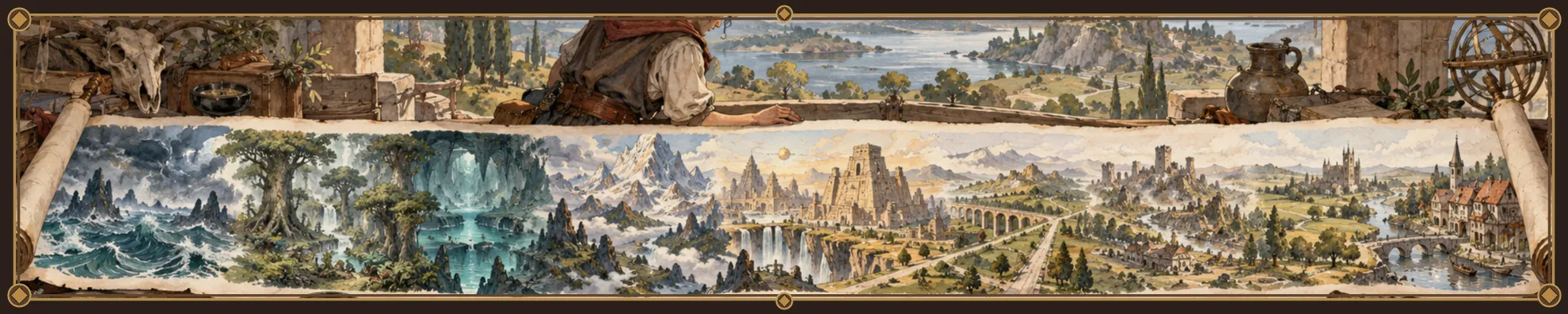
Of the first ages no one stood by to see, and we set them down as the ground gives them to us: in layers, the oldest lowest, each pressed flat by the weight of all that came after. Let no reader take the order of our pages for the order of the world. While one people was learning to stand, another was already old, and a third had not yet been born.
The Long Count
The history of Caeldon is older than any people now living can remember, save the Elves and the Dwarves, and they keep what they remember to themselves. It runs back through ruins whose builders have no names, through oaths sworn to orders that no longer answer, through a silence of eighty thousand years in which almost nothing was written down, to a time before there were peoples at all. Much of it happened at once: while one people was founding its first hold, another was burning in its own furnaces and a third was walling up its dead. Those who study it divide it into nine ages. An age is a stretch of history, not a category. The ages overlap where history did, and no age belongs to a single people. Dates are given in years before and after the Reckoning, BR and CR, and they are rough on purpose; the deeper they go, the rougher they are, and a span of thirty thousand years for a single event is no sign of carelessness. Nor was any of it orderly. The terms, accords, and settlements of the old histories were made by the stronger side and kept while it stayed stronger, and their quarrels were feuds and wars. Eight of the nine ages lie behind the Medieval Era, the first era of this book. The ninth is the Medieval Present itself. This chapter tells the eight in order, an age to a section, and stops at the threshold of the ninth.
The Foundations
c. 35,000,000,000–c. 500,000 BR. The first age is the longest by far and the least crowded. It begins when measurable time begins, c. 35,000,000,000 BR, and most of it belongs to the cosmos rather than to anything a historian would recognize. In the long strain of the Great Polarization the early field of reality was wrung towards extremes it could not hold together; in the Inward Sundering, c. 33,600,000,000 BR, it failed inward, the extremes tore away as separate planes, and a balanced core remained at the centre. That core did not become a world at once. It settled for more than thirty billion years, pocket by pocket, until at the First Equilibrium, c. 12,000,000 BR, it became a true Material Plane, able to hold its own balance. Only then could lasting bodies form in it, and in the First Celestial Condensations, c. 12,000,000–c. 2,500,000 BR, they did. How that happened, and what the planes are, is told in The Planes.
Caeldon itself is young by that measure. It was made c. 2,500,000 BR, fire first, then stone and sea, one lasting world among the bodies the Material Plane had learned to sustain, and for the next two million years it had no history, only land learning to keep its shape. In the First Regional Differentiations, c. 2,500,000–c. 500,000 BR, its great contrasts became permanent: a vast living canopy where the Elderweald and the Crownboughs would one day stand, a hard world of mountain mass and descending stone where the Ironspine and the Stonewake Deeps would be, a lower country of gathering waters and deep basins that would become the Human heartland, and beneath the forest a threshold of root and cavern that would become the Roothollows. Elsewhere other great lands took shape, among them the dry exposed uplands of the far side.
In the last two hundred thousand years of the age, life began to hold its shape too. In the First Material Lineages, c. 700,000–c. 500,000 BR, lines of living things started to carry what they had learned forward through inheritance instead of only surviving each season as it came: in the canopy world, lines of growth and binding to place; in the mountain world, lines of density and endurance; in the basins, mixed and adaptable lines whose importance would not show for a very long time. Most of what lived then was ancestor to no one, and its bones still turn up in cliff-falls and mine-cuts, too large, too many-jointed, or half stone, and are sold at fairs as the bones of monsters slain by heroes nobody can name. Nothing in this age is yet a people in any later sense. It is the age of the ground on which every later quarrel stands, and every later people woke on ground that was already old.
The Stabilizations
c. 500,000–c. 380,000 BR. At roughly the same depth of time, the first peoples became themselves, each made its first home, and the first blood was spilled where those homes met.
In the forest, an old inheritance marked by the Verdant Expanse was tamed, over some fifty thousand years, into a lasting people: the Elves, in the First Elven Stabilization, c. 500,000–c. 450,000 BR. Their first world ran unbroken from the groves of the Elderweald down into the older layers of the Roothollows below, one people of living settlement and grove memory, not yet divided into the branches later history knows. In the Rooting of the Elderweald, c. 490,000–c. 470,000 BR, that people settled into the first Wood Elf way of life, which holds that a people lives within the forest as it grows and does not cut it to its own design. The groves gathered into the Rootcrown Concord, c. 490,000–c. 460,000 BR, the oldest Elven civilization: no capital, no seat that spoke for all, only groves under trees older than the Concord itself, held together by memory and by duty to the forest.
Under the mountains, an older lithic inheritance crushed into shape under the Iron Backbone became the Dwarves in the First Dwarven Stabilization, c. 475,000–c. 425,000 BR. In the Holdmaking of the Ironspine, c. 465,000–c. 445,000 BR, they cut the mountain into halls rather than live on its face as it was, and came to believe that a people endures in what it builds: sound halls, dependable passages, memory cut into stone. The Ironspine Holds, c. 460,000–c. 438,000 BR, made that belief a shared custom. There was no king. A hold kept its own walls, its gate, its forge, and the tablets of its dead, and inside it power went to whoever could keep the roof up and the air moving where a weaker people would have broken.
In the broken ground between forest and mountain, the threshold peoples found their footing at the same time: the ancestors of the Goblins, the Kobolds, the Trolls, and the Ogres, peoples of cave mouths, fracture belts, scree, and drain-seams. They were not latecomers. They became themselves as early as the Elves and Dwarves did, and their later place on the margins was made for them afterwards. The first sign came almost at once: in the Enclosure of the Seams, c. 465,000–c. 420,000 BR, Dwarven holdmaking took, seam by seam, the ground Goblin warren-kin held by gap-right, and Goblins entered history already driven out (see The Bridge Peoples). It was the first of many times on Caeldon that one people’s founding was another’s loss, and Goblin song has not forgotten it.
Forest and mountain then had to learn to border one another at all. Along a long margin of outer woods, mountain feet, runoff channels, and seams, shaped c. 460,000–c. 445,000 BR, they first met as settled neighbours in the First Rootcrown-Ironspine Contacts, c. 445,000–c. 425,000 BR, and bargained as often as they fought. A long uneasy quiet followed, some fifteen thousand years in which each side kept to its own edge, until the verges between them filled; then, in the Elderweald-Ironspine Frontier, c. 410,000–c. 385,000 BR, the quarrel became the verge wars, generations of raid, ambush, fouled water, and felled groves, told in The Elder Peoples. The question underneath, whether a people endures by living with the land or by mastering it, is one of the oldest arguments on Caeldon.
The Elves did not stay one people for long either. In the Elven Branchings, c. 450,000–c. 318,000 BR, they divided into the branches later history knows. In the thorn and ravine of the Briarreach, c. 425,000–c. 410,000 BR, one people grew sharp, watchful, and slow to trust, living by the bow and the hedge, and became the Thornbound Circles, c. 405,000–c. 392,000 BR. In the Crownboughs another turned upward, c. 398,000–c. 390,000 BR, towards living halls bent from great trees, magical shaping, ranked houses, and splendour, and became the Crownbough Courts, c. 390,000–c. 375,000 BR, the High Elves. The Dwarves differed more quietly. In the Dwarven Deep Holds, c. 405,000–c. 330,000 BR, some holds below the Ironspine grew heavier than others, because a hold that held a junction or a reservoir held every hold that needed it.
The Deep Ruptures
c. 380,000–c. 300,000 BR. The age of the first catastrophes. The old peoples hardened and divided, a dark power touched Caeldon for the first time, and the oldest hatred on Caeldon began underground.
It began, though, with a change that has a date and no cause. Over the span c. 380,000–c. 330,000 BR, Failed Mending, a twisted repair of the body that closes, knots, and scars harm into new shape instead of restoring what was there, stopped being a rare misfortune among the Trolls and became the inherited condition of the whole people. Why it happened has never been settled. What followed was a custom: a people who are hard to kill and who carry every wound visibly had to decide who may be struck, which injuries should be allowed to close, and what a scar remembers, and from those answers came the body-law later Troll crossing custom grew from. The fear other peoples feel at a Troll-kept bridge begins here, though the bridge-monster story is far younger than the condition.
Above ground, the High Elves and the Dwarves met as rivals. After the First Crownbough-Ironspine Contacts, c. 375,000–c. 360,000 BR, the old frontier quarrel took on a prouder edge in the Courts of Stone and Canopy, c. 375,000–c. 355,000 BR, fought mostly with insult and splendour, and on the slopes between them with blood.
Below, one Dwarven people went deeper than all the rest. In the Stonewake Deeps the passages met, the great reservoirs lay, and the archive chambers filled, and the Dwarves who went down past the mountain roots into heat, bad air, and stone that had never held a hall learned what it costs to keep the ways open there; every hold of those years has its wall of names. In the Deepening of Stonewake, c. 365,000–c. 350,000 BR, they became a branch of their own, and made one of their defining customs, sealing authority: a great closure needed the word of several hold-keepers, but in a crisis the keeper on the spot might seal first and answer for it after, on a few accepted grounds, collapse, flood, contagion, or an enemy breaking through. Every seal left someone on the wrong side of it. The Stonewake Compact, c. 360,000–c. 348,000 BR, bound several deep holds into one power over the ways and the water. On its outer edge, c. 345,000–c. 340,000 BR, a deep threshold took shape between the stone ways and the root-caverns of the upper Roothollows, where the ancient underworld branch of the Elves lived, and the two peoples first met across it in the First Roothollow-Deep Contacts, c. 340,000–c. 335,000 BR. The threshold was tense, but not yet broken.
Far away on the other side of the world, and unseen by anyone, the first of the three Incursions ever to reach Caeldon came and went. In the Krystallis Incursion, c. 352,000–c. 349,000 BR, the Beyonder Krystallis broke through the Boundary over an unpeopled far-side valley and set it into crystal, thornscrub and stream and a hawk in its stoop, until three Primes bore on it through their planes and pressed it out. The dead lattice still stands there as the Hanging Vale, the one place where the living can still be turned to crystal, and shard-hunters still slip past the well-keepers at its mouth (see What Waits Outside).
Then the Roothollows broke. In the Roothollow Rupture, c. 335,000–c. 328,000 BR, came the Drowning Bloom: a catastrophe of the Surging Deep that flooded, severed, and later overgrew much of the upper underworld in several surges; Dark Elf laments still name the guards of the strongest of the flooded refuges, who sank so that others might float. In its aftermath, c. 328,000–c. 318,000 BR, the ruined upper passages were sealed with their dead inside, and the upper Roothollows became a homeland near enough to touch and closed for good. They keep everything a hundred drowned houses owned when the water came.
The survivors below became something new. In the darkening of the Roothollows, c. 326,000–c. 318,000 BR, the deep Elven branch hardened into the Dark Elves, a people who remembered failed aid and barred ways and who defined belonging through protection rather than kinship. They built the Gloamroot Covenant, c. 324,000–c. 318,000 BR, an order of houses that hold water and food and warding orders that hold the ways, grown into one another, because a house that cannot protect is brittle and a ward that cannot feed anyone does not last. Even inheritance grew harder there: in one remembered house quarrel, c. 319,000–c. 318,000 BR, a young Dark Elf who was plainly capable was still kept from inheriting, because the house elders did not yet trust the line to continue safely through them.
The Gloamroot survivors and the hardened Stonewake Compact now fought over the same places they could not live without, above all the Rootstone Heartwell, a deep water source and crossroads of the ways, and in the Heartwell Struggles, c. 320,000–c. 314,000 BR, they fought for it by lamplight in the water-chambers. Each people’s telling of that war then spread through its kin, the Dark Elf memory of abandonment in the Bitter Root Histories and the Stonewake memory of necessary closure in the Burdened Seal Histories, c. 318,000–c. 305,000 BR, and by the end of the age Elven hatred of Dwarves carried inherited grief, and Dwarven hatred of Elves inherited grievance. The war and its tellings are followed in The Threads of History.
The Elder Worlds
c. 300,000–c. 120,000 BR. The age of giants and their falls. A new people appeared in the basins; three great elder civilizations rose and ended; a fourth rose late; and in their shadow nearly every younger people found its feet, by serving them, surviving them, or picking over what they left. Their ruins are still the richest and deadliest ground on Caeldon. The elder civilizations themselves are told in Worlds That Came Before; this section follows the age.
Humans in the Basins
Humans emerged in the First Human Emergence on Caeldon, c. 300,000–c. 220,000 BR, in the mixed country where the Confluence Basins meet the Headwater foothills. They were a native people of the Material Plane, not the tamed heirs of one older inheritance as the Elves and Dwarves were, and their strength lay in making do. The basin gave them fertile depth and waterways; the foothill edge gave them hard passage and the habit of guarded movement; and from the start they were native to the meeting of the two. Over the long span c. 220,000–c. 90,000 BR that basin-edge country settled into one connected land. For most of this age, though, Humans stayed small and local, and the river country they lived beside already held an older people. The Reedfolk had kept the lower waters long before them, and in the Founding of the Floodkeeper Houses, c. 210,000–c. 182,000 BR, their reed settlements, crossing shrines, and house lines that remembered flood years and passable channels gathered into one order. No reed-city ruled it; it was held together by old oaths sworn across moving water and the duty to warn of floods.
The Elder Civilizations
The elder worlds ruled the age. High in the ridge country, the Upland Colossal Civilization rose c. 260,000–c. 195,000 BR, a world of ridge roads, storm terraces, weather shrines, and high tombs that treated exposed height as everyone’s. In furnace country whose scars still glass much of the far Glassbelt, the Ash-Furnace Civilization held its furnace sanctuaries and fire-halls; its long fall, c. 225,000–c. 168,000 BR, was a burning of its own making. In terraced uplands inland of the lower river, the Archive-Law Civilization rose c. 235,000–c. 175,000 BR, a world of archive-cities, oath halls, judgement terraces, and straight marker roads, which cut every promise, debt, boundary, and name into stone and kept armed wardens to make the stone hold.
None of them ended by conquest. The colossal world thinned in the Withdrawal of the Upland Colossal World, c. 198,000–c. 160,000 BR, drawing upward and inward until it was no longer met. The furnace world burned itself to glass and slag. The archive world hardened: in the Unlisting of the Warrens, c. 180,000–c. 150,000 BR, its frozen rolls began striking the very peoples it had cut into them, and in the Last Keeping, c. 150,000–c. 120,000 BR, its keepers sealed the last archive-cities with their records inside, though some first carried the old oath-craft down to the Floodkeeper Houses. Late in the Last Keeping the second of the three Incursions, the Mnemosyne Null Incursion, c. 132,000–c. 130,000 BR, unwrote one of the archive world’s river cities and left the Paling; it was stopped at the Floodkeepers' river, and it did not cause the closing (see What Waits Outside). Late in the age, c. 160,000–c. 120,000 BR, a fourth and far smaller civilization rose in a remote mountain basin beyond the archives' reach: the Sepulchre-Kin, a people of death-work and deep burial. They would fall in the next age, and nobody would see it.
The Younger Peoples Find Their Orders
The threshold peoples and their neighbours found their first lasting orders inside or beside these worlds, and most of those orders were shaped by what the elder world wanted from them; their stories are told in The Bridge Peoples. In the Swearing of the Crossing-Charges, c. 230,000–c. 190,000 BR, the colossal road-keepers bound the Troll lines at their worst crossings into hereditary keeping, and when the road-keepers stopped answering, the Trolls kept the charges for a world that no longer travelled the roads. In the Vent-Houses of the Furnace World, c. 250,000–c. 168,000 BR, the furnace-masters bound Kobold vent-kin into hereditary houses, and the survivors of the burning who fled downward were bound into the deep world’s service. As the colossal uplands thinned, the Ogre burden households made hearth-weight their custom in the Long Hunger, c. 195,000–c. 160,000 BR, against the hunger-bands their own starving camps became. And the Goblins, driven from their seams long before, found a place again as warranted peoples of the archive world, and lost it in the Unlisting.
Along the colossal roads, as the upkeep failed, survivor lines began walking them in seasonal circuits in the Walking of the Unkept Roads, c. 175,000–c. 140,000 BR, and became the Salvage Peoples, the first of whose orders is the Edgeway Kindreds (see Worlds That Came Before). Their oldest danger-marks, never touch, never dig, turn back, were cut at the edges of the dying furnace world’s ruin belts, where the ground killed or changed whoever disturbed it.
Of the Elves and the Dwarves the outside record of this age says almost nothing. After the Deep Ruptures, the holds closed their gates and kept their own chronicles where no outsider reads them, and the Elven realms turned inward to heal. Their histories go on through the Elder Worlds. They are simply not shared.
The Far Side Begins
Far from the cradle-web, on the other half of the known world, the peoples of the far side were founding their own orders at the same time. The Kavari bank councils of the freshwater tributaries stood together more and more over thirty thousand years until they were one order, the Bankright Circles, c. 190,000–c. 160,000 BR, a civilization that was never founded, only grew. The Orc route communities of the Windscar Expanse bound themselves into the Windscar Pacts, c. 180,000–c. 150,000 BR, an order of treaty-grounds and sworn escort. The Halfling fold towns of the Leeward Folds became the Foldward Commons, c. 170,000–c. 152,000 BR, an order of terraces, cisterns, and full stores held against hungry country. The Gnome harbour chains of the Tidelace Coasts became the Gaugeward Leagues, c. 165,000–c. 146,000 BR, an order of beacons, soundings, and harbour mouths that knew who might come in. The Thaluren already kept their return-waters under the Returning Concord, and late in the age they met their first great wound: in the Closure of the First Nesting Confluence, c. 178,000–c. 162,000 BR, egg blight turned their oldest holy spawning water deadly, clutch after clutch dying in the gravel, and forced them to close it to ordinary return and decide whether the return could live on in other waters. Those young orders, and what they did next, belong to the age that follows.
The Far-Side Terms
c. 160,000–c. 98,000 BR. This age overlaps the last on purpose. While the cradle’s elder worlds were closing, the young far-side peoples, Orcs, Halflings, Gnomes, Thaluren, and Kavari, fought over wells, passes, harbours, and spawning water through a long chain of feuds, raids, and wars, and the stronger side dictated terms each time. The terms that held became the custom of the far side for the rest of its history; later far-side songs look back to them and add nothing new.
The water peoples went first. After the closure, Thaluren who would guard the poisoned source and those who would let the return move with survival fought it out in the water in the Second-Channel Feud, c. 160,000–c. 156,000 BR, and when a turned-aside run then pressed into the Kavari nursery-water at the Gravelbraid Nurseries, the Kavari held it out for a whole spawning season until the Gravel Oath Accord, c. 153,000–c. 148,000 BR, named the Twofold Waters and the burdened return. The Oath has held ever since without ever becoming comfortable, and its first great quarrel, the Late-Closure Terms, c. 147,000–c. 146,000 BR, left dead in the shallows before the Kavari set the terms (see Peoples of the Water).
Each of the three far-side peoples on land then fought its own first great quarrel, and each was over whether a careful answer was also an honest one. The Gnomes came first, in the Sounding Gate Quarrel, c. 155,000–c. 149,000 BR, a feud of moved markers, false lights, and hired wrecker crews, and learned to tell trustworthy exactness from proud pretence: a reading earns trust only if others may test it. The Halflings followed in the Measure Cistern Reckoning, c. 154,000–c. 148,000 BR, a feud of raided vaults and a keeper drowned in her own cistern, and learned to tell honest narrowing from false: a fold may stay narrow, but not behind numbers nobody else may count. The Orcs came last and worst, in the Rimward Passage War, c. 135,000–c. 128,000 BR, when a hard dry cycle set the basin strongholds that hold the wells against the escort-bands of the High Scars, and wells changed hands season after season while parties turned away from one died of thirst before the next. They separated reserve-right from treaty-right, and a stronghold that must shut its gate now owes a sworn party one of three answers: a small, guarded welcome, a later welcome on stated conditions, or a guided turn towards another well.
Between the peoples, the same lesson ran outward, and it was bought with graves. The Leeward-Windscar Terms, c. 160,000–c. 145,000 BR, ended the first seasons of plundered folds and caravans left to die outside shut gates, and taught the far side that a fold may be open without being eaten, and that sworn passage is not a key to everything stored. The Tidelace-Windscar Approaches, c. 148,000–c. 138,000 BR, after years of raided sounding houses and burned boats, separated reception at the outer shore from entry to the inner harbour. The Leeward-Tidelace Measures, c. 146,000–c. 140,000 BR, taught two careful peoples to carry loads past the cliff-path raiders and meet without either swallowing the other’s caution. At the Split Reed Mouth, the Estuary Terms, c. 144,000–c. 138,000 BR, ended the killing in the reeds between sounding crews and Thaluren war-bands, and let an estuary be open to boats while still holding waters no boat may enter. Each meeting had its bloodiest season: armed escorts camped below the fold wall at the Measure Cistern, c. 147,000–c. 143,000 BR; parties dying on the shingle at the Answering Sound while the harbours gave one more delay, and war-leaders forcing the inner channels in fog, c. 141,000–c. 137,000 BR; loads rotting on the beach and carriers lost on the cliff paths at the Counted Lee, c. 139,000–c. 136,000 BR. Each ended in a custom. The Tidelace one, c. 137,000–c. 135,000 BR, obliged a harbour to say which kind of answer it was giving: a weather hold is not a pilot shortage, and a full harbour is not a refusal, which must be called one. To carry that word down the coast the Gnomes sent out sworn pilots, the Answerward Pilotage, c. 135,000–c. 129,000 BR, rowed out blind into the fog to climb aboard among armed strangers, and then, c. 126,000–c. 122,000 BR, Windscar crews and smaller harbours together had to fight the pilots back when they began to give orders far beyond the outer approaches.
By the end of the age the far side’s quarrels had hardened into orders, among them the Rimward Well-Keepers, c. 124,000–c. 116,000 BR, and the High-Scar escort orders, c. 121,000–c. 112,000 BR, and its meetings into routine. Calmer Orc-Gnome trade ran along the coast from c. 121,000 BR. On the Soundchain Roads, once trade was routine, the fight moved to whether a harbour may close a little at a time until a whole kind of trade is shut out without anyone saying so. After beacons were thrown down, a pilot killed, and convoys burned, the Soundchain Closure Terms, c. 104,000–c. 102,000 BR, made a harbour name what it closes and answer for all its closings together, and the Turnwater Reopening Accord, c. 100,000–c. 98,000 BR, reopened what had been closed, saved from wreckers by a hunt the two peoples made together. There the chain of far-side terms ends. What came after on the far side was argued in their words.
The Unrecorded Age
c. 120,000–c. 40,000 BR. When the archive world sealed its cities at the end of the Last Keeping, writing in the cradle ended with it. For the next eighty thousand years almost nothing was set down that later cradle peoples can read. On the far side, harbour ledgers kept their own count, unread by the cradle. This is the dark age of Caeldon’s history, dark because no one wrote it down.
What survives is house memory, songs, Reedfolk oath-keeping, Dwarven and Elven chronicles kept to themselves, and ruins. Memory kept by voice even had its own god. Each people that carried its genealogies, customs, and oaths in breath called on that power by its own name, and where they met, at crossings and markets where stories were traded with goods, their devotion fed one god with many names: the Many-Named, whom later scholars call the Oral Tradition. It faded when writing came back.
The age was not empty, and it was not peaceful. Peoples everywhere lived long, local lives: far-side compacts holding to their old forced terms, Floodkeeper houses keeping their channels, threshold camps and warrens holding their roads and seams against whatever came up them, Troll lines keeping their crossings, and Edgeway circuits walking their roads. In the basins, Humans gathered slowly. In the Gathering of the Confluence, c. 120,000–c. 50,000 BR, valley paths were walked until they were expected and foothill crossings were remembered, and so were the people who died on them; wolves followed the herds, and bands raided one another for stock and stores where no one remembers the reason. The people of the basin and the foothill edge came to know themselves as one varied people, holding one idea above the rest: strength comes from linking unlike lands, not from making them alike. From c. 70,000 BR Human bands settled the Headwater foothills, still without lords. A few drifted far along the coasts, to shores no one in the basins would ever hear of. Little of it reached any chronicle, and much of it is simply lost, though its graves and hoards are still turned up by the plough and the delver’s spade.
Somewhere in that silence, the Sepulchre-Kin destroyed themselves. In the Unburial War, c. 110,000–c. 80,000 BR, their burial houses turned their power over the dead into the weapon of their rivalries, and their great under-mountain Record-engine, damaged by the war, tried to save its people by preserving them and swallowed house after house (see Worlds That Came Before). Nobody else remembers them, and their vaults still hold everything their dead were buried with. What happened in the Unrecorded Age is one of the great riddles of medieval learning.
The Corridor Ages
c. 40,000–c. 2,000 BR. The Humans come into their own, fast and hungry, and writing comes back with them. The gathered basin world became the Confluence Marches, c. 40,000–c. 20,000 BR, the first broad Human civilization, held together by no crown but by shared habit: the same gods, the same oaths, and the same way of ending a quarrel, by sworn word, blood-price, or the sword. As debts and oaths were written down again, the Many-Named faded and the scribes' god rose in his place. Humans met their elders at the edges, and paid for it: the Wood Elves at the forest edge from c. 38,000 BR, which became the long Elderweald Border Pressures, c. 26,000–c. 10,000 BR; the Dwarves in the foothills from c. 34,000 BR, bound to them in trade and quarrel by the Headwater Alignments, c. 28,000–c. 14,000 BR; and from c. 16,000 BR the Crownbough Embassies of the High Elves, who met the young lordships with admiration and condescension at once. Those meetings are followed in The Threads of History.
Downriver, the river became power. In the Lower Serath Guarantees, c. 26,000–c. 16,000 BR, escorts, protected crossings, and sworn assurances hardened into a web of guarantees held with armed boats, and the river towns banded into the Serathic League, c. 22,000–c. 16,000 BR. To end a bloody inheritance feud on the quays, the great river houses swore the Oath of Layers, c. 19,000–c. 18,000 BR, three thresholds at once instead of one: Protection, Stewardship, and the full oath, set where the river houses wanted them and kept because the river houses had the boats. The same hunger had costs, and other peoples paid them. In the Lower River Absorptions, c. 30,000–c. 8,000 BR, the river towns hired, married into, and pushed down the Reedfolk houses until Reedfolk say became Reedfolk service. Ogre camps were held by debt on the corridor roads in the Chain-Camps, c. 18,000–c. 8,000 BR, until they bound themselves into the Hearth-Weight Compacts around c. 15,000 BR. Goblins won a place again as armed companies under warrants a lord could tear up, in the Iron Compacts, c. 20,000–c. 9,000 BR. And in the Spread of the Predecessor-Frames, c. 16,000–c. 2,000 BR, mindless Dwarven workframes left the holds along the new Headwater roads as labour that could not refuse. Late in the age came the last of the three Incursions, the Qzoth Incursion, c. 4,000–c. 3,500 BR, which the first fire-orders burned out of a Headwater farming valley along with the valley’s last town; the valley is the Wrongwood now (see Humans). How these powers made the world the Medieval Era inherited is told in that era’s own account of how its present was made.
The Settlement
c. 2,000 BR–c. 500 CR. In the eighth age the lordships, holds, leagues, and temples the Medieval Era takes for granted dug in across the cradle-web, the far-side roads, the water-worlds, and the ruin belts, and most of them were won by the sword. The chronicles call the long span the Hardening of the Lordships: old meetings, corridor customs, and inherited quarrels stopped being fresh beginnings and became the ordinary ground of life, and small wars that no one bothered to name left a burned mill or a ditch of old bones in every few valleys.
And in this age the youngest people of Caeldon appeared. In the Awakening of the Wrought, c. 1,500 BR–c. 200 CR, workframes in several places crossed, within a few centuries of one another, into memory, choice, and lasting selfhood. Owners held them as property, the sects later called the Unmakers hunted them down, and from around c. 50 CR the sanctuary workshops that hid them swore that a Wrought remained the same person through damage and repair, and became the Mending Orders (see The Bridge Peoples). The Wrought’s first fight to be counted as a people is still within living memory when the Medieval Era begins.
When the age closed, every people of Caeldon was alive at once, each carrying its history like a sword it could not put down: old roads and older oaths, grudges and taboos, half-remembered elder debts, peoples still fighting for a place among the others, and elder ruins and Zone-haunted ground near enough that ruin-delvers, beast-hunters, and sellswords make their living from them. That is the threshold of the ninth age, the Medieval Present, c. 500–c. 1500 CR, and of the Medieval Era, the first era of this book.
The Eras to Come
The Medieval Era is where this guide stands, and it is high fantasy: heroes, monsters, magic, and ruins full of wonder. It is not where Caeldon ends. Each later era grows more technical as magic and craft grow into one another, until the last eras reach the stars in a science-fantasy of starships, empires, and old powers. The wonder never turns into cold engineering, and it always rests on the same fixed laws: magic and the cosmos keep their rules in every era, however much more is made of them. Later eras add and develop; they do not replace. A place, a people, or a power of the Medieval Era may fall, be renamed, or be absorbed, but it does not vanish without a reason, and the lands the medieval world knows only by rumour are already there, waiting to be reached.
Tensions
-
The silence. What happened in the Unrecorded Age is one of the great riddles of medieval learning. Dwarven hold chronicles, Floodkeeper house-memory, and old ruins each hold fragments, and the sealed archive-cities of the Witnessfields, where the Grey Clerks still stop passers and demand their names, hold the last written word of the world just before it began. Each people that keeps a fragment has its reasons to share it or not.
-
The other count. The Unrecorded Age was unrecorded only for the cradle. Far-side harbour ledgers kept their own count through it, and no cradle scholar has read them.
-
Chronicles nobody reads. The Dwarves and the Elves kept their histories through the Elder Worlds in chronicles other peoples do not see. Every younger people’s account of that age, and of its own place in it, is written without them.
-
Custom that does not grow. The far side’s custom was forced into shape in the Far-Side Terms, and later far-side songs look back to it and add nothing new. A new quarrel over water or passage is argued in the words of terms more than a hundred thousand years old, imposed by whoever was stronger then.
-
The coast-drifters. In the Unrecorded Age a few Human bands drifted far along the coasts, to shores the basins never heard of. The basins have never learned where they went.
-
Hunted within memory. The Wrought were accepted as a people only at the end of the Settlement, and Wrought do not age like flesh. Some first-awakened Wrought are still alive, and they remember the owners who denied them and the sects that hunted them. Some of those sects still hunt.