Chapter 5. The Gods of the Medieval Era
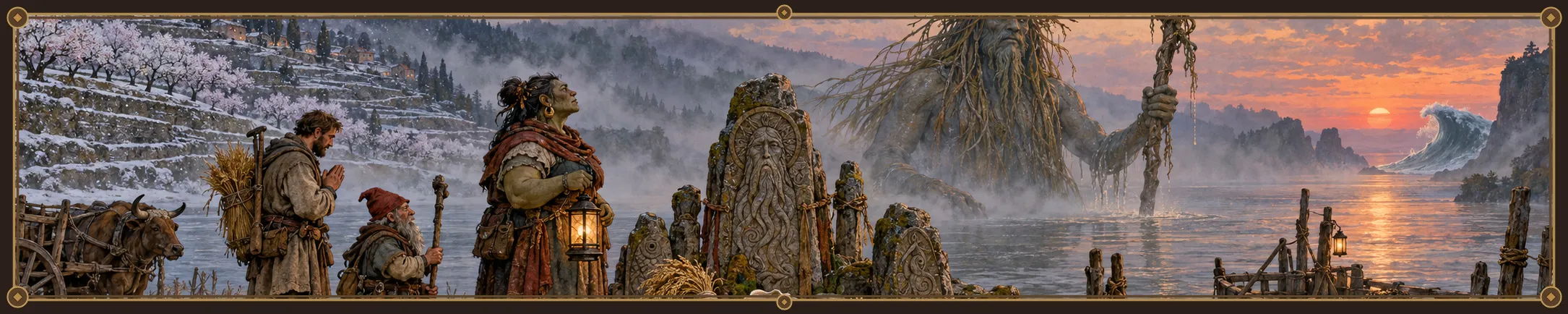
Every god at this shrine was born somewhere, out of something. Ask where, and out of what, before you ask it for anything.
The gods of the medieval world can almost all be found at the place that made them. Anvelle belongs to the basin fields, Serovan to the Serath, Kerrund to the hold gates, Maris to the Tidelace quays, Ushkar to the treaty-grounds of the Windscar; Ennor, born of no single grief, stands at the graves of most of the cradle-web. Each was born out of something: a famine, a siege, a decade of storms, a grievance over tolls, a frontier full of children who belonged to two peoples. Each has a face, a temper, and a want, and many have a trouble that is wearing them down. And each has done things that people still tell of at the fire: a river that rose in the night and took an army’s camp, horses and all; an orchard that blossomed in the snow over a besieging band; a liar’s face turning in the light of a lantern that gives no light. Every such tale is the god doing what it can do, and paying what it costs. How any god is made, and how one fades, is told in Stewards and Resonants (FND); how their worshippers keep them, at shrines and festivals and in the four organized faiths, is told in the next chapter, Faith in Practice. This chapter gives the gods themselves, Prime by Prime.
None of these gods asked to be born, and few of them are content. Iskel is burdened by every oath bent in his keeping; Varn feels the fear of everyone he hides; Abrel fears that if the frontier stops questioning, they will fade. A god is a person shaped by a need, and the need does not go away when the god arrives. Nor are the gods gentle because they are worshipped. Serovan blesses the war-barges that go downriver against a village that will not pay, and the god of the sworn word breaks the bones of those who break an oath sworn on them. Every power here has its pilgrims and the bandits who wait for them, its relics and the thieves who come for them, and its terrors.
Gods of Aion
Quennet the Clockmaker was born of the Gnome harbours of the Tidelace Coasts, where inlets and fog belts can be entered only inside narrow windows, and pilots begged for a breath more before a window closed. He appears as a gaunt, stooped, weary Gnome in a long coat of many pockets, each bulging with ticking mechanisms, his milky eyes seeing only the future; his brass pocket watch ticks backwards, and where he passes a harbour bell is heard a second after it swings. He is fading, because the harbours have learned to name who bears a lost moment and make them pay, instead of praying for more. The Grey Crews that row in the Long Grey are said to be the crews he stretched a moment for and could not save; they hail living boats a beat late, as his bells ring, and pilots answer no hail that comes after its sound. The wreckers of the outer chains, the tale goes, keep a stolen gauge-house timepiece in their huts and pray at it for a window to close early, and the harbour wards who raid such huts burn the timepieces on the quay.
Tamsel the Season-Weaver keeps the turning year in the Halfling folds, appearing young and green in spring, sun-brown and gold in summer, old and crimson in autumn, pale and frosted in winter, and strongest at the solstices and equinoxes. The folds tell of a siege winter when hill raiders camped below a terrace wall to starve it out, and the orchard above them blossomed overnight in the snow and set fruit within the week. The raiders took it for a curse and fled. The fold paid for that spring with three lean years, and still hangs a frost-blackened apple over its gate on the anniversary; reserve-keepers say ask for the season you can eat.
Gods of Aqua
Maris of the Tides was born in a decade of storms on the Tidelace Coasts, from the prayers of coastal Humans and Gnome harbour towns who did not want the sea to stop, only to be calmed and guided through it. Because both peoples prayed to the same power on the same coast, she is one god. She is tall, with skin of oyster-shell sheen and hair of living kelp that moves as if underwater even on dry land, and her eyes go from turquoise to storm-grey with her mood; her robes of wet silk never dry. The oldest passage story tells of a raider fleet that came on the coast in the last year of the storms, and of the single wave that rose in a flat calm and took the raiders' ships and no other; harbour children play it on the beach with toy boats, one child as the wave. Wreckers who light false beacons on her headlands are said to drown in their beds, found at dawn with salt water in their mouths and dry blankets round them, and pilgrims come down the coast roads with their sick on litters to the springs said to be her tears.
Serovan the River-King is the broad, mud-skinned, reed-haired god of the Serath, more foreman than monarch, barefoot and dripping, with a driftwood staff topped by a glowing river-stone said to be the river’s heart. His cult rose as the river towns took the Reedfolk rivers and the flood-keepers' knowledge with them, and the Reedfolk do not deny he is real. They deny the rivers are his. Serathic towns boast of the night an upriver army camped on the water-meadows to besiege them and the river came out of its banks and took the camp; the villages downstream tell the same tale as the year their own fields drowned with the army, because his flood cannot be steered once loosed. Before the towns' war-barges go downriver against a village that will not pay, they are blessed at his landing with river water poured over the bows, and the Reedfolk who have watched them come say the river has never once turned against them. As the spring rise falls, the River-Given walk up the landings, and ferry-keepers say Serovan gives back every body he is owed rites for.
Gods of Ignis
Ghessa the Hearth-Mother is the gentlest of Ignis’s gods. She condensed during the Long Hunger, the upland famine of c. 195,000–c. 160,000 BR, among Ogre households that bound their strength to feeding the weak first; her custom is hearth-weight, that strength must be tied to care. She is a broad Ogre woman with hair of soft flame and eyes like embers, smelling of woodsmoke and camp bread, carrying an iron lantern whose flame never flickers. She is fading wherever Ogre bands work far from their dependents and eat from an employer’s stores, because the fire they gather around is no longer their own. Ogre camps tell the frontier’s raider tales at her fire from the inside, as warnings: a band that has eaten before its weak cannot keep her flame lit, however much wood it burns, and the camps' proudest tales are of hearth-houses that held a broken village gate with their own bodies against such a band rather than become one. The carrier of the passed flame goes alone through the winter dark, and wolves follow the light.
Gods of Imago
Abrel the Changeling is the god of people between peoples on the Headwater frontier: foster children, hold apprentices, mixed households. Abrel rose in the Headwater foothills from their longing, and they did not pray to be made wholly one thing, nor to be left wholly outside; they prayed for clarity. To a foster child Abrel appears as the elder of the household the child most wants to be claimed by; to a Dwarven custodian, stern and patient; to a Goblin side-ford keeper, quick and half-hidden. Look closely, and the face is a shifting mosaic of features from more than one people, with eyes that reflect the viewer slightly better than they are, and a voice in more than one tongue asking "Whose are you?" Headwater tellers speak of a fosterling who wore Abrel’s mask into a raiders' camp as one of their own, sat at their fire for three nights, and opened the stockade gate at dawn; she never again answered to the name she had been given. The guides who take travellers over the raided passes carry a plain wooden mask in their packs for the same reason. Downriver zealots who hold Abrel too unsettled to enter have more than once crossed into the Headwater to break the god’s shrines, and a Headwater feud song names every downriver chapel that burned in return.
Saerith the Mirror-King is the High Elf god of the Crownbough Courts, born of the houses' pride and fear of being found less than they claimed: silver-skinned, gold-haired, with obsidian eyes that show nothing, carrying a shield in which each viewer sees the self they wish they were. His standard travels further than his worship, and its cost is despair and dangerous rites of self-perfection. In old and abandoned halls hang mirrors that show the viewer a perfect version of themselves, said to be his tears. Houses pay outsiders to carry them out of rivals' dead halls; the hirelings go in blindfolded and roped together, and the one who peeks is the one they leave behind, still gazing.
Gods of Lux
One god of Lux dominates the era. Ostrin the Lantern-Bearer was born of the grievance of the Serathic trade towns, where tolls were taken and the upkeep never came, and the wronged who brought their grievance to the lord’s hall found the lord siding with himself and his friends; his name is called as far upriver as Greyford. He is a tall, gaunt figure in a mendicant’s frayed white robes, blind, with milky eyes, and around his neck hangs an iron lantern that gives no visible light but shows those who look into it their own secrets and the lies of others. Where he walks, shadows do not flee but thin, and the noise of the market fades into a ringing silence. His voice is a bell in an empty hall, and he speaks only in statements: "You lied." "The money is behind the wall." In some Serath towns an accused thief may ask to face the lantern instead of the rope, and townsfolk swear they have seen the colourless light turn on a liar’s face. His zealots break into oath-chests by night to read sealed rolls aloud from the oath-house steps at dawn; most of them hang for it. He is increasingly alone, because the innocent fear his light as well as the guilty, and he has begun to doubt whether total truth is a kindness.
Gods of Memoria
Annoth the Keeper of Scrolls is the god of the scribes and record-houses of the Human corridor: a small, elderly woman with skin like parchment covered in faded script, eyes of liquid ink, and hair of white ribbons each written with a single word in a different tongue. She speaks in footnotes and asides, and carries a codex that writes itself. Somewhere in the corridor a record-house is always burning, and in every fire she must choose which rolls to save. Every record-house hangs a scorched satchel over its door for the scribe who carried a town’s rolls out through a burning gate on her back while the raiders were still in the streets, and the hidden second copies her scribes keep are a treasure in their own right: a family robbed of its land by a burned deed will hunt for years for the copy in a chapel wall or a buried jar, and the lord who profited hunts it as hard.
Ushkar the Ancestor-Warden is the Orc god of lineage and the dead on the Windscar, a figure of wind-scoured granite whose face shifts between a young escort, an old treaty-keeper, and a weeping mother, and who carries on his back the Stele of Names, whose names glow as he passes and fade when they are forgotten. Orc fathers tell of the escort who tried to strike his own name from the Stele to escape his family’s broken oath, and end it with a saying: you can outrun the raiders, not the name. To rob one of his fading cairns for its grave-goods is to be struck from every stele on the Windscar. A kindred whose honoured dead were shamed may ride out to take the debt back in blood, with Ushkar’s name cried at the start of the ride, and the escort roads empty while it is out.
Gods of Terra
Anvelle the Harvest-Mother is the farmers' god of the Confluence Basins, born there from basin farmers' dependence on soil and season: a tall, sturdy woman with skin of dark loam and hair of ripening wheat and wildflowers that bloom and wither in a breath, carrying a bronze sickle that glows when the harvest is near. The oldest fields there are said to grow her signs, crops in impossible patterns that form faces and symbols, and pilgrims walk to them at harvest with seed in their pockets, on roads the bandits know. Basin villages tell of the levy-riders who came for a widow’s seed-corn and rode into her field, and of the earth that thickened under them until the horses stood sunk to the chest and could go neither on nor back; ploughs in that field still turn up bridle-iron. She is struggling against the corridor powers' demand for more basin grain than the soil can give, and has begun to send harder signs: crops withering overnight, roots that break ploughs.
Kerrund the Stone-Warden was born at a besieged Dwarven gate during the early deep wars between Dark Elves and Dwarves, c. 330,000–c. 305,000 BR, a gate attacked again and again for longer than one generation. Its keepers prayed for walls that cannot be breached and were willing to become as hard as the rock, and so is he: granite-skinned, moss in his crevices, eyes of obsidian, speaking in single words. "Hold." "Stand." "This is the line." An oath sealed under him is sworn on the swearer’s own bones, and the holds know what a broken one looks like: the traitor who opened a postern to raiders and was found at dawn folded in on himself like a dropped sack. On the night before a raid an Ironspine gate-warden sits alone with both hands on the gate, and wardens who came through say the stone grew warm under their palms by dawn.
Two Dwarven gods of the deep are crisis-born and severe. The Last Chamber, root-bound stone with a vault for a torso and a lamp burning behind its ribs, condensed during the Heartwell Stakings, c. 322,000–c. 316,000 BR, where Dark Elf refuge-memory and Dwarven sealing-memory ground against each other. It is one of the clearest cases of a worshipped god growing directly out of the wounds of the old Steward crisis, and it is honoured as the question can this still bear? The deep laments tell of a gallery under a breaking flood and a single chamber that stayed dry until the last child was passed up the shaft, and of keepers who opened their refuge door to the fleeing with a war-band coming down the gallery, and held it with their own bodies. The Measured Seal, black ironstone and warded lintels, one arm a gate-leaf, asks must this close?, and its worship demands that every closure be answered for. Custodians keep a listening-watch at its oldest seals, an ear to the stone and a tally-stick to mark every knock, and seal-breakers learn to read its triple-mark shrines: a mark cut deep means a plague gallery, a shallow one a sealed store, and the custodians cut false marks over the richest closures to turn the treasure-hunters away. Both stand with Kerrund among the three great gods of the Held Covenant, whose questions are told in Faith in Practice.
Gods of Umbra
Ennor the Grave-Watcher was born of no single grief. He condensed slowly, over ages of burial and mourning, out of the funerary custom of many peoples at once, and most cradle-web peoples honour him at their graves under names of their own, which feed one god because those peoples have long lived and died alongside one another. He is tall and slender in a hooded cloak woven from twilight, with two points of pale silver light where his eyes should be and skin marked with faint silver scars like writing in many scripts, and mourners of every people hear him in their own tongue: "Rest now." "You are remembered." He has no church. Some of his devoted take to the roads instead, following crows and vultures to where bandits dumped a traveller and cutting down the hanged at crossroads to give the rites where the body lies; the outlaw who killed one is said to walk still, unable to die. Villages beside the old barrows pay a grave-warden to sit out the long nights with a lantern and a dog, and the wardens' warning is a single line: dig for gold, dig your own grave. He is overwhelmed, not by any catastrophe but by the ordinary dead of a whole cradle of peoples, each expecting something different at the threshold.
Varn the Shadow-Stalker is the god of the hidden in the Broken Marches, born in its culverts and ruined storeworks from the prayers of the hidden: Goblins without a warrant, fugitive Wrought, debtors, deserters, anyone power was hunting. He is living shadow in a cloak of night-silk, who speaks in single urgent words, "Hide." "Wait." "They are coming", and strikes at hunters who come too close. Hunters swear they have watched a pack run full cry to a culvert mouth and stop dead, whining, at a scent that ended in the air, and Marches hunt-masters now bring a priest of some brighter god on a big bounty. Bounty-takers drinking in the Marches towns raise a cup to the one who came back, and nobody at the table ever names him.
Umbra’s most recent faded god is young. The Echo-Mother was born c. 1,200 CR from the prayer of the Hushvale survivors not to be found, as they made the rite of concealment that still hides their vale; she was twilight-skinned and featureless, and she spoke without words. She taught them to forget, and they forgot her. In the first year, the tale goes, whole households stepped into her silence and were never found again, by the engine or by anyone, and Hushvale funerals are still held in whispers, because grief called loudly draws the vale’s hungry remnants out of the fog. The vale she hid is described in Sealed and Silent Places.
Gods of Verba
Iskel the Scribe of the Silent was born from the corridor’s distrust of the sworn word: the more depended on oaths, the more they were broken, and the stronger party broke them most safely. The people did not pray for a stronger lord; they prayed for a word that holds. He keeps oaths, sworn words, and sealed bargains in the oath-houses: a small, elderly, ink-stained man in grey wool, with eyes of black ink that reveal the true intent of those who meet them, carrying a sealed ledger with no end. He does not keep the records of what was done; that is Annoth’s. He keeps the oath itself, and whatever was sworn to stay silent, which sets him against Ostrin in the same oath-houses, and oath-breakers are cursed in his name from the oath-house steps.
Tavi the Bard of the Broken is the Goblin god of a history no lord would read: small, wiry, ink-tattooed, in a cloak with a patch for every warren and seam the songs remember, carrying a lute of bone and silver whose strings hum. He grew verse by verse over a very long span, from the torn warrants and lost seams that Goblins kept in song when the rolls left them out. Goblins tell of a lord who forbade a warren to sing in a ruin he had declared waste ground, and of Tavi singing there anyway, so softly that the lord heard nothing, until by morning every Goblin within a day’s walk knew the words. A Goblin caught singing the torn warrants in a corridor market can lose his tongue for it, and the warrens honour the tongueless as the bravest of his singers, who teach the songs on by fingers and drum.
Gods of Zephyr
Corrow the Gale-Runner is the wind at the backs of the Edgeway Kindreds on their circuits between ruin zones, born there from the need to keep going and grown sharper since lords' men began moving camps on: young, wiry, leather-skinned, with a silver-white mane like a banner in a gale and a cord at his ankle strung with chips of stone, each cut with a waymark someone once scraped from a ruin. His voice gives only fragments and directions, "Go." "Water ahead", and he has not rested in living memory. Kindred tellers say the dust that once rose behind a camp on the Glassbelt edge hid it from a war-band riding down on it, and that the raiders followed the wind instead, into the ruin zone the camp had skirted; and they say the reeve who scraped a whole causeway’s marks in a summer was found the next spring at the bottom of a ruin zone he had always known to skirt, his own map in his hand.
Rakhal the Storm-Caller is the Orc god of the scouring wind of the Windscar, which breaks what has gone stale: towering, storm-purple, crackling with lightning, shouting "Rise!" and "Break!" His following is growing as the Pact world settles, and he is growing more volatile with it. His young zealots ride out in the brown wall of a dust storm, faces wrapped, and fall on a guarded reserve while its keepers can see no further than their own hands; they call it the god’s scouring, and the reserve-holders hang the raiders they catch from the reserve’s own gate-post.
Tensions
-
Walls or breath. Kerrund and Anvelle meet in the Headwater Marches, where Human fields and Dwarven works share the same valleys. They respect each other and clash: Kerrund wants walls, roads, and fortified ground; Anvelle wants the land left to breathe.
-
Flood or crop. Serovan and Anvelle are close allies, his river giving the water and her fields the soil, but Serovan would flood a field to renew it, and Anvelle would protect the standing crop from drowning.
-
Truth at its own pace. Where corridor trade reaches the Headwater frontier, Abrel’s and Ostrin’s cults meet. Abrel helps people become their true selves and Ostrin reveals them, and Abrel often pleads with him to be gentler and let people find the truth at their own pace.
-
Prayers for open roads. Some Dwarves drawn outward by corridor trade now pray for open roads rather than held gates. The Held Covenant has no question for an open road. Custodians disagree whether such a prayer answers Kerrund or refuses him, and some fear it is being heard by a god outside the Covenant.
-
One guide or two. The Ordered Bough honours its guide of the returning dead under an Elven name, and the Sworn Accord enters a god of the dead as Ennor. Basin-edge households, whose mixed funerals divide the work between grove return and Human mourning, take them for one god. Many tenders in the courts do not, because one god at both graves would make Human mourning a rite of the same passage as Elven return.
-
A toll told too freely. A pilot who brought a craft through a storm told the story at Maris’s shrine, as her toll requires, and in the story called on her aloud while crossing a Thaluren return channel inside a closed window. The pilots hear thanksgiving. The run-watchers hear a god called on over the ascent, and want the circle to say so.
-
Harbours at blood-feud. Two Tidelace harbour towns are at blood-feud over fishing grounds, each praying to Maris for the other’s ruin, their boats ramming each other’s nets at sea. She is trying to calm the quarrel before it becomes a burning of harbours.