Chapter 11. Stone and the Deep
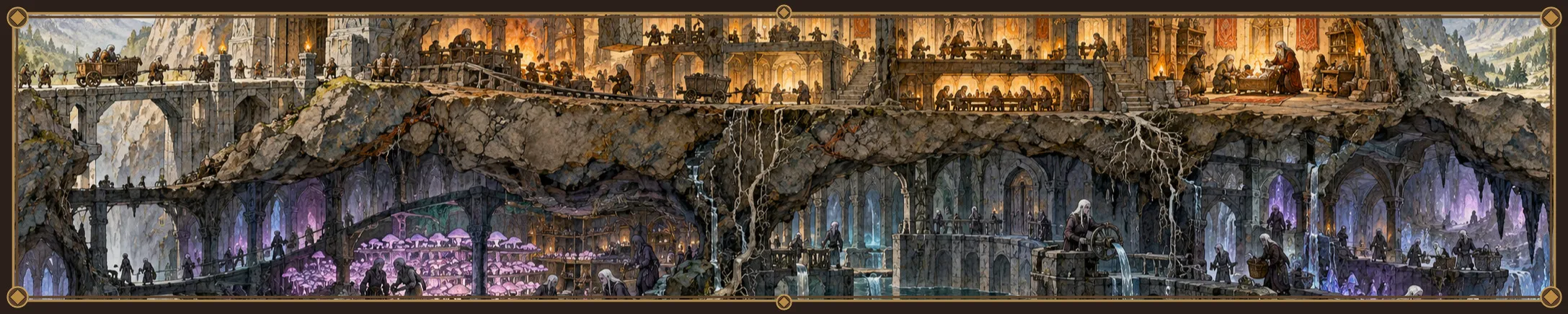
Must this close?
Then close it, and write why,
and leave the writing where
the ones outside can read it.
The Ironspine is as deep as it is high. From the foothill towns it looks like any mountain belt, bare ridges above faultbound valleys, smoke from the smelters hanging over the passes, but the mountains are only its upper storey. Behind every gate the holds run inward and down, through halls and forges and mines, into underways that join hold to hold through the rock, and below them into the Stonewake Deeps, where there is no weather and no season, only air, water, and load, and where something still knocks behind some of the sealed doors. Further still, where the stone gives way to living root grown down from the forest above, lie the Roothollows, the root-cavern country of the Dark Elves, who remember being left to drown. Between the two peoples of the deep sits one reservoir that both of them draw from every day, under each other’s spears, and neither has ever agreed to share; above the Dark Elves lies a whole storey of their old world, drowned with its dead and its treasure, that nobody has entered openly in three hundred thousand years. This is a country of doors. Every door has a record, every record has another that contradicts it, and every people down here can tell a stranger exactly which door was shut on them, and by whom, and when.
The Ironspine
The Ironspine is a long mountain belt and the oldest Dwarven homeland on Caeldon: bare ridges and faultbound valleys above, holds cut into the mountain faces, and mines, vaults, and underways running down into the rock beneath. It belongs to the Ironspine Holds, which took shape as a hold world in the Holdmaking of the Ironspine (c. 465,000 to c. 445,000 BR) and came together between c. 460,000 and c. 438,000 BR. No throne rules it. Each hold rules itself, and what binds them is a set of very old oaths about what must be kept standing. Its gates have held against sieges older than Human memory; its abandoned holds lie open to anyone who dares the dark, the bad air, and whatever still knocks behind the sealed doors. Most people here are Dwarves, but few holds are only Dwarven, and far below the mountain holds lie the Stonewake Deeps, part of the Ironspine and fed by it, with sealed doors and a war of their own.
Three Storeys
One hold may reach from a weather-beaten gate to workings that have never seen daylight, and the belt as a whole has three storeys. At the top lie the heights, the Stormcrown, where the fitted stone of a vanished colossal people still stands and almost nothing new is built. Below them is the hold country: mountain faces and faultbound valleys where the holds open their gates, with terraced fields and pasture in the sheltered valleys and smelting smoke above. The exposed hold lifeways Dwarves call Gatehold and Highhold belong to this storey, shaped more by weather, haulage, and traffic than by depth. At the bottom are the roots: mines, mineral-bearing strata, vaults, and the underways that join hold to hold through the rock, giving way further down to the Deeps.
The belt runs north to south through the middle of the cradle-web, some four months' walk long in its mapped part; where it ends in the north nobody has mapped. On the forest side it comes down in verges and outer watersheds to the Elderweald and, further south, the Crownboughs. On the other side it falls into the foothills and river origins of the Headwater Marches in the south and the Broken Marches further north. At its southern end the last spurs sink into the low ridges of the basin country, where no hold stands and no road climbs. Much of the water both lowlands live on rises here. A pass takes two or three weeks to cross the belt in summer. Anvilwake stands in the middle of it, about a month by hold roads and underways from Thrumgate, the south-eastern gate above Oathfoot, and three or four days above Stairdeep by the Hauling Stair; the Verge Stair climbs the south-western face from Highbraid. The holds are the settled cores, each with its gate valley, terraces, and mine-edges; between them lie bare rock, snowfields, and the high ground of stone cats, and the roads are travelled by leave, in company, from gate to gate. The holds say a stone cat seen on the gate stair means the passes close within days.
The dangers change with the storey. On the surface it is weather and the fall: passes close in winter, rockfall and avalanche take roads and the people on them, and a high hold can be cut off for a season. Exposure kills more travellers than anything that lives in the mountains, though plenty lives there. Pale stone cats take herds and lone climbers, pass bears raid the walled waystations every autumn, and gluttons rob every cache a traveller leaves; a hunter who follows a stone cat onto its own ground comes home with the pelt or not at all, and the pelt is worn at the gate by whoever brought it. Underground it is flood, bad air, and collapse. The mine-edges are where Ironspine Dwarves most often die before their time, in a working that floods, a brace that fails, gas gathering in a dead pocket; Kobold crews notice these first and are not always believed. Hog-sized Brace-Gnawers, stone-hided beasts, gnaw the props hollow from inside, and a brace that looks sound may be a shell.
Old works fail without warning everywhere: abandoned workings, early holds left empty, colossal roads too large to mend properly. Some old workings still hold the frames that once laboured in them, and nobody can tell from the doorway which of them are only tools. The empty holds draw treasure-seekers after forgotten forge-work, old weapons, and hoards of metal no archive remembers; the holds call them grave-robbers and wall up the ones they catch, but the dark keeps more of them than the wardens do. The old masters' tombs are worse than the dark, shut with triggered traps and slowed doors whose makers' craft has outlived them, and more than one has thieves' bones lying before it like a doormat. Some doors were shut with people still behind them. In the older holds there is knocking behind them still, the Seal-Knockers, and nobody can say whether it is the dead or the living; hold children are taught one rule before they can count, if it knocks, do not answer. In a few refuges whose keepers would not leave, the keepers have become Burden-Stays, grown into the stone as living props, and freeing one brings the roof down. And above the highest seams the miners leave the rock alone. Upland custom says Haurûm the Mountain-Father sleeps beneath the summits, and that digging too deep beneath them might wake him; he would not be angry, the warning goes, only confused, and a confused mountain can bury a valley with one stumble. Climbers report a slow, rhythmic rumble under the peaks, like a heartbeat.
A Town Turned Inward
A hold is a town turned inward. Its gate opens on the mountain face, and everything behind it is arranged by how much protection it needs. At the gate are the outer yards, storehouses, stables, and the halls where outsiders are received; traders, envoys, and hired crews rarely go further, and the sworn wardens of the gate are the first Dwarves most visitors meet. Behind it lie the halls and households, the forges, the market where hold craft changes hands, and the archive where the hold’s oaths, tallies, and dead are cut into stone tablets. It is said that an unjust oath cut there will crack its stone, and that Kerrund the Stone-Warden watches the tablets to keep them true. Deepest inside, behind the most doors, are the cradle-chambers: a Dwarven infant is still setting into durable form after birth, so the hold keeps what it can least afford to lose where an enemy would reach last. Below are the mines and workings, joined by underways to the neighbouring holds.
Work is mining, smelting, forging, and stonework, and above all the upkeep of everything those produce: bracing, draining, clearing roads, rebuilding gates. Food is grown where the mountains allow it, barley and roots on valley terraces, herds on summer pasture, fungal beds in the lower levels, and bought where they do not, mostly from Human farmers on the Headwater side. The mountain holds also feed the Deeps, which grow little of their own, so a poor harvest in the valleys is felt a long way down.
Childhood is long and maturity comes in stages, and hold life marks each stage slowly and in public. A child’s name is cut on a small stone kept in the cradle-chamber until the child is judged able to carry it; the stone then goes home with the household. A craft is taught one burden at a time. A young Dwarf’s first oath is sworn at the gate, before a custodian who asks Kerrund’s question aloud, and only once the young Dwarf is judged able to keep it; the answer is cut into the hold’s archive, and an oath broken at the gate is the whole hold’s to avenge, not only the injured kin’s. A marriage joins two households' names on one archive tablet, with each household’s craft and burdens read out so the hold knows what the new household will carry. When a returned exile, a changed survivor, or a disputed heir asks to be taken back, the hold-elders sit the Proving of the Unbroken Line (see The Elder Peoples, FND), and an heir with powerful kin behind them is heard sooner and more kindly. Burial is that hearing in miniature, the dead declared to have held and then sealed with care. Once a year, at the Festival of the First Stone, every household lays a single stone on its hold’s walls, and if it is laid with true intent, it is said, the wall will stand another year.
Who Else Lives Behind the Gate
Not everyone inside a hold counts the same. Kobold crews take the narrow, dangerous repairs in vent runs and mine-edges, usually under compact terms and often for work the hold prefers not to mention. Their Underhouse Compacts are strongest here and in the Deeps, and a compact’s refusal, all crews at once, closes a working without a blow struck: a hold that will not pay for danger soon finds its narrow repairs left undone. Goblin underwall households live in service passages and old seams within the walls, tolerated, useful, and seldom heard when the elders decide anything. They descend from those who stayed inside when early holdmaking took the seam-warrens in the Enclosure of the Seams, and warren memory still names seams that now lie deep within the holds; some households still call those seams theirs, at times with spears borrowed from the Iron Compacts. Underwall songs still name the seams the holds took, and they belong to Tavi the Bard of the Broken.
Wrought descended from Dwarven workframes work the forge levels and live more freely in the foothill towns, where repair houses speak for them. The Mending Orders keep houses near old Dwarven works and in the mixed foothill towns, and their quarrel is with craft-lines that still treat frame patterns as hold craft, and with anyone who calls a Wrought person’s repair maintenance. Human traders and hired hands, and now and then a fosterling from a Headwater family, belong to daily life at most foothill gates. Giants hold no power here and seek none. A highline family may still keep one pass or shrine line on the outer crest, and some hold archives keep oaths sworn with Giant lines that have not been heard from in centuries.
Who Holds the Hold
Power in a hold belongs to whoever keeps it standing: the hold-elders, the keepers of lineage memory, the masters of its crafts, and the great houses whose miners, smiths, and spears the hold cannot spare. They sit together over hold quarrels, and the strongest houses usually carry it. Houses that lose nurse it for generations, and Dwarven grudges between houses, and between holds, outlast the walls they began over. A hold’s word among the others is measured by what it maintains and what it can defend, and a hold whose gates, roads, or archives have failed loses weight, however large it is. A few leading holds speak for the Ironspine with the Crownbough Courts and the Human corridor powers, but they speak because they are the strongest, and any hold may decline to follow. Holds have marched on holds for less, and the underways between some of them are still walled off from old wars. Two neighbouring holds have kept their shared underway bricked up for longer than the Human world has kept records, over an anvil-stone each says the other stole, and each sends a warden to stand at its side of the wall on the feud’s day.
What gives the holds a common custom is the Held Covenant, the organized faith of the Dwarven holds. Its premise is that whatever holds must be able to answer for itself: a wall, a seal, a refuge, an office, and a person are all held, and all must be able to say aloud that they still deserve to stand. Its great gods are honoured as questions rather than as patrons, and worship is the act of answering them honestly. Will you hold? is the question of Kerrund the Stone-Warden, born at a besieged deep gate in the early wars of Dark Elves and Dwarves, asked of every oath, wall, gate, and office and answered by keeping them. Must this close? belongs to the Measured Seal, can this still bear? to the Last Chamber. The questions often pull against each other, and the Covenant does not settle the tension; it requires that each question be asked aloud. Its clergy are not priests but custodians, keepers of seals, tallies, and hearings, and a custodian whose own judgements are later condemned must answer the same questions they once asked of others.
The Ironspine keeps it in gate practice: outward-facing, oath-centred, used to bargaining with Human corridor lords and Elven embassies, and readier than the Deeps to accept a place won by bargain. Every hold tells the Legend of the Unbroken Gate in its own version, of the deep gate breached at last until Kerrund stood in the doorway and would not move. Some Dwarves drawn outward by corridor trade now pray for open roads rather than held gates, and the custodians have noticed. Haurûm the Mountain-Father stands outside the Covenant. Dwarves honour him by title, ask him nothing, and leave his colossal remains untouched; the Giants, who alone still know his name, keep his sleep. Corrow the Gale-Runner travels the kindred circuits on the outer roads and quarrels with Kerrund whenever a gate shuts on a road.
Roads Through Stone
Three kinds of road cross the Ironspine, each with different keepers. The underways run hold to hold through the rock. They are the safest roads in the belt and the most closed: each hold keeps its own stretch and grants passage by leave, and Kobold crews use service ways between them that no hold has mapped, some of which pass by sealed doors the crews will not speak near. The passes cross the belt and its spurs on the surface. Most are hold roads, walled, gated, and shut in winter. The oldest follow colossal ridge roads, the greatest of them the Long Tread, a road too broad for any living builder that runs for weeks along the outer crest from one gate to the next; Edgeway kindreds keep its culverts and mark its dangers, gate holds keep the stretches by their doors, and neither will grant the other the whole. A kindred that has cleared a colossal culvert for longer than the nearest hold has kept records does not accept that the hold may close the road it serves.
The exchange roads come down from the foothill gates into the Headwater Marches, fortified and escorted, and inside the outer gate of each foothill hold they end in an oath-yard, a walled yard where Headwater traders are received and every bargain is sworn before the hold’s custodian. Two stairs complete the network: the Verge Stair crosses to the Crownboughs, its lower half kept by the gate holds, and the Hauling Stair carries stores down to the Deeps and ore back up.
Out of the mountains go metal, tools, and weapons; dressed stone; route knowledge and teaching. In the time of the exchange roads Dwarven workframes went out the same way, which is where the Wrought’s long quarrel over who owns them begins. In come grain, salt meat, wool and cloth, lamp oil, and bracing timber, much of it bound onward for the Deeps. Shaped wood and gifts come across the Verge Stair, weighed for rank as carefully as for worth. Along the heights go salvage, news, and warnings of rockfall and beasts carried on the kindred circuits. Passage belongs to the gate holds. A traveller enters under gate oath, crosses a hold’s ground on its leave, and leaves owing whatever was sworn. Treasure has a trade of its own. Foothill taverns sell maps of the empty holds, nearly all of them false, to treasure-seekers who cannot tell; hold wardens pay a bounty on grave-robbers taken in the abandoned works, and hired beast-hunters come up from the Headwater side when a stone cat starts on the herds. The best guides are Kobolds who know the unmapped service ways, and the compacts punish any crew caught selling them.
The gate of Thrumgate does not look like a door until it opens. From the road it is only a darker place in the mountain face, with a row of cut steps below it and a warden at the top, her braids bound in metal and an axe across her knees, who watched us climb the whole way without moving. At the threshold she asked our business, then asked me to swear to keep the hold’s peace while I was under its roof. Before I answered she asked one more question, quite gently: whether I would hold. I said I would. She cut a mark on a tally and let us in, and I saw that the tally was stone, and that my mark sat in a long row of others, and that none of them could ever be scraped off.
The oath-yard is bigger than the market square of most towns I know, roofed in stone and lit by lamps set in niches all the way round, so that every face is lit from the side. On the wall above the inner gate hung a row of war-axes, rust-dark and heavy, each with a tablet under it, and our caravan-master told me they had belonged to captains who had come to take the hold and had not. Our grain was weighed on a beam older than my family. The custodian who sealed the sale spoke the terms aloud, had both parties repeat them, had a clerk cut them into a tablet for the hold’s archive, and then pressed her palm flat to the table-stone between us and waited until we had both done the same. I have written ten thousand bargains on the Serath, and every one of them could burn. I did not like how much I envied that clerk.
Beyond the yard a second gate stood open, and through it I saw a long hall going back into the mountain, and further, smaller doors, and further again, darkness. Nobody stopped me looking. Nobody asked me through. A line of Kobolds came out of a low passage in the yard wall, padded to the ears in wool and felt, coiled ropes on their shoulders, chalk on their hands, and went past the wardens without a word on either side, and one of them tapped twice on the doorpost as he passed, and somewhere inside the wall something tapped back. The warden at the inner gate turned her head at that, and listened, and did not answer it.
I asked the custodian what lay below the mines. She said the Deeps, and that they ate our grain, and that if I wished to know more I should ask in a hundred years. When we came out it was evening and snowing on the pass. I had been inside for an afternoon and felt I had been a guest of something very old that had been polite to me and would not remember my name, though it had cut my mark in stone.
Holds, Gates, and Terraces
No throne rules the Ironspine, so it has no capital. A few leading holds speak for it because the rest follow them, and the one other peoples meet most often is Anvilwake, a great upper hold whose gate opens on a mountain face above a faultbound valley. Behind the gate come the outer yards and halls, then halls, markets, and an archive of stone tablets, and deepest of all the cradle-chambers. Its forges send smoke above the ridge on every working day, and the valley below smells of it. Some twenty thousand Dwarves live there, with Kobold crews in the vent runs, Goblin underwall households in the service passages, and Wrought in the forge levels, and it is one of the holds that speak with the Crownbough Courts and the corridor powers. Its gate has never fallen, and its wardens can name every siege it has held; the war-axes of the besieging captains hang in the gate hall, one for each, and the oldest are of a make no smith alive can name.
Thrumgate is the face the foothills know: a gate hold above the Headwater town of Oathfoot, whose exchange road ends in an oath-yard inside the outer gate. Headwater traders are received there and every bargain is sworn before the hold’s custodian, and few of them see further in. Behind the yard live a thousand or two Dwarves, a Human fosterling or two, and the hired hands of the season.
Below the holds the work spreads out. Seamhead is a mine-edge settlement at the head of a working: lodgings, store-sheds, a smithy, and the timber yards that feed the bracing. In the working season a few hundred live there, hold miners, Kobold crews under Underhouse terms, and Human miners hired from the foothills, and when the Kobolds call a working unsafe, Seamhead empties faster than the hold would like. Its graveyard is the largest thing in it. The hold pays a bounty on every Brace-Gnawer killed in the workings, and the Kobold crews who collect most of it nail the stone hides up at the shaft-head. Barleystep is four Dwarven farmsteads on the terraces of a sheltered valley below a hold, growing barley and roots and driving herds to summer pasture. Everything it grows goes up to the gate it belongs to, and a poor year there is felt a long way down. Its herders keep spears for the stone cats and hire a beast-hunter when one starts taking calves.
Braids, Crews, and Name-Stones
About 320,000 people live in the Ironspine proper, the Deeps below counting their own. Some five in six are Dwarves. Kobold crews are about one in twelve, most of them along the mine-edges; underwall Goblins number perhaps 12,000; Humans come to five to eight thousand in the working season, nearly all at the foothill gates; and a thousand or more Wrought live in the forge levels. How many Giants keep the outer crest, nobody knows.
Hold dress is layered wool and leather against the cold of gates and passes, with heavy boots, and in forge and mine leather aprons and caps. Hair and beards are braided by hold custom, and a gate warden’s braids are bound in the hold’s metal, so that a stranger at the threshold knows whom to answer before a word is said. Ironspine Dwarves are ruddier and more weathered than the Dwarves of the Deeps. About one infant in five dies in the years when it is still setting into durable form, which is why the cradle-chambers lie deepest; after that, childhood is long and safe. Most who escape the mine-edges live two and a half to three centuries, and a newborn can expect about two hundred years. Of those who die before old age, the mine-edges take about half, by flood, bad air, and collapse, and passes and rockfall most of the rest; the old die of the slow stiffening of age. The name cut on a child’s stone in the cradle-chamber is given only when the child can carry it, and until then it goes by its household name. In full a Dwarf is given name, household, and hold, as the archive tablets have them: Haldrun Dovrek of Anvilwake, Gorvask Ostgar, Hethrun Brunvald, Bettra Dovrek, Ottra Brunvald, Gerrask Ostgar.
Kobold crews wrap themselves in layered wool and felt against the cold, with padded hoods and knee-pads for the vent runs, tails left free, and crew marks stitched at the shoulder; the mine-edge Kobolds run to rust and ochre scales. One child in four dies young, of cold and coughs, and adults die of collapse, bad air, and the repairs no one else will take. Few reach fifty, and a newborn can expect about twenty-five years. Every Kobold has a whistle-name in sound code that no other people can make, and a spoken name for larger peoples, given with crew and underhouse: Tisk of the Seamhead crew, Sekka, Ikkis, Chirra, Tsell, Vikk. The underwall Goblins wear the hold’s cast-off cloth cut down to size and are parchment-pale from the service passages; a household takes the name of the seam it claims, in old warren words no Dwarven archive records, Kittel of Ruttak among them. The Giant lines in the hold archives carry names like Haurûm’s: Ondûr, Valgrûm.
Edges and Memory
The Ironspine ends where the holds' reach gives way to someone else’s, and few of its edges were drawn by agreement. Towards the Elderweald and the Crownboughs it meets the forest across verges and watersheds that formed before either people argued over them, and which hardened over water, digging, and cut verges in the Elderweald-Ironspine Frontier (c. 410,000 to c. 385,000 BR) and over rank in the Courts of Stone and Canopy (c. 375,000 to c. 355,000 BR). Conquest has never settled it. Towards the Headwater Marches the belt falls into foothills, river origins, and mixed settlement, an edge made by use: ages of guarded waystations and exchange turned a frontier into the oldest Human-Dwarf corridor on Caeldon, and in practice it runs where the gate wardens take over the escort. Towards the Broken Marches old route lines run out into ground the holds call theirs; the holds reckon that edge from wherever their kept passages begin, and Kobold underways and Goblin seam-memory cross it regardless. Upward, the highest ground belongs to no hold, and the edge is a taboo rather than a line.
The holds remember their founding as ordinary work: chambers made sound, passages made dependable, memory carried forward. The Goblins remember the same span as their first dispossession. Towards the forest the Ironspine remembers being judged, and answers the High Elf view of it as unrefined with its own view of the courts as unsound. Towards the foothills it remembers teaching: Ironspine metallurgy, route craft, and stone-building went into the Human world through the Headwater corridor, and the holds still think of Human kingdoms as former pupils who did not stay small. The roads carry rival memories as well. Dwarven archives record the exchange roads as Dwarven work, while the Edgeway kindreds remember walking colossal roads over the same heights long before any Human came up from the foothills. The Kobold underhouses remember Dwarven frames arriving in the holds and the Kobolds' worth to the holds shrinking; some Dwarven craft-lines remember the same frames as a reform. And the deep war is remembered differently up here than in the Deeps. The mountain holds remember a gate held rather than a door sealed: Dark Elf war-parties coming up out of the roots, wardens dying shoulder to shoulder in a gate too narrow for three, and the god born of their holding. They carry its legacy as Kerrund and as a distrust of Elves older than any crown. They remember a villain too, the warden who opened a side-door to the war-parties for a promise, whose name is cut on no tablet, and the worst curse in the holds is to wish someone’s door sealed from the outside.
The Stonewake Deeps
Far below the mountain holds lie the Stonewake Deeps, the Ironspine’s deep central hold-cluster: a knot of holds, reservoirs, archive chambers, and warded corridors where more of the lower world’s routes and water converge than anywhere else. They are the home ground of the Stonewake Compact, which keeps the air, water, and lifts of the deep working for everyone who depends on them, and of a sealing custom so severe that a shut door here is at once a hold-elder’s judgement, a prayer, and a border. Behind some of those doors something still knocks. The region took its shape in the Deepening of Stonewake (c. 365,000 to c. 350,000 BR) and the founding of the Compact (c. 360,000 to c. 348,000 BR). Most people in the Deeps are Dwarves, but Kobold underhouses keep its air moving, Wrought descended from deep-hold workframes live in its forge and mine levels, and its Roothollow-facing edge has been fought over with the Dark Elves for more than three hundred thousand years.
Water, Heat, and Load
The Deeps lie far below the middle of the Ironspine, with the mountain holds above and around them on every side but the west. There, towards the forest side of the belt, the stone gives way to the root-caverns of the Roothollows, and the Rootstone Heartwell and the Undrawn Seal stand on that edge. The levels step downwards from the foot of the Hauling Stair to the reservoir holds and the hot lowest workings. Stairdeep, at the foot of the stair, is three or four days below Anvilwake and five or six weeks from Threewater Turn in the Roothollows; Blackbasin lies in the lower levels. The holds are the cores of the Deeps, with unworked dark and bad air between them. Every way between holds is walked under a hold’s watch, and the lost works below the lowest kept route are walked by delvers, who answer to no one and are buried by no one. Their saying at the lip of every unkept shaft is the deep pays once, and they mean both the treasure and the price.
The Deeps lie below the mountain roots, in stone that Dwarven bodies bear easily and other peoples find crushing. There is no weather and no season. In their place are water, heat, and load: reservoirs fed from the rock above, mineral-bearing strata, natural heat in the lowest levels, and chambers widened over ages until the stone carries far more emptiness than it was born with. Towards the Roothollows, bare stone gives way to root-bound caverns and water-bearing hollows where the old underforest still pushes down into the rock.
The dangers are the ones a Stonewake seal is meant to stop: collapse, flood or reservoir breach, sickness or corruption spreading, something coming up from below, and above all the slide, where one failure runs from hold to hold and takes people who did nothing wrong. Bad air is the quiet killer: trapped gas, dead pockets behind a silted vent, heat that builds faster than a draught can clear it. Brace-gnawers hollow props from inside until a gallery comes down on the crew that trusted it; kiln newts in the hot seep pools give a festering bite; pale lampless spiders curtain the unused ways. Below the lowest kept routes lie works no living hold keeps, among them the lost pressure holds of Dwarven memory, where unwoken frames still stand at their posts, and every delver’s tale puts the old forge-lords' hoards behind the last door: rune-cut ingots, seal-rings of holds no archive names, tools of a make no living smith can match. The frames draw delvers down and do not always let them back up, because a frame still at its old task does not know a delver from a load of ore, and has been known to carry one to the slag-pit with the rest. A darker danger walks in the refuges. The Cast-Out of Unyielding Burden is drawn to deep holds with too many dependents, and in refuges kept past mercy its keepers grow into the stone as Burden-Stays, living props who cannot die while the weight rests on them. Custodians in the Deeps count them among the hazards of the region, not among its legends. Behind sealed doors and in haunted grave closures the Seal-Knockers knock, and whether the knocking is the dead or the living is the custodians' oldest question.
Air, Water, and the Way Out
Life in the Deeps is arranged around three things nobody takes for granted. Air comes first. Every inhabited level has its draught, and every draught is somebody’s work: vent runs, trap-doors, and pressure gates are walked, listened to, and cleared on fixed rounds, with a caged air-finch for warning, much of it by Kobold crews whose sound codes and warning marks Dwarves have learned to read without being able to make them. Lamps are kept small, for the oil and because every flame is counted against the air. Water is the region’s wealth. Reservoir wardens know each basin’s level, its inflow, and what fails downstream if it drops; a hold’s share is set by the custodians and written down, and drawing beyond it is theft. A hold that does it can expect its gates shut against it, and water-thieves taken in the act have been left in the dark beyond the last lamp, with one lamp’s oil and the way back to find, if they can. The way out is known from childhood. Every household has its evacuation route and its refuge chamber, and the smallest shrines in the Deeps stand in exactly those places.
Holds sit where routes cross or a reservoir can be guarded, with workings, forges, and storehouses radiating outward and the cradle-chambers deepest inside. Without a sun, the day is reckoned in shifts and the shifts in rounds: a vent round, a reservoir reading, a walk past the seals to listen. Work is mining, smelting, forging, and above all upkeep. Ore is cut in the working levels and smelted where natural heat and old channels allow; the forge levels run hot, and much of their most dangerous labour falls to Wrought or to old frames that never woke. Food is the weak point. Little grows below beyond fungal basins, so most stores come down from the mountain holds and are kept in dense, long-lasting form. Deep Dwarves bear lean seasons better than most peoples, and a Stonewake storehouse is counted as carefully as a reservoir.
Custodians belong to daily life, but they also rule it. The same office that marks a closure keeps the hold’s tallies, settles quarrels, and seals the dead. Every grave closure carries more than one custodial mark and an archive entry, and children learn to read the marks on doors the way surface children read clouds, and to fear the doors with too many.
The Seal Round
The Compact’s sealing custom is something people walk past every day, in the form of seals, and its most ordinary rite is the inspection round. Every standing seal has a round cut into its closure marks: how often it is visited and what must be checked. On the day a junior custodian walks to it with lamp and tally-board and, where the seal touches an air run, a Kobold vent hand. At the seal they read the closure marks and the last inspection mark, lay a palm on the seam for warmth, listen for draught or water, and look for seep or fresh dust along the joint. If nothing has changed, the custodian cuts a small inspection mark beside the last one and enters it in the archive at the end of the shift. If something has changed, the round stops being routine: the custodian calls the custodians who marked the closure, and the next people to pass the seal find it watched.
Households near a seal know its round the way surface villages know a market day, and children follow the inspector to watch the mark being cut, and to listen at the seam for the knocking. A seal whose last mark is old is called unwitnessed, and any passer may raise it with the custodians. People in the Deeps raise unwitnessed seals readily, because a closure nobody checks is the first step towards the seal that never reopens. A Kobold crew may refuse a round behind a seal it judges unsafe, and the round waits until the custodians agree or a hungrier crew is found.
Keeping and Refusal
Power in the Deeps belongs to whoever keeps what others cannot live without. The Compact binds its holds through shared keeping rather than by one hold set over the rest: route keepers, reservoir wardens, and archive-custodians each hold their part, and grave decisions need several of them to agree. A hold may still seal first in an emergency and explain itself afterwards, and whether the explanation is accepted depends mostly on how much water and how many lifts it controls. The Deeps remain part of the wider Ironspine Holds, which feed them and send many of their people down, and never claim to replace the Holds' older ancestral lines. The mountain holds are kin, supplier, and critic: they keep the Covenant in gate practice while the Deeps keep it in seal practice, severe, slow to reopen, and haunted, in every sense, by seals later judged unjust, and each regards the other as a lesser form of the same faith. Gate practice accuses seal practice of closing what should hold; seal practice accuses gate practice of holding what should close. The quarrel has drawn blood more than once, and mostly at doors: a seal-practice custodian walled into a gallery by a gate hold that wanted it open, a gate-warden’s oath-company barred out to die by a deep hold that wanted it shut.
The Underhouse Compacts are the other power, and the only one that can stop the Deeps without a weapon. Kobold crews bargain as one, keep the shared maps and warning codes, and can declare a shaft unsafe so that no member crew enters it. Older underhouse lines once feared Sessik the Tongue-Taker, a god who punished noise in the tunnels; he faded once the compacts' shared sound codes made silence a skill. The compacts shelter crews who escape bonded service and treat any hold that keeps Kobolds captive as unsafe ground for all of them. That captivity survives here mostly as inherited protection-debt, defended by its holders as survival and condemned by Dwarven custodians as well as Kobold crews on the old ground that debt does not make a person a tool. Crews who run from it go through the vent galleries, where Dwarves cannot follow, and the holds that hunt them hire bounty-takers who can, Kobold turncoats among them, the most hated people in any underhouse. The Kobold guides who lead runaways through the galleries are hunted in turn as thieves of a hold’s property, and the underhouses hide them at any cost. One such hold is quietly losing its underwork to refusal: its custodians call the debt protection, its Kobolds call it captivity, and its vents are beginning to silt. The underhouses trace their place in the Deeps to the vent-kin who fled downward after the ash-furnace fall and were taken in under protection that became debt, and they have never forgotten how the one turned into the other.
The Wrought here are mostly Forgeframe and Mineframe lines, descended from frames first built in holds like these, and the Mending Orders keep some of their earliest houses in the region. Whether a hold counts its Wrought as people depends on the hold, as it does everywhere. Deep works still hold frames nobody has looked at in generations, and each one found standing in a sealed working is worth a fortune in old metal to the delvers who find it, hold property to the hold above, and perhaps a person left behind to the Wrought, who have begun sending their own people down to reach the frames first.
The Hauling Stair and the Seals
There are no rivers here in the surface sense. Water moves through channels, seeps, and reservoirs, and the custodians say where it goes. The roads are warded corridors running hold to hold and junction to junction, with guarded descents and lifts tying them to the mountain holds above. The greatest is the Hauling Stair, the stair-and-lift shaft by which food, bracing timber, lamp oil, cloth, and Dwarves taking up deep postings come down, and ore, smelted metal, and worked goods go up. Whoever keeps its lifts can ration everything below, so the Compact keeps it under heavier guard than any other route in the region, and a lift-cable cut in a feud once starved three holds for a winter. Raiders from the Roothollow side have tried the lower junctions in hard years, and every warded corridor ends in a gate a dozen axes can hold. Across the Deeps move water shares between holds, written down, traded, and fiercely defended; crew terms bargained through the Underhouse Compacts; and access to warded or sealed routes, granted by the custodians as favour rather than sold.
Seals are a weapon here, whether anyone admits it or not. A closure sound on its stated grounds can still divert traffic through one hold’s junctions, starve another’s reservoir, or cut a rival off from the Hauling Stair, and the bitterest charge in Stonewake memory is a seal kept shut because reopening had become inconvenient. A seal ends the region as surely as rock. Reopening a passage changes the border, the water shares, and who must answer for the dead all at once, and nobody knows for certain what is waiting on the other side. Before major closures the Measured Seal is asked must this close?, and its triple-mark shrines and tally-stones stand at closure sites; the Last Chamber is asked can this still bear? at the small shrines in route-houses, cisterns, and evacuation vaults. Kobold underhouses honour the Last Chamber at those same shrines under a name of their own, so the two peoples often pray in one place to one god without sharing a word for it. Kerrund is honoured, but less here than in the gate holds above, and the Wrought of the Deeps, like Wrought elsewhere, have no god of their own yet.
The clearest unfinished border is the Undrawn Seal on the Roothollow-facing edge, a closure marked as temporary and never reopened. Its marks name danger to the reservoirs, and the custodians who cut them are long dead. Kobold vent crews report a draught behind it, so something on the far side still breathes. Gloamroot claimants say it closed a refuge route. The custodians who would have to answer for opening it have every reason not to look, and delvers have offered more than one of them a fortune for a single unwatched night at it, so the seal is now guarded as much against the living on this side as against whatever breathes on the other.
The Deeps remember themselves as the place that had to choose. In the Stonewake telling carried outward by the Burdened Seal Histories, the old deep catastrophe proved that someone had to close what could not be kept open, and that those who did were later judged by people who never had to keep the deep alive. The Gloamroot counter-memory, that Dwarves hid abandonment behind seal-rites, is known here word for word and never conceded.
Holds of the Deep
With no hold set over the rest, the Deeps have no capital. The nearest thing to a centre is Stairdeep, where the Hauling Stair’s shafts reach the Deeps, because whoever keeps the lifts there can ration everything below. It is lift-houses, storehouses counted as carefully as any reservoir, and the custodians' halls, whose doors carry more marks than any other in the region, and the lifts knock and creak through every shift. Ten thousand or more Dwarves live there, many of them on deep postings from the mountain holds, with Kobold crews in its vent galleries. Every store that comes down is entered there before it goes on. Delvers bound for the lost works outfit there too, buying rope, finches, and lamp oil at hold prices, and the lowest taproom by the lift-houses keeps a wall of tally-sticks, one for each delver who went down and did not come up; a band about to descend touches the newest stick for luck.
Blackbasin is a hold of two or three thousand built around a guarded reservoir in the lower levels, and its life is the water’s: its wardens know the basin’s level, its inflow, and what fails downstream if it drops. Its quarrels with neighbouring holds over water drawn beyond a share have twice come to axes at the sluices. Over the main sluice a warden’s grave-marker is cut into the gate itself, He held the gate; the gate held: he stood in a breached reservoir gate with his shoulder to the leaf while the hold’s cradle-chambers were carried up past him, and the water took him when the last child was clear. Knockrun is a Kobold underhouse of a few dozen households in the vent galleries and service shafts of a deep hold, living in ways the Dwarves pass through but do not inhabit. Its crews walk and clear the draughts on fixed rounds for a bargained wage, keep a small shrine to the Last Chamber by their refuge, and talk in sound codes the hold can read but not make.
Sashes and Archive Names
About 80,000 people live in the Deeps, many of them on postings from the mountain holds above. Some three in four are Dwarves and about one in four Kobolds of the underhouses; the Wrought, mostly Forgeframe and Mineframe lines, number a thousand or more.
The lower levels run warm and the lowest hot, so deep dress is light: shirts of linen and thin wool, leather aprons, padded caps against low stone, and heavy cloth only for the climb up the Hauling Stair. Custodians wear their marks on a sash, read the same way as the marks on a door. Deep Dwarves are the palest and heaviest of their people. Infants are safer here than above, behind more doors, and perhaps one in six is lost while still setting; adults live as long as the Dwarves of the Ironspine. Bad air is the commonest early death, then collapse, heat, and the brace-gnawers' work in the working levels, and lean seasons, which a Dwarf bears well, kill few. The archive writes a Deep Dwarf in full, with both parents' households, the hold, and the hold the posting came from, so that one name fills a line; in speech it shrinks to given name and hold: Orrun Gaurek of Blackbasin, Dhuma Velkhar, Thulda Ombrak, Haskun Velkhar.
The underhouse crews dress, live, and are named as along the mine-edges above. The Vent-Kin of the deep galleries are darker and work the warm levels in little more than padding, and lines still under protection-debt are entered under the name of the hold that holds the debt, which is one of the things the Underhouse Compacts refuse. Names at Knockrun: Sikkit, Tchessa. The Wrought of the Deeps keep their lineage names and maker’s marks more often than Wrought anywhere else, and the archives enter them under both.
The Roothollows
Past the Deeps, where the forest’s roots come down through the ceiling and grow into the stone, lie the Roothollows: chambers floored with old leaf-mould and fungus, water lying black and still in reservoirs, and passages that run on long after the root gives out. Their people are the Dark Elves of the Gloamroot Covenant, who live in house chamber-clusters strung along the Known Ways, the routes their route keepers still count survivable. It is a small, closed, watchful country, and a dangerous one. Above it lie the drowned and barred hollows the Dark Elves lost in the catastrophe they call the Drowning Bloom; inward lie the holds of the Stonewake Compact, whom they blame for part of that loss. Everything in between is kept by people who remember being left to drown, and who still keep an old oath that says a refugee at the door must be let in. Beyond the last lamp lie struck ways no one walks, haunted chambers full of the drowned dead and the treasure they were buried with, and things in the black water that the laments do not name.
Root and Gloam
The Roothollows lie beneath the eastern Elderweald, between the root-mat of the deep groves and the stone of the Ironspine’s forest-side roots. Directly above the surviving hollows lies the sealed storey of the Upper Roothollows, and above that the forest. Eastwards the hollows run in under the mountains to meet the Stonewake Deeps, with the Heartwell on the line; north, west, and south they end only where the Known Ways end. The ground falls eastwards and downwards, from living root and gloam near the forest to dead root and bare stone towards the Deeps. Threewater Turn lies on a Known Way in the middle hollows, five or six weeks from Stairdeep through warded corridors and one watched crossing, and Sapfall far out towards the end of the Known Ways. The great houses on the Known Ways are the settled cores; off the ways lie struck passages, failing chambers, and black water where black-water eels lie, and nobody goes between houses except along a kept way with its route keepers' leave. Those who go off the ways without it are delvers or fools, and the houses rarely trouble to tell which.
The Roothollows are a threshold between living root and deep stone. Near the top, living root carries the ceilings and lines the walls; lower down it thins to dead strands and the stone takes over. Water-bearing caverns, root-bound hollows, the fungal darks where fungus grows thick on dead root and washed-down leaf-mould, hidden passages, and the remnants of an old underforest make the region richer in water and food than bare stone, and less stable. In places the living root gives off a faint pale glow, the gloam, the only light the region makes of itself.
There is no weather, but the forest’s year still reaches down. Sap rises in the living root in the forest’s spring and falls in its autumn, and seeps run fuller after the rains above. The dangers are water, rot, and the things that live in both. Water rises without warning when the forest above is wet, and still black water fills chambers nobody drinks from; long blind black-water eels lie in it, and their bite festers, and weeping caps grow on its margins, which is why the saying goes where caps weep, turn back. Root that dies stops holding: its chamber loses its bracing and its air together. Root-borers hasten it, chamber-grey mould is the first sign, and a house can watch a wall go grey for years before it gives, or lose it in a night. Beyond the Known Ways nothing is kept. The pale curtains of lampless spiders hang across ways no one has walked in years, and their bite numbs a hand long enough for a fall. The hunters' warning of the ways is short, a curtain torn is a curtain watched, because a torn web means something came through before you, and it may still be on the far side.
The House and Its Chambers
Life in the Roothollows is arranged around the chamber, the water, and the door. The Dwarves next door order their lives around air and the way out; here air comes down with the root, and what is guarded is who comes in. A house lives in a cluster of chambers held by chamber-right along a Known Way, and the layout says who belongs. The outermost is the threshold chamber, where the way enters, the route keepers lodge, and strangers are received. Behind it lie working chambers, store-hollows, and the fungus beds; then the shared sleeping chambers, where several generations sleep together around the few lamps; and innermost the root-chamber, the house’s oldest living root, where children are named and the dead are returned. Dependents, debt-bound workers, and refugees sleep in the outer chambers. How far in someone sleeps is how far they have been admitted, and everyone can read it.
Water comes from seeps and reservoirs and is drawn into root-cut basins in each house’s chambers. Running water is drunk; still black water is not, and parents tell children that if they stray near it Ithaere will take them as her tithe. A house’s water is passed as a debt of kin to its dependents and neighbours, rarely sold, and remembered. Once in each root-year the water-keeper reckons aloud, before the household, what the house owes in water and what is owed to it, and lesser houses hear the same reckoning from the other side, as debt. Fungus is the staple, tended in beds on dead root and leaf-mould and eaten fresh, dried, or pressed into cakes that keep; pale fish and small cave creatures come from the reservoirs, and in lean times the living root is tapped for sap. Fungus beds count in chamber-right like the chambers they lie in, which is why a house that loses a chamber can lose its food with it.
Light is scarce and kept low. Small lamps burn rendered fungus oil and the gloam does the rest, so Dark Elves read faces close and talk quietly. A chamber with living root breathes; a chamber whose root has died goes stale; watching the root is everyone’s work. Time is kept by the threshold watch, which changes at fixed turns and is the house’s day, and by the root-year of rising and falling sap, which keeps the forest’s seasons without anyone seeing them. Most house business, from namings to the renewal of water debts, is set by the root-year.
Ways Learned by Mouth
A child learns the Known Ways by mouth and by foot, because they are kept spoken rather than written. First the way from the sleeping chamber to the house’s refuge chamber, then to the nearest water, then the house’s own ways, walked with a route keeper and recited back turn by turn: each water, each refuge, each place a way was once struck. A child’s first full recital is given to a route keeper in the threshold chamber with the household watching, and a child who can recite a way to the keepers' satisfaction has passed one of the staged acceptances that Dark Elf naming moves through, slower and more guarded than anywhere else in the Elven world. It is the first time most Dark Elves feel the Covenant judge them. Naming itself is decided by house elders in the root-chamber, with the dead in the walls, and a household may wait years for it.
The dead are kept as Elves keep them, returned to the living root, but underground. A body is laid against the living root of the root-chamber, and the root takes it in. The dead of a house therefore lie in its chambers, and losing a chamber means losing the dead in it. Many houses' oldest dead lie in root-chambers beyond the Sealing bars, unreachable and never properly returned, and are named in laments instead. With them lie the grave-goods of a richer age: root-silver, Elder-cut lamps, house-blades laid on the breast. Delvers who have come back from beyond the bars say the dead there are not all quiet, and the houses hold that a blade taken from its dead carries the dead one’s quarrels with it; more than one feud has been reopened by a house-blade turning up at the wrong threshold.
The Oath at the Threshold
Every waking watch, someone of the house sits in the threshold chamber with a route keeper, and blades of root-hardened wood are racked by the door. Most watches nothing happens. When a stranger or refugee does come, they come to the threshold chamber and never further. The threshold-keeper is fetched, the claim is heard before the household at the chamber’s small shrine, and the house must either shelter the claimant or name, aloud, one of the old grounds for refusal there and then. A household that refuses lives with the refusal for generations.
The custom is older than the Covenant. Before the catastrophe, Roothollow houses already guarded their thresholds more closely than the forest above: route keepers watched which passages could be survived, whoever held a defensible chamber held the people in it, belonging came slowly, and refuge was a sworn duty rather than an open welcome. Refuge meant shelter and protection in the hour of need, not belonging. The grounds for turning someone away were few and grave: no room that would not kill the house, rot or breach that the newcomer would bring, a false tale of flight, or another refuge truly reachable by a way truly kept. A house that cannot hold more may send claimants on, but only to a refuge it can name, by a Known Way the route keeper on watch will swear is survivable, and if the way later proves lost, the charge falls on house and keeper both. A house that lied about its grounds bred a feud that could run for a thousand years, and some still do.
Shelter given is the first step only: protection and a place in the threshold chamber. The rest comes slowly and is marked by where the newcomer sleeps and whose water they drink: a lodging in the outer chambers in return for work, a share of the house’s water, and only after long years, sometimes generations, a naming in the root-chamber. Many refugee lines never get there; a threshold lullaby counts the few who did by their deeds, like the refugee girl who carried a house’s lamp back through the rising water and was named in its root-chamber the same year. Others find that the protection they were given has become debt. What a stranger sees of all this is the threshold chamber and nothing else: a lamp, a shrine, a route keeper who does not leave, and questions asked carefully enough to be remembered.
Power belongs to whoever can secure water, food, habitable chambers, safe movement, and protection. The houses hold chambers, reservoirs, and fungus darks by chamber-right; the Covenant’s survival and warding orders hold the danger, and the route keepers drawn from them keep the Known Ways. A house that cannot protect its dependents loses them, and an order that cannot feed its wardens cannot ward. Belonging is guarded inside the houses too: a young Dark Elf may be capable, useful, and trusted on the ways long before the house grants a share in its inheritance. What contests that power comes mostly from below it: lesser houses that buy water on debt from a neighbour, dependents who say that protection which cannot be refused is a chain, and refugee lines still lodged in outer chambers generations after they were let in. Between great houses the quarrels are older and colder. A blood-feud over a refusal in the flood years can still end with a knife on a dark way, and route keepers of rival houses have been known to let a way be "lost" with a rival’s party on it. A lesser house that cannot field blades of its own hires spears from its refugee lines for a share of water, and the toast drunk in outer chambers is to those hired spears: to the ones who held the crossing, and were never named for it. A Dark Elf whom a house has cast out and no other will shelter becomes wayless, an outlaw of the struck ways who lives by plundering unwatched fungus beds and guiding treasure-seekers where no keeper will; a house that catches one on its ways may kill them without a feud following, and the hunters sent after them are not always the ones who come back.
Three Houses
No seat rules the Gloamroot Covenant, so the Roothollows have no capital. Power is held house by house, and its weight lies with the great houses whose chamber-clusters hold the most water, since the houses that hold water also hold the debts of the houses that lack it. One of the largest is Threewater Turn, where three waters meet on a Known Way, and the sound of running water is never out of hearing. Its threshold chamber lodges the route keepers who watch the way; behind it lie working chambers, fungus beds on dead root, the shared sleeping chambers, and the root-chamber where its children are named and its dead returned. A thousand or more live there, among them dependents and refugee lines sleeping in the outer chambers generations after they were let in. A great house like it sells its leave to bar-crossers, small bands of Dark Elf and now and then Dwarf treasure-seekers who climb the struck ways towards the Sealing bars with rope, root-hardened spears, and a route keeper’s count of every turn, and who owe the house a share of whatever they carry back. A threshold counts such a band out and counts it in again, and does not ask after the ones who are missing.
Paleseep is a lesser house of a few households around a thin seep lit faintly by the gloam. Its own water does not cover its needs, so it buys the rest on debt from a neighbour, which is why its young people slip off to scout struck ways, and why fewer of them come home than the house admits: a great house pays a year’s water as bounty for a struck way proved passable, and none at all for a way proved drowned. Sapfall, near the end of the Known Ways, is a few households whose chambers breathe only while the root above them lives. The root behind its working chambers has begun to die, and the house must choose between holding on while the wall greys and giving the chambers up, with the fungus beds that count in them. Its threshold watch says it can hear the root-borers at night, a slow ticking in the wall, and that the black water behind the dying root has begun to rise.
Watchers of Faces
About 40,000 people live along the Known Ways, nearly all of them Dark Elves, and perhaps one in six of them are dependents and refugee lines sleeping in other houses' outer chambers.
Roothollow dress is close-fitting cloth woven from root fibre and fungal felt, dark and undyed, with soft soles for the quiet ways and a hood against the drip from the root. Dark Elves are pale and dark-haired wherever they live; here what a stranger notices first is how closely they watch a face. Births are rare and more children are lost than in the forest above, about one in six, to chill and bad air in failing chambers and to black water. Adults die of rising water, chambers gone stale, falls on the ways, eel-bite gone bad, now and then a knife in an old feud, and, in the houses that buy their water on debt, of hunger. In a safe chamber a Dark Elf lives as long as any Elf; the refugee lines die younger. A child is known by its house and sleeping chamber until its naming in the root-chamber, and the full name it is given there carries the house and the chamber it was named in. Refugee lines not yet named are called by the threshold where they sleep. Named in the root-chambers: Sythae of Threewater Turn, Vaneth, Ishren, Naereth, Caulith.
Doors on Every Side
Every edge of the Roothollows is a door of some kind: barred, guarded, or simply no longer kept. Inward, towards the Deeps, root-cavern gives way to dense stone across shared reservoirs and root-stone crossings, on a threshold that formed on the edge of an already standing Compact in the Shaping of the Roothollow-Stonewake Interface (c. 345,000 to c. 340,000 BR) and is older than the Gloamroot themselves. This is the region’s one contested edge; its crossings are few and watched from both ends, and the Heartwell and the Undrawn Seal both stand on it, and Dark Elf children are told that knocking can still be heard behind the seal. Above lie the sealed hollows and, beyond them, the forest. Beyond the Deeps lie the mountain holds, which reach the Roothollows only through Stonewake and are, to the Gloamroot, the Compact’s hinterland, the holds that feed it and send down its custodians. And elsewhere the Roothollows have no neighbour, only an end. The region runs as far as Gloamroot route keepers still keep passage, and striking a route from the Known Ways takes every chamber beyond it out of the region in all but memory.
Nothing here flows far enough to be called a river. Movement runs along the Known Ways, and under the old custom of refuge a Known Way is the only kind of route along which someone in need may be sent on without shame, so striking one off can be a kind of murder, and every house remembers someone who called it one. Water, fungus, chamber space, and protection pass between houses and their dependents, most of it as kin-debt rather than sale, and a house that holds water and safe chambers can turn that obligation into debt or worse. Nothing goes across to Stonewake in bulk beyond envoys, Heartwell claimants with their kin at their backs, and now and then bar-crossers of both peoples going after what the Sealing left behind; a delver who comes back with an Elder-cut lamp can buy water for a year, most come back with nothing, and some do not come back. Nothing goes upward at all: with the Sunken Stairs barred, word from a Gloamroot house to the forest must go the long way round, through the Stonewake crossings, up through the Ironspine, and out across its forest verges, at the leave of the people the Covenant trusts least, and it takes half a year or more to arrive.
The Place That Was Left to Drown
The Roothollows remember themselves as the place that was left to drown. They were the main stage of the Drowning Bloom, when floods rose through the upper hollows again and again during the Roothollow Rupture (c. 335,000 to c. 328,000 BR) and rescue came late or not at all. The order of the story matters to every Dark Elf who tells it: first the old deep world; then a Stonewake Compact standing on its inward edge before any Dark Elf house had banded with another; then the Rupture; the Sealing; the hardening of the survivors into a branch of their own in the Darkening of the Roothollows (c. 326,000 to c. 318,000 BR); and only then the founding of the Covenant (c. 324,000 to c. 318,000 BR). In the floods, the laments say, the strong gave themselves to the water so that a refuge might be spared, and rose again as the Drowned Court, spear-bearing dead who held the chambers for Ithaere. Nobody has seen the Court since she sank, and nobody wants to. The tale told in every threshold is of the warden who went up into a Court-held chamber to bring her house’s dead down to the living root, and came back in a single watch with nothing but the house’s lamp and white hair; what she met there she would never say.
What the Roothollows quarrel over most is refuge. They remember who was let in, who was kept waiting, who was turned away, who sealed too early, who lied that there was no room, who sent the desperate down a way they knew was drowned, and who struck routes not because they were lost but because reopening them would cost. Every house has a version, and some houses' versions name each other as murderers. That is why a route here can be an artery, a shrine-path, and a remembered wound at once, and why quarrels with Stonewake harden so easily into inherited feud. The Bitter Root Histories (c. 318,000 to c. 305,000 BR) carried that grievance outward into the wider Elven world.
Dark Elves honour the Last Chamber as a true but severe god, kept by houses and route keepers rather than by any priesthood. Its small shrines stand in threshold and refuge chambers, and the question put to it there is the host’s: can this house still hold one more? It is called on when a refugee is received, when a house names a ground for refusal, and when kin swear over the dead that a refuge could or could not have held. The Measured Seal is known and not denied, but to most Dark Elves it sounds too much like respectable closure. The flood terror of the Bloom briefly gathered into a god, Ithaere the Drowned Mother, who faded when the waters receded. Nobody prays to her. Her name is spoken in the laments sung when water rises in the root-year, over the dead who lie beyond the bars, and in the warning every child hears about black water, and the worst curse a Dark Elf can lay on an enemy uses it: may the black water learn your name. Those who work deep water basins sometimes report a voice beneath the surface calling for just one more; most say it is water moving through stone.
The Upper Roothollows
Between the deep groves of the eastern Elderweald and the surviving hollows lies a layer that nobody enters openly, reaching about as far as the deep groves do. It has no neighbours of its own on any side, only a storey above and a storey below, and nobody lives in it. Before the catastrophe the Upper Roothollows were simply the upper Roothollows, the part of the deep Elven world nearest the forest. Now they are a place both sides can point to and neither can reach: a drowned kingdom of chambers and root-halls, its dead unburied, its house-treasures where the water left them, and its last flood perhaps still waiting. They took the worst of the Drowning Bloom: water rose through them again and again, taking passages, then chambers, then whole refuges, until the survivors withdrew deeper. What the flood left was not a drowned world to be pumped out but a ruined one, overgrown, unstable, still holding water in places, with routes that could kill those who tried to keep them open. Over the generations of the Sealing of the Upper Roothollows (c. 328,000 to c. 318,000 BR) the passages were barred, abandoned, ritually closed, or written off as losses too costly to reverse. No single decree did it, and no single people.
What is known is known from the edges, mostly by people who have never seen it. From above, the Sunken Stairs that once climbed to the deep groves end in silt, collapse, and the bars of the Sealing; the nearest groves, the one-household grove of Silthollow among them, keep their mouths and do not go down, and in wet years their watchers hear water moving behind the bars. The grove tale told to children who lean too far over a stair-mouth is of the boy who dropped his lantern down one, and watched a second light rise out of the dark to meet it. From below, many Gloamroot houses still name ancestral chambers in the sealed layer, and some still count them in their chamber-right, holdings that are theirs and cannot be reached, where their oldest dead lie unreturned. For the Dark Elves these are the plainest proof of the old wound: home, near enough to name, closed. What goes upward instead is greed and grief. Bar-crossers climb the struck ways to the bars and now and then find a gap, and the few who come back bring root-silver, Elder-cut lamps, and house-blades looted from the dead, along with tales of lamplight moving in drowned chambers; the houses condemn the trade, buy what it brings, and do not ask how the way was walked. By the Covenant’s own reckoning the whole layer lies beyond the Known Ways, and so belongs to the region in memory alone. It is the oldest and largest such loss the deep world carries. In the upper hollows, too, lie the tithe stones, flat stones worn smooth at old flood-lines where the strongest are said to have been given to the water; most now lie beyond sealed passages, and those who have come near them say the water there is always colder.
Dark Elf laments say that somewhere in the layer lies the Last Water, the final still floodwater into which Ithaere walked when her worshippers refused her, and that it has never drained. Nobody has seen it since the Sealing, and nobody can say whether it is one pool, a flooded chamber-chain, or only a way of speaking, or whether the Court that rose from such water sank with her or only lies under it. The plainest fear is water: some of it still lies up there, and opening any part of the seal could send it somewhere else. The quieter fear is what else might come down with it, the drowned dead of a hundred houses and whatever has been guarding their treasure in the dark, and a Gloamroot curse carries it: may your door open upward. That is why a Gloamroot plea to open one of the Sunken Stairs worries an Ironspine hold as much as it moves the grove keepers. How much of the layer is still flooded, which chambers survived, whether anything lives there now or anything dead still haunts the chambers it once guarded, who set which bars and from which side, which house-named chambers can still be matched to a real place, and whether any stair could be opened without bringing the water with it: all of that waits behind the bars.
The Rootstone Heartwell
On the line between the Roothollows and the Deeps lies the Rootstone Heartwell, a root-cavern reservoir centred on a living stone-root confluence and the first great contested site between Dark Elves and Dwarves. To one side it is water, road, and a load-bearing heart of the deep earth; to the other, the surviving root-heart of the drowned underworld. Both peoples have bled for it for more than three hundred thousand years. Living root has grown through stone here and stone has closed around root, so that neither side can say where its own ground stops, and at the heart of it is the confluence chamber, where the stone-root meets the water: a black lake under a vault of braided root and rock, so still that a dropped pebble rings for a long time.
Two Approaches
The Heartwell is approached from two sides that do not resemble each other. From the Roothollows the way runs along Known Ways, root-bound passages kept by Gloamroot route keepers and hung with the curtains of lampless spiders wherever a side-way has gone unused. From the Deeps it runs through Stonewake basins, cut and braced, their doors carrying the marks of the wardens who hold them, their draughts kept moving by Kobold vent crews. Between them lies the confluence chamber, which nobody holds alone and which is entered only under watch from both ends. Every crossing is guarded, and each answers to whichever side holds its end, so a traveller reaches the chamber on one side’s word and is met there by the other side’s suspicion and its spears. Every ambush in the Heartwell’s long feud began at a crossing like these, and the guards on both sides know the names of the dead who fell at their own posts. The stone side has a slower enemy as well: brace-gnawers work into the basin props from behind, and a warden who leans on a hollow brace can bring a gallery down on himself.
Below the chamber the reservoir runs down into flooded galleries that nobody has mapped since the Drowning Bloom. Black-water eels live at their mouths and the margins grow weeping caps, and laments sung on the root side tell of drowned chambers beneath, where the old underworld’s treasures and its dead still lie. Those who have gone partway bring back a little: a ring of black silver, a root-lamp with no wick, a carved door-leaf that no living Gloamroot line can read. Each piece fetches a ransom in the markets of the Deeps, and each one draws the next diver down. Things come up out of the flooded galleries now and then, pale and blind and hungry, and both sides pay hunters to go down after them. It is the one shared work at the Heartwell nobody argues over, and the hunters, Dark Elf and Dwarf alike, drink together afterwards in a way their elders would not like to see.
The keepers are three. Gloamroot route keepers and claimants hold the root side by the old custom of refuge, by long memory, and by the blades of the route keepers, because the Heartwell is where Dark Elves were sheltered, refused, or turned away when the old world broke, and proof that they still belong below. Stonewake reservoir wardens and archive-keepers hold the basins because the Compact cut and braced them and garrisons their doors; the wardens read the levels, and the archive-keepers keep the tally of shares, readings, and every claim spoken. Kobold vent crews of the Underhouse Compacts keep the air moving on the stone side, paid in water and goods on terms the holds set, and are the first to notice what the rock and the draughts are doing. The mountain holds reach the Heartwell only through Stonewake and inherit its quarrel at one remove.
Spoken Claims, Written Shares
Nobody ever agreed to the line through the Heartwell. It is where the old fighting left each side’s reach, and both keep it as a held position rather than a peace. Few generations pass without a raid across it: a Gloamroot war-band cutting down a warden post at a crossing, a Stonewake reprisal burning out a root-side guardhouse, and then the long feud-reckoning between the lines that lost kin. Water is the only thing drawn here in quantity, and both sides draw it from the same lake. The Compact keeps a written share for each, read and marked by its wardens on their rounds, and the share favours the side that wrote it. The Gloamroot draw by their own reckoning, since they have never accepted that a Dwarven archive can write down their portion, so every reading the wardens take is also a quiet accusation. Little else crosses: envoys in both directions, and Gloamroot claimants who come with their kin to speak the Heartwell claim again before the confluence, so that nobody can say the Gloamroot have let it go.
Each side keeps its claim alive in its own way. A Gloamroot claim is spoken: the claimant names the old ground of refuge, the kin answer, and the Last Chamber is called on to hear that shelter was owed here and still is. A Stonewake claim is cut and written: readings, wardens' marks on the basin doors, and archive tallies showing that the reservoir has been held and kept under the Measured Seal. At the sharpest stake-speakings both gods are called together, as rival judges of the same deeds. The archive-keepers write down each Gloamroot stake-speaking as well, and the claimants count that as a second insult: their claim cut into a Dwarven tally beside the share they refuse. Each side has its words for the place. Stonewake wardens drink to the door that held at the end of a watch, and cut a short line on the lowest basin door for every warden lost at it. Gloamroot elders curse a liar with may you find the door shut, and Gloamroot children play a game of refuge in the dark passages, in which the one who is turned away must count to a hundred alone before anyone may come for her. Both sides watch the lake for the same omen: a dropped pebble that does not ring means something below has heard it, and nobody draws water for the rest of that watch.
How the Quarrel Was Made
The threshold the Heartwell sits on is older than the Gloamroot. It formed on the edge of a Compact already standing, and the Drowning Bloom broke it. Out of the Darkening and the Covenant’s founding came survivors who needed the Heartwell for refuge, facing a Compact the same flood had hardened and that needed it for water and its roads. Neither side invented its claim. The Heartwell Stakings (c. 322,000 to c. 316,000 BR) set those claims against each other, and the Heartwell Struggles (c. 320,000 to c. 314,000 BR) turned them into raids on the reservoir, ambushes at its crossings, and blood-feud between lines, and then into inheritance. Dwarven songs still tell of the warden who held the lowest basin door alone until it was sealed behind him; Gloamroot laments still name the refugee families turned back into the dark at the same door. Children in the outer chambers still play Heartwell raid, one side Dwarves and one side Elves, and the Dwarves are made to lose.
What the struggles fixed was two memories of one place. Gloamroot refuge-memory asks who was sheltered, refused, delayed, or rightly turned away when the old world broke, and remembers refuge betrayed. Stonewake sealing-memory asks who closed what had become too dangerous, who lied about the danger, and who let a short closure harden into exclusion, and remembers closure justified. The same struggles left the Heartwell among the holy places of two gods, the Last Chamber, of refuge that can be survived and the chamber that still holds, and the Measured Seal, of rightful closure and the seal that must answer for itself. The Bitter Root and Burdened Seal Histories carried the two memories far beyond the reservoir, into the wider hostility between Elves and Dwarves, and around c. 305,000 BR the Stonewake way of speaking about rightful closure spread into the Dwarven world as the shared form of the Held Covenant. Here, who abandoned whom below became a question about one lake.
The Falling Readings
The quarrel is pressing now. The wardens' readings have been running lower than the written shares explain. Stonewake suspects the Gloamroot of drawing beyond a share they refuse to accept. The Gloamroot answer that Kobold vent crews already report a draught behind the Undrawn Seal, and that a Compact afraid to look behind one closure has no business saying where the water goes. The seal’s marks name danger to the reservoirs, and on an edge where the reservoirs are shared it cannot be opened without reopening the question of shares at the Heartwell as well; on quiet watches the wardens nearest it say they hear knocking behind it, and the old songs of the Seal-Knockers do not say whether that is the dead or the living. Neither side is sure it would win that fight, and theft below has always been answered with blood. The Kobold crews who reported the draught can declare the way behind the seal unsafe and keep every member crew out of it, and both sides have begun courting them. One Gloamroot claimant has gone further and asked a vent crew to stand beside her at the next stake-speaking before the confluence, to call on the chamber that still holds. Kobold crews honour the Last Chamber under their own name at the same small shrines as the Dwarves; they are paid by Stonewake holds, which can stop paying them; and nobody on either side knows what a Kobold voice at the Heartwell would be worth, or what it would cost the crew.
Tensions
-
The Long Tread is shut. A gate hold closes its stretch of the Long Tread after a rockfall and keeps it closed once the road is clear. The kindred whose circuit runs through it watches its kept culverts beyond the closure begin to fail. The hold cites its gate oath, the kindred cites keepright, and the custodian at the gate must say which of the Covenant’s questions governs a road the hold never built. The hold has the wardens; the kindred has only its marks.
-
A seam beneath a summit. A hold short of ore opens a working under one of the highest peaks. The Kobold compact on that mine-edge declares it unsafe and will say no more than that the rock has a pulse. The hold calls it a strike dressed as superstition, and the Human miners hired from the foothills quietly leave.
-
The knock at the old seal. Miners widening an underway have broken into a gallery behind a seal no archive names. The knocking on its inner door answers when spoken to, and asks, in an old hold-speech, for the year.
-
The forge-lord’s ring. A band of delvers came up from below the lowest kept route one short, with a seal-ring of a forge-line every archive counts as extinct. Two holds now claim descent from that line and the treasure behind it; the surviving delvers will sell the way down to the higher bidder, and the band’s missing member, by their account, was carried off by a frame that still walks its round down there.
-
Where the water goes. Tracing the draught behind the Undrawn Seal means opening a closure Stonewake’s own forebears called necessary, which the Gloamroot will read as a confession, whatever comes out. Not tracing it leaves the falling readings at the Heartwell to be named at every stake-speaking as Gloamroot theft.
-
A struck way, passable. A route keeper reports that a passage struck from the Known Ways generations ago is passable after all. Restoring it would let a lesser house reach water it now buys from a neighbour on debt, and revive an old charge against the house that struck it, whose elders once swore there was no route. The keeper’s own order has asked for the report to be made again, more carefully, and someone has since cut the keeper’s guide-rope on that way twice.
-
Lamps beyond the bars. Delvers coming back along a struck way swear they saw lamplight moving in a drowned chamber above the Sealing bars, where no one has lived for three hundred thousand years. One of them brought back a house-blade with a living family’s mark on it; that family wants the blade, the delver wants a price, and two bar-crossing bands are already gearing to go up the same way before the houses can forbid it.