Chapter 3. Roads, Rivers, and Crossings
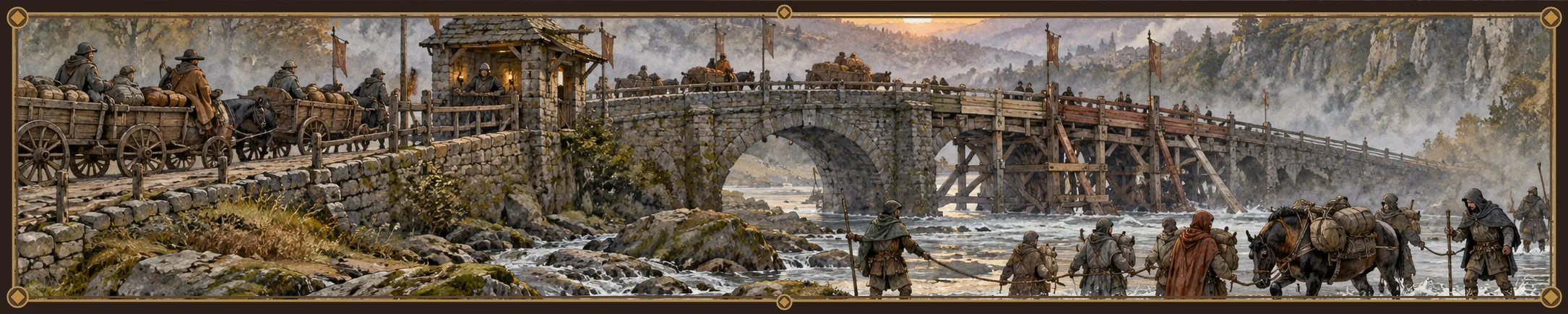
Pay the lord at his bridge and the town at its gate,
pay the Troll at the Rattlecut and the hold at the last;
then pay the road itself, in mending,
for it is the only one that keeps the count.
Nobody on medieval Caeldon simply travels. A journey is a string of handovers, each to someone strong enough to hold that stretch of the way and take a toll on it: a lord at his bridge, a guarantor at her reach of river, a Troll house at its ravine, an escort captain on the wind-shelves, a Gnome station at its quay, a route keeper in a threshold chamber underground. Each keeper asks something before the traveller may go on, a toll, a name, a sponsor, a count, and each keeps its own custom for what happens if the way fails. Between the keepers lie the wilds, where nobody keeps anything: wolves and bears on the passes, raiders at the fords, outlaws on the roads, and older, stranger things in the ruins the roads run past. The roads are old, and most were built by people who are gone. Each age has seized the same routes anew, and no older people has ever let go of its hold on them. The medieval present lives on those roads by keeping them, and keeping a road is how a people comes to count on it. Whoever has kept a crossing longest usually thinks it is theirs. Whoever has the men to hold it usually disagrees.
Old Roads, New Claims
The oldest roads on Caeldon were laid by the Upland Colossal world, which built the first great road network and then withdrew, leaving its roads without their builders. Its ridge roads still run along the heights. The greatest of them, the Long Tread, runs for weeks along the outer crest of the Ironspine from one gate to the next, too broad for any living builder. In the Broken Marches the Tallgrade runs on a grade too broad and too even for anyone now alive to have laid. Troll lines took charge of that network’s crossings under sworn charges while it stood, and kept the oaths after it was gone. Survivor lines walked the abandoned roads in seasonal circuits and became the Salvage Peoples. Much later, Human corridor powers set debt-bound Ogre camps to work on roads and fortifications, and Humans and Dwarves built the Headwater exchange roads over the same country, partly with that labour.
Every one of those layers is still on the ground. A medieval caravan on a Headwater road may cross a Dwarven bridge older than the town beside it, follow a stretch cut and embanked by a chain-camp whose camp-marks still name it, climb onto a colossal grade the kindreds keep, and pay a Troll house that holds its ravine by an oath older than any lordship. Younger frontier and war roads cross the colossal grades on worse foundations and fail first. Colossal roads fail too, without warning, because they are too large to mend properly, and a crew clearing one may lift a slab and find what the old builders sealed beneath it: mostly rubble, now and then a vault. And each layer’s keepers still demand a say in how the road is used, and back it with whatever spears they have.
This is the thread the histories call Roads and Crossings, and it runs into the medieval present as fought-over passage, repair forced on the weak while the strong take the tolls, Troll tolls nobody living ever granted, kindred keepright against a lord’s word, and at the Greyford Reach a failing bridge where every grudge on the thread meets at once.
What a Road Is
The word means different things in different countries, and a traveller who mistakes one kind for another is in trouble before the first toll.
A river. On the Lower Serath the river is the road. Downstream travel is fast and cheap on the current. Upstream is slow, by towpath and pole, and much of it goes by land along the rises. Ferries tie the banks together at every town. River-thieves lie up in the reeds, wreckers light false marks above the shoals, and every bargemaster hires sellswords against both. In the Headwater Marches the opposite holds: above the basin edge the rivers run too steep and fast for boats, so they are crossed, not travelled, and bridges and fords decide where the roads can go.
A built road. The exchange roads of the Headwater Marches climb from the basin Sheaf Road through walled foothill towns and waystations to the outer gates of the Dwarven holds, over Dwarven stonework and Ogre-cut embankments (see The Basins and the Marches). In the Ironspine the passes are hold roads, walled, gated, and shut in winter, and the oldest follow colossal ridge roads.
A kept path. The Elderweald has no roads, only paths walked open rather than cut, along which a watcher from the nearest grove leads every visitor (see The Forest Heartlands). Human roads stop at the treeline, so traffic between the basins and the Ironspine goes round by the Headwater Marches.
A way by leave. In the Crownboughs the main roads are in the air: boughways running hall to hall and court to court, each belonging to the house whose growth carries it, so that travel aloft is by leave, and a fall from one is the ordinary death of the careless. Under the Ironspine the underways run hold to hold through the rock, the safest roads in the belt and the most closed, each hold keeping its own stretch and granting passage on its leave, while Kobold crews use service ways between them that no hold has mapped. In the Stonewake Deeps the warded corridors run junction to junction, and the greatest route of all is the Hauling Stair, the shaft by which stores come down and ore goes up.
A spoken way. In the Roothollows movement runs along the Known Ways, the routes the route keepers count survivable, kept spoken rather than written and learned by mouth and by foot. Under the old oath of refuge a Known Way is the only kind of route along which someone in need may be sent on, so adding a route or striking one off is never only a matter of where the water has risen.
A line of knowledge. On the High Scars a road is not a built surface at all but a line of cairns, shelters, warning ridges, and treaty-ground ledges where parties change hands (see The Windscar). On the fading lines the Cairn-Wakers stand across the route, escorts who failed to warn and cannot rest, and no party passes one without a word for the dead.
A water road. In the Rimward Basins there are no rivers, and routes run from one water source to the next; a route is only as open as the last well on it, and struck-name raiders know it. On the Tidelace the highways are water and every one is marked: the Lacework, the inner channels behind the islands, surveyed by the nearest sounding house and its marks moved only in front of the families who set them; the faster outer roads seaward of the islands, which close first in fog and storm. In the Tidebound Reaches the roads are currents and rivers, and almost nothing on them is cargo: what moves is people, clutches, notice, and memory, carried home in return season on the great current road called the Homeward Set, with blackfin pods following.
A timed road. The Lee Road runs from the Leeward fold markets to the Rimward Basins under Windscar escort and keeps Halfling market timing, so that a party off its day waits, and can lose its season waiting.
Tolls, Tallies, and Guarantees
Almost every crossing on Caeldon has a keeper and a toll. What the toll buys is the question.
The Crossing and the Promise
In the Confluence Basins passage belongs to whoever holds the crossing: a lord at a ford, a walled town at its bridge, a march-town at its ferry. In the Headwater Marches it is a lord at his bridge, a town at its gate, the Troll house at the Rattlecut, and beyond the last waystation, the hold. Whoever holds a crossing takes what the traffic will bear, for as long as they can hold it.
On the Lower Serath the toll means something else. Above Toll’s End a basin lord’s toll buys one crossing and nothing else, and his men take what they like and give no tally. Below it, the dues a town of the Serathic League takes are supposed to buy a guarantee: the reach kept clear, the landing guarded, the crossing repaired, and the thieves hunted.
A sworn guarantor keeps each reach for the town’s great houses and writes the day’s dues and the day’s repairs side by side in the guarantee roll, which the great houses seldom read against one of their own (a guarantor’s day is followed in The Basins and the Marches). Where the dues are taken and the upkeep never comes, the cheated call on Ostrin the Lantern-Bearer, whose iron Ashen Lantern hangs at some water-gates, watching for exactly that.
The Tally
A bargemaster pays each League town’s dues for a passage tally, a notched and sealed token that proves the reach was paid for, so that the next town does not charge for the same water twice, and a town may hold a barge that cannot show the tally from the reach above. Above Toll’s End no tally is given. On the Lying Shoals and the other braided reaches the guarantee is only as good as the pilot, who is hired separately, for wages, not tolls, and a bargemaster who saves the pilot’s coin may end on the shoals with the river-thieves rowing out to meet him.
A tally is the only honest thing on a river. It does not say the reach was kept; it says I paid for it to be. Whether those are the same depends on who is asking, and how many spearmen he has.
A Road-Book of Both Halves
The Toll Gate
At Greyford, where the Headwater road meets the Broken Marches, the toll is taken once, at the Highbank gate of the Greyspan, in whichever direction people cross. The Tollwardens take what the lord asks, chalk a mark on the cart, and tap the braces with a mallet, marking any that ring dull, and what that toll owes the bridge is the quarrel of Greyford’s year (see The Basins and the Marches). At the side fords in the low months walkers pay less, in coin or in kind, and the river-raiders who work the fords take the rest. At the Lowbank end of the span there is no gate at all, only Goblin guides offering a bed or a safer road into the Marches.
Paying in Other Coin
Not every keeper wants money. In the Leeward Folds water is the one thing nobody bargains over: a party drinks what a cistern hall has said aloud it can spare. In the Rimward Basins guests are fed from a share that everyone in the camp knows. In the Stonewake Deeps a warded or sealed route is opened by the custodians' word, never sold, and those who try to buy their way past a seal end in the custodians' cells or behind the seal. On the Tidelace a pilot back from a hard passage pays Maris her toll of story, spoken aloud at her shrine. And the Ogre burden-camps that clear a pass or carry a load are paid first in food: a camp is fed and sheltered before it lifts anything.
Fords, Ferries, and Bridges
Where a road meets water, the water usually wins in the end, and every crossing is a bargain with that.
In the basins and on the Serath fords shift and banks slump, and some crossings lie about their own depth to anyone who has not watched them for a generation. In the Headwater Marches a bridge that stood for a century can go in an afternoon, and most fords are usable only in the low months. The oldest Headwater bridges are Dwarven, and the rivers there were channelled and bridged by Dwarven work before any Human town stood on their banks.
The Greyford crossing shows the whole repertoire in one valley: a lord’s bridge of old stone piers and newer timber spans set inside a braid of side channels, gravel bars, ferries, rope crossings, and low-water routes, where Goblin side-ford families and Kindred guides stake the fords in the low months, rope a party together, and go first with a pole. And at dusk the dead of old crossings are seen on the span, which is one reason the gate shuts at the dusk bell.
On the lower rivers the keepers are the Reedfolk, and no sensible boat crosses the Reedmere without one of their pilots, whoever takes the toll at the landing. In the Briarreach the one reliable through-route follows the cut of the Sallow, a narrow, silt-heavy river whose crossings are kept by Troll houses and change hands, collapse, and reopen over generations, and where the Troll families pile a stone at every place a ravine cat has killed.
Some crossings are stairs. The Verge Stair, between the Ironspine and the Crownboughs, is a stone stair of Dwarven building that ends at a gate the High Elf courts grew; each side has kept its own half for longer than anyone can date, and most exchange is done on the landing between. On the Soundchain Roads the Gullstair and lesser cliff paths bring escorted parties and their herds down from the Windscar routes to the stations' beach yards.
Escort and Answer
Toll buys passage. Escort buys the chance of arriving, and on most of Caeldon’s dangerous roads it comes with a promise: that the escort will warn in time, and that if the road betrays the party, someone will pay for it in goods, in service, or in blood.
Below the Gates
On the Headwater exchange roads escort below the gates is Human and Hobgoblin, drawn from town and lordly garrisons and from the watches of the Iron Compacts on the stretches they hold by a lord’s warrant. The roads are escorted against people as much as against rockfall, because metal and coin on a mountain road draw thieves, and the outlaw band that takes a caravan in the high passes is the oldest story on the road. Where the holds' gate-watch begins, hold wardens take the caravan, and the road ends in the oath-yard inside each foothill hold, where every bargain is sworn before a custodian.
On the Wind-Shelves
On the far side, escort is the whole of the road. The High-Scar escorts of the Windscar Pacts keep route moots that hear complaints against escorts, cairn-line wardens who keep the markers true, warning runners, escort captains, and the elders of the treaty-grounds, before whom a party is taken on or handed over. An escort’s name rests on one test: did the parties it guided arrive, and when they did not, was the reason sent ahead in time?
Most deaths in the High Scars come from exposure, rockfall, wild dog packs, struck-name raiders, and bad guidance, and the last is the one Orcs fear most, because it is the one a person chose; a storm delay is forgiven only if word of it is sent ahead (the escort custom is told in The Windscar). A party needs several hands to agree: the escorts, a Troll house at its crossing, a Rimward custodian at the bottom of the descent, and the weather. Beyond all of it travel the bands formed around those whose names were struck from honour, and their heirs, who know the routes as well as anyone, guide for whoever will pay, raid whoever will not, and answer to no route moot.
At the End of the Road
At the end of a far-side road a sworn party is owed an answer, not necessarily a welcome. A Rimward stronghold that must narrow access cannot simply turn away a sworn escorted party: it owes it one of three answers, a small, guarded welcome, a later welcome on stated conditions, or a guided turn towards another well that can take them. Halfling cistern halls first gave those answers; the Rimward Passage War forced them on the strongholds of basin and route.
On the Soundchain Roads the answers are the stations'. An escort nearing the coast sends word ahead, its captain declares the party at the beach yard, and the keeper takes it in, holds it until a named day, or points it down the coast, while officers of the Answerward Pilotage carry each answer in the same words from station to station; held parties wait in the lee anchorage every Orc escort calls the Patience (see The Tidelace and the Soundchain Roads).
Behind all of this stands one far-side rule, learned in blood on a cold shore: delay must be said aloud. A coast that holds a party must say so, and why, and name a day to ask again. Orc captains say a refusal in fine words is still the coast keeping them out, and they keep their own memory of which stations answered in time and which did not. The arriving party gains no right to come in. It gains the right to know which answer it has been given, and the escorts gained, after the closure years when beacons were thrown down and a Gnome pilot was killed on the Gullstair, the right to add the answers up.
Answering for a Wrong
A wrong between Orc kindreds is never answered in secret but declared at the next treaty-ground and held to the measure of the wrong (the custom is told in The Civilizations of the Medieval Era). In the cradle the same need is met by a lord or a great house: a League carrier whose cargo is lost on an unkept reach brings the tally to the toll-house, the great houses read what the guarantor wrote, and they decide, usually in favour of whoever has more friends among them.
Stations, Shelters, and Wells
Between the keepers stand the places where travellers stop, and on most roads the stopping places decide the road more than the road does. Beyond them lie the wilds, wide and deadly, where nobody keeps the way and nobody can be called on, so nobody crosses them alone: travellers go in armed companies from one stopping place to the next, and a journey between regions is reckoned in weeks and months.
Each of them is described with its own country in the atlas.
-
Waystations. Walled stops on the Headwater exchange roads, a laden caravan’s day apart, between foothill towns built round a market, an oath-house, and a yard where caravans are made up and broken.
-
Oath-yards. The walled yards inside each foothill hold’s outer gate, where the exchange roads end, every bargain is sworn, and visitors rarely go further.
-
Inns. At Greyford, merchant inns for factors and their sellswords on Highbank’s square, with a corner table kept by the bounty-takers, and carters' inns out along the road.
-
Passward shelters. Stone-walled refuges at the mouths of High-Scar passes, kept stocked by whoever holds the route and full in the windy season.
-
Strongholds and wells. Walled spurs above the Rimward water sources, and on the inland rim the Lastwater Wells, where Glassbelt crossings begin and end.
-
Cistern halls. The yards at each Leeward fold head where a party is answered, watered, and sent on without setting foot on the good ground.
-
Stations. Each Soundchain sound’s quays, declaration house, store sheds, sounding house, and beacon towers, with quay-wardens hunting pilferers through the sheds.
-
Receiving grounds. The Understorey Courts at the foot of the Crownbough canopy, where few envoys are ever taken higher, and the Thornbound Waitfield at the edge of the Briarreach, where most trade happens and goes no further.
-
Gathering-markets. The Edgeway kindreds' markets at ruined sites, such as the Undercroft Fair in the Broken Marches, often the only places where people of distant broken regions trade, marry, and settle quarrels.
Keepers Without Territory
The worst crossings and the longest roads belong, in practice, to peoples who hold no land at all. Their power lies in local memory, route knowledge, their name on the roads, and the plain fact that no distant lord can make a broken ravine safe by his word. Their orders are told in The Civilizations of the Medieval Era; on the road a traveller meets them like this.
The Troll crossing houses hold bridges, ravines, flooded causeways, landslide routes, and storm-torn passes in the Broken and Headwater Marches, the Briarreach, and the High Scars. A house decides when its crossing is too dangerous to use, warns of it, mends what the slides break, and names the Bridge-Dead at every repair, and escort captains on the High Scars have learned to bargain with it rather than override it. On the Human side of the Marches troll-hunting is a trade, and every crossing house hunts the hunters in turn. The Edgeway kindreds keep more road than anyone and are present at each piece of it only a few weeks a year. Their waymarks claim a ruin or grade its danger from braced to never-touch, and road-wardens follow the danger-marks without admitting it; where a kindred’s marks have been scraped off, it stacks the scraped stones at the waymark as an offering to Corrow the Gale-Runner and cuts the marks again nearby, and kindreds say the stacks hum in the wind. Their keepright over the works they keep is the source of most of their quarrels with the lords who depend on the same culverts.
Heavy work on the roads is done by Ogre bands of the Hearth-Weight Compacts, fed and sworn before any load moves, and in a hard season a walk-off can stop a route as surely as a slide. They haul dressed stone and beams on the Headwater roads and keep the winter roads open, driving the pass bears off the waystations every autumn with fire and staves; on the High Scars they clear rockfall, carry stores to the shelters, haul the injured down, and rebuild collapsed ledges. Goblin companies of the Iron Compacts hold frontier roads, fort watches, and gates under a lord’s warrant and bring back heads, not prisoners, and a new lord may tear up his father’s warrant and send a compact on the march to nowhere that every Goblin song remembers. Below ground the Kobold crews of the Underhouse Compacts keep the underlayers alive. Their underways and old service tunnels in the Broken Marches carry people and goods that would rather not be seen, treasure-seekers hire their guides for the sealed storeworks the crews break into, and a crew’s refusal closes a shaft without a single seal-mark.
On the water the keepers are pilots. Reedfolk pilots hold their berths on the braided Serath by whatever bargain their reach keeps, and a Floodkeeper house may refuse to sound a reach whose guarantor has ignored its flood warning, and leave the town to explain the closure to the carriers. On the Tidelace the harbour’s pilot families take the helm of any stranger’s craft at the harbour mouth; at the Sounding Gate a craft must take the channel in the window the harbour names, with one of the harbour’s pilots at the helm. At the far-side river mouths Gnome pilots sound the marked channels and keep hazard markers, while Thaluren run-watchers close the ascent channels in return season; a fishing passage is not a return run, and a return run is not coastal traffic, and the drowned on the shelves are what happens when someone forgets which is which.
Signals and News
On most of Caeldon news moves faster than goods, and the means of moving it are part of the road.
The far side builds for it. On the High Scars warning fires on one ridge can be read from the next shelf before a runner could cover half the distance, and older children graduate from running messages between camps to warning runs, carrying news of storm, slide, or raiding along the warning ridges faster than any caravan moves. Along the Soundchain Roads and the Tidelace headlands the beacon lines carry closings, fog warnings, and the days a held party may ask again far faster than any hull; a closing called at one station is burning on the next headlands by nightfall, and a harbour that misreads a neighbour’s light is shamed along the whole coast. In the Tidebound Reaches messengers swim ahead of a run to give notice at the mouths and upriver, and a Kavari village sees notice before it sees escorts and escorts before it sees a run.
The cradle moves news on paper and on foot. Letters and rolls travel with nearly every convoy on the Serath and the Sheaf Road: grants, guarantee rolls, debts, oaths, and the second copies careful scribes keep somewhere else, because a lost roll is a debt or a grant the stronger side can deny. Along the heights of the Ironspine and across the Broken Marches, salvage, news, and danger-warnings travel the kindred circuits, which link the Marches to ruin zones as distant as the Glassbelt and, by the one crossing over it, to the far side. Corridor carriers from the Serath brought the name of Ostrin the Lantern-Bearer up the Headwater roads to Greyford. Below ground, the Kobold crews' sound codes carry a warning through a whole underhouse.
From the Headwater valleys, valley folk read one more signal: the Weatherline, a chain of colossal weather shrines on the Stormcrown’s highest ridges that shows as a broken row of notches against the sky. When cloud hides the notches, the high roads will close before night.
At the Border
A border on Caeldon is rarely a line. It is the point where another people’s keepers take charge, and what a stranger meets there says more about a people than any map. What follows is what a traveller meets first, people by people.
In the Cradle
At the edge of the Briarreach a stranger does not walk in. They wait at the Waitfield or a hedge-edge until watchers come with their questions, and hospitality, if it comes at all, comes in steps, each under a sponsor who swears your harm is my harm and pays for whatever the guest does (the steps are told in The Forest Heartlands). A guest who walks in unasked meets arrows out of the hedge. Passage is held twice there: a Troll house decides who may cross its ravine, and a traveller who has paid one has not satisfied the other.
At the Elderweald a visitor is not turned away, but does not walk alone, and paths to the dead, to the stair-mouths, and between the deepest groves are not walked by outsiders at all. The danger most visitors meet is the one they bring: a living tree cut, a stream turned aside, or a fire set in the wrong place is not a small offence but a wound to the forest, and the welcome ends with it.
At the Crownboughs an embassy is judged by how high into the canopy it is received, and most are received at the Understorey Courts and no higher. At an Ironspine gate a traveller enters under gate oath and leaves owing whatever was sworn, and in the Headwater and basin towns a stranger is asked early whose god they swear by.
In the Roothollows a stranger or refugee comes first to a house’s threshold chamber and never further, where the threshold-keeper hears the stranger out before the household and the house must shelter, refuse, or send the stranger on by a Known Way it will swear is survivable (Stone and the Deep). Refusing refuge is a betrayal never forgiven; every stranger at the door may also bring the flood.
At Greyford’s Lowbank end there is no gate. Past Lowbank no one escorts anyone, and paths fan out from the ruined causeway onto broken frontier roads and kindred circuits that Goblin guides sell. In the Broken Marches passage is never simply free: a warranted road is kept by its compact, Troll houses charge at their crossings, Goblin guides sell safer detours, outlaws hold whatever nobody else does, and kindreds expect kept works to be left no worse than found.
On the Far Side
The Leeward Folds feed a traveller at a household door without question, but a party is received at the fold market or the cistern hall, and being received is not being let in. A party nobody refuses can still find that the cistern hall’s answer is not yet, and those who try the terraces uninvited meet the fold’s young on the walls with slings.
At a Rimward stronghold a party arriving in the dry months comes down the ramp in front of the camps pitched in their rings, and whatever is answered at the cistern is answered in sight of everyone whose water it is, with spears on both sides in plain view. At a Soundchain beach yard the captain gives the kindred’s name first, then the party’s count, and the keeper’s answer is given in front of everyone. At a Tidelace harbour mouth a stranger’s craft waits for its window and gives its helm to a pilot of the harbour’s families.
A Thaluren met on the current roads is asked run and hatch water before anyone asks about household (see The Tidebound Reaches and the Unrun Sea). Where Thaluren and Kavari waters meet, it is usually over a marker: Kavari nursery keepers mark the nursery-water and forbidden channels, Thaluren escorts send notice ahead and keep within the marks, and quarrels go to a circle at the water’s edge, where the side with more kin at the water usually has its way. A run that strays past the marks meets barbed spears.
And at the Lastwater Wells, where the Glassbelt begins, the border is simply the last water. Parties going out drink there for the last time. Parties coming in reach it first, often with nothing left.
Tensions
-
A claim at a shared crossing. Where kindred circuits and Troll crossing houses meet on the same road, kindred marks and house oaths often record the same danger in different terms. Both rest on the same colossal road network, the houses on charges sworn while it stood and the kindreds on walking it after it was abandoned, and at a shared crossing the side that holds it is usually the one with more people standing at it.
-
The forged tally. Passage tallies from one upstream town are turning up in numbers no toll-house could have issued. Either someone is forging them, or the town’s own guarantor is selling them without collecting dues, and every town downstream must decide whether to honour them.
-
The thief-lord of the shoals. A river-thief band below the Lying Shoals has grown large enough to sell protection to the barges it once robbed, and some guarantors are said to be paying it rather than hunting it.
-
Roads too large to mend. Colossal grades such as the Long Tread and the Tallgrade are kept in stretches by gate holds, kindreds, Troll houses, and frontier powers, and none of them can mend the whole. Younger roads laid across them on worse foundations fail first. On the Long Tread the gate holds keep the stretches by their doors and the kindreds keep its culverts, and neither will let the other hold the whole.
-
A captain in the Patience. A counted party has been held below the Gullstair for a full season. Every delay has named its reasons and a day to ask again, but fever is in the camp and the water is short, and up in the High Scars the captain’s kindred is beginning to call it a refusal in fine words.
-
Raiders on the low fords. A band working the Greyford side fords has taken three parties mid-channel and left the guides drowned. The Bridge Hall says the fords are not its business; the Goblin ford families have put a bounty on the band out of their own pockets, and a Kindred guide swears one of the raiders wore a Tollwarden’s apron.