Chapter 15. The Windscar
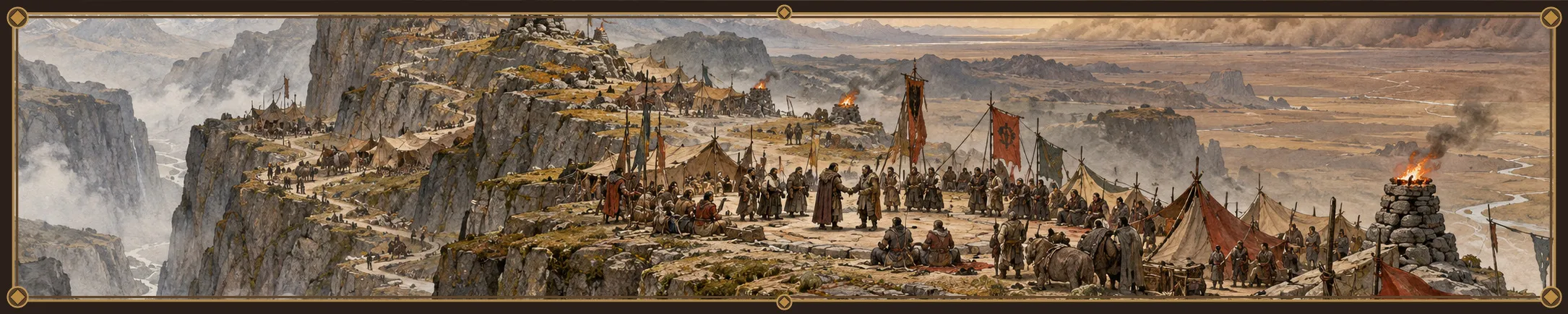
Say the storm before it finds you,
say the slide before it falls,
say the wait before they ask it:
the road forgives the one who calls.
The Ridge-Calls
Beyond the one crossing, past the glassed ground that parts the two halves of the known world, the land rises into wind. It climbs in steps, shelf above shelf of bare stone and thin grass, each one cut off from the next by a cliff face the colour of old bone, and below the highest of those faces lie bowls of salt and cracked clay that hold water for a few weeks in a good year and none in a bad one. This is the Windscar Expanse, the country of the Orcs, and one of the first signs that Caeldon is a whole planet rather than one crowded valley of peoples. It is not quite desert; it is something that teaches the same lessons more slowly. What kills here is distance, and the dun dogs that follow it, and the raiders who wait at the wells for parties the distance has weakened. The Orcs answered it long ago not with walls or kings but with the escort: an armed company that brings a party across country that kills the careless, warns it in time, and rides out to take blood if the road betrays it, and a name that dies if it fails. Those oaths, kept and broken for more than a hundred and fifty thousand years, are the Windscar Pacts, and everything else in the Expanse hangs from them.
The Expanse and the Pacts
The Windscar is a country of exposed breadth: open uplands, hard seasonal margins, interior basins with salt or dust floors, cliffs, and a few thin corridors where a party can live long enough to cross. It fills the west of the far side, from the edge of the Glassbelt east to the Lee Wall and north to the sea cliffs above the Soundchain Roads, and what lies south of it nobody has mapped. The prevailing wind is dry, off the desert. Its distances are long: about three months from the Lastwater Wells to the Lee Wall, about four months from the basin rims to the sea. Its only settled cores are the rim strongholds of the Basins; the rest is open wild, and every party crosses it with a kindred or an escort, or does not cross it. It has two halves, and the Pacts keep them distinct. Above lie the High Scars, the escarpment and pass country, held by moving escorts. Below lie the Rimward Basins, the rim country of defended wells, held by keeping. Inland, past the last of the wells, lies the Glassbelt Interior, a true desert nobody holds. Beside the Expanse, past the Lee Wall, lie the sheltered terraces of the Leeward Folds; coastward, at the end of the longest escort routes, the Gnome harbours of the Tidelace Coasts.
A People Built for Distance
Orcs are tall, heavy-boned, and long-striding, built to walk all day under load and to bear wind, cold nights, and short water better than most peoples. They tire slowly, and an old escort’s body carries the marks of every bad crossing. They are not distorted Humans or wilderness caricatures, and their history began and has largely stayed far from the cradle-web. A child is named into its kindred at its first gathering and is grown when it answers for its own word on the route; the Orc life from naming to the keeping of the dead is told in The Folds, the Scarps, and the Shore (FND).
The kindred is the household that matters, and it moves. The dangers are common enough that every kindred raises its children to the spear. A stranger meets Orcs first as a party on the road or a watch above a ramp, and is received, if at all, in the open: fed from a declared share that everyone in the camp knows, and told plainly what the camp can spare.
Three Countries of Orcs
About 180,000 people live in the Expanse, and nearly all of them are Orcs: some 80,000 in the Rimward Basins, some 48,000 in the High Scars, and about as many again in the Open-Steppe kindreds of the dry country north of the Scars, out to the sea cliffs, with a thousand or two Ogres and Trolls on the routes. The Open-Steppe Orcs herd, dress, and are named as the rest of the Windscar is; they are as lean and long-limbed as High-Scar Orcs, and they are the kindreds most often away on the coast run, sometimes for whole seasons. Shares of water and pasture in the steppe are sworn anew at gatherings they often miss, and the kindreds who stayed treat what was agreed in their absence as agreed. Beyond the last well to the south, herders say, there is grass, and a dry river-bed lined with old stones, and the last camp-ring of a kindred that went to look and never sent word.
Held by Pact
The Windscar Pacts are the oldest major named civilization of the Orcs and the first great inland civilization of the far side. No settlement stands over the others, no basin king sits anywhere, and no capital exists to be taken. The Pacts hold open country, not walled ground, and power belongs to whoever can bring people and goods alive across the shelves, keep a treaty-ground without treachery, and answer a raid, a betrayal, or a broken escort with spears. They are hard, but they are not chaos. Escort is a duty as much as a trade, water and pasture are shared by agreement sworn at the treaty-grounds, and an old custom of answering blood keeps feuds from becoming wars. In Orc country the difference between raiding, escorting, guarding, and surviving is decided by who swore what to whom, and often by who is left standing.
The Pacts keep two rights apart. Reserve-right belongs to the anchored side, the custodians who hold water and give a declared reply to arriving parties. Treaty-right belongs to the exposed side, the route moots, cairn-line wardens, warning runners, escort captains, and the elders who keep the treaty-grounds. Neither may erase the other, because each is backed by enough spears that it cannot be erased, and the two meet, often with hands on weapons, at the Oath Cistern, at the foot of the Shearline.
A Treaty-Ground Gathering
In the calmer months a kindred travels to its treaty-ground and pitches in the place its line has always held there. For an ordinary Orc the gathering is the one time in the year that most of the people they know stand in one place. Herds are traded, marriages arranged, young escorts taken on by captains, and news of every route exchanged. The serious business is done before the whole gathering: escort terms sworn, grievances aired, and the names of the dead recited with the crossings they held, as the rite of the Reciting of the Names requires. It is said that if the names are spoken with true respect, the kindred is granted a year of safe passage. A kindred whose names are recited badly, or not at all, leaves with less honour than it came with, and everybody saw it.
The names recited longest are the escorts who held a crossing: the captain who took a whole caravan down the Shearline in a dust storm by the feel of the rope; the warning runner who ran three shelves with a broken foot to light a cairn-fire before a flood came down a wash; the escort who stood alone in a pass against a struck band while her charges got away, whose name the band itself is said to honour. Children on the rims play her stand with a stick for a spear and a ring of thorns for the band. The toast at every season’s-end fire is to the escorts who brought a party through when the wells were dry and the dun dogs were on the line.
The Declared Answer
A wrong between kindreds is never answered in secret. The wronged kindred declares its answer aloud at the next treaty-ground, the elders hold it to the measure of the wrong, and an answer taken without declaration is not retaliation at all but a raid, and may be answered in its turn; the custom is told in The Civilizations of the Medieval Era. Most answers are paid in animals, but when blood is owed a kindred sends its best, and every kindred has its blood-feud that began with a passage betrayed.
Name and Wind
Orc belief is local and kept by the clans, with no priesthood anywhere in the Expanse. Two gods divide it. Ushkar the Ancestor-Warden keeps the names of those who held passage and strikes the names of those who broke it, and the clans' lineages, honour, and dead are kept under him. Rakhal the Storm-Caller is the scouring wind of the Expanse, breaking whatever has gone stale. At the start of the windy season camps light First Gale fires on high ground and dance as the wind rises; it is said that if they are lit with true defiance, Rakhal grants a year of change and renewal, and when lightning strikes a lone thorn on the shelves, kindreds say he has marked a place where someone once held. Beneath both gods, escort custom is its own alignment custom of held passage and answered betrayal. The two gods pull against each other in every camp. Ushkar’s people say a captain is worth what the line has been worth; Rakhal’s say a road is worth what it is worth this year, and a name that cannot answer for this year’s road is only a name.
The High Scars
The High Scars are the travelling half of the Windscar. Few of the people who live in them stay anywhere for long, and what holds the region together is not a settlement but a promise: that a party taken under escort will be guided honestly, warned in time, and avenged in blood if the road betrays it.
Shelves, Faces, and Passes
The Scars are the northern and eastern half of the Expanse. They rise in shelves from the Shearline, the escarpment facing south over the Rimward Basins, and beyond them the dry country runs on north to the sea cliffs. West of them lies the Glassbelt; south-east, the escort routes come down towards the Leeward Folds. The Whetgap cuts the first shelves above the basins, with Gapmouth at its mouth and Slidescar on its worst stretch, and Oldcairn lies on a high shelf beyond, five or six weeks from Deepdraw by the ramps and the pass and two to three months from the Turnwater Quays by the longest escort routes. The Scars have no settled core, only fixed points on the routes; between them lie open shelves where nobody goes except in an escort.
The High Scars rise in steps. Long escarpment faces separate one shelf from the next, and the greatest of them, the Shearline, is the cliff-broken edge where the high country drops towards the basin rims. Between the faces lie bare plateaus of stone and thin grass, scree fans, dry ravines, and a handful of passes cut through the rock by wind and old water. Visibility is enormous on a clear day. A warning fire on one ridge can be read from the next shelf before a runner could cover half the distance, and a party crossing a shelf can be watched for most of a day by people it will never see.
The wind is the first fact of life. It funnels through the passes hard enough to strip a camp, carries dust off the lower basins in brown walls, and shifts with little warning when the seasons turn. Storms come fast along the faces, with lightning on the high ground and sudden rock-slide below. Water is the second fact: a few seeps, cisterns, and catch-pools along the routes, each one known, named, and argued over. The rivers are only seasonal torrents that cut the ravines deeper and leave them dry.
Most deaths in the Scars come from a handful of things. Exposure on the open shelves, when a storm catches a party between shelters. Rockfall, scree slides, and ledges that give way in the passes, especially after hard rain. Beasts: packs of dun dogs that shadow a party for days and take the straggler (an escort child’s first warning call is on the line, meaning a pack is following), scorpions in the shelter walls, wound flies that lay maggots in an open cut, and in a swarm year locusts that strip the shelves until the herds starve. Raiders: struck-name bands who know the routes as well as any escort and fall on parties in the passes, often in the last hour before a shelter, when everyone is looking at its walls. And bad guidance: a warning not given, a delay not declared, or an escort that claimed knowledge it did not have. The last is the one Orcs fear most, because it is the one a person chose. Its dead do not always lie still. An escort’s dead whose wrong was never answered may rise as Cairn-Wakers and stand across the route at a fading cairn, and a party that pushes past one does not always come out the other side. A ring of scar vultures over a pass is read as news before any runner arrives.
Life Along the Routes
High-Scar life is lived along the routes rather than around fixed towns. Kindreds move between seasonal camps on the sheltered side of ridges, with their herds grazing the thin grass of the shelves until it gives out, then moving on before the ground is spent. Larger gatherings happen at the treaty-grounds and at the passward shelters: stone-walled refuges set at the mouths of passes and the ends of exposed stretches, kept stocked by whoever holds the route. A passward shelter in the windy season is a crowded, smoky, patient place, full of parties waiting for a pass to open and escorts arguing about when it will.
Most adults have some share in escort work, even those who never captain a party. A child’s first lessons are cairns: which stacked stone points the way, which marks a water hold, which records a death. Older children run messages between camps and graduate to warning runs, carrying news of storm, slide, or raiders along the warning ridges faster than any caravan moves. Herd-children learn early to throw stones at the fast spotted wind cats that sprint in for the kids and lambs, and to pull the purple stagger-vetch before the herd finds it. The year turns on the wind. The windy season closes the highest passes and fills the shelters; the calmer months are when escorts move most traffic, herds go highest, and treaty-grounds fill. Food is lean and portable: herd stock, milk, dried meat, and whatever grain and fruit the escort trade brings up from the basins and the folds.
Two other peoples live along the routes, and the orders of both reached the far side from the cradle-web by the one crossing. Troll families of the Crossing-Oath Houses live settled on the crossings they keep for generations, mending what the slides break and taking their price from whoever crosses, and they swear their crossing-oaths under the title of the Mountain-Father, as their houses do on the far side of the Glassbelt. Ogre burden-camps appear when the routes need more than Orc backs can give: they clear rockfall, carry stores to the shelters before the windy season, haul the injured down, and rebuild collapsed ledges. They come under the terms of the Hearth-Weight Compacts, which means a camp is fed and sheltered before it lifts anything, and leaves when the work is done; its fires are kept for Ghessa the Hearth-Mother, whose fires burn on this side of the Glassbelt only in the camps of the burden orders that keep the crossing.
Rarest are Giants. Old guides speak of high storm shelves, well above the cairn chains, where Giants still pass, but few living escorts claim to have met one. Some of the oldest cut ledges may be colossal work, and guides tell of a sealed door in one cliff-face too tall for any Orc to have made, which nobody who went looking for has found twice. Thingrass tales put the colossal dead behind it with their gear, and every few years a young escort goes looking with a rope and a sack, and the kindred raises a cairn when the season ends.
Who Holds a Road
Power in the High Scars belongs to whoever can make passage safe, or make a broken passage cost blood, and it is spread across several hands.
| The escort orders |
The High-Scar escort orders are the region’s heaviest power: route moots, where elder captains hear the grievances of the bereaved and name the blood-price; cairn-line wardens who keep the markers true; warning runners; escort captains; and the treaty-ground elders who stand by when a party is taken on or handed over. They are heeded on a simple test: did the parties they guided arrive, and when they did not, was the reason declared in time? A kindred the orders turn against finds that no party will hire it. |
| The kindreds |
Behind every escort stands a kindred, and behind every kindred its remembered tally of crossings held and betrayals answered. A captain’s word is worth what their line’s word has been worth, and a blood-price unpaid is collected by the bereaved kindred’s own blades, sometimes a generation later. The longest blood-debt on the shelves has run eleven generations between two kindreds over a single broken passage, and both still recite it with their dead. |
| The Troll crossing houses |
On a few passes and landslide routes, a house holds the crossing by oath, decides when it is too dangerous to use, and takes its price for keeping it. On the crossing its word is final, because it can cut the ropes, and escort captains have learned to bargain rather than force it. |
| The burden-camps |
Ogre camps can refuse heavy work that would consume them unfed or unsworn, which in a hard season can stop a route as surely as a slide. |
The order is contested from inside. Younger escorts, who spend more of their lives among other peoples than among their own dead, ask why a captain’s worth should rest on what their grandparents did on the road. And bands formed around those whose names were struck from honour, and their heirs, live outside the Pacts entirely. They know the routes as well as anyone, guide for whoever will pay, answer to no route moot, and in a lean year raid the parties they were not paid to guide. Their captains' names are spoken as curses at the treaty-grounds, and as boasts at their own fires. The escort orders put a price on the worst of them, and bounty-takers of the kindreds hunt them across the shelves.
The Whetgap and the Roads of Knowledge
A High-Scar road is not a built surface but a line of knowledge: cairn chains across the shelves, passward shelters at either end of the exposed stretches, warning ridges where fires and runners carry news, and treaty-ground ledges where parties change hands. The main crossing of the high country is the Whetgap, a narrow storm-cut pass where the wind is strongest and the scree least stable. Most traffic between the basin rims and the routes outward passes through it or waits for it to open. A Troll crossing house keeps its worst stretch, and Ogre camps are hired there most years to clear what the windy season brings down.
What moves through the Scars is mostly kindreds, herds, and the goods of escort trade: hides, felt, and stock outward, and grain, dried fruit, worked metal, and coastal goods inward from the folds and the Soundchain corridor. Messages and warnings move faster than any of it. Passage is held at several points, and a party needs all of them to agree. The escort orders decide whether any kindred will escort a party at all. A Troll house decides whether its crossing is open and what it costs. A Rimward custodian at the bottom of the descent decides what can be received. And the weather, which no one controls, decides whether any of those decisions matter this week. Escort custom forgives storm delay only if it is declared; a captain who waits out a storm without sending word has, by High-Scar reckoning, half-broken passage already.
Not every blade on the shelves belongs to an escort order. Struck-name outlaws hire out as sellswords to anyone the orders refuse. Hire-spears of no fixed kindred take a party’s pay for a single crossing, and a captain short of warriors hires them and counts them twice at every well. Camp-rings pay beast-hunters by the pair of ears in a dun-dog year, and treasure-hunters come up from the basins looking for a guide who will take them to the Glassbelt edge and no further.
We waited four days at Gapmouth, the shelter below the Whetgap, with eleven other parties, everyone in it wrapped to the eyes, and I learned more about the High Scars in those four days than in the months before. The shelter is a long stone room with a fire at each end and no door on the windward side, because a door there would be torn off; the wind comes in, goes round the room like a dog looking for its place, and goes out again. Over the inner door hangs a spear with a broken shaft, and the first night an old escort told me whose it had been and how the parties sheltering there had taken it from him. Every morning a runner came down from the ridge and said whether the pass was open. Every morning it was not, and every morning our captain sent a runner of our own back down the route to say so to whoever was waiting for us at the bottom. Nobody in that shelter would have dreamed of not sending word.
On the fifth morning we went up. The worst stretch belongs to a Troll house, and its keeper sat on a ledge at the mouth of it as if the mountain had set her down there and forgotten her. She took her price from our captain in salt, weighed by eye, and then she looked along the pass for a long while, at nothing I could see, and said we could go. I have called tolls at a river window for most of my working life and I envied her. Nobody argued. Above her the ropes of the crossing ran along the face, and I understood that nobody argued because she could cut them.
Halfway through, the scree had come down across the path, and an Ogre camp was clearing it, a dozen of them moving stones I would not have tried to move with a team. They had a fire going on a sheltered shelf and a pot on it, and our captain stopped and set a share of our stores beside the pot before we went past. Nobody asked. I asked afterwards, because that is my trade, and was told that an Ogre camp that is fed first is a road that stays open, and a camp that is not is a slide waiting to happen. Beyond the pass a cairn stood on its own on the bare shelf, with a name cut in it that the wind had nearly taken. The captain touched it going by and said the name aloud, so that it had been said once more, and told me, when I asked, that a name nobody says is how the dead come to stand in the road.
Grounds, Shelters, and Houses
The High Scars have no capital and few places that stay put. What stands still is the route: treaty-grounds where parties change hands, passward shelters at the pass mouths, and Troll houses on the worst crossings. The greatest treaty-ground, Oldcairn, is the nearest thing to a centre, since the route moots sit there in the calm months. It is a broad ledge on a high shelf among the oldest cairns of the chains, whose names no living kindred can read. Most of the year it holds a few wardens and elders and the wind; in the calm months kindreds gather in their thousands, recite their dead, take parties on and hand them over, and settle their blood-debts before the route moot, or, when the moot will not settle them, at the edge of the ledge with knives. Every kindred that camps there knows which of the unreadable cairns its neighbours claim.
Gapmouth is the passward shelter at the mouth of the Whetgap: stone-walled refuges, store-chambers, and a catch-pool, kept stocked by whoever holds the route. Ogre camps carry its stores up before the windy season, and once the pass closes it fills with parties waiting it out, sometimes several hundred at a time, all eating from the same declared stores. Its walls have held against raiders twice in living memory, and the second time the parties sheltering inside held them; the raiding captain’s spear still hangs over the inner door. Slidescar, the Troll crossing house that keeps the worst stretch of the pass, is a family of a dozen settled in rock shelters above the scree, mending what the slides break and taking its price from whoever crosses. Escort captains pay what it asks, since it can close the stretch at will, and most years it hires an Ogre camp to clear what the windy season brought down.
Thingrass is what most of the High Scars looks like on any night: the seasonal camp-ring of one kindred, about a hundred strong, pitched in hide shelters on the sheltered side of a ridge while its herds graze the thin grass of the shelves. When the grass gives out the ring moves on. Its children learn their cairns on the walk between grounds and run warnings to the next camp.
Captains of the Whetgap
About 48,000 people live in the High Scars, some nineteen in twenty of them High-Scar Orc kindreds. Ogre burden-camps bring a thousand or more for the heavy seasons, Troll crossing houses hold about four hundred, and Giants are rarer than the stories about them.
Route dress is a knee-length coat of felt or hide, belted, with a hood and face-wrap against the wind, leather leggings, and the hair bound long. High-Scar Orcs are lean and long-limbed even by Orc measure. Most do not die old. One child in three is lost before it is grown, and the routes take most adults, by exposure on the shelves, rockfall and slides, and the raids and retaliation that follow broken passage. A captain who survives the road years is an honoured elder at sixty, and a newborn can expect about thirty years. Names follow the kindred, as in the Rimward Basins, and when a captain stands before a route moot, the passes the line has held are named after the person: Durakh Ishna, Zhaldru Ovra, Thakka Mur. Ogres and Trolls live, die, and are named here as on the cradle side of the Glassbelt.
Memory and Belief
The High Scars remember themselves as the reason the Pacts exist. Long before the Founding of the Windscar Pacts (c. 180,000–c. 150,000 BR), distance here killed whoever tried to cross it alone, and the treaty-grounds, escort oaths, and the blood owed for a broken passage that became the Pacts grew from the need to cross together. Much later the route side hardened into the escort orders themselves, in the High-Scar Escort Orders (c. 121,000–c. 112,000 BR), as the basin side hardened into the well-keepers below. The memory is kept on the land. Every cairn raised where an escort fell is a remembrance, and every route moot remembers which kindreds held passage and which broke it.
The war at the wells is the first tale a captain tells a new party at the shelter fire: the escort-bands that came down the ramps armed and took the wells by force, the sorties from the rim strongholds, the travellers who died of thirst between wells that kept changing hands, and the treaty-ground where both sides swore at last because both had buried too many. Smaller deeds are cut beside the names: the warning runner who outran a raiding band across three shelves in one night and fell dead at Gapmouth’s gate with the warning given, and the escort songs about raiders who tried to cross against a Cairn-Waker’s raised arm, every one of which ends on a slide. The live argument is whether that memory still measures anything true, or whether the High Scars now honour names more than roads. It sits on two of the threads of Caeldon’s history: Roads and Crossings, for who keeps the passes open and by whose strength, and Burden and Bonded Labour, for the Ogre camps that carry the routes and what they are owed for it.
Ushkar keeps the names here. Kindreds recite their dead at the treaty-grounds, and the oldest cairns, their names worn past reading, are called his tears: the Warden still trying to remember those who have been forgotten. Children hear the tale of the escort who tried to strike his own name from the stone to escape his family’s broken oath, and was made to remember it, because the debt was part of his line and not a burden he could put down. Rakhal is the wind itself. Lone thorn trees along the escarpment routes, struck by lightning and not burned, are taken as his marks, still waiting for the next storm, and his following is growing among those who think the escort orders have started honouring names over roads.
The Rimward Basins
Below the Shearline the Windscar stops moving and starts keeping. The Rimward Basins are the anchored half of the Expanse: a country of closed interior basins whose rims carry the strongholds, defended wells, and rock-cut cisterns that let Orc life stay in one place long enough to matter. Water, stores, and refuge are counted here, guarded here, and fought over here: by escorts who think a well is being hoarded, by struck-name raiders who think it is thinly held, and by whatever comes in off the desert with nothing left to lose. Without the Basins a passage confederacy would have roads but nowhere to stand. Dry, hard, and defended, they are nothing like the soft river basins of the cradle-web that share the word.
Bowls of Salt
The Basins are the lower, south-western half of the Expanse: a chain of closed basins along the desert’s edge. The inland rim faces west over the Glassbelt, with the Lastwater Wells on its outermost spurs; the Shearline rises to the north and east, and the ramps climb it to the High Scars. Eastwards the rim tracks give way to the Lee Road, which runs over the Lee Wall to the Leeward Folds in seven or eight weeks under escort, and south of the basins nothing is mapped. Deepdraw stands on a rim spur near the middle of the chain, three or four weeks from the Lastwater Wells, and the Long Pan, with Saltcut on its edge, fills a neighbouring basin. The strongholds round the deep wells are the settled cores. Between them lie pans and washes where dun dogs and pan hyenas follow the weak, and crossers bury their dead under stone, because the hyenas dig.
Each basin is a shallow bowl with no outlet. Its floor is salt crust, dust flat, or cracked clay that may hold a skin of brackish water for a few weeks after the rare storms before it dries back to white. The rim is the living part: terraced spurs and rock shelves where runoff can be caught, springs and deep wells reached, and stone cut and stacked into walls. Low dividing ridges and dry washes separate one basin from the next, and long ramps climb from the rims towards the escarpments above. The broadest floor, the Long Pan, floods ankle-deep in a good year and grows a short-lived green fringe. Every herd within reach is driven down to graze it before it browns, and the pan’s edge is the one place in the Basins where many kindreds camp side by side without a stronghold between them.
The dangers are mostly slow ones. One bad year is survivable; a run of them is not, because reserves that carry a basin through a season cannot carry it through three. Dust storms strip the floors, bury catchment channels, and close the ramps for days at the turn of the windy season. Salt crust lies over mud that takes a laden animal to the belly, the pans store heat and give it back at night, and washes run as sudden floods off the rim after a storm nobody in the basin saw. An unworked well silts up; a cistern left too long goes bad. Then there are the things that bite: sand-coloured horned vipers buried at the edge of the shade, scorpions in every wall, hairy sun spiders that chase a sleeper’s shadow, a cornered dust runner that kicks hard enough to break bone, and pan hyenas that take the sick, the weak, and anyone who sleeps alone. And there are people: raiders who know which reserves are thinly guarded and come up the washes by night under the wind’s noise in the last dry weeks, parties claiming an escort they do not have, and, on the inland rim, whoever has come in off the Glassbelt with nothing left.
The Stronghold and the Rings
Rimward life breathes in and out with the water. In the dry months households and herds draw in to the rims and crowd around the strongholds; after the storms they spread out again across the outer slopes and basin floors, and each stronghold shrinks to its keeping garrison. A stronghold is a walled spur above a water source: dry-stone walls, a cistern cut into the rock below, stone-lined channels leading runoff into it, store-chambers dug back into the rim, and a watch platform that sees the ramps and the pan, where a horn can call the whole camp to the walls. Seasonal camps pitch in the same rings around it year after year, low felt tents in circles, herds penned between them, and a family’s place in those rings shows its rank, and is fought over when the rank changes.
Most work is water work. Well-keepers draw and clean. Cistern crews scrape silt, patch lining, and clear the channels after every storm. Herders move their animals between pastures shared under water-and-pasture bargains between kindreds, kept for as long as neither grows strong enough to break them; when one does, herds are driven off at night and feuds start that last three generations. Salt cutters work the pans in the cooler months, the white slabs stacked at the rim for the escorts to carry out. Below the larger cisterns, small walled terraces grow hardy grain and fodder on strict water shares. People eat milk and meat from the herds, dried and salted stores, terrace grain, and whatever the trade roads bring up. Guests are fed, but from a declared share that everyone in the camp knows. The dry-season gathering is when the most people stand closest to the least water, and it is also when escorted parties arrive down the ramps or in from the inland edge. Whether they can be received is reckoned in the open, at the cistern, in front of the people whose water it is, and with the escort’s spears and the stronghold’s both in plain sight.
Keeping and the Three Answers
Power in the Basins belongs to whoever holds the water, and whoever holds a water source answers for it. The rim’s offices are the ones that hardened in the age of the Rimward Well-Keepers: well-keepers and cistern guardians who hold each source; reserve moots, where custodians from several strongholds meet to check one another’s counts and the stronghold with the most spears has the last word; and answer bearers who face arriving parties and give the stronghold’s declared reply. A custodian’s word is weighed against the remembered honesty of the line behind it, and a line that once lied about water carries that lie for generations, and sometimes pays for it in blood when the lie is found out.
Pact oaths bind them, and the escorts' spears keep the oaths honest. A stronghold may narrow access when a reserve would truly fail, but a sworn escorted party is still owed one of three answers: water and rest for a time, delay on a named condition, or redirection under guard to another well that can bear it. Refusing without an answer is the thing a Rimward custodian least wants said of his stronghold, because escorts answer it in blood. The answers are not Orc in origin. The Rimward Passage War forced the strongholds to swear them, and the Pacts took them from the Halfling cistern halls of the Leeward Folds, which had set out four such answers in the Measure Cistern Crisis (c. 147,000–c. 143,000 BR). On the Lee Road towards the folds the Rimward Orcs find themselves on the asking side of someone else’s reserve, and Rimward folk who have waited on a Leeward cistern hall’s answer come home understanding the High Scars a little too well.
The keeping is fought over from several sides. The High-Scar escort orders hold that every narrowing is hoarding until the count shows otherwise. Inside the Basins, the growing following of Rakhal has little patience for reserves that stay shut for reasons nobody can still state; some strongholds keep cisterns closed under old reserve-right whose first reason no living custodian can give. Struck-name bands live outside the Pacts and take water wherever the guard is thin; the reserve moots put a price on their captains' heads, and bounty-takers bring back the heads. On the inland rim, desert crossers who belong to no Pact arrive needing water no Pact oath was ever sworn for.
Ramps, Tracks, and the Last Water
There are no rivers. Water moves by well, channel, and cistern, and roads run from one water source to the next. A route is only as open as the last well on it. The ramps climb the Shearline to the High Scars, and the busiest ends at the Oath Cistern. The rim tracks link strongholds around each basin and across the dividing ridges, carrying herds, stores, and custodians on their way to reserve moots. The Lee Road leaves from the Basins as the escorted route towards the Leeward fold markets, running on Halfling market timing. And on the outermost spurs of the inland rim stand the Lastwater Wells, a chain of defended wells and the last water any Pact custodian answers for, where Glassbelt crossings begin and end.
Salt cut from the pans, herd animals, hides, and escort service go out. Grain, dried fruit, and stored goods come back from the Folds, along with whatever coastward trade has passed through other hands. Salvage and travellers come in from the desert edge. Escorts decide who travels, but custodians decide where they can stop, and in this country that means custodians decide whether a road is usable at all. A stronghold cannot close a road with a wall. It can narrow one by declaring reserve, which is why the three answers matter more here than anywhere else in the Pacts, and why salt-trains are what struck bands wait for between the wells.
The edge country keeps its own trades. A salt-train hires its escort kindred and then, in a bad year, a second band of hired blades to watch the first. Bounty-takers ride the rim tracks with a reserve moot’s price on a struck captain’s head. Beast-hunters are paid by the stronghold for every pan hyena that has learned to dig at the cairns. And at the Lastwater Wells, salvage from the Glassbelt changes hands for water, with the custodians watching for the shards and slag they forbid.
Strongholds and Grounds
The Rimward kindreds have no capital. The reserve moots are as near as they come to a centre, and the largest of them meets at Deepdraw: a stronghold on a rim spur above the deepest well of its basin, with dry-stone walls, a rock-cut cistern below, stone-lined channels, store-chambers dug back into the rim, and a watch platform over the ramps and the pan. After the storms it shrinks to a keeping garrison of a hundred or more; in the dry months well over four thousand people camp around it in their customary rings. The custodians who gather there check the counts of half the basin’s strongholds, and nobody checks Deepdraw’s own too closely. Its walls have never fallen, and the rim below them is strewn with the bones of raiders who tried. The Oath Cistern, at the foot of the busiest ramp, is a stronghold too, and its quarrels are the Basins' best known.
Saltcut is a small stronghold on the edge of the Long Pan, home to a few dozen households: salt cutters who work the crust in the cooler months, and the well-keepers of its one shallow well. Its salt goes out by escort to the Folds and the routes beyond. The crust out on the pan has swallowed whole salt-trains, and its cutters say that on still nights the drowned animals can be heard far out on the white. It once took a raiding band that chased a salt-train onto it, and Saltcut children still dig at the edge for its loot. The camping ground on the pan’s green fringe is Shortgreen: empty in most years, it holds for a few weeks after a good flood more herds than anywhere else in the Windscar, and then the fringe browns. With so many kindreds camped close, old feuds come out with the grass, and most years end with blood on the pan before the herds go home.
On the outermost spurs, each of the Lastwater Wells is a small walled post with its well, a cistern, and a handful of custodians and their kin, the first water that Glassbelt crossers reach, often in poor shape, and the last that salvage crews and treasure-hunters drink going out. The custodians cut a notch on the well-post for each one who goes out and a second for each who comes back, and the first row is always the longer. The southernmost watches the mouth of the Hanging Vale, a dry valley a day’s walk along the rim that the Incursion of Krystallis (c. 352,000 to c. 349,000 BR) left standing in crystal: thornscrub, stones, and a hawk in mid-stoop, all clear and still, and an edge that still facets a hand laid on it long or a sleeper laid against it. Inside stand the Shard-Hosts, people and beasts turned into perfect crystal copies of themselves, still since the breaking, and nobody wants to learn what would wake them. No kindred camps within sight of the valley. Shard-hunters chip at its edge in gloves anyway, for the clear stone the strongholds buy, and the kindred torques and blades of those who walked in and stood still lie inside the edge in plain sight, a long arm’s reach too far.
Whose Water
About 80,000 people live in the Rimward Basins, nearly all of them Orcs of the Rimward kindreds, and in the dry months half a basin’s people may camp in the rings around one stronghold. A few dozen Ogre and Troll crossers, kindred circuits, and desert arrivals are at the wells in any season.
Rimward dress is felt and hide: a long belted coat, leggings, and a headcloth wound against the dust, worn alike by herders and custodians. Salt cutters wrap their hands and eyes against the glare off the pans. Rimward Orcs are the heaviest of their people. One child in three dies before it is grown, of fevers and fouled water, and in the third year of a dry cycle of hunger and thirst. Adults die mostly of the land, by thirst and hunger in a long dry run, flash floods in the washes, and raids on thinly guarded reserves. Custodians, who stay nearest the water, live longest, into their seventies. The kindred’s name comes first, as Orc custom has it; custodian lines add the water they keep, and a struck name loses the kindred. Recited at a dry-season gathering: Kharzu Ura, Utmar Grushna, Ogvath Aksha, Sarakh Mhuran, Utmar Tazgul. A Rimward greeting asks a stranger whose water they drank last.
Counts and Recitations
The Basins remember in counts: which stronghold gave honest numbers in the bad years, which one hid behind reserve-right, which party drank past its declared share. Their chain runs from the Founding of the Pacts, when rim strongholds stopped being only local lifelines, through the outward-facing terms with the Leeward Folds and the Measure Cistern Crisis, to the Rimward Passage War (c. 135,000–c. 128,000 BR) and then the Rimward Well-Keepers (c. 124,000–c. 116,000 BR), when keeping the water became the Basins' defining burden.
The rims tell the Passage War as the time they kept the Pacts' reserves from being spent past recovery: the sorties from the walls, the well-keepers who sealed their own cisterns with stone rather than let them be taken, the custodian line that held Deepdraw through a whole dry season with the escorts camped below. Both sides claim one hero of it, the answer bearer who walked out alone towards the escort camp with Deepdraw’s true count and was killed by a raider’s arrow before she reached it; the war ran on another year because her count was never heard. The worst Rimward curse is still may you be counted short. High-Scar memory tells the same war as the time the basins tried to close the roads. Both versions are recited, and neither side lets the other’s go unanswered.
Belief is kept by clans. At dry-season gatherings custodian lines recite the ancestors who kept honest counts, and in Rimward memory a struck name is as likely to belong to a custodian who lied about water as to an escort who broke passage. Rakhal grows strongest where the Windscar settles, and nowhere is more settled than the Basins. Dust storms off the pans are his, First Gale fires burn on the rim heights, and the tale of the Still Well is told against the strongholds: a camp stayed so long at one well that the water soured and the herds sickened, and still no one would move, until the Storm-Caller tore the shelters down and drove the camp on to sweet water. Beyond the inland rim lie the Glassbelt’s dead salt pans, all that is left of the sea whose people worshipped Mereth the Salt-Witch, the faded god of preservation and Rakhal’s opposite in principle. His followers point at them when they want to show a custodian where keeping ends.
The Oath Cistern
At the foot of the busiest ramp down the Shearline, where the escort country of the High Scars ends at the rim of the Basins, stands the Oath Cistern: a Rimward stronghold and its cistern. Escorted parties come down the ramp under the escorts' oath of passage and arrive at water the stronghold holds by its own walls, and whether they will be let drink is the most argued question in the Windscar. It is the place where the Pacts come closest to breaking their own peace. The ledge where parties are handed over is escort ground, and the water a few paces below it is not. A war was fought over that stair.
The Place
The ramp comes down the Shearline in long switchbacks cut into the escarpment face and ends on a broad shelf of rock above the rim. That shelf is the Sworn Ledge, the oath-ground where High-Scar captains hand their parties over and the stronghold gives its answer. From it a short stair leads down to the cistern. Cairns stand on the switchbacks for every escort lost on the ramp, and parties do not linger by the oldest of them after dark: where a cairn’s name is fading, Cairn-Wakers have been seen barring the path. The highest cairns are older than the rest and larger, the graves of war-captains who fell on the ramp in the Passage War, raised over them by their own escorts with their blades and torques beneath the stones. Every few years one is found opened, and the escorts hunt whoever did it down the whole length of the rim.
The cistern is cut into the rock of the rim beneath the Shearline, which gives it more runoff than most: stone-lined channels gather what the escarpment sheds in a storm and bring it into the basin. Above it the stronghold stands on a walled spur, with store-chambers dug back into the rim and a watch platform that sees the whole ramp and the pan below. Beneath the working cistern lies an older chamber, sealed by reserve-right since before anyone’s grandmother. No living keeper can say why it was closed. The camp rings say it holds the water of a better age, sweet and deep enough to green the pan; others say it holds the bones of the stronghold’s first keepers, walled in with what they would not share; Rakhal’s followers say something in it answers when the First Gale blows across the seal. The keepers say nothing, and set a guard on the seal in the windy season.
In the dry months the seasonal camps pitch around the stronghold in the same rings every year. A party coming down the ramp sees them long before it arrives, and arrives in front of them: whatever is answered on the ledge is answered in sight of the people whose water it is. Out on the pan, beyond the last ring, pan hyenas wait for the weak, the sick, and the newly buried, which is why the Rimward dead go under stone.
Ledge and Water
The water belongs to the stronghold because the stronghold can hold it. Well-keepers and cistern guardians hold the cistern and its channels; the stronghold’s answer bearer meets each arriving party on the ledge and gives the reply; its counts go before the reserve moot it shares with neighbouring strongholds, where each checks the others' figures and none lets a neighbour grow too strong. In the War the strongholds' war-captains held the rim against the route captains, and their descendants still carry the swords of that siege at the dry-season gathering.
The ledge belongs to passage. Oath-ground elders of the escort orders stand at every handover, and a grievance against either side goes first to the High-Scar route captains, who side with their own escorts more often than not. Keepers do not climb the ramp to answer, and escorts go down the stair to draw only when the answer lets them. The users are the escorted parties themselves, mostly Orc traders and kindreds with herds, salt, and hides, some bound on along the rim tracks or towards the Lee Road; their captains; the Rimward households and herders of the rings; and Ogre burden-camps bringing the injured down off the shelves. The struck-name bands come no closer than the camp rings will let them, and in a bad year they raid the shelves for what the ledge refused them, run off herds, and leave escorts dead beside their cairns. The stronghold pays a price for the head of a raider brought down to the ledge, and some of the herders' sons live on it. In the hardest years the strongholds hire whole sellsword companies off the rim tracks to clear the shelves, and pay them in water, which no company refuses and none forgets.
The Cistern’s Year
The Oath Cistern is busiest when it is driest. As the dry months come on, the households and herds draw in to the rim and the camp rings fill, and that is when the escorts bring the most parties down the ramp. At the turn of the windy season, dust storms close the ramp for days at a time and parties wait it out on the shelves above or on the ledge below. After every storm the cistern crews are out clearing the channels.
An ordinary day starts on the watch platform, where the guards read the warning fires along the shelves and sight parties on the switchbacks hours before they reach the bottom. A fire lit twice means raiders; a fire lit three times means dun dogs on the line behind a herd. When a party reaches the ledge, its captain declares it before the elders, and the answer bearer gives one of the three answers. In an easy year most answers are the first. In a hard year few are, and each one is argued on the ledge with hands on hilts.
At the dry-season gathering the keeper lines recite the ancestors who kept honest counts here, and High-Scar kindreds waiting on the ledge recite their own dead at the same time. The two recitations do not always agree about the same years. Up on the rim heights, followers of Rakhal light the First Gale fires, and some of them look hard at the sealed chamber. The War is still close here, in curses more than in songs. May your stair run foul is the worst thing a rim herder can say to a neighbour, after the keepers who poisoned their own stair rather than let it be stormed. Escorts tell, round the fires on the shelves, of the war-band that held the ledge for nine days with the water in sight and drank its own horses' blood, and of the keeper’s daughter who carried water up to them by night and was walled in for it; the keepers tell the same tale with her name struck out. Camp children play ledge and stair, one side holding the steps and the other trying to reach the trough, and nobody wants to be the keepers.
We came over the lip of the Shearline at first light and the whole basin was under us at once, white as a salt dish and as flat, with the ramp folding down the cliff towards it in switchbacks so long I lost count of them. Our captain stopped us there and lit nothing, said nothing, only waited until a fire answered from the stronghold’s watch platform far below. Then we went down. It took the whole morning. The wind came up the face at our backs and pushed at the packs, and twice the captain sent a runner ahead to say we were slower than declared. We passed the great cairns on the upper bends, and nobody spoke there. By noon I could see the camp rings around the spur, hundreds of low felt tents in circles so even they might have been drawn with a cord, herds penned between them, and a haze of dust and dung smoke over everything. I could see the people too, which was the point. They could see us.
The ledge is a bare shelf of rock, swept clean by the wind. Two elders of the escort orders were already standing on it, and a custodian with a staff, headcloth wound to the eyes, came up the stair and stopped one step short of the top. That step, I was told later, is the whole of the bargain, and men have died on it. Our captain declared us: how many, how many beasts, which kindred had guided us and by which shelters. The custodian answered with numbers, the stronghold’s water against the camps' need, and then the answer: water for a time, one draw tonight and one at dawn. Nobody cheered. A woman in the nearest ring said something to her neighbour, and they both looked at the ground below the cistern, where an older, darker stone was set into the rim with no channel leading to it.
On the Serath the toll is whatever the bridge-holders have decided, and the clerk reads it out to whoever asks, and nobody listens. Here the answer was given to perhaps three hundred people who had walked a long way to hear it, with spears on both sides of the stair, and every one of them could have recited it back. I wrote it down that night, which made our captain laugh. Down here, I was told, a thing written is a thing one person remembers.
We drank in turn, by the count, from leather buckets the well-keepers lowered for us. The water was cold and tasted of stone. That night the custodian lines sang their ancestors' names at one fire and our captain’s kindred sang theirs at another, and at one point the two songs came to the same dry year from opposite sides, and both fires went quiet for a moment before going on.
How the Ledge Was Made
The cistern became an oath-ground in the long age of the Founding of the Pacts, when rim strongholds stopped being only local lifelines. Its walls and channels have been torn down by storm and siege and raised again through every age since; the ramp, the ledge, and the name have outlasted every wall. It took its present shape in the Rimward Passage War. In a hard dry cycle the Rimward strongholds shut their water to escorted parties more sharply than custom allowed, and the High-Scar route captains called it hoarding behind respectable fear and came down the ramps in arms. The Oath Cistern was besieged from the ledge; its keepers fouled the stair rather than let it be stormed, and parties died of thirst within sight of the water. Neither side could take the other’s ground, so the peace named two customs and let neither erase the other. Reserve-right lets keepers narrow access where a reserve would truly fail. Treaty-right gives an accepted escort more than bare refusal, so the keeper must still give one of the three answers. Afterwards each side built a heavier order on its own half of that peace, the well-keepers on the rim and the Escort Orders (c. 121,000–c. 112,000 BR) on the routes. The line between them now runs down the stair from the ledge to the cistern, and each side holds its half with its own spears.
The Glassbelt Interior
The inland rim of the Basins is the edge of the whole Windscar, and past the Lastwater Wells the land stops pretending. The Glassbelt Interior, which escorts and crossers call simply the Glassbelt, is Caeldon’s first named true desert: a country of dead fire and dead sea, where the salt-crusted dead walk the old shorelines at night, figures fused into the ruins whisper after those who rob them, and every crosser has heard of a furnace-lord’s treasure-vault that the sand uncovers once a lifetime and covers again. The Windscar is dry and hard but still has its uplands, basin rims, escarpment routes, defended wells, and Orc passage custom. The Glassbelt begins where all of that gives out: salt flats, heat basins, glassed ground, dead furnace zones, rare wells, mirage roads, and country that even skilled Windscar escorts will not enter without need. It lies between the halves, the cradle-web to the west and the Windscar to the east, and runs north and south further than anyone has followed it: the only overland ground between the two halves of the known world. On its western side it meets the ruin margins of the Broken Marches; on its eastern side it faces the Lastwater Wells and the inland edge of the High Scars.
Twice Made Worse
The Glassbelt was dry before anyone lived in it, but people made it worse, twice. The elder Ash-Furnace Civilization burned hardest in parts of this country. Its overburn, and the god it fed, Ozhar the Pyre-King, left vitrified ruins, slag belts, and glassed ground that still shape the land as much as the climate does; the fall of that civilization ran from c. 225,000 to c. 168,000 BR. Separately, an inland sea once lay here, and the people who harvested its salt grew so devoted to preservation that their worship helped kill it. Their faded god, Mereth the Salt-Witch, is remembered in desert lore; the people themselves are not, and their sea is now salt pan and dry seabed. What remains is too dry, too hot, and too full of dangerous ruin for any one people to hold. Settlement is thin, the ruins hold more death than shelter, and no power has ever held the whole.
The Desert as Crossers Know It
The Glassbelt is not empty. It is thinly peopled at its edges, crossed by few, and survivable only by knowing the wells, fearing the ruins, and never trying to hurry. Its ground is salt pans and dry inland seas, ash-coloured flats, heat-shimmer basins, stone deserts, glassy furnace scars, buried road-lines, dead cisterns, caravan wells, shade sanctuaries, and ruin fields. The pale scorpion of the glassed ground kills, and crossers shake out their boots every dawn. On the warm glass hunt glassback lizards, man-long hunters of anything that moves, with the scars' heat in their blood and a burning bite, and striped pan hyenas follow the crossings at a distance. At the edges raiders wait at the wells for parties too weak to fight. The kindreds hunt well-raiders without mercy, and a raider they take is left staked by the well he robbed, for the hyenas and as a warning to the next band.
Out on the pans the stepped shorelines of the vanished salt-people still stand far above any water. Those who cross say they can hear the crunch of Mereth’s footsteps there, and that the air drains the moisture from the lungs. At night the Salt-Kept, salt-crusted dead of that people, walk the old shorelines and dry whatever they hold. Desert folk tell of a ruler of that people who asked her to keep him forever, and was kept, unable to move, while his people dwindled around him; they say he is still out there on the pans, with his crown and his treasury around him, and that the Salt-Kept are his court.
In the deepest dead furnace zones the glassed ground is said to hold the fire’s heat still, and dark red ember moss grows there that smoulders for days once lit. Crossers go over such ground only when they must, and salvagers who work it keep the old warnings: do not speak Ozhar’s name near a furnace, and do not carry ash or slag out. At a few dead furnaces the furnace world’s own automata, the Slag-Tenders, still rake the cold slag and drive off whoever takes it, and in the vitrified ruins stand the Fused Dead, figures melted into the walls, whose whispers rise and follow anyone who carries ash or slag away. The metal in those haunted ruins is the best on Caeldon, and the salvagers' saying about it is a short one: one more piece is the last piece. The oldest never-touch marks of the Edgeway Kindreds, the grade of danger-mark that says a place is not to be entered at all, descend from warnings set around vitrified furnace ground like this.
The One Crossing
The two halves of the known world touch here and nowhere else. Windscar peoples know the Glassbelt’s edges and some crossing routes, especially from the Rimward Basins and the High Scars, but the deep Glassbelt is not Orc homeland, and Orc escorts keep to its Windscar edge. Only a few road peoples go the whole way across: the deep-desert circuits of the Edgeway Kindreds, who know where never-touch ground lies; some Ogre burden orders and Troll crossing houses; and a scatter of Goblin and Wrought salvagers among the Salvage Peoples. Those crossers are why the same road peoples, and some of the same gods, turn up on both sides: kindred marks on cradle-web ruins and on the far side’s, Troll houses swearing under the same title on both sides of the desert, Ogre fires kept for the same Hearth-Mother. None of them owns the region. No lord, league, or hold on either side deals with the other, and no Human caravan or settler crosses. Now and then a band of treasure-seekers out of the Broken Marches tries the near ruins without a kindred guide; the kindreds find their camps afterwards, and sometimes their maps, which are sold again at the Undercroft Fair to the next band. The crossing runs west to east between the two edges, four to six months well to well, and nobody starts it in the hot months. In a good year a few hundred crossers go over in the cool months, most of them kindred folk, wrapped from head to foot against sun and salt, and thirst and heat kill more of them than anything in the ruins, though every circuit sings a list of names at the far well.
At the Glassbelt’s cradle-facing edge, at the foot of an unnamed range, lies the fog of the Hushvale, which crossers know only as a route nobody takes and a place nobody comes back from unchanged. No settlement of the Glassbelt’s own is known; its caravan wells and shade sanctuaries are stopping places rather than homes. Crossers tell of oasis towns deep in the interior and of lamps seen at night where no well is marked, and every circuit has a crosser who will swear, after the last of the water is shared out, that he saw towers in the heat beyond the mirage roads, and that the lamps were moving towards him. Where those towns and true wells lie, if they exist, who lights the lamps, which furnace-lords' vaults still lie under the glass and what guards them, and which salvage routes are worth the lives they cost, nobody has written down.
I crossed the Glassbelt twice, once each way, and I will not cross it a third time. I went over with a kindred whose circuit runs the whole way, in a company of perhaps forty with their beasts and their loads of salvage, and in all those months they never once told me how far we had still to go. I came to understand that this was not secrecy. Distance out there is not a number. It is how much water is left, and they told me that every evening, exactly.
The ground changes colour as you go. First the grey of ash, then a white so bright at noon that the kindred wrapped their eyes in cloth and led the beasts by touch, then a brown pan crazed into plates like a dry riverbed a hundred miles wide. Twice we passed stepped ridges standing up out of the flats, one above another, and someone told me they were shorelines, and that the sea had stood at each of them in turn on its way down to nothing. On the second evening a woman of the kindred walked out a little way from the camp and stood listening, and came back and said only that we would start before dawn. Nobody asked her what she had heard. In the night I woke to a dry, slow crunching out on the pan, like someone walking on old snow, and the kindred lay very still around their fire until it had gone by. My lips cracked, and I drank my share of the evening count very slowly.
There is a kind of ground out there that shines. It lies in long tongues among the ruins, smooth and dark as old bottle-glass, and the kindred went round it even when going round cost half a day. Their marks stood at its edges, stacked stones in a pattern I learned to know, and I asked what the pattern meant. Never-touch, they said, and when I asked why, they said it was older than the asking. Once, passing such a ruin at dusk, I heard what I took for voices in the walls, and a salvager who had been joking all day stopped joking and threw a piece of slag from his pack back over his shoulder without looking.
We came in at the Lastwater Wells at evening, out of the heat-shimmer onto the rim, and the custodian who met us owed us nothing at all. We were no escorted party, no Pact had sent us, and the kindred did not pretend otherwise. The custodian looked at us a long time, at the beasts and at me, a Human out of the desert. Then water was given, a measure for each, and the measure was named aloud so that everyone at the well would know it had been given and not owed. Behind the custodian the well-post was cut with two rows of notches, and the upper row was much the longer. It was the first water I had drunk in that country, and I drank it standing.
Tensions
-
Redirection by another name. A sworn escort reaches the Oath Cistern late in a dry year and is offered redirection under guard to another well, across the Whetgap in the windy season. The captain calls it refusal dressed in Pact words, and has a party who will die on the shelves if the captain is right; the custodians hold the water either way.
-
The struck guide. A party refused by the escort orders hires a guide from a struck-name band and arrives safely by a route no kindred will vouch for. The route moot must decide whether to take that route into the cairn-lines, or to hunt the guide down so that no party learns that honour is optional.
-
Who feeds the camp. An Ogre burden-camp will not clear the Whetgap until it is fed. The escort orders say the route’s food belongs to the parties waiting to cross, the Rimward custodians say their reserves are not for High-Scar labour, and the camp, by Hearth-Weight custom, is right to wait.
-
A Waker on the Whetgap. A Cairn-Waker has risen across the Whetgap approach, and the escort it was failed by belongs to the strongest kindred on the route, which will not stand before the moot. A struck-name band is offering, for a price, a way round the Waker that no warden has walked.
-
The sealed reserves. Some Rimward strongholds keep cisterns closed under old reserve-right whose first reason no living custodian can give, the chamber beneath the Oath Cistern among them. Rakhal’s followers want such reserves opened or broken; a Rakhal band has already broken one by night and found it full of something other than water. Custodians answer that a forgotten reason is not a false one.
-
A well held for ransom. Desert crossers refused at a Lastwater well came back with a struck band and took it, since no Pact oath says what the wells owe anyone off the Glassbelt. The band now says it will give the well back if the reserve moot restores its captain’s name. Bounty-takers are already hunting the captain, and if they bring in his head the band has said it will foul the well before it leaves.
-
The lost season. A party bound for the Leeward fold markets is given a proper delay at the Oath Cistern on a named condition, the next storm’s runoff. The storm comes four days late, and the party misses its market day. The captain wants the loss answered for, with goods or with blood; Pact custom has three answers for what a keeper owes a party at the ledge, and none for what that delay costs at the far end of the road.