Chapter 10. The Forest Heartlands
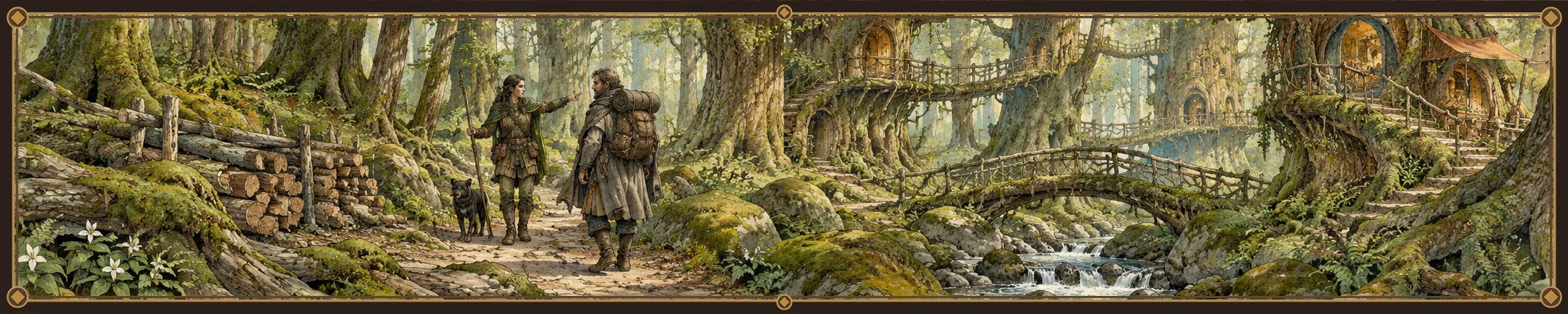
Take what the branch lets go of,
walk the path the old feet chose,
leave the water where it runs,
and the forest will not ask your name.
Walk out of the basin farmland towards the trees and the change comes before the shade does. The ditches stop, the field walls stop, and the last cart-track ends at a stand of trunks so broad that a household could live inside one, and some do. This is the old Elven forest world, and it is three countries, not one. In the north-west lies the Elderweald, never cut, dim at noon, floored with root, where bears den under the root-mat and barred stairs lead down into a drowned world. In its south-eastern corner, against the mountains, the Crownboughs rise, the same forest trained over more lifetimes than anyone counts into halls, terraces, and gardens held high in the canopy, where duels are fought on garden-walks with nothing beneath them. Along its western and south-western edge the Briarreach breaks into thicket and wet ravine, and arrows come out of the hedges at anyone who walks in unasked. All three grew from one root, all three still measure themselves against it, and all three have spent hundreds of thousands of years telling younger peoples, each in its own manner, that a forest is not a resource. The basin farmer who wants a weir, the Dwarven envoy who wants a spring, and the Human lord who wants his embassy taken up into the trees all learn the same lesson in three accents: the forest answers slowly, it answers on its own terms, and it remembers what it was asked.
The Elderweald
The Elderweald is the old-growth forest at the centre of the Elven world, the oldest major named Elven region on Caeldon, and the homeland of the Wood Elves of the Rootcrown Concord. Their way of life took root here between c. 490,000 and c. 470,000 BR, the groves bound themselves into the Concord over the same long span, and they have kept the forest ever since. Every other Elven heartland began as part of this one. The Crownboughs and the Briarreach grew out of its edges, and the Roothollows far below were once its lower storey. To Humans and Dwarves it matters more plainly: it is the forest that will not be cleared, dim and huge, where moss-coated deer walk in the oldest groves, and it has quarrelled with the Ironspine over water for more than four hundred thousand years and with the basin farmers for nearly forty thousand.
The Land
The Elderweald fills the north-western heart of the cradle-web. The Ironspine rises along its eastern side, the Crownboughs open from its south-east, and the Briarreach runs along its western and south-western edge; its southern treeline looks out over basin farmland, and what lies north of it nobody has mapped. The ground climbs eastwards into the broken ridgeland of the mountain verges. The forest is about two months across. The deep groves lie in the middle and the east, a month’s walk with a watcher from the treeline, and beneath the eastern half of the forest, far down, lie the Roothollows. From the southern edge, Fernrest is about four weeks by cart from Sheafmeet. People live in the edge villages along the treeline and the grove rings of the deep weald; between them lies untended forest of hollow ground, brown bears, and grey wolves, and nobody crosses it without a watcher.
The Elderweald is temperate forest that has never been cut. A grove’s oldest stand can be older than the Concord itself, and the canopy closes so completely that the floor stays dim and cool through the height of summer. Light comes down in coins and threads; sound does not carry far; the air smells of leaf-mould, wet bark, and running water. Underfoot is root: a soft, deep mat of living root, mould, and moss, laced with springs, slow streams, and water-bearing hollows. The ground holds water the way a sponge does, and gives a little under every step. Towards the Ironspine it rises into broken ridgeland, mountain feet, and runoff channels; towards the basins it thins into lighter woodland cut by feeder streams, and the first fields show through the trunks.
The forest is not gentle for being old. Root-fed hollows open under the leaf-litter; most hold only standing water, but a few reach down towards the old root-depths beneath the forest, and the groves tell of travellers who fell into one and were heard calling for days from somewhere no rope could reach. Basin inns still tell that the lost lower groves lie at the bottom of such hollows with their grave-goods untouched, and every few years a treasure-hunter goes down a rope to look; the groves say there is nothing down there worth the rope. An ancient tree comes down rarely, and when it does it can crush a dwelling, dam a stream, and flood a string of hollows in a single night. In the wet season the hollows fill and join, low paths go under, and ground that was firm in autumn will not hold a person in spring.
The forest has its beasts. Brown bears den in the hollows and come out angry when a wet season floods them; grey wolves hunt the edge farms in hard winters; wild boar kill gleaners at the treeline, and hornets nest in the hollow boles. At the edges a Skin-Lost, a shape-changer who forgot the way back, sometimes hunts with a person’s cunning. The edge villages give one old she-bear of the eastern hollows a name, the Mother of the Hollows, and count the spearheads her hide has carried off; three generations of beast-hunters have gone after her, and the grave-markers at Eddymill say how that went. Pale caps look like the good mushrooms and kill after a false recovery, and dreamcress in the slow streams brings sleep too deep and dreams too dark. But the danger most visitors meet is the one they bring. A living tree cut, a stream turned aside, a fire set in the wrong place ends the welcome at once, and the grove’s hunters track the one who did it. Timber thieves and poachers after the moss-coated greenharts come in from the basin side every few years; few go home.
Living in the Groves
Wood Elves live in groves. A grove is a household-sized settlement grown into a stand of old trees: dwellings shaped from hollowed bole and living root, root-holds that widen as slowly as the trees around them, floors laid on the root-mat itself. Nothing is built that the grove could not have grown. Some groves have been lived in without a break since before the Concord, and their people speak of the trees as kin before they speak of them as shelter.
Work is tending rather than shaping. Households gather nuts, fruit, fungus, roots, and medicinal growth. They clear deadfall from the streams and watch the water through the dry months, and they keep paths open by walking them, not by cutting them. Wood comes only from what has fallen. Hunting is real but bounded, and a grove that over-hunts its ground soon hears about it from the next. The hunters are also the forest’s swords and its beast-slayers: they walk with visitors, run down poachers, and go out against a bear or a wolf pack that has taken someone.
Births are rare and come in cycles, as among all Elves, and the old Wood Elf lines carry the oldest Elven nature most visibly. In the oldest groves a birth can still pass through a plainly grove-linked threshold before infancy, and the rare archaic birth is an event for the whole grove. Children are named slowly, and nobody hurries them. A Wood Elf child is expected to become readable in its own season, as a sapling shows in time what kind of tree it is, and the grove declares it grown when its elders and ritual keepers agree it has arrived. The agreeing is done aloud: at a grove gathering each says that the young one has arrived, and a single keeper’s doubt does not overrule the rest but defers the matter to the next season. A household that moves to another grove is not counted of it until it has walked that grove’s paths through a full year and learned where its dead lie.
The dead are returned. A body is given back to living ground among the grove’s trees, and the ground that holds a household’s dead is its oldest claim to be where it is. That is why grove ground is never sold and cannot be cleared. To clear it would be to clear someone’s dead.
The Concord and Its Circles
The Concord has no seat and no crown. It is many groves, each distinct, held together by shared memory and inherited duty to the living forest. Within a grove the elders and ritual keepers are heeded because they hold the memory of place: who remembers where a watercourse ran, which paths are old, where the dead lie. When a matter crosses more than one grove’s ground, a stream, an edge, a death in a mixed settlement, a circle of the groves concerned meets on it.
Such decisions are slow on purpose. A circle may part without deciding, and a question can wait a generation, which the groves call care and their neighbours call stalling. No grove can bind another, but a grove that ignores a circle soon finds the other groves' paths closed to it, and old grudges between groves are remembered for longer than Human kingdoms last. The basin Humans who live beside the Concord most often misread it as absent. A basin lord may grant his settlers a clearing and find their fences down and their hunting gone within the season, because whatever the lord has granted, a settler who wants to clear forest land must ask the nearest grove, and the answer, when it comes, often comes from a circle.
Nearly everyone in the deep weald is Wood Elf. Dwarves come as envoys to the verges and seldom further. High Elves and Thorn Elves who enter the forest are received as kin, though the groves keep count of how each branch came to leave.
The Basin Edge
At the outer edge the forest shades into mixed country. Wood Elf groves stand near the treeline, Human hamlets and farms lie out on the cleared side, and a few settlements hold Human-Wood Elf households whose children are named earlier than any grove would name them. The edge itself was drawn by use before any agreement: first by the recurring meetings of the First Confluence-Elderweald Contacts (c. 38,000 to c. 24,000 BR), then by the long friction over clearing, roads, and water of the Elderweald Border Pressures (c. 26,000 to c. 10,000 BR). It is still contested, and it still shifts one clearing at a time. In practice it lies wherever a grove’s watchers last said no and were heeded.
The edge country’s best-known custom was born of grief. Sometime between c. 16,000 and c. 15,000 BR a death in a mixed settlement brought Human and Wood Elf expectations into collision. The Human side needed the death sworn before the gods, a marker, and a family that would remember; the Wood Elf side needed return, the body given back to living ground and not kept by anyone. Both believed they were defending the dignity of the dead. The settlement learned to divide the work, and the Elderweald Funerary Accord made the division custom: in the edge country a death is finished twice. The body is returned to an edge grove in the Wood Elf manner; the remembrance is sworn and kept in the Human one, under the Sworn Accord. Neither side is asked to concede that its deepest instinct was wrong. The accord holds only where both keep it.
There the most trusted people are often not grove elders but mediators: those whom both sides believe about kin, remembrance, and the right completion of a life. They hold no title, only that trust, and in a death or a marriage a mediator can carry more weight than a lord.
The Ironspine Verges and the Deep Edge
The Elderweald has five edges. Two are contested, and only one of those still moves. Where the forest climbs into ridgeland it meets the Ironspine and its holds. The ground of that border, its watersheds, mountain feet, and mine edges, was in place before either people claimed it, and the two first met there between c. 460,000 and c. 445,000 BR. Their quarrels over redirected water, deep digging, and cut growth hardened into the Elderweald-Ironspine Frontier (c. 410,000 to c. 385,000 BR). The border is fought over stream by stream: a weir torn out at night, a work-gang driven off by arrows, a grove’s spring found dry. No conquest or treaty has ever fixed it.
Towards the Briarreach the welcome grows slower and warier until it becomes judgement; towards the Crownboughs the trees begin to be trained. Neither of those kin edges has a line, and neither has ever been fought over by armies.
The fifth edge runs down. The deep groves once continued into the Roothollows, the forest’s own lower storey, until the flood of the Roothollow Rupture (c. 335,000 to c. 328,000 BR) rose through them and the long Sealing of the Upper Roothollows (c. 328,000 to c. 318,000 BR) barred the way. In the deepest groves, past paths no outsider walks, the Sunken Stairs still open in the forest floor and end in silt and bars a little way down; their keeping belongs to the sealed places of the cradle-web. Far beneath them lies the Gloamroot Covenant, with which the forest has almost no ordinary dealings. This edge is closed rather than contested.
Paths and the Slowwater
The Elderweald has no roads, only kept paths. They are old, walked open rather than cut, and part of the forest’s memory, so a path’s age counts for as much as where it goes. Visitors are not turned away, but they do not walk alone: a watcher from the nearest grove goes with them and chooses the way. Paths to the dead, to the stair-mouths, and between the deepest groves are not walked by outsiders at all. Human roads stop at the treeline, and every attempt to cut one further has ended in blood or in a road the forest closed within a generation. Traffic between the basins and the Ironspine goes around by the Headwater Marches, not through the trees.
The main water is the Slowwater. It gathers from springs on the Ironspine verges, runs west and dark and root-lined through the deep weald, then turns south and leaves the forest at Eddymill as one of the feeder streams of the basin farmland. Both neighbours want it, the holds for works upstream and the farms for ditches and mills downstream. The groves treat its course as remembered water that no one people may move. Nobody uses it as a road.
There is no toll at the edge of the Elderweald, and I looked for one. A clerk learns to find the place where a road changes hands, the chain, the post, the bench with a ledger on it. Here the cart-track simply ran out against a trunk wider than the Serath toll-house, and a young Wood Elf was sitting on a root beside it as if the root had been grown for sitting, a bow unstrung across the knees. That was the toll, I understood later: not coin but company. Nobody walks in alone.
My watcher did not ask my name or my business. The only question was whether I meant to cut anything, and when I said no, it was asked a second time, more slowly, as a man at home might ask whether you truly meant to pay. Then we went in. The path was no wider than my two feet and soft as a bed, and it bent for no reason I could see, round a hollow, back along a stream, out again past a stand where the trunks had been worn smooth at shoulder height by hands. Three times my guide stopped and listened to water I could not hear. Once we waited the length of a long breath while something heavy moved across the path ahead, and the bow was strung before I saw it move, and I never saw what it was strung against.
At noon the light was like the light inside a shuttered room. We ate nuts and a dark fungus that tasted of smoke, sitting on the root-mat, and I asked how far it was to the grove. My watcher considered the question as though it were a hard one and said that it depended which way the path wished to go. I have kept toll-rolls on the Serath and never met a road with opinions.
By the stream my guide called the Slowwater, the water was the colour of strong ale and made no sound at all. A post stood in the shallows on the far bank, raw, newly cut, with the bark still on. My watcher looked at it for a long time and said nothing, and I wrote it down, because it was the first thing I had seen in the forest that anyone had put there on purpose, and I knew at once whose it was.
Very little is traded, and nothing grand. Outward go what the forest lets fall: nuts, fruit, fungus, resin, medicinal herbs, seasoned deadwood, and the hire of a watcher-guide. Cut timber is never sold, which is exactly what the basin side most wants. Inward come salt, cloth, and metal tools, most of it bought at the edge settlements. Most outsiders' business with the Elderweald is asking, not trading: a family asking that its mixed dead be returned to an edge grove, a hold asking leave to work a spring, a village asking what it may take from a stream, a lord asking for watchers to hunt down an outlaw band that fled into the trees. Outlaws who flee a basin lord into the forest meet one of three ends: the grove hands them back, keeps them, or lets the forest have them, and bounty-takers sit at Fernrest for weeks waiting to learn which. Beast-hunters hire on at the edge villages when a bear or a wolf pack turns killer, and must take a watcher with them. Strangers who come asking the way to the Sunken Stairs, with ropes and empty sacks, are given a meal and walked back to the treeline. A grove’s watchers decide the paths. The circles decide anything that crosses groves. No one alone decides the water.
Groves and Edge Villages
Nobody in the Elderweald asks after a capital. The Concord has no seat, a circle meets wherever the groves concerned happen to be, and the groves with the longest memory carry the most weight in it without ever becoming a centre. What passes for a settlement here is a stand of old trees with one long-lived family in it. Four places show the range, from the deep forest out to the farmland.
Oldstand is a deep grove whose oldest stand is older than the Concord, lived in without a break since. Twenty or thirty Wood Elves of many generations sleep in hollowed boles and root-holds on floors laid over the root-mat, and the place smells of old wood, wet moss, and very small fires. Its ritual keepers remember where every watercourse within reach once ran, which is why a circle listens when Oldstand speaks. A birth here can still pass through the old grove-linked threshold, and when one does, the neighbouring groves come to see it.
Silthollow, deeper still, is a single household beside one of the Sunken Stairs. It keeps the stair-mouth and does not go down. Its people sing the laments for the Drowning Bloom there, and in wet years they say they hear water moving behind the bars, and sometimes something that is not water; twice in living memory the bars have been found scratched from below. No grove carries the forest’s share of the deep world’s grief more heavily (Sealed and Silent Places).
At the basin-facing treeline, Fernrest is the edge country in one place: a Wood Elf grove on the forest side, Human farmsteads on the cleared side, and between them a few dozen households with kin in both. Its mixed dead are returned to the grove and remembered in the village under the Funerary Accord, and its mediators are trusted further along the edge than any lord. Downstream, where the Slowwater leaves the forest for the farmland, Eddymill is a Human village of about forty households with a mill, ditched fields, and a ford, and the knock of its wheel carries into the first trees. Its miller keeps a boar-spear by the door and an old Elven arrowhead on the mantel, taken out of his grandfather. The village wants a weir to hold water through dry years and has already cut the posts. The nearest grove says the stream’s course is not its to give.
The People of the Weald
About 160,000 people live in the Elderweald and along its edge. Some three in four are Wood Elves, and in the deep weald nearly everyone is. The Humans of the edge hamlets and mill villages make up most of the rest, perhaps a quarter, with a thousand or more mixed households among them; Dwarven envoys come to the verges and go again.
A Wood Elf is dressed by the forest and the edge market together: soft leather and deerskin worn under cloth bought at the edge settlements, dyed with bark and leaf to the browns and greens of the place, and in summer many go barefoot on the root-mat. The Wood Elves of the Elderweald carry the old Verdant traces of their people more strongly than any others, and here the change in colour and scent that comes over them at a threshold of life is plainest to see. Because births are rare and a grove watches every child, few are lost, perhaps one in ten. Most Wood Elves live six to eight centuries and grove elders longer, and what kills one before age is usually the forest itself: a great fall, hollow ground, a wet-season path that does not hold.
Until the grove agrees that a child has emerged it goes by a household child-name, a plain word nobody keeps. Then the grove gives its name, said with the grove’s own, and there are no family names, because the grove stands for one: Tavrael of Oldstand, Aelorin, Ellowin, Sirrith, Ulmaeth, Ondrevel. The edge folk dress, live, and die as basin folk do (The Basins and the Marches) and carry basin holding-names: Jory Fennick, Hanne Coyle. A mixed child of the edge gets a Human name within days and a grove name later, if the grove gives one, and Fernrest has more than one child like Ilo Coyle, whose grove name is still awaited.
Memory and Belief
The Elderweald remembers being first. Before there was a Concord to argue about, there was an Elderweald way of life to depart from, and the groves still reckon history by who departed from it. Each branching is remembered as a leaving. The groves do not call the leavers wrong, but they keep count.
The deepest grief belongs to the drowned world below. When the Roothollow catastrophe spread into wider Elven memory through the Bitter Root Histories, the Wood Elf retelling made it a story of failed stewardship, of the distance kin had let grow between the upper forest and the lower hollows before the water came. The groves that keep the Sunken Stairs carry that memory most heavily. Their lullabies are of the flood: the watcher who held a stair-mouth while the water rose behind her and the last of the climbers came up past her, and the bars that were shut with kin still knocking on the far side. At Silthollow the last verse is the names of those left below, and a child who can say them all is counted old enough to keep the stair-mouth. Ironspine holds tell the same years otherwise, in the Burdened Seal Histories, with their suspicion that Elven sacred claims ask others to bear the cost, and that suspicion is felt on every verge stream.
The Human edge is a younger quarrel and a plainer one. It was never about rank. It is about clearing and water, and about whether a settlement owes anything to the living ground it occupies. Edge villages remember the axe-gangs that went in and the arrows that came out, and the feuds that followed for generations; groves remember the fires, and above all the basin lord who fired a grove with its household inside to clear a road. His hall burned the following winter, nobody was ever caught for it, and the edge still says the forest keeps its own accounts when a debt is paid in kind. The groves have watched the basin peoples grow from scattered hamlets into a great power in what the forest counts as a short span.
The Wood Elves keep the grove reverence from which the Crownbough faith later grew, but they keep it as custom, not as a faith. There are no temple-gardens, no tenders, no doctrine, no patrons of finished form. Ritual keepers hold memory and rites; they are not clergy. Reverence is the ordinary practice already described: taking only fallen wood, walking paths open, leaving water where it runs, naming a child when it has emerged, returning the dead. At the grave the groves honour the god Humans call Ennor the Grave-Watcher under a name of their own, as the one who sees the returned onward, and at a mixed graveside the two names for one watcher are often the one thing the mourners agree on. Laments for the Drowning Bloom, kept at the stair-mouths, name Ithaere the Drowned Mother, though the upper forest knows little of her beyond the name. The edge farms bring Anvelle the Harvest-Mother with them, the god of the fields the forest keeps declining to become.
The Crownboughs
Where the forest faces outward, nothing large has been left to grow as it pleased. The Crownboughs are a cultivated canopy forest in the south-eastern corner of the old Elven world and the homeland of the High Elves and the Crownbough Courts. Trees have been trained into halls and terraces, gardens raised into the canopy, whole settlements composed over more lifetimes than most peoples have history. The High Elf branch rose out of the older Concord between c. 398,000 and c. 390,000 BR, gathered into courts soon after, between c. 390,000 and c. 375,000 BR, and has been ruled by its great houses ever since. This is where Elven reverence for living growth became the art of shaping it, and where that art became a measure for judging others. Dwarves and Humans know High Elves by the polished face the great houses turn outward. Behind it lie blood duels fought on garden-walks above the drop, poison measured by the leaf, dead halls where silver mirrors still hang, and bears in the wild dark beneath the canopy, with worse beasts beside them that no house will name.
The Grown Country
The Crownboughs fill the south-eastern corner of the forest world, with the Elderweald to their north and west, the Ironspine to the east, and the Confluence Basins to the south; the Headwater Marches lie on the far side of the mountains. The floor climbs gently eastwards to the southern verges of the Ironspine, and the great houses' watercourses come down from the verges through the gardens towards the basins. The Understorey Courts stand on the southern, basin-facing edge, about five weeks from Sheafmeet by the embassy road; Amberbough lies in the middle of the canopy, two or three weeks higher for those taken up; and Highbraid stands on the eastern side at the Verge Stair, about a month below Anvilwake. The great seats and the embassy villages below them are the settled cores; between them the canopy is kept only along the boughways, and the forest floor is wild, with brown bears in the hollows. Those who stray below the boughways are sometimes found, and sometimes only their horses. Most of the Crownboughs' height, though, is grown. Great trees have been bent and braided over generations into galleries, living halls, and stepped terraces, linked by boughways and suspended garden-walks well above the forest floor. The understorey beneath them is cleared, planted, and kept: orchard rows, herb beds, swept paths. A traveller coming in from the edge leaves ordinary temperate woodland and walks into something closer to a garden the size of a country, with the life of the place going on overhead.
Its dangers are the price of living high. Much of daily life happens in the canopy, and a slip from a garden-walk is the ordinary death of the careless, the young, and the visiting. A canopy strong enough to carry a hall also catches every storm; limbs grown heavy with building come down in high wind, and the storm seasons strip the outer walks. Shaped growth does not stay shaped. A boughway left alone for a few seasons begins to sag, a trained hall closes its own doorways with new wood, and an abandoned terrace becomes unsafe long before it looks ruined. Hall Canker enters through a late pruning cut and creeps from hall to hall along the grafted boughways; a bad outbreak can cost a house the growth of a hundred generations, and every outbreak starts a quarrel over whose knife let it in.
Halls left empty by failed houses go wild and haunted, dropping their walks, and some still hold silver mirrors that show the viewer an improved face, said to be the tears of Saerith the Mirror-King, still trying to fix the world. Those who look too long come away changed. A dead house’s silver, grown armour, and old grafts lie in those halls too, and basin treasure-climbers who go up after them with ropes and empty sacks seldom climb out the way they went in. Lowgarden tells of one dead hall where a whole house’s grown armour still stands on its racks, light as bark and harder than iron, and a ward-hound bound to its threshold still holds the door. Villagers keep away. Courtiers sometimes do not. Below, in the understorey, worse than bears comes down: a lesser house whose rite of change went wrong sometimes lets the Ill-Hatched thing go into the dark rather than put it down or keep it, and the gardeners find what it leaves. When a beast kills in the understorey, a great house sends its sword-champions down after it, and the one who brings back the head is named at court for a thousand years.
Houses and Halls
Most High Elves are not courtiers. They belong to houses: long-lived households bound to a family grove and to a hall the house has been growing, in many cases, since before anyone living was born. Work is tending. Branches are trained into roofs and walkways; terraces and garden-walks are kept; fruit, nuts, roots, and herbs come from the canopy gardens and the planted understorey; and the family grove, where the house’s dead have been returned, is cared for as closely as any child. No hall is ever finished. A young High Elf learns a craft by continuing shaping begun by a grandparent’s grandparent, and pride lies in handing it on in better shape than it was received.
Children are few, because Elven fertility is rare and cyclic, and their growing up is watched closely. A house marks each stage formally, birth, naming, coming of age, the taking of a house role, and marks each only when the person has visibly grown into it. Village and household tenders are consulted at every step. Adulthood ends in presentation: in the court season a house of rank shows its young one at court, and the young one brings a piece of shaping they have carried on themselves, most often a bough or sapling trained from the house’s own grove. The court reads the work and the person together. A tender who has watched the child may say not yet. A house may present against that word, and some do, but the great houses remember which presentations came early.
That is where the region’s oldest argument enters the kitchen. The same pruning knife can tend a sapling towards its own shape or cut it towards a shape decided in advance, and High Elf parents argue over their children in exactly those terms. Tenders counsel patience, because a child named too early is named wrong. Rank-minded kin worry that a slow child will be read as an unfinished house. Most families live between the two. They are patient and warm at home, and at the court season they paint their faces gold. The condescension outsiders meet is real, but it is mostly the great houses' view of the world, and many High Elves live inside it without ever quite choosing it.
Courts and Tenders
Several courts rule rather than one crown. Each gathers around a few great houses, with lesser houses and dependants ranked beneath them, and rank is read in visible refinement: the hall a house has grown, the gardens it keeps, the composure of its people, the heirs it can present. The great houses rule because they are the oldest, the richest in growth, and the best attended, and they dress that in the old claim that refinement is a duty. Their word on rank is obeyed even by those it humbles, because a house they turn against loses its marriages, its gifts, its friends, and sometimes its grove. A house that cannot present anyone for several seasons is spoken of as unfinished, and a lesser house may spend a generation’s shaping on one hall to keep its place, quietly selling its grove’s fruit to do it.
Under the composure the houses fight. A slight between houses of equal rank is answered by a duel of shaping before the assembled houses, or, when the insult runs deep enough, by the houses' sword-champions on a garden-walk with nothing beneath it, and an old feud can cost a house a champion a season. A champion carries the house’s grown blade, is chosen in the duel season before the whole court, and is mourned when they fall as a hall is mourned; the canopy has no greater heroes. Quieter weapons are a canker let into a rival’s boughs, a guest who falls, and heart-leaf, which steadies an old heart at one dose and stops it at the next. Every great house keeps a tender who knows the difference.
The senior tenders of the Ordered Bough hold the other authority. They guide the great temple-gardens, and they are heeded for their patience and for what has visibly flourished under their care. A tender can say that a garden, a house, or a person is not ready, and that word weighs against a great house’s. The population is overwhelmingly High Elf. Mixed Human-High Elf families, the most familiar mixed kin on Caeldon, live chiefly in households tied to the embassies, and whether their children are counted as kin is still settled house by house. Human and Dwarven envoys come and go at the edges but rarely live deeper in.
The Ordered Bough
The Crownboughs are the home of the Ordered Bough, one of the few organized religions of the medieval world. It is older than the courts in substance and younger in form: its roots are the grove reverence the Elderweald still keeps as custom, and it became a faith with its own houses, teachers, and rites as the courts were founded. Its premise is that life, the world, and the self are living growth, and that growth should be tended towards its intended form. Nothing is born finished. Everything worth honouring is being grown.
Its temples are temple-gardens, living halls and groves and terraces shaped over generations, where the work of one tender is continued by the next. A temple-garden is never complete, and its incompleteness is part of its sanctity. Its clergy are the tenders: senior tenders at the great temple-gardens, lesser ones serving houses, villages, and roadside groves. Birth, naming, coming of age, and the taking of a house role are each a stage of emergence, and death is the last. The dead go back to the family grove under the Bough’s rites of return, guided by the god Humans call Ennor the Grave-Watcher, whom the Bough honours under an Elven name; a High Elf who dies on embassy far from any grove of the house is carried home over a long road or returned where they fell, and the tenders disagree over which keeps the rite whole.
The faith’s deepest tension lies within its own premise. To tend is to help something become what it is growing towards. To perfect is to decide in advance what it should become and to cut away everything else, and that second path has its own god. Saerith the Mirror-King is the Bough’s most powerful and most contested patron, the god of finished form, honoured at court wherever prestige, lineage, and flawless presentation are at stake. His devotees, strongest in great houses anxious for their lineage, regard him as the Bough’s fulfilment. Its older tenders regard him as its corruption, the point at which cultivation becomes judgement and the unfinished are treated as lesser. At some court occasions courtiers paint their faces with gold and silver to match his image, and it is said that a perfect painting earns a year of perfection; the court tale of the noble who matched the image so exactly that he shattered like glass is told to the young as a warning. Saerith’s standard travels further than his worship. In the halls of lesser houses it shows as dangerous rites of self-perfection, magical self-reshaping, and quiet despair, and in the basins as Human households painting gold faces of their own.
Edges, Ways, and Gifts
The Crownboughs have four edges and two doors. Inward they shade into the Elderweald with no marked line: the border is where trained growth gives way to growth left to itself, and each side regards the other as kin, to the Concord kin who shaped too much, to the great houses kin who stopped too soon. Towards the mountains the canopy-mountain threshold sits on the old Elderweald-Ironspine frontier, and there, between c. 375,000 and c. 355,000 BR, the Courts of Stone and Canopy turned an argument about water into one of the oldest rivalries of prestige on Caeldon. Each side read the other as powerful but incomplete: to the canopy, the holds were masters of load-bearing stone without grace; to the holds, the canopy was brilliant, suspect, and careless of the harder duties of building. Neither could call the other primitive, and so neither has stopped measuring itself against the other. Verges, watercourses, and quarrying along that edge still go to whichever side is stronger on the spot that generation; arrows have flown from the boughs and axes answered on the stair in a dozen small wars, but neither side has ever settled it by conquest. Towards the basins the courts face the Human Confluence Marches across a border of rank rather than ground. No Crownbough edge reaches the Headwater Marches, but the great houses watch them closely, because that corridor is where their two great rivals, Dwarves and Humans, learned to grow strong together.
Inside the region the main roads are in the air. Boughways run hall to hall and seat to seat, each belonging to the house whose growth carries it, so travel aloft is by leave, and a stranger on a walk without it may be helped down the quick way. The great houses treat their watercourses as garden water, to be kept and composed, never as roads. What leaves the Crownboughs is trained and shaped wood, grafts and seedlings given as gifts and never sold, fine garden-craft, and teaching: Human lords have long borrowed High Elf ceremony, magical shaping, and composure, and the great houses send them as instruments of rank as much as goods. What comes in is worked metal and dressed stone from the Ironspine, which the great houses use more freely than their boasts admit, and basin goods from the Human side. Both ways moves prestige. Every gift is measured, every reception ranked, and an embassy is judged on how high into the canopy it is received. Lowgarden is the canopy’s one door for hired danger: beast-hunters come up the embassy road when a house posts a bounty on something in the understorey, envoys bring sellswords who must be watched every hour, and now and then a climber slips past with a sack, bound for a dead hall. What comes back is sold in the basins and sworn to have been found elsewhere, because the great houses count a dead house’s silver as theirs by kinship and hang a thief from his own rope.
The great houses remember the rising of the Crownboughs as the moment Elven life chose to be seen; the Elderweald remembers it as a departure. Both tellings are polite, old, and unforgiving. An older and quieter memory came up from below through the Bitter Root Histories, and it passed into the memory of the great houses as a question nobody has answered: whether refinement and distance let them fail their kin in the drowned hollows. Court children learn the champions before their letters: the one who held the Highbraid gate boughs alone while the stair below ran with Dwarven and Elven blood, the one who went down into the understorey after a bear that had killed a house’s heir and came back three years later carrying its skull, and the one who looked into a dead hall’s mirror and walked out wearing a face no one knew. They learn the villains too, above all the house that poisoned its rivals with heart-leaf at a court-season feast and was itself dead within a generation. Its hall still stands empty with the cups on the table, and the oldest Crownbough curse is a wish that a house’s boughs remember it.
Great Seats and House Halls
With no crown there is no capital. The great seats together are the region’s centre: several seats, each grown around the halls of a few great houses and a temple-garden. The oldest and most closely watched is Amberbough, grown around the Unfinished Garden. Its great houses' halls are braided from trees older than the houses that live in them, galleries and garden-walks link them high above the floor, and the senior tenders keep the garden at its heart. About ten thousand High Elves live there with their dependants, and more in the court season, when the lesser houses come to be seen, the boughways fill, and the gold faces come out. Whether the garden is to be declared finished is argued here first.
Highbraid, on the mountain-facing side, is the seat nearest the Verge Stair. Its halls rest at the root on dressed Ironspine stone, more freely than its courtiers would say, and its great houses host most of the envoys who come up from the landing. About four thousand High Elves live there, and it reads the Dwarves more closely than any other seat. Its gate boughs still carry the arrow-scars of the oldest war over the Stair.
Willowstep is what most of the Crownboughs look like: the hall of one lesser house, a single trained hall of five storeys with its terraces, canopy gardens, and the family grove where the house’s dead have been returned. A few dozen High Elves of several generations live in it, continuing shaping begun long before any of them was born. It feels the great houses' standard more than they do, and its elders argue over every presentation. Its last champion died on a garden-walk at Amberbough, and the house has not yet named another.
At the foot of the canopy, Lowgarden is a village of a hundred or two on the low terraces beside the Understorey Courts. Its households are tied to the embassies: High Elf hosts and gardeners, Human envoys' staff who have stayed, and the mixed Human-High Elf families whose children a house may take in or leave outside. It lives by lodging, feeding, and tending the people the great houses receive and seldom take higher, and by guiding the beast-hunters and envoys' sellswords who must not wander off the embassy road.
Faces of the Courts
Some 100,000 people live in the Crownboughs, and nineteen in twenty are High Elves. About four thousand Humans live mostly in the embassy villages along the basin-facing edge, over a thousand mixed Human-High Elf households beside them, and a hundred or so Dwarven envoys stay at Highbraid.
House dress is fine cloth woven from canopy-garden fibres and traded basin wool, dyed in garden colours and cut long, but bound at wrist and ankle for walking aloft, with soft-soled shoes for the boughways. In the court season the robes are layered and the faces painted gold. High Elves are the most alike of all their people in look and bearing, and here the most composed; a visitor from the basins usually remarks on the stillness before anything else. Children are few and watched closely, yet perhaps one in eight is lost, most of them to falls, the ordinary death of the careless and the young. Most High Elves live seven or eight centuries. Of those who die sooner, falls and storms that bring down a laden limb take most; the duel takes its champions; and in the lesser houses the rites of self-perfection and a quiet despair take others.
A High Elf is named in stages: a birth-name used only within the hall, a given name at the naming, and the house name only at presentation, after which a house role may add its title. Presented names of the courts: Ilvaren Thaelion, Ilisaine Varandel, Elbrevor Isquel, Lysaedre Thaelion, Aumeris Varandel. The embassy households wear basin cloth in Crownbough cut, and the mixed families take basin holding-names; a mixed child takes a house name only if a house presents it.
The Understorey Courts
The embassy road from the forest edge of the Confluence Basins ends at the Understorey Courts, the terraced receiving grounds at the foot of the canopy on the basin-facing edge, and for most Humans so does the High Elf world. The road is the first danger. For days it runs through ordinary woodland where grey wolves follow lone walkers in hard winters and outlaw bands wait for envoys coming home with Crownbough gifts, since a graft or a gold-painted mask is worth more in a basin market than a farm. For its last stretch the road leaves the wild wood and runs through the planted understorey; ahead the ground rises in broad terraces edged with trained roots, stepping up towards the trunks of the great trees, and far above the galleries and garden-walks of the canopy are plainly visible and out of reach.
Everyone on the terraces knows they are graded. Traders and supplicants keep to the lowest, where the road comes in and goods change hands. Embassies lodge higher, in low halls trained from understorey growth, and the terrace an embassy is given is read in the basins as the canopy’s judgement of the power that sent it. The highest terrace lies against the trunks, and from it climbs the Leave Stair, a grown stair of root and bough into the canopy, which no visitor climbs without a house’s leave. Being taken up it is the measure by which the Crownboughs judge an embassy; the terraces are the finer grades beneath. Nothing here is hard to enter. Staying is easy. Rising is the difficulty, and it turns on manners, gifts, and the whim of whoever is hosting. The canopy sheds onto the terraces as well, and a limb falling from that height kills whatever it hits. What falls with it is another matter: gilded rail-fittings, lamp-cages, a carved panel from a hall nobody below has seen. The canopy claims every scrap that comes down and its wardens search the wild understorey after each storm, but the basin folk who get there first call it wrack, and a piece of it sells in a river town for a year’s wages. Beyond the planted ground the wild understorey begins again, and brown bears that come out of their hollows angry in a wet spring have walked onto the lowest terrace more than once.
The grounds belong to the great seats in common. The keeping passes from seat to seat in turn, and the seat holding it keeps order with its own wardens, gives out the terraces, and sets the calendar of receptions. Whom an embassy meets, and whether it ever climbs, is decided by the great house that hosts it, which is why every envoy spends the stay courting that house. Tenders of the Ordered Bough keep the gardens and advise the seat in charge; they decide nothing about rank, but their word on whether a guest is ready carries weight. Up the road come envoys of lords and of towns run by their richest houses, sent to be seen, to bring a gift home, or to learn the manners that raise their sender’s name in the basins; traders with basin goods, who seldom leave the lowest terrace and do not expect to; supplicants seeking a graft, a teacher, a healer’s working, or a word with someone above; scribes and oath-keepers, who travel with every serious embassy, because by basin custom nothing agreed here binds until it is sworn and written under the Sworn Accord; and the swords for hire who walk the embassies up the road and back, and spend the long waits drinking and dicing on the lowest terrace, where their toast is to the road home, because the road home is where they earn their pay. In the wild wood beyond the planted ground live the wrack-pickers, basin foragers who go out after every storm for what the canopy drops, racing its wardens and each other. Some envoys' people stay. Many of the mixed households tied to the embassies live on or below the terraces, between Human kin who expect a child named early and Elven kin who expect one to emerge first.
Most days are spent waiting. Envoys pay calls on the terraces above their own, send small gifts upward, and study the High Elves who come down. A long stay is not always a slight: to the canopy, an embassy received in a hurry has not really been received. Basin envoys know this and complain anyway. The busy weeks fall in the court season, when the canopy’s lords and ladies descend the Leave Stair with their faces painted gold and receptions are held terrace by terrace. The canopy’s side of the exchange is grown on the Graft Terrace, a middle terrace the tenders keep as a nursery, where seedlings and grafts meant for basin lords are raised until they are given. Under the courtesy there is steel. Young High Elves come down to fight their duels on the terraces, where the drop is shorter than on the garden-walks above, and basin envoys who give offence have been invited to answer it with a sword they cannot match. Basin inns tell of the one who could: a lord’s sword-bearer who took up such a challenge in his envoy’s place, fought a young High Elf to a standstill on the Graft Terrace, and was taken up the Leave Stair the next morning, the only basin man of his age to climb it. Nobody in the basins agrees what happened to him there. On festival nights the canopy lights its walks with lights that hang in the air without lamp or flame, and the whole lower terrace stands looking up at a forest lit from within. It is the sight envoys write home about first, and the one that makes the long wait bearable.
Two kinds of memory are kept side by side. Basin scribes write down everything said to their embassy, by whom, and from which terrace, so that their lord can hold the High Elves to it. The canopy remembers each reception in its own way and does not put its name to the scribes' rolls. The habits are old: the First Confluence-Crownbough Contacts (c. 18,000 to c. 10,000 BR) were display before ceremony, and the Crownbough Embassies (c. 16,000 to c. 8,000 BR) turned display into ceremonial reception; the graded terraces are that ceremony laid out on the ground. Every embassy household also knows the Crownbough Heir Controversy (c. 14,000 to c. 13,000 BR), when a mixed heir rose to power before anyone agreed what the child was. Saerith’s devotees remember it as proof of how much a lineage can be made to bear, the tenders as a warning of what that costs, and its lesson, that a clear line of heirs and a ripe heir do not come together, is repeated on the terraces whenever a mixed child’s place comes up.
I came up the embassy road as clerk to a basin envoy, hired to keep the tally of her gifts, with six hired swords riding ahead and behind who looked at every thicket as if it owed them money. On the fourth day one of them pointed out a cart turned over in the ditch with its traces cut, and said it had been an envoy’s, coming home. Then the road changed under my boots before I understood why. One moment it was mud and leaf like any forest track; the next it was swept, and the trees on either side stood in rows, with herb beds between them that someone had weeded that morning. Nobody was in sight. I have never felt so plainly that I was expected and not yet welcome.
The lowest terrace was loud with basin voices, traders arguing over cloth and salt as they would at any ford-market at home, and our swords went straight to the dice. Above it the terraces stepped up towards the trunks, each edged with roots trained as neatly as a mason lays a kerb, and on each the people grew quieter and better dressed. Our envoy was given the fourth. Her scribe wrote the number down before he had unpacked his ink, and I wrote it down in my own roll beside the cost of the road, because in the basins the one will be weighed against the other.
Far overhead the galleries hung in the green, with figures moving along them too high to have faces. On the second evening a party came down the Leave Stair, their long robes bound tight at wrist and ankle, their faces catching the lamplight gold, and one of them wore a slim grey blade that looked grown rather than forged. One stopped beside a tender kneeling at a seedling bed on the middle terrace, laid two fingers on a graft and studied it, the way a buyer studies a horse. The tender did not look up. The courtier went on down to our terrace and spoke to our envoy for the time it takes to drink a cup of water.
We stayed thirty-one days. The scribe filled two rolls. I filled one, and could put a price to nothing in it but our own bread. On the last night the canopy lit itself from end to end with lights that hung in the leaves like fruit, and every one of us, swords and scribe and envoy, stood on the terrace with our heads back until they went out. On the last morning a dead limb came down out of the canopy onto the lowest terrace, and the traders cleared it without stopping their bargaining.
The Verge Stair
On the mountain side the old rivalry of Elves and Dwarves stands face to face on the Verge Stair, the one place where it is carried on by daylight and in person, and a place that has run with the blood of both. The stair climbs the flank of the last rock spur on the forest side of the mountains, where the outermost great trees stand close against the stone. It starts in the outer yard of an Ironspine gate hold at the spur’s foot and rises in long dressed flights, walled on the drop side, to a landing level with the canopy. The stonework is plain, close-jointed, and heavy. By hold standards it is fine work. By canopy standards it was never finished.
The gate stands above the landing between two great trees whose limbs were trained, over more lifetimes than anyone counts, into posts, lintel, and leaves of living wood. Beyond it the first boughway runs into the canopy towards Highbraid. The gate moves in wind as the trees do, and its roots have spread across the top of the stair, so that the uppermost course of stone, which the Dwarves call the Root Course, now lies half under root. Where the stone half ends and the grown half begins can no longer be seen, only argued. The landing is the top of the stone: a broad floor of dressed slabs, vaulted over the drop, with a long table-stone at its centre that both sides call the Laying Stone. Below the stair’s wall the forest floor falls away into the understorey, where brown bears den and the bones of things that fell from the flights lie unclaimed. Inside the spur, behind the outer yard, run the old sally-galleries cut in the fighting on the stair, from which wardens once came out onto the middle flights behind a canopy war-band; they are sealed now, and the masons who reset the flights say they can hear wind in them where no wind should go.
The two halves are entered as differently as they were made. A visitor from below swears gate oath to the hold’s wardens at the first step and climbs the whole stair in view of the gate. A visitor from above needs the leave of the house that holds the gate, and steps out onto the landing level, having climbed nothing. By old custom either side may stand on the landing without the other’s leave. Neither goes further without it, and few ever ask. The stone half belongs to the gate holds, kept under the gate oaths of the Held Covenant, and in practice to the hold whose gate opens at the stair’s foot: its wardens guard the flights, its masons keep them, and a Covenant keeper comes up whenever business is done, because the hold has sworn under Kerrund the Stone-Warden to keep the stair whole, and among the other holds its name rests partly on whether it does. The hold also pays hunters to keep the understorey’s beasts off the lower flights; a bear that comes up the stair in spring is the hunters' to kill, a hunter who kills one on the forest floor has made an enemy in the canopy, and the hunters take a tally-mark on the haft of their spears for every beast. The gate belongs to the house whose growth carries it, which keeps it trained and pruned like one of its own halls and sends its officers, and its sword-champions, to every meeting on the landing.
Nobody can date the stair. Hold tallies name it Dwarven work older than the gate; canopy memory holds that the gate was grown first and the stair built up to meet it. In each telling the other side came asking. What both accept is that the halves were made by rivals already judging each other and already skirmishing over the verges, and the stair’s oldest custom follows from that judgement. Neither side has ever dressed or finished the other’s half, because to do so would say aloud what each believes: to the canopy the stone is unfinished, and to the holds the gate is unsound. Both have tried to take the other’s half, and neither has been strong enough. Canopy households still name their eldest daughters after the champion who held the Highbraid gate boughs alone while the stair below ran with blood; the holds tell that day with a different hero, the warden who carried the hold’s banner back down the flights through the gate’s archers, and the gate hold’s children count the flights in a skipping game that ends and down he came, and the banner too.
The users are few and great: envoys of the leading holds and envoys of the canopy. Hold traders bring up worked metal and dressed stone; canopy houses send down shaped wood, grafts, and seedlings, which are given and never sold. Humans reach the canopy by the basin road, and the Human traders who come to the gate hold from the foothill side are not taken up. Exchange is seasonal. The stair opens in late spring, once the masons have reset what the winter loosened, and closes with the autumn storms, when the gate’s limbs move too much for anyone to trust the landing beneath them. On an exchange day both parties time their arrival with care, because whoever waits on the landing for the other is read as having come to ask.
Goods are set out on the Laying Stone, and every gift is weighed twice. The Covenant keeper tallies weight and worth, as at any hold bargain, and seals the bargain under Kerrund’s question, will you hold? The canopy’s officers note rank: who laid first, how near the gate each party stood, whether a gift came in the hands of a great house or a dependant. A bargain that satisfies one reckoning and slights the other is ordinary, and both sides spend more care on the second than they admit. Canopy envoys sometimes come out with their faces painted gold, and the wardens have long since stopped remarking on it. They have not stopped watching the champions' hands, because insults on the landing have been answered with blades within living memory, and a duel fought on the Laying Stone ended with a Dwarven envoy over the wall; his chain of office, gold links set with hold-garnets, lies somewhere in the understorey below, and nobody has ever been allowed down to look for it. Since then the wardens have a saying for any bargain that goes too smoothly: count the champions before you count the gold. Dwarven envoys are met level, at the top of their own stair, where Human envoys are received below the canopy on the terraces. The High Elves call that courtesy. The holds call it the least the canopy could do.
The canopy takes more Dwarven stone and metal up through the gate than it admits, and carries it through itself, so that no Dwarf is ever seen passing the gate with a load. For some years now the masons' spring resetting has not lasted the summer. The failure is worst in the upper flights and the Root Course, where the roots work between the joints, and a mason fell from the vaulting last autumn when a slab turned under him. The hold has begun hiring Kobold crews for the narrow work in the vaulting under the landing, on terms it does not discuss with the canopy. It has also offered to rebuild the failing stone properly, and the offer is harder to answer than it sounds.
The Briarreach
The Briarreach is a belt of broken woodland, thicket, and wet ravine along the western and south-western edge of the old Elven forest, and the homeland of the Thorn Elves and the Thornbound Circles, who hardened here out of older Wood Elf stock between c. 425,000 and c. 392,000 BR and still govern most of it. It is the one Elven heartland that remembers Caeldon as dangerous rather than generous, and it is still dangerous. Wolves and ravine cats hunt its crossings, the dead of fallen bridges stand on the broken spans, and arrows come out of the hedges at anyone who walks in unasked. Its people treat entry as something to be weighed, and the Trolls who keep its ravine crossings make every traveller pay. A traveller here deals with both, and satisfying one has never satisfied the other. Basin traders say a bale of Thornbound dye is worth the risk and a map of the inner ravines would be worth a life; nobody has ever sold one.
The Breaking Forest
The belt runs along the Elderweald’s western and south-western edge, with the deep forest east of it and the farm frontier of the Confluence Basins to the south; its far west and north are unmapped. The ground falls southwards in ravines, and the deepest is cut by the Sallow, which runs south out of the belt towards the basin rivers and carries the one through-route, five or six weeks from end to end, with Sevenbreak’s crossing on the way. Wovenbrake lies deep in the middle, Deadweave near the southern edge, and the Waitfield on that edge itself, about six weeks from Sheafmeet. The circles are strung along the ravines, more of them than outsiders know, and between them lies hedge, deadfall, and ravine country where ravine cats wait at the water and thorn ants nest in the hedges.
The Briarreach is not deep old-growth like the Elderweald. It is a forest that keeps breaking: windthrow, deadfall, thorn thickets that close over a path in a season, clearings that will not stay clear. The ground drops without warning into wet ravines where streams cut soft soil and the slopes slide after heavy rain. Paths exist one year and are gone the next, so outsiders get lost within a day’s walk of the edge and starve or drown in a ravine; in the wet season a slip-slope can carry a whole camp down. Ravine cats wait at the water, grey wolves come in hard winters, wild boar lie up in the thickets, and heath adders on the warm slopes. The Thornbound hedges have false gaps woven with ant-thorn, so that a raider who forces one walks into a swarm of thorn ants, and the purple-black bitterberry is the circles' poison bait. At the failed crossings the Bridge-Dead mostly only warn, though a few draw strangers towards the weak plank. Hidden approaches make ambush easy and rescue slow. Waitfield guides give hirelings one warning before anything else, a quiet hedge is a full one, because the false gaps hum just before the ants pour out, and the Troll families pile a stone at every place a ravine cat has killed, so that a careful walker can count the cairns at a ford and choose another.
And there are pockets of ground the Thornbound will not enter and do not explain. Waitfield traders whisper that elder things sleep there, or elder treasure: worked stone under the moss, a blade that never rusts, a cup of green-black glass. Every few summers a treasure-hunter slips past the hedges to look, and the circles leave what they find of him at the Waitfield as a warning.
The harshest pressures that shaped the region are older than any living memory, and they have eased since. In the span later called the Hardening of the Briarreach, c. 425,000 to c. 410,000 BR, one part of the Elderweald’s people held on in a rougher woodland that rewarded caution more than confidence, and survival came to depend on watchfulness, close-kept knowledge, and the reading of danger before it arrived. Over time those habits became the circles' whole way of life; only then, between c. 405,000 and c. 392,000 BR, did the Circles take their lasting shape. The land is still hard, but no longer as hard as its people’s customs assume.
Inside the Hedge
Thornbound life is small and close. A settlement is a cluster of dwellings around a hidden clearing, ringed with cultivated thorn-hedge and woven deadwood, with only a few ways in that anyone outside the circle knows. Most work is tending: foraging, coppicing, small grove-gardens, hunting, and the endless labour of keeping hedges, watch-paths, and safe routes readable. Every adult carries a share of the watch. Knowing the land well enough to notice a change in it is the basic skill of a grown Thorn Elf, and children are taught approaches and warning signs before they are taught much else. They are kept close and named late, even by Elven standards, and outsiders rarely see them at all. The Thornbound dead are returned to living ground in the circle’s own clearing, never in any shared or open grove.
There is no Thornbound court or crown. Power sits in the circles: clusters of hidden clearings bound by shared watch and by one jealous right, to say who comes near. A circle is heeded for as long as it keeps its people alive and its trust unbroken, not for its size or wealth. Circles stand together when raiders or a bad winter press them, but none commands another, and old grudges between circles run as long as Elven lives. The Thornbound keep the older Elven grove reverence as custom, the same root the Ordered Bough grew from, but without temple, clergy, or doctrine.
Being Received
A stranger does not walk into Thornbound woods. They wait: at the Waitfield, a cleared ground at the outer edge, if they are traders or envoys, or at any hedge-edge where a watcher will see them. Watchers come in pairs and ask three things.
Who sent you? What do you carry? Who will answer for you if you do harm here?
A stranger with no answer to the third is turned back politely and finally. If the circle agrees, hospitality comes in steps, each earned by behaving well in the last. At the outer fire the guest is given a fire outside the hedge and food from the circle’s stores for a fixed number of nights, and someone is always watching. A guest who has kept the outer fire well may be led inside by the blind way, a path chosen so that they could not retrace it, to eat at the circle’s hearth. Only after seasons of return is a guest taught the known way, one way in. Few outsiders ever reach it, and those who do are spoken of as half belonging.
At every step a member of the circle stands sponsor, and whatever the guest does, the sponsor answers for it as if they had done it themselves. That is why sponsors are slow to offer, and why guests are watched most closely by the one person who most wants them to behave. A trader may camp at the Waitfield a whole season for the right to buy thornwood, resin, and herbs and never be invited past the outer fire. A circle may hire out a guide, at a high price, to boar-hunters, herb-seekers, or a Human lord chasing an outlaw into the thickets, and the guide’s own sponsor answers for every party the guide leads.
I had paid at Sevenbreak, the Sallow crossing, and paid well: the Troll who took my coin turned it over twice, named every fall the bridge had suffered since his grandmother’s time and the dead of each, showed me the scar he had of the last one, and then let me over with a warning about the far bank that turned out to be exact. Below the span, in the mist off the water, people were standing on the stumps of the old crossings, quite still, and the Troll told me their names too, as if introducing neighbours. I was pleased with the bargain all the same. A clerk likes a toll that tells you what it buys.
The far bank did not care what I had bought. The track ran a little way into thorn and stopped at the Waitfield, a long clearing trodden bare, with the ash of a great many fires in it and a dozen traders' camps strung along its edge, and at the far end of it, set out on a flat stone where everyone could see, a pack, a pair of boots, and a rope cut short. Nobody came to meet us. A salt-trader who had been there since the new moon told me that was usual, and that the first time I would know I had been seen was when two of them were standing at my fire.
It was the third evening. I had not heard them come, and I had been awake. They were hooded and gloved, and between glove and sleeve their wrists were crossed with old white scars. They asked who had sent me, and what I carried, and I answered both easily; then they asked who would answer for me if I did harm, and I found I had nothing to say. I said the League would. One of them repeated the word, politely, as though trying the weight of a coin from a country it had not heard of, and they went back into the thorn.
In the morning a third came and asked whether I wished to sell my salt here, at the Waitfield, at a fair price, and I did, and that was all the Briarreach I ever saw. The salt-trader said I had done well; some wait a season for the same. I wrote in my roll that the Sallow toll buys you the ravine and nothing either side of it, and that the price of the woods beyond is a name, and a name is the one thing nobody can carry in from outside.
Circles and Crossing-Houses
Along the ravines another power holds. Small Troll families, mostly of the Scarwood and Ravine woundlines, hold the wet ravines and broken stretches where crossings fail and are rebuilt. They live on the crossing: repairing it, warning of it, taking their price for it, and naming the dead of every collapse. They belong to the Crossing-Oath Houses, the Troll civilization that claims no forest, only crossings, and on those crossings a house’s word holds because it can close the ravine to anyone who defies it, or cut the ropes. Their oldest bridge-oaths descend from charges sworn to the elder road-keepers of the colossal world in the Swearing of the Crossing-Charges, c. 230,000 to c. 190,000 BR, kept long after the road-keepers withdrew, and they take their price on that oath. A bridge fee here may be extortion; it may also pay the people who keep flood, rot, and landslide from swallowing the road again. The Trolls keep body-law, in which scars are sacred record, and swear their crossing-oaths under the title of the Mountain-Father, whose true name they do not know.
The Briarreach has no great road. What crosses it follows the ravines, and the main of these is the Sallow, a narrow, silt-heavy river whose cut carries the region’s one reliable through-route. Its crossings are kept by Troll houses and change hands, collapse, and reopen over generations. Passage is paid for twice: a circle decides who may enter its woods, and a Troll house decides who may cross its ravine and at what price. A traveller who has paid one has not satisfied the other, and the ones who try neither are found later in the ravines, or not at all. The circles and the Houses have lived beside each other for a very long time and have never settled where one’s say ends and the other’s begins. Outward from the Waitfield go seasoned thornwood and coppice poles, bark and resin, dyes, medicinal herbs, and the occasional guide; inward come salt, worked metal, cloth, and, in lean years, grain.
The Waitfield draws more than traders. Beast-hunters come for the ravine cats, whose spotted pelts fetch a lord’s price in the basins, and for the great boar of the thickets. Bounty-takers come after outlaws who fled into the edge, betting that a circle will kill the quarry first and leave enough of it to claim the reward. Sellswords hire on as caravan guards and learn on the first day that a sword is no use against a hedge. A Thorn Elf guide is the prize hire, and the price rises with every death on the Sallow.
Clearings and Crossings
The Briarreach has no capital. No circle commands another, so there is no seat to find, and the one place an outsider can count on reaching is the Waitfield, trampled bare and ringed with the cold hearths of earlier camps. Nobody lives on it for good, but in the trading months it holds more people than any circle, and most of the region’s trade is done there and goes no further.
Inside, the circles keep out of sight. Wovenbrake, a large circle by Thornbound measure, is four or five hidden clearings a short walk apart, each ringed with thorn-hedge and woven deadwood and joined by watch-paths only its own people can read. A thousand or more Thorn Elves live there by coppicing, foraging, small grove-gardens, and hunting, every adult keeps some share of the watch, and like any circle it is heeded because it has kept its people alive. Deadweave is the other end of the scale: three or four households in heavy deadfall near the Human-facing edge, so thickly walled with woven deadwood that from outside it looks like windthrow. Its watchers see the settlers' clearings before anyone deeper in does, and carry word inward.
On the Sallow, Sevenbreak is the Crossing-Oath house where the through-route crosses the ravine on a timber-and-rope crossing the house has rebuilt seven times within its memory. A Scarwood Troll family of a dozen or so lives in turf-roofed dwellings cut into the ravine wall above it, mending, warning, and taking its price. Its dead stand thick on the old spans below, and the family tells each traveller their names. Its safe-conduct is the one a circle has lately refused to honour.
Watch-Names and Scars
About 28,000 people live in the Briarreach, and some twenty-four in twenty-five are Thorn Elves in their circles. About a thousand Trolls live in the crossing houses on the ravines. Humans come to the Waitfield in the trading months and never stay.
A Thorn Elf in circle dress wears hard leather and thornproof hide over cloth dyed in the circles' own dyes to mottled bark and thorn colours, with a hood and gloves for hedge work. They are the leanest and most scarred of the Elves, and the scars here are on the hands and forearms, from the hedges. Children are few, kept close, and seldom lost to sickness, but adults die younger than other Elves: ravine slides in the wet season, deadfall, and the falls and ambushes of the watch take many before their fifth century, though an elder who escapes them may live as long as any. A Thorn Elf is named late and keeps the name inside the circle. An outsider is given a watch-name, a short name for dealing beyond the hedge, and never learns the other: Vireth, Seffa, Kaedris, Tirne, Ysk.
The crossing families wear little, a leather kilt and in the wet season a hide over the shoulders. Their scars are left bare, since they are the family’s record, and the Scarwood knots on their backs grow moss. Wounds rarely kill a Troll. The young die more of hunger, because regrowth needs feeding, and of falls than of sickness; those who are fed live two Human lifetimes or more and die at last of crushing too deep to regrow, of starvation in a lean year, or of age. A Troll is named with its crossing, and every byname comes from a scar and is told with its story: Skorra of Sevenbreak, Ardh, Velg, Mhorra, Torv.
Edges and Memory
Inward, the Briarreach shades into the Elderweald with no marked line: the border is where hospitality stops being freely given and starts being judged. Along the ravines the crossings are a border of their own, held by Troll oath and Troll strength rather than by either neighbour. On its open side the Briarreach faces settlement pushing out from the Confluence Marches, and that edge is contested, unfixed, and drawn by no agreement anyone remembers. It moves with clearing and with refusal. A Human village clearing towards the Briarreach may find its woodcutters turned back at a hedge it did not know was there, with no one it can bargain with, and lately some of them have been found shot through with thorn-tipped arrows.
The Briarreach remembers the world as it was before it softened, and treats that memory as instruction. Its central argument is whether the caution is still owed. Elders hold that the old dangers are quiet, not gone. Others, especially those who trade at the Waitfield, ask what a closed forest is protecting now. The circles keep their own tales. Children play hedge-and-wolf, one child the watcher who held the gap at Deadweave alone through a night of wolves, the rest the pack that never got past. Elders tell of hunting parties who walked into a forbidden pocket and came out grey-haired, and of Human axe-gangs who came to clear the edge and were never seen again. Two northern circles have not shared a watch since one let raiders through its hedge in a winter beyond counting, and the dead of that night are still named aloud whenever the two meet. Basin inns answer with their own story: the treasure-seeker who came back from a pocket with a green-black cup and was dead of fever within the month. The cup is said to stand on a lord’s shelf in the basins still, and no one drinks from it. The Trolls remember differently, as crossings remember: by every fall, every repair, and every promise kept to a grantor who never came back.
Tensions
-
The Slowwater weir. A mill village on the Slowwater wants a weir to hold water through dry years. The nearest grove says the stream’s course is not its to give, and the circle has not met. The village has already cut the posts, and a mixed household with kin on both banks has been asked to carry the answer.
-
The bounty on the Mother. The old she-bear of the hollows has killed a mill-hand at Eddymill, and a basin lord has put a bounty on her hide. Beast-hunters from three valleys have come to claim it and want to go in without a watcher. The nearest grove says only its own hunters go after a killer, and its hunters are in no hurry.
-
The Unfinished Garden. A faction of great houses wants the oldest temple-garden declared complete, its forms fixed, and its shaping ended in Saerith’s honour. The senior tenders answer that a finished temple-garden is a dead one, and the houses of Amberbough must choose between them in public.
-
The Root Course. The gate hold’s offer to rebuild the Verge Stair means lifting the Root Course, and that means cutting the gate’s roots or setting Dwarven stone beneath them. Saerith’s devotees would sooner regrow the gate elsewhere; the tenders answer that a gate rooted in stone this long is partly made of it. If the canopy refuses, the hold’s keeper must say whether an oath to keep the stair whole binds the hold to work across the line no Dwarf has ever worked, and meanwhile the stair grows more dangerous every season.
-
The climb alone. A basin envoy is at last offered the Leave Stair, on condition that she climbs alone, her scribe and oath-keeper left below. If she goes, the highest reception her lord has ever had will be unsworn and unwritten, and by basin custom it will not have happened. If she refuses, the offer will not come again. Her sellswords have heard of envoys who climbed alone and came down years later, changed, or not at all.
-
Paid at the ravine, refused at the hedge. A circle has turned back a caravan that already paid the Troll house at the Sallow crossing. The house says its safe-conduct has been broken. The circle says no Troll may promise entry to Thornbound woods, and the caravan, which can make neither side give way, is likely to pay twice or turn home.
-
A pocket that is safe. A young watcher has found that one of the forbidden pockets of the Briarreach is not dangerous at all. Either the elders were wrong about it, or they were guarding something other than danger. Word of it has already reached the Waitfield, and someone there is offering silver for the way in.