Chapter 2. A Year in the Medieval Era
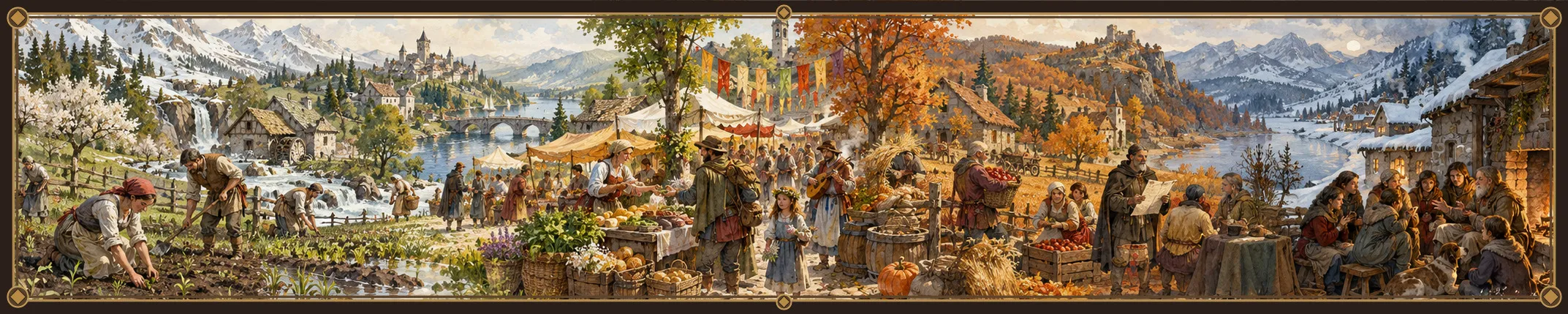
At the rise, the crossings close
and the drowned come walking home;
at low water, every arm is crowded;
at the sheaf, the barges come down;
in winter, mend the hull and mind your scores.
Whoever keeps another year
keeps it in another book.
The dates in the margins of this book are a convenience. Before Reckoning and Common Reckoning give every event on Caeldon one place on one line, and the medieval present sits at about 1,350 CR. The peoples of the medieval world live in other years. There is a river’s year that opens at the spring rise and a hold’s year that ends with a stone laid on the wall. There is a root-year of rising and falling sap, kept by people who have never seen the forest it belongs to, and a day of shifts and rounds kept by people who have never seen a sun. There is a wind-year, a water-year, a tide table, and a return. Each has its feasts, and each has something most households care about more than any feast: its counting days, when the levy is reckoned, the reserve is read aloud, the flood is added to the roll, or the dead are recited with the crossings they held. Each has its dangerous season too, when the wolves come down, the raiders ride, or the water gives back its dead. A year in the Medieval Era is less a calendar than a set of appointments with the land, the gods, the neighbours, and whatever is hungry, and the quarrels of every people gather around the days it cannot move.
How a Year Is Kept
No single calendar runs across Caeldon, and none is needed. A year is set by whatever a people cannot argue with. In the basins that is the river, which arrives all at once every spring whatever anyone has planned. In the Headwater foothills it is the snow on the passes. In the holds it is the wall, and in the Deeps the air. On the Windscar it is the wind and the water, in the Folds the harvest and the reserve, on the Tidelace the tide and the storm, and in the Tidebound Reaches the return of the runs. Everything else, the markets and oath-days, the weddings and namings, the feasts of the gods, the raids and the hunts, is fitted in around those facts.
Religion follows the same rule. The Sworn Accord, the faith of the Human corridor world, is built around its two first gods, Anvelle the Harvest-Mother of the basin fields and Serovan the River-King of the Serath, and its calendar follows their seasons. The festivals of cults the Accord has entered appear in a town’s calendar; household gods and country shrines it merely tolerates keep their own days without one. Other peoples' feasts are just as plainly about their country: a stone on the hold wall, flowers thrown to the sea, fires lit for the wind.
Most years have more than one clock. A Dark Elf house keeps a watch that changes at fixed turns and a root-year that follows the sap. A Gnome harbour keeps the tide table and the storm season at once, and a Thaluren river mouth keeps both of those and the return besides. Wherever two peoples share a place, they share it on two calendars, and many medieval quarrels, some of them bloody, come down to whose year the place is keeping.
The Cradle Year
The Human year of the cradle-web belongs to field and river, and it is the year most cradle peoples meet even when they do not keep it, because they buy its grain, cross its bridges, and pay its tolls.
The Rise
On the Lower Serath the year opens with the spring rise, when the whole basin’s water arrives at once. It renews the corridor’s fields and closes its crossings, drowns landings, and turns a day’s ferry into a week’s wait. A good rise means plenty and a failed one means hunger, and no town can do anything about either. Traffic stops. As the water falls, the drowned of the year come walking home out of it, up the landings towards the doors they knew, and the rites for them are as much a part of spring as the planting. The towns keep the Festival of the First Flow, offering bread, wine, and flowers to the river, and it is said that Serovan walks among the crowds in disguise to accept their thanks. Serathic tradition holds that he dictated the "Law of the River" to the first guarantors, and the strongest towns read it to their own advantage. The Reedfolk do not deny that Serovan is real. They deny his claim, and say the river belongs to whoever remembers it correctly; some of them cut the towns' fish-weirs in the dark and call it giving the river back.
They mark the rise their own way, with the flood-telling, when a Floodkeeper house sounds its channels again and speaks the year’s water into its remembered roll (see The Civilizations of the Medieval Era). Many river towns that owe the Reedfolk nothing they would admit to still quietly ask a Reedfolk family before the rise.
Upstream in the Confluence Basins the plough waits for the rise to fall back. Then the fields are ploughed and sown, and the year’s work begins in earnest. In the Headwater Marches the year turns not on the flood but on the passes: the year begins when they open, which is when the snow allows, and the first caravans up go heavily guarded, because the outlaws of the hills have been hungry all winter too. A wet spring is the Rattlecut’s worst season, when the river takes the road and gives back only part of it. At Greyford, where the Headwater road meets the Broken Marches, spring is flood watch: braces checked, ropes strung, and Lowbank sleeping light. In the Broken Marches the culverts are cleared in spring, many of them by Edgeway kindreds who have kept the same culvert on their circuit for generations.
In the forest, spring is the wet season. Root-fed hollows fill and join, low paths go under, and ground that was firm in autumn will not hold a person. In the Briarreach the ravine floors turn sodden and the slip-slopes are at their worst. And at the mouths of the Sunken Stairs, where the deep groves of the Elderweald once ran down into the Roothollows, the wet season is the stairs' season: as the hollows fill, mourners gather to keep the laments for the Drowning Bloom, and the watchers lying at the bars on wet nights listen for the tread on the steps below.
Low Water and the Long Road
Summer low water is the Serath’s busy season. The shoals show, every arm of the river is crowded, and bargemen take grain and goods downstream on the current while haulers drag them back up the towpaths. It is the river-thieves' season too, and the wreckers' above the shoals. The warm months bring fever to the crowded corridor towns and the low wet ground of the basins. In the Basins themselves summer is weeding and herding, the wet meadows grazed in common, and the granary watched.
In the Headwater Marches it is the long trading summer. Caravans are made up in the walled foothill towns and climb the exchange roads under escort, from waystation to waystation, to the oath-yards of the holds. Grain, salt meat, wool, and lamp oil go up; metal, tools, dressed stone, and craft teaching come down, and both draw outlaws, sellswords, and bears. Human miners and hands go up into the holds for a season and come back with wages and Dwarven habits. At Greyford summer is the long trading season on the span, and the queue on the Highbank road forms the night before every market day. When the water drops further, in the low months, the Greyford fords become daily work, and most Headwater fords are usable only then. Goblin side-ford families and Kindred guides walk the staked routes at first light to see what the night changed, and crossings run from dawn to early afternoon, before storms in the hills can raise the water. River-raiders wait at the side fords for anyone who crosses alone. The low months are the busiest time for salvage, when dressed stone and timber cross in quantity, and the Kindred caravans come through then on their circuits.
In the forest the dry months are a time of watching. Wood Elf households clear deadfall from the streams and watch the water through the dry months, because the Slowwater, the forest’s main water, is wanted by the holds upstream and the farms downstream alike, and the grove watchers carry bows for a reason.
The Sheaf and the Count
Harvest is the basin year’s great hinge. It opens with the Festival of the First Sheaf, when the first stalk is cut and offered to Anvelle so that she will see the harvest through. Then the threshing, and with it the levy: the lord’s or the town’s share is counted out on the same threshing floor as the village’s own store, by the lord’s men, with the lord’s riders watching, which is where most basin quarrels start. Some fields are kept fallow in Anvelle’s name, and wherever levies force a second harvest the tale of the Starving Winter, when the people would not rest the land and half the villages starved, is told more often.
At harvest the Sheaf Road, the basin grain road from granary to granary and march-town to march-town, is all carts, levy-reckoners, and the armed men who ride with them, and the bands who watch the road from the flood-forest know exactly when the carts are fullest. The grain barges come down to the Serath and fill the towns. In the Headwater Marches it is a hurried autumn before the snow, with the last caravans pressing up to the gates. In the Broken Marches the causeways are braced before the floods.
Once the levy is counted, the oath-house holds record-day and reads the year’s entries aloud, and anyone who would gainsay one must speak then (see The Basins and the Marches). For a basin household this is the day the year is fixed, and the day a neighbour’s quiet objection, unspoken for twelve months, finally has to be spoken or given up.
Mending and Judgement
Winter in the cradle’s Human country is a season of mending, waiting, and settling scores. On the Serath the boats are mended and the great houses settle the year’s quarrels; the ones they cannot settle are carried on in back streets with knives. In the basin towns the oath-days come round, when the lord or the town’s elders hear oaths and settle quarrels under Iskel and Ostrin the Lantern-Bearer. In the Headwater Marches snow shuts the upper roads for months and cuts the highest towns off from the gates; a caravan caught late loses its animals first and then its people. In hard winters the wolves come to the basin folds, and a hungry band comes down off the hills to take a village’s stores and its cattle. Ironspine passes close in winter, and a high hold can be cut off for a season. At Greyford winter is mending, accounts, and short days at the toll gate.
The Forest’s Slower Year
Elven years run on Elven lives, and those are long. The groves of the Elderweald do not hurry anything: a person is adult when the grove’s elders and ritual keepers all agree they have arrived, a household that moves groves is a guest for a full year, and a circle of groves may part without deciding (see The Civilizations of the Medieval Era). Some questions wait a generation, and a Human farmer who has cut a ditch in the meantime may find an arrow in the post instead of an answer.
In the Crownboughs the year turns on the court season. Houses of rank present their young at court, each bringing a piece of shaping they have carried on themselves, most often a bough or sapling trained from the house’s own grove. The courtiers who descend the Leave Stair to the Understorey Courts at the foot of the canopy then go with their faces painted gold after the image of Saerith the Mirror-King, and the receptions of basin envoys and suitors crowd into those weeks. So do the blood duels on the garden-walks above the drop.
Under Stone and Root
Behind the Ironspine gates the hold’s year is marked by one gesture. At the Festival of the First Stone every household lays a single stone on its hold’s walls, and it is said that if the stone is laid with true intent, Kerrund the Stone-Warden will strengthen the wall for another year. Hold life keeps slower appointments too, none of them fixed to a season: a name given when it can be carried, a craft taught one burden at a time, an oath at the gate when a young Dwarf is judged able to keep it.
Further down, in the Stonewake Deeps, there is no sun to keep time by. The day is reckoned in shifts and the shifts in rounds of upkeep: a vent round, a reservoir reading, a seal inspection, whose day households near the seal know the way surface villages know a market day (see Stone and the Deep).
In the Roothollows the Dark Elf houses keep two clocks. The threshold watch, which changes at fixed turns, is the house’s day. The root-year, the rising and falling of sap in the living roots, keeps the forest’s seasons for people who never see them, and most house business, from namings to the renewal of water debts, is set by it. Once in each root-year comes the water reckoning, when the water-keeper says aloud what the house owes in water and what it is owed. When water rises in the root-year, the laments are sung that still name Ithaere the Drowned Mother, a faded god nobody prays to, and the black water in the old chambers rises with it.
The Far-Side Year
The far side keeps its years by weather and water. Its seasons are not the cradle’s seasons with other names: a windy season, a dry season, a storm season, and a return season each have their own country, and none of them is reckoned against the Serath’s rise.
Wind
In the High Scars the year turns on the wind. The windy season closes the highest passes and fills the passward shelters with parties waiting it out, and dust storms close the Rimward ramps for days at its turn. At its start Orc camps keep the First Gale: fires lit on the high ground, and dancing in the wind as it rises, for Rakhal the Storm-Caller. If the fires are lit with true defiance, it is said, he grants a year of change and renewal. Before the windy season Ogre burden-camps carry stores up to the shelters. A storm delay is forgiven only if it is sent ahead, so the windy season is also the season when runners carry word that a party is waiting, and why; a party that simply fails to arrive is mourned first and avenged after.
The calmer months are for moving. Escorts carry most of the year’s traffic, herds go highest, and kindreds travel to their treaty-grounds, where terms are sworn, wrongs declared and answered, sometimes with blades, and the dead recited in the Reciting of the Names that Ushkar the Ancestor-Warden’s rite requires (see The Windscar). The escorts who held a crossing are recited as long as their kindred lasts, and a young escort setting out touches the cairn of the nearest of them for the road.
Below the Shearline, in the Rimward Basins, life breathes in and out with the water. In the dry months households and herds draw in to the strongholds on the rims and crowd around them in the same rings year after year, and a family’s place in those rings shows how much it counts. The dry-season gathering brings the most people closest to the least water just as escorted parties come down the ramps to ask for some of it, and struck-name raiders watch for a thinly held reserve. After the storms the households spread out again across the outer slopes and basin floors, and each stronghold shrinks to its keeping garrison. Cistern crews scrape silt and clear the channels after every storm. In a good year the Long Pan floods ankle-deep and grows a short-lived green fringe, every herd within reach is driven down to graze it before it browns, and its edge is the one place in the Basins where many kindreds camp side by side without a stronghold between them. Salt cutters work the pans in the cooler months.
Fold
In the Leeward Folds the year turns on two moments. In spring the planting rites open the terraces; late frost, pooling in the hollows on still nights, can take a year’s blossom in one night. Orchard work moves through the year from pruning to picking to drying and pressing, and orchard leagues share labour, presses, and drying floors across neighbouring folds. Walls are mended after every heavy rain, and cistern circles clear the channels before the wet season.
In autumn the harvest comes in and the reserve is counted aloud at the cistern hall in the autumn count, where any household may challenge a figure, and after it each fold meets as a commons to decide which terraces rest (see The Leeward Folds). Winter is lived on stores, walls, and the arguments the count produced.
Trade runs on the same clock. The Market Round is the seasonal circuit of fold markets, each fold hosting in its turn at the time its harvest allows, in an order old enough that changing it would start a quarrel among every fold on it. The escorted Lee Road to the Rimward Basins keeps Halfling market timing. Down at the Counted Lee, where fold loads meet the coast, the year is pinched between two calendars: the folds release nothing until the autumn count has set aside the reserve, and the coast’s calm months end in the storm season. Most of the Lee’s business is crowded into the weeks between the count and the gales.
The folds' great feast is the Festival of the Turn, kept for Tamsel the Season-Weaver at the changing of the seasons; if it is held with true joy, it is said, Tamsel will see the harvest good. Tamsel is strongest at the solstices and equinoxes, when the turn of the year is strongest, and weakest in late autumn and early spring. Every fold child knows the tale of the Long Summer that emptied a fold’s stores to the last measure, and Halflings tell it as the reason the reserve is never spent on plenty. A run of dry years is lowering the cisterns in the medieval present, and in a dry year every hungry band on the far side remembers where the water is.
Shore
On the Tidelace the year is kept by tide table and gale. In the calm months the breakwater crews rebuild, the sounding houses resurvey the Lacework, and traffic moves. In the storm season gales drive surge into the inlets and break what the calm months built; some harbours close their mouths entirely until spring. Then the harbour families mend, the beacons burn through the long nights, and on the darkest of them there are fires on the headlands that no Gnome lit, set by wreckers or by worse. Each season closes at the sounding house, where readings are compared and markers moved in front of the families who set them.
The tide hall sits at slack water, between tides, and every household of a beacon district owes its storm-season nights at the tower (see The Tidelace and the Soundchain Roads). Once a year the Festival of the Tides brings a whole harbour down to the quays with flowers, shells, and stories for Maris of the Tides, in the hope of a bountiful catch, and the Human hamlets between the harbours keep their own shrines to her at the water’s edge.
Along the Soundchain Roads the year is the rhythm of arrival: Orc escorts work the coast run while the passes are open and the sea is kind, returning to their camping grounds above the beach yards as reliably as Gnome crews to their quays, and the storm season thins the corridor to messengers and repair crews.
Return
The Thaluren year has one hinge. As spawning season nears, a sea settlement’s run gathers along the Kelpshade and the outer shoals, the Clutch-Watch Circle says who is going and in what place, and messengers swim ahead to give notice at the mouths and upriver. The great current road of the Reaches, the Homeward Set, carries most runs home in return season. Settlements time their departures by it, and a year when it sets late is remembered as a hard one. Blackfin pods follow the runs on the outer roads, and the Homeward Set lines name over every gathering the escorts who turned to face a pod so that the run could reach the kelp. The Outer-Route runs, coming in on longer, lonelier currents from the far edge of the known sea, arrive last and least predictably.
The run crosses into brackish water before watchers, climbs the river at the time it gave notice of, and spawns in a known ground under the spears of the Sanctuary Custodians, who stand over the gravels against the hunters that raid the spawning beds. Nobody spawns alone, and nobody’s clutch is a private matter. The adults return to the sea. The young who survive come down later, in their own time and without ceremony, and are counted when they reach the Kelpshade; the circle names each one by clutch and water before any household takes them in. For redirected families whose clutches now hatch at the Second Channel, the count at the Kelpshade is part of that water’s record: a good count means the water is accepted for another year, and a thin count turns the judgement into a quarrel that lasts all winter.
For most of the year a Kavari bank village sees no Thaluren at all. Its year is the river’s own: bank councils settling access, repair, and quarrels between neighbours, pool-kin households remembering which waters owe what, nursery keepers cleaning, turning, shading, and defending the gravel beds where Kavari young grow. In dry years pearl-takers come up the rivers to rake the mussel beds and trample the nursery gravels as they go, and meet barbed spears. In return season the village sees notice first, then escorts, and only then, if the water allows, a run.
At the river mouths the pilots keep a third calendar. At the Split Reed Mouth the tide table rules: every tide moves something, so the marked channels are re-sounded on a fixed cycle and after every storm. Out of return season the mixed circle of pilots and run-watchers sits seldom, for marker moves and quarrels, and the mouth is mostly pilots' water. In return season it is not.
Years on the Move
Some peoples keep no seat to keep a year in. Their calendars are circuits.
An Edgeway kindred returns season after season to the same broken roads, culverts, wells, spans, and storeworks along its inherited circuit, and its year is the year of its kept works: a culvert cleared every spring, a well relined, a causeway braced before flood season. The kindreds share a calendar of gathering-markets held at old ruined sites, often the only places where people from distant broken regions trade, marry, and settle quarrels. At the Undercroft Fair in the Broken Marches delvers' maps and furnace salvage change hands along with everything else. When a kindred sets out from a gathering-market it leaves a lit lantern at the edge of the site, facing the road out, for Corrow the Gale-Runner; if the lanterns are lit with true gratitude, it is said, he keeps the circuit open for another year.
Ogre burden bands have a year of jobs. They arrive for heavy work, are fed before they lift, and move on when the work is done: carrying stores to the High-Scar shelters before the windy season, clearing the Whetgap of what the windy season brought down, shifting stone from the Greyford yards and setting the rope crossings in flood season, keeping the Headwater winter roads open. Troll houses, by contrast, stay on the crossing they keep, and their year is its year: what the slides broke, what the flood took, when the crossing is too dangerous to use.
The Counting Days
Set side by side, the counting days of the medieval world have a family likeness. Record-day in the basins, the flood-telling of the Reedfolk, the autumn count in the Folds, the water reckoning in the Roothollows, the Reciting of the Names at the treaty-grounds, the season’s close at a Tidelace sounding house, the count of the young at the Kelpshade: each is a day when the year is spoken aloud before everyone it touches, and when a challenge must be made or let go. Each people keeps its memory in its own form, written, remembered, tallied, sounded, or recited. All of them agree that a count nobody has heard is not yet a count, and that the time to challenge it is the day it is read, though everyone also knows whose challenge will be heard and whose will not.
That is why so much of medieval life gathers around these days. A fold marriage is not finished in the tallies until the next count has moved the share aloud. A basin sale, boundary, or inheritance is safe only once record-day has passed without challenge. A kindred that has done well on the routes wants its dead recited well, and one that has done badly knows exactly who will be listening. Writers looking for the moment a private quarrel becomes public, and a public one becomes a fight, will usually find it on one of these days.
A Life Across Many Years
Beside the turning year runs a longer set of appointments: the stages by which a person comes to count. Almost every people marks them, and almost none marks them on a fixed day.
In the Headwater Marches a young person is sworn twice, first to working right, which lets them carry messages and travel on a household’s errands, and years later to oath-right, the right to swear and inherit in their own name. Downriver the Serathic Oath of Layers counts a person in three steps, Protection, Stewardship, and the full oath, and a half-Elven child of a ferry family may run the family boat for years before the great houses let them swear for the ferry. A Dwarven child’s name is cut on a small stone kept in the cradle-chamber until the child is judged able to carry it. A Dark Elf child’s first full recital of a Known Way is given to a route keeper in the threshold chamber with the household watching. A Wood Elf is adult when the grove agrees. A High Elf is presented at the court season, or held back by a tender’s not yet. A Gnome’s first reading is declared at the bench. A young Thaluren is counted on coming down to the sea, by clutch and water before household. None of these is a feast in the calendar, and every family knows which of its members are waiting for one.
Tensions
-
The second harvest. A lord orders a village’s resting field sown again to meet a corridor buyer who has already paid. The village elders say Anvelle forbids it. The steward says Anvelle does not sit in judgement, and the lord’s riders are already in the lane.
-
The grain sworn uphill. A foothill town has sworn in its hold’s oath-yard to deliver grain the hold needs for the Deeps. The basin harvest is short, and the Sheaf Road brings half of what was promised. Keeping the oath empties the town’s own granary before winter; breaking it closes the gate to the town’s carters. The custodian asks whether the town will hold, and its farmers, who have already skipped one fallow year, ask what the harvest can bear.
-
A deferred arrival. A young Wood Elf of the Elderweald is adult only when the grove’s elders and ritual keepers all agree they have arrived. One ritual keeper has doubted a young one’s arrival for many seasons running, and the grove has begun to ask whether the doubt is about the young one at all.
-
The egg-taker year. Egg-takers have come up the river to the Gravelbraid Nurseries in numbers nobody living has seen, and the Kavari households are losing young faster than they can hunt. Thaluren escorts have offered to hunt the side channels with them. Some bank councils want the help; others say a Thaluren spear in a nursery channel is the first step of a run through it.
-
A pod that follows. A blackfin pod has learned to follow the Homeward Set to the edge of the kelp and has taken escorts two seasons running. The escort-captains of Turningshoal want to hunt it down beyond the shoals before the next run; the Run-Watchers fear a run left thinly guarded while its best spears are away, and the young warriors are already sharpening for it.