Chapter 12. The Basins and the Marches
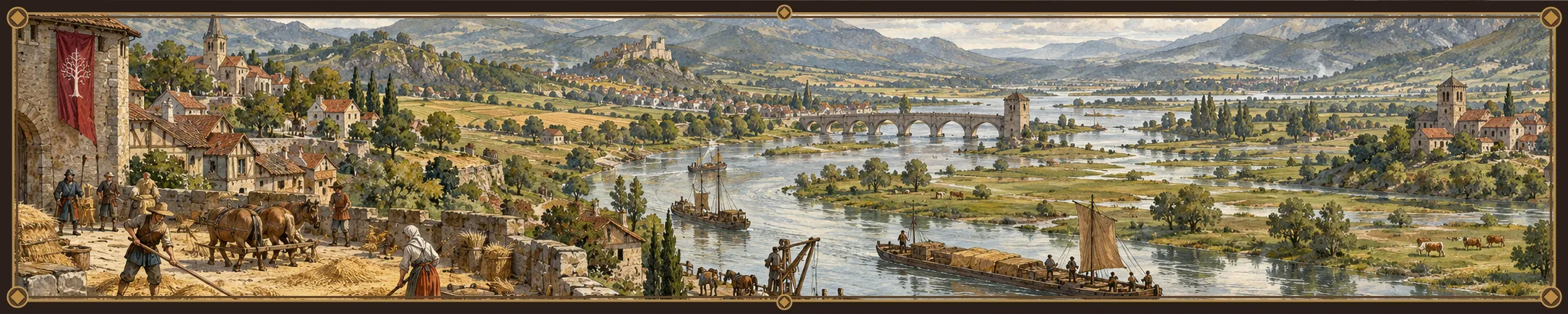
Above Toll’s End you pay for the crossing,
below it you pay for the promise,
and the river, that keeps neither,
takes its share of both.
Every river of the Human heartland tells the same story if it is followed far enough. It is born as snowmelt under the Ironspine, runs white through foothill gorges where Dwarven bridges older than the towns beside them carry the road, slows into wide valleys gold with barley, and gathers at last into the Serath, broad and brown and crowded with barges, its banks walled with towns that fight over every reach of it. On the way it passes a ruin-belt where nobody rules and a failing bridge where everybody argues. These five regions are the Human heartland of the cradle-web and its youngest country: the lordships and leagues that hold them took shape only in the last few tens of thousands of years, beside forest and mountain peoples many times older, on ground already scored by the roads and terraces of a people older still. What the young country has in place of age is nerve and numbers: lords who hold the fords with hired spears, towns that hold the bridges behind their walls, oaths sworn aloud before the gods, and the stubborn habit of writing everything down before the river, or the stronger neighbour, can change its mind.
The Confluence Basins
The Confluence Basins are the broad lowland heartland of Humans on Caeldon: a country of wide valleys, deep fields, and linked rivers that come down from the uplands, meet, and gather towards the Serath. More Humans live by the plough here than anywhere else, and the corridor towns that live by roads and river-trade eat what the Basins grow. Plenty draws hunger: outlaws in the flood-forest, wolves at the folds in hard winters, lords who burn each other’s barns, and the drowned who walk back out of the river in spring. The Basins are the home ground of the Confluence Marches, the first great Human civilization, and they were never only Human. The Reedfolk kept the lower waters as the Floodkeeper Houses long before the first basin town, and the towns still depend on what they know. Beside the forest and mountain peoples on their edges the Basins are young. The Marches came together only between c. 40,000 and c. 20,000 BR; the Rootcrown Concord in the forest next door is more than ten times older.
Fields and Flood
The Basins lie south of the forest and the foothills. The Elderweald and the Crownboughs run along their northern edge, the Briarreach closes the north-west, and in the north-east the Headwater Marches rise where the Sheaf Road climbs out; between Crownbough and Headwater country the last low spurs of the Ironspine die out among the northern ridges. The land falls gently southwards and the rivers with it, the Headwater rivers turning south-west and the forest streams running south, joining valley by valley into the Serath. Its lower course, the Lower Serath, is the Basins' southern part, with the Reedmere just above it, and the empty uplands of the Witnessfields rise in the south-east. The Basins are two to three months across. Sheafmeet stands in the middle valleys, about two months by cart from Oathfoot, four weeks by barge above Correth, and four weeks from Fernrest on the forest edge. Even here people live in cores, the river valleys, each a chain of villages round its march-towns. Between them lie fen, flood-forest, and high heath where wolves and wild boar run and no lord’s peace holds, and outlaws who have fled some lord’s judgement live off whatever passes, so carts on the Sheaf Road go in company under a march-town’s escort. A village troubled by wolves hires a beast-hunter; one troubled by outlaws pays whoever has the spears.
The Basins are not one valley but a field of them: broad, gentle lowlands parted by low ridges, each with its own river, the rivers joining as they descend. On the upland side the valleys narrow and climb into foothill country; towards the forest the fields run up to the edge of the Elderweald. Downstream the water slows and the ground loses its nerve; long reaches of reed, fen, and seasonal flood open where land and river never settle which is which. The greatest of them is the Reedmere, above the Lower Serath, the main Reedfolk country inside the Basins. In summer it is a green flat country of reed taller than a rider, threaded with channels only a pilot can tell apart, loud with frogs at dusk and silver with mist at dawn.
The soil is deep and the seasons kind enough that a good year feeds far more than the village that grew it. The price of plenty is water. The spring rise renews the fields and drowns the careless; a river can hold its bed for a generation and take a new one in a night; and the floods that matter most are the ones nobody living remembers. Fords shift, banks slump, and a crossing that held last season may be a scour hole this one, and the low wet ground breeds fever in the warm months. Two dangers are of the Basins' own making. Where grain levies demand a second harvest and the fallow year is skipped, the land is wearing out, and in some districts crops have begun to fail. And a dike, weir, or drained fen made for one town moves the flood onto another: the drowned reed settlements of Reedfolk memory came from exactly such work.
The wet country has teeth. Great catfish longer than a barge pole lie under the landings, and bargemen tell of one taking a child; mud turtles take fingers at the eel-traps, fen pitchers close on a dog’s paw in the Reedmere, and past the Grey Line the bulls of the wild kine kill anyone on foot who comes too near. Lords keep Spurred Hounds for their wars, dogs grown huge by magic that turn without warning, and every valley has a story of a kennel that broke loose. The dead are worse. As the spring rise falls the River-Given, the unrited drowned, walk dripping out of the water and up the landing steps to find their own doors. On the Sheaf Road the Crossroad Hanged drag at night carters from beneath the lords' gibbets until a village quiets its own dead, and under old fever-years lie plague pits that no roll marks, where a plough or a treasure-digger that breaks through wakes the Pit-Wakers, and the valley takes them for the plague come back. At the field edges the Skin-Lost come at dusk to houses they once lived in, beasts now with a person’s habits. Villages tell their children not to answer a knock after dark, and argue whether to hunt one or leave it bread.
The Village and the Granary
Most basin people farm. A village is a few dozen households on a rise above the flood line, with fields running down towards the water and the wet meadows grazed in common. The year belongs to field and river: ploughing and sowing once the spring rise falls back, weeding and herding through the summer, harvest and threshing, then a winter of mending and waiting. The Festival of the First Sheaf opens the harvest in every village that keeps Anvelle the Harvest-Mother: the first stalk is cut and offered to her, and if the offering is sincere, it is said, she will see the year’s harvest through. Where levies rise, the old tale of the Starving Winter is told more often, of the year the people refused to rest the land and half the villages starved. In some of the oldest fields crops grow in patterns that form faces and symbols, and the villages say these are her signs, still watching.
The granary sits at the centre of all of it. Each village keeps a store against the bad year, and the lord’s or the town’s share is counted out on the same threshing floor, which is where most basin quarrels start, and where some of them end with a steward’s men and a row of spears.
March-Towns and the Oath-House
March-towns stand where roads cross rivers: walled markets at fords, bridges, and ferry points, each with a mill and an oath-house of the Accord, and the larger ones a record-house. An oath-house is a squat stone hall by the landing, the town’s roster of gods cut into its lintel and its oath-rolls kept in iron chests below the floor. Grain is sold and shipped here and levies are reckoned, and anything that must bind is sworn aloud at the oath-house and written down. A marriage is sworn under a god the town has entered, each family bringing one of its own to stand beside the priest, so that three people can later say what was promised; a careful family pays the scribe for a second copy kept somewhere else. An inheritance, a land sale, or a boundary goes the same way. A field that changed hands on a handshake is open to any quarrel, and the stronger family usually keeps it, sometimes with scythes. The writing says who swore; it does not make the stronger party keep the oath, and many a valley feud began with a roll each side reads its own way.
Once a year, after the harvest levy is counted, comes record-day: the oath-house reads the year’s entries aloud, and anyone who would deny one must shout it then. A poor family’s word against a rich one seldom outlasts the reading. On oath-days the lord or the town’s elders hear oaths sworn and settle quarrels, mostly in favour of whoever stands closest to them; agreements are sealed under Iskel the Scribe of the Silent and accusations brought under Ostrin the Lantern-Bearer, and most end in a blood-price, an ordeal, or a fine paid to whoever sits. A few end at the ford at dawn, with swords, and the town turns out to watch. When an oath is denied and no one can settle it, the entered gods decide by ordeal, hot iron, the river, or combat before the oath-house, and a rich man may name a champion; basin sellswords make a trade of it. A stranger is asked early whose god they swear by, and whether that god is entered here, because an oath under an unentered god is a private matter, not a bond. The rolls are treasure in their own right: an old roll can win a manor or lose one, rival houses pay thieves to lift one from a chest or burn it before an oath is sworn on it, and old priests sleep on the chests. Scribes are among the most needed people in the Basins and among the most anxious. They swear in the name of Annoth the Keeper of Scrolls to read, write, copy, and keep, and to save the record before themselves when a record-house burns, and records are always being lost.
The Floodkeepers
Reedfolk life runs alongside and partly underneath. In the fens and on the lower reaches, Reedfolk households live in stilt settlements and on reed islands, fishing, cutting reed, and guiding boats through channels that will not stay put. In the towns they work as pilots, channel-menders, and flood-keepers. No sensible boat crosses the Reedmere without a Reedfolk pilot, though the landing-fee goes to whoever holds the landing; the Reedfolk who know where the channel actually runs are paid wages, and seldom thanked. How far they are heeded differs from town to town: one keeps a Reedfolk flood-keeper by old custom, another a family that owes service by inheritance, a third only a household everyone quietly asks before the spring rise. Outlaws who settle in the fens without a guide’s leave learn what that knowledge is worth. When they raid the stilt villages and the barges, the houses lead them out onto ground that will not hold them, and the reed keeps what it takes.
After each spring rise a house’s keepers sound the channels again and add the year’s water to the house’s remembered roll, spoken aloud each year at its crossing shrine, and a quarrel over a channel is settled by the memory that matches the water as it now runs (see Peoples of the Water (FND)).
Lords, Towns, and the Edges
No one rules the Basins. The Marches are a quarrelsome web of lords who hold land and the villages on it, towns run by their richest houses, and march-towns that keep crossings behind their walls. Alliances shift with harvests and marriages, and feuds with burned barns, stolen herds, and a neighbour’s son found in the river; a feud is fought with torches in the rick-yard and arrows from the hedges until one side can no longer pay its sellswords, or until both go to the oath-house, whose word on who swore what is cheaper than another season of killing. What holds the Marches together is shared habit more than any crown: the same gods, the same oaths, and the expectation that a bargain is sworn before it counts. Who then keeps it depends on who can be made to. Lords' power is grain and the spears it feeds; they levy a share of every harvest, send it along the corridor roads, and in a bad feud hire a sellsword company for the season. Towns' power is the market, the crossing, and the wall. The priests of the Accord, called witnesses, remember who swore what, and both sides heed them when neither is strong enough to ignore them.
That order is fought over from below and from beside. Farmers who keep Anvelle’s rest-year resist levies that force the fallow. Reedfolk houses hold the knowledge but not the decision, and say that the river belongs to whoever remembers it correctly, and that the basin habit of swearing before a witness was theirs first. The Headwater roads and the Serathic towns downstream both need more basin grain than the Basins can safely give, and basin lords sell to whoever pays. At the forest edge Rootcrown stewards weigh every clearing, and settlers who cut without their leave find their fences down and their hunting gone, whatever the nearest lord has granted. Outlaw bands, many of them men left lordless by the last feud, hold stretches of road and fen, and the villages nearest them pay them in food to be left alone; the boldest captains are better known than most lords, their heads are cried at every march-town gate with a price beside them, and in some valleys they are drunk to in secret as the only men who ever robbed a levy-reckoner.
The Basins have no surveyed frontier. Upstream they shade into the Headwater Marches with no line at all, the two shaped as one country; basin folk say the Headwaters begin where the fields get too steep for the plough. Downstream lies the Lower Serath, inside the Basins but a world of its own. Towards the canopy the embassy road climbs to the Crownbough receiving grounds, a border of rank rather than ground. And in the south-east, beyond the lower river, the fields thin into the terraced, empty uplands of the Witnessfields, where basin herders turn their flocks back at the Grey Line of boundary markers: the one basin edge that is fixed, though by no one living.
Roads and Records
The rivers are the first roads. Barges and flatboats carry grain downstream at harvest, and every ford, ferry, and bridge has a keeper who takes his cut; upstream travel is slower and goes mostly by land. The Sheaf Road, the basin grain road, runs along the valley rises above the flood line from granary to granary and march-town to march-town. Above the Basins it climbs into the Headwater roads; below, it reaches the Serathic towns. At harvest it is all carts, levy-reckoners, and the spearmen hired to guard them, since a harvest cart is what every outlaw band in the flood-forest has waited all year for. Out of the Basins go grain above all, then flour, livestock, and labour hired out for the season. In come worked metal and Dwarven craft down the Headwater roads, river goods up from the Serath, and Crownbough grafts and ceremony, given as gifts and measured as prestige. Both ways go oath-rolls and the second copies scribes keep, travelling with every convoy, and the sellsword companies that follow the money from feud to feud.
Feud and plenty keep a whole crowd of sword-trades in work. Sellsword companies winter in Sheafmeet’s lower town and hire out by the season, and a company that changed sides mid-feud is remembered in three valleys by the same curse. Beast-hunters follow the bounties on wolves, on a kennel’s runaway, or on the great catfish of a landing. Bounty-takers work the gibbet roads. And at the back of certain march-town smithies, old silver from the Paling is sold quietly, at a price that counts the risk and not the weight.
Towns and Villages
No one rules the Basins, so they have no capital. The nearest thing to a centre is a handful of great march-towns where most of the harvest is reckoned, sold, and shipped, and the largest is Sheafmeet, a walled town where the Sheaf Road meets two joining rivers. It has a long bridge, three mills, a granary larger than some villages, the valley’s greatest oath-house, and a record-house whose scribes keep second copies for half the valleys around. Its walls have been stormed twice in song and once in living memory, when a lord’s warband and its hired swords came over the river gate at night; the breach-stones are still black, and the town’s children dare each other to touch them after dark. Ten thousand or more people live inside and below the walls; at harvest the carts, levy-reckoners, and barges double that, and the town smells of chaff, wet rope, and mill-dust. Reedfolk pilots of the Floodkeeper Houses take its grain boats down towards the Serath.
Chaffbridge is the ordinary march-town: a wall, a mill, a market square, and an oath-house at a bridge over a feeder river, but no record-house, so its scribes send their second copies to Sheafmeet. Some two thousand people live by the bridge, the grain market, and the carts on the Sheaf Road. The lord who holds the bridge takes a toll of every cart; the town’s ruling houses take everything else, and the two feud over the line with a few armed men each and a body in the river most years.
Fallowrise is a basin village of the ordinary kind: some forty households on a rise above the flood line, fields running down to the water, wet meadows grazed in common, and the granary in the middle with the threshing floor beside it, where the village’s store and the lord’s share are counted out. It keeps Anvelle’s rest-year, which makes it exactly the kind of village where the second-harvest quarrel is fought, and its men remember the autumn the lord’s riders came to take the seed-corn and three of them did not ride home.
Out on the Reedmere, Ninefloods is a Reedfolk settlement of a few dozen households on stilts and reed islands, joined by boats, around a crossing shrine where the house’s flood roll is spoken aloud each year. Its people fish, cut reed, and hire out as pilots. Boats that tried the Reedmere without one have been found weeks later in the reed, empty, and the Reedfolk will not say what lives in the deep channels. At the south-eastern edge, where the fields thin towards the Witnessfields, Flockturn is a handful of farmsteads and sheepfolds. Its herders graze up to the Grey Line, turn their flocks back there, and sell wool and mutton at the march-towns. Nobody from Flockturn crosses the markers, and nobody asks them to, though now and then a treasure-hunter with a pack and a hungry look asks the way to the old marker roads and walks on past them. Flockturn wishes such strangers luck and does not expect to see them again.
Holding-Names and Flood Rolls
Some 2.4 million people live in the Basins outside the Lower Serath, which counts its own, and no other region of Caeldon comes near that number. About nineteen in twenty are Humans. The Reedfolk of the Reedmere and the lower fens, perhaps 100,000 of them, are most of the rest; a few Wood Elf and mixed households at the forest edge, Goblin carters and hands in the march-towns, and the odd Wrought smith make up the remainder.
Basin folk wear undyed wool and linen from their own sheep and flax: a long shirt, a belted tunic or kirtle, hose, a hooded cloak, wooden-soled shoes for the wet months, and at harvest shirts and straw hats. Rank shows in colour. A lord’s household wears dyed wool, and a scribe the dark gown and ink-stained cuffs of the record-house. Most basin folk run to brown hair and weathered fair or olive skin, darker in the southern valleys. One child in three dies before five, most of them of fever and flux in the warm months, so a newborn can expect about thirty-five years, though those who grow up commonly reach their fifties or sixties. Sickness takes about half of all adults, the low-ground fevers and winter chest illness first; childbirth causes about one death in eight among women; drowning, harvest accidents, and the hungry spring after a failed rise take most of the rest. A child is named within days and carries the holding-name of the land its household works. The name belongs to the fields in the record-house roll, so a family that takes over a holding takes its name as well, and the march-towns add bynames of trade. In any basin roll: Edda Garrow, Aldous Fennick, Mabry Tarrent, Corwin Tessaly, Lissa Brenn, Wenna Dask.
Reedfolk wear little that holds water: short, close-bound tunics of linen or reed fibre, bare legs and feet, and a reed cape against rain. Basin Reedfolk are reed-brown and mud-grey, lean, and seldom seen hurrying. Their children die young about as often as basin children, though seldom by drowning, and their adults live about as long as Humans and die of the same fevers; more Reedfolk die when a channel is moved than when a flood rises. A name is given with the house and the water the house keeps, and recited each year in its flood roll: Lirren of Ninefloods, Ossel, Shoma, Tevvin, Ammeth, Seshu. Basin scribes write the house down as if it were a holding-name, and the houses resent it.
Memory and Belief
The Basins think of themselves as the original Human answer. Before there were Serathic guarantees or Headwater roads there was the Confluence way, deep fields joined to a hard edge, and later Human lordships are still measured against it. Behind that lies a long dimness: Human bands gathering slowly across the valleys in the Gathering of the Confluence (c. 120,000 to c. 50,000 BR), during the Unrecorded Age, keeping history in speech. Writing came back into common use only as the Marches formed, so basin memory begins with the written roll, and basin people trust what is written more than their neighbours think wise. What they sing is older. Every basin feast ends with a toast to the ford, and the man in it: the lord who held a ford alone until the flood took him and his enemies together. Mothers tell of the girl who led a whole village out of the Paling and remembered none of it. And the long valley wars left burned keeps on the ridges, haunted, it is said, by the men who held them, each said to hide the war-chest its lord buried before the walls fell. Every generation someone digs for one, and every generation the diggers have a reason to stop.
The Reedfolk remember the same rivers differently: in the Lower River Absorptions (c. 30,000 to c. 8,000 BR) no army took the fens, but houses were hired, married into, written around, pushed to the fen margins, or drowned behind channels moved for stronger neighbours.
One memory belongs to no people at all. South of Flockturn, a few days up a side river from the corridor, lies the Paling: grass, heath, and stone the colour of old ash round the smoothed, letterless walls of an archive river city, unwritten by the Incursion of Mnemosyne Null (c. 132,000 to c. 130,000 BR). It is the city that forgot its name. A night inside still takes the morning’s memories, and the households along its edge say their names, songs, and genealogies aloud every night. Silver-diggers go in anyway for the old silver, and come back without knowing where they found it; the edge households set a candle in the window for each one who goes in, and pinch it out at noon.
Basin belief is the Sworn Accord at its most ordinary, the faith of the corridor world: a god is honoured in the towns only once the Accord has entered it on a town’s sworn roster. Entered gods have their shrines kept openly and defended by the town’s spears; unentered ones count for nothing, and their shrines are fair game. Its temples are the oath-houses and its priests are witnesses, sworn to attend and remember rather than to command, and feared more than loved, since a witness’s word can hang a man or disinherit a widow, and a witness tends to remember what the strong would like remembered. An unsworn death leaves the Unsworn Dead at the back of the oath-house. Anvelle stands first; she was born here, from basin farmers' dependence on soil and season. Beside her stands Serovan the River-King, whose spring-rise rites the Basins keep though his heart is the Serath. The dead go to Ennor the Grave-Watcher. Country shrines and household gods are tolerated rather than entered, and beneath all of it lies the seasonal custom of sowing and harvest. The Reedfolk keep their own river-memory rites, refuse Serovan’s claim on the water, and remember Hesserin the Shattered Saint, who shattered when their houses accepted service.
The Lower Serath
By the time the basin rivers have joined, the Serath is broad, brown, and slow, and it carries the water of every valley above it. The Lower Serath is its lower course and the crowded corridor of walled towns strung along it. It lies inside the Basins and eats their grain, but it lives by passage rather than by the plough: barges, ferries, landings, markets, and the great houses that decide what a crossing owes and to whom. It is rich, crowded, and dangerous: river-thieves in the reeds, wreckers above the shoals, catfish under the landings, and every spring the drowned walking home out of the falling water. It is the country of the Serathic League, a league of river towns held together by sworn oaths and the fear of breaking them rather than by a crown, and one of the strongest surviving countries of the Reedfolk, who read this river for well over a hundred thousand years before the first town wall went up. Beside that the corridor is young: what sets it apart from the rest of the Basins took shape only in the Lower Serath Guarantees (c. 26,000 to c. 16,000 BR).
A River That Walks
The corridor is the southern course of the river, inside the Basins, with basin fields along both banks and upstream to the north, and the river runs south through it. The Reedmere and Toll’s End lie at its top, Correth about midway down, and Pellith lower, above the Lying Shoals, with Towrest a day above it on the towpath. East of the corridor, past a strip of basin fields, rise the empty uplands of the Witnessfields, two or three weeks on foot from Correth to Stillgate. Correth is about four weeks by barge below Sheafmeet and two months or more back up. The corridor is the longest unbroken core on Caeldon, town after town with their villages behind them; on the water the drowned who were never given their rites come ashore as the River-Given, so barges go in company and the towpath is walked by daylight.
The Serath runs through a wide flood-ground of its own making: abandoned channels, backwaters, oxbow lakes, reed beds and willow thickets at the margins, and low rises of firmer ground where the towns stand. Within that ground the main channel wanders over a lifetime and the side channels faster. In places the river splits into braided arms around sandbars and reed islands, and the worst of these, which bargemen call the Lying Shoals, keep no channel from one low water to the next.
The river gives the corridor its wealth and nearly all of its dangers. Every spring the whole basin’s water arrives at once: the rise renews the corridor’s fields, closes its crossings, drowns landings, and turns a day’s ferry into a week’s wait. A good rise means plenty and a failed one means hunger, and no town can do anything about either. A quay can silt up in a season. A town can wake to find its channel moved to the far bank, and its trade with it, and some crossings lie about their own depth to anyone who has not watched them for a generation. A weir that drives one town’s mills, or an embankment that saves another’s fields, sends the flood or the drought somewhere else. And the corridor is crowded: fever in the warm months, fire in close-built streets and record-houses, and so much traffic that one sunken barge in a narrow arm, or one quarrel between two towns, can stop a whole reach.
What lives in the water is no kinder. Leeches wait in every backwater for the bare-legged, and the catfish under Correth’s landings have taken children and dogs; the bargemen call the greatest of them Grandmother Mud and say she has outlived the bounty on her three times, and the hook of the last beast-hunter who tried for her hangs rusting in the river shrine, as long as a man’s arm. River-thieves cut barges loose in the night and strip them in the reed. Above the Lying Shoals wreckers light false marks and loot whatever runs aground, and a stranded crew that fights them rarely lives to complain; bargemen say every reed island between Pellith and the shoals has a wreckers' hoard buried on it, and Pellith hangs any wrecker it takes in an iron cage on a pole above the shoals, where the next crew can see him. Under every reach lie wrecks, barges sunk in the town wars and grain fleets lost to the rise, and a silver barge that went down in a channel the river has since abandoned and buried. At every low water treasure-divers go down after what the silt gives back, and the drowned are said to haunt their cargo.
The Corridor Town
A corridor town stands on a rise above the flood line, walled on the landward side, with a water-gate and quays on the river and a ferry landing below them. Inside are the market, the toll-house where the town takes its dues, an oath-house, a record-house, and the great houses' moot-hall, where on the oath-days the great houses hear oaths sworn and settle what they please. Outside the walls are the boatyards, the ropewalks, the fish weirs, and the corridor’s own fields on the higher ground, never enough to feed the town. Most people work the river or the trade it carries. Bargemen take grain and goods downstream on the current; haulers drag them back up the towpaths or pole them through slack water; ferrymen hold the crossings, porters and clerks the quays, and every market has its weighers, criers, and money-changers. Above them sit the scribes, oath-keepers, and guarantors who answer for a reach of river. Below them all live the river-thieves in the reeds and the wreckers above the shoals, the sellswords every bargemaster hires against both, who change sides oftener than the bargemasters like, and the bounty-takers who sell river-thieves' heads to whichever town cried the price.
The year follows the water. At the spring rise traffic stops, crossings close, and the towns keep the Festival of the First Flow for Serovan, offering bread, wine, and flowers to the river; he is said to walk among the crowds in disguise, accepting their gratitude. When the water falls, Reedfolk pilots go out to sound the channels again before anyone trusts last year’s marks, and the towns meet the River-Given on the landings with the rites. Summer low water is the busy season, when the shoals show and every arm is crowded. Harvest brings the grain barges down from the Basins and fills the towns, and in winter the boats are mended, the great houses settle the year’s quarrels, and the ones they cannot settle are carried on in back streets with knives.
The Guarantee
The League has no king and no single capital. Each town keeps its own walls, ruling houses, and market, and binds itself to its neighbours by sworn guarantee: it answers for its reach of river, its crossings, and its landings, and treats carriers from other League towns as its own. What the towns share is the guarantee custom, the Law of the River that Serovan is said to have given, and the Sworn Accord that swears both. A town that breaks faith finds its barges stopped at every other town’s water-gate, and the fear of that, not any council, is what holds the League together. When the fear fails, towns fight: barges burned at the quays, a water-gate stormed, a rival’s grain fleet sunk in a narrow arm. Feuds between great houses of rival towns can outlast the quarrel that began them by a century. Inside the towns, power belongs to the great river houses that hold the markets and the landings, pay the town’s spears, and settle everyone else’s quarrels, usually in their own favour. Guarantors answer for the river on their behalf, with armed boats when words fail, and scribes and oath-keepers write down what the great houses have already agreed.
A guarantor is sworn for one reach of river and lives within sight of it. The morning begins at the toll-house, listening to what the night watch and the ferrymen report: a snag below the landing, a broken towpath post, a barge that tied up without paying, river-thieves seen in the reeds. Then the reach itself, walked along the towpath or poled in a skiff with two spearmen in the bow, checking the channel marks the Reedfolk pilots set, the landing stage, the crossing ropes, and the reeds where thieves lie up. Grumbles and threats come wherever the guarantor stops, and most are settled on the spot. Before dark the day’s dues and the day’s repairs are written side by side in the guarantee roll, because the roll is what the great houses read when a carrier swears the reach was not kept. A guarantor whose dues run far ahead of their repairs can expect angry carriers at the door, and sometimes a knife.
A bargemaster coming down the Serath stops at each League town’s toll-house, pays the reach’s dues, and may ask to hear its guarantee read aloud. In return comes a passage tally, a notched and sealed wooden token naming the barge, the reach, and the day, so that the next town does not charge for the same water twice. Above Toll’s End, the point where League boats give way to a basin lord’s men, the lord’s men take what they like and give no tally; corridor folk use the name for the corridor’s upper edge, and no two towns put it in quite the same place. A Reedfolk pilot for the braided reaches costs extra, and a bargemaster who saves that coin may end on the Lying Shoals with the river-thieves rowing out to meet him. On the Lying Shoals the guarantee is only as good as the pilot.
At some toll-houses an Ashen Lantern hangs by the door, an iron lantern that gives off a faint, colourless light, and people say it is Ostrin’s eye, watching for a guarantor whose dues run far ahead of their repairs. Dues taken without upkeep and quarrels that always end in the great houses' favour are the corridor’s oldest grievance, and the cheated call on Ostrin to show where the money went. Most of them lose anyway, and some go to the reeds, where a few become the outlaw reed-captains the quays drink to in whispers: robbers of the great houses' barges, never of a ferryman’s. Ostrin was born from the grievance of these towns. His Lantern-Sworn, a few ascetics vowed never to speak a lie even to save a life, stand at the oath-days to call out cheats and are widely disliked for their bluntness, and in some towns an accused thief may ask to be judged by the lantern instead of the rope: a devotee holds an Ashen Lantern to his face before the crowd while he swears, and the townsfolk swear they have seen the light turn on a liar.
Every road in this book starts from home, and home is a toll-house window on the Serath, where I sat for longer than I like to count and took the river’s money. I set down what it is like here because I have since learned that it is not like this anywhere else, and nobody at home believes me.
The day starts before light, when the guarantor comes in wet to the knee from the towpath, his two spearmen dripping behind him, and tells the window what the night did: a snag below the landing, a post down, a barge that slipped its mooring and its dues together, lamps seen in the reeds where no honest boat would be. I enter it. Then the barges come, and each master, bare-armed in a sleeveless jerkin whatever the weather, leans in at the window and pays, and I cut the tally, notch for the reach, notch for the day, the town’s seal pressed into the wax, and push it across. Some masters ask to hear the guarantee read. I read it to them as it was read to me when I was a child standing in the same queue: this reach kept clear, this landing kept safe, this crossing kept in repair, and the carrier treated like the last. Most of them mouth the words along with me. The Reedfolk pilot waiting on the stage outside never does.
In the evening the guarantor and I sit down with the roll and enter the dues on the left and the repairs on the right, line against line. That is the whole of my trade: keeping two columns honest enough that the great houses could read them at the moot-hall and find that we did what we were paid to do, or honest enough, at least, that no carrier comes to the door with a knife. Over our door hangs one of the old iron lanterns, and at dusk it gives a light like water with no colour in it. The guarantor does not look at it. I have caught myself looking at it more than once, when the left-hand column ran long.
In spring the river comes up and everything stops. We throw bread and flowers off the quay for the River-King, and the old women tell children he is there in the crowd somewhere, and the children stare at every stranger. When it falls, the drowned come up the landing steps, slow and streaming, and the old women go down to meet them with the rites while the rest of us keep indoors. Then the pilots go out in their narrow boats to sound the Lying Shoals, and nobody trusts a mark until they come back. One year a pilot told me, quite pleasantly, that the channel our guarantee promised had moved three hundred paces to the east in the night, and that the town across the water would be glad of our trade. I wrote that down too. It was the first time I understood that the river had never sworn anything.
Three Layers
The towns are mixed, and they know it. Reedfolk live in stilt quarters at the water’s edge and on reed islands between towns; Goblins and the Wrought turn up on the quays and in the workshops; and some households are part Elven or Dwarven by marriage. That mixture is why the corridor towns count people in three layers, a custom the strongest river houses fixed in the Serathic Oath of Layers (c. 19,000 to c. 18,000 BR) and have kept ever since. Protection comes first and comes to everyone the town takes in: food in a famine, a place behind the walls, and a house that will avenge them. Stewardship comes next: holding a boat, a stall, a debt, or goods in trust, with a master or a house watching. The full oath comes last: swearing to a guarantee, inheriting a ferry or a berth, carrying a house’s heaviest burdens in one’s own right. A half-Elven child of a ferry family is protected from birth, may run the family boat under stewardship for years, and may not swear the ferry’s guarantee until the great houses at the moot-hall say so. Families argue about when that is. The houses are seldom quick, and quicker for a child with rich kin.
How far the Reedfolk count follows no single rule. Since the Absorptions each reach has kept whatever its town imposed: here a Reedfolk office the town tolerates, there a house that owes service by inheritance, elsewhere only a family that every bargemaster quietly asks before the rise. Reedfolk say the League found three layers for everyone else and has kept them on the middle one ever since.
Corridor Towns
The League has no capital. Each town keeps its own walls and ruling houses; what gathers the corridor is its oldest and richest towns, whose word the smaller towns follow because they cannot afford not to, and the largest of them is Correth. Forty thousand people or more live there on a broad rise above the flood line, walled on the landward side and fronted by water-gate, quays, and a busy ferry landing. Inside are several markets, the toll-house, the greatest oath-house on the river, two record-houses, and a moot-hall whose word other towns quote back at it. Its water-gate has been forced once, in a war with an upstream town that its children still re-fight with sticks on the quays, and its great houses have never forgiven the town that did it. Its quarters are as mixed as the corridor: Reedfolk stilt houses at the water’s edge, Goblins and the Wrought on the quays and in the workshops, and families part Elven or Dwarven by marriage.
Pellith, a ferry and boatyard town of ten thousand or so, stands above the Lying Shoals, where barges wait for a Reedfolk pilot before they go down. Its boatyards, ropewalks, and haulers' yards spill out beyond the wall and smell of tar and hemp, and its guarantee for the reach is read aloud at the water-gate to anyone who asks. Most of its quarrels are with the river, which has moved its channel twice in living memory, and with the wreckers above the shoals, whose false lights its watchmen hunt down every low-water season for a bounty on every lamp. Beside it, on reed islands, lies Oldchannel, home to the Reedfolk pilot house that has held one channel longer than the town has stood. A few dozen households live there by pilotage, channel-mending, and fish, and it is the house now asking Pellith’s great houses to let it swear in its own name. Its pilots know where the wreckers hide on the shoals, and say so only when they choose.
A day above Pellith on the towpath, Towrest is a haulers' hamlet: a long inn, stabling for draught teams, and the houses of the families who drag barges upstream. It lives on the slow half of the river trade, and its haulers know every stretch where the towpath has fallen in, every bend where the River-Given come ashore in spring, and every one where bandits wait for a team that has fallen behind.
Berth Names and Roll Names
Between 600,000 and 800,000 people live along the corridor, the most crowded country on Caeldon: forty thousand or more in Correth alone, and perhaps one in five behind some town wall. About seven in eight are Serathic Humans and about one in ten Reedfolk, in the stilt quarters and on the reed islands; Goblins on the quays, a thousand or more Wrought in the workshops, and the households part Elven or Dwarven by marriage make up the rest.
Corridor dress is linen for the river trades and wool for winter, cut short for work on boats and quays: a sleeveless jerkin and breeches for a bargeman, leather aprons and gloves for haulers and ropewalk hands, a long dyed gown and a seal on a cord for guarantors and the great houses. The blue and madder-red of the town dyers tell a townsman from a basin farmer at a glance, and the faces under them are as mixed as the corridor. Town life is short. Two children in five die before five, of warm-month fever and whatever else passes through a crowded quarter, and a newborn can expect about thirty years; those who grow up reach their fifties more often than their sixties. Fever and flux kill most adults and fire in close streets kills some, and on the water drowning takes more bargemen than any sickness. Serathic names are longer than basin ones: a given name and the family name of the berth, boat, or ferry the family holds, with the parent’s given name set between them in a guarantee roll, so that Sabeth Ivo Merriden is Ivo’s daughter of the Merriden ferry. Others on the rolls: Kester Osswey, Ivo Vantry, Hester Merrowin, Perrin Doswey, Maudry Senneth.
Corridor Reedfolk dress and live as they do in the Basins, and a pilot who holds a berth wears its token on a cord; fever comes less often to the reed islands than to the towns. Their own names follow the house and its water, but the towns enter them under a roll name that a scribe makes from the house’s channel or berth, so that Imreth of Oldchannel is Imreth Oldchannel on the guarantee roll; others on the reaches are Tellis, Suvva, and Ennan. Quay Goblins dress, live, and are named as the Goblins of the Broken Marches are, with a quay byname a corridor scribe adds, and the Wrought as in the Headwater Marches.
Who Taught the River
The corridor remembers itself as a promise kept, the guarantees and the League they made (see How the Present Was Made). Serathic houses quote their own old oaths with a pride other Human powers find tiresome. Quayside taverns tell harder things: the bargemaster who ran the Lying Shoals at night with the wreckers' false lights all around her and brought her grain fleet through; the river wars between upstream and downstream towns, when one town could drown its rival’s harvest by opening its own sluices; the spring the River-Given came ashore in hundreds after a flood that drowned a whole town; and the bargewoman who rammed a basin lord’s toll-chain at Toll’s End and broke it, whose barge has been looked for under the Serath ever since for the lord’s strongbox she is said to have carried off.
Underneath that story lies another. Serathic tradition says Serovan dictated the Law of the River to the first guarantors. Reedfolk say most of it is flood-keeper knowledge with a Human seal on it, absorbed with the houses themselves, and the oath-forms the League is proudest of are older still: archive-world forms that the Floodkeeper houses kept after the Last Keeping (c. 150,000 to c. 120,000 BR) and the towns took from them. Some Floodkeeper houses say so. Serathic scribes rarely agree. The archive cities themselves stand sealed in the Witnessfields, dead cities holding oaths nobody has ever released, and corridor treasure-hunters who go looking for their vaults seldom come back the same; the quays have a saying for a man who has lost his wits over money: he has been to the archive. Upstream League towns want new weirs for their mills now, and their own flood-keepers warn that the weirs will move a channel; the tale of the Dry Year, when the Serath ran dry because a town built a dam without Serovan’s leave and its elders had to walk into the riverbed to beg, is told whenever a town talks about building one.
The towns keep the Sworn Accord (see Faith in Practice), and Iskel’s oath-keepers are vowed never to reveal what they keep. Ostrin’s name is called as far away as Greyford. Some downriver oath-houses refuse to enter Abrel the Changeling, finding a god of in-between people too unsettled, and their zealots have more than once crossed into the Headwater country to break the god’s shrines. Reedfolk grant that Serovan exists and refuse him the water. They keep their own river-memory rites and the memory of Hesserin, the god of refusal who broke apart once their houses took service, and in some old crossing shrines her broken mirrors, set back together with gold, still hang above the water. Whoever looks into one, it is said, sees their own cracks and the gold that holds them.
Above the corridor, basin lords hold their crossings by the sword, not by guarantee, take a toll of whatever passes, and sell their grain to whoever pays; the League needs that grain and does not control it. Away from the river the corridor is only as wide as the towns' fields and the flood-ground, and the line between town fields and a lord’s villages is set field by field. Further up, the Headwater Marches never touch the corridor but are its other half, and what comes down from the mountains reaches the Serath through the Basins. Downstream, nothing below the lowest guaranteed town is fixed: whether the Serath reaches the sea through an estuary, spreads into further wet country, or does something else entirely is left open.
The Headwater Marches
Upstream, the valleys narrow, the fields tilt onto terraces, and the rivers quicken into gorges. The Headwater Marches are foothill country between the Human farmland and the Dwarven mountains: steep valleys where the basin rivers begin, walled towns at the crossings, and the escorted exchange roads that climb from basin granaries to the gates of the Ironspine. They belong to the Confluence Marches, but they live by passage more than by the plough, and by the sword that guards it. Metal comes down these roads and grain goes up, and both draw outlaws, sellswords, and bears; above the valleys stand the broken works of giants, and in the south-east lies a burned valley nobody may dig. Basin folk say the Headwater Marches begin where the fields get too steep for the plough; Headwater folk say they end where a road stops needing an escort. They are also the oldest shared country of Humans and Dwarves on Caeldon. Human bands settled these foothills slowly, c. 70,000 to c. 35,000 BR, met the outer holds as patrols and guarded waystations, and over the twenty-odd thousand years that followed turned that contact into habit, custom, and road.
Gorges, Terraces, and Older Stone
The Marches are the foothills along the eastern face of the southern Ironspine, with the Stormcrown on the crest above them. To the south and south-west they fall into the Confluence Basins. To the north, beyond the March Wall, lie the Broken Marches, which wrap round their eastern side as well, with the Greyford Reach on that eastern edge; south-east, past the last farmed valley and the Wrongwood, rough country nobody has mapped rises towards the unnamed range at the desert’s edge. The valleys come down off the mountains and bend south-west towards the basins, and their rivers with them. Oathfoot stands at a valley head half a day’s climb below the gate of Thrumgate, about two months by cart from Sheafmeet and a month from Greyford; Snowshut is the last stop on the upper road, and Notchfield sits high under the Weatherline. The cores are the valley floors below the gates, each with its walled town and villages; above and between them lies high wild country of snow, slides, and pass bears.
Every river here begins as Ironspine snowmelt, and much of it was channelled and bridged by Dwarven work before any Human town stood on its banks. Above the last towns the valleys become gorges and stream-cut spurs running up into the mountains, and above the foothill valleys lie the heights of an older world. Broken ridge roads, terrace flights, and weather shrines of the Upland Colossal Civilization crown the uplands, and some foothill farms still plough colossal terraces whose retaining walls no living people could raise. Kindred caravans walk the high roads, and once in a long while someone reports a Giant on them. The heights have their own lure: Notchfield grandmothers can name every climber who went up after a giant’s grave on the Stormcrown and came down with the thaw.
What kills people here is fast water first. Snowmelt and summer storms send floods down the gorges with little warning; a bridge that stood for a century can go in an afternoon, and most fords are usable only in the low months. Road cuts slide and rockfall closes valley heads, and the worst stretch of the main road, the Rattlecut, is a gorge so narrow that in a wet spring the river takes the road and gives back only part of it. The Rattlecut Dead, those it took and gave back in pieces, search the gorge for what they lost, and many of them walk upstream ahead of a rise; carters teach their boys the gorge’s one rule, when the dead go uphill, so do you. Snow shuts the upper roads for months; a caravan caught late loses its animals first and then its people. Pass bears learn the waystations and come back every autumn for the stores, grey wolves take sheep and lone walkers in hard winters, gluttons rob every trap-line, and crag eagles take lambs and, the valleys swear, now and then a child. Colossal works fail without warning. Unwoken Predecessor-Frames still stand in some abandoned Dwarven works, and a few earthen Field Bulwarks at old gates and crossings still rise when something touches their anchors. Headwater miners keep the upland taboo against digging deep beneath the highest peaks, where Haurûm the Mountain-Father is said to sleep, even when they are hired into the holds. And metal and coin on a mountain road draw outlaw bands, who wait above the cuts and roll stone onto the leading cart, so the exchange roads are escorted against people as much as against rockfall. Many escorts are sellswords hired for the season, and not always better than the thieves: Oathfoot carters still spit at the name of the company that sold its caravan to the band it was hired against, and drink to the carter’s boy who cut the lead mule loose under the arrows and rode down to raise the valley.
Living on the Road
Most Headwater people farm hard ground and sell what passes through. A valley household works narrow terraced fields of barley and oats, grazes sheep and cattle on the summer slopes, and cuts timber in the foothill woods. Little of it stays home: the holds above buy grain, salt meat, wool and cloth, lamp oil, and bracing timber, and Headwater farmers are their nearest sellers. The valleys rarely grow enough for themselves and the holds both, so basin grain comes up the Sheaf Road to make up the difference.
Foothill towns stand at crossings and valley heads. Each is walled, built around a market, an oath-house, and a yard where caravans are made up and broken; the larger ones add a lord’s tower or a hall where the leading families settle quarrels, smithies working to Dwarven methods, a burden house for the Ogre camps, and a house of the Mending Orders. Between the towns, walled waystations keep stores, fresh animals, and the escort, spaced so a laden caravan can reach the next before dark. Everyone works the road in some season: carting, escort, bridge and road repair, inn-keeping, hiring out. Ogre bands haul dressed stone and beams and keep the winter roads open. Human miners and hands go up into the holds for a season and come back with wages and Dwarven habits. The year follows the passes: up when they open, a long trading summer, a hurried autumn before the snow, and a winter of mending, waiting, and telling the year’s dead.
Foothill Towns
No town rules the Headwater Marches. Their centre is the string of walled foothill towns below the gates, where escorts, sellswords, and caravans meet, and the largest, Oathfoot, is where a Headwater lords' hall sits most often. It stands at a valley head below the gate of Thrumgate, the hold whose exchange road it serves, and has everything a foothill town can have: a market, an oath-house, a caravan yard, a lord’s tower and the hall where the Headwater lords sit over road quarrels, smithies working to Dwarven methods, a burden house for the Ogre camps, and a house of the Mending Orders. Ten thousand or more people live there, Dwarven families thickest in the upper streets near the road to the gate, and nearly all of them work the road in some season. Its taverns are where caravan-masters hire sellswords and beast-hunters, and where the bounty on the latest outlaw band is cried.
Above it, Snowshut is the last walled waystation on the upper road before the hold’s wardens take over: stores, fresh animals, the escort, a Hobgoblin compact watch, and a dozen households who keep the place. Snow closes the road above it for months each winter, and a caravan that reaches it late waits there for spring or loses its animals trying to go on. Its walls carry the claw-marks of the pass bear that came over them three autumns running before the watch killed it, and the skull hangs over the gate, where every beast-hunter who passes touches it for luck.
Notchfield is a high valley village of some thirty households ploughing colossal terraces whose retaining walls no living people could raise. They grow barley and oats, send sheep up to the summer slopes, and watch the notches of the Weatherline for the weather, since cloud over them means the high roads will close before night. Its young people hire into the holds for a season and keep the taboo on the deepest seams when they do. On a terrace above the main road, Winterfire is an Ogre road-camp: a few long timber-and-hide houses around one great fire, home to a band of a few dozen under Hearth-Weight terms. The band hauls stone and beams in summer and keeps the winter roads open, and every job it takes is fed first and written down at Oathfoot’s burden house.
Two Oaths
Households are often mixed, and almost every family has ties uphill. Dwarven families live in the foothill towns, thickest near the gates. Children are fostered across the line, and now and then a Headwater fosterling goes up to live behind a hold’s gate for years. The rare Human-Elf child grows up here as well. Wrought, many of them descended from frames carried out of the holds in the time of the Headwater Exchange Roads (c. 16,000 to c. 8,000 BR), work as smiths, haulers, and field hands and keep repair houses of their own.
Young people are counted grown twice, under the custom set by the Headwater Rite of Two Oaths (c. 23,000 to c. 21,000 BR). Working right comes first: it lets them carry messages, serve as caravan-hands and apprentices, and travel in a master’s or kinsman’s name. Oath-right comes later, and with it the right to swear, inherit, and carry a sword in their own name. Every Headwater family knows the years between from experience and argues about them out of habit. Some mixed households mark the end of those years by having the young burn masks made for the selves they were told to be. The custom began with the Headwater Fosterage Feud (c. 24,000 to c. 23,000 BR), when a Human foster child, trusted and useful in a hold-linked community, was refused oath-right and both sides believed they were acting rightly.
Valley-Names and Hold-Names
About 400,000 people live in the Headwater valleys and towns. Some five in six are Humans. Foothill Dwarves are about one in fifteen, thickest near the gates; Goblins, most of them of the Hobgoblin compacts, about one in thirty; the Ogres of the road-camps about one in fifty; and the Wrought about one in a hundred, a larger share than anywhere else. A few Troll families keep the worst passages, Kindred circuits pass through, and the rare Human-Elf child grows up here too.
Headwater dress is heavy: wool and sheepskin, felted cloaks, gaiters, and hobnailed boots of Dwarven make. A carter is known by the leather hood, and Dwarven buckles and clasps on a valley coat mean kin or a fosterling uphill. Headwater folk run fairer than basin folk and broader from hill work. One child in three dies before five, more in a hard winter, and few adults die old: winter and fast water kill many, road and mine accidents take one man in four, and fever and childbirth most of the rest, so a newborn can expect about thirty-five years and a grown carter perhaps fifty-five. A child is named within days, with a given name and a valley-name from whichever side of the family holds the land. A fosterling who goes up behind a gate is given a hold-name there, and many keep it for life: Brann Askran is Brannuk inside Thrumgate. Other valley names: Gida Torvel, Rossa Dunagh, Ketter Hallorn, Sefa Morrin. Foothill Dwarves dress as hold Dwarves do, in Human-woven cloth, and are named as in the Ironspine with a short form for the valley: Durvel Ostgar is Durv on the road, and Hennik Dovrek is Henn.
The Ogre road crews wear thick leather and long hide coats, pad their shoulders for hauling, and go bareheaded. Their children sleep nearest the hearth, and only about one in five dies young. An Ogre the road spares lives into the eighties, but most die of the road: crushing, falls, backs and knees worn out by fifty years of loads, and in a hunger year the cold. An Ogre is named by band and birth hearth, the burden house writes both beside every job, and a byname for the heaviest load a person ever carried follows them for life. In the burden-house books: Hulma of the Winterfire band, Brogga, Dorrum, Mabba, Tunn, Gesk. Hobgoblin watches wear the compact’s badge on matched coats, the only matched clothes most Goblins own, and add the watch to their names: Vossk of the Snowshut watch. Most Wrought wear nothing for warmth. Working frames wear leather aprons and the painted plate of their repair house, and in the towns a cloak, so that carters' animals do not shy. They have no natural end; what ends them is damage past repair, repair refused, and being taken apart. A Wrought person carries its lineage and either its maker’s mark read aloud or a name chosen after waking, often a valley name, and the Mending Order house writes down both: a Forgeframe called Dovrek-nine after the craft-line that built her, or Ondrel, Hask, Iveth.
Lords, Gates, and Compacts
Headwater people are mostly Human, and power is a frontier patchwork: marcher lords holding valleys from towers above them, foothill towns run by their leading families, and the Headwater lords' halls, gatherings where the lords of a stretch of road sit together over road quarrels and the lord with the most spears behind him usually carries the day. When the hall cannot settle it, the valleys feud: herds driven off, a waystation burned, an heir ambushed on the road home. Some feuds are older than the towers that wage them; the dead of both sides lie under one cairn at the ford where it began, with the score cut into the capstone and a fresh notch added whenever it is evened. Unlike basin lords, Headwater lords live on what they take at their bridges and on escort fees more than on grain levies, and none of them can keep a road open alone.
Others hold real weight beside them. Foothill Dwarves are more exchange-minded than the hold heartland; their weight comes from the holds behind them, not from any Human lord, and their word counts in any matter that touches a gate. Fosterage elders, oath-keepers, and the heads of mixed households often decide more than any lord about who a person is and what they may carry. Hobgoblin compacts of the Iron Compacts hold road stretches, waystation watches, and fords on the warrants of the lords who need them held; a warrant is a lord’s written word, and he takes it back when it suits him, though a compact that loses its warrant has been known to keep the ford anyway, until someone drives it off. No heavy road work is done without the Hearth-Weight Compacts, whose burden houses keep the work records of every Ogre camp, some of them ledgers from the chain-camps, and who live by one word: strength must stay tied to care, so before any job the employer feeds the band. Troll houses of the Crossing-Oath Houses hold a few of the worst passages, the Rattlecut among them, by oaths older than any lord’s claim, and take their price there. The oldest circuits of the Edgeway Kindreds run on the colossal roads of these uplands, and their keepright puts them at odds with any lord who tries to take a cut on a high road.
The holds stand over all of it. They do not rule the Marches, but they open and close the trade the Marches live on, and a foothill town that loses the confidence of its gate is soon a poor one.
The Exchange Roads
The exchange roads are why the Marches look the way they do. They start at the valley rises where the Sheaf Road climbs out of the farmland, run up through the foothill towns past waystations and fortified crossings, and end in each hold’s oath-yard, inside its outer gate, where every bargain is sworn before the hold’s custodian. In places they are walled and paved with Dwarven stonework. Long stretches were cut and embanked by Ogre camps, and every stretch is mended each season by whoever holds it. Escort below the gates is Human and Hobgoblin, drawn from town and lordly garrisons, from compact watches, and from sellsword companies hired at Oathfoot; at the last waystation, hold wardens take the caravan. Every crossing takes its cut, a lord at his bridge, a town at its gate, the Troll house at the Rattlecut, and beyond the last waystation the hold, and a basin caravan pays at every one of them and expects to. Heavy haulage belongs to Ogre bands under Compact terms, sworn before any load moves.
The rivers are crossed, not travelled; above the basin edge they are too steep and fast for boats, and the oldest bridges are Dwarven. Up the roads go grain, salt meat, cloth, lamp oil, and bracing timber, much of it bound past the holds for the Deeps, along with hired hands for the mines and fosterlings. Down come metal, tools, and weapons, dressed stone, and the craft teaching that goes with them, carried on along the Sheaf Road to the basin towns; in the time of the exchange roads Dwarven workframes came down the same way, the start of the Predecessor-Frames’ spread through the Human country. Across the heights go salvage from the colossal ruins, news, and warnings of rockfall, bears, and raiders on the Kindred circuits. The Headwater roads are also the way around the Elderweald, whose groves let no road through.
Below the gates the Marches are the best hiring ground in the cradle-web for anyone who lives by a blade. Sellsword companies sign on for the trading season at Oathfoot; beast-hunters take the waystations' bounty on pass bears; bounty-takers follow outlaw bands north over the March Wall into the ruin-belt; salvagers pass through bound for Greyford and the ruins beyond. The Wrongwood’s brood-hunters are honoured in every valley tavern and invited to no one’s wedding.
I paid nine tolls between the last basin granary and the hold gate, and I have them all written down, with what each one bought. The ninth was the Rattlecut. The gorge closes in until the cart-wheels run a hand’s breadth from the drop and the river is so loud below that the carters, hooded in leather, give their orders by touch. At the mouth of it a Troll sat on a stone block worn hollow by a great many years of sitting, with a strongbox at his feet and a coil of rope beside it as thick as my arm.
He did not name a price at once. First he told us the road: that the third bend had slipped in the thaw and been pinned, that the river had taken the outer edge at the long straight two springs ago and given back half, that we should walk the mules there and not ride, and that if we met anyone walking uphill in the gorge we should turn and walk uphill with them and not ask why. He told it the way a guarantor reads a reach at home, except that he had no roll and needed none; every slip was on him somewhere, he said, and he showed us the long pale scar across his forearm where the road had last come down with him on it. Then he named the toll, and it was higher than the other eight together, and our caravan-master paid it without a word.
Our escort was Hobgoblin as far as the last waystation, under a warrant the leader carried in a sealed tube against her chest and showed to every gatekeeper whether they asked or not. Twice on the way up she halted us under a cut and sent two of hers up the slope with their spears before she would let the leading cart go on, and the second time they came down with blood on one blade and said nothing about it. The Ogres who hauled the timber ahead of us would not lift a beam until the master had fed them, and the master did not argue that either; there were pots of barley and beans on the fire before the sun was up, and the youngest of the band and a lame one ate first. Our master told me that a caravan which skimps on that is never hauled twice, by any band, on any road.
On the long straight I walked the mules as I had been told, and looked down once, and saw the old road under the water, a pale line of dressed stone running on beneath the current like a thing that had decided to go another way. Somebody had cut marks into the rock face above it. Our master said they were the names of the camp that built the road, and that no Ogre would cut them away, and that no lord who wanted Ogres on his roads ever tried. I copied them into my book as well as I could, though I could not read them.
The Roads' Memory
The Marches remember being made, not found, though the ground was not new when they made it. The settlers came into uplands already marked by colossal roads and terraces, and Kindred circuits had walked those roads since the Walking of the Unkept Roads (c. 175,000 to c. 140,000 BR); the Kindreds still mention this whenever a lord claims a high road as his own. The founding memory is the alignment with the holds, through the First Headwater-Ironspine Contacts (c. 34,000 to c. 22,000 BR) and the Headwater Alignments (c. 28,000 to c. 14,000 BR). Headwater people tell it as a partnership between two peoples who needed each other. The holds tell it as teaching. Both agree it began with need rather than friendship.
The roads carry the heaviest memory. Many of them were built by debt-bound Ogre camps during the Chain-Camps (c. 18,000 to c. 8,000 BR), and the Hearth-Weight Compacts formed along these roads around c. 15,000 BR as the camps' organized refusal. Some stretches still carry the camp-marks naming the camps that built them, no Ogre band will cut those marks away, and Ogres say the dead of those camps walk the stretches where the marks have been cut. Who the roads belong to has four answers here: Dwarven archives call them Dwarven work, Headwater lords' rolls lordly work, Ogre camp-marks camp work, and the Kindreds point out that the oldest of them were colossal work before anyone else arrived. The Marches' less comfortable invention is the waste-ground doctrine, by which ruined country past the frontier was anyone’s to take, and which the Goblins of the ruin-belt remember as the years when lords' men walked into their homes with torches and called them empty.
The newest of the old memories is the burning. In the Incursion of Qzoth (c. 4,000 to c. 3,500 BR) the Bloom broke out in the last south-eastern valley, and the folk of the valleys round it burned it back, their own sick and houses among it; the valley’s last town burned itself with the Bloom inside. What is left is the Wrongwood, grown over round the ash-mounds of its towns, where Kindless Broods still breed and broken ground wakes the Changing Fever. The valley below keeps the watch, and nobody fells, digs, or ploughs there. On the anniversary it keeps a vigil for the last night: for the bell rung by someone who stayed inside to ring it, and for the things that came to the edge of the fire and did not cross. The valley’s brood-hunters go into the Wrongwood with fire for a bounty per head, and now and then a digger goes in after the strongrooms said to lie under the burned towns. The road keeps its own heroes too. Snowshut’s compact watch tells of the hard winter when a few dozen Hobgoblins held the upper ford against an outlaw host come to take the winter stores, until the hold’s wardens came down through the snow; the lord whose warrant they held took the credit, and the watch still wears the scar-badge he never gave them.
Gods of the Threshold
Headwater belief gathers at thresholds. The oath-houses keep the Sworn Accord, and Abrel the Changeling is honoured in them as some oath-houses downriver still refuse to do. Abrel was born in these foothills from the longing of people who belong to two peoples at once: Humans call the god Abrel, frontier Dwarves call it Durrask, Goblins of the mixed crossings call it Ziv, and the same god answers all three. Fosterlings, apprentices, and everyone still waiting for oath-right pray to Abrel, and some old frontier shrines keep mirrors said to show a different face at every look. The tale of the fosterling who belonged to two households, was shown a true face, and ran from it, is told to the young as a warning against the fear of change. When downriver zealots come up the road to break Abrel’s shrines, the frontier answers in kind.
At the gates the Held Covenant is kept in its outward-facing gate practice. Oath-right and every oath-yard bargain are sworn under Kerrund the Stone-Warden, who guards the oath not yet given, while Abrel keeps company with whoever is waiting to give it. In the terraced valleys Kerrund also contends with Anvelle over whether corridor ground should be walled or planted, and on the oldest terraces, farmers say, Haurûm’s stone holds Anvelle’s soil. Ogre camps keep Ghessa the Hearth-Mother at their fires. They also remember Haggun the Wall-Breaker, the god of the chain-camps, who faded once the camps' refusal had won and held, and say that on the chain-camp roads at dawn the sound of cracking stone can still be heard. Goblin compacts sing for Tavi the Bard of the Broken, the Kindreds bring Corrow the Gale-Runner up the high roads, and where corridor trade reaches the frontier the cult of Ostrin meets Abrel’s.
The Broken Marches
Past the March Wall, a broken run of Human frontier wall still quarried for stone and still fought over as a boundary, the country goes feral. The Broken Marches are a ruin-belt and salvage margin and the main regional home of Goblins: a broad march of failed works, broken routes, abandoned holdings, half-repaired roads, old storehouses, contested bridges, and small settlements living in the bones of stronger ages. Nobody rules them. Vault-breakers strip their cellars, bounty-takers hunt their tunnels, outlaws hold their roads, and under it all the old works keep their secrets: vaults no one has opened, earthworks that still rise to hold a breach, and the dead of failed crossings seen on the broken spans. Goblin warrens and Hobgoblin compacts share the Marches with Salvage Peoples on their circuits, Kobold underkeepers, Ogre burden bands, scattered Troll crossing houses, Wrought repair houses and fugitives, and Humans who came for salvage, debt, or a second chance. Medieval Caeldon feels inherited rather than freshly built largely because places like this exist.
Built Land Without Builders
The Broken Marches lie east of the northern Ironspine and wrap round the north and east of the Headwater Marches behind the March Wall, with the Greyford Reach on their south-western edge. Eastwards their ruin margins thin into the Glassbelt, where the cradle end of the crossing begins, and the fog of the Hushvale lies two or three weeks south along that edge; their northern reaches and southern margins are unmapped. The land runs down from the mountain flank in old terraces, failed causeways, and braided rivers, and crossing it from the mountains to the desert edge takes three to four months. The Undercroft Fair lies about two months on foot from Greyford by Kindred paths, the crossing’s cradle end about six weeks beyond it, and Wallbreach stands on the March Wall itself. There is no protected core here in the usual sense: warrens, repair camps, and walled towns are islands in ruin country that kills by collapse and bad air, and travellers go with a Kindred circuit along its marked paths.
The Marches are built country gone feral rather than wilderness. Roads continue without patrols. Old border walls are quarried while still steering movement. Canal cuts have become flood channels, culverts and service tunnels run under fields nobody owns, and ruined storeworks and root cellars give partial shelter almost everywhere. Rivers braid and shift around failed causeways, so a route that held last year may be a gravel bar or a scour hole this year.
Most danger comes from the works themselves. Structures look sound and are not; collapse, bad air, and trapped water wait in the underlayers, and cellar rot eats a beam from inside and leaves its shape, which is why "sound-looking" is a warning in the Marches. Kindred danger-marks chalked and cut on the stones grade what is braced, what is unsound, and what is never to be touched, and wise travellers read them even when they will not admit it. The ruins are full of life that bites. Ruin hogs, the feral swine of the failed settlements, root in the cellars and culverts, and a herd in a ruin is worse than bad air; hog-hunters with boar-spears and dogs clear a ruin before a salvage crew goes in, and charge by the tusk. Round-bellied glove spiders in the root cellars are the reason salvagers reach in gloved. On old battlefields and breached walls stand the mounds of field bulwarks, earthworks raised long ago to hold a breach; most are only mounds now, but a few still rise. At broken bridges and fords the Bridge-Dead are seen on the spans, and the crossing families steer travellers by them, with a warning for strangers: if the span is crowded, the span is empty. Some crossings are woundland, where Troll Failed Mending and repeated bad repair have made the ground itself wrong, and nobody crosses without the leave and the guidance of the house that keeps it. People are a hazard too: bounty-takers with lamps and dogs, salvage gangs clearing a ruin with a lord’s leave and without asking who sleeps in it, outlaw bands that live off the paths between towns, the rare Ogre camp broken into a hunger-band, and hidden Unmaker circles that still remember the Wrought who escaped them.
Keeping Things Usable
Most people here live by keeping something usable a little longer. Settlements range from walled towns with a lord’s hall and a market to tolerated repair camps, salvage markets, and squatters' quarters that appear wherever leftover value can feed a household. Watchtowers become granaries, shrines, squats, robbers' posts, or lairs. A ruined fort can hold a Goblin warren in its upper breaks and a Kobold underhouse below, each knowing a different half of the same failure.
Work is salvage, bracing, clearing, hauling, ferrying, watch duty, and repair; vault-breakers and bounty-takers make a harder living off the same ground. Every camp has a delver’s tale of a sealed vault under a storework, full of colossal-age metal, that the teller nearly reached before the roof spoke, and every camp has a grave or two of those who reached one. The vault-breakers work in small crews of mixed peoples, a Goblin to read the danger-marks, a Kobold to taste the air, a strong back to brace, and one who can fight, and they sell what they find to border lords' buyers, to relic-sellers who swear every bent fitting is colossal work, and, when they must, to whoever is holding the knife. Food comes from small plots in sheltered ruined yards, stores kept in old cellars, and trade with the settled side. The year follows the works: culverts cleared in spring, causeways braced before the floods, Ogre bands arriving for heavy jobs and moving on when the work is done, and Kindred caravans returning on their circuits for a few weeks before walking on. The largest gatherings are the Kindred gathering-markets, and the best known here is the Undercroft Fair, held in the vaulted cellars of a ruined storework, where people from distant broken regions trade, marry, and settle feuds by blood-price. It is also where crews form and break: bounty-takers post their writs on the vault pillars, crews short a hand hire one at the cellar stairs, and in the deepest vault hangs the chain of the Ogre burden band that carried a whole warren’s children out of a burning storework on their backs, the one tale every people in the Marches tells the same way.
Marks, Warrants, and Keepright
No single power owns the Marches, and nobody inside them wants one to. Power is a patchwork of overlapping holds, each reaching only as far as its keepers can make it hold, and the gaps between them are where the outlaws live. The Iron Compacts hold road stretches, ruin keepings, and watches by written warrant from settled powers: a lord’s word, set down, and good for as long as he wants it. Theirs is the only Marches holding a Headwater lord accepts without argument, which is also why he can take it back. A compact’s spears are seldom idle; it fights the outlaw bands on its road every season and brings back heads, not prisoners, because a warrant pays for a quiet road and not for prisoners to feed. Freer warrens refuse warrants altogether, which makes them the people the clearances find first (the compacts are told in The Bridge Peoples (FND)).
The Edgeway Kindreds claim keepright, a voice in works they have kept alive for generations, whoever holds the title. A kindred is a kin-linked company of caravans, camps, and repair crews travelling a known circuit between ruin zones, returning season after season to the same culverts, wells, spans, and storeworks, and their shared mark-language binds a mark to care: a kindred’s mark is honoured only if those who set it leave the place no more dangerous than they found it. The Underhouse Compacts rule the ruin underworks by deciding when a structure is too unsafe to enter, and the Hearth-Weight Compacts do the same for heavy work, which no Ogre band will take without food, shelter, and its own people looking on. Crossing-Oath Houses hold a few dangerous passages by oath, and take a share from those who use them. Mending Order houses in the mixed towns shelter the Wrought and speak for them.
The pressure from outside comes mostly from the Human lords of the Headwaters. They give warrants, sell the right to strip a ruin, and take a compact’s warrant back when a ruin is worth clearing, and they have the armed men to make it stick. A clearance is a raid in all but name, and the warrens answer in kind: a lord’s salvage carts burn on the Tallgrade, clearance gangs find their ladders cut, and a warren driven out in spring may be back in its ruin by the first frost with the gang’s tools as loot.
Fair, Town, and Ruin
Nobody rules the Marches and nobody inside them wants anyone to, so they have no capital. The nearest thing to a centre moves with the Kindred circuits: the gathering-markets, and above all the Undercroft Fair. For a few weeks each year its vaulted cellars are crowded with people from distant broken regions come to trade, marry, and settle feuds; the rest of the year a few keepers mind the vaults and the danger-marks on the stairs.
Wallbreach is the settled face of the Marches: a walled town of two or three thousand at a gap in the March Wall, with a lord’s hall, a market, a Mending Order house, and an Iron Compact watch on its road. Humans, Goblins, the Wrought, and salvage households live there by repair, hauling, and the salvage that border lords buy quietly, and its own stone comes from the wall it is named for. Bounty-takers drink in its taverns between hunts, under the eye of the compact watch, which hangs any outlaw they bring in alive. Twohalves is a ruined fort of the kind described above, with a Goblin warren in its upper breaks and a Kobold underhouse below. Some fifty people live there by salvaging, bracing, and keeping watch, and the warren refuses warrants, which makes it the first place a clearance looks. It has beaten off two, and its children play at clearances in the yard, where the clearance side always ends up in the cellar. Halfroof is a tolerated repair camp in an old watchtower and the storework beside it, half of whose roof is still standing. A Wrought repair house, two Kobold crews, and a few salvage families keep it, mending tools and fittings for anyone who pays and asking no questions of the outlaws and fugitives who sleep in the tower.
Warren Names and Kindred Names
About 120,000 people live in the Marches, and nobody has counted them. Some two in five are Goblins, Hobgoblin compacts among them, and about one in five Humans who came for salvage, debt, or a second chance. Salvage Peoples, resident and on circuit, are about one in seven, and Kobolds about one in eight; Ogre bands and the Wrought, many of the Wrought fugitives, are about one in twenty each, and Trolls a thousand or more.
Marches Goblins wear mended, mismatched clothes cut down from salvage and layered for the cold, with many pockets and hidden ones, mostly in dark colours for the night. Two children in five die young, of crowded-warren sickness, cold, and collapse; a Goblin of sixty is old, and a newborn can expect about twenty-five years. Adults die of the ruins, by collapse and bad air, of sickness, and more often than anywhere else of people: clearances, bounty-takers, and gangs with a lord’s leave. Goblin given names are short and change as a person earns another, the warren’s name follows, and a Hobgoblin is named in the compact’s warrant as well. A name earned in a fight is worn proudly: Vozz Two-Knives. Warren names: Tikka of Twohalves, Vozz, Skiv, Marrit, Ozzo, Gresk.
The kindred folk wear road clothes, layered and patched, with gloves, rope, and the kindred’s marks cut into their gear; they come of several stocks and look it. Few grow old on the circuits, where collapse, bad air, and the fevers of crowded camps take most. A Kindred person is named with the kindred, given name first: Dessa Ardow, Jessom Varlish, Juvel Ruvane, Tobbe Ardow, Arli Varlish. The Humans bring Headwater names, and many drop the family name for a byname of trade, like Brede the Mender. Kobolds live and are named as on the Ironspine mine-edges, with ruin-crews in place of hold crews, and Ogres and the Wrought as in the Headwater Marches, except that fugitive Wrought go by chosen names and keep their maker’s marks hidden.
The Tallgrade and the Underways
The oldest road through the Marches is the Tallgrade, a raised route on a grade too broad and too even for any living builder, generally taken to be colossal work. Kindred circuits keep long stretches of it, and some Troll crossing houses on it hold charges older than any lord’s line. Outlaw bands know it too, and the worst ambushes in Marches memory were laid where the grade runs between ruin walls; one stretch is called the Purse for the merchants' money that went into it and never came out, and Kindred caravans cross it at a run, with bows strung. Younger Human frontier and military roads cross the Tallgrade on worse foundations and fail first. Rivers matter more as obstacles than as highways: braided fords, ferries, rope crossings, and patched bridges decide where traffic can go in any given season. Underneath, Kobold underways and old service tunnels carry people and goods that would rather not be seen.
What leaves the Marches is salvage and skill: dressed stone, timber, metal, and recovered fittings that border lords buy quietly while calling the sellers thieves, and repair labour hired for work the settled side cannot do. What comes in is coin, grain, tools, and people in trouble. News, warnings, and keep-marks travel the Kindred circuits, which link the Marches to ruin zones as distant as the Glassbelt Interior and, by the one crossing over it, to the far side. Passage is never simply free. A warranted road is kept, and watched, by its compact, which takes its share; Troll houses charge at their crossings; Goblin guides sell safer detours, some of them true; and Kindreds expect kept works to be left no worse than found. Off the kept roads, the price is set by whoever has the most knives.
Layered Aftermath
The Marches have no single origin catastrophe. They are aftermath piled on aftermath, and each age has left its own holders. No war was ever fought for the Marches as a whole; they have had instead a thousand small ones, clearances, warren raids, and feuds between crossing houses, and every ruined fort in them has been taken and lost more times than anyone can count. The deepest layer is the colossal road and its keepers: Troll charges sworn to the elder road-keepers, and the Kindred circuits that began on the unkept roads and reached the Marches later. Goblins bring a different memory: seams lost to the Dwarven holds in the Enclosure of the Seams, warrants struck in the Unlisting of the Warrens (c. 180,000 to c. 150,000 BR), and finally the waste-ground doctrine that turned the old Goblin holdings of the frontier into empty ruins by a lord’s say-so. The Iron Compacts took their present shape c. 20,000 to c. 9,000 BR as the answer to that third loss: if Goblins could not keep what was theirs, they would hold what others needed held, a road, a ruin, a watch, with their own spears. Ogre burden houses remember the Chain-Camps, whose debt-bound bands built frontier roads like the ones now failing here. The youngest layer is the Awakening of the Wrought, when fugitives came into the tunnels; some of them are still alive. The live argument is whether the Marches were ever empty. Headwater lords say the waste was unowned when they named it so. Goblins, Kindreds, and Troll houses each say they were already there.
Belief here is unorganized and mostly hidden. Varn the Shadow-Stalker, god of the hidden and the hunted, was born here from the prayers of the hidden, and shuttered lamps left in ruins honour him; the thieves who rob the corridor’s oath-chests pray to him before a job too. The struck-warrant songs of Tavi the Bard of the Broken are sung at compact gatherings, often in places only Varn’s worshippers can find. Ennor keeps the graves Varn keeps secret, and the Kindreds bring Corrow with them. The Sworn Accord reaches only as far as the Headwater oath-houses do, and under it Goblin devotion is unentered and the warrants Tavi sings are struck, so the region’s own gods count for nothing in the halls that decide its ruins. Anyone praying to Varn is, almost by definition, someone those halls want found: a fugitive, a thief, an outlaw, or a Goblin whose warren was struck.
The Greyford Reach
Where the Broken Marches meet the Headwater Marches, one river breaks into many across a wide gravel valley, and in the middle of it stands Greyford. It is not a capital and not a wilderness. It is a necessary crossing where Humans, Goblins, Kobolds, Ogres, the Wrought, and salvage households all make a living from the same failing bridge: a place where fugitives run for the Marches with bounty-takers on their heels, where river-raiders wait at the side fords, and where the dead of old crossings are seen on the span at dusk. This year the bridge has begun to fail in public.
The Braided Ford
The Greyford Reach is a wide gravel valley where one river breaks into many. Between the banks lie shifting bars, willow islands, side channels, and the stubs of a ruined causeway, and across the main channel runs the lord-held Greyford Bridge, the Greyspan: old stone piers, newer timber spans, patched for longer than anyone can say, set among side channels, gravel bars, seasonal paths, ferries, rope crossings, and low-water routes known only to those who walk them. Highbank, on the Headwater side, stands on a terrace above the flood line, holds the bridge, and takes the toll. Lowbank, the Fordbank, on the Marches side, sits lower and wetter among flood-cut banks, old culverts, abandoned storeworks, and repair yards, and holds most of the people who keep the crossing working.
The Reach lies east of the Headwater towns. Its river comes down from the mountain flank to the north-west, out of ruin country, and runs south between the Headwater Marches on its western bank and the Broken Marches on its eastern. Greyford stands where the March Wall meets it, with Onefire Terrace on the gravel upstream. Below the Reach the river runs on south, and where it goes after that nobody has fixed. Oathfoot is about a month west by the Highbank road, and the Undercroft Fair about two months into the Marches on foot. Greyford and the farms of the Headwater bank are the Reach’s one core, ruin country lies above and below it, and the Highbank road is travelled in company, because outlaws know when the carts come.
The river is Headwater water. It runs high and brown with snowmelt in spring, rises without warning after summer storms in the hills, and drops in the low months of late summer and autumn, when the side fords open. In hard winters the edges freeze and the main channel does not. Bars shift every flood, and a summer storm upstream can put a hand’s depth on a ford in the time it takes to cross it. The culverts and storework cellars under Lowbank flood, trap air, and collapse, glove spiders nest in the root cellars, and in the ruins upstream a sow of the ruin hogs with young has killed more salvagers than any lord. Rotten planking, cracked braces, and overloaded carts have always killed a few people a decade on the bridge itself; deathwatch beetles hollow the braces, and their ticking in spring is heard as a death-omen. At dusk the Bridge-Dead, those the river took at failed crossings, are seen on the broken causeway and the old piers, and Lowbank names them at every repair. Bounty-takers come to Greyford because everyone fleeing the Headwaters passes through it, and a fugitive caught on the span is dragged back to the Bridge Hall for the lord’s reward. In the low months river-raiders work the side fords where no watch goes, and a laden party caught mid-channel has nowhere to run. At the crossroads above Highbank stands the lord’s gallows, and the man-shaped gallows root that grows under it is dug by night and sold to people who should not have it.
A Toll Day at the Greyspan
Greyford lives by the crossing, and almost every household earns from it: gate work, carting, inns, guiding, ferrying, hauling, repair, salvage, selling food to people waiting to cross, or quietly helping the hunted cross unseen, fugitives, thieves, and runaway debtors with bounty-takers a day behind. The span opens at the dawn bell and closes at dusk. On market days the queue forms on the Highbank road the night before, carts nose to tail back past the inns, drivers asleep under them with a cudgel to hand. At the toll gate the Tollwardens take what the lord asks, by the head, the axle, and the load, and chalk a mark on the cart to show it has paid; toll is taken once, at the Highbank gate, in whichever direction people cross. Only one laden cart goes onto the span at a time, and Tollwardens walk beside the heavy ones. Going over to Lowbank are grain sacks, salt meat, lamp oil, tools, cloth, and people on foot with everything they own. Coming back are dressed stone, timber, scrap metal, recovered hinges, locks, and fittings, and Ogre crews returning from jobs in the Marches. Stone too heavy for the span waits in Lowbank’s yards for the low months, when it crosses on the fords.
Highbank and Lowbank
Greyford, well over four thousand people on its two banks together, is the Reach’s centre, though not a capital: the Bridge Hall rules the crossing, not the country around it, and past the farms the country belongs to whoever is armed. Highbank is a walled Headwater town in small. Its market square lies below the Bridge Hall, where the lord of the crossing sits, with the gatehouse at the bridge end and an oath-house of the Accord across the square. Merchant inns on the square house factors from the Headwater towns and the sellswords who guard their carts, and the bounty-takers who drink there keep a corner table of their own, under a beam cut with the marks of every fugitive taken on the span. The inn tale every stranger hears first is of the carter who paid a grey toll-keeper at dusk, crossed in the fog, and found in the morning that the span he had driven over had fallen thirty years before. Carters' inns out along the road have big yards, stabling, and a common room where people eat barley bread, mutton broth, and trout from the side channels and wait for their turn at the gate. The lord’s salvage yards sit outside the wall, where only salvage that has paid at the gate is bought, beside a burden house where Ogre crews are hired and fed. Highbank families are mostly Human. They work as the lord’s men, Tollwardens, innkeepers, carters, and traders, and most of them have crossed to Lowbank for a guide or a repair while saying they never go there.
Lowbank has no wall and no single street. Goblin households live on timber platforms raised on piles and old causeway stubs above the flood line, joined by plank walks. Three generations share a platform under a roof of salvaged tile and canvas, sleep on rush mats around a clay hearth, and pull the ladders up at night. They eat eel and small fish from wicker traps in the side channels, porridge from Highbank grain bought with guiding money, greens from patches on the islands, and whatever a salvage day turns up. Below them, Kobold families live in the dry chambers of the old culverts and storeworks, with small lamps and marked doors. Wrought workshops and forges occupy the soundest storework halls, and salvage households of every people live among the yards. Ogre bands camp on Onefire Terrace, the high gravel terrace upstream, above the floods: a few long timber-and-hide houses around one large fire, with sleeping benches along the walls and children and the injured nearest the hearth. Before any job the employer feeds the band, as Compact terms require, big pots of barley and beans, salt meat, and bread, served to the weakest first. The bands carry beams for the bridge braces, shift stone from the yards, and in flood season set and pull the rope crossings.
The Side Fords
When the water drops, the fords become daily work. Goblin side-ford families and Kindred guides mark each route with stakes and reversible marks and walk it at first light to see what the night changed. Crossings run from dawn to early afternoon, before storms in the hills can raise the water. A guide ropes a party together and goes first with a pole, a cudgel in the belt against river-raiders. Walkers and pack animals pay the guide less than the bridge would take, in coin or in kind, a measure of grain or salt or a share of a load. Carts mostly stay on the span, but heavy stone and timber go over on the fords on Ogre backs and sledges. When the river rises in autumn the stakes come up and the ferries and ropes take over. Spring is flood watch, braces checked, ropes strung, Lowbank sleeping light; summer is the long trading season on the span; the low months are the fords' season and the busiest for salvage, when the Kindred caravans come through on their circuits; and winter is mending, long nights, and wolves on the Highbank road, with a bounty from the Bridge Hall on every pelt brought to the gate.
Twelve Thousand at the Ford
Between 12,000 and 16,000 people live in the Reach, well over four thousand of them in Greyford itself. Some three in five are Humans, in Highbank and on the farms of the Headwater bank, and about one in five Goblins, most of them in Lowbank; Kobolds, salvage households, the Wrought, and the Ogres of Onefire Terrace make up the rest, each a small share. Highbank’s men-at-arms, Tollwardens, and carters wear Headwater wool and leather, the Tollwardens a chalk-stained apron over it, and they live, die, and are named as Headwater folk are, with the bridge and the river added to what kills them. At the toll gate: Wilmet Askran, Mett Torvel, Brisa Dunagh. Lowbank Goblins dress as the Goblins of the Broken Marches do, with waders and leather leggings for the side fords, and a side-ford family adds the ford it keeps to the warren’s name and cuts the same mark on the stakes along its routes: Pikka of the upper ford. The Kobold underkeepers, Wrought repair houses, salvage households, and Ogre crews live, die, and are named as their peoples do in the Marches, though here the side fords, the culverts, and the failing span take more of them than sickness does.
The Mixed Bridge Oath
Highbank holds the crossing. Its lord, a Human marcher of the Confluence Marches, sits in the Bridge Hall; his Tollwardens take the toll, his yards buy the salvage, his men-at-arms keep the gate, and the market runs on his terms. What he says at the Greyspan is what holds there, because he has the men to make it hold. Iron Compact watches hold stretches of the Highbank road for the Headwater lords, for as long as those lords want them there, and hang the outlaws they catch at the nearest milestone. Lowbank holds what Highbank depends on but does not respect: the side fords, the salvage yards, the ferries, the underways, and the working customs of the crossing. Its loose Fordside Compact binds the people who keep the crossing usable beyond the reach of the Bridge Hall’s gate, Goblin side-ford families, Ogre burden crews, Wrought repair houses, Kobold underkeepers, salvage households, and the Kindreds whose circuits cross the river. It meets where it needs to, has no hall and no lord, and its word holds only as far as its people stand together.
Between them stands the old Mixed Bridge Oath, sworn when nobody remembers, which names the many hands the crossing needs: the gate, heavy labour, repair, salvage clearance, the supports underneath, road watch, ferrying, and ford knowledge. Now the lord of the Bridge Hall says what the Oath means, and nobody in Lowbank is strong enough to say otherwise. Every people at the crossing remembers it differently. Highbank remembers it as a grant, Headwater lords taking the crossing and letting others work on it. Lowbank remembers it as a pact sworn in blood on the span, on the night raiders came over the bridge, when every people at the crossing fought on it side by side and a Goblin girl held the Greyspan gate with a boat-hook until the bridge was cut behind her; Lowbank children still swear their own small oaths "by the boat-hook", and the Bridge Hall, they say, took the Oath over later by force of arms. The Kindreds point out that the causeway was old before the Oath and their keep-marks on it are older than any ledger. The Ogre crews know the Highbank road as one of the chain-camp roads and do not forget what it means to carry a road for people who will not seat you. Lowbank Goblins carry the memory of the doctrine by which Headwater lords called their side of the river empty, and made it so. Under all of it lies an older layer: a few foundation stones too large for any living builder, a road grade too old, and repair custom that keeps half-remembered taboos about which stones are never cut. The Kobold underkeepers say one of the great stones under the third pier is hollow, and that in the lowest water something can be heard moving inside it; Lowbank children dare one another to wade out and put an ear to it, and salvagers say a colossal-age stone that is hollow was made hollow to hold something. Most people at Greyford care less about that than about who took the money, who carried the bridge, and who answers when it fails.
We came down to the Highbank road at dusk and found the queue there before us: carts nose to tail back past the inns, drivers asleep beneath their axles with cudgels in their fists, a boy going down the line with trout in a wet basket. Above the crossroads something turned slowly on the lord’s gallows, and nobody in the queue looked up at it. The Tollwardens had been turning back heavy loads all week, the innkeeper told me over barley bread and mutton broth, and still taking full toll for what they let pass. I asked her what the toll was supposed to buy. She looked at me as if I had asked what the rain was for.
At the dawn bell I paid at the gate, my mare by the head, and a warden in a chalk-stained apron chalked the mark on my saddlebag without looking up. I asked whether I might hear what the toll guaranteed. He did not know the word. I asked who answered for the span if it failed, and he said the lord, and when I asked what the lord answered with he looked past me at the men-at-arms by the gatehouse and waved me on. A woman went past me the other way, towards the Bridge Hall, carrying an iron lantern that was not lit. Nobody remarked on it, which told me more than any remark could have.
The bridge begins in grey stone and turns to timber within a few paces, as if its builders had run out of one age and finished in another. The planking is patched in three colours of wood. When I leaned over the rail, the braces under it looked newer than the piers they hold, and the piers looked older than anything I had a name for. From the middle you see the whole of it at once: the river broken into a dozen arms across the valley, roped lines of people wading the staked paths, Goblin houses standing on their piles like herons, smoke from the Ogre camp upstream, a ferry rope sagging over a side channel. A laden cart went over ahead of us alone, a warden walking at its wheel, and nobody on the span spoke until it was off.
There is no gate at the Lowbank end. Three Goblins met me at once, each with a guide, a bed, or a safer road into the Marches to sell, and from the platforms behind them someone was singing, a slow song whose one line came round again and again like a name being kept. Dressed stone lay stacked in the yards, waiting for the low water. The forges smelled of hot iron and the culvert mouths of wet stone, and on the causeway block beside me someone had chalked a mark that my guide asked me, very kindly, to keep my mare away from. I had paid once, at the far end, for the whole of it, and I could see from where I stood exactly who had done the work. At home we would have called that a reach unkept, and there would have been a carrier at the toll-house door by noon, and a knife in his belt.
This Year’s Trouble
This year the crossing is failing in public. A pier has moved, flood-scoured footings show at low water, old braces are cracking, and temporary supports are not enough to make the span reliably safe. At the same time the braided fords are changing: gravel bars move, seasonal channels cut new paths, and the side fords matter more as the bridge grows less dependable. With the Greyspan unsafe and the Ogre crews refusing emergency work, the Tollwardens turn back heavy carts while still taking full price for what passes. The queue at the gate is longer, Highbank’s inns are full of stranded carters, unsold stone piles up in the Lowbank yards, and the side fords opened early and carry more than they ever have; the guides charge more because of it, and the river-raiders have noticed.
The quarrel is about who takes the money and who carries the bridge. Highbank’s lords have taken the toll for generations, saying it keeps the Greyspan up; Lowbank says Highbank pockets it while Lowbank does more and more of the work that keeps Greyford passable. The lord calls the quarrel the Greyspan Toll Quarrel, and will end it by deciding. Lowbank calls it the Maintenance Reckoning, and puts it simply: if Highbank takes the money, Highbank owes the bridge; if Lowbank carries the bridge, Lowbank is owed a share and a say. Lowbank’s only weight in the hall is that the bridge does not stand without it, and some in Lowbank have begun to say that a bridge which falls would teach the lord faster than any hearing.
The Ogre burden crews are the most visible voice. They have stopped emergency heavy work until the Bridge Hall pays for the repairs it let slide and stops hiring them as backs to be fed and sent away. The Wrought repair houses say they warned the Bridge Hall about the braces years ago, and whether those warnings were ignored or just never paid for is a question the lord would rather nobody asked aloud. The Kobold underkeepers, an underhouse compact in all but name that Highbank has never bothered to count, know hidden supports and culverts the Bridge Hall barely knows are there, and one of them, they say, that nobody should ever cut. The Goblin side-ford families keep the side crossings open and say those routes are not cheating the lord when his bridge is failing; a warrant like those the Iron Compacts hold their road stretches by would make the fords theirs to keep, but if the lord calls them cheats instead, he can send the watches he pays to pull up the stakes, and the families have said what they will do to the first man who tries. The Edgeway Kindreds, who have kept stretches of the ruined causeway and the ford approaches for generations, say that keeping a thing that long makes it partly yours. Rival crossings up and down the river, a lord’s bridge, ferries, a Troll passage through wounded ground, take more traffic for as long as the Greyspan stays unsafe, and their keepers have no reason to want the quarrel settled quickly.
Highbank keeps the Sworn Accord at its oath-house, where bargains and oaths sworn before the lord are written down; Lowbank’s gods are mostly written nowhere. On the days the lord sits some Lowbank folk carry unlit iron lanterns into the Bridge Hall and set them down facing the lord’s seat, calling on Ostrin to show where the tolls went, and both banks have reason to fear what his light would show. The hidden who pass through leave shuttered lamps for Varn in the culverts below Lowbank. The Ogre camp keeps Ghessa at its fire and passes one flame from hearth to hearth in deep winter. Goblin families sing Tavi’s struck-warrant songs, and many at the crossing pray to Abrel, whom Lowbank Goblins call Ziv.
Both banks expect a public failure soon: a cart through a weak span, a support giving way, an approach collapsing into the river. Nobody in Lowbank will call it an accident, Highbank will blame the crews who stopped work, and both banks are quietly sharpening what they own.
Tensions
-
The burned roll. A record-house fire takes the only boundary roll for a whole basin valley. The one other memory of those boundaries is the Reedfolk flood-roll, spoken and never written. Two lords are already riding the old line with armed men, and whoever the Reedfolk name as owner, the other will call them liars.
-
Toll’s End. A basin lord hangs a toll-chain across a reach that the nearest League town says has lain under guarantee for generations. Each side has a record that proves it; both were copied from older ones, and the older ones are lost. The lord has brought men-at-arms, and the town has its barges, its walls, and a sellsword company it can hire by the week.
-
Lights on the shoals. Three barges have gone aground on the Lying Shoals since the water fell, all under false lights, and the wreckers who stripped them knew which barges carried silver. Pellith says someone in Correth is selling the cargo lists; Correth says Pellith’s own watchmen are the wreckers.
-
A house asks to swear. A Reedfolk pilot house that has held one channel longer than the town beside it has stood asks Pellith’s great houses for the full oath, citing the Oath of Layers itself: if the houses can raise a half-Elven ferry child to the full oath in stages, why not a house? Granting it would let Reedfolk swear guarantees on the river. Refusing it would say plainly what the layers are for, and the great houses lose nothing by saying it.
-
An heir in waiting. A marcher lord’s heir has lived for years as a fosterling behind a foothill gate and holds working right but not oath-right. The lord is dying, and someone must swear for the valley at the oath-yard. The hold’s elders say the heir is not ready, the lord’s rivals agree with them loudly, and the heir has started praying to Abrel.
-
The Greyford example. If Lowbank’s Maintenance Reckoning wins a share and a say for the people who actually carry the Greyspan, every warrantless keeper in the Broken Marches will press for the same. The Headwater lords know this, and so do the keepers, which is why few expect Lowbank to win.
-
The hollow stone. A salvage crew from the Marches has offered the Kobold underkeepers a fortune to show it the way under the third pier in the lowest water, and is quietly hiring sellswords against the night it goes. The underkeepers say that stone is one of the ones never cut, and that whatever moves inside it has been moving since before the bridge; the Bridge Hall, which has heard the rumour, wants the treasure for the lord’s yards and a watch on the pier.