Chapter 14. The Leeward Folds
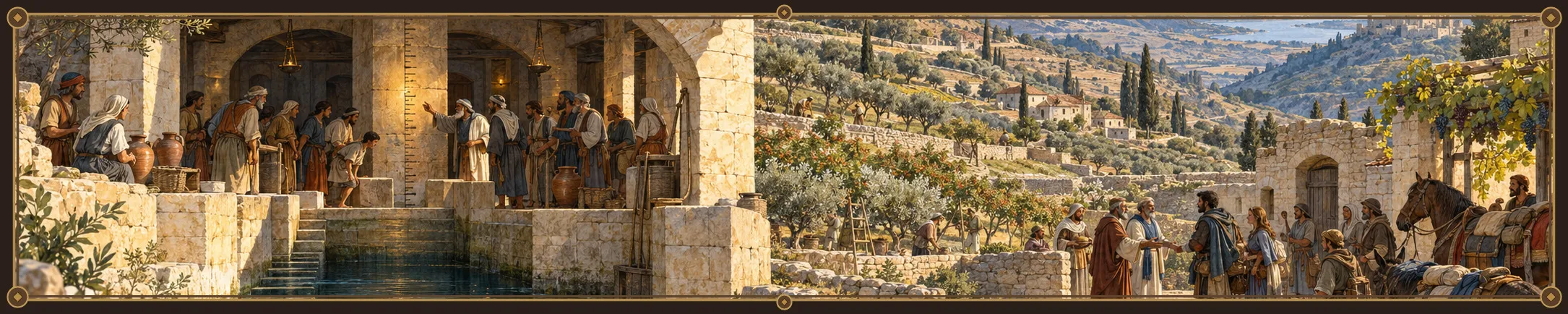
One for the table, one for the shelf,
one for the cistern, one for itself,
one for the guest at the edge of the yard,
and the last for the year that is long and hard.
Cross the bare saddle from the Windscar side and the wind drops as if a door had closed behind you. Below lies a fold: a pocket of good ground held inside poorer country, its slopes stepped from floor to rim with dry-stone walls, orchards on the warm terraces, grain and gardens on the floor, and at its head a cistern cut back into the rock. Beyond the next spur lies another, and another, a whole sheltered country of hollows and terraces in the lee of one long ridge. These are the Leeward Folds, on the far side of Caeldon, well outside the cradle-web: the first named homeland of the Halflings, and beside the Orcs of the Windscar the far side’s second great people. Visitors call the Folds gentle. The Halflings who keep them know better. A country of full store-rooms and blossom on still air is a prize, and in a dry year every hungry band on the far side remembers where the water is. What looks soft from outside is liveable only because every generation has learned how much a fold can carry, how much of a good year has to stay in reserve, and how to stand on a wall with a sling, and because every child is taught, before it can count far, that a good fold can be eaten by its own success.
The Lee and the Folds
A fold is a pocket of good ground held inside poorer country. Some are deep hollows with a spring at their head; others are long interior valleys whose slopes have been stepped from floor to rim with dry-stone retaining walls, terrace above terrace like the shelves of a store-room. The orchards take the warmer slopes, grain and garden plots the valley floors, and cisterns sit at the fold heads, cut into rock or walled in clay, where runoff and spring water can be caught and held. Between the folds run bare saddles and thin-soiled spurs that nobody bothers to terrace, and from the top of one a traveller can count the green pockets ahead by the pale lines of their walls.
The Folds lie in the middle of the far side, east of the Rimward Basins and south-east of the High Scars. North of them the terrace country falls away to the harbours of the Tidelace Coasts; east and south the folds thin into dry spurs and the Dry Folds, and beyond those nobody has mapped anything. Plumbfold is the windward fold where the Lee Road comes over the wall, seven or eight weeks from Deepdraw under escort. Evenlee lies in a deep hollow of the inner folds about two weeks further in, and from there the coast road runs about three weeks down to the Counted Lee. The fold clusters are the settled cores, with more small folds than anyone outside counts. The dry spurs and saddles between them are another country: scorpions lie under the stones, locusts come with a bad year, and nobody walks them without an escort, against bandits as much as stings.
The Lee Wall
The Folds owe their life to the Lee Wall, a long ridge running north to south along their western, Windscar side, which is no built wall at all. It takes the dry wind on its far face, and in its shadow the air is still enough for blossom to set and soil to stay where it is put. Climb it from the windward side and the wind leans on you the whole way up; come over the crest and it is suddenly a sound behind you rather than a weight. The wind shadow is only the start. Slope shape, retaining walls, stored water, the memory each fold keeps of its own soil, and long familiarity with its own limits all matter, and a fold that forgot any one of them would find out within a few years that the ridge alone does not feed anyone.
Inside the folds there are no rivers worth the name; the short ones that do run go north out of the terrace country to the Tidelace estuaries. Water comes from springs, from runoff off the ridges, and from seasonal streams that run in the wet months and are stony beds the rest of the year. It moves by channel and by release, from cistern to terrace, and never carries a boat. A fold’s whole life can be read in its water-works: the catch channels slanting across the slopes above the orchards, the cistern at the head, the little sluices at each terrace that open in turn, and the drains below that carry what is left down to the next wall.
The Slow Dangers and the Loud One
The Folds are never far from the dry country around them, and most of their dangers are the slow kind. One is not.
| Dry runs |
A short wet season leaves the cisterns low by midsummer. A run of them eats into the long-cycle reserve, the stores and water a fold keeps for the years that ordinary reserve cannot cover. Such a run is under way now. |
| Slips |
A neglected retaining wall, or a cloudburst that overtops one, can bring a terrace down onto the terraces below it, and one slip can bury three seasons of work. Wall figs seed into the dry-stone and split it from within. |
| Late frost |
Cold air pools in the hollows on still spring nights, and one bad frost can take a year’s blossom. |
| Tired ground |
A terrace pushed through too many harvests goes tired and needs years of fallow before it bears again. |
| Swarms and stings |
In a swarm year locusts blow in off the dry edges and strip a fold in a day. Hornets nest in the orchards and drive pickers off the ladders, and the orchard leagues burn the nests at night. |
| Raiders |
The loud danger. In a dry run struck-name Orc bands and desperate outsiders come over the saddles for the cisterns and the store-rooms. They come at night, by the saddles the watchers cannot see, and the terrace wards meet them on the walls with slings, pruning bills, and boiling water from the cistern hall. |
| Too many mouths |
The danger Halflings name first is demand: more guests, more trade, more feasting than a fold can bear. It looks like prosperity until the reserve is gone. |
That last item is the one a stranger finds hardest to take seriously, and the one that explains most of what a stranger sees. Halflings are not afraid of the dry; they have lived beside it for as long as there have been folds. They fear raiders, and bar the door against them. They fear more the good year that teaches a fold to spend, because a fold that has spent its reserve has nothing left to bar the door with. A fold raided once reads out the raid’s dead with every autumn count for a thousand years.
The Dry Folds
On the outer margins lie the Dry Folds, valleys whose terraces have gone to scrub and whose cisterns stand cracked and empty. From a saddle they look like any other fold until the eye finds the colour wrong: grey-green thorn where the orchards should be, walls slumped into the slope, a cistern mouth open to the sky like a dry well. They are remembered as the country of the Dryfold Halflings, an older lifeway that did not survive there. Why the Dry Folds failed is argued in every generation, at every commons, and no argument has ever settled it. Most Halflings take them as the plainest warning in the region of what happens when a fold spends past its keeping.
Nobody lives in them, and they are not empty. The Dryfold folk are said to have sealed their store-rooms against a year that never came, and treasure-diggers break into the cracked cisterns after the jars of oil and dried fruit that are said to wait there still. Outlaws winter in the empty houses. Fold children dare each other to go over the saddle and bring back a jar of Dryfold wine, or to sleep a night in a Dryfold hearth-room, and come back with tales of hearths that are still warm and of a dry cistern that echoes footsteps nobody is making. Most who go find thorn, empty terraces, and scorpions. One boy in a generation does not come back at all.
Fold Life
The Halflings of the Folds are small and sturdy, built for terrace work, stooping, and carrying up steep steps rather than for long marches, and most of them never live far from the fold where they were born. Their country asks for that body and that patience. Almost everything in a fold is within a morning’s walk, and almost everything in it has been mended by someone whose grandmother mended it before.
A Fold Town
A fold town is a close cluster of stone houses along the upper edge of the terraces, kept off the good ground, with store-rooms on the cool side of each house. The houses lean into one another for shelter and share walls where they can; their roofs are low, their doors face down the fold, and from any doorstep a household can see its own terraces. Nothing is built on soil that could grow something. A stranger notices the fallow terraces before anything else: whole steps of good ground lying idle in plain sight of hungry people, and nobody allowed to plant them.
Every household keeps its own stores and owes a share to the common reserve held at the fold’s cistern hall, and everyone knows roughly what both amount to. Counting is household work before it is anything else. Children learn to tally the shelves, to tell which terraces rest this year, and to say how many days of water the cistern holds. A Halfling child is named at the first autumn count after its birth, comes of age when a share of the stores is set in its name, and marries by moving a share, each step said aloud at the count (the counted life is told in The Folds, the Scarps, and the Shore (FND)). Every fold lullaby begins count the jars and bar the door, and few children know that the next line is about the raiders.
Work and Table
Most work is maintenance. Walls are mended after every heavy rain, stone by stone, by the household whose terrace they hold and by the terrace ward that keeps the whole slope and mans it when the horn blows. Cistern circles release water to the terraces in turn and clear the channels before the wet season. Orchard work moves through the year from pruning to picking to drying and pressing, and orchard leagues share labour, presses, and drying floors across neighbouring folds, so that in picking season whole households walk over the saddle to work another fold’s trees and expect the same back. A share of every fold’s terraces lies fallow at any time, and a household that tries to plant its fallow share hears about it at the next commons.
People eat fruit fresh and dried, grain, preserved and pressed stores, and garden food. A good table in the Folds is generous without being lavish: enough that a guest is never stinted, never so much that anyone at it could mistake the meal for a boast. The smell of a fold in late summer is fruit on the drying floors, warm stone, and the faint sourness of the presses; in winter it is woodsmoke and the cold, dusty sweetness of a store-room opened for the day’s measure.
The Turning Year
The year turns on two moments. In spring the planting rites open the terraces, and the cistern hall’s first reading of the year says how much the terraces may draw. Summer is weeding, watering by turn, and watching the cistern fall; in a dry run there are watchers on every saddle, and a horn from the rim sends the children to the cistern hall and the young to the walls. In autumn the harvest is brought in, the reserve is counted aloud at the cistern hall before the elders of the measure orders, and only what lies beyond it goes to market. Any household may challenge a figure. The tally is then recounted on the spot, and a challenger whose recount holds the hall’s figure owes a day’s labour on the walls, which keeps challenges honest without making them rare. After the count and before planting, each fold meets as a commons: terrace wards report on the walls, cistern circles on the water, and the fold decides which terraces rest. Winter is lived on stores, walls, and the arguments the count produced.
The Edges of Hospitality
Hospitality is real but has edges. A traveller at a household door is fed, without question and without being asked to pay. A party at the edge of a fold is a different matter, received at the fold market or the cistern hall according to what the fold has said aloud it can spare. Windscar escorts camp at the terrace-edge grounds outside the fold, trade at the market, rest, and water by counted measure, and then go on. Gnome traders on the coastward side are received the same way, their arrival called and their loads counted. Being received is not being let in, and both peoples have long since learned the difference. An escort could force a fold’s terraces in an afternoon. It does not, because a fold raided once is never generous again, and the next dry year the escort would be the one waiting at a shut cistern.
The cistern halls are built for that difference. Each stands at its fold head, where the road comes in along the bare saddles between folds, and receives its guests in a yard outside the terraces, so that a party can be answered, watered, and sent on without setting foot on the good ground. A stranger can spend a season in the Folds and never walk a terrace. Those who try uninvited, thieves and raiders alike, meet the fold’s young on the walls. Larger powers call that narrowness, or suspicion. To a Halfling it is simply what a fold is: abundance is a discipline rather than a spree, and a door is only generous if it can also be closed.
Four Folds
The Folds have no capital, and if they have a centre it is the great cistern halls of the inner folds, where the measure orders carry most weight. The largest of those halls stands at Evenlee, an inner fold town of two or three thousand Halflings in a deep hollow with a spring at its head, its stone houses packed along the upper edge of the terraces and the measure orders' tally houses ringing the hall. Its outer yard has been stormed and held more often than any other in the Folds. Each autumn the reserve is counted aloud there before the whole commons, and other folds wait to hear the count.
Plumbfold, on the windward side, owns the Measure Cistern, where the Lee Road comes in over the saddle. A few hundred Halflings live there with the escorts' camping ground in plain view, and the hall that receives Orc parties also keeps their own reserve. No fold argues more often about what it can spare, and none has been besieged more often. Spurfold, an outer fold on a spur beside the Lee Road, is home to Edgefold and Outfold households who live closest to outside traffic. Its market takes its turn on the Market Round, and in good years it does well from escorts and coastal goods passing through. In bad years the same traffic arrives asking for water, and now and then it stops asking and starts raiding.
Dewcup is the smallest kind of fold: a hollow with a spring at its head and terraces stepped from floor to rim, half a dozen households, an orchard on the warm slope, and a cistern cut into the rock. It shares presses and drying floors with its neighbours through an orchard league, and keeps its fallow share as strictly as any great fold. Its spring is small enough that a single bad summer could end it, and the raiding bands know where it is.
Tallies at the Belt
About 240,000 Halflings live in the Folds, and they are nearly everyone there. Most are Foldward. The Leeward folk of the inner folds and the Edgefold and Outfold households along the roads are smaller shares. Orc escorts at the terrace-edge grounds and Gnome traders at the Counted Lee are received, counted, and gone again, and none of them lives in a fold.
Fold dress is home-woven wool and felt from the Windscar trade: smocks and aprons for terrace and orchard work, short coats in winter, and bare feet in the warm months. Most adults carry a household tally on a cord at the belt, and a stranger soon learns to watch it the way one watches a purse elsewhere; most carry a sling beside it. Edgefold Halflings are browner and leaner than the folk of the inner folds. Stores carry a fold through most bad years, so only about one child in five dies young, mostly of winter coughs. Adults commonly pass seventy, a hundred is old, and a newborn can expect about sixty years. Most die of age and winter illness, some of slips and falling terraces, some on the walls, and in a long dry run, like the present one, of hunger.
The household name a child takes at its first autumn count is the name its share stands under in the store tally, and the fold’s name follows it outside the fold; Edgefold households often add a road byname. Read out at an autumn count: Merrin Coddry, Bendel Tullam, Odella Wenning, Pimsy Orrel, Hesper Coddry. Whoever comes to a door is asked, before anything else, how long they mean to stay.
The Commons and the Count
No town rules the Folds. The Foldward Commons, the first named Halfling civilization, spread authority thin on purpose, so that no house, town, or cistern district can spend what the whole fold needs. They are not an early empire of small farmers but a people bound by one stubborn custom, the keeping of enough: fold towns, orchard leagues, terrace wards, cistern circles, and market rounds, held together by the reserve, by old oaths, and by the shame of a fold that spent what it should have kept.
Who Answers for What
| The commons |
Each fold runs itself through its households, the terrace wards that keep the walls and man them, the cistern circles that keep and release the water, and the orchard leagues that tie neighbouring folds together. These are the bones of the order that hardened in the Founding of the Foldward Commons, long before any cradle-web lord held a hall. In practice the oldest and best-stocked households speak loudest at the commons. |
| The measure orders |
The keepers of the cistern halls, the orchard tally houses, and the reserve-report circles, who keep the counts that anyone with something to lose can check. They are the Leeward measure orders, and they carry most weight in the inner folds around the great cistern halls. They are heeded only while their numbers hold up when a household, or a hungry escort with spears, challenges them. |
| The receiving elders |
At the fold markets and cistern halls, those who answer outsiders decide what reception can be given: exchange, rest, shelter for a time, rarely anything deeper, or nothing yet. The foremost of them sit at the Measure Cistern. |
Under the Commons, three Halfling lifeways share the region. Foldward Halflings are most of it. Leeward folk, of the measure-heavy inner folds, are the ones outsiders meet across a tally bench, and the ones outsiders describe when they describe Halflings at all. Edgefold or Outfold households hold the outer valleys along the roads and live closest to outside traffic, its profits and its raiders; they remember the roadfold Halflings, whose measure did not outlast the road, and argue among themselves how much trade a fold can take in before it stops being a fold.
The Old Quarrel
The order is fought over from inside, and always along the same line. Prestige-minded households and receiving elders hold that a fold too narrow in good years will lose trust and influence, and that reserve can harden into fear. Reserve-minded custodians answer that abundance is exactly when a people becomes dangerous to itself. Each side suspects the other: generosity that is really display, or caution that is really hoarding in clean language. Neither suspicion is ever wholly wrong, which is why the quarrel has outlived every bargain that tried to end it.
In the present dry run a third quarrel sits on top of the old one: whether this is the run the long-cycle reserve was kept for. Open it too early and the fold has spent its last defence on a bad year rather than a ruinous one; open it too late and there may be no terraces left to save. Every cistern hall in the Folds is asking the question this year, and every one of them is asking it in front of its own households, with watchers on the saddles and the struck bands somewhere beyond them.
Roads and Trade
Inside the region, roads are stepped paths along the terraces and over the saddles between folds, walked and carried rather than driven. Nothing in the Folds runs on wheels for long; loads go on backs, on poles between two bearers, and on the pack animals that come over the ridge with the escorts.
| The Market Round |
The seasonal circuit of fold markets. Each fold hosts in its turn, at the time its harvest allows, and the order of the Round is old enough that changing it would start a quarrel among every fold on it. |
| The Lee Road |
It runs from the fold markets over the Lee Wall to the Rimward Basins, under Windscar escort. It keeps Halfling market timing, so a party that arrives off its day waits at the terrace-edge grounds, and a delayed answer at either end can cost a caravan its season. |
| The coast road |
It runs down to the Counted Lee, carrying timed loads sorted into burden classes, so that a fold knows before it picks how much fruit a declared approach can take. |
Dried fruit, grain, and other stored goods go out along both roads, but only from what lies beyond the counted reserve. Salt, hides, felt, and herd animals come back from the Windscar, along with escort service for anyone who needs it. Coastal goods come up from the Counted Lee, and some of them pass on along the Lee Road into Windscar hands, so that a Windscar herder may own a coil of Gnome cordage without ever having seen the sea. Water is the one thing the Folds will not bargain over. A party drinks what a cistern hall has said aloud it can spare, and not a cup more.
Passage, in fold country, means access. Windscar escorts decide who travels the Lee Road, and Gnome declarations decide when a coastal handoff can happen. But inside the edge a fold’s commons decides what leaves it, and its cistern hall decides what water is spared. A party nobody refuses can still find that the cistern hall’s answer is "not yet".
In a raiding year the folds hire blades they would rather not feed. A fold may pay a Windscar escort kindred in stores to sit on its saddles through the dry months, which is cheaper than a raid until the escort decides it is not. The markets of the Round cry a bounty on struck-band captains, paid in dried fruit and oil, and bounty-takers come up the Lee Road to collect it. And sealed Dryfold jars dug out of the cracked cisterns fetch more at the Counted Lee than anything inside them could be worth, from Gnome buyers who do not ask who dug them.
Memory and Belief
The Folds remember in tallies: which hall counted honestly in the hard years, which one narrowed too quickly, which feast spent what it should not have. The oldest of it is older than the cradle-web’s whole written past. The Founding of the Foldward Commons (c. 170,000–c. 152,000 BR) bound the folds into one order. The Leeward-Windscar Terms (c. 160,000–c. 145,000 BR) won Orc escorts an answer given aloud at the fold edge, because the Pacts could close the Lee Road and the folds could not hold it, and kept the folds closed behind it. The Measure Cistern Reckoning (c. 154,000–c. 148,000 BR) made the Commons admit that "measured" and "just" are not the same word, and the Measure Cistern Crisis (c. 147,000–c. 143,000 BR) tested that lesson against armed Orc escorts camped at the saddle while the measure orders (c. 146,000–c. 139,000 BR) hardened out of it. On the coast the same lesson came quietly, through the Leeward-Tidelace Measures (c. 146,000–c. 140,000 BR), the Counted Lee Timing Feud (c. 139,000–c. 136,000 BR), and the shared-loss rule of the Leeward-Tidelace Timing Oath (c. 136,000–c. 134,000 BR). Medieval cistern halls still recite these as old custom rather than add to them.
What the folds tell round the autumn count is plainer and bloodier. They tell of the old woman who opened the cistern sluices on a raiding band camped in the channel below; of the slinger who killed a struck-band captain at sixty paces from the Plumbfold wall; of the dry year when a whole fold walked out over the saddle and was never seen again. Every hall keeps the name of its villain too, the cistern-keeper who sold a fold’s count to a raiding band and opened the yard gate to them at night, and a tally-stick is broken on the hall floor in his memory each autumn.
No chain of the great threads of Caeldon’s history runs through the Folds, but three of its questions are asked here every autumn. Who Counts and Who Records asks who counts, and in the Folds that is literal: a household counts for what its tally can prove against a challenge. Water and Who Keeps It is asked of stored water rather than living rivers. Roads and Crossings is asked on the Lee Road, where whoever holds the water at the end of a road decides whether it goes anywhere.
The Season-Weaver
There is no Halfling church in the Folds and no clergy. Belief is household and commons custom, the alignment custom of bounded plenty, with one god at its centre. Tamsel the Season-Weaver, a Resonant of Aion born of the folds' long dependence on the balance of the harvest, keeps the turning year: spring planting rites, the thanks of autumn storing, and the Festival of the Turn, which is said to bring a good harvest if it is kept with true joy. Fold households picture Tamsel as the season wears them: a green, rain-smelling youth in spring, sun-browned and gold in summer, old and crimson and smelling of woodsmoke and stored fruit in autumn, pale and still as frost in winter.
Children are told the tale of the Long Summer, when Tamsel held the summer for a year, with endless warmth and plenty, and the winter after it emptied a fold to its last measure. It is the reason given for never spending the reserve on plenty, and the reason a Halfling grows uneasy at a season that will not end. Tamsel’s strength rises and falls with the health of the folds, and in the present dry run the god faces the same choice as the cistern halls. A season forced too hard runs up a seasonal debt that the cycle must repay, a late frost on early blossom, ground tired for years after a rushed harvest, and a debt like that could ruin a fold for generations. A season left alone means watching the folds spend what they were taught to keep. Some households pray for rain and growth, and some would rather Tamsel force the season than see any reserve opened.
Other gods keep company at the edges. At the Counted Lee, Gnome clerks still murmur the name of Quennet the Clockmaker. Windscar escorts camped at the terrace-edge grounds keep their own gods at their fires: Ushkar the Ancestor-Warden, who keeps the names of those who held passage, and Rakhal the Storm-Caller, whose followers are quickest to call a fold’s narrowing stale.
The Measure Cistern
On the windward side, where the Lee Road comes in over the Lee Wall from the Rimward Basins and the High Scars, stands the Measure Cistern, the great cistern hall of the Folds. It is two things that the Folds keep apart everywhere else and cannot keep apart here: the hoarded water of the fold that owns it, and the foremost receiving ground of the Commons, where escorted Orc parties of the Windscar Pacts are told what water and stores can be spared. Every fold hall asks quietly whether its numbers are honest. Here the question is asked aloud, in front of thirsty strangers with spears.
The Place
The cistern lies at the head of its fold, against the foot of the Lee Wall: a long basin cut back into the rock, roofed over most of its length against the dry wind and fed by a spring at the fold head and by catch channels off the ridge. Down its inner wall run the Reading Steps, a flight of narrow steps cut one measure apart, by which the water’s depth is read. A reading is called out from the steps and repeated in the hall below, never written up first. Children dare each other to touch the lowest step, which has not been dry in living memory, and the fold tells them that the year it shows is the year the Dry Folds died.
The hall sits just beneath the cistern’s mouth on a broad walled terrace: a long stone hall, store-rooms cut into the slope behind it, and a receiving yard in front, where the cistern’s outflow channel feeds a stone trough before running on to the terraces. The trough is where guests drink. Below the hall the fold opens out into terraced orchard and garden, and a guest is not taken down there. The Lee Road reaches the yard along a bare saddle above the terraces, so a party can be brought in without setting foot on the good ground, as the Folds build every cistern hall. Beside the road, outside the yard wall, lies the camping ground where escorts wait out a day that is not theirs, among stones that hide scorpions; every escort shakes out its boots at dawn. A party standing in the yard can see the hall, the trough, and the roofline of the cistern above. It cannot see the water. What the cistern holds reaches it as a number.
Further out, the Lee Road is open and dangerous country. Raiders out of the dry lands strike at parties on the saddles, where there is no cover and no water, and in a swarm year locusts come over the Lee Wall in a brown cloud. From the highest bend of the saddle a traveller can see the nearest of the Dry Folds, a valley of thorn and cracked cistern walls whose store-rooms, the fold says, were sealed in the last year anyone kept them and never opened again.
Keepers and Users
The cistern belongs to Plumbfold, the fold at whose head it stands. Its cistern circle keeps and releases the water, its households owe their share of the common reserve to the store-rooms behind the hall, and its commons decide what leaves the fold, which in practice means the oldest and best-stocked households do. Around them work the measure orders, which carry more weight here than anywhere: terrace elders who stand at the Reading Steps, orchard tally houses from the neighbouring folds, and reserve-report circles that check the hall’s figures against their own. The receiving elders give the fold’s answer to whoever has arrived: exchange, rest, shelter for a time, delay, redirection, or nothing yet.
The users come mainly by the Lee Road. Windscar escorts bring parties up from the defended wells of the Rimward Basins and down from the passes of the High Scars: traders with salt, hides, and felt, herders with animals to sell, and travellers who need water more than trade. Halflings from the outer valleys come to the yard too, to buy, to sell, or to argue a count, and once a year every fold within reach sends someone to hear the autumn reading. A few herders of the outer valleys hire out as saddle guides, who know which seeps still run in a dry year and which bends the raiders favour, and who are paid by whichever side asks first. In dry years the fold hires sellswords out of the Rimward Basins to ride the saddle, and watches them almost as closely as the raiders they are paid to chase.
The Hall’s Year
The hall’s year follows the fold’s. In spring the circle opens the terraces by turn, and the first reading of the year says how much they may draw. Through summer the level falls and the readings are taken more often. In autumn, after the harvest, the reserve is counted aloud: the circle reads the steps, the store-rooms are tallied shelf by shelf, and the reports of the neighbouring circles are set against both. When the Market Round brings the fold its turn, the yard fills with stalls for a few days, and the escort traffic, and the raiding on the saddle, peak with it.
On an ordinary day the work is small and public. A reading in the morning, called down and repeated. Water released to the terraces by turn. An escorted party arriving on its market day is met in the yard; a receiving elder hears its captain and names what the fold can spare, and the party drinks from the trough by counted measure, in front of both sides. A party that misses its day pitches outside the yard wall and waits, counting what the wait will cost it at the far end of the road.
The yard has its own legend. In the summer of the Crisis, the tale goes, a receiving elder walked out alone through the escort camp with a single water-skin, drank from it in front of the war-captain, and gave him the rest, and nobody drew a blade that night. Escorts and fold alike still say the guest drinks first, the count comes after when a party reaches the trough, and Halfling mothers sing their children to sleep with a counting rhyme for the Reading Steps that ends on the step that is never dry.
The escort brought us down off the Lee Wall at noon on our market day, along a saddle so bare it might have been swept, and I understood only afterwards that it had been laid out that way: the road keeps a guest above the good ground the whole way in, like a hand held flat so nothing can be taken from it. Below us on the right the orchards stepped down the fold, close and green and very quiet. Nobody looked up at us from the terraces, but on every wall-end there stood a small figure with a sling, and none of them looked anywhere else.
In the yard the captain of our escort stood before the receiving elder, a small grey Halfling in a plain coat with a tally cord knotted at the belt, and they spoke as two people who have done this many times and respect each other a little and trust each other not at all. Then a voice came down from the roofline, calling a number, and a second voice in the hall repeated it, and a third said it again, and the elder named what the fold could spare: water for every beast and person, rest for the night, and no stores. The captain said, very courteously, that last year there had been stores. The elder said, as courteously, that last year the steps had been dry two measures lower down.
I have called tolls at a window on the Serath for most of my working life, and I know the sound of a figure its caller expects to be challenged. This was the same sound, and nothing at all was written. On my river a figure is what the bridge-holders have decided and the clerk has put on the roll; here it is a thing said three times by three people, and the proof of it is that any of the three could be made to say it again. I asked our captain afterwards whether the readings were ever false. The captain said that was what the Crisis had been for, and that once, long ago, the escorts had camped a whole summer at this wall with their spears to make the Halflings say their numbers aloud.
We drank at the trough under counted measure, an escort and a Halfling standing by, and I have rarely drunk water so cold or so carefully given. Beyond the yard wall, on the camping ground, a party that had come a day late sat by their packs and did not look at us. I never saw the cistern. I saw its roof and its mouth and the steps going down into shadow, and I heard what it held told to me as a number.
How the Hall Was Made
The cistern was already an old and respected receiving ground while the Founding of the Foldward Commons was binding the folds together, and in the long ages since, its basin has been recut and relined so often that nothing of the first work can be told. Three quarrels made it what it is now, and its yard is laid out to remember each of them.
| Reception is not entry |
The Leeward-Windscar Terms won escorted parties an open welcome at fold markets and cistern halls, because the Pacts could close the Lee Road and the folds could not hold it, and kept the folds shut behind them. The yard, the trough, and the saddle road are that bargain in stone. |
| Measured is not just |
The Measure Cistern Reckoning began here as a Halfling quarrel, in good years under rising outside traffic, between generous receiving elders who wanted broader markets and reserve-minded keepers who saw prestige spending dressed as welcome. Some halls had understated their stores to keep exchange small and their own households great; some generous elders were spending tomorrow to look open today. It ended in the line between honest and false narrowing. A fold may stay narrow, but a count that nobody else may challenge no longer counts, at least among Halflings. |
| Counted aloud |
The Measure Cistern Crisis brought that standard face to face with Windscar escorts in a hard season. Escorts called the fold’s narrowing a shut door; the fold called their demands extortion. Armed escorts camped at the gates, the folds called in their kin and hired guards, and for a summer the yard was a camp on the edge of a battle. The spears bought the end as much as argument did: a narrowing fold must now say aloud what it can still receive, delay, redirect, or carry for a time. The Orcs later took three of those four answers into their own Pact terms. |
The hall argues from all three today without ever adding a fourth.
The Dry Run at the Cistern
This year the readings have been falling for longer than anyone likes. The hall still gives water to every party it accepts; it gives stores less often, and says so aloud, as it swore after the Crisis. Hungry escorts camped outside a fold wall have broken in before, and the fold’s young keep a night watch on the terraces with slings and dogs. Behind the hall the question of the whole region, whether this is the run the long-cycle reserve was kept for, is sharpest here, because the hall answers its own terraces and the Lee Road from the same yard. If it opens the reserve, the water it has told the escorts it cannot spare will be running into orchards in plain view of the camping ground. If it keeps the reserve closed, its own households will watch strangers drink at the trough while their terraces wait for a release. Old sealed jars from the Dry Fold have begun to sell at the camping ground, two who ate from one lie sick in the hall, and a band has been striking parties on the saddle road, Orc and Halfling alike. Whatever the hall decides, the Windscar will hear of it within the season.
The Counted Lee
Down the coast road, where it reaches the harbour water of the Tidelace Coasts, lies the Counted Lee: a tally hall, transfer pier, and staging yard on the shore below the Folds. Halflings of the Commons bring their loads down to it counted and classed; Gnomes of the Gaugeward Leagues bring their craft in to it on declared windows. Nothing changes hands until both have been made plain. It has none of the fame of the Measure Cistern, nor of the Gnome harbour of the false mark further along the coast. It is where two careful peoples learned to hand things to each other, and later learned what it costs, and how hot tempers run, when the timing slips and a year’s fruit rots on the pier.
The Place
The Lee sits in the shelter of a headland, where a short shelf of level ground lies between the foot of the terrace country and a stretch of quiet water off the outer roads. The coast road comes down off the last terraces in a long zigzag and ends at the staging yard: a walled, open yard where loads are set down in rows by burden class and wait. Below it the transfer pier runs out into the lee water, long enough for Gnome coastal craft to lie alongside at most states of the tide. The pier has its own enemies. Shipworms hollow its piles from inside, so that every few years a stretch gives way under a laden cart, and congers live in the rubble below and take the fingers of any hand that trails in the water.
The tally hall stands between yard and pier, a plain stone hall with two doors, one facing up the road and one facing the water. Inside, Halfling counters and Gnome clerks sit at the same benches and keep the Long Tally, the joint count of the Lee, in which every declared window, every change to it, and every load that waited too long is written twice, once in fold count and once in harbour reading, side by side. Above the headland a signal post answers the coast’s beacon lines, so that a window declared or moved along the Lacework reaches the hall before any craft does. Nothing else stands there: no breakwater, no market, no village. No one lives at the Lee but the hall’s keepers and a few hired spears who watch the yard at night, for a yard full of the folds' best stores draws thieves down off the terraces, and the zigzag has dark bends where a carrier’s mule can be cut loose and gone before the shout carries.
Under the headland the rocks run out in a ragged spur that the tide covers twice a day, and every craft that has ignored a moved window has gone onto it. What they carried lies in the kelp below: casks of lamp oil, crates of harbour brass, and, the carriers say, a Gnome strongbox with a gauge-house seal that three generations of fold children have dived for at low water and none has raised. Beyond the spur is a small cove that the Long Tally does not mention, with a beach and a path up the cliff.
Two Benches
The Lee is shared rather than held, and each half answers for its own side of a handoff. The sharing is not even: the harbours own the craft and the water, and a fold with a load spoiling in the yard has less to bargain with than a clerk who can sail away. On the fold side, counters and elders of the folds that send their goods down the coast road keep the yard and the Halfling bench; they say how much each load is and the day after which waiting spoils it or costs a fold its reserve. On the harbour side, clerks from the nearest Gaugeward harbour keep the pier, the signal post, and the Gnome bench; they declare approach windows and move them when tide, fog, or weather will not hold the earlier ones, as harbour custom lets them. Between them stands the custom the Timing Feud won: any change that comes after a load has passed its day must be named in the hall with both benches sitting, and the loss written in the Long Tally before anyone shouts over who bears it.
The users are carriers coming down the coast road with dried fruit, grain, and preserved stores; Gnome coastal craft putting in with fish, cordage, lamp oil, worked metal, and instruments from the gauge houses; and the harbour hands who load them, among them some coastal Humans who work Gnome quays and crews. In the busy weeks the folds hire escorts for the road, and the spears who walk carriers down the zigzag are often the same Humans who loaded a craft the week before. The hall pays its yard spears by the season, and when a road band grows bold it posts a price, which brings bounty-takers down from the folds and sellswords off the harbour quays. Both benches hire them; neither trusts the ones the other hired. Fold goods go no further than the pier, and harbour goods no further than the yard.
A Day and a Year
The Lee’s year is pinched between two calendars. The folds release nothing until the autumn count has set aside the reserve, so the bulk of the year’s surplus comes down the road late. The coast’s calm months end in the storm season, when windows shorten, the outer roads close first, and some harbours shut their mouths until spring. Most of the Lee’s business is crowded into the weeks between the count and the gales, and in those weeks the yard is full, the road is busy, and the thieves are busiest of all. Every fold knows that a load picked too early may wait and spoil, and a load picked too late may find no window left.
An ordinary day starts with the morning signal. A clerk writes up the windows the beacon line has passed down, the counters match them against the loads in the yard, and the carriers on the road learn by noon whether to hurry or wait. When a craft comes alongside on its window, loads go out of the yard in the order the hall has set, and each one is struck off both columns of the Long Tally as it crosses the pier. When a window moves, both benches sit. Most changes pass without a quarrel, because fog in the outer roads is plain to everyone. Fewer pass quietly when the sky over the headland is clear, and a hall that has seen knives drawn across its benches keeps its spears close on those days. When the Long Grey lies on the water, no craft comes, and the hall keeps a lamp in the seaward door. Pilots say that a hail out of the fog off the Lee is not to be answered unless the boat’s name is one the hall is expecting.
The road has its own tales, told in fold kitchens to carriers' children. The best loved is of the carrier who walked the zigzag alone on a moonless night with her fold’s whole seed-grain on two mules, while a band held the dark bends above, and who sang the counting song so loudly the whole way down that the thieves took her for a column of spears and let her pass. Carriers still sing it on the bends, and say count it twice or count it gone as they load. A fold sends its loads down tied with a count-cord, a knotted tally charmed to remember its knots, so that a load cut open on the road and retied cannot pass the hall as whole; thieves who know this cut the cord and take everything.
I went down to the Lee with a carrier who had a load of dried fruit on a pole and a figure in his head, and he said the figure to himself under his breath at every turn of the zigzag, the way a man counts steps in the dark. At the darkest bend he stopped saying it and sang instead, loud and badly, and the hired spear walking behind us laughed and told me why. The yard at the bottom was laid out like a toll-roll: rows of loads in burden classes, each with its little stake and its knotted cord, and a Halfling walking the rows the way I have walked a queue of barges, looking at nothing and seeing all of it.
The hall has two doors and two benches and one book, and I would give a good deal to bring that book home. Every line is written twice, once in the fold’s reckoning and once in the harbour’s, side by side, so that neither party can say afterwards that the other kept the only copy. On the Serath we keep second copies against fire and loss. Here they keep the second copy against each other, in the same room, and call it trust, and I am not sure they are wrong.
That afternoon a signal came down from the headland and the benches sat. A Gnome clerk stood, said a name under her breath, and announced that the craft expected on the evening window would come in at the next morning’s instead, for fog in the outer roads. I looked out of the sea door. The sky over the headland was clear, but out past it a low grey bank lay on the water like wool on a floor. The Halfling bench looked too, a long while, and then the loss was written, in both columns, before anyone said whose it was. Nobody raised a voice, though I noticed that the spears by the door had come in from the yard. I have seen worse quarrels over a ferry penny, and some of them ended in the river.
How the Lee Was Made
The Lee grew out of the Leeward-Tidelace Measures, the custom that made fold count and harbour declaration two halves of one exchange. Its hall and pier have been rebuilt more times than anyone has counted. The place and the custom have lasted. The custom took its present shape in the Counted Lee Timing Feud. Fold elders charged that the harbours moved their windows to push the loss onto the folds; harbour masters answered that some folds wanted a difficult coast to keep inland time. Loads rotted on the pier, the folds went into hungry winters, and they won what they won only by threatening to take their grain to other landings. No blood was shed, which is why the feud is the quietest of the far side’s great quarrels and why it still rankles. The end was a bargain: the harbours kept the power to move a window, and a late change had at least to be named as lost time. The Leeward-Tidelace Timing Oath swore the whole edge to it: name the change, write down the loss, then bargain over who caused it. The benches at the Lee still recite the oath, and the folds still bear most of the loss it names.
Two gods keep company at the Lee without much liking each other. Gnome clerks murmur the name of Quennet the Clockmaker when a window has to be moved, half in thanks and half in apology to whoever will bear the lost time, and Halfling carriers keep the year of Tamsel. Their worshippers first quarrelled here over who had wasted whose time, and the quarrel has never quite stopped. The oath is also the main reason Quennet is fading on the coast: a harbour that can name who bears a lost moment has less need to pray for one.
This year the folds are in a dry run. Less comes down the road, every count is argued harder before anything leaves the terraces, and harbours that count on fold grain have begun to ask why their windows go half filled. Hungry years bring more thieves to the road, and this one has. For the first time in a long while it is the folds, not the coast, whose timing everyone is cursing.
Tensions
-
The year the reserve is for. The cisterns are falling for another year. One cistern hall wants the long-cycle reserve opened now, while there are still terraces worth saving; another says the run has not yet earned it. Some households would rather Tamsel force the season than see any reserve opened, though every Halfling knows a forced season may cost more than the reserve would. At the Measure Cistern the same choice would be made in plain view of the escorts' camping ground.
-
Feast at the gate. A fold holds a lavish Festival of the Turn in the same week its cistern hall tells a waiting Windscar escort that it can spare water but no stores. The escort calls it false narrowing and wants the count made in front of it, and its captains have begun pacing the terrace walls. The hall’s own reserve-minded custodians privately agree with the escort.
-
Swords on the saddle. Plumbfold wants to hire a Windscar escort kindred to hold its saddles against the struck bands through the dry run. The kindred’s price is water, the cistern hall must say aloud how much it can spare, and every escort party camped below will hear the answer.
-
Lights in the Dry Folds. Fires have been seen at night in a Dry Fold nobody has lived in for ages, where treasure-diggers lately found the old store-jars still full, and three folds now say the jars are their forebears' and theirs to take. Spurfold says a struck outlaw band is wintering there and means to come over the saddle at the first dry month; the children who went to look say the fires burn in hearths with no one beside them.
-
Seeing the water. A Windscar captain refused stores at the Measure Cistern asks to stand at the Reading Steps beside the terrace elders and see the level for herself. The receiving elders say the cistern is inside the fold, and reception is not entry; the captain says a count only the fold has seen is the very thing the Reckoning was meant to end, and some reserve-report circles quietly agree. Her escorts have not unstrung their bows.
-
Neighbours at the trough. Plumbfold’s own terraces have had their releases cut twice this year, while escorted strangers drink at the trough. The receiving elders answer that the Terms were sworn by the whole Commons and that a broken oath on the Lee Road brings spears; the households answer that the Terms do not water their orchards, and somebody has begun fouling the trough at night.
-
Thieves on the zigzag. Three loads have gone missing on the coast road to the Counted Lee this season, with their mules and one carrier, while a fold that cut a promised load still argues with the harbour bench over whose loss it was. The folds say harbour hands sell to the thieves; the harbour says the thieves come down from a fold that is starving. The hall has put a price on the band, and a pair of hard-faced Human bounty-takers have arrived to collect it.